Market Snapshot
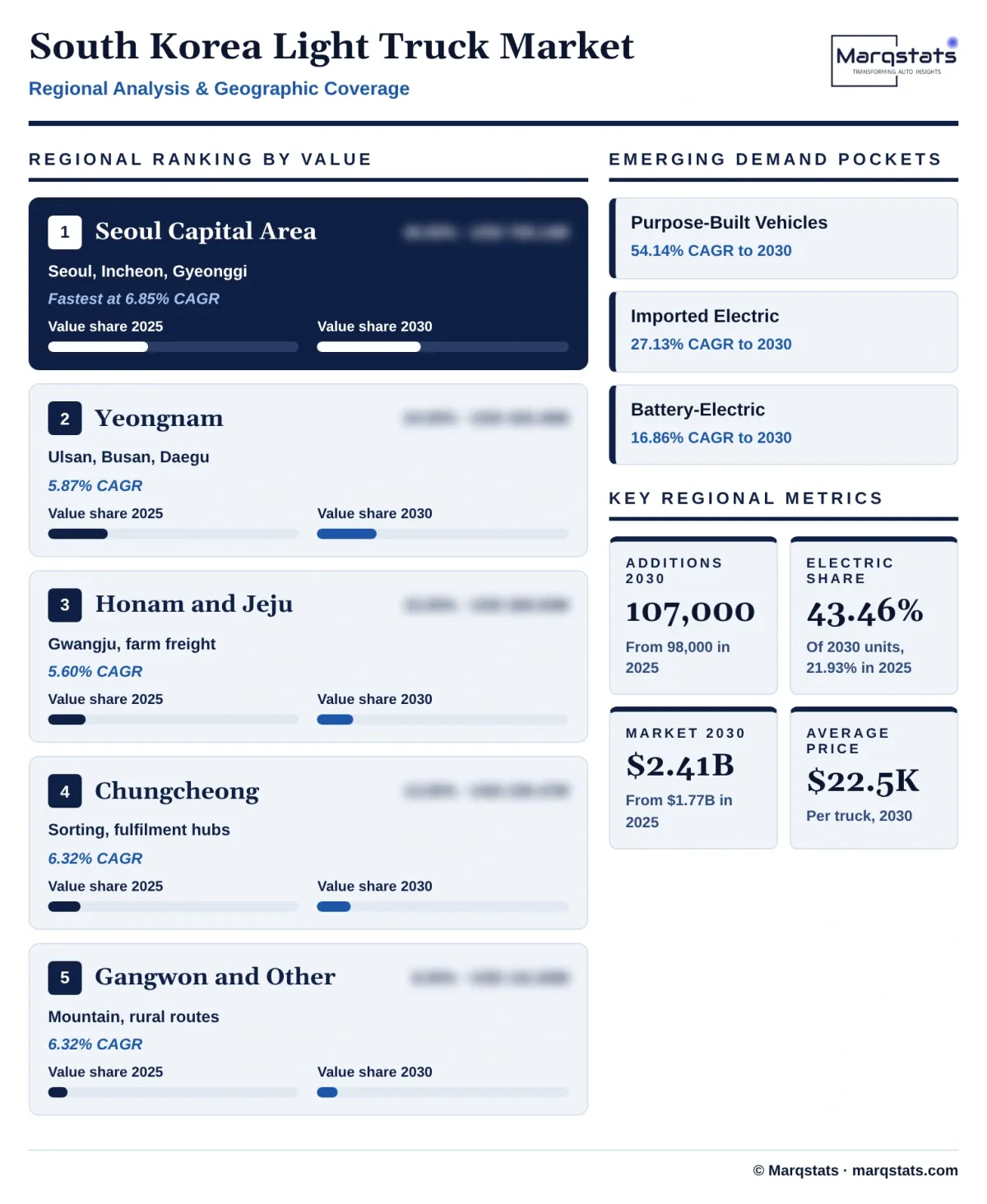
The South Korea light truck market size is estimated at USD 1,772.86 million in 2025 and is projected to reach USD 2,408.58 million by 2030, growing at a CAGR of 6.32% over 2026 – 2030. Annual additions rise from about 98,000 to 107,000 trucks, a 1.77% annual rate, while the average value per truck climbs from about USD 18,090 to USD 22,510 as electric and semi-bonnet models take a larger share.
Marqstats defines the market as the net value of new freight-registered light trucks and cargo vans with a payload of up to one tonne and a gross weight of up to 3.5 tonnes sold in South Korea, such as the Hyundai Porter II, Kia Bongo III, Hyundai ST1, Kia PV5 Cargo and BYD T4K. Value is counted at the price paid to the dealer, net of the 10% value-added tax, before subsidies and before third-party bodies. Pickups, micro-sized trucks, passenger-registered vans, medium and heavy trucks and buses are excluded.
Cab-over one-tonne trucks account for 90.62% of 2025 value, LPG and other combustion trucks for 64.85% and self-employed trades and retail for 54.66%. The Seoul Capital Area accounts for 40.00% of value, while semi-bonnet and purpose-built vehicles grow fastest, at 54.14% a year, as the 2027 crash rules reshape the segment.
Key Takeaways
Market Overview & Analysis
Report Summary
Marqstats sizes the South Korea light truck market as the net value of new freight-registered trucks and cargo vans of up to one tonne payload and 3.5 tonnes gross weight that enter the national fleet each year. It counts cab-over one-tonne trucks, semi-bonnet and purpose-built electric and LPG vehicles and imported electric trucks, and excludes pickups, micro-sized trucks, passenger-registered vans, medium and heavy trucks and buses.
The class is the working base of small business in South Korea. The Ministry of Land, Infrastructure and Transport counted 3,700,835 registered freight vehicles and 4,494,416 commercial vehicles at the end of June 2025, and the Korean Ministry classifies a small freight vehicle as one of up to one tonne payload and 3.5 tonnes gross weight. Hyundai Motor Company reported Porter sales of 56,538 trucks in 2025, and Kia Corporation reported Bongo III sales of 36,030, so two nameplates made up 94.46% of the 98,000 trucks Marqstats counts.
The powertrain changed within weeks. The Special Act on the Improvement of Air Quality in Air Management Zones, passed by the National Assembly on 27 February 2023, restricted diesel vehicles used for parcel delivery and children’s school transport from 1 January 2024, after a postponement from 3 April 2023. Hyundai and Kia stopped making diesel one-tonne trucks and launched 2.5 litre turbo LPG versions, with 159 horsepower in the automatic version, on 22 November 2023, and more than 30,000 were sold in the first week, about 12 times the weekly average of 2023. Cumulative sales of the LPG Porter II and Bongo III passed 102,405 by the end of January 2025.
Volumes fell sharply as the buying rush faded. The market grew from an estimated 151,900 trucks in 2021 to about 162,000 in 2023, then fell 29.38% to about 114,400 in 2024 and 14.34% to 98,000 in 2025. Porter sales of 69,267 in 2024 were the first below 70,000 since 2008, and Porter sales in the first half of 2025 fell 26.4% to 28,379, as small-business sentiment weakened and high borrowing costs delayed replacement.
In value, the market is estimated at USD 1,772.86 million in 2025, equal to about KRW 2,520.12 billion at the 2025 average rate of KRW 1,421.5 per US dollar, against USD 1,896.19 million in 2024 and USD 2,729.03 million in 2023. The value decline of 6.50% in 2025 is smaller than the volume decline because the average value per truck rose with the share of electric and purpose-built models.
South Korea Light Truck Market Size and Forecast
The South Korea light truck market grows from USD 1,772.86 million in 2025 to USD 2,408.58 million in 2030, a CAGR of 6.32%. Price and mix contribute most of the growth: the average value per truck rises at 4.47% a year, from about USD 18,090 to USD 22,510, while additions rise at 1.77% a year, from about 98,000 to 107,000 trucks. Value dips 3.44% in 2026 and recovers 3.61% in 2027 as the 2027 safety standards take hold.
The 2025 value is built bottom-up from nameplates and prices. Marqstats counts 76,508 LPG and 16,060 electric Porter II and Bongo III trucks, 4,440 purpose-built vehicles (about 1,340 Hyundai ST1 and 3,100 Kia PV5 Cargo) and 992 imported electric trucks, led by about 855 BYD T4K. Prices are net of value-added tax at about KRW 21.36 million for an LPG truck, KRW 40.45 million for an electric cab-over truck and KRW 44.08 million for a purpose-built vehicle, before subsidies and before third-party bodies. Marqstats has taken list prices of KRW 20.28 million for a regular-cab LPG Porter, KRW 43.45 to 46.35 million for the Bongo III EV and KRW 56.55 to 72.53 million for the ST1 as anchors, and removed the 10% value-added tax.
The base is checked against company and registration data. Hyundai Motor Company reported 56,538 Porter sales and Kia Corporation 36,030 Bongo III sales for 2025. Registration data for January to October 2025, compiled from the Ministry of Land, Infrastructure and Transport and reported by Sangyongcha Magazine, show 80,387 one-tonne registrations against 99,149 a year earlier, of which LPG was 65,047, electric 15,273 and diesel 48, and Marqstats scales these by the 2024 ratio of ten-month to full-year registrations to reach the 98,000 full-year estimate.
Electric and purpose-built models add value faster than volume. Marqstats expects electric trucks and vans to rise from 21,492 units in 2025 to 46,500 in 2030, or 21.93% to 43.46% of units, and purpose-built vehicles to rise from 4,440 to 45,000 units. A purpose-built electric vehicle is priced at about 2.06 times an LPG cab-over truck, which lifts the electric share of value to 56.39% in 2030.
Marqstats tracks four indicators to monitor the forecast: monthly domestic sales of the Porter, Bongo, ST1 and PV5 published by Hyundai and Kia, the Ministry of Environment subsidy schedule and its July 2026 eligibility assessment, the timing of the Hyundai LT2 and the Bongo successor against the 2027 safety standards, and LPG prices at the pump against electricity tariffs for commercial charging.
Market Dynamics
Key Drivers
Five forces are holding up demand for new light trucks in South Korea even as the market settles after the diesel switch.
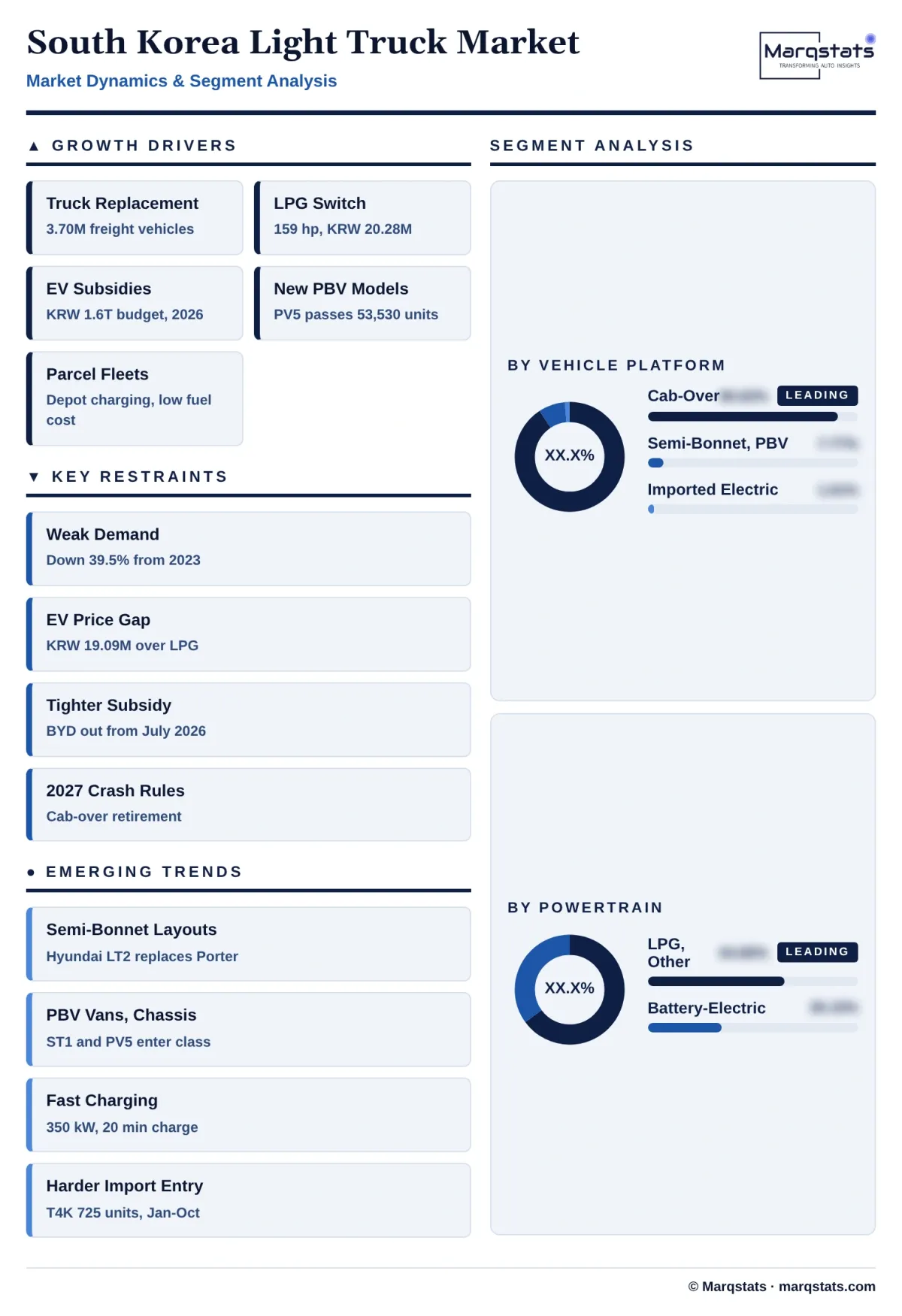
- Small business replaces trucks on a fixed cycle. The Ministry of Land, Infrastructure and Transport counted 3,700,835 registered freight vehicles at the end of June 2025, of which 3,127,817 ran on diesel, so a large and ageing base of owner-operator trucks must move to LPG or electric power as the diesel supply ended in November 2023.
- LPG gives a low-cost way to stay on the road. The 2.5 litre turbo LPG engine delivers 159 horsepower against 135 for the diesel it replaced, a regular-cab Porter lists at about KRW 20.28 million, and the government offered up to KRW 9 million to owners who scrapped a diesel truck and bought a new LPG one, with 1,915 LPG stations at the end of 2024.
- Electric subsidies remain large. The 2026 subsidy plan carries a budget of KRW 1.6 trillion for about 300,000 electric vehicles, adds a bonus of KRW 1.5 million for chargers of 150 kilowatts or more and KRW 1 million for a range of at least 280 kilometres, and the Hyundai ST1 is quoted at a net price of KRW 25 to 35 million after central, local and small-business support and the refund of value-added tax.
- New purpose-built models widen choice. Kia Corporation launched the PV5 in June 2025 and passed 53,530 cumulative sales by the end of July 2026, while Hyundai Motor Company updated the ST1 in July 2025 with a 76.1 kilowatt-hour battery, a range of 317 kilometres and 350 kilowatt charging, so fleet buyers can now choose a vehicle that is not cab-over.
- Parcel and retail fleets keep growing their vans and small trucks. Delivery operators such as CJ Logistics Corporation and Coupang, Inc. run large last-mile networks in the Seoul Capital Area, and low per-kilometre energy costs, estimated at KRW 65.96 for electric against KRW 150.00 for LPG, favour electric vehicles that return to a depot each night.
Key Restraints
Four constraints keep volumes below the 2023 peak and slow the move from LPG to electric power.
- Weak small-business demand has cut volumes. Sales of the Porter fell below 70,000 in 2024 for the first time since 2008 and fell 26.4% in the first half of 2025, and the market is estimated at 114,400 trucks in 2024 and 98,000 in 2025, a decline of 39.5% from the 2023 level of about 162,000.
- Electric trucks cost more up front. Marqstats estimates an electric cab-over truck at about KRW 40.45 million net of value-added tax against KRW 21.36 million for an LPG truck, and an unsubsidised payback of about 7.57 years on fuel savings, so owner-operators without a depot charger keep choosing LPG.
- Subsidy rules are tightening. The 2026 plan penalises chargers below 100 kilowatts by KRW 0.5 million, the range threshold rises from 280 kilometres to about 308 kilometres in 2027, fire-safety insurance is required from July 2026, and BYD Company Limited was the only battery-electric manufacturer excluded from subsidy from 1 July 2026.
- The 2027 standards raise the cost of staying on sale. The remaining three crash criteria apply to existing models in 2027, and trade reports expect the Porter II and Bongo III to be discontinued as the Hyundai LT2 and a Kia successor are developed, so buyers may delay purchases and makers must invest before volumes recover.
Key Trends
Four shifts are changing which light trucks are built, powered and bought in South Korea.
- Semi-bonnet layouts replace the cab-over. The Hyundai LT2, reported in April 2025 as the Porter II successor, moves the engine compartment forward to create a crumple zone and is expected in electric and LPG versions with no diesel option.
- Purpose-built vans and chassis-cabs enter the one-tonne class. The Hyundai ST1 is sold as a cargo van, refrigerated van, high-top and chassis-cab, and the Kia PV5 as a standard, long-range and chassis-cab platform, so body builders and fleet buyers can specify the load space rather than modify a truck.
- Fast charging becomes a purchase criterion. The subsidy plan now rewards 150 kilowatt chargers and a 280 kilometre range, and the ST1 charges from 10% to 80% in about 20 minutes, which separates new models from the first-generation Porter and Bongo electric trucks.
- Chinese electric trucks face a harder entry. The BYD T4K registered 725 units in January to October 2025, up 45.6% from 498, but the 2026 subsidy plan names its sub-100 kilowatt charging as a disadvantage and the July 2026 assessment excluded BYD from subsidy.
Strategic Implications
- For Hyundai Motor Company and Kia Corporation, the task is to hold more than 98% of units through a platform change. Offering an LPG semi-bonnet model alongside the ST1 and PV5 keeps price-sensitive owner-operators inside the group, while electric purpose-built vehicles go to depot-based fleets.
- For new entrants and importers, a cab-over design is not a route into the market, and eligibility for the central subsidy depends on charging speed, range, battery energy density and after-sales capability. Importers that pass the July 2026 assessment, and partner with a service network, can reach fleet buyers that value low running cost.
- For component suppliers, the move from diesel to LPG and from cab-over to semi-bonnet shifts demand from injection pumps and exhaust after-treatment to high-pressure LPG fuel systems, front crash structures, door and steering components and driver assistance sensors that the emergency braking requirement extends to small trucks.
- For fleet operators and lenders, the unsubsidised payback of about 7.57 years makes electric trucks a depot-charging decision rather than a general replacement, and financiers can use subsidy-adjusted prices of KRW 25 to 35 million for the ST1 and the PV5 price range to set residual values.
- For body builders and aftermarket firms, purpose-built chassis and chassis-cabs open demand for refrigerated, tail-lift and box bodies that fit a new frame, while the ageing base of cab-over diesel trucks keeps strong demand for service, tyres and brake parts.
Market Segmentation
Cab-over trucks, the Hyundai Porter II and Kia Bongo III in LPG and electric versions, account for 90.62% of 2025 value, USD 1,606.64 million, and decline at 7.03% a year to USD 1,115.90 million and 46.33% of the market. Marqstats counts 92,568 units in 2025, 94.46% of volume, falling to 58,500 in 2030 as successors replace them.
Semi-bonnet and purpose-built models account for 7.77% of 2025 value, USD 137.67 million, and grow fastest, at 54.14% a year, to USD 1,197.89 million and 49.73% of the market. About 4,440 units were added in 2025, the Hyundai ST1 and the Kia PV5 Cargo, and Marqstats expects 45,000 in 2030 including LPG successors to the Porter and Bongo.
Imported electric trucks account for 1.61% of 2025 value, USD 28.55 million, and grow at 27.13% a year to USD 94.79 million. About 992 units were added in 2025, mainly the BYD T4K sold through GS Global, and growth depends on meeting the charging-speed and after-sales rules of the subsidy plan.
LPG and other combustion trucks account for 64.85% of 2025 value, USD 1,149.64 million, and decline at 1.79% a year to USD 1,050.44 million and 43.61%. They are 78.07% of 2025 units, 76,508 trucks, with about 60 diesel trucks from remaining stock, and their share of units falls to 56.54% by 2030.
Battery-electric trucks and vans account for 35.15% of 2025 value, USD 623.22 million, and grow at 16.86% a year to USD 1,358.14 million and 56.39% of the market. Units rise from 21,492 to 46,500, 21.93% to 43.46% of the total, as purpose-built models and a lower subsidy-adjusted price reach fleet buyers.
Self-employed tradespeople and small retailers account for 54.66% of 2025 value, USD 968.94 million, and grow at 4.37% a year to USD 1,199.95 million. Marqstats estimates 55,000 units in 2025, mostly LPG drop-side trucks bought for low upfront cost and wide fuel access.
Parcel and logistics fleets account for 21.01% of 2025 value, USD 372.48 million, and grow at 10.40% a year to USD 610.88 million and 25.36%. They buy electric vans and trucks for depot charging, and the diesel restriction on parcel delivery vehicles made them the first group to leave diesel.
Food, cold chain and wholesale buyers account for 14.70% of 2025 value, USD 260.66 million, and grow at 4.37% a year to USD 322.81 million. Refrigerated and box bodies on the Porter, Bongo and ST1 serve markets, restaurants and grocery distributors.
Agriculture, construction and municipal users account for 9.63% of 2025 value, USD 170.78 million, and grow at 9.99% a year to USD 274.94 million. Four-wheel-drive and high-clearance chassis, farm freight and local-government fleets lean on LPG, with municipal buyers adding electric trucks as subsidies allow.
By Geography
Seoul Capital Area
The Seoul Capital Area, covering Seoul, Incheon and Gyeonggi, accounts for 40.00% of 2025 value, USD 709.14 million, and grows at 6.85% a year to USD 987.51 million and 41.00% by 2030. Parcel fleets, dense delivery routes and the diesel restriction in the air management zones make it the centre of electric and purpose-built demand.
Yeongnam
Yeongnam, covering Busan, Daegu, Ulsan and the Gyeongsang provinces, accounts for 24.00% of 2025 value, USD 425.49 million, and grows at 5.87% a year to USD 566.02 million. Hyundai builds the Porter at Ulsan, and port, factory and market freight keep LPG trucks dominant.
Honam and Jeju
Honam and Jeju account for 15.00% of 2025 value, USD 265.93 million, and grow at 5.60% a year to USD 349.24 million. Kia builds the Bongo at Gwangju, farm and coastal freight favour four-wheel-drive LPG chassis.
Chungcheong
Chungcheong, covering Daejeon, Sejong and the Chungcheong provinces, accounts for 13.00% of 2025 value, USD 230.47 million, and grows at 6.32% a year to USD 313.12 million. Sorting centres and fulfilment hubs create fleet demand for vans and small trucks.
Gangwon and Other
Gangwon and other areas account for 8.00% of 2025 value, USD 141.83 million, and grow at 6.32% a year to USD 192.69 million. Mountain roads and long rural routes keep demand focused on LPG and four-wheel-drive models.
How Competition Is Evolving
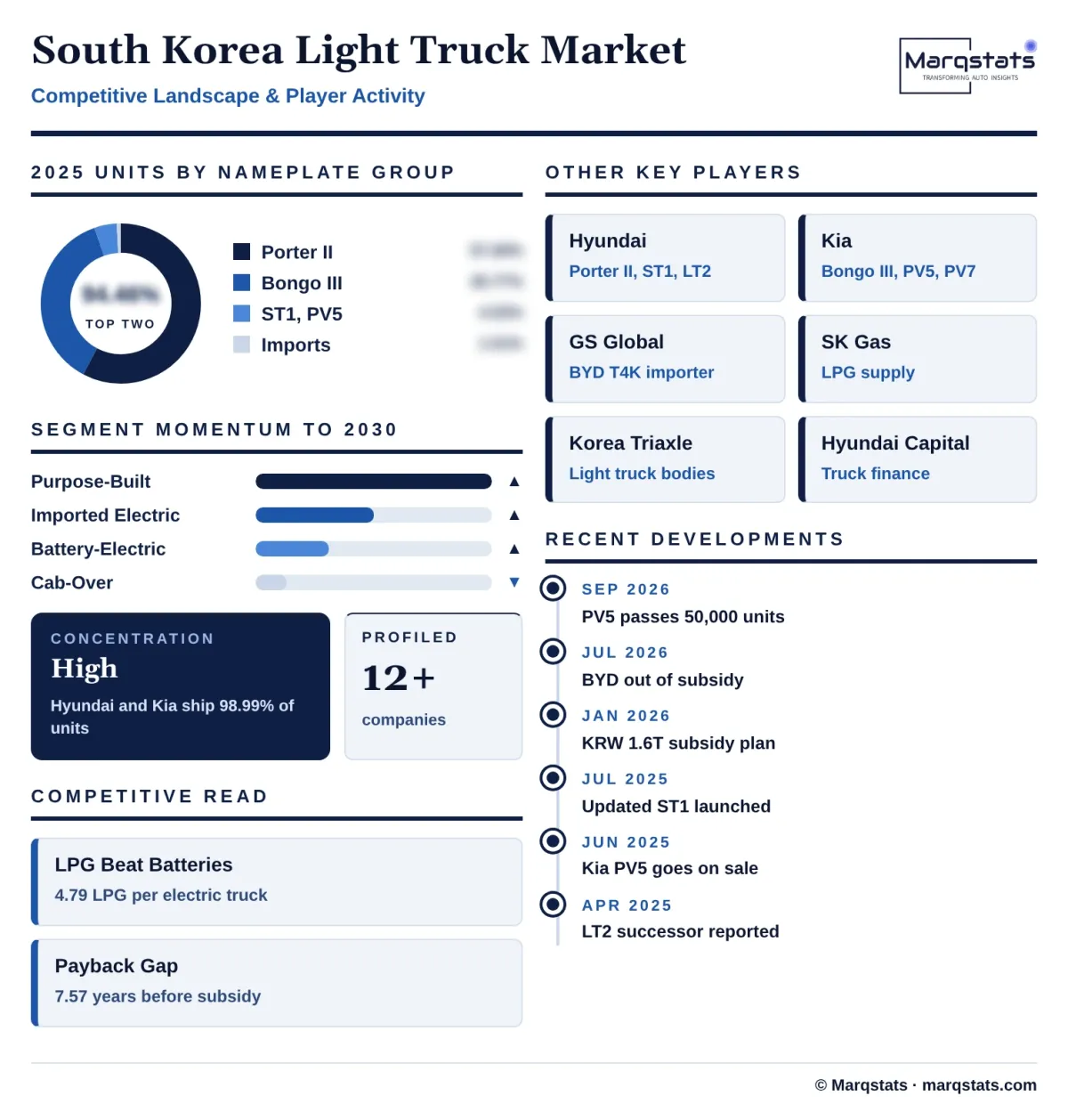
The market is highly concentrated. Marqstats estimates that Hyundai Motor Company delivered 59.06% of 2025 units and Kia Corporation 39.93%, a combined 98.99%, while GS Global, importer of BYD, held 0.87% and other importers 0.14%. The Herfindahl-Hirschman Index calculated on these unit shares is about 5,083.
Hyundai Motor Company leads with the Porter II, sold at 56,538 units in 2025, and the ST1. The Porter fell 26.4% in the first half of 2025 and the ST1 registered 1,135 units in January to October 2025, up 51.3% from 750. The company has reported the LT2 as the Porter successor, with a semi-bonnet layout and electric and LPG versions.
Kia Corporation follows with the Bongo III, sold at 36,030 units in 2025, and the PV5. Kia domestic commercial sales were 41,277 units in 2025, and in September 2026 the Bongo III sold 2,347 and the PV5 1,888. PV5 global sales passed 53,530 units by the end of July 2026, about 60% of them overseas, and the PV7 was unveiled at IAA Transportation 2026.
Competition is shifting from price to eligibility. GS Global sold 725 BYD T4K units in January to October 2025, but the sub-100 kilowatt charging speed counts against it under the 2026 subsidy plan, and the July 2026 assessment excluded BYD from subsidy, so importers must show service networks, battery quality and fast charging to compete with Hyundai and Kia.
Companies Covered
Companies covered in the report include:
Recent Market Activity
Table of Contents
Coverage & Segmentation
The study covers the South Korea light truck market, with 2025 as the base year, 2021 – 2025 as the historical period and 2026 – 2030 as the forecast period. It covers new freight-registered trucks and cargo vans of up to one tonne payload and 3.5 tonnes gross weight, including cab-over one-tonne trucks, semi-bonnet and purpose-built vehicles and imported electric trucks, segmented by vehicle platform, powertrain, end use and region. Values are net of 10% value-added tax, before subsidies and third-party bodies, in US dollars at the 2025 average rate of KRW 1,421.5 per US dollar.
Pickups such as the KG Mobility Rexton Sports and Musso, micro-sized vehicles, passenger-registered vans, medium and heavy trucks, buses and used vehicles are excluded, as is the value of bodies fitted by third parties. Segment and regional splits are Marqstats estimates built on company sales, registration counts, price lists and subsidy rules. The live Marqstats report on the South Korea electric commercial vehicle market is a broader electric-only series that includes medium and heavy trucks and buses, and its figures should not be added to this market.