Market Snapshot
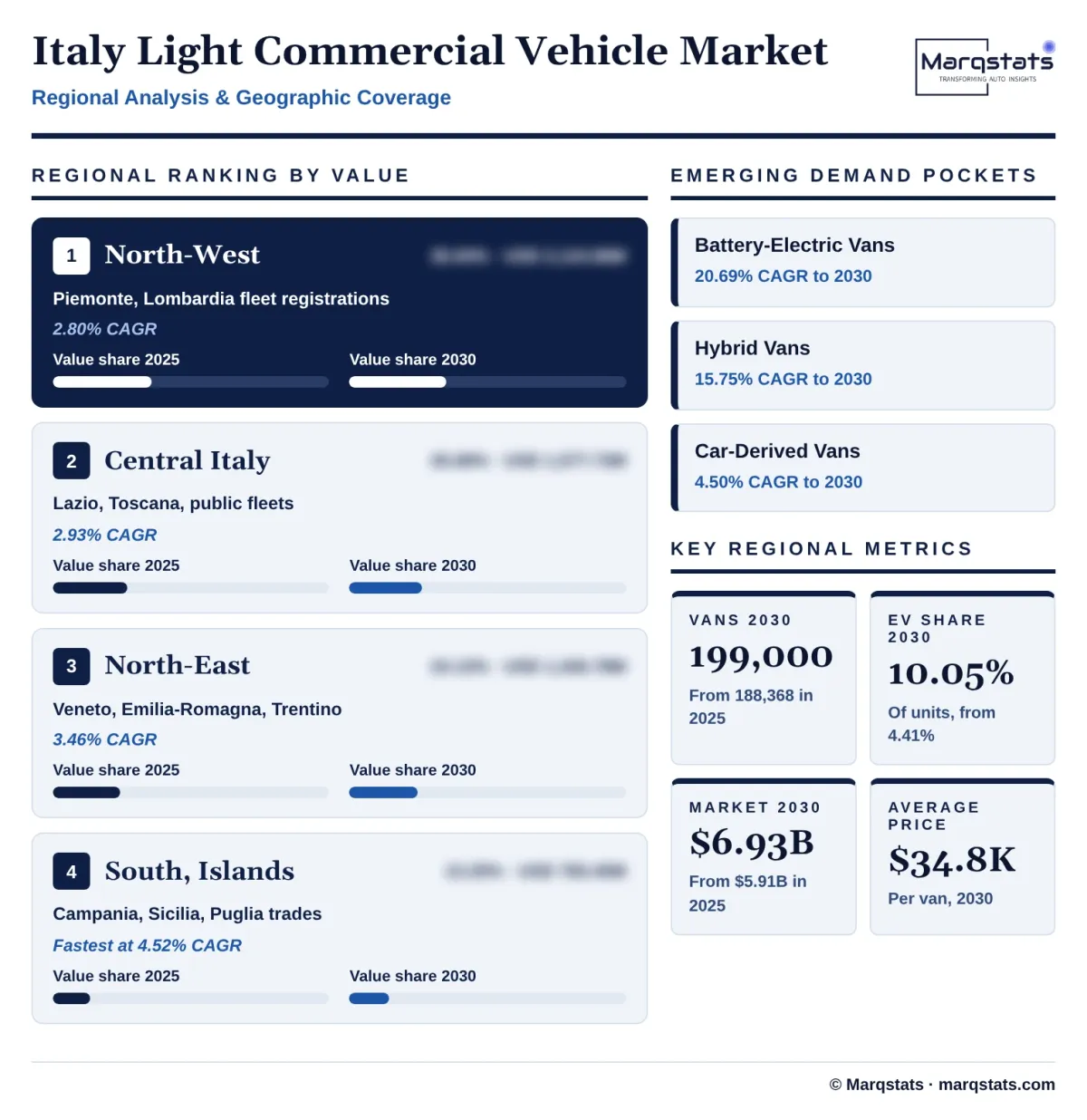
The Italy light commercial vehicle market size is estimated at USD 5,912.84 million in 2025 and is projected to reach USD 6,931.87 million by 2030, growing at a CAGR of 3.23% over 2026 – 2030. Registrations of new vans up to 3.5 tonnes rise from 188,368 to 199,000, a 1.10% annual rate, as electrified models lift value per van.
Marqstats defines the market as the transaction value of new category N1 light commercial vehicles of up to 3.5 tonnes gross vehicle weight registered in Italy, from car-derived vans and minicargo vans to medium and large panel vans, chassis-cabs and pick-ups. Value is counted at the buyer transaction price before value added tax in US dollars, converted from euros at USD 1.13 per euro. Trucks above 3.5 tonnes, buses, trailers, used vans and exports are excluded.
Medium and large vans account for 48.96% of 2025 value, diesel for 78.16% and rental without driver for 35.54%. North-West Italy accounts for 35.94% of value because large rental and leasing fleets register vehicles there, while South and Islands grow fastest by region at 4.52% a year. Battery-electric vans, from a base of 8,310 registrations, grow fastest of all segments at 20.69% a year.
Key Takeaways
Market Overview & Analysis
Report Summary
Marqstats sizes the Italy light commercial vehicle market as the transaction value of new vans, pick-ups and chassis-cabs of up to 3.5 tonnes gross vehicle weight that are registered in Italy each year. The Associazione Nazionale Filiera Industria Automobilistica (ANFIA) counted 188,368 such vehicles in 2025, down 5.0% from 198,219 in 2024, and Marqstats uses that count as the unit base. The Unione Nazionale Rappresentanti Autoveicoli Esteri (UNRAE) reported 189,050 in its December 2025 release, down 4.9% from 198,703, and the European Automobile Manufacturers' Association (ACEA) series used in Marqstats Europe pages shows 188,373.
The three counts differ by under 0.4% because each applies its own cut-off date and category rules. Marqstats takes ANFIA for body type, powertrain, region, channel and brand shares because it publishes all five on one base, and UNRAE for model rankings, monthly 2026 trends and carbon dioxide averages. The market is small beside the Italian car market of 1,525,722 cars in 2025, yet it is large enough to support the Atessa plant of Stellantis N.V., which builds the Fiat Ducato, Peugeot Boxer, Citroën Jumper and Opel Movano.
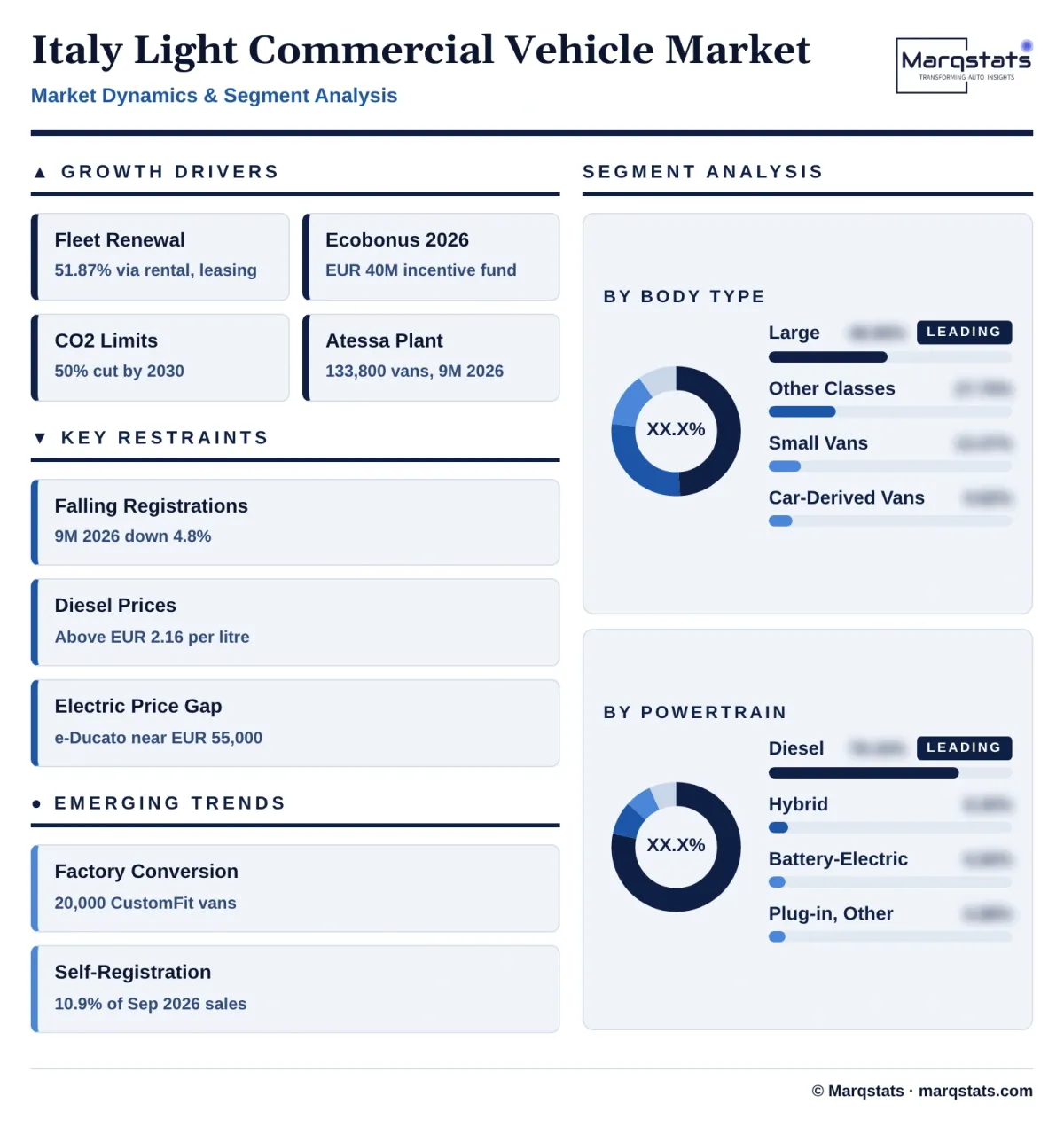
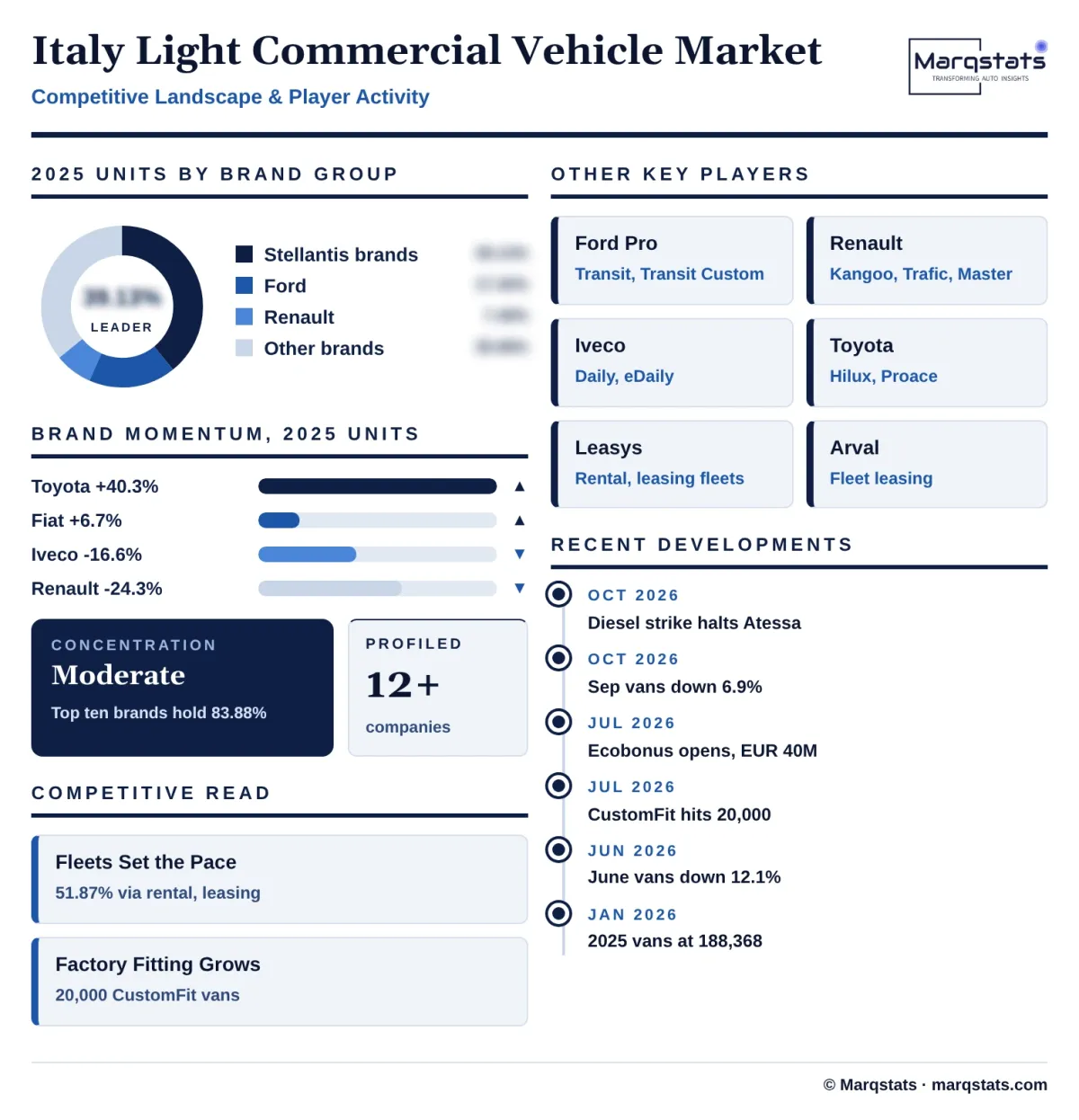
Demand is a fleet market. ANFIA data for 2025 show rental without driver at 66,516 vans, companies at 63,365, corporate leasing at 31,189, private buyers at 21,512 and individual leasing at 5,512. Rental and corporate leasing together placed 97,705 vans, 51.87% of the total, and private buyers, who include artisans and sole traders, fell 12.1% in 2025. Companies, rental houses and lessors therefore set the pace of renewal, and their buying cycle explains most of the swings in registrations.
Policy pressure comes from two directions. Regulation (EU) 2019/631, as amended by Regulation (EU) 2023/851, asks manufacturers to cut the average CO2 of new vans by 15% from 2025 and by 50% from 2030 against the 2021 reference, and Italy answers with a national incentive. The decree of MIMIT dated 27 July 2026 opened reservations on 29 July 2026 for EUR 40 million of Ecobonus support for new low-emission commercial vehicles and EUR 4 million for LPG and methane retrofits, for purchases made between 26 June and 31 December 2026.
Registrations were 198,219 in 2024 and 188,368 in 2025, and the first nine months of 2026 ran at 134,885 vans, down 4.8% from 141,641, according to UNRAE. Marqstats estimates the 2025 value at EUR 5,232.61 million, or USD 5,912.84 million at the 2025 average of USD 1.13 per euro, and the 2026 value at USD 5,746.28 million on about 179,300 registrations. Both figures are Marqstats estimates built from units and transaction prices, rather than reported turnover.
Italy Light Commercial Vehicle Market Size and Forecast
The Italy light commercial vehicle market grows from USD 5,912.84 million in 2025 to USD 6,931.87 million in 2030, a CAGR of 3.23%. Price and mix contribute more than volume: registrations rise at 1.10% a year, from 188,368 to 199,000 vans, while the average value per van rises at 2.10% a year, from about USD 31,390 to USD 34,834, as battery-electric and hybrid models take a larger share and list prices rise with Euro 6 and safety content.
The 2025 value is built bottom-up from ANFIA body classes and Marqstats transaction prices. Marqstats estimates 72,162 medium and large vans at about EUR 35,500 each, 32,131 car-derived vans at EUR 16,000, 29,377 small vans at EUR 24,000, 25,756 other vans at EUR 30,000, 18,181 minicargo vans at EUR 19,000 and 10,761 pick-ups and unclassified vehicles at EUR 31,000. The total is EUR 5,232.61 million, an average of about EUR 27,779 per van, before value added tax.
The prices are checked against 2026 list prices before value added tax: Peugeot Boxer EUR 31,300, Renault Master EUR 32,730, Ford Transit Custom EUR 33,500, Fiat Ducato from EUR 33,600, Ford Transit EUR 39,600 and Mercedes-Benz Sprinter from EUR 40,980, with electric large vans near EUR 54,500 to 61,000. Small vans anchor lower, as the Fiat Doblò Cargo lists at EUR 22,900 and the e-Doblò Cargo at EUR 33,500 in France in February 2026. Fleet discounts pull transaction prices below list, while options and body fitting push them up, so Marqstats holds the large-van average near EUR 35,500 and sets car-derived and minicargo vans far lower. The price layer is a Marqstats construction, and the true average could differ from it by several percent, which would move the value but not the registration counts.
The forecast follows registrations, not subsidy headlines. Marqstats expects about 179,300 registrations in 2026, 4.81% below 2025 and in line with the 4.8% decline of the first nine months, and USD 5,746.28 million of value, a -2.82% change. Registrations then recover by about 2.5% a year toward 199,000 in 2030, close to the 198,219 of 2024, as the fleet renewal postponed in 2025 and 2026 returns.
Battery-electric vans add value faster than volume. Marqstats expects battery-electric registrations to rise from 8,310 in 2025 to 20,000 in 2030, a 19.20% annual rate, lifting their share of units from 4.41% to 10.05%, and hybrid vans from 14,335 to 28,000. Battery-electric vans are priced at about 1.55 times a diesel van of the same class, so their share of value reaches 14.55% in 2030. Marqstats tracks four indicators: monthly UNRAE registrations, the Ecobonus reservation pace, the 2026 CO2 average against 183.3 g/km, and diesel pump prices.
Market Dynamics
Key Drivers
Five forces keep Italian businesses buying new vans even in a year when registrations are falling.
- Fleet renewal cycles keep volume high. Rental without driver and corporate leasing registered 97,705 vans in 2025, 51.87% of the market, and corporate leasing grew 3.5% in a year when total registrations fell 5.0%. Rental houses and lessors such as Leasys S.p.A., Arval Service Lease Italia S.p.A. and Ayvens replace vehicles on set mileage and age rules, which gives Italian van demand a floor that private buying does not.
- A national incentive supports electric vans. MIMIT opened Ecobonus reservations for commercial vehicles on 29 July 2026 with EUR 40 million, paying a battery-electric van of 2.40 to 3.49 tonnes up to EUR 14,000 with scrapping and EUR 10,000 without, and a van of 1.50 to 2.39 tonnes up to EUR 8,000 with scrapping. Rental companies qualify for battery-electric vans leased to small businesses for at least three years.
- European CO2 rules force manufacturers to supply electric vans. Regulation (EU) 2019/631 requires a 50% cut in the average emissions of new vans from 2030 against the 2021 reference, and the weighted average in Italy was 183.3 g/km in 2025 and 183.5 g/km in the first nine months of 2026, according to UNRAE. A gap of that size gives Stellantis N.V., Ford Motor Company and Renault Group a reason to place electric vans with Italian fleets, and the European Commission proposal of December 2025 to ease the 2030 van target from 50% to 40% would soften that pressure without removing it.
- A large domestic production base shortens supply. The Atessa plant built 133,800 vans in the first nine months of 2026, up 17.3%, which is 39% of Stellantis N.V. output in Italy, and the CustomFit Center there had upfitted 20,000 vehicles by 17 July 2026. Short lead times on the Fiat Ducato and its Peugeot, Citroën and Opel twins help Italian buyers, although the plant also builds for other European markets.
- Small businesses are moving to lighter vans. Car-derived vans rose 13.8% to 32,131 registrations in 2025 and small vans rose 6.3% to 29,377, while medium and large vans fell 9.5%. Marqstats reads this as artisans and service firms choosing cheaper vehicles with lower running cost, which supports the 4.50% value growth of car-derived vans to 2030.
Key Restraints
Four constraints hold the market below its 2024 level and slow the shift away from diesel.
- Registrations are falling. UNRAE counted 134,885 vans in January – September 2026, down 4.8%, with June down 12.1% and September down 6.9% to 15,737. Dealer self-registrations reached 9.8% of the nine-month total and 10.9% in September, so part of the published volume is stock moved into the register and underlying retail demand is weaker than the headline.
- Diesel prices squeeze small operators. The average diesel price passed EUR 2.16 per litre in September 2026, up 35 cents on February according to the Ministero dell'Ambiente e della Sicurezza Energetica (MASE) survey, and hauliers stopped trucks from 16 October. Higher running cost delays van replacement at owner-operator fleets, and the stoppage cut component deliveries to Atessa from 19 October.
- The electric price gap is wide. A Fiat e-Ducato costs close to EUR 55,000 before value added tax against EUR 33,600 for a diesel Ducato, roughly 60% more, and private buyers took only 11.42% of 2025 registrations, down 12.1%. The battery-electric share fell to 3.9% in the first nine months of 2026 from 4.5%, which shows that the 2025 jump did not reach small buyers.
- The incentive is small against the market. The EUR 40 million fund pays at most about 2,857 vans at the EUR 14,000 top N1 rate or 5,000 vans at EUR 8,000, equal to 34.38% to 60.17% of the 8,310 battery-electric vans registered in 2025. Applicants must be small or medium-sized enterprises, must scrap a Euro 4 or older vehicle of the same category held for 12 months to claim the scrapping rates, and compete on a first-come reservation platform.
Key Trends
Four shifts are changing who registers vans, what they run on and how the body is fitted.
- Factory conversion replaces the independent bodybuilder. Stellantis Pro One announced on 17 July 2026 that its CustomFit Center at Atessa had produced 20,000 upfitted vehicles and that Gliwice in Poland had reached 5,000, with the first Atessa orders for Cargo Box vans of over 20 cubic metres for Enterprise. Body fitting happens on the line, which shifts margin from third-party bodybuilders to the manufacturer.
- Tactical self-registration is becoming a volume tool. Dealer self-registrations rose from 8.5% of registrations in 2025 to 9.8% in the first nine months of 2026 and 10.9% in September, more than double the level of September 2025, and UNRAE reported that 57% of the September volume came from two brands of one group. Marqstats treats retail demand as weaker than registered volume.
- Hybrids take share from diesel. Diesel fell to 77.7% of registrations in January – September 2026 from 80.0% in 2025, and hybrids reached 10.8%, up 3 points, while plug-in hybrids held 2.1%. Mild and full hybrids give fleets a lower-emission option without a charging point, which is why Marqstats expects hybrid vans to reach 14.07% of units by 2030.
- Smaller body classes win share. Car-derived vans grew 13.8% and small vans 6.3% in 2025, while minicargo vans fell 25.1% and medium and large vans fell 9.5%. Buyers are splitting between low-cost car-based vehicles and large vans, and the minicargo class in between is losing out.
Strategic Implications
- For manufacturers, Italian van volume is a fleet decision, so electric vans should be sold through the rental houses and lessors that place 51.87% of registrations. A residual value guarantee agreed with Leasys S.p.A., Arval Service Lease Italia S.p.A. or Ayvens moves more electric vans than retail dealer promotion, because private buyers account for only 11.42% of volume.
- For incumbents, the CO2 gap decides the next two years. With the fleet average at 183.5 g/km in 2026 and Regulation (EU) 2019/631 asking for a 50% cut by 2030, Stellantis N.V., Ford Motor Company and Iveco Group N.V. need battery-electric supply that Italian fleets will take, which means financing support and price cuts on the e-Ducato class, now close to EUR 55,000.
- For rental and leasing companies, the 2026 contraction in long-term rental is a pricing opportunity. Used-van residuals, charging at depots and the Ecobonus rule that lets lessors claim battery-electric support for three-year leases to small businesses allow a lessor to widen its customer base beyond large fleets.
- For bodybuilders and upfitters, factory conversion is the main threat. CustomFit output of 20,000 vehicles at Atessa shows that large-van bodies are moving onto the manufacturer line, so independent firms need niches such as refrigerated, tipper and accessible vehicles, where volumes are small and the Pianale and Cassone classes still sell 8,029 and 8,616 units.
- For investors and suppliers, registration data should be read with care. Piemonte, Lazio and Trentino-Alto Adige swung by 36.3%, 47.0% and minus 42.5% in 2025, so dealer networks and workshops belong where vans operate, in South and Islands and the central corridors, not where fleets are registered.
Market Segmentation
Medium and large panel vans account for 48.96% of 2025 value, USD 2,894.77 million, and grow at 3.87% a year to USD 3,499.39 million. ANFIA counted 72,162 registrations in 2025, down 9.5%, led by the Fiat Ducato at 20,825 registrations, the Ford Transit at 11,366 and the Ford Transit Custom at 9,905, alongside the Renault Master, Peugeot Boxer and Iveco Daily, which UNRAE counts at 13,824 registrations.
Car-derived vans account for 9.82% of 2025 value, USD 580.93 million, and grow at 4.50% a year to USD 724.10 million. Registrations rose 13.8% to 32,131 in 2025, the strongest of any class, as small firms and professionals choose commercial versions of cars, and Toyota gained 40.3% to 8,764 vans in the same year.
Small vans account for 13.47% of 2025 value, USD 796.70 million, and grow at 3.36% a year to USD 939.71 million. Registrations rose 6.3% to 29,377 in 2025, led by the Fiat Doblò, the best-selling van model in Italy at 20,859 registrations according to UNRAE, with the Renault Kangoo and Volkswagen Caddy in the same class.
The class that ANFIA reports separately as Van accounts for 14.77% of 2025 value, USD 873.13 million, and grows at 1.72% a year to USD 950.89 million. Registrations fell 3.9% to 25,756 in 2025. Marqstats prices the class between small and large vans, at about EUR 30,000, because it spans both ends of the range.
Minicargo vans account for 6.60% of 2025 value, USD 390.35 million, and are the only class that shrinks, at -2.87% a year, to USD 337.53 million. Registrations fell 25.1% to 18,181 in 2025 as buyers moved to car-derived vans and larger small vans.
Pick-ups and unclassified vehicles account for 6.38% of 2025 value, USD 376.96 million, and grow at 4.96% a year to USD 480.25 million. ANFIA counted 10,649 pick-ups in 2025, down 7.4%, plus 112 unclassified vehicles, and the Toyota Hilux and Ford Ranger are among the best-known models. The other vans, minicargo and pick-up classes together hold 27.75% of value.
Diesel and biodiesel vans account for 78.16% of 2025 value, USD 4,621.09 million, and shrink at 0.72% a year to USD 4,457.27 million, while their share falls to 64.30%. ANFIA counted 149,671 diesel and 1,452 biodiesel registrations in 2025, together 80.23% of units, and diesel was still 77.7% of registrations in January – September 2026.
Mild and full hybrid vans account for 8.30% of 2025 value, USD 490.94 million, and grow at 15.75% a year to USD 1,020.29 million. ANFIA counted 9,569 petrol-hybrid and 4,762 diesel-hybrid registrations in 2025, and UNRAE reported hybrids at 10.8% of registrations in January – September 2026, up 3 points.
Battery-electric vans account for 6.66% of 2025 value, USD 393.86 million, and grow at 20.69% a year to USD 1,008.58 million and 14.55% of the market. Registrations rose 116.9% to 8,310 in 2025, 4.41% of units, then the share eased to 3.9% in the first nine months of 2026, with a peak of 7.0% in August.
Plug-in hybrid vans account for 1.34% of 2025 value, USD 79.38 million, and grow at 16.34% a year to USD 169.18 million. ANFIA counted 1,997 registrations in 2025, up from 464, and UNRAE put plug-in hybrids at 2.1% of registrations in January – September 2026.
Petrol, LPG, methane and other powertrains account for 5.54% of 2025 value, USD 327.57 million, and shrink at 3.33% a year to USD 276.55 million. Petrol registered 7,509 vans, LPG 5,024 and methane just 49, down 59.2%, and the plug-in hybrid and this group together hold 6.88% of value.
Rental without driver accounts for 35.54% of 2025 value, USD 2,101.63 million, and grows at 3.05% a year to USD 2,442.63 million. ANFIA counted 66,516 registrations in 2025, down 2.1%, and UNRAE put long-term rental at 31.6% and short-term rental at 5.4% of registrations, with long-term rental falling about 30% in September 2026.
Companies and entities account for 34.54% of 2025 value, USD 2,042.10 million, and grow at 3.08% a year to USD 2,377.09 million. ANFIA counted 63,365 registrations in 2025, down 9.4%, and UNRAE reported direct company sales up 2.3% in September 2026, which cushioned the fall in rental.
Leasing accounts for 20.59% of 2025 value, USD 1,217.57 million, and grows fastest among channels, at 3.87% a year, to USD 1,471.88 million. Corporate leasing registered 31,189 vans, up 3.5%, and individual leasing 5,512, up 3.0%, in 2025.
Private buyers, mainly artisans and sole traders, account for 9.20% of 2025 value, USD 543.75 million, and grow at 3.01% a year to USD 630.81 million. ANFIA counted 21,512 registrations in 2025, down 12.1%, and UNRAE shows private buyers at 14.4% of 2025 registrations on its own channel definitions.
Other buyers, which cover public bodies and unclassified purchases, account for 0.13% of 2025 value, USD 7.79 million, and grow at 3.96% a year to USD 9.46 million. The group is the residual of 274 registrations that ANFIA does not assign to a named channel.
By Geography
North-West Italy
North-West Italy, which ANFIA reports as Nord-Ovest, accounts for 35.94% of 2025 value, USD 2,124.88 million, and grows at 2.80% a year to USD 2,440.02 million. It registered 67,681 vans, up 12.9%, with Piemonte at 37,469 (up 36.3%) and Lombardia at 26,818 (down 6.4%). Marqstats reads the Piemonte jump as the registration of large fleets at a few addresses, so the figure measures where vehicles are booked, not where they work.
North-East Italy
North-East Italy, or Nord-Est, accounts for 24.13% of 2025 value, USD 1,426.78 million, and grows at 3.46% a year to USD 1,691.38 million. Registrations fell 30.3% to 45,445, with Trentino-Alto Adige down 42.5% to 15,918, Emilia-Romagna down 31.1% to 14,906 and Veneto down 8.5% to 11,860. Marqstats reads the drop as a reversal of a 2024 high in fleet registrations, not a loss of trade demand.
Central Italy
Central Italy, or Centro, accounts for 26.68% of 2025 value, USD 1,577.73 million, and grows at 2.93% a year to USD 1,823.08 million. Registrations rose 7.6% to 50,253, with Lazio up 47.0% to 24,862 and Toscana down 17.4% to 20,498. Lazio holds Rome and its public and corporate fleets, which makes it a registration hub as much as a demand centre.
South and Islands
South and Islands, or Sud e Isole, accounts for 13.25% of 2025 value, USD 783.45 million, and grows fastest by region, at 4.52% a year, to USD 977.39 million. Registrations fell 5.2% to 24,954, led by Campania at 6,723, Sicilia at 5,000 and Puglia at 4,629. Marqstats reads the area as one where few fleets register, so it reflects owner-operator and trade demand, and the 35 vehicles that ANFIA leaves without an area are spread across the four regions in proportion.
How Competition Is Evolving
The market is moderately concentrated and led by Stellantis N.V. ANFIA registrations for 2025 give Fiat 26.11% (49,189 vans, up 6.7%), Ford 17.40% (32,775), Renault 7.49% (14,103), Iveco 7.11% (13,396), Peugeot 5.47%, Citroën 4.69%, Toyota 4.65%, Volkswagen 4.22%, Mercedes-Benz 3.88% and Opel 2.85%. The ten brands together hold 83.88%, and the four Stellantis brands alone hold 39.13%.
Fiat and Ford lead on different strengths. Fiat Professional sells the Doblò at 20,859 and the Ducato at 20,825 registrations in the UNRAE series, and builds the Ducato and its Peugeot, Citroën and Opel twins at Atessa, so it controls both volume and delivery time. Ford sold 11,366 Transit and 9,905 Transit Custom vans, and its 32,775 total is the largest import-built position.
Several brands lost volume in 2025. Renault fell 24.3%, Citroën 23.3%, Opel 22.1% and Iveco 16.6% in 2025, while Toyota rose 40.3% and Fiat 6.7%. UNRAE counts 13,824 Daily registrations against 13,396 for the Iveco brand in ANFIA data, a gap that reflects the different category rules of the two series, and Tata Motors Limited is acquiring Iveco Group N.V., the parent of the Daily.
Competition is moving from price to fleet terms and factory fitting. Leasys S.p.A., Arval Service Lease Italia S.p.A. and Ayvens buy against residual value guarantees, Stellantis Pro One sells conversions as part of the vehicle order, and Volkswagen Commercial Vehicles and Mercedes-Benz Vans defend the premium end with the Crafter and the Sprinter at EUR 40,980 and above.
Companies Covered
Companies covered in the report include:
Recent Market Activity
Table of Contents
Coverage & Segmentation
The study covers the Italy light commercial vehicle market, with 2025 as the base year, 2021 – 2025 as the historical period and 2026 – 2030 as the forecast period. It covers new category N1 vans, car-derived vans, minicargo vans, chassis-cabs and pick-ups of up to 3.5 tonnes gross vehicle weight registered in Italy, segmented by body type, powertrain, purchase channel and region. Values are transaction values before value added tax in US dollars, converted at USD 1.13 per euro, the 2025 average.
Trucks and electric vans above 3.5 tonnes registered as category N2, buses, trailers, used vans, exports of Italian-built vans and bodies sold separately are excluded. Segment and regional splits are Marqstats estimates built on ANFIA registrations and transaction prices. Live Marqstats reports on the Europe electric light commercial vehicle market and Europe LCV body conversion market are broader or different layers, and their figures should not be added to this market.