Market Snapshot
Key Takeaways
Market Overview & Analysis
Report Summary
The Canada car wash services market comprises professional operators that clean passenger and light commercial vehicles across four service formats — tunnel/conveyor, in-bay automatic (roll-over), self-service, and manual or mobile hand wash — monetized through pay-per-wash tickets and recurring unlimited-membership subscriptions. The 2025 market of USD 1.50 billion sits against a base of more than 7,500 car wash listings nationwide, the majority of which are independent single-site or fuel-retailer forecourt operations. Professional washing captures roughly 68% of Canadian vehicle owners, with winter road salt the defining demand driver.
The market moved from a 2022 reopening recovery of about 7.5% into a steadier normalization phase, and now grows through express-tunnel and franchise network expansion alongside services pricing gains. Unlike the United States, private-equity roll-up activity is limited, and no single national express-tunnel platform dominates. National fuel retailers — Suncor's Petro-Canada, Imperial Oil's Esso, Shell Canada, and Couche-Tard's Circle K — operate the largest wash networks through forecourt sites, supported by loyalty programs that bundle washes with fuel and convenience purchases.
The Canadian format mix differs structurally from the United States. Tunnel/conveyor share is lower at about 43% in 2025 versus roughly 55% south of the border, in-bay automatic is higher at about 28%, and fuel-station forecourt washes hold about 36% of revenue against roughly 22% in the United States. Subscription penetration is also less mature at about 24% of revenue. Wash intensity per vehicle sits near USD 51, about 78% of the United States level, reflecting a shorter organized-tunnel history and a larger informal and forecourt base.
Demand is strongly seasonal. Winter road salt and grime concentrate exterior-wash volumes from late autumn through early spring across Ontario, Quebec, and the Prairies, while milder coastal British Columbia carries steadier year-round demand. Consumer preference for paint and rim safety sustains a large touchless and soft-cloth base, and municipal wastewater rules push operators toward water-reclamation systems that recycle up to 90% of wash water.
Operating economics vary by format and region. Express tunnels achieve the strongest margins through automation and throughput, whereas forecourt and self-service formats carry lower per-site revenue. Winter concentration raises fixed-cost pressure in colder provinces, and reclamation, heated-bay, and freeze-protection requirements add capital and operating costs not seen in warmer markets. These conditions favor loyalty-linked forecourt networks and, increasingly, membership-backed standalone tunnels that smooth seasonal demand into recurring monthly revenue.
Market Dynamics
Key Drivers
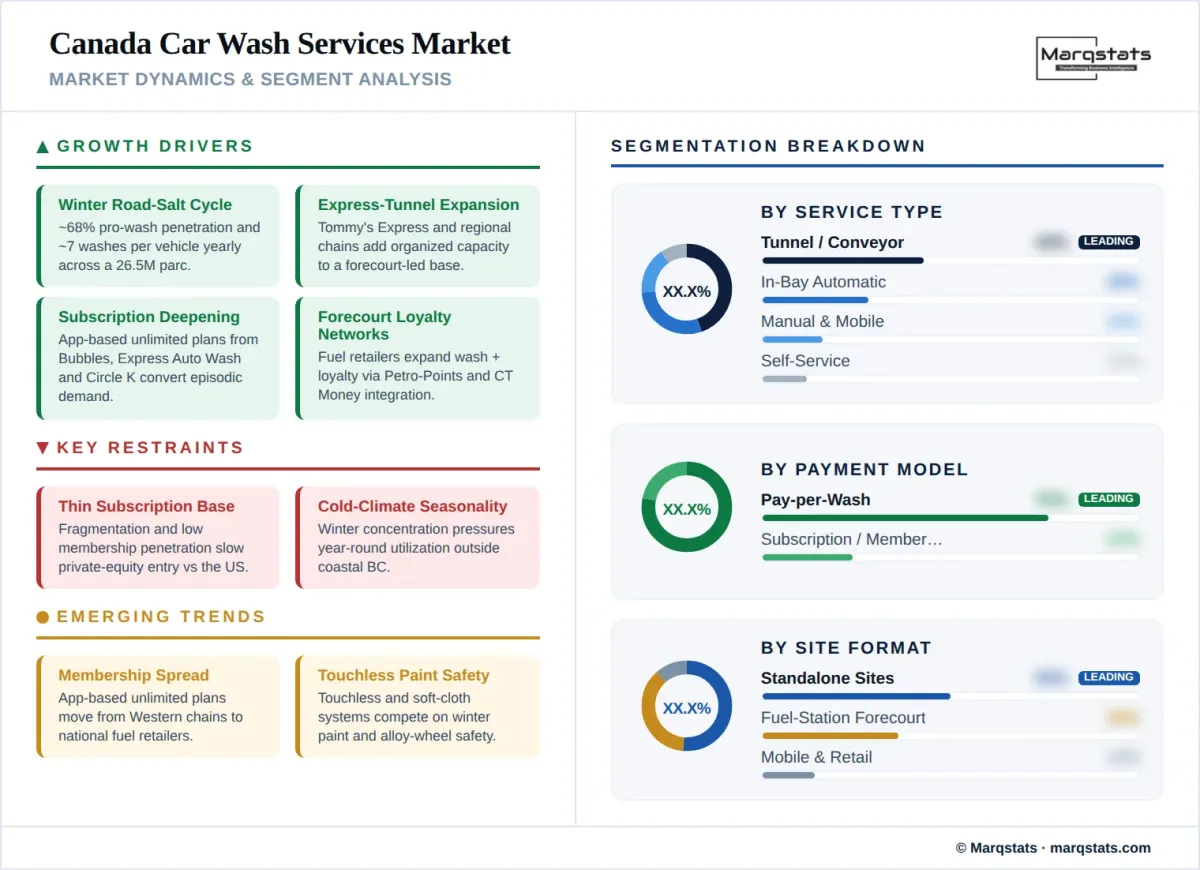
- The winter road-salt cycle lifts exterior-wash frequency, with roughly 68% professional-wash penetration across a 26.5-million-vehicle parc and about seven washes per vehicle each year.
- Express-tunnel and franchise network expansion, including Tommy's Express and regional chains, adds organized capacity in a historically forecourt-led market.
- Services pricing gains contribute roughly 2 percentage points of annual revenue growth across the format mix.
- Subscription deepening via app-based unlimited plans from operators such as Bubbles, Express Auto Wash, and Circle K converts episodic demand into recurring revenue.
- National fuel retailers expand forecourt wash networks and loyalty-linked wash programs, including Petro-Points and CT Money integration.
- Commercial and fleet demand rises from logistics, car-sharing, and government fleets that outsource washing to meet image and compliance standards.
Key Restraints
- Fragmentation and thin subscription penetration limit recurring-revenue scale relative to the United States, slowing private-equity entry.
- Cold-climate seasonality concentrates demand in winter and shoulder months, pressuring year-round site utilization outside coastal British Columbia.
- Municipal wastewater and water-discharge bylaws require reclamation systems, raising construction and operating costs for new sites.
- The structural decline of self-service coin-op formats drags roughly 1 to 2 percentage points from headline growth each year.
Key Trends
- App-based unlimited memberships spread from Western Canada express chains to national fuel retailers, reshaping payment models.
- Touchless and soft-cloth systems compete on paint and rim safety, a recurring Canadian consumer concern with winter tires and alloy wheels.
- Water reclamation systems recycling up to 90% of wash water address municipal discharge rules and rising utility costs.
- Loyalty integration bundles washes with fuel and convenience retail, using programs such as Petro-Points and Canadian Tire's CT Money.
- Rising electric-vehicle ownership raises demand for sensor-safe, track-free touchless washes, and encourages ties between operators and mobility platforms.
Market Segmentation
Tunnel/conveyor washes hold the largest revenue share at roughly 43% in 2025, equal to USD 649.60 million, and rise toward 50% by 2030. Express-exterior tunnels with free vacuums and membership entry are the focus of new organized development, led by franchise operator Tommy's Express and regional chains such as Popular Car Wash in the Greater Toronto Area and Express Auto Wash in British Columbia. The format's share sits well below the United States level, leaving room for continued conversion from forecourt and self-service capacity.
In-bay automatic washes hold about 28% share in 2025 at USD 423.08 million, a higher weighting than in the United States. Most sit on fuel-station forecourts operated by Petro-Canada, Esso, Shell, and Circle K, and many use touchless equipment favored by drivers concerned about paint and alloy-wheel protection during winter. The segment grows slowly in absolute terms while ceding revenue share to tunnels through 2030, and operators increasingly upgrade aging rollovers with soft-cloth and reclamation systems to defend forecourt volumes.
Self-service coin-op bays account for roughly 12% of 2025 revenue, USD 183.22 million, a larger base than in the United States. The format is in structural decline as express tunnels expand, though it retains relevance for oversized vehicles, price-sensitive users, and smaller communities across the Prairies and rural Quebec where tunnel density is low. Operators increasingly add app-based mobile payment and vacuum bundles to defend volumes.
Manual and mobile hand-wash services hold about 16% share, USD 243.19 million, concentrated among independent operators, Western Canada detail centres such as Bubbles Car Wash & Detail Centres, and app-based mobile providers in Toronto, Montreal, and Vancouver. The segment loses share to automated formats yet retains a durable base in premium detailing and interior-focused cleaning.
Single-visit tickets and prepaid wash cards account for roughly 76% of 2025 revenue, USD 1.14 billion, and remain the dominant channel in a market where subscription adoption trails the United States. Fuel-retailer wash-and-go cards, season passes, and points-linked promotions anchor this segment. The share declines toward 65% by 2030 as unlimited memberships gain traction.
Unlimited-membership plans reach about 24% of 2025 revenue, USD 358.12 million, and grow near 13% annually to 35% of revenue by 2030, worth USD 650.72 million. Recurring membership is the fastest-expanding revenue stream, propelled by app-based plans from Bubbles, Express Auto Wash, Popular Car Wash, and Circle K's Car Wash Club, and by fuel-retailer season passes across Petro-Canada and Shell networks.
Purpose-built standalone washes hold roughly 50% of 2025 revenue, USD 752.88 million, and gain share toward 53% by 2030 as express-tunnel and franchise development continues. The format supports the highest throughput and the strongest membership economics, and concentrates in dense urban corridors across Ontario, Alberta, and British Columbia. Site development costs and municipal water-reclamation requirements favor better-capitalized operators, gradually shifting share from forecourt and self-service formats toward standalone tunnels.
Forecourt washes attached to fuel and convenience retail hold about 36% of 2025 revenue, USD 543.00 million, a far larger share than in the United States. Petro-Canada operates 250-plus wash locations under its Super Wash and Glide brands, while Esso, Shell, Circle K, and Co-op gas bars run extensive touchless and soft-cloth networks. The share eases toward 34% by 2030 as standalone tunnels expand.
Mobile and retail-parking formats account for roughly 14% of 2025 revenue, USD 203.21 million, serving on-demand, fleet, and shopping-centre demand in major metros. App-based mobile providers such as Wash Me Now and waterless methods add convenience-oriented capacity, particularly in Toronto, Montreal, and Vancouver, where parking constraints and condo living limit access to fixed sites. The channel remains niche relative to forecourt and tunnel formats yet fits underserved urban and corporate-fleet locations.
Passenger vehicles generate about 89% of 2025 revenue, USD 1.33 billion, reflecting the consumer orientation of forecourt, tunnel, and membership models. Household commuters drive subscription sign-ups, and the share eases slightly across the forecast period as commercial washing grows faster.
Commercial and fleet washing holds roughly 11% share in 2025, USD 171.56 million, rising toward 12% by 2030. Growth is driven by last-mile delivery, logistics, government, and car-sharing fleets — including mobility-as-a-service operators — that outsource washing or install dedicated bays to meet image and compliance standards.
By Geography
Ontario
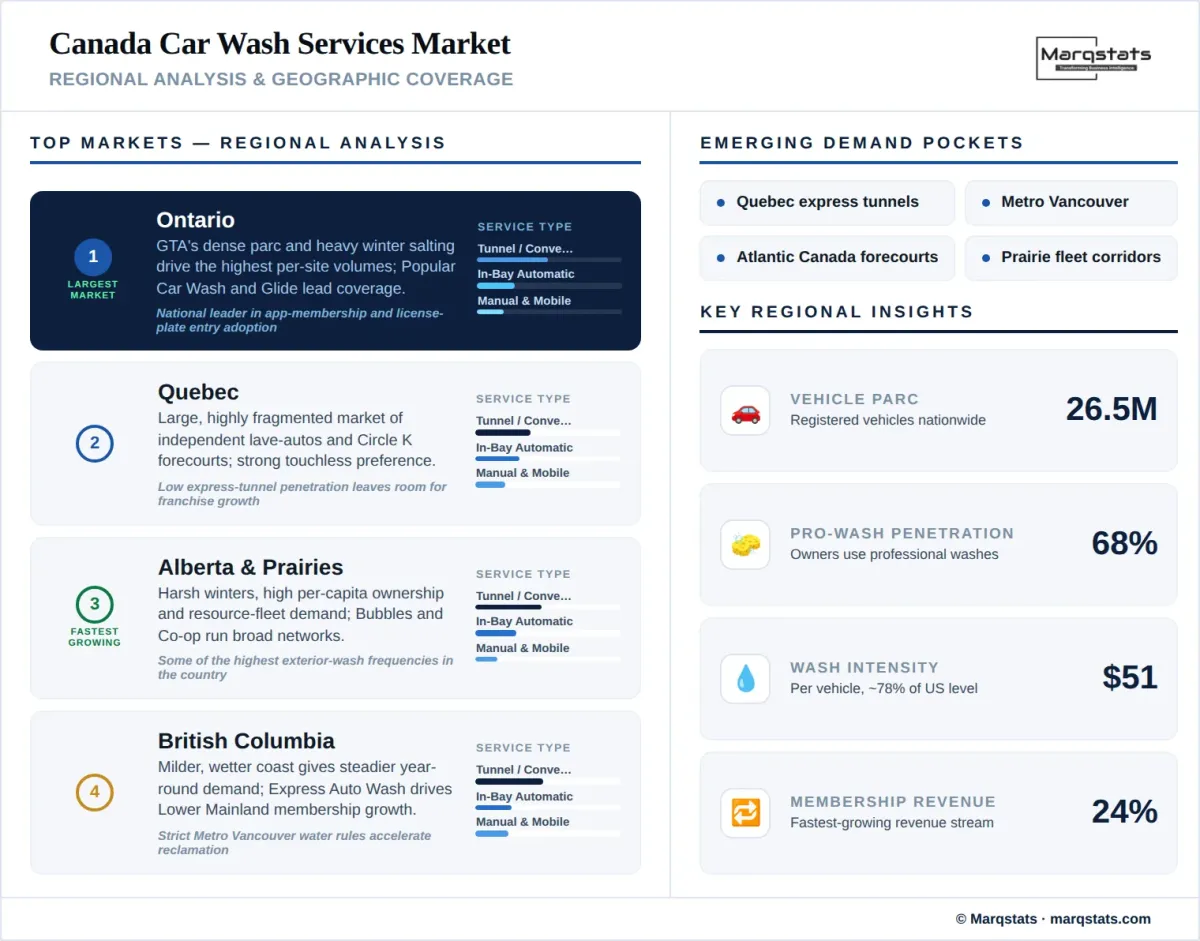
Ontario is the largest provincial market, anchored by the Greater Toronto Area's dense vehicle parc and heavy winter salting. Regional express chains such as Popular Car Wash operate multi-location GTA networks with unlimited wash clubs, while Petro-Canada's Glide soft-cloth washes and Esso forecourt sites provide broad coverage. Strong population growth and commuter density support the highest per-site volumes in the country, and the province leads national adoption of app-based memberships and license-plate entry among standalone operators.
Quebec
Quebec is a large yet highly fragmented market dominated by independent lave-autos across Montreal, Quebec City, and Laval, alongside forecourt washes operated by Couche-Tard's Circle K, which is headquartered in the province. Severe winter salting drives frequent exterior washing, and consumer preference for touchless systems is pronounced. Organized express-tunnel penetration remains lower than in Ontario, leaving substantial room for franchise and membership-led development across the Montreal and Quebec City metros.
British Columbia
British Columbia carries steadier year-round demand owing to a milder, wetter coastal climate with less road salt. Express Auto Wash operates unlimited-membership tunnel sites across Vancouver, Coquitlam, Surrey, and Kamloops, and Lower Mainland density supports subscription growth. Stringent municipal water rules in Metro Vancouver encourage reclamation adoption, and interior-focused detailing holds a firmer base than in salt-heavy provinces.
Alberta & the Prairies
Alberta and the Prairies form a fast-growing region supported by harsh winters, higher vehicle ownership per capita, and resource-sector fleet demand. Bubbles Car Wash & Detail Centres operates detail and express sites across Calgary, Edmonton, and Kelowna, and Co-op gas bars run extensive forecourt washes across Saskatchewan, Manitoba, and Alberta. Membership adoption and app-based plans are expanding quickly, and long, salt-heavy winters sustain some of the highest exterior-wash frequencies in the country.
Atlantic Canada
Atlantic Canada is a smaller, forecourt-led market where fuel retailers and regional operators such as Petro Service Limited provide the bulk of organized capacity across Nova Scotia, New Brunswick, and Newfoundland. Coastal salt exposure and winter road treatment sustain steady exterior-wash demand, while lower population density limits standalone express-tunnel economics relative to central Canada. Growth relies mainly on forecourt upgrades and prepaid wash cards rather than large membership-backed tunnels.
How Competition Is Evolving
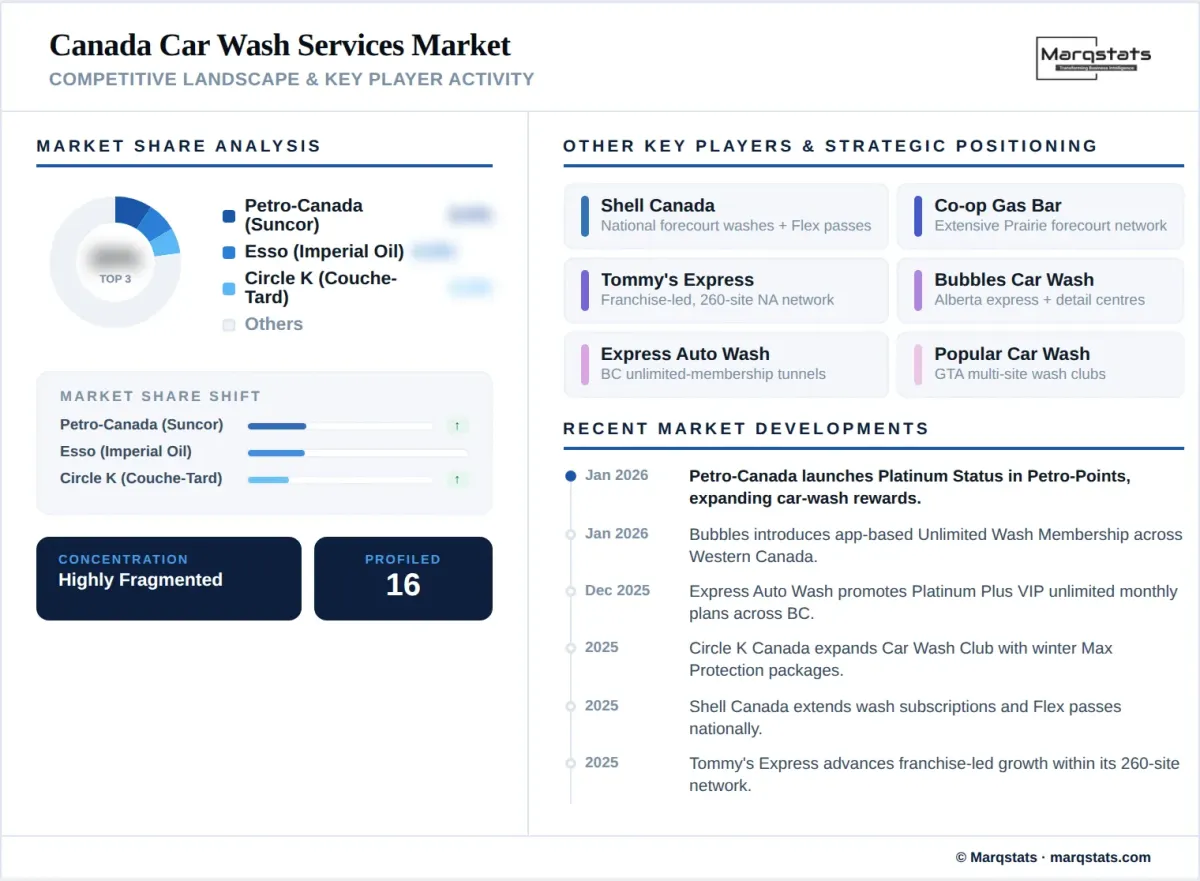
The Canada car wash services market is highly fragmented, with more than 7,500 wash listings nationwide and no single operator holding a dominant share. National fuel retailers run the largest wash networks: Suncor's Petro-Canada operates 250-plus locations under Super Wash and Glide, while Imperial Oil's Esso, Shell Canada, Alimentation Couche-Tard's Circle K, and Federated Co-operatives' Co-op gas bars maintain extensive forecourt washes. Loyalty programs — Petro-Points, Circle K Car Wash Club, and Canadian Tire's CT Money — bundle washes with fuel and convenience retail.
Organized standalone competition is led by franchise and regional express operators. Tommy's Express Car Wash expands through its franchise model within a 260-site North American network that includes Canadian locations. Regional chains — Popular Car Wash in the Greater Toronto Area, Express Auto Wash in British Columbia, and Bubbles Car Wash & Detail Centres in Alberta — compete on unlimited memberships, free vacuums, and app-based convenience. Suds Car Wash and numerous independent single-site operators fill out the standalone and self-service base.
Private-equity roll-up activity is limited relative to the United States, owing to lower subscription penetration and a smaller organized-tunnel base. The Canadian Carwash Association supports the sector through benchmarking, its Wash Volume Report, and the CARWACS trade event. Competition centres on winter-season throughput, touchless paint safety, loyalty integration, and the gradual conversion of pay-per-wash customers to unlimited memberships.
The competitive base tiers into three groups. National fuel retailers — Suncor, Imperial Oil, Shell Canada, Couche-Tard, Parkland, Federated Co-operatives, and Canadian Tire — hold the widest forecourt wash footprints and the deepest loyalty ecosystems. Regional and franchise express operators — Tommy's Express, Popular Car Wash, Express Auto Wash, and Bubbles — drive standalone tunnel growth and membership adoption. Thousands of independent single-site washes and detail centres form the long tail, sustaining the market's fragmentation and leaving room for organized consolidation over the forecast period.
Companies Covered
The report profiles 16++ companies with full strategy and financials analysis, including:
Recent Market Activity
Table of Contents
Coverage & Segmentation
This report provides a comprehensive analysis of the Canada car wash services market covering the historical period 2021 to 2025 and the forecast period 2026 to 2030, with 2025 as the base year. The study defines the market as annual revenue earned by professional operators cleaning passenger and light commercial vehicles through tunnel/conveyor, in-bay automatic, self-service, and manual or mobile formats, inclusive of basic interior cleaning; full detailing and equipment or chemical sales are excluded. Market size is presented in value terms (USD billion).
The study segments the market by service type, payment model, site format, and vehicle type, and examines provincial demand across Ontario, Quebec, British Columbia, Alberta and the Prairies, and Atlantic Canada, alongside competitive concentration and fuel-retailer wash networks. Market sizing uses a bottom-up model anchored to Statistics Canada vehicle registrations and NAICS 811192 services statistics, cross-checked against wash intensity per vehicle and Canadian Carwash Association benchmarks. The competitive section profiles 16 operators spanning national fuel retailers, regional express chains, and franchise networks.