Market Snapshot
Key Takeaways
Market Overview & Analysis
Report Summary
The Brazil car wash services market comprises professional and informal operators cleaning four-wheel vehicles across four service formats — manual lava-rapido and mobile, in-bay automatic (roll-over), tunnel/conveyor, and self-service — monetized through pay-per-wash and subscription plans. The 2025 market of USD 1.04 billion sits against a four-wheel parc of roughly 45 million, with paid-wash penetration near 50% and one of the highest wash frequencies of any major market at about 12 washes per vehicle annually, sustained by low tickets near BRL 18.
Informality defines the market's structure. Manual lava-rapido operations — spanning independent roadside washers, neighbourhood outlets, and organized shops — account for about 69% of 2025 revenue, delivered by a workforce that is only partly formalized and often operates through state-level sindicatos rather than a single national body. The organized layer is expanding rapidly through franchising: ecological brands such as Acquazero, with hundreds of units, and DryWash, a waterless pioneer of over 30 years, formalize the sector with standardized service, subscription clubs, and sustainability positioning.
Automation remains modest, though it is growing. In-bay automatic roll-overs hold about 17% of revenue, concentrated at fuel-station forecourts and organized outlets, while tunnels remain a small 7% and self-service under 7%. Fuel retailers — Petrobras-branded stations, Ipiranga, Shell, and Vibra networks — add forecourt washing at about 22% of site revenue, and standalone sites, including informal lots, hold about 61%. The franchise and forecourt channels together drive the organized shift, while the vast informal base keeps the market fragmented.
Water is the market's defining strategic theme. Traditional lava-rapido washing is water-intensive, and periodic drought and rising water costs in major cities have made waterless and low-water methods a competitive advantage. Acquazero's ecological washing uses a fraction of the water of a traditional wash, and DryWash reports saving billions of litres over its history. Wash intensity per vehicle sits near USD 21, about 32% of the United States level, framing a long formalization and premiumization runway as incomes, parc, and organized supply expand through 2030.
The formalization path in Brazil runs through franchising rather than automation. At tickets near BRL 18, a manual wash remains cheaper to deliver than an automated one wherever labour is abundant, so organized growth comes from branded franchise networks, ecological differentiation, subscription clubs, and adjacent services such as detailing, vitrification, and paint protection that lift average revenue per customer. This mirrors India's formalize-first, automate-later sequencing and distinguishes Brazil from the automated, forecourt-led markets of North America and Europe, where machinery rather than franchising organizes supply.
Market Dynamics
Key Drivers
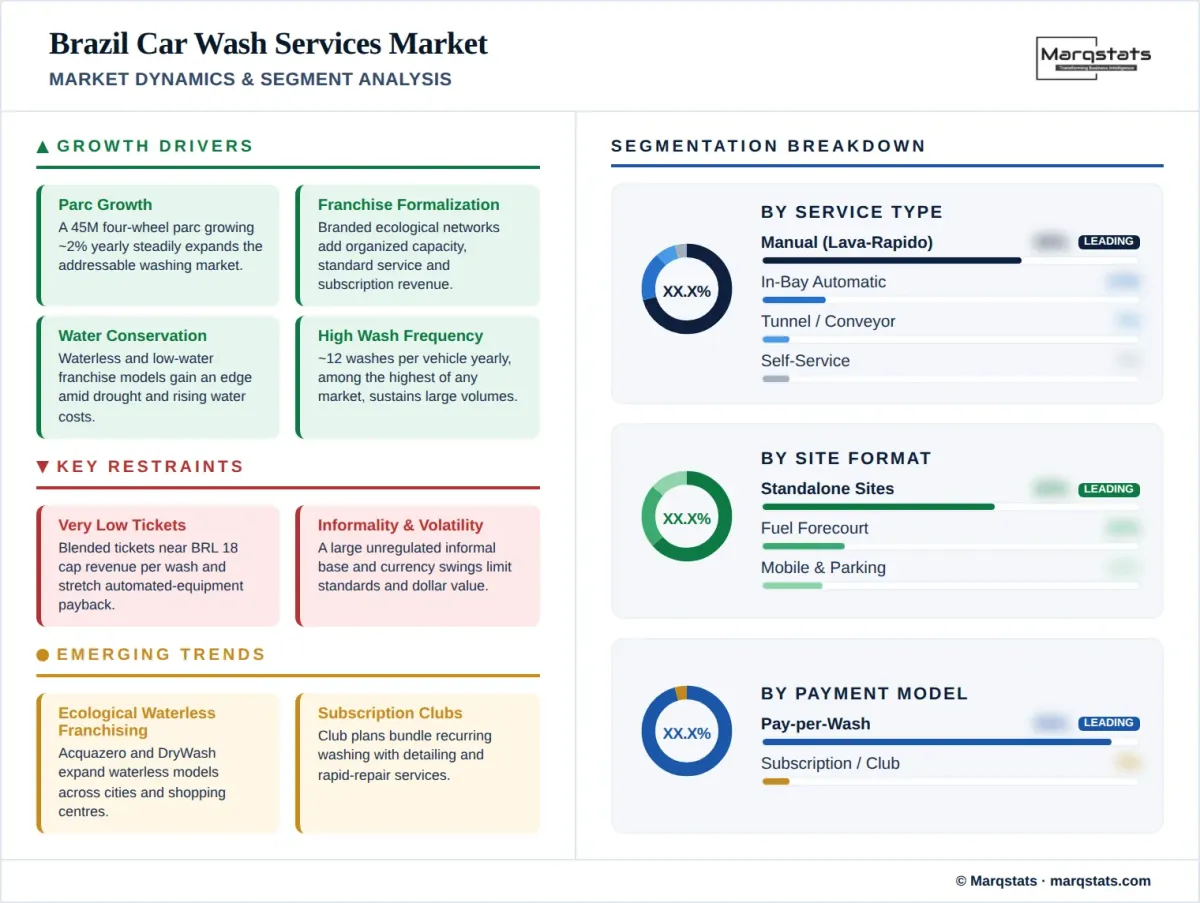
- Four-wheel parc growth of about 2% annually on a 45-million base steadily expands the addressable market.
- Formalization through franchising adds organized capacity, standardized service, and subscription revenue to a historically informal sector.
- Real pricing gains lift tickets from a low base as ecological and premium washes spread.
- Subscription and membership-club plans convert episodic demand into recurring revenue, growing near 14% annually.
- Water conservation favours waterless and low-water franchise models amid drought and rising water costs.
- High wash frequency, among the highest of any market, sustains large underlying volumes across the parc.
Key Restraints
- Very low tickets near BRL 18 cap revenue per wash and stretch payback for automated equipment.
- Abundant low-cost labour keeps manual lava-rapido washing economically dominant.
- A large informal base with limited regulation constrains standards, water use, and pricing power.
- Economic volatility and currency effects weigh on dollar-denominated market value and investment.
Key Trends
- Ecological, waterless franchise models expand rapidly, led by Acquazero and DryWash, across cities and shopping centres.
- Subscription clubs formalize recurring washing, bundling cleaning with detailing and rapid-repair services.
- Detailing, vitrification, and paint-protection services pull washing into higher-value franchise formats.
- Fuel retailers add roll-over and forecourt washing as non-fuel revenue lines across major networks.
- Pix instant payment and split-payment technology lower friction, enabling small operators and franchise subscriptions to scale.
Market Segmentation
Manual lava-rapido and mobile washing holds the dominant revenue share at about 69% in 2025, equal to USD 717.04 million, spanning informal roadside washers, neighbourhood outlets, organized shops, and mobile providers. The share eases toward 65% by 2030 as franchising and automation expand, while the segment grows in absolute terms with the parc. Low wages and frequent-washing habits keep the model viable, and franchise networks formalize its upper tier with ecological and subscription-based offers. The cultural preference for hand washing, combined with limited home-washing among apartment dwellers in dense cities, sustains steady lava-rapido demand across income levels.
In-bay automatic roll-overs hold about 17% of 2025 revenue, USD 180.42 million, and rise toward 19% by 2030, the largest automated format. Machines concentrate at fuel-station forecourts and organized outlets in major metros, offering faster throughput than manual washing. Compact footprints and falling equipment costs support gradual roll-over adoption at higher-traffic sites, and fuel retailers increasingly treat washing as a non-fuel revenue line that draws footfall to forecourts.
Tunnel/conveyor washes hold about 7% of 2025 revenue, USD 76.33 million, and rise toward 9% by 2030, the fastest-growing service format. Express tunnels concentrate in Sao Paulo and other large metros, where throughput and membership economics justify land and capital costs, and integrate most readily with subscription plans. The format captures the bulk of new automated investment as organized operators seek the throughput that manual washing cannot match at scale.
Self-service bays hold about 6% of 2025 revenue, USD 67.08 million, rising toward 7% by 2030. The format grows from a small base at fuel stations and standalone sites, serving cost-conscious users and enthusiasts, and increasingly adds cashless and app-based payment. It faces strong competition from cheap full-service lava-rapido washing, which limits its share in a low-wage market where hand washing is affordable.
Standalone sites, including informal lots, organized outlets, and franchise stores, hold about 61% of 2025 revenue, USD 636.09 million, easing toward 60% by 2030. The channel includes the bulk of manual lava-rapido washing alongside franchise and detailing outlets, and consolidates gradually around branded, standardized formats. Shopping-centre franchise units, a distinctive Brazilian format pioneered by DryWash, extend organized washing into high-traffic retail locations.
Forecourt washes hold about 22% of 2025 revenue, USD 238.24 million, and gain share toward 24% by 2030, the fastest-growing site format. Petrobras-branded stations, Ipiranga, Shell, and Vibra networks add roll-over and manual washing as fuel retailers build non-fuel revenue across major highway and urban outlets. Brazil's large fuel-station network and high traffic make forecourts a natural channel for organized washing, and retailers bundle it with loyalty and convenience offers.
Mobile and parking-lot formats hold about 16% of 2025 revenue, USD 166.54 million, a stable share. Mobile ecological washing, shopping-centre franchise kiosks, and app-booked doorstep services serve convenience-oriented demand across major cities. The mobile ecological model, requiring minimal water and no fixed site, has become a low-cost entry route for franchise operators and a fast-scaling channel in dense, water-conscious metros.
Single-visit payment accounts for about 93% of 2025 revenue, USD 966.85 million, reflecting cash, card, and Pix payment at informal and organized outlets alike. The share declines toward 89% by 2030 as subscriptions expand, while Pix instant-payment rails keep single-payment friction minimal across every format. The near-universal adoption of Pix has been a quiet enabler of formalization, letting even small operators accept instant cashless payment and improving revenue tracking across the sector.
Subscription and membership plans reach about 7% of 2025 revenue, USD 74.02 million, and grow near 14% annually to about 11% of revenue by 2030, worth USD 143.37 million — the fastest-growing revenue stream. Franchise membership clubs, such as Club DryWash, and organized-chain plans covering regular washing and detailing formalize recurring relationships and are the primary lever operators use to stabilize demand. Split-payment technology and Pix integration make monthly billing straightforward for franchise networks, accelerating subscription adoption among urban middle-class car owners.
Passenger vehicles generate about 85% of 2025 revenue, USD 880.11 million, reflecting household demand for frequent, low-cost cleaning. The share eases slightly across the forecast period as commercial washing grows faster, though private-vehicle lava-rapido washing remains the market's core, sustained by Brazil's strong car culture and limited home-washing in dense urban housing.
Commercial washing holds about 15% of 2025 revenue, USD 160.76 million, rising toward 16% by 2030 — among the highest commercial shares of any major market. Ride-hailing, delivery, and logistics fleets — including mobility-as-a-service operators — sustain high-frequency washing across Brazil's dense metros and transport corridors. App-based ride-hailing has expanded rapidly in Brazilian cities, adding a large base of drivers who wash frequently to meet platform presentation standards.
By Geography
Southeast (Sao Paulo, Rio de Janeiro & Minas Gerais)
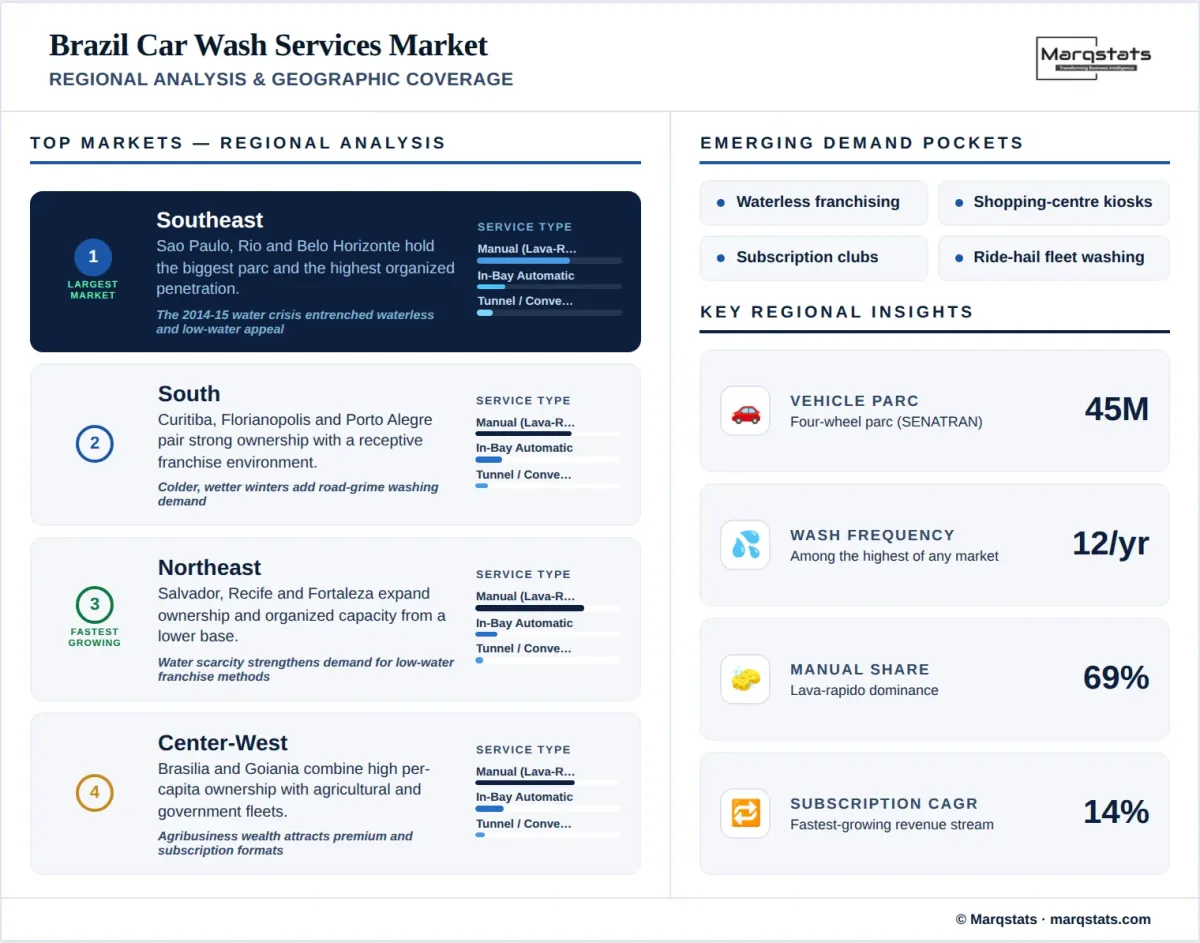
The Southeast is the largest regional market, anchored by Sao Paulo, Rio de Janeiro, and Belo Horizonte, and holds the country's biggest vehicle parc and highest organized penetration. Franchise networks, detailing studios, and express tunnels cluster in Sao Paulo, and periodic water restrictions in the region reinforce the appeal of waterless and low-water washing. High incomes support premium and subscription-based services, and the 2014 to 2015 Sao Paulo water crisis left a lasting mark on consumer and operator attitudes toward water use.
South (Parana, Santa Catarina & Rio Grande do Sul)
The South, led by Curitiba, Florianopolis, and Porto Alegre, is a major market with strong vehicle ownership and a receptive franchise environment. The region's higher incomes and organized retail support ecological franchise expansion and detailing, and its automotive culture sustains steady washing demand across the year. Colder, wetter winters add road-grime washing, and the region's strong franchising tradition makes it a favoured expansion territory for organized chains.
Northeast (Bahia, Pernambuco & Ceara)
The Northeast, anchored by Salvador, Recife, and Fortaleza, is a fast-growing region as vehicle ownership and organized capacity expand from a lower base. Warm, humid conditions sustain frequent washing, and water scarcity in parts of the region strengthens demand for low-water and ecological methods as franchises enter the largest cities. Coastal tourism cities add seasonal demand, and rising middle-class car ownership underpins structural growth.
Center-West (Brasilia & Goias)
The Center-West, led by Brasilia and Goiania, combines high per-capita vehicle ownership with agricultural and government fleets. The region supports roll-over and franchise formats, and its dry-season conditions and dust sustain regular washing, with commercial and fleet demand adding to the mix. Agribusiness wealth and Brasilia's high car ownership make the region attractive for premium and subscription-based services, and franchise networks increasingly target its affluent, planned-city consumer base.
North (Amazonas & Para)
The North, including Manaus and Belem, is a smaller, dispersed market dominated by informal lava-rapido washing. Organized chains and forecourt washing are entering the largest cities, and rising vehicle ownership across the region supports steady growth from a low base. High humidity and rainfall sustain frequent washing, and lower organized penetration leaves substantial headroom for franchise entry.
How Competition Is Evolving
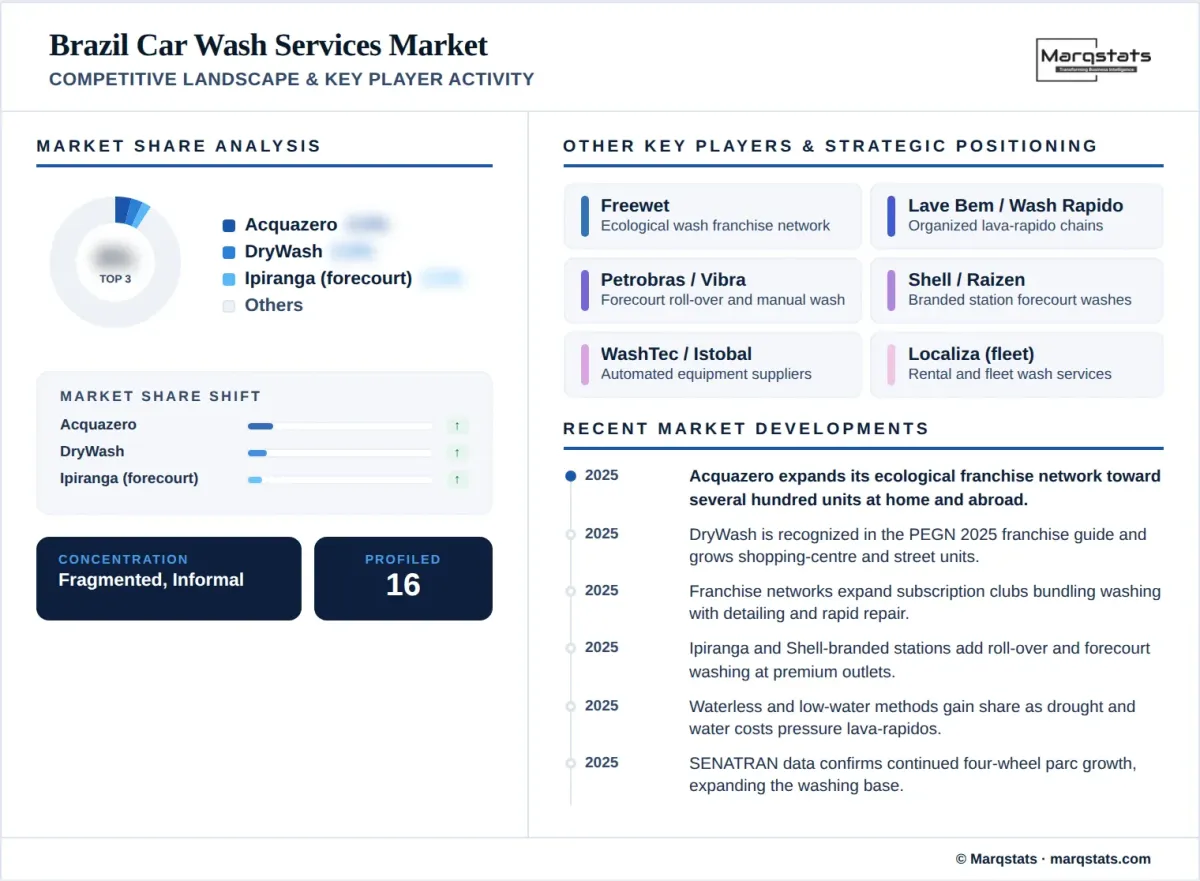
The Brazil car wash services market is intensely fragmented, with informal lava-rapido operators delivering the majority of washes and no operator holding a material national share. The organized layer is led by ecological franchise networks: Acquazero, the largest automotive-cleaning franchise with hundreds of units across Brazil and abroad, and DryWash, a waterless pioneer of over 30 years present in major shopping centres, anchor the segment, alongside Freewet and other franchise brands and independent detailing studios. These networks carry Brazilian Franchising Association recognition and export their models to the United States, Portugal, and other markets, underscoring the maturity of Brazil's automotive-franchise sector.
Fuel retailers form a second organized channel. Petrobras-branded stations, Ipiranga, Shell, and Vibra Energia networks host roll-over and manual washing bundled with fuel and convenience retail, adding forecourt capacity across urban and highway sites. Franchise networks compete on ecological positioning, subscription clubs, and service breadth spanning washing, detailing, vitrification, and rapid repair, while fuel retailers compete on convenience and location.
Competition in the organized segment turns on franchise economics, water efficiency, and sustainability. Waterless and low-water methods differentiate franchise brands amid drought and rising water costs, subscription clubs build recurring revenue, and detailing and paint-protection services anchor higher-value formats. Formalization is expected to advance steadily through franchising and forecourt investment, while the vast informal lava-rapido base keeps the market fragmented through 2030. Equipment suppliers, including WashTec, Karcher, and Istobal, support the automated and semi-automated tiers, and international detailing-chemical brands add to the premium end of the market.
Companies Covered
The report profiles 16++ companies with full strategy and financials analysis, including:
Recent Market Activity
Table of Contents
Coverage & Segmentation
This report provides a comprehensive analysis of the Brazil car wash services market covering the historical period 2021 to 2025 and the forecast period 2026 to 2030, with 2025 as the base year. The study defines the market as annual revenue earned by professional and informal operators cleaning four-wheel vehicles through manual lava-rapido, in-bay automatic, tunnel/conveyor, and self-service formats, inclusive of basic interior cleaning; full detailing, vitrification, and equipment or chemical sales are excluded. Market size is presented in value terms (USD), with historical figures reflecting real exchange effects and forecasts assuming constant exchange rates.
The study segments the market by service type, site format, payment model, and vehicle type, and examines regional demand across the Southeast, South, Northeast, Center-West, and North, alongside formalization, franchising, water conservation, and subscription adoption. Market sizing uses a bottom-up model anchored to SENATRAN fleet registration and IBGE services-survey data, noting that the sector is organized through state-level sindicatos rather than a single national body, cross-checked against wash intensity per vehicle. The competitive section profiles 16 franchise networks, fuel retailers, and equipment suppliers.