Statistics & Highlights

Market Snapshot

Market size in USD Billion
$1.62B
2025
Base year
$1.68B
2026
Estimated
  
$1.93B
2030
Forecast
Largest market
London & South East England
Fastest growing
North of England
Dominant segment
Manual / Hand Car Wash
Concentration
Fragmented
CAGR
3.56%
2026 – 2030
GROWTH
+$0.31B
Absolute
STUDY PARAMETERS
Base year2025
Historical period2021 – 2025
Forecast period2026 – 2030
Units consideredValue (USD BN)
REPORT COVERAGE
Segments covered4 segments
Regions covered5 regions
Companies profiled16++
Report pages250+
DeliverablesPDF, Excel, PPT
Executive Summary

Key Takeaways

UK car wash services market valued at USD 1.62 billion in 2025, projected to reach USD 1.93 billion by 2030 at a 3.56% CAGR.
Hand car washes dominate with about 68% of 2025 revenue and roughly 80% of the sector by volume across a 39-million-vehicle parc.
An estimated 10,000 to 20,000 hand car washes operate nationwide, having displaced over 1,100 automatic forecourt washes in the decade to 2016.
Labour-standards and environmental concerns drive the Responsible Car Wash Scheme and GLAA enforcement across the hand-car-wash sector.
Automated express tunnels and wash subscriptions revive the organized segment, with subscriptions the fastest-growing stream at roughly 10% of revenue.
IMO Car Wash is the largest automated operator, with 280-plus UK sites washing over 10 million vehicles a year.
Market Insights

Market Overview & Analysis

Report Summary

The UK car wash services market comprises professional and informal operators that clean passenger and light commercial vehicles across four service formats — manual hand car wash, in-bay automatic (roll-over), tunnel/conveyor, and self-service jet wash — monetized through pay-per-wash tickets and wash subscriptions. The 2025 market of USD 1.62 billion sits against a licensed vehicle parc of roughly 39 million and a paid-wash penetration near 58%. Wash frequency of about 7.5 washes per vehicle each year is supported by low hand-car-wash prices and convenient access.

The defining feature of the UK market is the dominance of hand car washes. Over the past 15 years, cheap hand car washes competing on cost and convenience displaced automatic forecourt washes, and they now account for roughly 80% of the sector by volume and about 68% by revenue. Government estimates place the number of hand car washes at 10,000 to 20,000, though no accurate figure exists. Many operate informally on former forecourts and brownfield lots, and pricing for a basic exterior wash ranges from about GBP 5 to GBP 15.

This structure carries labour-standards and environmental consequences. The hand-car-wash sector has been linked to minimum-wage undercutting and, in serious cases, modern slavery, prompting the Modern Slavery Act 2015, GLAA enforcement, and an Environmental Audit Committee inquiry. The Responsible Car Wash Scheme, backed by the Car Wash Association, major supermarkets, and enforcement agencies, accredits compliant sites, while the Safe Car Wash app enables public reporting. Untreated wash effluent discharge is a parallel environmental concern under water-industry rules.

The organized segment is reviving. Automated operators, led by IMO Car Wash with more than 280 UK sites, are investing in app-based subscriptions, fleet care, and water recycling, and express tunnels are returning at select sites. Wash intensity per vehicle sits near USD 38, about 58% of the United States level, reflecting low hand-car-wash tickets. Growth is therefore driven by pricing, formalization, and subscription adoption rather than volume, with the hand-car-wash share easing only slightly across the forecast period.

The economics of the two-decade shift explain the market's shape. Hand car washes carry low fixed costs and rely on manual labour and cash payment, allowing tickets well below automated formats and rapid site rollout on low-value land. Automated operators carry higher capital and compliance costs yet command better throughput, water efficiency, and recurring revenue through subscriptions. The gap between a large low-price informal base and a smaller, better-capitalized organized layer defines both the market's structure and its formalization runway through 2030, with retailer and fleet demand for accredited, compliant washing acting as the main upward force on standards.

Market Dynamics

Key Drivers

  • Services pricing gains, tracking elevated inflation, add roughly 2 percentage points of annual revenue growth across formats.
  • Gradual formalization and hand-car-wash accreditation through the Responsible Car Wash Scheme support compliant, higher-value operations.
  • A revival of automated express tunnels and roll-over investment by operators such as IMO Car Wash rebuilds organized capacity.
  • Wash-subscription adoption converts episodic demand into recurring revenue, growing near 13% annually from a low base.
  • Commercial and fleet demand rises with logistics, delivery, and ride-hailing operators outsourcing washing to meet image standards.
  • Retailer and fleet responsible-sourcing requirements push demand toward accredited, compliant operators, supporting higher-value organized washing.

Key Restraints

  • A mature vehicle parc and high hand-car-wash penetration leave limited volume headroom for the overall market.
  • Persistent informality and labour-standards issues in the hand-car-wash sector constrain pricing power and reputational value.
  • Environmental and wastewater-discharge rules require interceptors and reclamation, raising costs for compliant sites.
  • Low hand-car-wash tickets suppress average revenue per wash and slow investment in automation and subscriptions.

Key Trends

  • Wash subscriptions spread from automated operators to forecourt and supermarket sites, reshaping the payment mix toward recurring revenue.
  • Consolidation among automated operators advances, exemplified by the change of ownership at IMO Car Wash in early 2026.
  • Water reclamation, effluent interception, and app-based payment standardize across accredited and automated sites.
  • Responsible-sourcing pressure from supermarkets and fleets lifts demand for accredited, compliant hand-car-wash operators.
  • Rising electric-vehicle ownership and water-efficiency expectations favour touch-free automated and low-water methods over traditional hand washing.
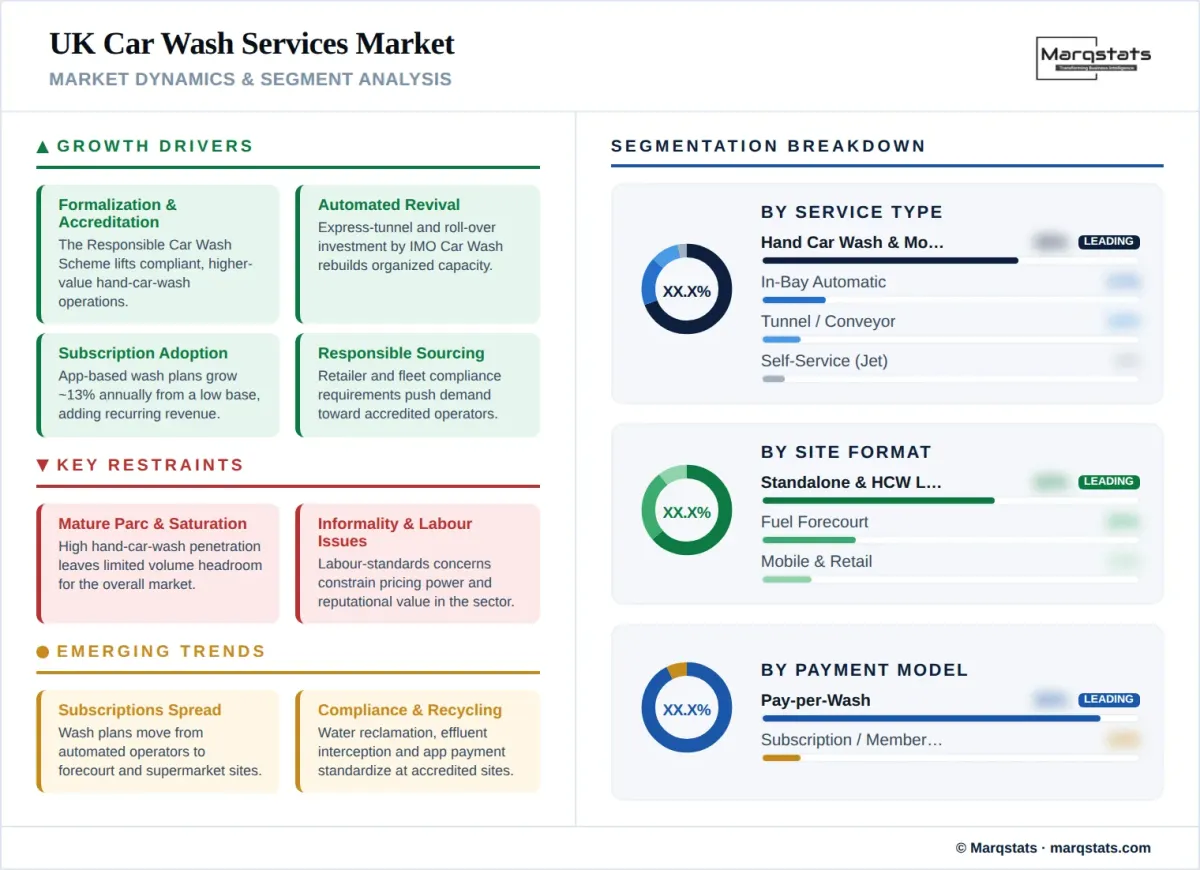
UK Car Wash Services Market Market Dynamics Segment Analysis Infographic
Segment Analysis

Market Segmentation

Manual / Hand Car Wash & Mobile
Leading

Manual hand car washes and mobile services hold the dominant revenue share at about 68% in 2025, equal to USD 1.09 billion, and roughly 80% of the sector by volume. The segment spans thousands of independent hand car washes on forecourts and brownfield sites, alongside accredited operators and mobile providers. Its revenue share eases only marginally toward 67% by 2030, as hand washing remains deeply embedded in UK consumer habits, though formalization and accreditation gradually raise standards across the segment. Basic exterior washes typically price between GBP 5 and GBP 15, and the segment's scale rests on low labour costs, convenient locations, and quick turnaround that automated formats struggle to match on price.

In-Bay Automatic (Roll-over)

In-bay automatic roll-over washes hold about 17% of 2025 revenue, USD 276.83 million, and are the largest fully automated format. Most sit on fuel-station forecourts and supermarket sites operated by IMO Car Wash, Waves, and fuel retailers, often using German-engineered systems with water recycling. The share eases toward 16% by 2030 as express tunnels gain ground, though roll-overs remain the backbone of automated UK washing and the main channel for subscription rollout at forecourt and grocery sites.

Tunnel / Conveyor

Tunnel/conveyor washes hold about 10% of 2025 revenue, USD 158.19 million, and rise toward 12% by 2030, the fastest-growing service format. Express-exterior tunnels with subscriptions are returning at select sites, led by automated operators and franchise entrants such as Tommy's Express, and integrate most readily with recurring memberships and higher tickets. The format captures the bulk of new organized investment as operators seek the throughput and membership economics that hand car washes cannot match.

Self-Service (Jet Wash)

Self-service jet-wash bays account for about 6% of 2025 revenue, USD 89.88 million, and ease toward 5% by 2030. The format retains a durable role for cost-conscious users and motorcycles, often co-located with forecourts and retail car parks, and increasingly adds contactless payment. It faces pressure from both cheap hand washes and automated roll-overs, yet holds a niche where drivers prefer to wash vehicles themselves.

Pay-per-Wash
Leading

Single-visit tickets account for about 90% of 2025 revenue, USD 1.45 billion, reflecting the cash-and-card, walk-up nature of hand car washes. The share declines toward 84% by 2030 as automated operators expand subscriptions, though pay-per-wash remains central to the hand-car-wash and forecourt segments. Occasional users, tourists, and forecourt customers combining washing with fuel purchases keep single-visit demand resilient even as memberships grow.

Subscription / Membership

Wash subscriptions reach about 10% of 2025 revenue, USD 168.98 million, and grow near 13% annually to about 16% of revenue by 2030, worth USD 308.33 million. Recurring subscription is the fastest-expanding revenue stream, led by IMO Car Wash and other automated operators through app-based unlimited plans, and is the primary lever operators use to stabilize demand.

Standalone Sites (incl. Hand-Car-Wash Lots)
Leading

Standalone sites, including hand-car-wash lots on former forecourts and brownfield land, hold about 62% of 2025 revenue, USD 1.00 billion, a share that stays broadly stable through 2030. The format is the backbone of the hand-car-wash sector and also includes standalone automated and express sites operated by organized chains.

Fuel-Station Forecourt

Forecourt washes attached to fuel stations hold about 25% of 2025 revenue, USD 406.26 million, and ease toward 24% by 2030. Forecourt operators such as Motor Fuel Group, EG Group, Rontec, and Ascona host automated roll-over washes, often operated by IMO or Waves, alongside fuel and convenience retail.

Others (Mobile, Retail Parking)

Mobile and retail-parking formats account for about 13% of 2025 revenue, USD 208.52 million, and gain share toward 14% by 2030. Supermarket car parks host hand and automated washes, and mobile valeting providers serve on-demand and fleet demand across major cities. Convenience-oriented and workplace washing, booked through apps, adds organized capacity within this channel, particularly in London and other large metros where fixed-site access is limited.

Passenger Cars
Leading

Passenger vehicles generate about 90% of 2025 revenue, USD 1.45 billion, reflecting the consumer orientation of hand car washes and automated formats. The share eases slightly across the forecast period as commercial washing grows faster.

Commercial Vehicles (incl. Fleet)

Commercial and fleet washing holds about 10% share in 2025, USD 168.98 million, rising toward 11% by 2030. Growth is driven by logistics, delivery, and ride-hailing fleets — including mobility-as-a-service operators — that outsource washing or use fleet-care programmes from automated operators.

Regional Analysis

By Geography

London & South East England

London and the South East form the largest regional market, anchored by the highest vehicle density and consumer spending in the country. Hand car washes are especially prevalent across Greater London, alongside forecourt and supermarket automated sites, and labour-standards scrutiny is highest here. Subscription and express-tunnel adoption is advancing fastest among affluent commuter belts around the capital.

The Midlands

The Midlands, centred on Birmingham and the West and East Midlands, is a large market where the Responsible Car Wash Scheme first piloted accreditation. A dense mix of hand car washes, forecourt roll-overs, and emerging express sites reflects the region's central motorway network and logistics base, which also supports commercial-vehicle washing. The region's role as a distribution hub sustains steady fleet demand alongside consumer washing.

North of England

The North of England, including Manchester, Leeds, Liverpool, and Newcastle, is a substantial market with extensive IMO Car Wash and forecourt networks. Industrial and logistics activity sustains fleet washing, and organized automated capacity is expanding through roll-over upgrades and new express sites across the region's major cities. Lower land costs relative to the South East support standalone express-tunnel development.

Scotland

Scotland, led by Glasgow and Edinburgh, is a distinct market with its own enforcement and licensing context. Hand car washes remain common, while automated operators and forecourt sites serve urban demand. Colder, wetter conditions sustain steady exterior-wash frequency across the central belt, and Scottish licensing initiatives have been discussed as a route to raise hand-car-wash standards.

Wales & Northern Ireland

Wales and Northern Ireland form smaller markets where hand car washes and forecourt roll-overs dominate. Lower population density limits large express-tunnel economics, and growth relies mainly on formalization, forecourt upgrades, and gradual subscription adoption in the largest towns and cities. Cardiff, Swansea, and Belfast anchor organized demand, while rural areas remain served largely by independent hand washes.
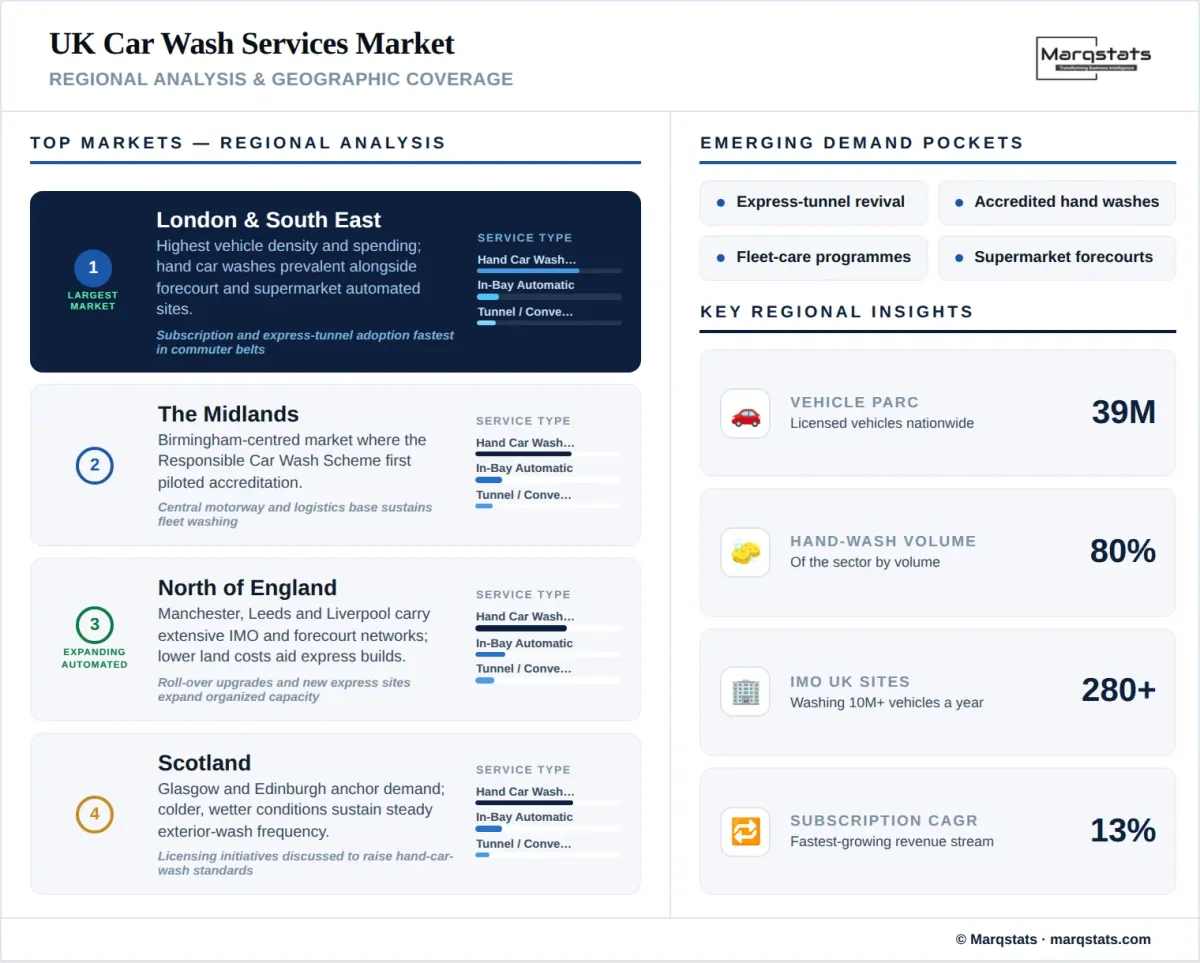
UK Car Wash Services Market Regional Analysis Geographic Coverage Infographic
Competitive Landscape

How Competition Is Evolving

The UK car wash services market is highly fragmented, with thousands of independent hand car washes accounting for the majority of revenue and volume. No single operator dominates the sector, and the automated segment is led by IMO Car Wash, the largest chain with more than 280 UK sites washing over 10 million vehicles a year. Waves operates automated and hand washes at supermarket and forecourt sites, and franchise entrant Tommy's Express is developing express tunnels.

Fuel and grocery retailers are central to the organized segment. Forecourt operators including Motor Fuel Group, EG Group, Rontec, Ascona, and Applegreen host roll-over washes, while supermarkets such as Tesco, Sainsbury's, Morrisons, and Asda host automated and hand washes in their car parks. Competition centres on convenience, price, subscription offers, and, increasingly, on labour and environmental compliance as retailers manage reputational risk in their supply chains.

Compliance and consolidation are the defining competitive forces. The Responsible Car Wash Scheme, the Car Wash Association, and the Gangmasters and Labour Abuse Authority drive accreditation and enforcement, raising standards across hand car washes. Among automated operators, consolidation continues, illustrated by the change of ownership at IMO Car Wash in early 2026. The organized segment is expected to gain share gradually through automation, subscriptions, and accreditation, while the informal hand-car-wash base keeps the market fragmented.

The competitive base tiers into three groups. Automated chains — led by IMO Car Wash, with Waves and franchise entrant Tommy's Express — drive subscriptions, express tunnels, and fleet care. Forecourt and grocery hosts — Motor Fuel Group, EG Group, Rontec, Ascona, Applegreen, and the major supermarkets — provide the sites and footfall for organized roll-over washing. Thousands of independent and mobile hand car washes form the long tail, sustaining the market's fragmentation and low average ticket while accreditation slowly reshapes the segment.
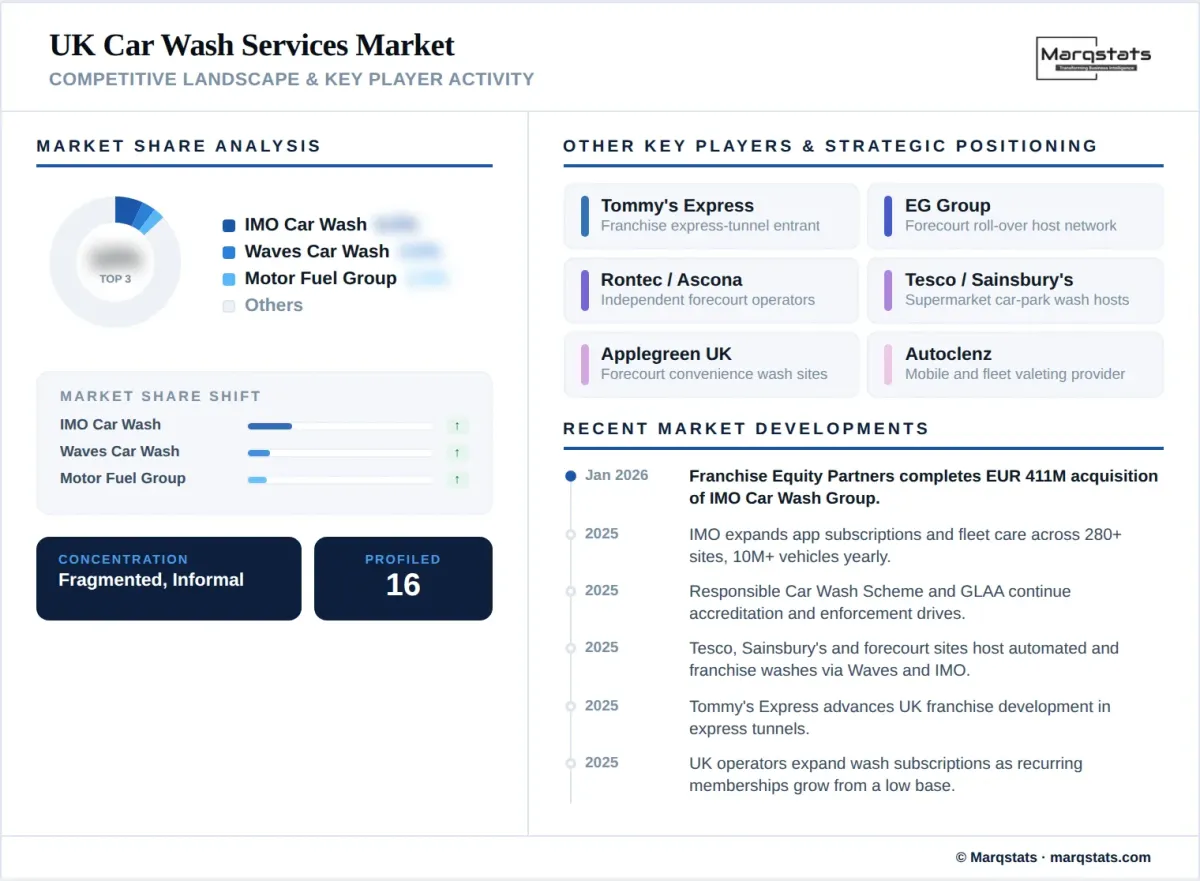
UK Car Wash Services Market Competitive Landscape Key Player Activity Infographic
Major Players

Companies Covered

The report profiles 16++ companies with full strategy and financials analysis, including:

IMO Car Wash Group UK
Waves Car Wash
Tommy's Express Car Wash
Motor Fuel Group (MFG)
EG Group (EG On the Move)
Rontec
Ascona Group
Applegreen UK
BP UK
Shell UK
Esso (ExxonMobil UK)
Tesco plc
J Sainsbury plc
Wm Morrison Supermarkets
Asda
Autoclenz (Mobile & Fleet Valeting)
Note: Full company profiles include revenue analysis, product portfolio, SWOT, and recent strategic developments.
Latest Developments

Recent Market Activity

Jan 2026
Franchise Equity Partners completed its EUR 411 million acquisition of IMO Car Wash Group from Driven Brands and Roark Capital.
2025
IMO Car Wash expanded app-based subscriptions and fleet care across 280-plus UK sites washing over 10 million vehicles a year.
2025
The Responsible Car Wash Scheme and GLAA continued accreditation and enforcement to raise hand-car-wash labour and environmental standards.
2025
Supermarket and forecourt operators, including Tesco and Sainsbury's sites, hosted automated and franchise washes via Waves and IMO.
2025
Tommy's Express advanced UK franchise development within its international express-tunnel network.
2025
UK operators expanded wash subscriptions as recurring memberships grew from a low base.
Report Structure

Table of Contents

1. Introduction
1.1 Study Assumptions & Market Definition
1.1.1 Scope — Professional & Informal Car Wash Services (Passenger & Light Commercial)
1.1.2 Formats Covered — Hand Car Wash, In-Bay Automatic, Tunnel, Self-Service Jet Wash
1.1.3 Inclusions — Basic Interior Cleaning, Tickets, Subscriptions
1.1.4 Exclusions — Full Detailing, Equipment & Chemical Sales
1.1.5 Market Metric — Annual Service Revenue (USD Billion)
1.2 Scope of the Study
1.3 Currency, FX Treatment & Base Year (2025)
1.4 Key Definitions & Industry Terminology
1.4.1 Hand Car Wash (HCW) vs. Automated Formats
1.4.2 In-Bay Roll-Over vs. Express Tunnel
1.4.3 Wash Subscription & Recurring Revenue
1.4.4 Forecourt & Supermarket Host Sites
2. Research Methodology
2.1 Analysis Framework
2.2 Bottom-Up Base — Parc × Penetration × Frequency × Ticket
2.2.1 DfT Licensed Vehicle Parc (~39M excl. Motorcycles)
2.2.2 Paid-Wash Penetration (~58%)
2.2.3 Wash Frequency (~7.5/Vehicle/Yr) & Blended Ticket (~GBP 7)
2.3 Sector-Structure Anchors — CWA & Responsible Car Wash Scheme
2.3.1 HCW ~80% of Sector by Volume; 10,000–20,000 Sites
2.4 FX Treatment — USD Terms, 2022 GBP Depreciation, Constant-FX Forecast
2.5 Wash-Intensity Cross-Check vs. United States (~58%)
2.6 Primary Research — 40+ Interviews
2.7 Assumptions & Limitations
3. Executive Summary
3.1 Market Size & Forecast Snapshot 2021–2030
3.2 Key Findings & Analyst Takeaways
3.3 Hand-Car-Wash-Dominant Structure (~68% Revenue, ~80% Volume)
3.4 Labour & Environmental Compliance Context
3.5 Organized-Segment Revival & Subscription Growth
4. Market Overview & Definitions
4.1 Industry Structure & Sector Shift
4.1.1 Rise of Hand Car Washes (Past 15 Years)
4.1.2 Decline of Automatic Forecourt Washes (−1,100 to 2016)
4.1.3 Fragmentation & Organized-Segment Revival
4.2 Value Chain & Ecosystem
4.2.1 Operators, Forecourt & Supermarket Hosts, Fuel Retailers
4.2.2 Equipment, Water Reclamation & Effluent Interception
4.2.3 Accreditation & Compliance Bodies (RCWS, CWA, GLAA)
4.3 Consumer Behavior & Paid-Wash Penetration (~58%)
4.4 Unit Economics — HCW vs. Automated
5. Market Dynamics
5.1 Key Drivers
5.1.1 Services Pricing Gains
5.1.2 Formalization & HCW Accreditation
5.1.3 Automated Express-Tunnel & Roll-Over Revival
5.1.4 Wash-Subscription Adoption
5.1.5 Commercial & Fleet Demand
5.1.6 Retailer & Fleet Responsible-Sourcing Requirements
5.2 Key Restraints
5.2.1 Mature Parc & High HCW Penetration
5.2.2 Informality & Labour-Standards Issues
5.2.3 Environmental & Wastewater-Discharge Compliance Costs
5.2.4 Low HCW Tickets & Suppressed Revenue-per-Wash
5.3 Key Trends
5.3.1 Wash Subscriptions Spreading to Forecourt & Supermarket Sites
5.3.2 Consolidation Among Automated Operators (IMO Ownership Change)
5.3.3 Water Reclamation, Effluent Interception & App Payment
5.3.4 Responsible-Sourcing Pressure & Accreditation
5.3.5 EV Touch-Free & Low-Water Washing
5.4 Porter's Five Forces Analysis
5.5 Industry Value Chain Analysis
6. Regulatory & Compliance Framework
6.1 Modern Slavery Act 2015 & Labour-Standards Enforcement
6.2 Gangmasters and Labour Abuse Authority (GLAA)
6.3 Responsible Car Wash Scheme (RCWS) Accreditation
6.4 Environmental Audit Committee Findings & Licensing Debate
6.5 Effluent Discharge & Water-Industry Regulation
7. Technology & Format Innovation
7.1 In-Bay Roll-Over & Express Tunnel Systems
7.2 Water Reclamation & Effluent Interception
7.3 App-Based Payment & Subscription Platforms
7.4 Fleet-Care & Business Wash Programmes
7.5 Touch-Free & Low-Water Methods
8. Subscription & Formalization Economics
8.1 Wash-Subscription Model & Recurring Revenue
8.2 Subscription Penetration Trend 2021–2030 (6% → 16%)
8.3 HCW Accreditation & Formalization Runway
8.4 Pricing, Churn & Revenue-per-Member
9. UK Car Wash Services Market Sizing & Forecast
9.1 Total Market Size & Forecast 2021–2030
9.1.1 Historical Revenue 2021–2025 (incl. FX Effect)
9.1.2 Forecast Revenue 2026–2030 (Constant FX)
9.1.3 CAGR & Absolute Growth
9.2 Growth Driver Decomposition
9.2.1 Parc-Growth Contribution
9.2.2 Formalization Contribution
9.2.3 Pricing Contribution
9.2.4 Subscription-Adoption Contribution
10. Market Segmentation — By Service Type
10.1 Manual / Hand Car Wash & Mobile
10.1.1 Revenue & Share 2021–2030 (68% → 67%)
10.1.2 Independent, Accredited & Mobile Providers
10.2 In-Bay Automatic (Roll-over)
10.2.1 Revenue & Share 2021–2030 (18% → 16%)
10.2.2 Forecourt & Supermarket Roll-Overs
10.3 Tunnel / Conveyor
10.3.1 Revenue & Share 2021–2030 (8% → 12%)
10.3.2 Express-Tunnel Revival & Subscriptions
10.4 Self-Service (Jet Wash)
10.4.1 Revenue & Share 2021–2030 (6% → 5%)
11. Market Segmentation — By Payment Model
11.1 Pay-per-Wash
11.1.1 Revenue & Share 2021–2030 (94% → 84%)
11.2 Subscription / Membership
11.2.1 Revenue & Share 2021–2030 (6% → 16%)
11.2.2 Recurring-Revenue Growth (~13% CAGR)
12. Market Segmentation — By Site Format
12.1 Standalone Sites (incl. Hand-Car-Wash Lots)
12.1.1 Revenue & Share 2021–2030 (~62%)
12.2 Fuel-Station Forecourt
12.2.1 Revenue & Share 2021–2030 (26% → 24%)
12.2.2 MFG, EG Group, Rontec & Ascona Host Sites
12.3 Others (Mobile, Retail Parking)
12.3.1 Revenue & Share 2021–2030 (12% → 14%)
13. Market Segmentation — By Vehicle Type
13.1 Passenger Cars
13.1.1 Revenue & Share 2021–2030 (~90%)
13.2 Commercial Vehicles (incl. Fleet)
13.2.1 Revenue & Share 2021–2030 (10% → 11%)
13.2.2 Logistics, Delivery & Ride-Hailing Fleet Demand
14. Regional Analysis
14.1 London & South East England — Largest Market — Density, HCW Prevalence
14.1.1 Market Size & Forecast 2021–2030
14.1.2 Demand Drivers & Key Operators
14.2 The Midlands — Birmingham; RCWS Accreditation Pilot
14.2.1 Market Size & Forecast 2021–2030
14.2.2 Demand Drivers & Key Operators
14.3 North of England — Fastest Growing — Express Development, Lower Land Cost
14.3.1 Market Size & Forecast 2021–2030
14.3.2 Demand Drivers & Key Operators
14.4 Scotland — Glasgow, Edinburgh; Distinct Enforcement
14.4.1 Market Size & Forecast 2021–2030
14.4.2 Demand Drivers & Key Operators
14.5 Wales & Northern Ireland — Cardiff, Belfast; Forecourt-Led
14.5.1 Market Size & Forecast 2021–2030
14.5.2 Demand Drivers & Key Operators
15. Competitive Landscape
15.1 Market Structure & Fragmentation
15.2 Operator Tiering — Automated Chains, Forecourt/Grocery Hosts, Informal HCW
15.3 Competitive Strategies — Convenience, Price, Subscription, Compliance
15.4 Forecourt & Supermarket Host Networks
15.5 Accreditation, Enforcement & Consolidation
16. Company Profiles
16.1 IMO Car Wash Group UK
16.1.1 Company Overview
16.1.2 Format & Service Portfolio
16.1.3 Site Footprint & Geographic Presence
16.1.4 Subscription / Compliance / Fleet Approach
16.1.5 Recent Strategic Developments
16.2 Waves Car Wash
16.2.1 Company Overview
16.2.2 Format & Service Portfolio
16.2.3 Site Footprint & Geographic Presence
16.2.4 Subscription / Compliance / Fleet Approach
16.2.5 Recent Strategic Developments
16.3 Tommy's Express Car Wash
16.3.1 Company Overview
16.3.2 Format & Service Portfolio
16.3.3 Site Footprint & Geographic Presence
16.3.4 Subscription / Compliance / Fleet Approach
16.3.5 Recent Strategic Developments
16.4 Motor Fuel Group (MFG)
16.4.1 Company Overview
16.4.2 Format & Service Portfolio
16.4.3 Site Footprint & Geographic Presence
16.4.4 Subscription / Compliance / Fleet Approach
16.4.5 Recent Strategic Developments
16.5 EG Group (EG On the Move)
16.5.1 Company Overview
16.5.2 Format & Service Portfolio
16.5.3 Site Footprint & Geographic Presence
16.5.4 Subscription / Compliance / Fleet Approach
16.5.5 Recent Strategic Developments
16.6 Rontec
16.6.1 Company Overview
16.6.2 Format & Service Portfolio
16.6.3 Site Footprint & Geographic Presence
16.6.4 Subscription / Compliance / Fleet Approach
16.6.5 Recent Strategic Developments
16.7 Ascona Group
16.7.1 Company Overview
16.7.2 Format & Service Portfolio
16.7.3 Site Footprint & Geographic Presence
16.7.4 Subscription / Compliance / Fleet Approach
16.7.5 Recent Strategic Developments
16.8 Applegreen UK
16.8.1 Company Overview
16.8.2 Format & Service Portfolio
16.8.3 Site Footprint & Geographic Presence
16.8.4 Subscription / Compliance / Fleet Approach
16.8.5 Recent Strategic Developments
16.9 BP UK
16.9.1 Company Overview
16.9.2 Format & Service Portfolio
16.9.3 Site Footprint & Geographic Presence
16.9.4 Subscription / Compliance / Fleet Approach
16.9.5 Recent Strategic Developments
16.10 Shell UK
16.10.1 Company Overview
16.10.2 Format & Service Portfolio
16.10.3 Site Footprint & Geographic Presence
16.10.4 Subscription / Compliance / Fleet Approach
16.10.5 Recent Strategic Developments
16.11 Esso (ExxonMobil UK)
16.11.1 Company Overview
16.11.2 Format & Service Portfolio
16.11.3 Site Footprint & Geographic Presence
16.11.4 Subscription / Compliance / Fleet Approach
16.11.5 Recent Strategic Developments
16.12 Tesco plc
16.12.1 Company Overview
16.12.2 Format & Service Portfolio
16.12.3 Site Footprint & Geographic Presence
16.12.4 Subscription / Compliance / Fleet Approach
16.12.5 Recent Strategic Developments
16.13 J Sainsbury plc
16.13.1 Company Overview
16.13.2 Format & Service Portfolio
16.13.3 Site Footprint & Geographic Presence
16.13.4 Subscription / Compliance / Fleet Approach
16.13.5 Recent Strategic Developments
16.14 Wm Morrison Supermarkets
16.14.1 Company Overview
16.14.2 Format & Service Portfolio
16.14.3 Site Footprint & Geographic Presence
16.14.4 Subscription / Compliance / Fleet Approach
16.14.5 Recent Strategic Developments
16.15 Asda
16.15.1 Company Overview
16.15.2 Format & Service Portfolio
16.15.3 Site Footprint & Geographic Presence
16.15.4 Subscription / Compliance / Fleet Approach
16.15.5 Recent Strategic Developments
16.16 Autoclenz (Mobile & Fleet Valeting)
16.16.1 Company Overview
16.16.2 Format & Service Portfolio
16.16.3 Site Footprint & Geographic Presence
16.16.4 Subscription / Compliance / Fleet Approach
16.16.5 Recent Strategic Developments
17. Investment, Consolidation & Compliance Analysis
17.1 Automated-Operator Consolidation (IMO Ownership Change)
17.2 Forecourt & Supermarket Wash Investment
17.3 HCW Accreditation & Formalization
17.4 Water-Reclamation & Compliance Capex
18. Opportunities, Risks & Strategic Recommendations
18.1 Growth Opportunities by Region & Format
18.2 Compliance, Reputational & Cost Risk Assessment
18.3 Subscription, Automation & Accreditation Strategy
18.4 Strategic Recommendations for Operators & Investors
19. Appendix
19.1 Research Methodology Detail
19.2 Data Triangulation & Confidence Flags
19.3 Abbreviations & Glossary
19.4 List of Tables
19.5 List of Figures
19.6 Disclaimer & Legal Notice
Study Scope & Focus

Coverage & Segmentation

This report provides a comprehensive analysis of the UK car wash services market covering the historical period 2021 to 2025 and the forecast period 2026 to 2030, with 2025 as the base year. The study defines the market as annual revenue earned by professional and informal operators cleaning passenger and light commercial vehicles through manual hand car wash, in-bay automatic, tunnel/conveyor, and self-service jet-wash formats, inclusive of basic interior cleaning; full detailing and equipment or chemical sales are excluded. Market size is presented in value terms (USD billion), with historical figures reflecting sterling-to-dollar exchange effects and forecasts assuming constant exchange rates.

The study segments the market by service type, payment model, site format, and vehicle type, and examines regional demand across London and the South East, the Midlands, the North of England, Scotland, and Wales and Northern Ireland, alongside competitive concentration, formalization, and labour and environmental compliance. Market sizing uses a bottom-up model anchored to Department for Transport licensed-vehicle data and Car Wash Association and Responsible Car Wash Scheme sector estimates, cross-checked against wash intensity per vehicle. The competitive section profiles 16 operators and hosts spanning automated chains, forecourt operators, supermarkets, and fuel retailers.

Frequently Asked Questions

FAQs About the UK Car Wash Services Market

The UK car wash services market is valued at approximately USD 1.62 billion in 2025 and is projected to reach USD 1.93 billion by 2030, expanding at a 3.56% CAGR over the forecast period.
The market is expected to grow at a 3.56% CAGR between 2025 and 2030, driven by services pricing gains, gradual formalization, a revival of automated express tunnels, and rising wash-subscription adoption.
Manual hand car washes dominate with about 68% of 2025 revenue and roughly 80% of the sector by volume, having displaced automatic forecourt washes over the past 15 years; automated roll-overs and tunnels form the organized minority.
London and the South East form the largest regional market by revenue and vehicle density, while the North of England is among the fastest-growing regions as express-tunnel development advances on lower-cost land.
Major players include automated operator IMO Car Wash, Waves, and Tommy's Express; forecourt hosts Motor Fuel Group, EG Group, Rontec, Ascona, and Applegreen; and supermarkets Tesco, Sainsbury's, Morrisons, and Asda.
The Modern Slavery Act 2015, the Gangmasters and Labour Abuse Authority, and the Responsible Car Wash Scheme drive enforcement and accreditation, while water-industry rules govern wash-effluent discharge; the Safe Car Wash app enables public reporting.
The report is delivered as a PDF report (250+ pages), Excel data tables with market sizing across 2021–2030 by segment and region, and a PowerPoint summary deck, with analyst email support included in every licence tier.