Market Snapshot
The Canada commercial van upfitting market size is estimated at USD 187.54 million (CAD 262.14 million) in 2025 and is projected to reach USD 254.27 million (CAD 355.42 million) by 2030, growing at a CAGR of 6.28% over 2026 – 2030. Upfits rise from 28,300 to 31,160 a year as spend per job climbs from CAD 9,263 to CAD 11,406.
Marqstats defines the market as the installed value of equipment fitted inside and on top of full-size commercial cargo vans in Canada, together with installation labour. It covers shelving, drawers and bins, bulkheads and partitions, floor and wall liners, ladder racks and roof systems, auxiliary electrical, lighting and inverters, and refrigeration and specialty fit-outs, whether installed on new vans, transferred from an old van or fitted to a used one. The van itself, cutaway and box-body conversions, ambulance, passenger and wheelchair-accessible conversions, recreational camper vans and loose accessories sold without installation are excluded.
Trades and field service fleets account for 56.60% of 2025 value, shelving and storage systems for 35.50% and dealer and regional upfitters for 54.00%. Ontario holds 40.00% of value, and upfits on battery-electric vans grow fastest, at 35.10% a year, from a base of about 1,000 jobs in 2025.
Key Takeaways
Market Overview & Analysis
Report Summary
Marqstats sizes the Canada commercial van upfitting market as the installed value of the equipment that turns a bare full-size cargo van into a working vehicle: shelving and drawers, bulkheads, liners and floors, ladder racks, auxiliary power and lighting, and refrigeration and specialty fit-outs, plus the labour to install them. In 2025 the market was worth an estimated CAD 262.14 million, or USD 187.54 million at the 2025 average rate of CAD 1.3978 per US dollar, from about 28,300 completed upfits.
The van base is small and concentrated. Canadian sales of the five full-size van lines totalled 39,550 units in 2025, down from 41,362 in 2024: the Ford Transit sold 19,201 (down 4.8% from 20,165), Mercedes-Benz Vans Canada retailed 6,083 (down 5% from 6,408), the Ram ProMaster sold 5,247 (from 5,586), the GMC Savana 5,029 (from 3,617) and the Chevrolet Express 3,990 (from 5,586). The Transit alone was 48.55% of the base, so Ford Pro engineering data and ship-through codes shape most Canadian upfit designs. The compact Ford Transit Connect, Ram ProMaster City and Nissan NV200 have left the market, which moves small-trade buyers into full-size vans.
Most cargo vans are fitted out before they work. Marqstats applies the same assumptions used for its United States van upfitting estimate: about 72% of full-size vans are cargo versions and about 70% of those are upfitted, which gives about 19,930 new-van upfits in 2025. A further 8,370 jobs move racking from a retired van to a new one or fit out a used van, which brings the total to 28,300.
Rules for altering vans are federal. Under the Motor Vehicle Safety Act and the Motor Vehicle Safety Regulations (C.R.C., c. 1038), administered by Transport Canada, a company that completes an incomplete vehicle must certify it with a National Safety Mark, and a company that alters a certified vehicle before its first retail sale must add an alteration label and confirm it still meets the Canadian Motor Vehicle Safety Standards. Upfitters calculate axle loads and centre of gravity before installation, and the Canadian Transportation Equipment Association (CTEA) and the National Truck Equipment Association (NTEA) supply the forms and training that most shops use.
The market rose from an estimated CAD 176.10 million in 2021, on about 22,400 upfits, to CAD 264.60 million in 2024, on about 29,400, as van supply recovered after the chip shortage: Ford Transit sales in Canada climbed from 10,685 in 2022 to 15,274 in 2023 and 20,165 in 2024. In 2025 value eased 0.93% to CAD 262.14 million as the van base fell, with higher spend per job offsetting most of the drop in volume.
Canada Commercial Van Upfitting Market Size and Forecast
The Canada commercial van upfitting market grows from CAD 262.14 million (USD 187.54 million) in 2025 to CAD 355.42 million (USD 254.27 million) in 2030, a CAGR of 6.28%. Completed upfits rise at 1.94% a year, from about 28,300 to 31,160, while average spend per upfit rises at 4.25% a year, from about CAD 9,263 (USD 6,627) to CAD 11,406 (USD 8,160).
The 2025 value is built bottom-up from three end uses. Marqstats estimates about 13,867 trades and field service upfits at about CAD 10,700 each, 10,188 delivery and logistics upfits at about CAD 3,250 and 4,245 refrigerated and specialty conversions at about CAD 19,000. These prices sit about 13% to 14% above the matching United States averages after conversion at CAD 1.3978, reflecting cross-border freight on equipment made in the United States, Canadian labour rates, winter packages and the 25% counter-tariff on United States steel and aluminium goods.
The van base sets the volume. Marqstats expects full-size van sales of about 39,200 in 2026, in line with Ford Transit sales of 14,049 in the first nine months of 2026 (down 2.0%) and Chevrolet Express sales of 2,999 (up 0.1%), rising to about 42,400 by 2030, a 1.40% annual rate. Upfits grow a little faster than vans because fleets keep vans longer and move racking from old vans to new ones, and Marqstats lifts the ratio of upfits to vans from 0.72 in 2025 to 0.73 in 2030.
Spend per job rises for three reasons. Installed prices rise as tariffs and higher wages pass through, refrigerated and specialty conversions take a larger share of jobs, from 15.00% to 16.37%, and electric vans need no-drill mounting, lighter composite parts and separate auxiliary batteries, which Marqstats prices about 15% above a comparable combustion-van job. Year-on-year growth stays close to 6.3% through the forecast, with no single year above 6.31%.
The Canadian estimate is consistent with the two live Marqstats van upfitting pages. It equals 13.42% of the USD 1,397.36 million United States commercial van upfitting market, which uses the same definition, against a Canadian van base equal to 11.34% of the 348,831 full-size vans sold in the United States. The North America commercial van upfitting page gives Canada 12% to 15% of a USD 5.20 billion regional market, or about USD 624 million to USD 780 million, but that wider measure also counts chassis-cab and cutaway bodies, ambulance and mobile-workshop conversions and integrated telematics. The cargo-van layer sized here equals 24.04% to 30.05% of that wider slice and must not be added to it.
Market Dynamics
Key Drivers
Five forces keep Canadian fleets spending more on each van they put to work, even in a year when fewer vans were sold.
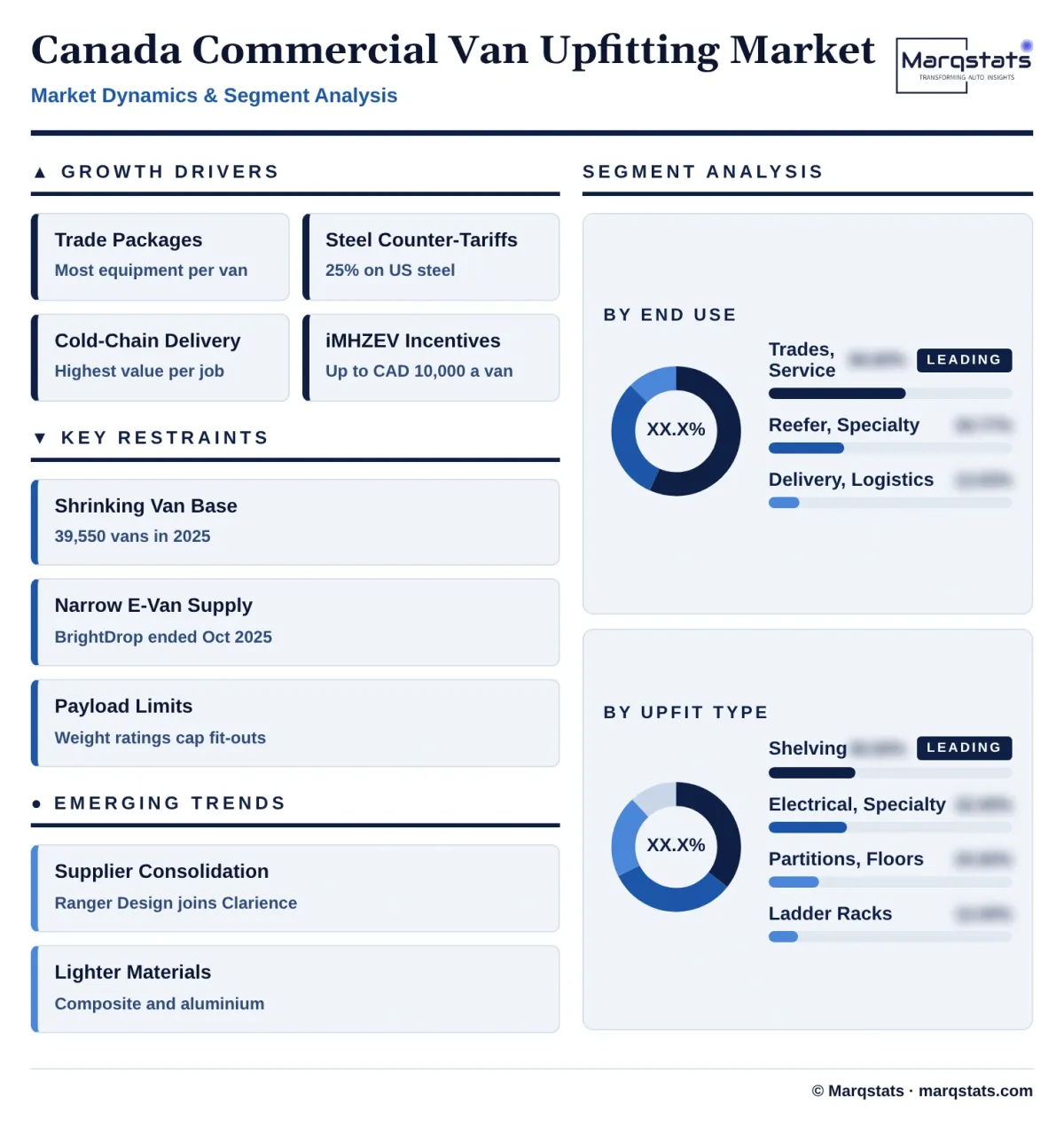
- Tradespeople need more equipment per van. Plumbing, heating, electrical and telecom fleets buy drawers, bins, tank and cylinder racks, ladder racks and 1,000 to 2,000 watt inverters, and a full trade package costs about CAD 10,700 installed, more than three times a basic delivery interior.
- Tariffs raise the cost of imported racking. Canada has applied 25% counter-tariffs on United States steel and aluminium products since 13 March 2025, kept them when it removed other counter-tariffs on 1 September 2025, added a 25% tariff on listed steel derivative goods from 26 December 2025, and ended most remission on 1 February 2026 for steel and on 1 July 2026 for aluminium, which lifts the landed price of United States-made shelving and partitions.
- Cold-chain delivery needs specialist bodies. Grocery, meal-kit, pharmacy and food-service fleets in Toronto, Montreal and Vancouver buy insulated liners and refrigeration units, and each conversion costs about CAD 19,000, so these jobs add value much faster than they add volume.
- Federal incentives still support electric vans. The Incentives for Medium- and Heavy-Duty Zero-Emission Vehicles programme offers up to CAD 10,000 for an eligible Class 2B van and up to CAD 40,000 for a Class 3 vehicle, capped at 10 incentives or CAD 1 million per organisation per year, which keeps parcel and utility fleets testing electric vans that need their own upfit designs.
- Fleet buyers want vans to last longer. Ford Pro reported record Canadian sales in 2025, up 7.65%, and fleets that keep vans for more years buy heavier-duty racking and move it from one van to the next, which supports retrofit and transfer work alongside new-van upfits.
Key Restraints
Four constraints hold the number of upfits below what the size of the Canadian van fleet would suggest.
- The van base is shrinking. Full-size van sales fell from 41,362 in 2024 to 39,550 in 2025, Mercedes-Benz Vans Canada sales fell 10.9% in the second quarter of 2026 and Ford Transit sales were down 2.0% in the first nine months of 2026, so the number of new vans to fit out does not grow.
- Electric van supply is narrow. General Motors ended BrightDrop production at CAMI Assembly in Ingersoll, Ontario on 21 October 2025 after suspending it in May 2025, and the eSprinter, E-Transit and Ram ProMaster EV now carry the electric segment, so upfitters design for fewer electric platforms with smaller volumes.
- Payload limits restrict what can be fitted. Battery packs on electric vans and heavy steel racking on combustion vans both eat into gross vehicle weight ratings, and alterers must confirm axle loads and relabel load-carrying capacity under the Motor Vehicle Safety Regulations, which pushes some fleets to buy less equipment rather than lighter equipment.
- Distance raises costs outside the main cities. Much upfit equipment is shipped from Quebec, Ontario or the United States to dealers across a very large country, and shops in the Prairies, the Atlantic provinces and the North pay more freight and wait longer for parts, which limits demand for full packages in low-density regions.
Key Trends
Four shifts are changing what goes into a Canadian work van and who installs it.
- Equipment makers are consolidating. Clarience Technologies, owner of Truck-Lite and Safe Fleet, added Ranger Design on 27 January 2025, and Expertec and Transform Fleet Outfitters combined their Western Canada and Ontario operations into a national upfit platform, which gives fleets fewer, larger suppliers.
- Entry-level packages are back. Ranger Design launched its B-Series van shelving in 36, 48 and 60 inch lengths at Work Truck Week 2026 in March 2026, aimed at independent contractors and small fleets that had been buying stock vans without racking.
- Composite and aluminium replace steel. Upfitters in British Columbia and Ontario fit composite shelving, floors and liners to save weight on electric vans and fuel on combustion vans, and lighter materials raise the price of each package.
- Electric-van upfits become their own specialty. Mercedes-Benz Vans Canada sold 155 eSprinter vans in the second quarter of 2026, up 18.3%, and shops build no-drill mounting kits and separate lithium auxiliary batteries so that tools do not draw on the traction battery.
Strategic Implications
- For equipment makers, Canadian content is now a price advantage. A shelving or partition package built in Quebec or Ontario avoids the 25% counter-tariff that applies to listed United States steel and aluminium goods, so makers with Canadian plants or Canadian assembly can price below imported rivals without cutting margin.
- For national and regional upfitters, the growth is in spend per job, not in more vans. Shops that offer refrigeration, auxiliary power and electric-van mounting win more value from the same van base, while shops that sell only basic delivery shelving face a flat market.
- For fleet managers, transferring equipment pays when vans are scarce. Moving drawers and racking from a retired van to its replacement saves part of a CAD 10,700 trade package, and specifying modular systems at purchase makes later transfers simpler.
- For van makers, the upfit network decides electric-van uptake. Ford Pro, Mercedes-Benz Vans and Ram can lift electric-van sales by certifying more Canadian upfitters for their electric platforms and publishing mounting points that avoid battery and high-voltage areas.
- For dealers outside the major cities, local installation partners are worth building. Dealers in Alberta, Saskatchewan, Manitoba and the Atlantic provinces that hold stock vans with installed packages can capture contractors who would otherwise wait weeks for equipment from central Canada.
Market Segmentation
Trades and field service fleets account for 56.60% of 2025 value, USD 106.15 million, and grow at 5.45% a year to USD 138.43 million. Marqstats estimates about 13,867 upfits in 2025, 49.00% of all jobs, at about CAD 10,700 each, for plumbing, heating, electrical, telecom, utility and municipal service fleets. These buyers fit the most complete packages, with drawers, bins, cylinder and tank racks, ladder racks and inverters, and their share of value eases to 54.44% by 2030 only because cold-chain work grows faster.
Delivery and logistics fleets account for 12.63% of 2025 value, USD 23.69 million, and grow at 5.16% a year to USD 30.46 million. They make up 36.00% of jobs, about 10,188 upfits, but spend only about CAD 3,250 per van on a bulkhead, a floor, wall liners and folding shelves. Parcel, courier and last-mile fleets in the Greater Toronto Area, Montreal and Metro Vancouver buy in large batches, often through ship-through programmes.
Refrigerated and specialty conversions account for 30.77% of 2025 value, USD 57.70 million, and grow fastest, at 8.15% a year, to USD 85.38 million and 33.58% of the market. About 4,245 vans were converted in 2025 at about CAD 19,000 each, mainly insulated and refrigerated vans for food and pharmacy delivery and mobile workshops and laboratories for utilities and fibre networks.
Shelving and storage systems account for 35.50% of 2025 value, USD 66.58 million, and grow at 5.85% a year to USD 88.49 million. Steel shelving remains the default for trades because it is cheaper and resists wear, while aluminium and composite lines from makers such as Ranger Design gain share on electric and delivery vans.
Partitions, flooring and cargo protection account for 20.50% of 2025 value, USD 38.45 million, and grow at 5.75% a year to USD 50.85 million. Almost every cargo van receives a bulkhead and a floor, and Ontario makers such as Legend Fleet Solutions supply composite floors and wall liners to fleets across North America.
Ladder racks and exterior access account for 12.00% of 2025 value, USD 22.50 million, and grow at 5.92% a year to USD 30.00 million. High-roof Transit and Sprinter vans push buyers from fixed crossbars to drop-down ladder racks that lower ladders to waist height.
Electrical, refrigeration and specialty equipment accounts for 32.00% of 2025 value, USD 60.01 million, and grows fastest, at 7.19% a year, to USD 84.93 million and 33.40% of the market. Inverters, lithium auxiliary batteries, lighting, refrigeration units and specialty work benches raise the value of each job more than any other item.
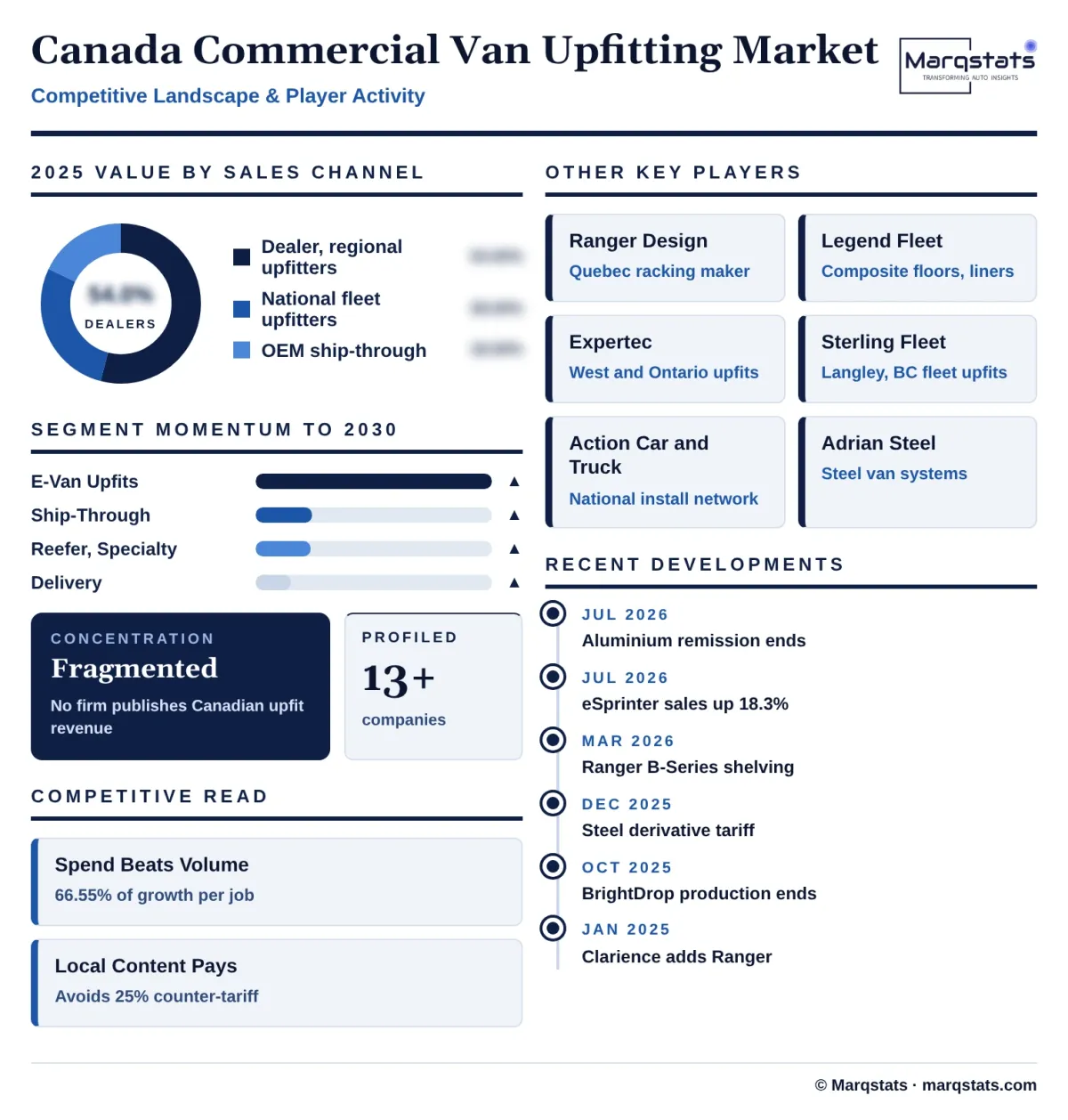
Dealer and regional upfitters account for 54.00% of 2025 value, USD 101.27 million, and grow at 5.48% a year to USD 132.22 million. Contractors and municipalities buy stock vans from dealers and have them fitted locally, which suits a country where many buyers are far from a national upfit centre.
National fleet upfitters account for 28.00% of 2025 value, USD 52.51 million, and grow at 6.28% a year to USD 71.20 million. Multi-site firms such as Expertec, Transform Fleet Outfitters, Sterling Fleet Outfitters and Action Car and Truck Accessories serve fleet management companies and large corporate accounts.
OEM factory and ship-through programmes account for 18.00% of 2025 value, USD 33.76 million, and grow fastest, at 8.54% a year, to USD 50.85 million and 20.00% of the market, as Ford Pro, Mercedes-Benz Vans, Stellantis and General Motors route more fleet orders through approved upfitters before delivery.
Upfits on internal combustion vans account for 95.96% of 2025 value, USD 179.96 million, and grow at 4.11% a year to USD 220.16 million, while their share falls to 86.59%. Gasoline Transit, ProMaster, Express and Savana vans and diesel and gasoline Sprinter vans carry nearly all Canadian upfit work.
Upfits on battery-electric vans account for 4.04% of 2025 value, USD 7.58 million, and grow at 35.10% a year to USD 34.11 million and 13.41% of the market. Marqstats estimates about 1,000 electric-van jobs in 2025, 3.53% of the total, rising to 3,700, 11.87%, with each job priced about 15% above a comparable combustion-van job.
By Geography
Ontario
Ontario is the centre of Canadian upfitting because the Greater Toronto Area holds the parcel hubs, fleet head offices and the largest cluster of upfit shops, from Legend Fleet Solutions in Tillsonburg to G.W. Anglin Manufacturing in Tecumseh. It accounts for 40.00% of 2025 value, USD 75.01 million, and grows at 6.28% a year to USD 101.70 million by 2030, keeping a 40.00% share as delivery and trade fleets grow together.
Quebec
Quebec is the second market and the home of Ranger Design, which supplies racking across North America through more than 200 resellers. The province accounts for 22.50% of 2025 value, USD 42.20 million, and grows at 5.80% a year to USD 55.94 million. Utility, municipal and trade fleets lead demand, and Quebec-built equipment avoids the counter-tariff that United States racking carries.
Alberta
Alberta buys the heaviest packages because oil and gas service, pipeline and construction fleets need compressors, heavy steel drawers and winter-ready electrical systems. The province accounts for 14.00% of 2025 value, USD 26.26 million, and grows at 6.27% a year to USD 35.60 million, with Calgary and Edmonton shops such as Expertec serving the region.
British Columbia
British Columbia grows fastest because its fleets adopt electric vans and lightweight composite fit-outs earlier than the rest of Canada. It accounts for 13.50% of 2025 value, USD 25.32 million, and grows at 7.05% a year to USD 35.60 million and 14.00% by 2030, led by Sterling Fleet Outfitters in Langley and shops across Metro Vancouver and the Fraser Valley.
Prairies, Atlantic Canada and the North
Saskatchewan, Manitoba, the four Atlantic provinces and the territories together account for 10.00% of 2025 value, USD 18.75 million, growing at 6.28% a year to USD 25.43 million. Telecom, utility and municipal fleets lead demand, and Moncton and Dieppe in New Brunswick, where Action Car and Truck Accessories and Malley Industries are based, serve as the Atlantic hub.

How Competition Is Evolving
The Canadian market is fragmented. No upfitter or equipment maker publishes Canadian upfit revenue, and Marqstats does not assign company shares. The market is better read by layer: equipment makers that design and build racking, national and regional upfitters that install it, and van makers that certify upfitters and route fleet orders. By channel, dealer and regional upfitters hold 54.00% of 2025 value, national fleet upfitters 28.00% and OEM factory and ship-through programmes 18.00%.
Equipment makers compete on weight, price and local content. Ranger Design, part of Clarience Technologies since 27 January 2025, builds aluminium and steel shelving, partitions and ladder racks in Quebec and launched its B-Series entry shelving in March 2026. Adrian Steel Company supplies steel and aluminium systems from Michigan through Canadian dealers and installers, and Legend Fleet Solutions supplies composite floors and liners from Tillsonburg, Ontario. The 25% counter-tariff on United States steel and aluminium goods gives Canadian-built lines a price advantage in fleet tenders.
Installers compete on reach and certification. Expertec and Transform Fleet Outfitters now operate as one platform across Western Canada and Ontario, Sterling Fleet Outfitters works from Langley, British Columbia, G.W. Anglin Manufacturing runs a fleet upfitting centre in Ontario, and Action Car and Truck Accessories operates a national installation network from Moncton, New Brunswick. Holding a Transport Canada National Safety Mark and OEM upfitter approvals decides which shops can work on ship-through and fleet management company orders.
Van makers set the rules. Ford Pro, whose Transit was 48.55% of 2025 full-size van sales, Mercedes-Benz Vans Canada, FCA Canada for the Ram ProMaster and General Motors of Canada for the Express and Savana publish body builder data and approve upfitters, and the exit of the BrightDrop in October 2025 leaves electric-van upfit work concentrated on the E-Transit, eSprinter and ProMaster EV.
Companies Covered
Companies covered in the report include:
Recent Market Activity
Table of Contents
Coverage & Segmentation
The study covers the Canada commercial van upfitting market, with 2025 as the base year, 2021 – 2025 as the historical period and 2026 – 2030 as the forecast period. It covers equipment and installation labour on full-size commercial cargo vans, whether fitted to new vans, transferred between vans or fitted to used vans, segmented by end use, upfit type, sales channel, powertrain and province or region. Values are installed values in Canadian dollars converted to US dollars at the 2025 average of CAD 1.3978 per US dollar, excluding sales taxes and freight on the van.
The van itself, cutaway, chassis-cab and box-body conversions, ambulance, passenger, wheelchair-accessible and camper conversions, pickup and work truck upfitting and loose accessories sold without installation are excluded. The live Marqstats North America Commercial Van Upfitting page is a broader parent whose Canada slice includes chassis-cab bodies, ambulance conversions and integrated telematics, and the live United States Commercial Van Upfitting page covers the United States only; their figures must not be added to this market. Segment and regional splits are Marqstats estimates.