Market Snapshot
The India two-wheeler finance market size is estimated at USD 13,224.49 million in 2025 and is projected to reach USD 21,835.25 million by 2030, growing at a CAGR of 10.55% over 2026 – 2030. Loan disbursements rise from about INR 1,15,053.07 crore to INR 1,89,966.70 crore as about 13,483,303 loans a year grow to 19,089,000.
Marqstats defines the market as the value of new retail loans disbursed in a calendar year to buy new and used motorcycles, scooters, mopeds and electric two-wheelers in India, by banks, small finance banks and non-banking financial companies (NBFCs), including the captive lenders of TVS Motor Company, Hero MotoCorp and Bajaj Auto. Value is the principal disbursed, not the outstanding loan book. Leases, subscriptions, rental fleets, three-wheeler loans and unsecured personal loans used to buy a vehicle are excluded.
NBFCs, captive and independent, disburse 69.50% of 2025 value, ICE motorcycles absorb 62.10% and borrowers in semi-urban and rural India take 60.00%. Electric two-wheeler loans grow fastest, at 29.28% a year, from 6.40% to 14.00% of value by 2030.
Key Takeaways
Market Overview & Analysis
Report Summary
Marqstats sizes the India two-wheeler finance market as the principal disbursed each calendar year on retail loans for two-wheelers. It counts loans for new motorcycles, scooters, mopeds and electric two-wheelers sold through dealers, and loans for used two-wheelers bought from dealers and individuals. Lenders are scheduled commercial banks, small finance banks and NBFCs regulated by the Reserve Bank of India (RBI), including captive NBFCs owned by two-wheeler makers. The market is measured as a flow, the money lent in the year, not as the stock of loans outstanding.
The flow measure matters because the two figures move apart. CareEdge Ratings put NBFC two-wheeler loans outstanding at INR 1,12,751 crore on 31 March 2025 and NBFC two-wheeler disbursements at INR 74,948 crore in FY25, up 11% after growth of 28% a year earlier. CRIF High Mark reported total two-wheeler loans outstanding of about INR 1.9 lakh crore in June 2026. Outstanding balances grow faster than disbursements when tenors lengthen, so sizing the book would overstate the money lenders actually put to work in a year.
Two-wheeler loans are the first formal credit product for much of India. TransUnion CIBIL data reported in 2026 show that about six in 10 two-wheelers are now bought on credit, that four in 10 two-wheeler borrowers have no prior credit history, down from about 60% in 2019, and that about 60% of borrowers are aged 35 or younger. Of a cohort that took a two-wheeler loan in the second half of 2022, more than two-thirds had taken another credit product by the second half of 2025.
Sales set the ceiling. The Federation of Automobile Dealers Associations (FADA) reported retail sales of 20,295,650 two-wheelers in calendar 2025, up 7.24% from 18,924,815 in 2024. Hero MotoCorp retailed 5,823,063 units, Honda Motorcycle and Scooter India 5,037,953, TVS Motor Company 3,788,459 and Bajaj Auto 2,155,166. Electric two-wheeler retail sales reached 1,279,951 units, led by TVS Motor Company, Bajaj Auto, Ather Energy and Ola Electric Mobility.
Marqstats estimates that 62.00% of new two-wheelers sold in 2025 were financed, about 12,583,303 loans at an average of about INR 88,000, and that about 900,000 loans financed used two-wheelers at about INR 48,000. Total disbursements were INR 1,15,053.07 crore, or USD 13,224.49 million at the 2025 average rate of INR 87.00 per US dollar, up 11.65% from USD 11,845.01 million in 2024. The average loan across new and used vehicles was about INR 85,330, or USD 981.
India Two-Wheeler Finance Market Size and Forecast
The India two-wheeler finance market grows from USD 13,224.49 million in 2025 to USD 21,835.25 million in 2030, a CAGR of 10.55%. Three things drive it. Retail sales grow at 5.56% a year, from 20,295,650 to about 26,600,000 units. The share of new vehicles financed rises from 62.00% to 66.50%. The average new-vehicle loan rises from about INR 88,000 to INR 103,000 as premium motorcycles and electric scooters take a larger share. The number of loans grows at 7.20% a year, from about 13,483,303 to 19,089,000.
The 2025 base is built from units and tickets and checked against lender data. Applied to FY25, the CareEdge Ratings figure of INR 74,948 crore of NBFC disbursements implies total two-wheeler disbursements of about INR 1,06,000 crore to INR 1,09,400 crore, depending on whether the NBFC share is taken as the 70.6% origination share reported by CRIF High Mark or the 68.5% book share reported by CareEdge. Calendar 2025 runs nine months ahead of FY25 and captures the festive season after the GST cut, which is why the Marqstats estimate of INR 1,15,053.07 crore sits about 5% to 8% above that range.
Growth peaks in 2026. Disbursements rise 11.02% to USD 14,681.70 million in 2026, as the full year of lower GST lifts retail sales to about 22,300,000 units and penetration to 63.00%, while the average new-vehicle loan dips to INR 87,500 because vehicles are cheaper. FADA reported FY26 retail sales of 21.42 million two-wheelers, about 13% above FY25, which supports the 2026 step. From 2027 growth settles at about 10% a year.
Loan size, not loan count, adds most value after 2026. Marqstats expects the average new-vehicle loan to grow at about 4% a year from 2026 to 2030, as buyers move to 125cc and larger motorcycles, connected scooters and electric models priced above INR 1 lakh. CRIF High Mark reports that models priced above INR 1 lakh already account for 43% of new two-wheeler loan value and that the average balance per borrower rose from about INR 30,000 to INR 50,000.
Marqstats tracks four indicators to monitor the forecast: FADA monthly retail sales, quarterly disbursement disclosures from TVS Credit Services, L&T Finance, Shriram Finance and Bajaj Auto Credit, two-wheeler delinquency in TransUnion CIBIL and CRIF High Mark reports, and RBI policy on NBFC funding and consumer credit risk weights. A rise in early delinquency would slow penetration gains, while further rate cuts would lower the cost of funds for NBFCs.
Market Dynamics
Key Drivers
Five forces push two-wheeler loan disbursements up faster than two-wheeler sales.
- The GST cut lowered the entry price. From 22 September 2025, GST on two-wheelers up to 350cc fell from 28% to 18%, which cut about INR 7,812 from a vehicle with an ex-showroom price of INR 1,00,000. Because most buyers borrow 75% to 85% of the on-road price, the cut lowered the cash a buyer needs at the dealer by about a third and brought more buyers within reach of a loan.
- Credit bureaus make first-time borrowers lendable. TransUnion CIBIL reports that four in 10 two-wheeler borrowers had no prior credit history and that 90 to 179 day delinquency fell to 1.4% by June 2026, the lowest since 2019. Lenders can approve more new-to-credit buyers at the dealer because bureau data, digital know-your-customer checks and electronic mandates have cut the cost and time of a decision.
- Captive lenders push their own sales. TVS Credit Services, Hero FinCorp and Bajaj Auto Credit finance the dealer networks of their parents. CRISIL Ratings reported in July 2025 that Bajaj Auto Credit, which began lending on 1 January 2024, had a loan book of INR 9,577 crore at 31 March 2025, about 60% in two-wheelers, and finances about 40% of the two- and three-wheelers made by Bajaj Auto, which had invested INR 2,700 crore in it.
- Bank funding to NBFCs became cheaper. On 25 February 2025 the RBI reversed the 25 percentage point increase in risk weights on bank loans to NBFCs that it had imposed on 16 November 2023, with effect from 1 April 2025. NBFCs fund two-wheeler loans largely with bank borrowing, so lower capital charges for banks feed directly into the rates NBFCs pay.
- Fresh equity is flowing into retail NBFCs. MUFG Bank acquired 20% of Shriram Finance for about INR 39,618 crore through a preferential allotment of 471.1 million shares at INR 840.93 each, announced in April 2026. L&T Finance reported FY26 retail disbursements of INR 83,213 crore, up 39%, with two-wheeler disbursements up 16%. More capital lets lenders reach smaller towns where many buyers still pay cash.
Key Restraints
Four constraints cap how far lenders can push penetration and ticket sizes.
- Cash still buys about four in 10 new two-wheelers. With about six in 10 two-wheelers bought on credit, according to TransUnion CIBIL, a large group of buyers either has savings, borrows informally or is not served by a lender, and penetration gains slow as lenders move from easy approvals to thin-file and seasonal-income borrowers.
- Credit costs force lenders to prune. Bajaj Finance said in its results for the quarter to December 2025 that its legacy captive two- and three-wheeler book was being phased out because it contributed disproportionately to loan losses, with medium-term credit cost guidance of about 165 to 175 basis points. A lender that exits a segment hands volume to others, but it also signals how thin the margin for error is.
- Rates are high for the riskiest buyers. Lenders charge sub-prime two-wheeler borrowers about 12% to 18% a year, and fintech lenders to gig-economy riders charge more, so equated monthly instalments stay a large share of income for daily-wage and delivery workers, which limits ticket sizes.
- Electric two-wheeler resale values are unproven. TransUnion CIBIL cannot separate electric two-wheeler loans from other two-wheeler loans in its data, and no public series tracks used electric two-wheeler prices, so many lenders cap loan-to-value ratios or require telematics on electric models, which slows the shift of finance toward them.
Key Trends
Four shifts are changing who lends, to whom and against which vehicle.
- Captive lenders are being rebuilt. Bajaj Auto moved its financing from Bajaj Finance to its own NBFC, Bajaj Auto Credit, and Bajaj Finance is running down its legacy captive book, while Hero FinCorp has approval from the Securities and Exchange Board of India (SEBI) for an INR 3,668 crore initial public offering.
- Two-wheeler loans become the start of a credit relationship. More than two-thirds of a 2022 cohort of two-wheeler borrowers had taken another loan within three years, with consumer durable loans, personal loans, gold loans and credit cards following, so lenders price the first loan to win a long-term customer.
- Electric two-wheeler finance moves to OEM and fintech partnerships. Makers such as Ather Energy, TVS Motor Company and Bajaj Auto tie up with banks and NBFCs, and fintech NBFCs finance delivery riders with telematics and battery tracking, as the extended PM E-DRIVE incentive keeps electric models cheaper.
- Lenders follow buyers into smaller towns. TransUnion CIBIL reports that 64% of two-wheeler borrowers live in semi-urban or rural areas and that 61% of two-wheeler and passenger vehicle originations in the first half of 2026 came from those areas, up from 56% in 2019, so branch networks and dealer tie-ups move beyond the top cities.
Strategic Implications
- For NBFCs, the GST cut is a window to win first-time borrowers before penetration flattens. The saving of about INR 7,812 on a INR 1,00,000 vehicle lowers the down payment by about a third, and lenders that approve thin-file buyers at the dealer in 2026 can then cross-sell the consumer durable and personal loans that two-thirds of borrowers take within three years.
- For banks, the opportunity is the premium end and salaried buyers. Private sector banks hold about a fifth of disbursements, and tickets above INR 1 lakh for premium motorcycles and electric scooters suit their lower cost of funds, while rural first-time buyers remain NBFC territory.
- For two-wheeler makers, a captive lender is a sales tool, not just a profit centre. Bajaj Auto Credit finances about 40% of Bajaj Auto vehicles, and makers without a captive depend on partner lenders whose appetite can change with credit costs, as the Bajaj Finance run-down shows.
- For electric two-wheeler makers, financing terms decide adoption as much as the incentive. The PM E-DRIVE incentive is capped at INR 5,000 per vehicle, smaller than the GST saving on a petrol model, so buy-back guarantees, battery warranties and telematics that support higher loan-to-value ratios close more of the price gap.
- For investors and banks lending to NBFCs, growth is real but credit discipline sets the return. Disbursements grow at about 10% a year to 2030, while delinquency is at a seven-year low, so the next test is how loans to new-to-credit rural borrowers perform when the GST-led sales boost fades.
Market Segmentation
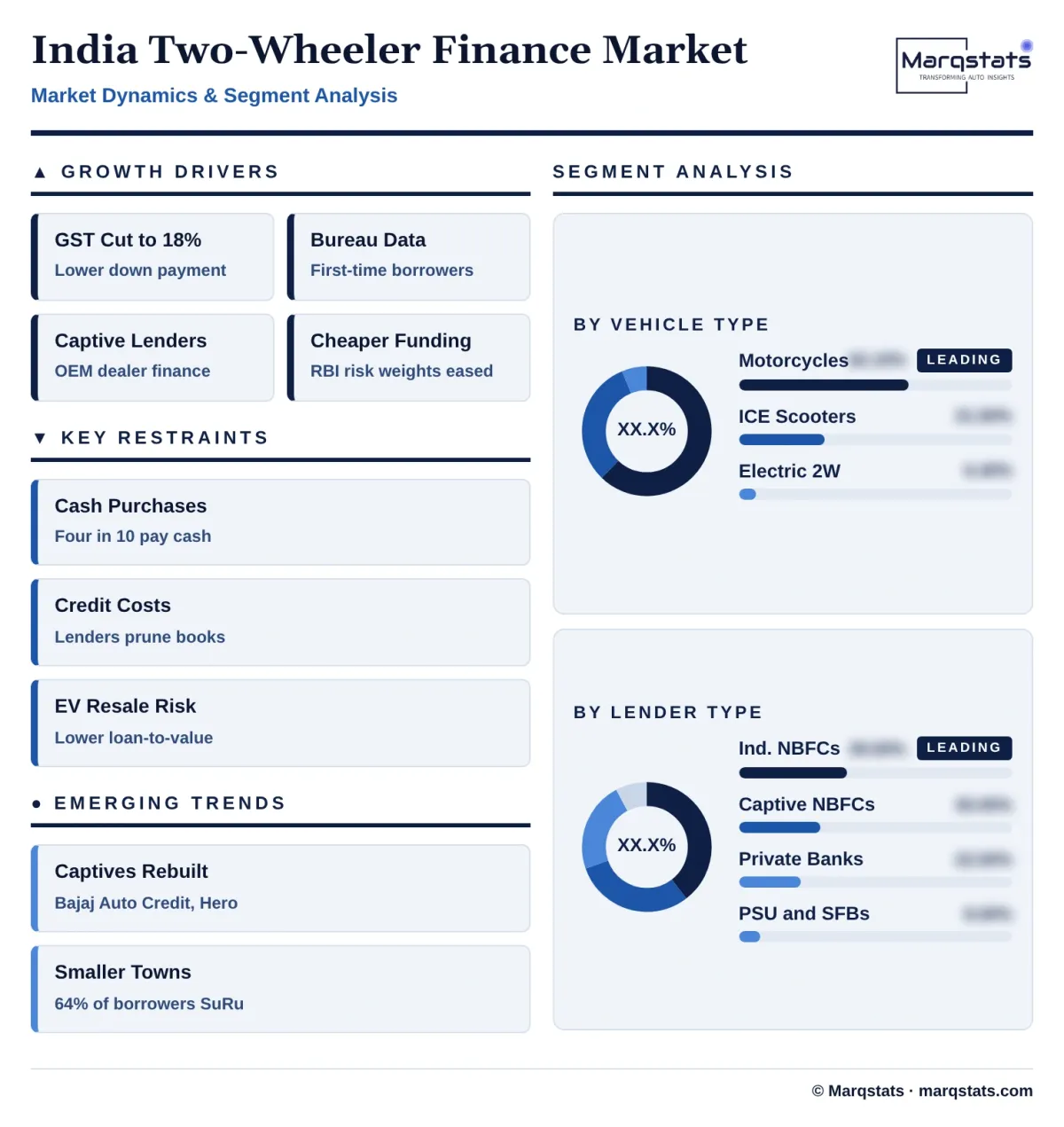
Loans for petrol motorcycles account for 62.10% of 2025 value, USD 8,212.41 million, and grow at 8.13% a year to USD 12,140.40 million, while their share falls to 55.60% by 2030. Commuter motorcycles of 100cc to 125cc from Hero MotoCorp, Honda Motorcycle and Scooter India and Bajaj Auto are the core of rural lending, and Royal Enfield models from Eicher Motors carry the largest tickets in the segment.
Loans for petrol scooters and mopeds account for 31.50% of 2025 value, USD 4,165.71 million, and grow at 9.77% a year to USD 6,637.92 million and 30.40% of the market. Scooters such as the Honda Activa, TVS Jupiter and Suzuki Access sell mainly in cities and to women buyers, and the TVS XL100 moped serves rural traders.
Loans for electric two-wheelers account for 6.40% of 2025 value, USD 846.37 million, and grow fastest, at 29.28% a year, to USD 3,056.93 million and 14.00% of the market by 2030. Retail sales were 1,279,951 units in 2025, and Marqstats estimates a lower financed share than for petrol models, about 55%, at a higher average loan of about INR 1,05,000, because lenders still limit loan-to-value ratios on electric scooters.
Independent NBFCs disburse 39.50% of 2025 value, USD 5,223.67 million, and grow at 11.10% a year to USD 8,843.27 million. Shriram Finance, L&T Finance, Cholamandalam Investment and Finance Company, Muthoot Capital Services and Manba Finance lend across brands through dealer tie-ups and rural branches.
Captive NBFCs owned by two-wheeler makers disburse 30.00% of 2025 value, USD 3,967.35 million, and grow at 11.28% a year to USD 6,768.93 million and 31.00% of the market. TVS Credit Services, Hero FinCorp and Bajaj Auto Credit win at the dealer because they share data and incentives with their parents.
Private sector banks disburse 22.50% of 2025 value, USD 2,975.51 million, and grow at 9.55% a year to USD 4,694.58 million. HDFC Bank, ICICI Bank, IDFC FIRST Bank and Axis Bank lend mainly to salaried and urban buyers and finance more premium motorcycles and electric scooters.
Public sector banks and small finance banks disburse 8.00% of 2025 value, USD 1,057.96 million, and grow at 7.64% a year to USD 1,528.47 million, the slowest of the four groups. State Bank of India, Bank of Baroda, Jana Small Finance Bank and AU Small Finance Bank serve existing account holders but rarely compete at the dealer.
Loans for new two-wheelers account for 96.25% of 2025 value, USD 12,727.94 million, and grow at 10.47% a year to USD 20,942.15 million. Marqstats estimates about 12,583,303 new-vehicle loans in 2025, rising to 17,689,000 in 2030.
Loans for used two-wheelers account for 3.75% of 2025 value, USD 496.55 million, and grow faster, at 12.46% a year, to USD 893.10 million and 4.09% of the market. About 900,000 loans at about INR 48,000 were made in 2025, mostly by NBFCs that finance dealer-certified used motorcycles.
Borrowers in semi-urban and rural India take 60.00% of 2025 value, USD 7,934.69 million, and grow at 11.46% a year to USD 13,647.03 million and 62.50% of the market. Their share of value is below the 64% share of borrowers reported by TransUnion CIBIL because their loans are smaller.
Borrowers in cities take 40.00% of 2025 value, USD 5,289.80 million, and grow at 9.13% a year to USD 8,188.22 million. Urban buyers borrow more per vehicle for scooters, premium motorcycles and electric models, and banks hold a larger share of this segment.
By Geography
North India
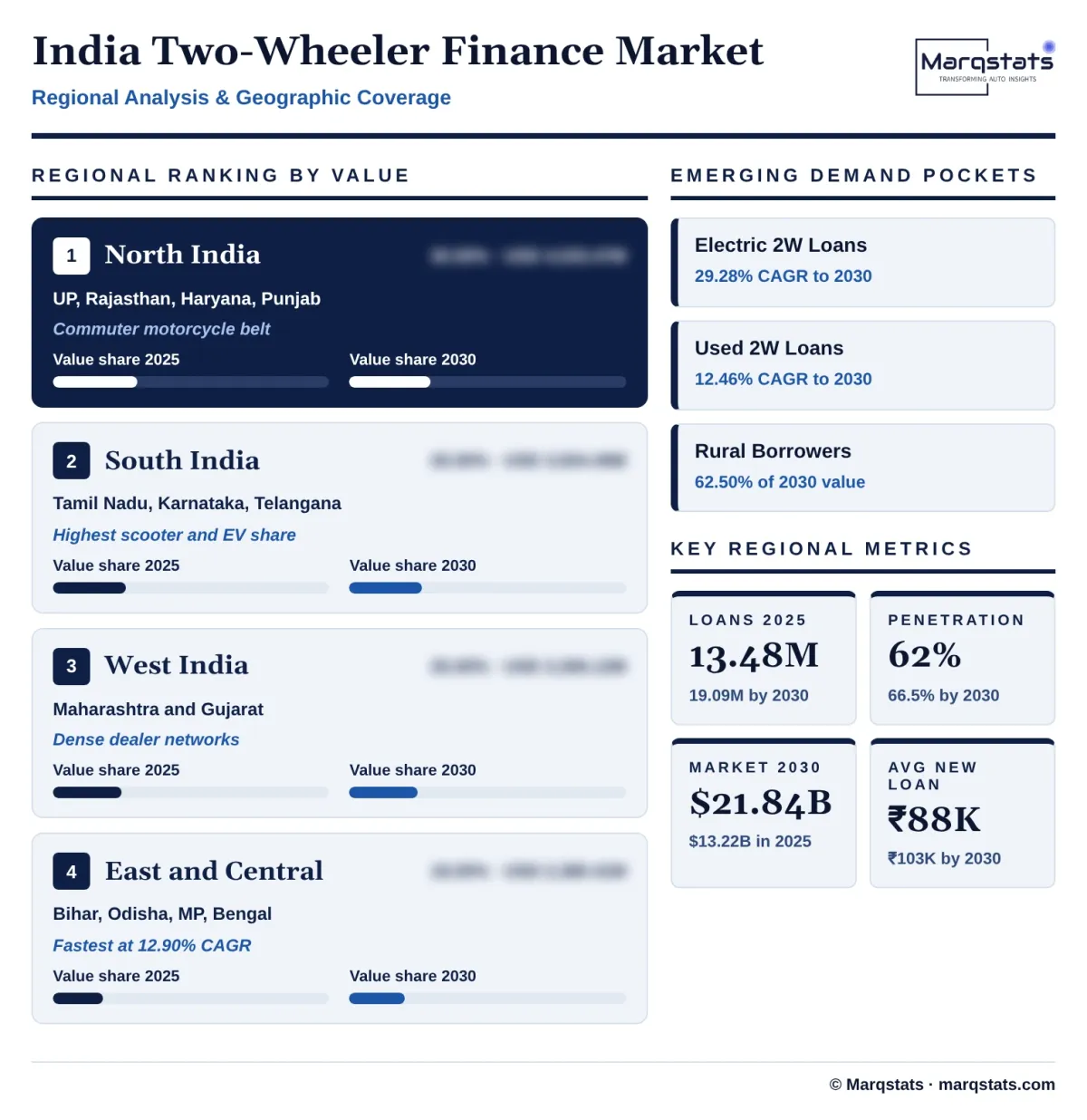
North India accounts for 30.50% of 2025 value, USD 4,033.47 million, and grows at 9.81% a year to USD 6,441.40 million and 29.50% by 2030. Uttar Pradesh, Rajasthan, Haryana, Punjab and Delhi buy the most commuter motorcycles in India, and Hero MotoCorp, Hero FinCorp and Shriram Finance have dense dealer and branch coverage across the region.
South India
South India accounts for 26.50% of 2025 value, USD 3,504.49 million, and grows at 10.13% a year to USD 5,677.16 million. Tamil Nadu, Karnataka, Telangana, Andhra Pradesh and Kerala have the highest scooter and electric two-wheeler shares, and TVS Credit Services, Cholamandalam Investment and Finance Company and small finance banks are strongest here.
West India
West India accounts for 25.00% of 2025 value, USD 3,306.12 million, and grows at 10.10% a year to USD 5,349.64 million. Maharashtra and Gujarat combine urban scooter demand with industrial-belt motorcycle buyers, and lenders such as Manba Finance and Bajaj Auto Credit have deep dealer networks around Mumbai, Pune and Ahmedabad.
East and Central India
East and Central India accounts for 18.00% of 2025 value, USD 2,380.41 million, and grows fastest, at 12.90% a year, to USD 4,367.05 million and 20.00% by 2030. Bihar, Odisha, West Bengal, Madhya Pradesh and Chhattisgarh start from lower finance penetration, and new branches and digital approvals are bringing more buyers into formal credit.
How Competition Is Evolving
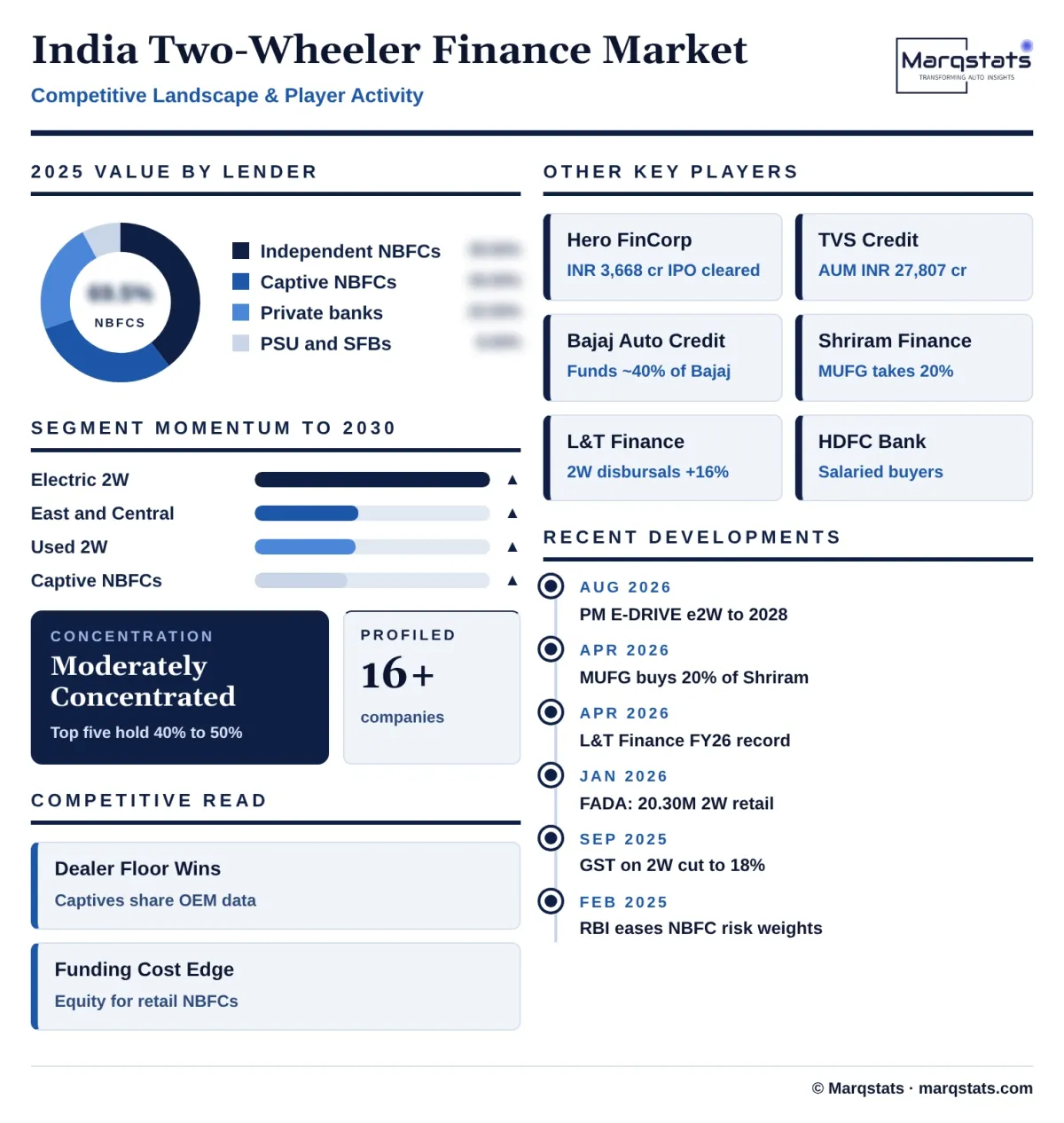
The market is moderately concentrated. Marqstats estimates that NBFCs, captive and independent, disbursed 69.50% of 2025 value, and that the five largest lenders, Hero FinCorp, TVS Credit Services, Shriram Finance, L&T Finance and Bajaj Auto Credit, together hold between 40% and 50%. No single lender holds more than about a seventh of disbursements, and the long tail includes regional NBFCs, cooperative banks and fintech lenders.
Captive lenders compete on the dealer floor. TVS Credit Services reported assets under management of INR 27,807 crore at September 2025 and more than 2.5 million new customers in the first half of FY26, across two-wheeler, consumer durable and mobile phone loans. Hero FinCorp finances Hero MotoCorp buyers and is preparing an INR 3,668 crore listing, and Bajaj Auto Credit has replaced Bajaj Finance as the main lender for Bajaj Auto dealers.
Independent NBFCs compete on reach and cost of funds. Shriram Finance, with assets under management of more than INR 2.9 trillion and fresh equity from MUFG Bank, can lend cheaply in small towns, and L&T Finance grew two-wheeler disbursements by 16% in FY26 using its in-house credit scoring. Bajaj Finance is running down its legacy captive two-wheeler book, freeing dealer share for others.
Banks compete on price and existing customers. HDFC Bank, ICICI Bank, IDFC FIRST Bank and Axis Bank offer pre-approved loans to account holders and finance premium models at lower rates, while small finance banks such as Jana Small Finance Bank and AU Small Finance Bank and fintech NBFCs serve buyers that banks decline, often with telematics on electric models.
Companies Covered
Companies covered in the report include:
Recent Market Activity
Table of Contents
Coverage & Segmentation
The study covers the India two-wheeler finance market, with 2025 as the base year and 2026 – 2030 as the forecast period. It measures the principal disbursed in each calendar year on retail loans for new and used motorcycles, scooters, mopeds and electric two-wheelers, by banks, small finance banks and NBFCs including captive lenders, segmented by vehicle type, lender type, vehicle condition, borrower geography and region. Values are in US dollars at the 2025 average of INR 87.00 per US dollar, with crore figures in Indian rupees.
Outstanding loan books, interest income, insurance, leases, subscriptions and rental fleets, three-wheeler and electric rickshaw loans, unsecured personal loans and buy-now-pay-later credit are excluded. Two-wheeler leasing and subscription revenue is covered separately by Marqstats and is not additive with this market. The live Marqstats India Two-Wheeler Market report sizes vehicle sales value, of which these loans finance a part, so the two figures should not be added. Splits are Marqstats estimates.