Market Snapshot
The GCC auto finance market, measured as the gross outstanding stock of dedicated vehicle finance held by banks and licensed finance companies, is valued at USD 29.88 billion in 2025 and is projected to reach USD 42.50 billion by 2030, a CAGR of 7.30%. Active financed contracts rise from about 1,473,302 to 1,740,092, a 3.38% rate. Saudi Arabia sells 55.24% of the region's new vehicles but holds 46.69% of its finance stock, and it still supplies 61.41% of the growth to 2030.
These are Marqstats estimates. The Saudi slice is taken unchanged from the live Marqstats Saudi Arabia Auto Finance Market page: a lease-to-own stock of SAR 52.30 billion (USD 13.95 billion) in 2025. For the other five states we start from 2025 new-vehicle sales, apply a financed share and an average financed ticket per country, and convert that annual flow into a year-end balance with a stock-to-flow ratio of 2.50 for amortising loans. The financed share is the input the non-Saudi total is most sensitive to: one percentage point on the UAE share moves the 2025 regional total by about USD 0.23 billion.
Structure, not population, decides where the balance sits. Saudi lease-to-own contracts carry residual payments at the end of the term, so the Kingdom keeps about 3.36 years of new financing on the book. Salary-deducted instalment loans in the UAE, Kuwait, Qatar, Oman and Bahrain run down faster, and Marqstats holds them at 2.50 years. One riyal of new Saudi lease finance therefore stays outstanding about a third longer than a dirham of new UAE car-loan finance.
2026 is a slower year, not a reversal. The US-Iran conflict that began in late February 2026 cut UAE new-vehicle sales by 18.6% in the first quarter and prompted the Qatar Central Bank to cut its reserve requirement in March. Outstanding stock still grows 5.99% in 2026, to USD 31.67 billion, because balances written in 2023 to 2025 amortise over four to five years and a weak sales quarter trims only one year of new business.
Key Takeaways
Market Overview & Analysis
Report Summary
The GCC auto finance market covers the outstanding balance of credit written specifically to buy a vehicle in Saudi Arabia, the United Arab Emirates, Kuwait, Qatar, Oman and Bahrain. It counts lease-to-own (Ijarah Muntahia Bittamleek) contracts, Murabaha vehicle sales and conventional car loans booked by banks and licensed finance companies, for individuals, small businesses and corporate fleets. The headline is a year-end stock in USD billion, because balances are what central banks report and what lenders price capital against.
Six markets share one currency peg system but not one credit model. Saudi Arabia finances vehicles mainly through lease-to-own contracts written by banks and SAMA-licensed finance companies. Kuwait, Oman and Bahrain lend against salary transfers under consumer-loan ceilings. The UAE runs a large expatriate retail book that grew 9.4% in 2025. Qatar is the smallest per buyer relative to vehicle prices and was hit hardest by the 2026 conflict.
Our conclusion is that the region is a Saudi growth story with a stable Gulf base around it. The five non-Saudi markets grow 5.48% a year together, broadly in step with new-vehicle sales and ticket inflation. Saudi Arabia grows 9.24% because its contracts are getting larger, its fleet leasing is expanding and its lease structure keeps balances on the book for longer.
GCC Auto Finance Market Size and Forecast
Marqstats estimates the GCC auto finance stock at USD 21.40 billion in 2021, USD 23.10 billion in 2022, USD 24.96 billion in 2023 and USD 27.07 billion in 2024, reaching USD 29.88 billion in 2025. That is an 8.70% CAGR over the historical window, faster than the forecast rate because 2023 to 2025 combined high Saudi lease growth with strong new-vehicle sales in Saudi Arabia, Oman and Qatar.
The forecast path runs to USD 31.67 billion in 2026, USD 34.24 billion in 2027, USD 37.04 billion in 2028, USD 39.68 billion in 2029 and USD 42.50 billion in 2030. The 2026 step is the smallest at 5.99%, reflecting the first-half sales shock in the UAE, Qatar and Kuwait. From 2027 the five non-Saudi books return to 5.5% to 7.5% annual growth as sales normalise.
Every series is in nominal USD at fixed 2025 conversion rates: SAR 3.75, AED 3.6725, QAR 3.64, OMR 0.3845 and BHD 0.376 per US dollar, which are the official pegs, and KWD 0.3068, the 2025 average of the Kuwaiti dinar basket. Because five of the six currencies are pegged to the dollar, local-currency growth rates and USD growth rates are the same for all but Kuwait.
Saudi Arabia Supplies Three-Fifths of GCC Growth to 2030
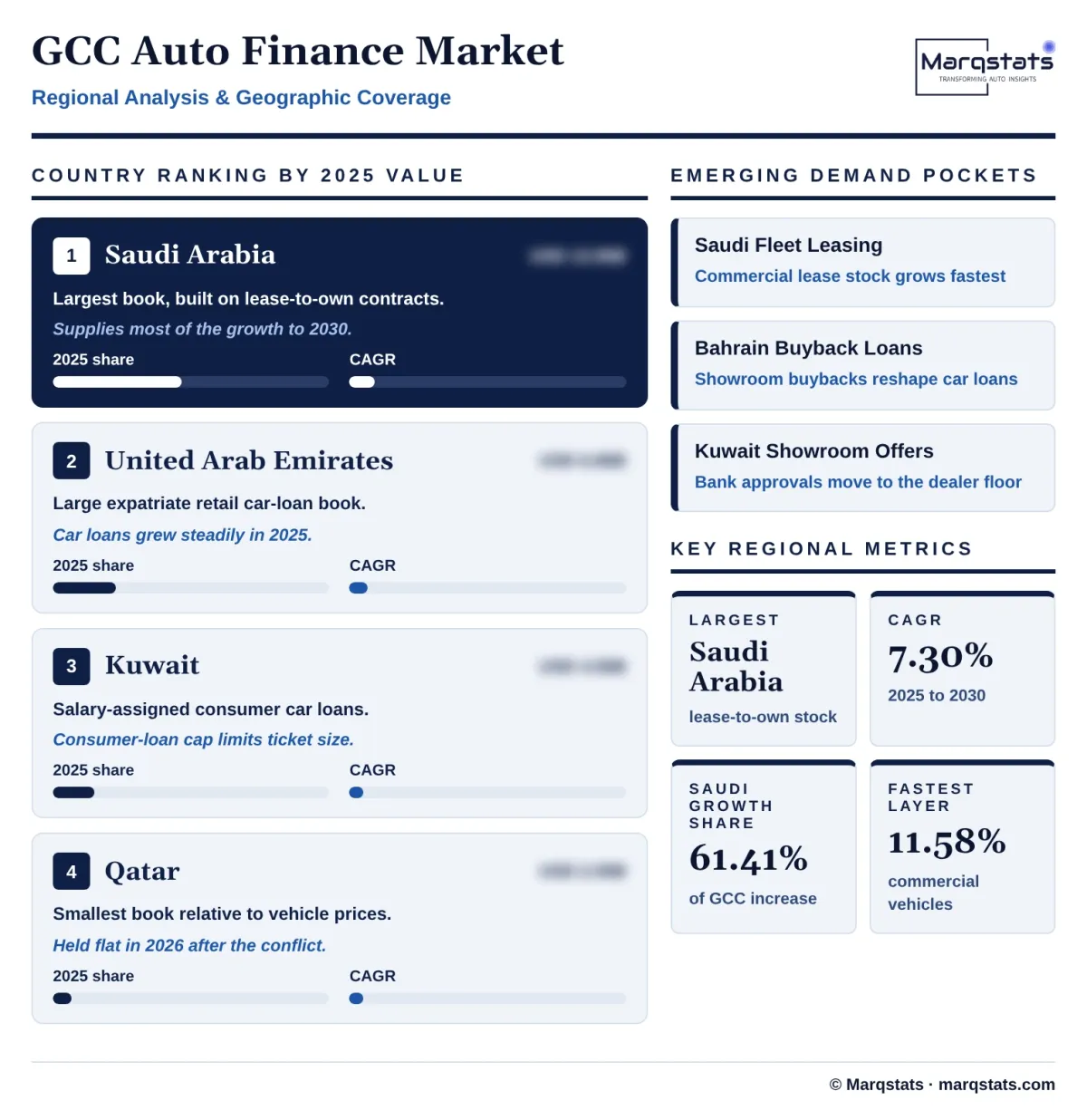
The Saudi lease-to-own book rises from USD 13.95 billion to USD 21.70 billion, adding USD 7.75 billion of the region's USD 12.62 billion growth. That is 61.41% of the increase from a market that starts with 46.69% of the stock. The UAE adds USD 2.48 billion and Kuwait USD 1.20 billion; Qatar, Oman and Bahrain, which together hold 15.12% of the 2025 stock, add USD 1.19 billion.
Two forces drive the Saudi line, and neither is population. The first is ticket size. The live Marqstats Saudi page puts the average new financed amount at SAR 84,582 in 2025, rising to SAR 124,123 by 2031, as buyers move up to larger SUVs and as fleet leases take a bigger slice. The second is the commercial layer: Saudi commercial-vehicle lease stock is SAR 10.46 billion in 2025 and grows to about a quarter of value by 2030.
The conclusion for lenders is direct. A GCC portfolio strategy that allocates capital by population or by new-vehicle sales will under-weight Saudi Arabia, where each new contract adds more balance and keeps it on the book for longer.
Stock-to-Flow Explains the Gap Between Sales Share and Finance Share
Saudi Arabia accounts for 857,247 of the 1,551,807 new vehicles sold across the GCC in 2025, or 55.24%. Its finance share is lower, at 46.69%, because only 184,200 new lease contracts were written against those sales and because Murabaha car loans and personal finance used for cars sit outside the lease-to-own measure. The live Saudi page keeps those products out of its total and so does this page.
The ratio that matters is how many years of new lending a book carries. Saudi new financed value was SAR 15.58 billion in 2025 against a stock of SAR 52.30 billion, a ratio of 3.36. Marqstats holds the other five markets at 2.50, which is what a steady flow of 60-month level-payment loans produces once early settlements are allowed for. This is a Marqstats construction, built from the published Saudi ratio and the tenor rules lenders apply elsewhere in the Gulf.
If the non-Saudi ratio were 2.75 instead of 2.50, the 2025 regional total would rise by USD 1.59 billion to USD 31.47 billion. That sensitivity is why we disclose the ratio rather than bury it.
The 2026 Conflict Slows New Business but Not the Balance
UAE new-vehicle sales fell to 65,969 units in the first quarter of 2026, down 18.6%, with March down 47.2% as the US-Iran conflict disrupted shipping through the Strait of Hormuz. In Qatar, private-sector credit grew only 0.2% between 28 February and the end of June 2026, and the Qatar Central Bank cut the deposit reserve requirement from 4.5% to 3.5% in March.
A stock measure absorbs one weak year. Marqstats holds Qatar's book flat in 2026 and grows the UAE and Kuwait by 2.0%, while Saudi Arabia continues on the live page path to SAR 58.00 billion. The regional stock still rises 5.99% in 2026. The risk is a second weak year: if 2027 new lending in the five non-Saudi markets also fell by a fifth, their 2030 stock would sit roughly USD 0.5 billion below the published path.
Market Dynamics
Key Drivers
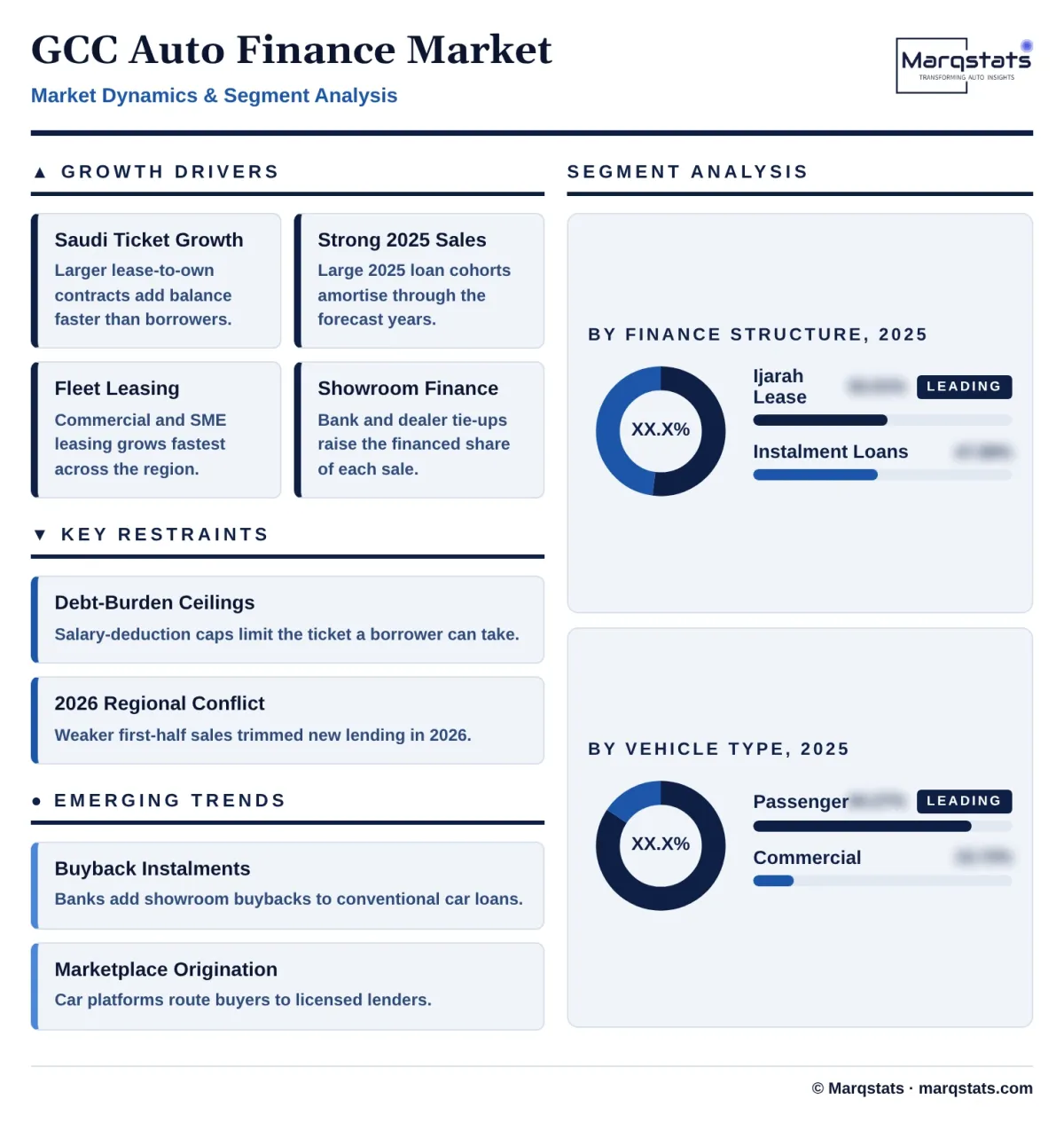
Four forces, each tied to a named instrument or a published number, set the growth rate.
- Saudi lease-to-own ticket growth: the average new financed amount in the Kingdom rises from SAR 84,582 in 2025 toward SAR 124,123 by 2031 on the live Marqstats Saudi page, so the Saudi stock grows at 9.24% while active contracts grow at only 5.04%. Larger vehicles and longer residual structures add balance without adding borrowers.
- Strong new-vehicle sales in 2025: Saudi Arabia sold 857,247 vehicles (up 3.6%, its best year since 2015), the UAE 335,772 (up 5.3%), Oman 75,549 (up 14.5%) and Bahrain 37,713 (up 8.8%). Those 2025 cohorts amortise through 2029 and 2030, which locks in a large share of the forecast balance.
- Commercial and fleet leasing: Saudi commercial-vehicle lease stock of SAR 10.46 billion grows faster than passenger stock, and finance companies regulated under the Finance Companies Control Law write most of it. Across the GCC the commercial layer grows at 11.58% a year, the fastest in any dimension.
- Dealer and bank partnerships at the point of sale: Al Rajhi Bank and Porsche Services Middle East and Africa launched Shariah-compliant financing for all Volkswagen Group brands in May 2025, and Gulf Bank offered 0% financing up to KD 25,000 at Auto World Show 2026 in Kuwait. Financing that is approved in the showroom raises the financed share of each sale.
Key Restraints
The restraints are regulatory ceilings and a regional shock, not lender capacity.
- Debt-burden and salary-deduction ceilings: Saudi Responsible Lending Principles limit consumer-finance deductions to one-third of salary, and the Central Bank of the UAE caps total debt burden at 50% of salary and car loans at 80% of the vehicle value. Ceilings cap the ticket a borrower can take even when vehicle prices rise.
- Kuwait's consumer-loan cap: consumer car finance in Kuwait is offered up to KD 25,000 over five years, which pushes higher-value purchases into other credit lines and keeps Kuwait's stock growth to 4.79% a year.
- The 2026 regional conflict: UAE first-quarter sales fell 18.6% and Qatar's private credit stalled between March and June 2026. Marqstats treats this as a one-year dip in new lending; a longer disruption would lower the non-Saudi path.
Key Trends
Three shifts in how vehicle credit is sold are visible in 2025 and 2026 announcements.
- Buyback-backed instalment products: Al Salam Bank launched Flexi Auto Finance in Bahrain in August 2026 with Al Haddad Motors, combining zero down payment, a three-year all-inclusive instalment and a showroom buyback. This moves conventional loans toward the residual-value logic of Saudi leases.
- Marketplace-led origination: Syarah signed a memorandum of understanding with J-B at Money20/20 Middle East in Riyadh in September 2026 to attach financing to car purchases on its platform. Digital marketplaces are becoming a channel for lenders rather than lenders themselves.
- A larger licensed non-bank sector in Saudi Arabia: SAMA licensed Tamara Finance in March 2025, taking the finance-company count to 65 from 62, and issued the Implementing Regulation of the Finance Companies Control Law on 11 January 2026. More licensed non-banks means more competition for lease-to-own business outside the banks.
Strategic Implications
- For entrants: the open ground is the Saudi commercial and SME lease book, which grows faster than retail, and the residual-value products that Bahraini and Kuwaiti banks are only now copying. A licence under the Saudi Finance Companies Control Law is the entry ticket.
- For incumbents: Gulf banks outside Saudi Arabia should expect their books to grow at roughly 5% a year, in line with sales and prices. Defending share means owning the dealer point of sale, as Gulf Bank and Al Salam Bank did in 2026, rather than competing on headline rate alone.
- For investors and suppliers: credit-decisioning, residual-value and remarketing services are the growing layers, because lease and buyback structures need them. Saudi Arabia is where those services scale first.
Market Segmentation
Lease-to-own contracts hold USD 15.54 billion in 2025, 52.01% of the GCC stock, and reach USD 23.78 billion in 2030 at an 8.88% CAGR, rising to 55.95%. The whole Saudi slice of USD 13.95 billion sits here, identical to the live Marqstats Saudi page. Outside Saudi Arabia, Marqstats estimates that lease-to-own contracts are 10% of vehicle credit, written mostly by Islamic banks and leasing companies for fleet customers. The segment grows faster because the Saudi lease book grows faster.
Instalment loans hold USD 14.34 billion in 2025, 47.99%, and reach USD 18.72 billion in 2030 at 5.48%, falling to 44.05%. These are salary-assigned car loans and Murabaha cost-plus sales in the UAE, Kuwait, Qatar, Oman and Bahrain. Saudi Murabaha car loans are outside this page on the same basis as the live Saudi page, so the segment is a five-country measure.
Individuals hold USD 23.53 billion in 2025, 78.75%, rising to USD 32.87 billion in 2030 at 6.91%. In Saudi Arabia individuals are 71.6% of lease-to-own stock on the live page; in the other five markets Marqstats places retail borrowers at 85% because central-bank car-loan statistics are reported within personal lending.
Business borrowers hold USD 6.35 billion in 2025, 21.25%, rising to USD 9.63 billion at 8.69%. Saudi SMEs alone hold SAR 10.56 billion of lease stock and corporates SAR 4.29 billion. Fleet renewals for logistics, rental and ride-hailing operators drive the faster rate.
Passenger vehicles hold USD 25.18 billion in 2025, 84.27%, and grow to USD 34.37 billion at 6.42%. Saudi passenger lease stock is SAR 41.84 billion across 572,000 active contracts.
Commercial vehicles hold USD 4.70 billion in 2025, 15.73%, and grow to USD 8.13 billion at 11.58%, reaching 19.13%. Saudi commercial lease stock of SAR 10.46 billion is the largest single block, and new commercial financed value in the Kingdom grows at 16.73% a year on the live Saudi page.
By Geography
Saudi Arabia
Saudi Arabia is the largest market at USD 13.95 billion (SAR 52.30 billion) in 2025, 46.69% of the GCC, and grows to USD 21.70 billion (SAR 81.40 billion) by 2030 at 9.24%, taking 51.06%. These are exactly the figures on the live Marqstats Saudi Arabia Auto Finance Market page, measured as lease-to-own stock at banks and SAMA-licensed finance companies. Active contracts number about 650,000 in 2025, and 184,200 new contracts were written for SAR 15.58 billion. Saudi Murabaha car loans and personal finance used to buy cars are not added here.
United Arab Emirates
The UAE holds USD 6.86 billion (AED 25.19 billion) in 2025, 22.96%, rising to USD 9.34 billion in 2030 at 6.37%. Marqstats builds it from 335,772 new-vehicle sales, a 30% financed share and an average ticket of AED 100,000, giving 100,732 new loans. The Central Bank of the UAE reported car loans up 9.4% in 2025. Growth slows to 2.0% in 2026 after first-quarter sales fell 18.6%.
Kuwait
Kuwait holds USD 4.55 billion (KWD 1.40 billion) in 2025, 15.23%, and USD 5.75 billion in 2030 at 4.79%. A 40% financed share on about 155,018 new-vehicle sales and an average ticket of KWD 9,000 give 62,007 new loans. Consumer car finance up to KD 25,000 over five years against a salary transfer is the standard product, which keeps tickets below the vehicle price for premium buyers.
Qatar
Qatar holds USD 2.05 billion (QAR 7.46 billion) in 2025, 6.86%, and USD 2.59 billion in 2030 at 4.79%. Sales of about 90,508 vehicles, up 18.6%, a 30% financed share and a QAR 110,000 ticket give 27,152 new loans. Marqstats holds the Qatari book flat in 2026, the year private credit stalled after the conflict began.
Oman
Oman holds USD 1.77 billion (OMR 0.68 billion) in 2025, 5.92%, and USD 2.29 billion in 2030 at 5.29%. Sales of 75,549 vehicles, up 14.5%, a 40% financed share and an OMR 9,000 ticket give 30,220 new loans. Murabaha vehicle finance from Islamic windows sits alongside conventional salary loans.
Bahrain
Bahrain holds USD 0.70 billion (BHD 0.26 billion) in 2025, 2.34%, and USD 0.83 billion in 2030 at 3.47%, the slowest rate. Sales of 37,713 vehicles, a 35% financed share and a BHD 8,000 ticket give 13,200 new loans. The Central Bank of Bahrain reports retail-bank loans with a vehicle title at BD 93.8 million in December 2025, 35.53% of the Marqstats stock; finance companies and personal finance carry the rest.
How Competition Is Evolving
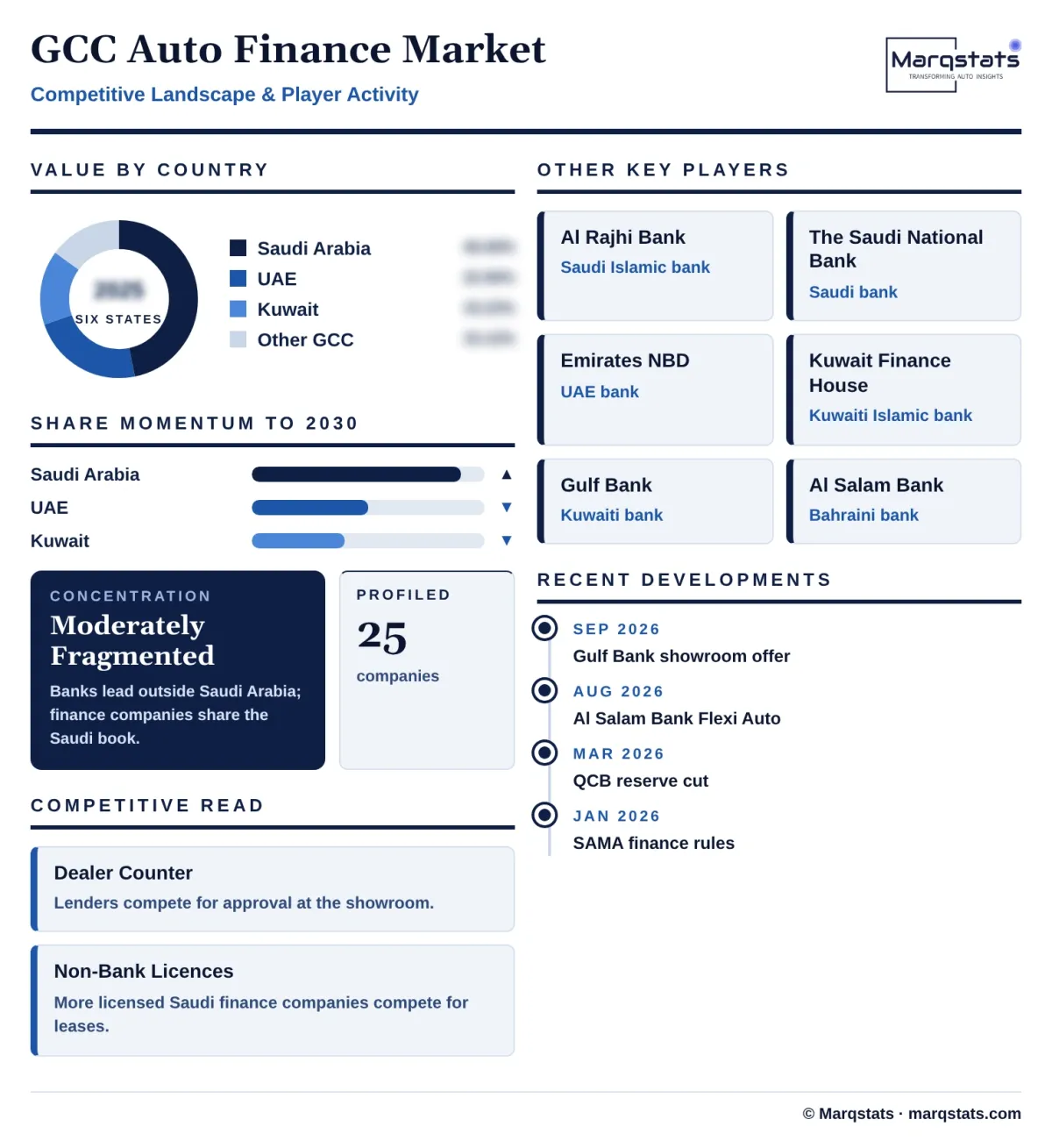
Competition sits in three layers, and the layers differ by country. Commercial banks dominate everywhere outside Saudi Arabia, where salary-assigned car loans are a standard retail product. In Saudi Arabia banks and SAMA-licensed finance companies share the lease-to-own book; the live Marqstats Saudi page places finance companies at about 55% of vehicle lease stock in 2024 and banks at about 45%.
Moderately fragmented is the right description. No regulator publishes lender shares of vehicle finance for the region, so Marqstats describes competition by layer and by dated action rather than by share. The 2025 and 2026 actions point one way: lenders are moving to the dealer counter, as with Al Rajhi Bank and Porsche Services Middle East and Africa in May 2025, Al Salam Bank and Al Haddad Motors in August 2026, and Gulf Bank at Auto World Show 2026.
The third layer is captive and marketplace finance. Abdul Latif Jameel United Finance anchors the Toyota-linked Saudi market, while platforms such as Syarah connect buyers to lenders. Marketplaces route demand; they do not yet hold balances.
Companies Covered
Companies covered in the report include:
Recent Market Activity
Table of Contents
Coverage & Segmentation
Included: the year-end gross outstanding balance of credit written to buy a specific vehicle in the six GCC states, held by commercial banks, Islamic banks and licensed finance companies, for individuals, SMEs and corporates, covering passenger cars, light commercial vehicles and trucks. Products are lease-to-own (Ijarah) contracts, Murabaha vehicle sales and conventional car loans. Excluded: operating leases and rental, unsecured personal loans not tied to a vehicle, motor insurance premiums, dealer floor-plan finance, and annual new-lending flows, which are shown only as supporting figures.
Saudi boundary and do-not-add note: the Saudi slice of USD 13.95 billion in 2025 and USD 21.70 billion in 2030 equals the live Marqstats Saudi Arabia Auto Finance Market page and uses the same definition, lease-to-own stock only. Saudi Murabaha car loans and personal finance used for cars are outside both pages. Do not add the Saudi page to this GCC total; it is already inside it. The live Saudi Arabia EV Financing and Leasing Market page is a further sub-slice of Saudi vehicle finance and must not be added either. The live UAE and Saudi vehicle rental and leasing pages measure operating revenue, a different level of the stack.