Market Snapshot
The India truck market size is estimated at USD 16,626.32 million in 2025 and is projected to reach USD 23,286.21 million by 2030, growing at a CAGR of 6.97% over 2026 – 2030. Annual sales of new goods carriers rise from 908,899 to 1,130,000, a 4.45% annual rate, while the average value per truck climbs from about INR 15.91 lakh to INR 17.93 lakh as heavier trucks, electric models and factory-fitted cabins take a larger share.
Marqstats defines the market as the value of new goods carriers registered in India each year, from small commercial vehicles and pickups up to 3.5 tonnes gross vehicle weight through light, medium and heavy trucks, tippers and tractor-trailers, in every powertrain: diesel, CNG and LNG, petrol and battery-electric. Value is counted at ex-showroom prices before Goods and Services Tax and converted at INR 87.00 per US dollar. Buses, passenger carriers, three-wheelers, trailers and separately sold bodies are excluded.
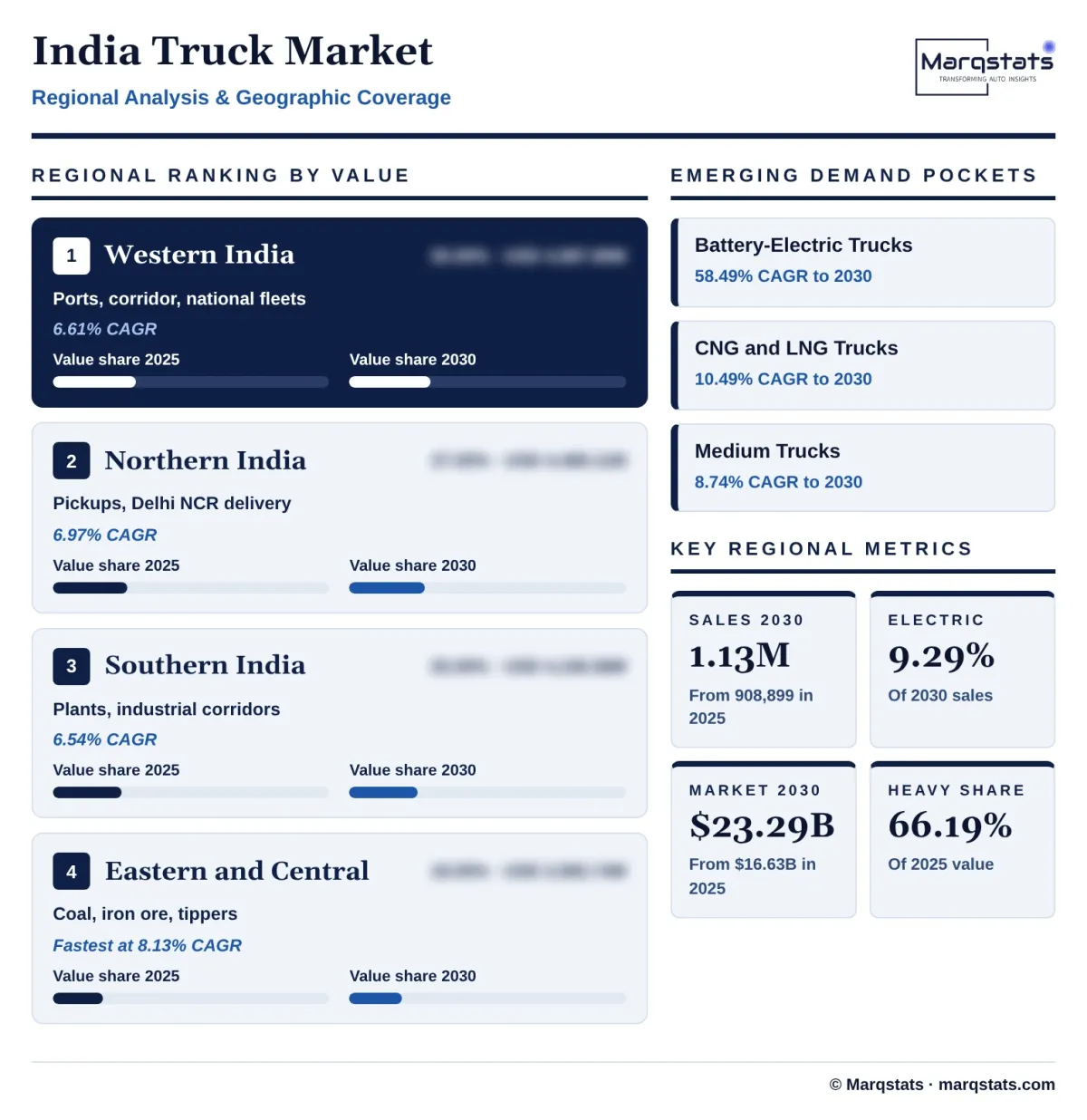
Heavy trucks above 12 tonnes account for 66.19% of 2025 value while making up only 31.93% of units, and diesel trucks account for 92.35% of value. Western India leads with 30.00% of value, while battery-electric trucks are the fastest-growing segment at 58.49% a year from a base of USD 180.00 million.
Key Takeaways
Market Overview & Analysis
Report Summary
Marqstats sizes the India truck market as the value of new goods carriers sold and registered in the country each year. It covers every goods vehicle from small commercial vehicles and pickups up to 3.5 tonnes gross vehicle weight, through light trucks of 3.5 to 7.5 tonnes and medium trucks of 7.5 to 12 tonnes, to heavy trucks above 12 tonnes, including rigid haulage trucks, tippers and tractor-trailers. All powertrains are included. Buses and passenger carriers, three-wheelers, e-rickshaws and e-carts, trailers and bodies sold separately are excluded.
The base is the Federation of Automobile Dealers Associations retail count. FADA reported 1,009,654 commercial vehicle retail sales in calendar 2025, up 6.71% from 946,190 in 2024: 611,306 light commercial vehicles, 82,423 medium vehicles, 315,170 heavy vehicles and 755 others. These totals include buses and passenger carriers, so Marqstats removes an estimated 100,000 passenger carriers and the 755 others to reach 908,899 goods carriers. The Society of Indian Automobile Manufacturers (SIAM) reported calendar 2025 commercial vehicle wholesales of about 1.03 million, up 7.7%, which confirms the scale of the retail base.
Small commercial vehicles and pickups dominate volume. Marqstats estimates 490,000 goods carriers up to 3.5 tonnes in 2025, 53.90% of units, consistent with Mahindra & Mahindra, which sold 284,930 commercial vehicles at retail in 2025, stating that it holds 54.2% of this class. Heavy trucks above 12 tonnes are only 31.93% of units, but at an average of about INR 33.00 lakh before tax, against about INR 6.00 lakh for a small commercial vehicle, they carry 66.19% of value.
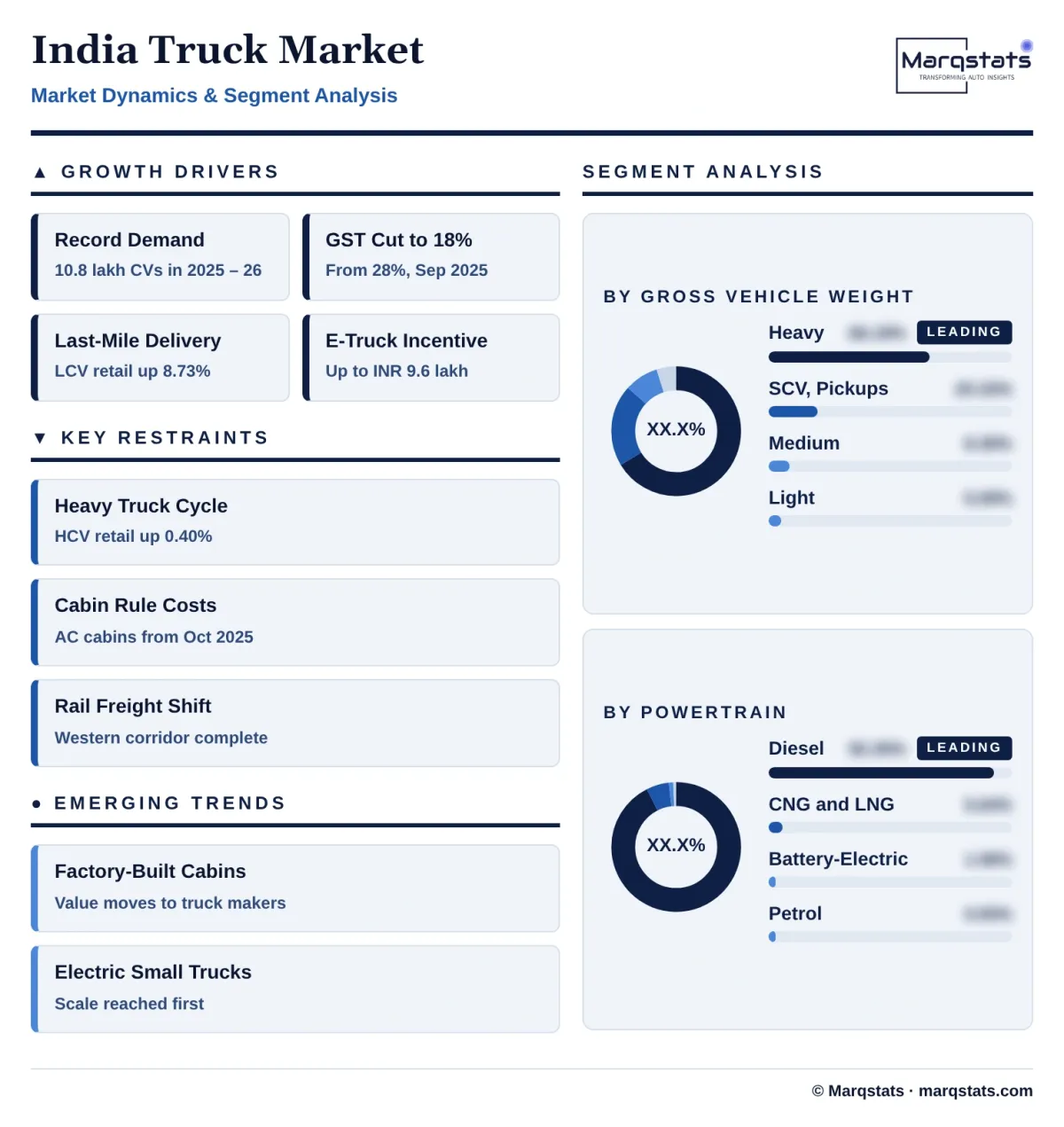
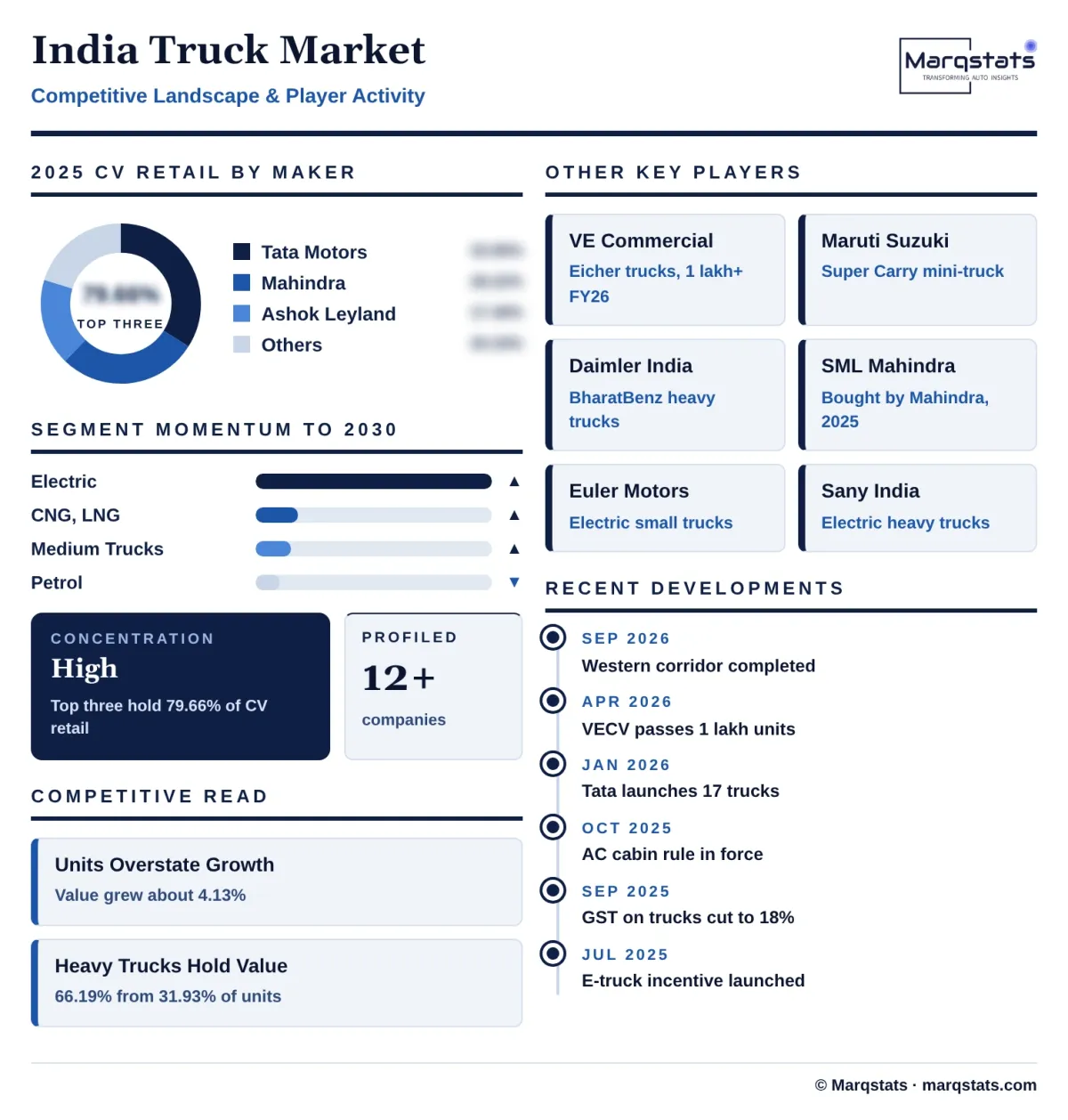
Policy changed the market sharply in the second half of 2025. The Ministry of Heavy Industries launched the first purchase incentive for electric trucks under the PM E-DRIVE scheme on 11 July 2025, the Goods and Services Tax on trucks and buses fell from 28% to 18% on 22 September 2025, and from 1 October 2025 every N2 and N3 goods vehicle manufactured in India must have an air-conditioned cabin tested to IS 14618:2022. The tax cut lowered on-road prices, while the cabin rule raised the cost of building a truck.
Demand in the fiscal year to March 2026 was the strongest on record. SIAM reported domestic commercial vehicle sales of 10.8 lakh units in 2025 – 26, up 12.6% and an all-time high, and the rating agency ICRA expects wholesale growth to moderate to 4% to 6% in 2026 – 27 after the boost from the tax cut. Marqstats therefore forecasts unit growth of about 4.45% a year to 2030, with value growing faster as the mix shifts toward heavier and electric trucks.
India Truck Market Size and Forecast
The India truck market grows from USD 16,626.32 million in 2025 to USD 23,286.21 million in 2030, a CAGR of 6.97%. Unit sales rise from 908,899 to 1,130,000 goods carriers, a 4.45% annual rate, and the average value per truck before tax rises at 2.41% a year, from about INR 15.91 lakh to INR 17.93 lakh. For 2026 Marqstats expects about 949,300 trucks worth USD 17,785.17 million, a gain of 6.97% that reflects the strong first quarter of 2026 after the tax cut.
The 2025 value is built bottom-up from weight classes and prices. Marqstats estimates 490,000 small commercial vehicles and pickups at about INR 6.00 lakh each, 61,306 light trucks at INR 12.00 lakh, 67,423 medium trucks at INR 18.00 lakh and 290,170 heavy trucks at INR 33.00 lakh, all at ex-showroom prices before Goods and Services Tax. That gives INR 144,648.96 crore, or USD 16,626.32 million at INR 87.00 per US dollar.
By 2030 Marqstats expects 610,000 small commercial vehicles, 80,000 light trucks, 90,000 medium trucks and 350,000 heavy trucks. Average prices rise to about INR 6.60 lakh, INR 13.60 lakh, INR 20.50 lakh and INR 38.00 lakh, driven by factory-fitted air-conditioned cabins, safety systems such as those Tata Motors fitted to its January 2026 range, more multi-axle trucks and a larger electric share. All values use a constant INR 87.00 per US dollar so that rupee and dollar growth rates are the same.
The electric slice is aligned with the live Marqstats India Electric Truck Market report. Battery-electric goods carriers are worth USD 180.00 million in 2025, INR 1,566.00 crore, from 11,720 units, and USD 1,800.00 million in 2030 from about 105,000 units. They are a subset of this market and should not be added to it. VAHAN recorded 17,292 electric light goods carriers and 1,637 electric heavy goods carriers in January to August 2026, which already exceeds the full 2025 totals and supports the 2026 estimate of 18,200 units.
Marqstats tracks five indicators to monitor the forecast: monthly FADA retail sales by light, medium and heavy class; SIAM wholesales and dealer stock; VAHAN registrations of electric and CNG goods vehicles; claims under the PM E-DRIVE electric truck scheme; and freight indicators such as the move of container traffic to the Western Dedicated Freight Corridor after its final sections opened in September 2026.
Market Dynamics
Key Drivers
Five forces lift demand for new goods carriers in India, and each one favours a different weight class.
- Freight demand keeps rising. SIAM reported record commercial vehicle sales of 10.8 lakh units in 2025 – 26, up 12.6%, and ICRA notes that both medium and heavy trucks and light trucks passed their 2018 – 19 volume peaks in that year. Road building, cement, steel, mining and consumer goods distribution need more trucks each year, and most freight in India still moves by road.
- The tax cut lowered the cost of buying a truck. The Goods and Services Tax on trucks and buses fell from 28% to 18% on 22 September 2025, and VE Commercial Vehicles said it would pass the full benefit to customers, cutting prices by up to INR 6 lakh on some models. A ten-point tax cut lowers the on-road price of a INR 33 lakh heavy truck by more than INR 3 lakh, which brings forward replacement purchases.
- Last-mile delivery drives small truck sales. E-commerce, quick commerce and rural trade use small commercial vehicles and pickups, and FADA reported light commercial vehicle retail up 8.73% in 2025 to 611,306 units. Mahindra & Mahindra, the leader in this class with a stated 54.2% share, and Tata Motors, Maruti Suzuki and Ashok Leyland compete for this demand.
- Heavier trucks carry more freight per trip. Fleet owners are moving from two- and three-axle trucks to multi-axle rigids and tractor-trailers, and Tata Motors launched trucks from 7 to 55 tonnes in January 2026, including the Prima E.55S electric prime mover. Each heavier truck is worth more, so value grows faster than units.
- Electric truck incentives have started. The Ministry of Heavy Industries set aside INR 500 crore of the INR 10,900 crore PM E-DRIVE scheme for electric trucks on 11 July 2025, offering up to INR 9.6 lakh per truck for up to 5,600 N2 and N3 trucks, with scrapping of an old truck required. VAHAN electric heavy goods carrier registrations rose 618% in January to August 2026 to 1,637 units.
Key Restraints
Four constraints hold the market below the pace that freight growth alone would suggest.
- Heavy truck demand is cyclical. FADA reported heavy commercial vehicle retail up only 0.40% in 2025 while light and medium classes grew strongly, and ICRA expects overall wholesale growth to slow to 4% to 6% in 2026 – 27 after the tax-cut boost. Heavy truck buyers depend on freight rates, infrastructure spending and diesel prices, which can turn quickly.
- New rules raise the cost of building a truck. From 1 October 2025 every N2 and N3 goods vehicle must have an air-conditioned cabin, and chassis sold for body building must come with an air-conditioning kit. Emission and safety rules add further cost, and fleet owners with small margins delay purchases when prices rise.
- Electric trucks remain costly and hard to charge. Heavy electric trucks cost several times a diesel truck, and the PM E-DRIVE scheme requires a scrapping certificate for an old truck before the incentive is paid, which excludes fleets that are growing rather than replacing. Only about 565 medium and heavy electric goods carriers were registered in 2025, against scheme support for up to 5,600 trucks.
- Rail takes some long-haul freight. The 1,506 kilometre Western Dedicated Freight Corridor was completed when its final 326 kilometres, including the section to New JNPT, were dedicated on 8 September 2026. Container traffic between the north and the western ports can shift from road to rail, which reduces demand for long-haul tractor-trailers on that route even as it raises demand for short-haul trucks at rail terminals.
Key Trends
Four shifts are changing which trucks Indian fleets buy, how they are built and what they run on.
- Factory-built cabins replace body-builder cabins. The air-conditioned cabin rule from October 2025 moves cabin value from local body builders to truck makers, and new ranges such as Tata Motors Azura and the upgraded Signa and Prima lines come with factory cabins and up to 23 active safety features.
- Small electric goods carriers reach scale first. Tata Motors registered about 7,867 electric commercial vehicles in January to August 2026, mostly small commercial vehicles, and Euler Motors 4,637, while electric heavy trucks remain concentrated at ports, steel plants and mines.
- Ownership of the industry is changing. Tata Motors split its commercial vehicle business into a separate listed company from 1 October 2025, while Mahindra & Mahindra bought 58.96% of SML Isuzu for INR 555 crore in 2025 and renamed it SML Mahindra.
- Gas grows in light and medium trucks. CNG trucks gain share in city distribution where gas stations are dense, and LNG is tested on heavy routes for cement and steel, while petrol small commercial vehicles lose share to CNG and electric models.
Strategic Implications
- For truck makers, the money is in heavy trucks but the growth in units is in light and medium classes. A maker that wins only small commercial vehicles holds a large unit share but a small value share, so Mahindra & Mahindra bought SML Isuzu to reach the trucks above 3.5 tonnes that make up most of the 79.67% of value outside the small class.
- For fleet owners, the tax cut and new cabin rule change the timing of purchases. On-road prices fell in September 2025 while build costs rose in October 2025, so buyers that placed orders in the fourth quarter of 2025 captured most of the tax benefit, and later buyers face higher prices before tax.
- For electric truck makers, the first profitable buyers are captive fleets at ports, steel plants, cement works and mines where trucks return to one charging point. The PM E-DRIVE scrapping condition favours fleets that replace old trucks, so makers should target operators with ageing fleets rather than growing start-ups.
- For component suppliers, cabin air-conditioning, safety electronics, telematics and battery systems gain content per truck. Each heavy truck sold after October 2025 carries an air-conditioning system, and electric trucks need batteries, motors and power electronics that the PM E-DRIVE rules push toward domestic sourcing.
- For lenders and lessors, the market is worth about INR 1.45 lakh crore a year before tax, but value is concentrated in heavy trucks whose demand is cyclical. Truck leasing and finance revenue is a separate market and should not be added to this one.
Market Segmentation
Small commercial vehicles and pickups up to 3.5 tonnes account for 53.90% of 2025 units but only 20.33% of value, USD 3,379.31 million from 490,000 units, and grow at 6.49% a year to USD 4,627.59 million. Mahindra & Mahindra leads with its Bolero pickups and states a 54.2% share, followed by Tata Motors with the Ace and Intra, Maruti Suzuki with the Super Carry and Ashok Leyland with the Dost range. Most electric goods carriers sold in 2025 fall in this class.
Light trucks of 3.5 to 7.5 tonnes account for 5.09% of 2025 value, USD 845.60 million from 61,306 units, and grow at 8.14% a year to USD 1,250.57 million. Tata Ultra, Eicher Pro 2000 series and Ashok Leyland Bada Dost and Partner models serve parcel, food and city distribution, and this class benefits from the move of city deliveries from small pickups to larger trucks.
Medium trucks of 7.5 to 12 tonnes account for 8.39% of 2025 value, USD 1,394.96 million from 67,423 units, and grow fastest among weight classes, at 8.74% a year, to USD 2,120.69 million. FADA reported medium commercial vehicle retail up 19.65% in 2025, VE Commercial Vehicles sold 47,789 light and medium duty trucks in 2025 – 26, and the Tata Motors Azura range launched in January 2026 targets the same regional distribution and hub-and-spoke work.
Heavy trucks above 12 tonnes account for 66.19% of 2025 value, USD 11,006.45 million from 290,170 units, and grow at 6.79% a year to USD 15,287.36 million. Tata Motors, Ashok Leyland, VE Commercial Vehicles and Daimler India Commercial Vehicles lead with Signa, Prima, AVTR, Eicher Pro 6000 and BharatBenz trucks, and growth comes from multi-axle rigids, tippers and tractor-trailers rather than from more units.
Diesel trucks account for 92.35% of 2025 value, USD 15,353.22 million from 771,179 units, and grow at 5.25% a year to USD 19,826.44 million while their share of value falls to 85.15%. Nearly all heavy trucks run on diesel, and the diesel share of units falls from 84.85% to 76.55% as CNG and electric models take light and medium sales.
Gas trucks account for 5.64% of 2025 value, USD 937.93 million from about 96,000 units, and grow at 10.49% a year to USD 1,544.83 million. CNG small commercial vehicles and light and medium trucks from Tata Motors, Ashok Leyland, Mahindra & Mahindra and VE Commercial Vehicles serve city distribution where gas stations are dense, while LNG heavy trucks remain at trial scale.
Petrol goods carriers account for 0.93% of 2025 value, USD 155.17 million from about 30,000 units, and decline at -5.83% a year to USD 114.94 million. They are mainly the smallest mini-trucks and van-based carriers, where buyers are moving to CNG and electric versions with lower running costs.
Battery-electric goods carriers account for 1.08% of 2025 value, USD 180.00 million from 11,720 units, and grow fastest, at 58.49% a year, to USD 1,800.00 million and 7.73% of value. VAHAN recorded 11,155 electric light goods carriers and about 565 heavier electric goods carriers in 2025. These figures match the live Marqstats India Electric Truck Market report and are a subset of this market.
Last-mile and distribution trucks up to 7.5 tonnes account for 25.41% of 2025 value, USD 4,224.91 million from 551,306 units, and grow at 6.83% a year to USD 5,878.16 million. They carry parcels, groceries, farm produce and building materials within cities and between towns and villages.
Regional and long-haul haulage trucks, medium trucks and heavy rigid cargo trucks, account for 42.47% of 2025 value, USD 7,061.63 million from 237,423 units, and grow at 6.57% a year to USD 9,706.90 million. This is the largest application by value and the one most exposed to the move of container freight to the dedicated freight corridors.
Tippers account for 21.02% of 2025 value, USD 3,494.25 million from about 80,000 units, and grow at 7.43% a year to USD 5,000.00 million. Road building, coal and iron ore mining, quarries and cement plants buy multi-axle tippers, and the Tata Prima E.28K is among the first electric tippers in the market.
Tractor-trailers account for 11.10% of 2025 value, USD 1,845.53 million from about 40,170 tractors, and grow fastest among applications, at 7.92% a year, to USD 2,701.15 million. Container, steel and cement haulage use them, and ports and steel plants are the first buyers of electric prime movers such as the Tata Prima E.55S. Trailers themselves are counted in the separate Marqstats India Truck Trailer Market report.
By Geography
Western India
Western India, covering Maharashtra, Gujarat, Rajasthan and Goa, accounts for 30.00% of 2025 value, USD 4,987.89 million, and grows at 6.61% a year to USD 6,869.43 million. JNPT, Mundra and Kandla ports, the Western Dedicated Freight Corridor and the industrial belts around Pune, Ahmedabad and Surat create the largest demand for tractor-trailers and multi-axle trucks, and many national fleets register trucks here. Growth is slightly below the national rate as some container traffic shifts to rail.
Northern India
Northern India, covering Uttar Pradesh, Delhi NCR, Haryana, Punjab, Uttarakhand and the hill states, accounts for 27.00% of 2025 value, USD 4,489.11 million, and grows at 6.97% a year to USD 6,287.28 million. Uttar Pradesh is a large market for pickups and small commercial vehicles bought by farmers and traders, while Delhi NCR rules favour CNG and electric trucks for city delivery.
Southern India
Southern India, covering Tamil Nadu, Karnataka, Andhra Pradesh, Telangana and Kerala, accounts for 25.00% of 2025 value, USD 4,156.58 million, and grows at 6.54% a year to USD 5,705.12 million. Ashok Leyland, Daimler India Commercial Vehicles and Tata Motors plants and the Chennai and Bengaluru industrial corridors support strong demand for intermediate and heavy trucks.
Eastern and Central India
Eastern and Central India, covering Madhya Pradesh, Chhattisgarh, Odisha, Jharkhand, Bihar, West Bengal and the North East, accounts for 18.00% of 2025 value, USD 2,992.74 million, and grows fastest, at 8.13% a year, to USD 4,424.38 million. Coal, iron ore and steel production and new road building create demand for tippers and heavy haulage trucks, and the Eastern Dedicated Freight Corridor adds terminal traffic.
How Competition Is Evolving
The market is highly concentrated. FADA reported that Tata Motors sold 342,766 commercial vehicles at retail in 2025, a 33.95% share, Mahindra & Mahindra 284,930, Ashok Leyland 176,574 and VE Commercial Vehicles 83,967, followed by Maruti Suzuki with 47,837, Force Motors with 25,901, Daimler India Commercial Vehicles with 20,911 and SML with 14,192. These figures include buses and passenger carriers, but the top three together held 79.66% of commercial vehicle retail sales.
Leadership differs by weight class. Mahindra & Mahindra leads small commercial vehicles and pickups and says it holds 54.2% of light commercial vehicles below 3.5 tonnes but only about 3% above 3.5 tonnes. Tata Motors is strong in every class and leads medium and heavy goods carriers, followed by Ashok Leyland and VE Commercial Vehicles. Daimler India Commercial Vehicles sells BharatBenz heavy trucks and tippers.
Ownership changes are reshaping competition. Tata Motors demerged its commercial vehicle business into a separate company effective 1 October 2025, and the new company was listed on 12 November 2025. Mahindra & Mahindra completed the purchase of 58.96% of SML Isuzu at INR 650 a share, INR 555 crore, in 2025, and aims for 10% to 12% of the commercial vehicle market by 2030 – 31.
Electric trucks bring new competitors. In January to August 2026 Euler Motors registered 4,637 electric commercial vehicles and Sany Heavy Industry 797 heavy electric trucks, while Tata Motors led with about 7,867. Switch Mobility, Blue Energy Motors, IPLTech Electric and Montra Electric also compete, mostly in ports, steel and mining applications where trucks run on fixed routes.
Companies Covered
Companies covered in the report include:
Recent Market Activity
Table of Contents
Coverage & Segmentation
The study covers the India truck market, with 2025 as the base year, 2021 – 2025 as the historical period and 2026 – 2030 as the forecast period. It covers new goods carriers of categories N1, N2 and N3, from small commercial vehicles and pickups up to 3.5 tonnes to heavy trucks, tippers and tractor-trailers, in all powertrains, segmented by gross vehicle weight, powertrain, application and region. Values are ex-showroom prices before Goods and Services Tax, converted at INR 87.00 per US dollar, the 2025 average.
Buses and passenger carriers, three-wheelers including L5 cargo vehicles, e-rickshaws and e-carts, trailers, bodies sold separately, used trucks, tractors and off-road equipment are excluded. The live Marqstats India Electric Truck Market report covers the battery-electric subset of this market, and the live India Truck Body Building and India Truck Trailer reports cover equipment fitted to or pulled by these trucks; none of them should be added to this market. Truck leasing and finance revenue is a separate market and is not additive to vehicle sales. The electric slice uses the VAHAN count of 11,720 electric goods carriers in 2025, 11,155 light and 565 medium and heavy, the same count as the Marqstats India Electric Commercial Vehicle Market report, which values them at USD 193.25 million on its own price assumptions, while the India truck market keeps USD 180.00 million to match the live India Electric Truck Market report, whose wider electric truck taxonomy includes medium N2 trucks.