Market Snapshot
Middle bar: base-year value × (1 + CAGR), rounded to two decimals. This is a calculated illustration, not a separately researched annual estimate.
The Guatemala used car market size is estimated at USD 2,271.43 million in 2025 and is projected to reach USD 3,415.73 million by 2030, growing at a CAGR of 8.50% over 2026 – 2030. Used vehicle transactions rise from 265,000 to 332,000, with SUVs and crossovers leading at 41.00% of 2025 volume.
Guatemala builds no cars, and most of its fleet arrives used from the United States. The Superintendencia de Administración Tributaria (SAT) reported that the national vehicle fleet grew 8.81% in 2025 to about 6.33 million vehicles, half of them motorcycles. Marqstats estimates 265,000 used four-wheel vehicle transactions in 2025: about 119,000 imported used vehicles and 146,000 domestic ownership transfers (traspasos). At an average of Q65,400, the market was worth Q17,331 million, converted at Q7.63 per US dollar.
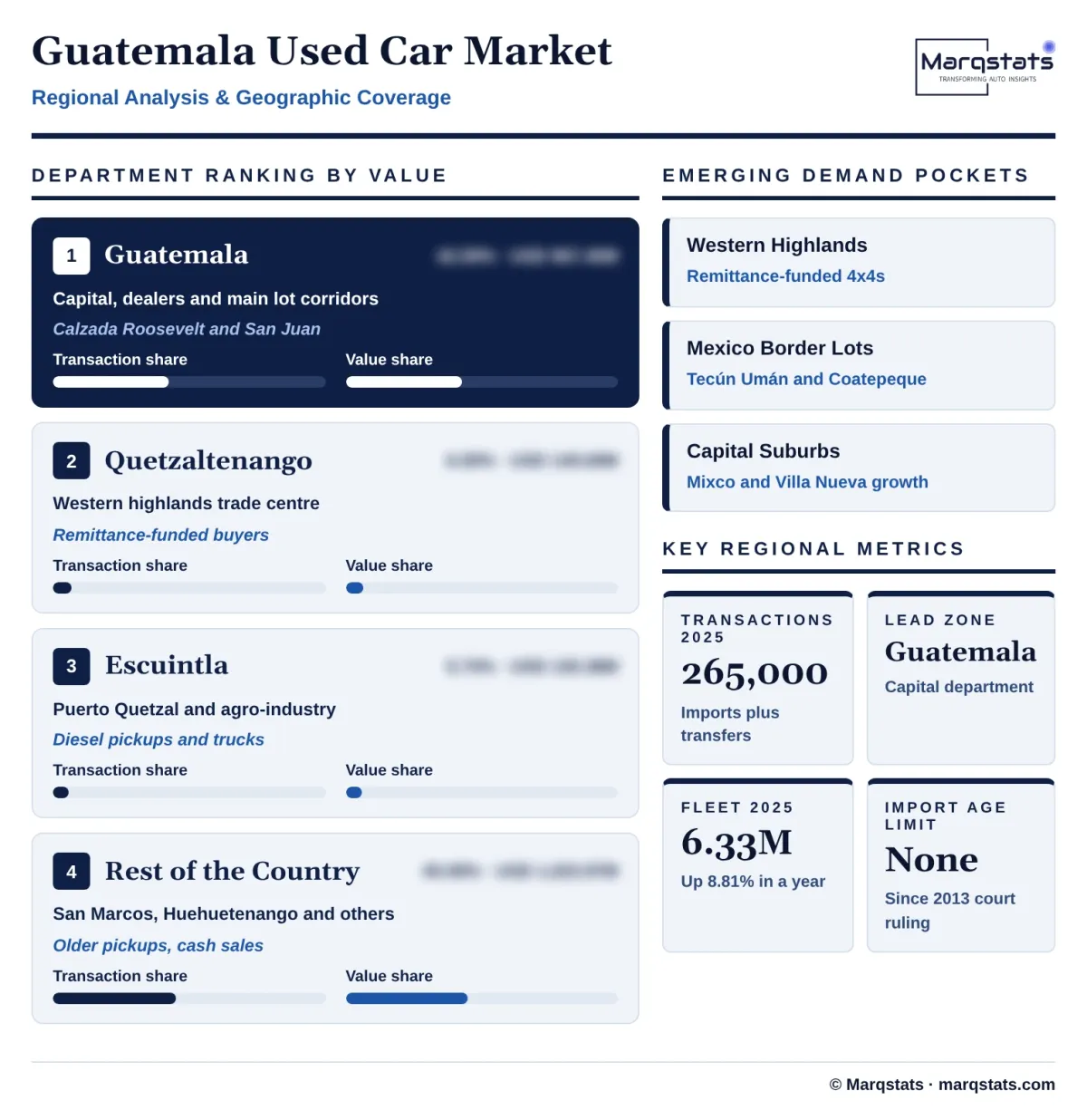
Demand is concentrated in the capital. The department of Guatemala accounts for an estimated 42.59% of transactions, followed by Quetzaltenango at 6.59% and Escuintla at 5.74%. The study segments the market by vehicle type (SUVs and crossovers, pickups, sedans and hatchbacks, and vans), sales channel and powertrain (gasoline, diesel, hybrid and battery electric).
Key Takeaways
Market Overview & Analysis
Report Summary
Marqstats sizes the Guatemala used car market as the value of all used four-wheel light vehicle transactions in a year: imported used vehicles cleared through customs and registered for the first time, and domestic ownership transfers registered with SAT through notarial deeds. In 2025 these totalled an estimated 265,000 transactions, about 119,000 imports and 146,000 transfers. Transactions are valued at an average of Q65,400 based on lot, dealer and listing prices, converted at Q7.63 per US dollar, the Banco de Guatemala reference rate, which has been stable at about Q7.62 to Q7.64.
Import costs are moderate and do not depend on age. Imported passenger cars and light trucks pay no import duty, but pay 12% VAT and a first-registration tax (IPRIMA) on SAT reference values, which vary by vehicle category. Domestic transfers of cars four or more model years old pay a flat transfer tax of Q500, and those two to three years old Q1,000, which keeps transfer costs low for older cars.
The fleet is old and growing fast. Private vehicles built in 1999 or earlier make up about 36% of the private fleet, and those built from 2020 onward about 7%. The 2007 model year is the single largest group of cars on the road. Fleet growth of nearly 9% in 2025 shows that imports keep adding vehicles faster than old ones are retired.
Japanese brands dominate. Toyota accounts for about 896,000 registered private vehicles, about 41% of the private fleet, followed by Honda with about 241,000, Mazda with about 196,000, Nissan with about 134,000 and Mitsubishi with about 101,000. Korean brands Hyundai and Kia and American brands Chevrolet and Ford follow. This concentration means parts and repair skills for Toyota, Honda and Mazda are widely available, which supports the resale value of these brands and keeps older cars on the road for decades.
The forecast rests on three conditions. Remittances keep growing at a moderate pace, the open import regime and salvage supply from US auctions remain in place, and the quetzal stays stable against the dollar. Under these conditions transactions reach 332,000 in 2030 and market value USD 3,415.73 million.
Guatemala Used Car Market Size and Forecast
The Guatemala used car market grows from USD 2,271.43 million in 2025 to USD 3,415.73 million in 2030, a CAGR of 8.50%. In local currency the market grows from Q17,331 million to Q26,062 million at the same rate, because the quetzal is held stable against the dollar. Transactions grow from 265,000 to 332,000, a 4.61% annual rate, with imports rising to about 138,000 and domestic transfers to about 194,000.
Value grows faster than volume, by about 3.9 percentage points a year. SUVs, hybrids and younger cars carry higher prices, repair and parts costs are rising, and franchise dealers sell a larger share of late-model stock. Domestic transfers grow faster than imports as the fleet expands and digital registration makes transfers easier.
Market Dynamics
Key Drivers
Five conditions drive strong growth in both transactions and value.
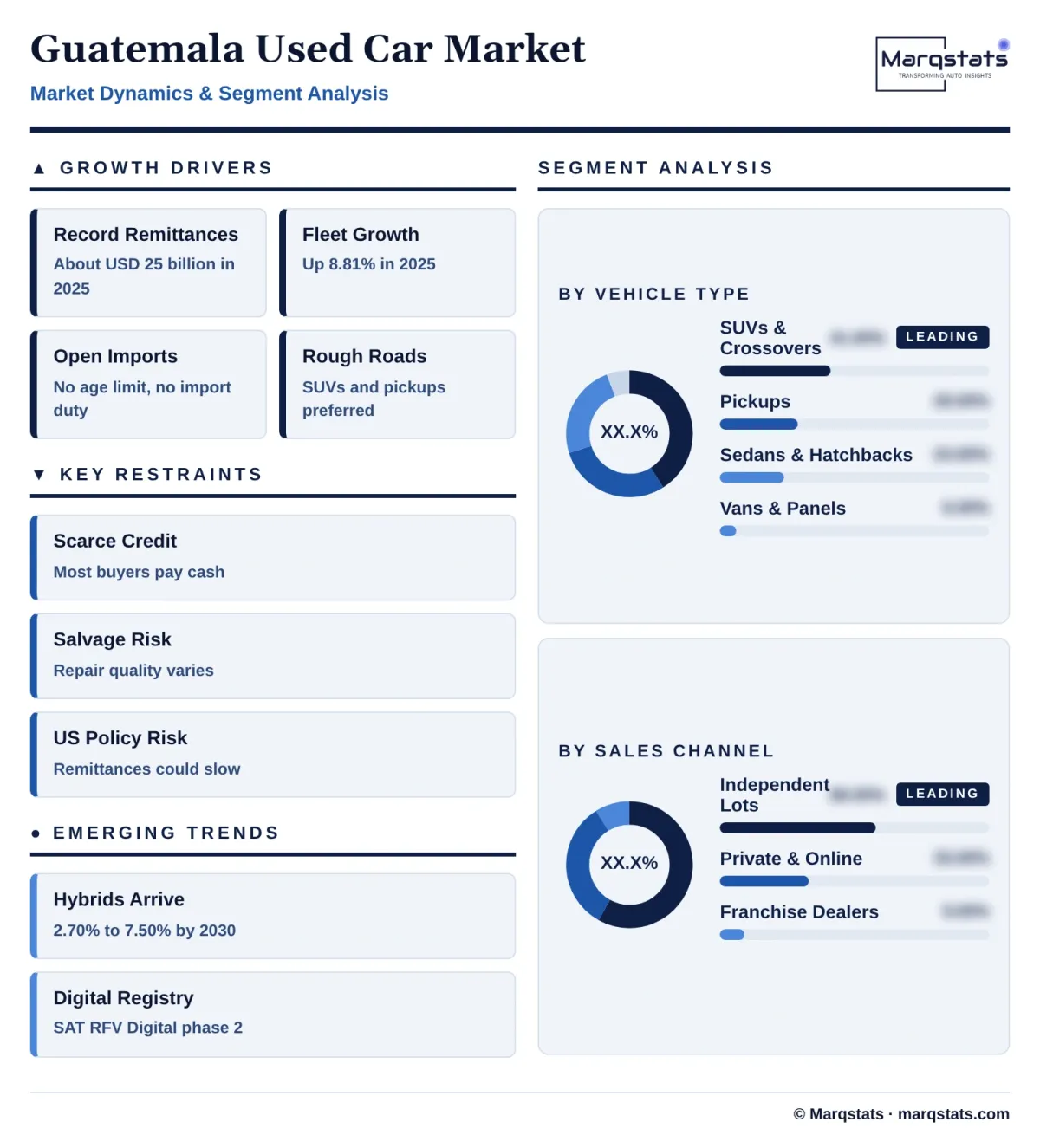
- Remittances keep rising. Record remittances of about USD 25 billion in 2025 give millions of households cash to buy vehicles, particularly in western and rural departments where bank credit is scarce. Remittance-funded purchases are typically paid in cash or by bank transfer when the notarial deed is signed, and buyers often choose pickups and SUVs that can serve both family and work needs.
- The fleet is growing fast. SAT reported fleet growth of 8.81% in 2025, adding more than half a million vehicles. Every car added becomes future used supply, and domestic transfers grow faster than imports.
- Open imports keep prices low. With no age limit and no import duty, importers can bring in cars of any age from US auctions, repair them locally and sell them at prices households can afford. Salvage cars typically cost USD 3,200 to USD 4,800 at auction, plus about USD 1,900 to USD 2,200 for shipping and Q8,000 to Q14,000 for local repair. This cost structure lets lots sell late-model SUVs and pickups at prices well below those of franchise dealers.
- Roads favour SUVs and pickups. Unpaved rural roads, mountainous terrain and urban flooding make SUVs and pickups the preferred vehicles, and they carry higher prices than sedans, lifting the average transaction value.
- Banks are lending on younger used cars. Banco Industrial and BAC Credomatic offer used car loans of up to five years through franchise dealers, helping buyers afford late-model certified cars. As the digital registry makes title checks faster, lenders are expected to extend these loans to a wider range of used vehicles.
Key Restraints
Four constraints hold back the formal side of the market.
- Most buyers cannot get credit. Bank loans are largely limited to certified cars sold by franchise dealers, so most buyers at independent lots and in private sales pay cash, use remittances or split payments on credit cards. This caps how much buyers can spend.
- Repaired salvage cars carry hidden risk. Many imported cars have been in accidents, and the quality of local repairs varies. Buyers face uncertainty about structural damage and safety, which lowers resale values and favours dealers who offer inspection and warranty. Imported vehicles must pass VIN checks against US title databases, but the quality of local repairs is not formally inspected.
- Remittances depend on US policy. A large share of vehicle demand in the western departments is funded by remittances. Tighter US immigration enforcement or slower US job growth would reduce remittances and vehicle purchases.
- Congestion and road capacity limit car use. Rapid fleet growth has caused severe congestion in Guatemala City and its suburbs, and poor roads raise maintenance costs. Some households are turning to motorcycles, which make up about half the fleet. Motorcycle registrations grew 13.2% in 2025, faster than four-wheel vehicles, and compete with cheap used cars for first-time buyers.
Key Trends
Four shifts are changing how used cars are imported, sold and registered.
- Hybrids are entering the market. Tax incentives for electric vehicles under Decree 40-2022 and higher fuel prices are encouraging imports of hybrids such as the Toyota Prius. Hybrids rise from 2.70% of transactions in 2025 to 7.50% by 2030, growing at 33.10% a year in value.
- Franchise dealers are expanding certified used sales. Cofiño Stahl Usados, Excel Usados of Grupo Poma, Grupo Q Usados and Continental Motores sell inspected, warranted cars with bank finance. Their share rises from 9.00% of transactions in 2025 to 11.00% by 2030. Dealers source most of this stock from trade-ins on new-car sales and from corporate fleet returns.
- Online platforms set prices. Encuentra24 and Facebook Marketplace carry most private listings, giving buyers and lots a common price reference, while notarial agents handle the legal transfer. Many lots now advertise their full stock online, and buyers compare prices across departments before travelling to view a car.
- SAT is digitising the vehicle registry. The second phase of RFV Digital, launched in June 2026, moved used-vehicle document replacements online, and a third phase will digitise ownership transfers, reducing the time and cost of formal sales.
Strategic Implications
- For franchise dealers, regional expansion is the opportunity. Most demand outside the capital is served by independent lots. Dealer groups that open certified used sites in Quetzaltenango and Escuintla and offer bank finance can capture remittance-funded buyers who want quality and warranty.
- For independent importers, quality will matter more. Buyers are becoming more cautious about repaired salvage cars. Importers that source cleaner, later-model cars and hybrids, and offer basic inspection and warranty, will hold their prices better.
- For aftermarket suppliers and repair shops, the old fleet is a large, steady market. With two thirds of private cars built in 2009 or earlier and a constant flow of repaired auction imports, demand for body repair, parts and servicing is strong. Suppliers that stock parts for Toyota, Honda and Mazda models and support hybrid repair will benefit as the fleet ages and electrifies.
- For lenders, the digital registry opens new lending. Once ownership transfers are digital, banks and fintech lenders can check titles, outstanding taxes and liens and register their own pledges quickly, making it practical to lend on three- to eight-year-old cars that are now bought with cash.
- The main uncertainty is remittances. The base case assumes remittances keep growing moderately. A sharp fall would reduce demand in western departments, while continued strong growth would push transactions above the base case.
Market Segmentation
SUVs and crossovers account for an estimated 108,650 transactions in 2025, 41.00% of the market and USD 931.29 million. They are the largest and fastest-growing vehicle type, rising to 142,760 transactions and 43.00% by 2030, with value growing at 9.54% a year to USD 1,468.76 million. The Honda CR-V, Toyota RAV4, Mazda CX-5 and Nissan Rogue lead.
Light pickups account for an estimated 76,850 transactions in 2025, 29.00% of the market and USD 658.71 million, rising to 96,280 transactions and USD 990.56 million by 2030, an 8.50% value CAGR. Farmers, traders and contractors rely on the Toyota Hilux, Toyota Tacoma, Ford Ranger and Isuzu D-Max.
Sedans and hatchbacks account for an estimated 63,600 transactions in 2025, 24.00% of the market and USD 545.14 million. Their share falls to 22.00% by 2030 as buyers move to crossovers, with value growing at 6.63% a year to USD 751.46 million. The Toyota Corolla, Toyota Yaris, Honda Civic and Mazda 3 lead.
Vans and light commercial panels account for an estimated 15,900 transactions in 2025, 6.00% of the market and USD 136.29 million, rising to USD 204.94 million by 2030. Delivery firms and passenger transport operators use the Toyota HiAce, Hyundai H-1 and Chevrolet N400.
Independent lots and importers account for an estimated 58.00% of 2025 transactions, about 153,700 vehicles worth USD 1,317.43 million. They import and repair US auction cars and sell mainly for cash. Their share eases to 56.00% by 2030, with value growing at 7.74% a year to USD 1,912.81 million.
Private sales arranged through Encuentra24, Facebook Marketplace and personal networks account for an estimated 33.00% of 2025 transactions, about 87,450 vehicles worth USD 749.57 million, rising to USD 1,127.19 million by 2030, an 8.50% value CAGR.
Franchise dealers and certified programmes account for an estimated 9.00% of 2025 transactions, about 23,850 vehicles worth USD 204.43 million. They are the fastest-growing channel, rising to 11.00% and USD 375.73 million by 2030, a 12.94% value CAGR, as banks extend used car loans through dealers.
Gasoline vehicles account for an estimated 201,400 transactions in 2025, 76.00% of the market and USD 1,726.29 million. Their share falls to 70.00% by 2030, with value growing at 6.73% a year to USD 2,391.01 million.
Diesel vehicles account for an estimated 55,650 transactions in 2025, 21.00% of the market and USD 477.00 million, concentrated in pickups, vans and work vehicles. They hold their share through 2030, reaching USD 717.30 million, an 8.50% value CAGR.
Hybrids account for an estimated 7,155 transactions in 2025, 2.70% of the market and USD 61.33 million. They rise to 24,900 transactions and 7.50% by 2030, with value growing at 33.10% a year to USD 256.18 million, led by the Toyota Prius, RAV4 Hybrid and other imported hybrids.
Battery electric vehicles account for an estimated 795 transactions in 2025, 0.30% of the market and USD 6.81 million, and are the fastest-growing powertrain. They rise to 4,980 transactions and 1.50% by 2030, a 49.70% value CAGR, though charging remains limited outside the capital.
By Geography
Guatemala
The department of Guatemala, including Guatemala City, Mixco and Villa Nueva, holds 42.59% of the national fleet and an estimated 112,864 used vehicle transactions in 2025, worth USD 967.40 million. Franchise dealers, lenders and most independent lots are concentrated along Calzada Roosevelt, Calzada San Juan and Calzada Aguilar Batres, and imported cars from the ports are distributed from here. Rapid growth in the suburbs of Mixco and Villa Nueva adds tens of thousands of vehicles each year and keeps demand for compact SUVs and sedans high.
Quetzaltenango
Quetzaltenango accounts for an estimated 6.59% of transactions, about 17,464 vehicles worth USD 149.69 million. As the commercial centre of the western highlands it has a dense network of used car lots, and remittances fund many purchases. Buyers from neighbouring highland departments travel to Quetzaltenango lots for wider choice and better prices.
Escuintla
Escuintla accounts for an estimated 5.74% of transactions, about 15,211 vehicles worth USD 130.38 million. Puerto Quetzal and agro-industry drive demand for diesel pickups and work trucks. Sugar, palm oil and logistics companies buy and sell light vehicles regularly, adding fleet stock to the local used market.
San Marcos
San Marcos accounts for an estimated 4.52% of transactions, about 11,978 vehicles worth USD 102.67 million. Cross-border trade with Mexico and high remittance inflows support demand for pickups and SUVs. Lots in Tecún Umán and Coatepeque, near the border, serve buyers from across the south-west.
Huehuetenango
Huehuetenango accounts for an estimated 3.97% of transactions, about 10,520 vehicles worth USD 90.18 million. Mountainous terrain makes four-wheel-drive pickups and SUVs essential, and remittances fund most purchases. Toyota Hilux and Tacoma pickups command premium prices because of their durability on steep, unpaved roads.
Rest of the Country
The remaining seventeen departments account for an estimated 36.59% of transactions, about 96,964 vehicles worth USD 831.12 million. Rural buyers favour older pickups and sedans bought for cash, often from lots in the capital or Quetzaltenango, and vehicles stay in service for many years. Sololá has the smallest share of the national fleet, at about 1%. Departmental shares are a Marqstats allocation based on the SAT fleet distribution.
How Competition Is Evolving
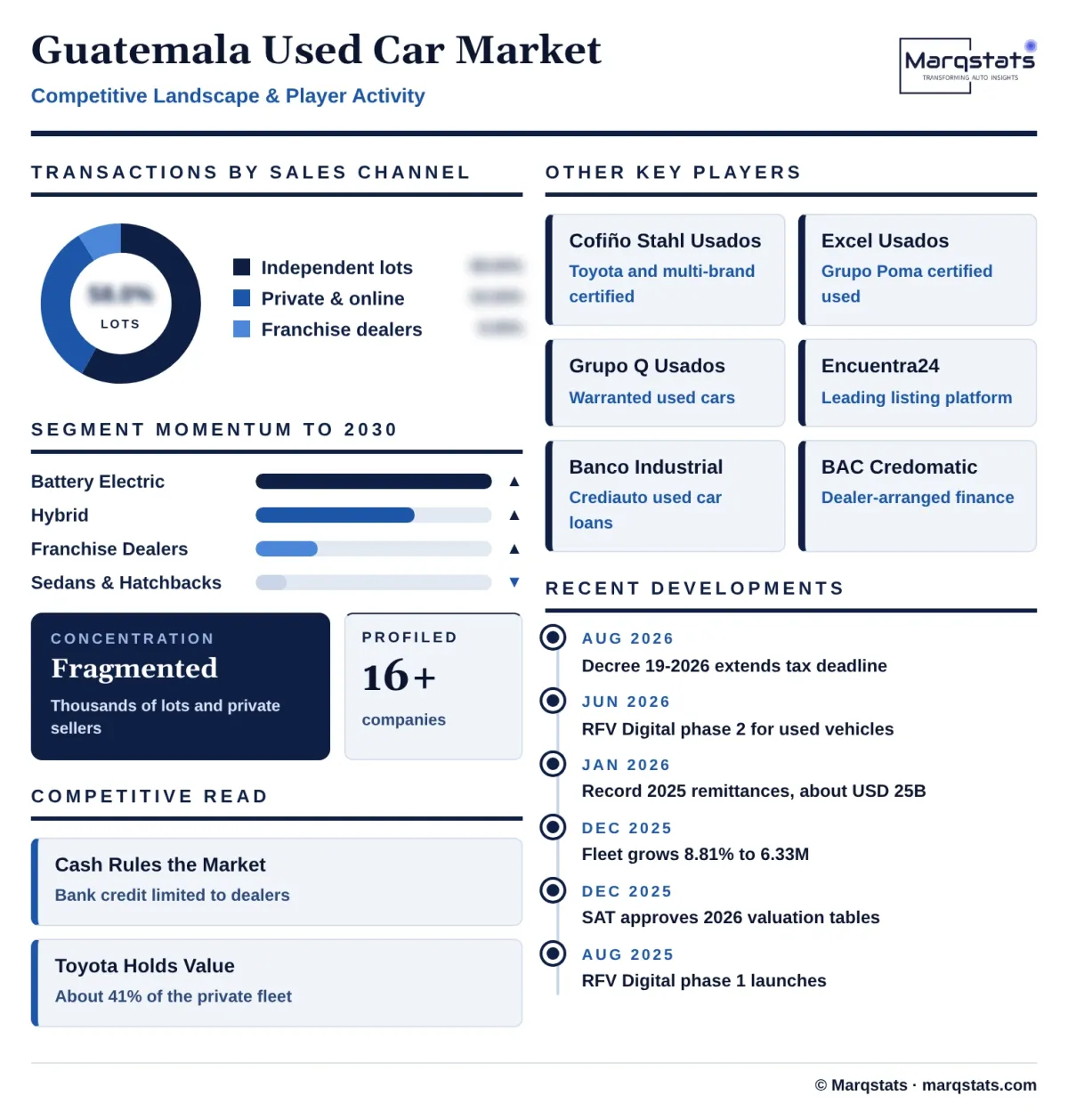
The Guatemala used car market is highly fragmented. Thousands of independent lots compete with private sellers and a handful of franchise dealer groups. Marqstats estimates independent lots handle 58.00% of transactions, private and online sales 33.00% and franchise dealers 9.00%. No single seller holds a meaningful share.
Franchise dealer groups lead the formal market. Cofiño Stahl Usados draws on trade-ins from its Toyota, Chevrolet, Subaru, Audi and Land Rover franchises and sells from sites on Calzada Roosevelt and Carretera a El Salvador. Excel Usados, part of Grupo Poma, sells used Mitsubishi, Nissan, Ford, BMW and Kia vehicles, and Grupo Q Usados and Continental Motores serve buyers who want documented, warranted cars.
Independent importers dominate volume. Lots along the main avenues of Guatemala City and in Quetzaltenango, Tecún Umán and Coatepeque import repaired US auction cars, and their trade body, the Gremial de Importadores de Vehículos Usados, has successfully defended the open import regime in the courts.
Payment methods divide the market. Franchise dealers sell with bank loans secured by a registered pledge on the vehicle, typically over 12 to 60 months. Independent lots and private sellers rely on cash, remittance transfers, short-term promissory notes and credit card instalment plans for amounts up to about Q40,000. As a result, franchise dealers serve mostly salaried, urban buyers, while lots serve the much larger cash market across the country.
Finance and platforms shape access. Banco Industrial and BAC Credomatic provide most dealer-arranged car loans, while Encuentra24 and Facebook Marketplace are the main listing platforms. As SAT digitises transfers, dealers and lenders that combine verified cars, finance and fast registration are best placed to take share from informal sales.
Companies Covered
Companies covered in the report include:
Recent Market Activity
Table of Contents
Coverage & Segmentation
The study covers the Guatemala used car market nationally, with 2025 as the base year, 2021 – 2025 as the historical period and 2026 – 2030 as the forecast period. Values are in US dollars, converted from quetzales at Q7.63 per US dollar. The market is defined as the value of used four-wheel light vehicle transactions, including cars, SUVs, pickups and vans: imported used vehicles registered for the first time and domestic ownership transfers. It is segmented by vehicle type, sales channel and powertrain.
Motorcycles, heavy trucks and buses are excluded, as are new-vehicle sales and finance, insurance and aftersales revenue. The import and transfer counts, the average transaction value and the vehicle type, channel, powertrain and departmental splits are Marqstats estimates built on SAT fleet data and lot, dealer and listing prices.