Market Snapshot
Middle bar: base-year value × (1 + CAGR), rounded to two decimals. This is a calculated illustration, not a separately researched annual estimate.
The Costa Rica used car market size is estimated at USD 2,514.40 million in 2025 and is projected to reach USD 3,447.01 million by 2030, growing at a CAGR of 6.51% over 2026 – 2030. Used light vehicle transactions rise from 224,500 to 268,250, with SUVs leading at 46.50% of 2025 volume.
Costa Rica buys about 3.3 used vehicles for every new one registered. In 2025 the market recorded an estimated 224,500 used light vehicle transactions: 198,700 domestic title transfers (traspasos) registered at the Registro Nacional through notarial deeds, and 25,800 first registrations of imported used vehicles cleared by the Dirección General de Aduanas. At an average transaction value of USD 11,200, the market was worth USD 2,514.40 million. The fleet keeps growing: the Instituto Nacional de Seguros (INS) billed 1,943,587 vehicle circulation permits (marchamos) in November 2025, about 58,000 more than a year earlier.
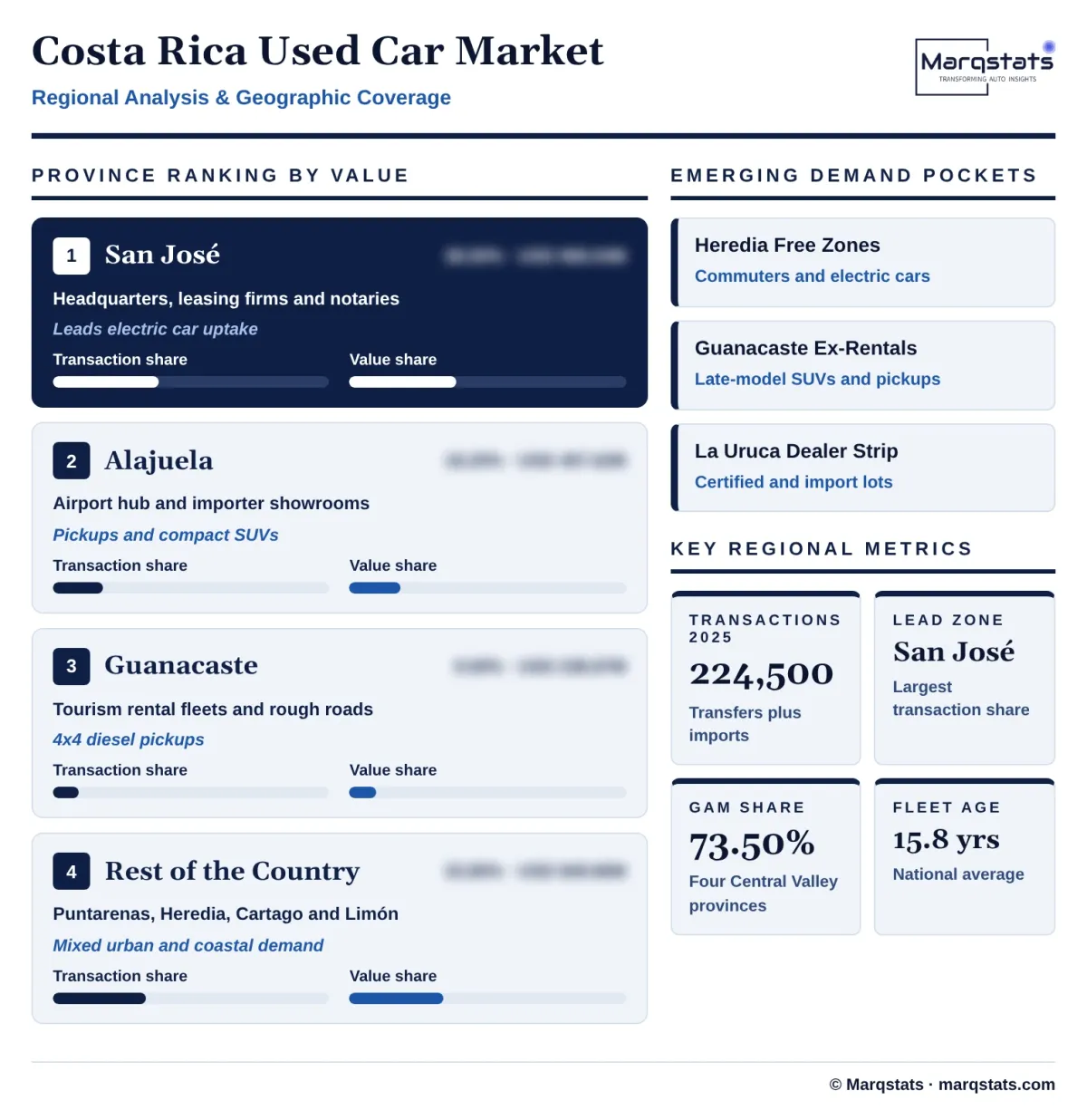
Demand is concentrated in the Central Valley. The four provinces of the Greater Metropolitan Area (GAM), San José, Alajuela, Heredia and Cartago, account for 73.50% of transactions, led by San José at 38.50%. The study segments the market by body type (SUVs, sedans and hatchbacks, pickups and light commercial vehicles, vans and microbuses), powertrain (gasoline, diesel, hybrid and battery electric) and vehicle age, and covers light vehicles only.
Key Takeaways
Market Overview & Analysis
Report Summary
Marqstats sizes the Costa Rica used car market as the value of all used light vehicle transactions in a year: domestic title transfers recorded at the Registro Nacional de la Propiedad Mueble and first registrations of imported used vehicles cleared by customs. In 2025 these totalled 224,500 transactions, 198,700 domestic transfers and 25,800 imports. Transactions are valued at an average of USD 11,200, derived from certified dealer, independent dealer and online listing prices and calibrated against Hacienda fiscal values, with an 8.5% premium for private sales recorded at fiscal value.
Every used car sale in Costa Rica goes through a notary. The buyer and seller sign a public deed, which must be presented to the Registro Nacional within 30 days. Transfer tax of 2.5% applies to the higher of the contract price and the official fiscal value, and registration stamps, notarial fees and VAT on those fees take total closing costs to about 5.4% of the vehicle value. Sales over USD 10,000 also require a sworn declaration of the origin of funds. Imported used vehicles must arrive with clean titles, because Article 5 of the Traffic Law (Ley 9078) bars the registration of total-loss and salvage vehicles, and must pass a DEKRA technical inspection before they can be registered.
The forecast rests on three conditions. Decreto 45920-H stays in force, keeping import tax tied to Hacienda reference values and favouring formal dealers. Household incomes and dollar-linked credit remain stable. And the first generation of hybrids and electric cars continues to move into the used market. Under these conditions transactions reach 268,250 in 2030 and market value USD 3,447.01 million.
Costa Rica Used Car Market Size and Forecast
The Costa Rica used car market grows from USD 2,514.40 million in 2025 to USD 3,447.01 million in 2030, a CAGR of 6.51%. Transactions grow from 224,500 to 268,250, a 3.63% annual rate, slightly slower than the 3.55% to 7.19% growth recorded between 2022 and 2025 because the new decree raises the cost of entry-level imports. The average transaction value rises from USD 11,200 to USD 12,850.
Value grows about 2.9 percentage points a year faster than volume. The gap comes from the mix: SUVs replace sedans, hybrids and electric cars carry higher prices than the gasoline cars they replace, and cars up to five years old rise from 18.00% to 22.00% of transactions. Imports fall as a share of the market, while domestic resale of younger stock through certified dealers grows. Gasoline remains the largest powertrain throughout, but its share falls from 68.50% to 58.00% as hybrids and electric cars gain.
Market Dynamics
Key Drivers
Five conditions lift both transaction volume and the value of each sale.
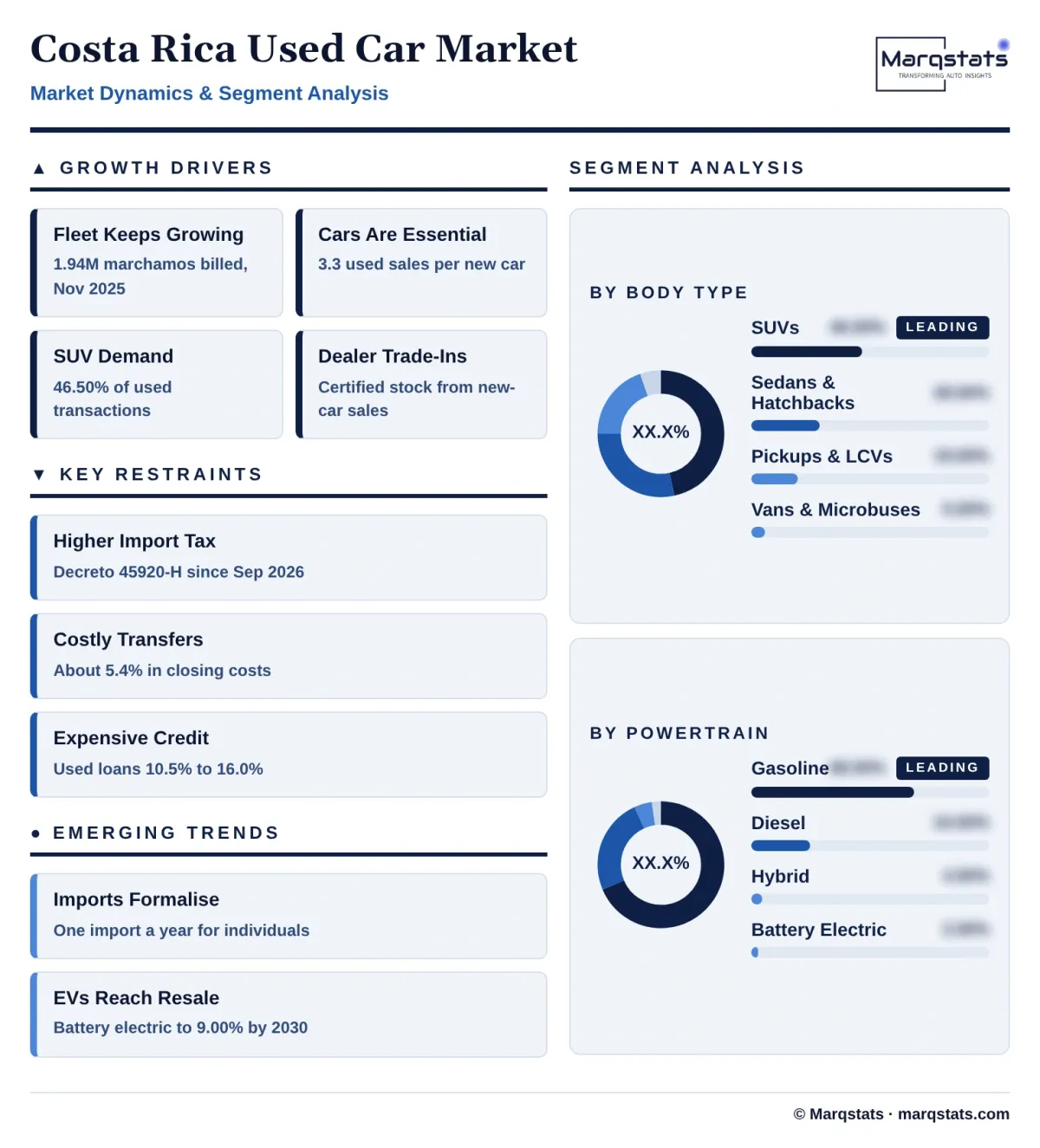
- The fleet keeps growing. INS billed 1,943,587 circulation permits in November 2025, about 58,000 more than the year before, after an increase of 131,184 vehicles, or 7.5%, the year before that. For 18 consecutive years, more vehicles have been registered in Costa Rica than babies born. Every vehicle added to the fleet becomes future used supply.
- Public transport is weak, so cars are essential. Limited mass transit in the Greater Metropolitan Area makes a private car a necessity for middle-income commuters. Buyers who cannot afford a new car turn to the used market, which is why used transactions outnumber new registrations by about 3.3 to one. Free trade zones in Heredia, Alajuela and Cartago employ large numbers of commuters who travel across the Central Valley every day, and remittances and tourism income support car purchases outside the capital.
- SUV demand lifts transaction values. SUVs account for 46.50% of used transactions and rise to 50.88% by 2030. The Toyota RAV4, Hyundai Tucson and Suzuki Grand Vitara command strong resale values, and their growing share raises the average transaction price.
- New-car trade-ins feed certified used stock. Authorised distributors such as Grupo Purdy, Grupo Q and Grupo Cori Car take trade-ins on new-car sales and resell them with inspections, warranties and financing. Events such as Expomóvil, organised by the importers association AIVEMA, generate large trade-in volumes for dealer used divisions.
- Electrified cars are reaching their second owners. Costa Rica has had one of the highest electric car shares of new sales in the Americas, supported by tax incentives under Law 9518. Those cars and hybrids such as the Toyota RAV4 Hybrid and Corolla Cross Hybrid are now entering the used market, adding higher-priced stock.
Key Restraints
Four constraints raise costs and slow the formal side of the market.
- Import taxes have risen. Since 1 September 2026, Decreto 45920-H taxes imports on the higher of the invoice and the Hacienda reference value. Importers say this has doubled or tripled their tax on many cars, raising the price floor for imported vehicles under USD 10,000 and reducing the supply of cheap imports.
- Transfer costs are high. Transfer tax, registration stamps, notarial fees and VAT on those fees add about 5.4% to every used car sale. The cost discourages quick resale and leads some private parties to delay registering transfers by using special powers of attorney instead.
- Used car credit is expensive. Used car loans cost 10.5% to 12.0% in dollars and 13.5% to 16.0% in colones, and private banks such as BAC Credomatic, Davivienda and Scotiabank mainly lend on cars under eight years old with 20% to 30% deposits. Older cars are mostly bought with cash or SINPE Móvil transfers.
- Buyers are wary of used electric cars. Uncertainty about battery health, few independent mechanics outside San José able to diagnose electric drivetrains, and the gradual reduction of electric car tax incentives under Law 9518 slow used electric adoption.
Key Trends
Four shifts are changing what is sold, who sells it and how it is financed.
- Imports are formalising. The one-car-a-year limit for unregistered individuals is pushing informal brokers to register as businesses with electronic invoicing. Marqstats expects imports to fall from about 11.5% of used transactions toward 8% as independent lots consolidate.
- Chinese brands are entering the used pool. Grupo Cori Car, which distributes Chery, JAC and Dongfeng, led electric car sales in early 2026 and takes gasoline trade-ins against new electric models. Chinese electric cars such as the BYD Yuan Pro and Geely Geometry E are appearing in used listings.
- Online platforms are adding transaction tools. CRAutos and Encuentra24 remain the main price references, while newer platforms such as LoVendoCR add lien checks and transfer-cost calculators. Facebook Marketplace carries much of the private-sale traffic.
- Certified used programmes are expanding. Purdy Usados and Purdy Usados Premium hold more than 300 inspected cars in La Uruca, and Grupo Q Usados sells certified Hyundai, Chevrolet and Isuzu stock. Dealers are extending warranties to win buyers away from private sales.
Strategic Implications
- For authorised dealers, the decree is an opening. Independent importers face higher taxes and import limits, while dealer groups source stock from trade-ins. Groups such as Purdy, Grupo Q and VEINSA can take share by expanding trade-in programmes, extending certified warranties and using captive finance for five- to ten-year-old cars.
- For independent importers, compliance is now the cost of doing business. Registering as a trader, sourcing clean-title vehicles from US auctions and pricing against Hacienda reference values are now essential. Importers that focus on late-model SUVs and hybrids, where the reference value is closer to the real price, will be less affected.
- For lenders and platforms, verified data unlocks credit. The gap between new-car and used-car loan rates leaves room for lenders that use Registro Nacional and DEKRA inspection records to price risk. Platforms that combine lien checks, inspection data and digital notarial services can bring private sales into a formal, financeable process.
- The court challenge to Decreto 45920-H is the main uncertainty. AEPSAU has said it will take the decree to court. If courts overturn it, cheaper imports would return, raising transaction volume but lowering the average transaction value. The base case assumes the decree stays in force.
Market Segmentation
SUVs account for 104,392 transactions in 2025, 46.50% of the market and USD 1,169.20 million. They are the leading and fastest-growing body type, rising to 136,486 transactions and 50.88% by 2030, with value growing at 8.45% a year to USD 1,753.84 million. The Toyota RAV4, Hyundai Tucson and Suzuki Grand Vitara are the most traded models.
Sedans and hatchbacks account for 63,983 transactions in 2025, 28.50% of the market and USD 716.60 million. Their share falls to 23.50% by 2030 as buyers move to crossovers, and value grows only 2.48% a year to USD 810.05 million. The Toyota Yaris, Hyundai Accent and Nissan Versa dominate.
Pickups and light commercial vehicles account for 43,778 transactions in 2025, 19.50% of the market and USD 490.31 million, rising to 20.00% and USD 689.40 million by 2030, a 7.05% value CAGR. Agriculture, construction and tourism drive demand for the Toyota Hilux, Mitsubishi L200 and Isuzu D-Max.
Vans and microbuses account for 12,347 transactions in 2025, 5.50% of the market and USD 138.29 million, rising to 5.62% and USD 193.72 million by 2030, a 6.97% value CAGR. Tourism operators and regional passenger services rely on the Toyota HiAce, Hyundai Staria and Nissan Urvan.
Gasoline vehicles account for 153,782 transactions in 2025, 68.50% of the market and USD 1,722.36 million. Their share falls to 58.00% by 2030, with value growing at 3.03% a year to USD 1,999.27 million. The Toyota Corolla, Hyundai Tucson and Suzuki Swift lead.
Diesel vehicles account for 55,003 transactions in 2025, 24.50% of the market and USD 616.03 million, concentrated in pickups and large SUVs. Their share falls to 20.00% by 2030, with value growing at 2.28% a year to USD 689.40 million.
Hybrids, including plug-in hybrids, account for 10,103 transactions in 2025, 4.50% of the market and USD 113.15 million. They rise to 34,873 transactions and 13.00% by 2030, with value growing at 31.69% a year to USD 448.11 million, led by the Toyota RAV4 Hybrid and Corolla Cross Hybrid.
Battery electric vehicles account for 5,612 transactions in 2025, 2.50% of the market and USD 62.86 million, and are the fastest-growing powertrain. They rise to 24,142 transactions and 9.00% by 2030, with value growing at 37.61% a year to USD 310.23 million, as early buyers of the BYD Yuan Pro, Geely Geometry E and Hyundai Ioniq trade in.
Vehicles up to five years old account for 40,410 transactions in 2025, 18.00% of the market and USD 452.59 million. They rise to 22.00% and USD 758.34 million by 2030, a 10.87% value CAGR, the fastest of any age group. Certified dealer stock and bank or captive financing from CrediQ and CAFSA dominate this group.
Vehicles aged six to ten years account for 69,595 transactions in 2025, 31.00% of the market and USD 779.46 million, rising to 33.00% and USD 1,137.51 million by 2030, a 7.85% value CAGR. Savings and credit cooperatives and personal loans finance many of these purchases.
Vehicles more than ten years old account for 114,495 transactions in 2025, 51.00% of the market and USD 1,282.34 million. Their share falls to 45.00% by 2030, with value growing at 3.88% a year to USD 1,551.15 million. Most are private cash sales of durable Japanese and Korean models.
By Geography
San José
San José is the largest provincial market, with 86,432 transactions in 2025, 38.50% of the total and about USD 968.04 million. Corporate headquarters, leasing companies and most notaries are based here, and many vehicles used elsewhere are registered in the capital. Compact SUVs, sedans and electric cars lead demand.
Alajuela
Alajuela accounts for 40,859 transactions, 18.20% of the total and about USD 457.62 million. The province hosts the main airport and a large cluster of independent importer showrooms along its main roads. Pickups and compact SUVs lead, and the province is a major source of stock for buyers from northern and western Costa Rica.
Guanacaste
Guanacaste accounts for 21,328 transactions, 9.50% of the total and about USD 238.87 million. Tourism rental fleets and rough roads drive demand for four-wheel-drive diesel pickups and full-size SUVs, and ex-rental vehicles supply the local used market.
Puntarenas
Puntarenas accounts for 20,654 transactions, 9.20% of the total and about USD 231.32 million. Coastal freight, fishing and agriculture support demand for pickups and utility vans.
Heredia
Heredia accounts for 19,756 transactions, 8.80% of the total and about USD 221.27 million. Free trade zone employers attract commuters, and the province has above-average uptake of compact sedans, crossovers and electric cars.
Cartago
Cartago accounts for 17,960 transactions, 8.00% of the total and about USD 201.15 million. Mountain roads favour small pickups and manual hatchbacks.
Limón
Limón accounts for 17,511 transactions, 7.80% of the total and about USD 196.12 million. The Caribbean port corridor supports demand for diesel pickups and light microbuses, and humidity shortens vehicle life. Provincial shares are a Marqstats allocation based on registry and fleet distribution.
How Competition Is Evolving
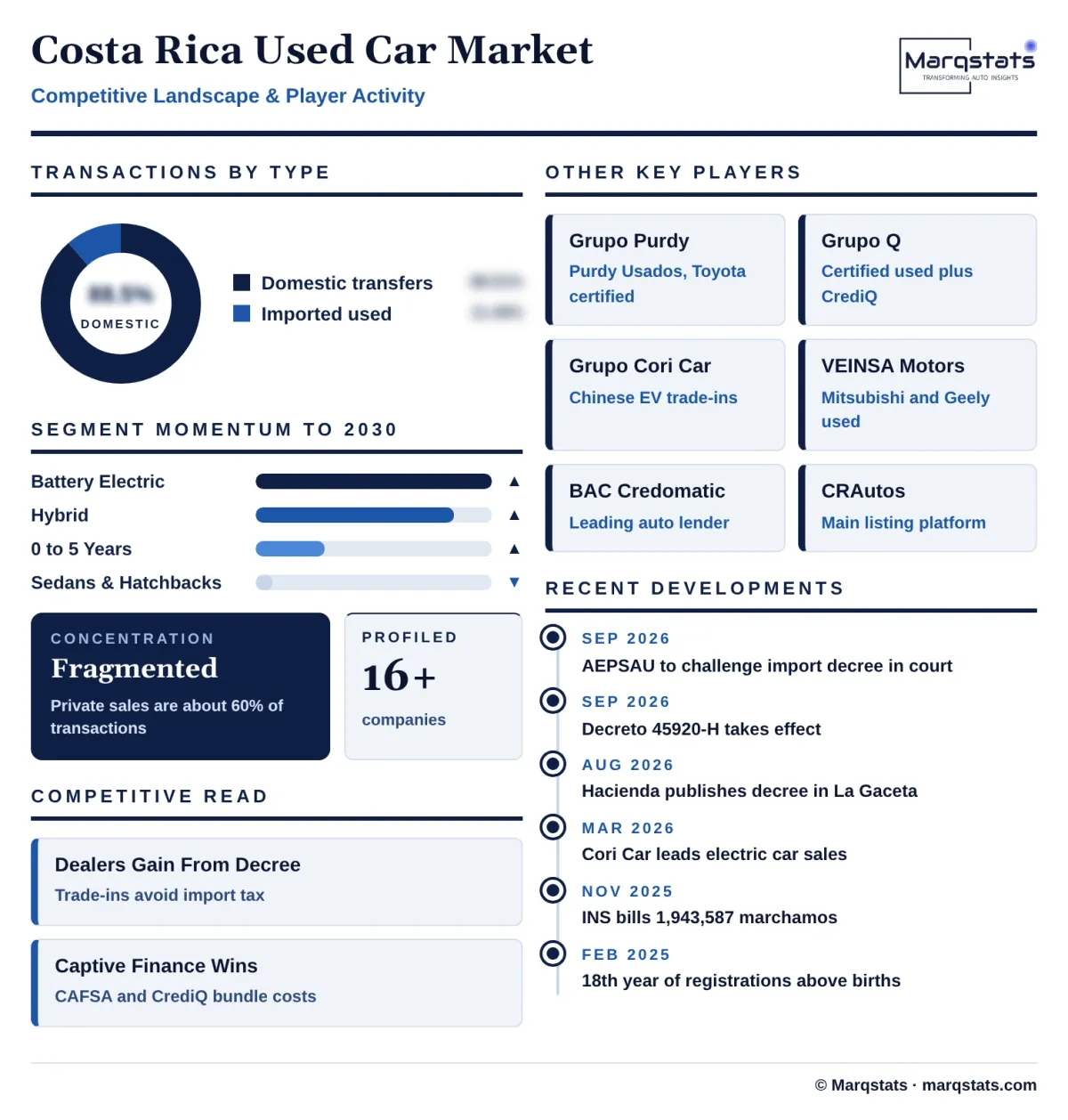
The Costa Rica used car market is fragmented. Private sales between individuals account for roughly 60% of transactions, mostly through online classifieds and social media. The rest is split between certified used divisions of authorised distributors and hundreds of independent lots, many of which import from US auctions. No single seller holds a large share of transactions.
Authorised distributors lead the formal tier. Grupo Purdy, distributor of Toyota, Lexus, Ford and Volkswagen, runs Purdy Usados and Purdy Usados Premium from La Uruca, and benefits from the strong resale value of Toyota models. Grupo Q runs Grupo Q Usados for Hyundai, Chevrolet and Isuzu, backed by its captive lender CrediQ. Grupo Cori Car uses trade-ins on Chery, JAC and Dongfeng electric cars to build used stock, while VEINSA Motors and Grupo Danissa serve buyers of Mitsubishi, Geely, Nissan and Audi.
Independent importers face the biggest change. Clustered in La Uruca, Paseo Colón and Alajuela and represented by AEPSAU, they have relied on low-cost imports from US auctions. Decreto 45920-H raises their tax costs and limits informal imports, which favours registered traders and authorised dealers. BAC Credomatic, Davivienda and Scotiabank lead used car lending, and CRAutos, Encuentra24 and LoVendoCR are the main listing platforms.
Competition is moving toward verified condition and financing. DEKRA runs the mandatory technical inspection, and dealers increasingly use inspection results, Registro Nacional lien checks and written warranties to justify higher prices. Captive lenders bundle transfer costs and insurance into loans, so buyers can finance the full cost of a certified used car in one step, something private sellers and most independent lots cannot match.
Companies Covered
Companies covered in the report include:
Recent Market Activity
Table of Contents
Coverage & Segmentation
The study covers the Costa Rica used car market nationally, with 2025 as the base year, 2021 – 2025 as the historical period and 2026 – 2030 as the forecast period. Values are in US dollars. The market is defined as the value of used light vehicle transactions, including cars, SUVs, pickups, light commercial vehicles and passenger vans: domestic title transfers recorded at the Registro Nacional and first registrations of imported used vehicles. It is segmented by body type, powertrain and vehicle age.
Motorcycles, heavy trucks over ten tonnes, buses and agricultural machinery are excluded, as are new-vehicle sales and finance, insurance and aftersales revenue. The transaction count, the average transaction value and the segment and provincial splits are Marqstats estimates built on registry, customs, INS fleet and dealer pricing data.