Market Snapshot
Middle bar: base-year value × (1 + CAGR), rounded to two decimals. This is a calculated illustration, not a separately researched annual estimate.
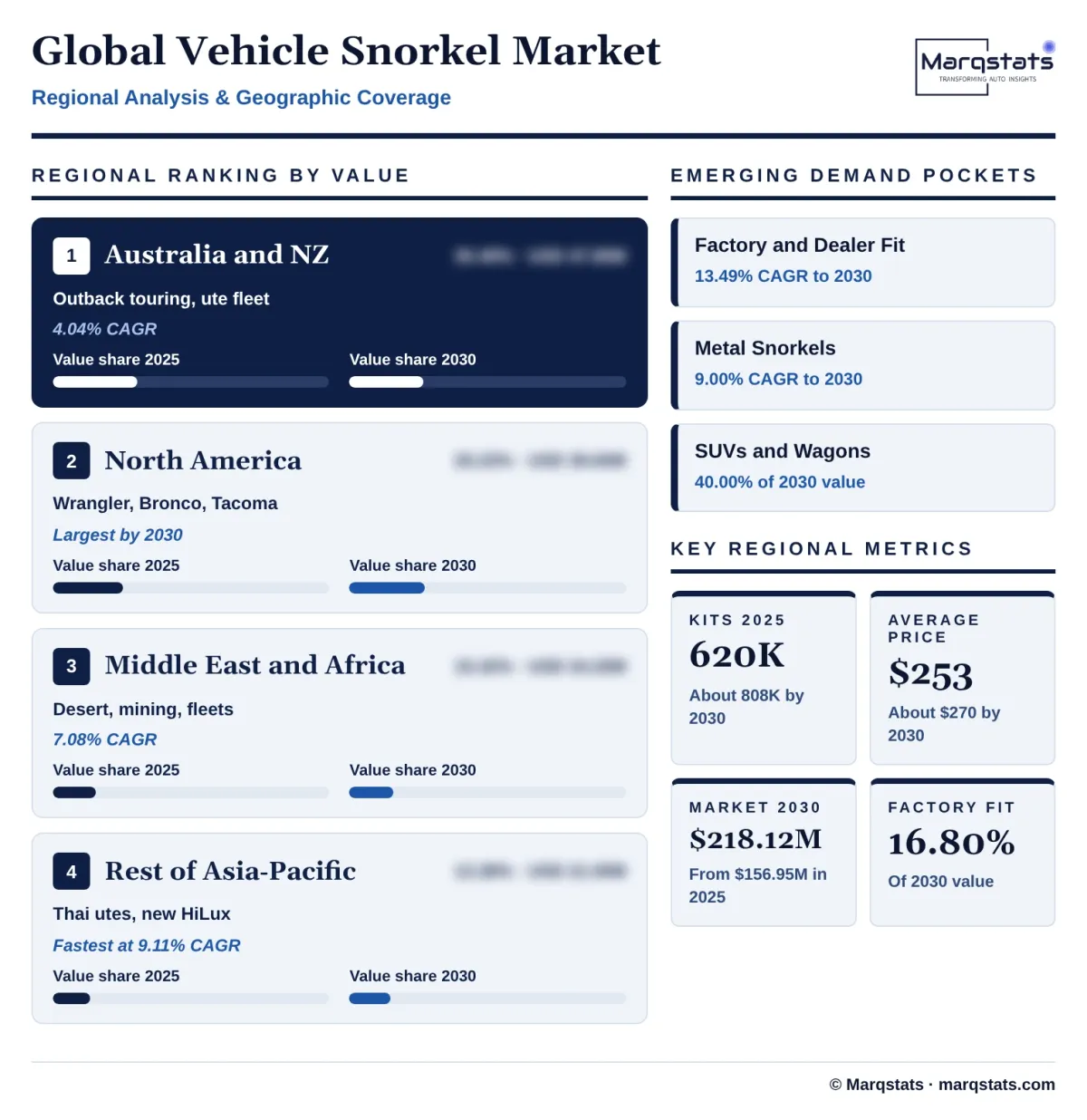
The global vehicle snorkel market size is estimated at USD 156.95 million in 2025 and is projected to reach USD 218.12 million by 2030, growing at a CAGR of 6.80% over 2026 – 2030. Annual sales rise from about 620,000 snorkel kits to about 808,200, a 5.45% annual rate, while the average supplier selling price rises from about USD 253 to USD 270 per kit as buyers move to high-flow designs and factory-fitted systems.
Marqstats defines the market as the supplier selling value of raised air intake systems fitted to four-wheel-drive pickups, utes, SUVs, wagons, 4x4 vans and light commercial work vehicles. It covers complete snorkel kits, including the snorkel body, air ram or intake head, connecting ducting, mounting hardware and airbox adapters, sold through aftermarket retail and fitting centres, sold to fleets and government buyers, or fitted at the factory or port as part of a vehicle trim. Under-bonnet cold air intakes without a raised pillar, replacement air filters and pre-cleaners sold on their own, fitting labour, retail mark-up and sales taxes are excluded.
Rotationally moulded polyethylene snorkels account for 78.00% of 2025 value, aftermarket retail for 80.00% and pickups and utes for 54.00%. Australia and New Zealand account for 30.49% of 2025 value and North America for 25.23%. The study segments the market by material, sales channel, vehicle type and region.
Key Takeaways
Market Overview & Analysis
Report Summary
Marqstats sizes the vehicle snorkel market as the supplier selling value of raised air intake kits for four-wheel-drive vehicles. About 620,000 kits were sold worldwide in 2025, worth an estimated USD 156.95 million at an average supplier price of about USD 253 per kit.
A snorkel moves the engine's air intake from low in the front guard or behind the grille to roof height. The snorkel body runs up the A-pillar, an air ram head at the top faces into or away from the airflow, and ducting connects the snorkel to the factory airbox. The design keeps water out of the engine during river crossings, but in daily use its larger value is cleaner and cooler air: on corrugated gravel roads and in desert conditions the air at roof height carries far less dust than air drawn near the wheels, so filters last longer and turbochargers and injectors are better protected.
The market is anchored in Australia. Long unsealed outback roads, river crossings on touring routes and a large fleet of utes and four-wheel-drive wagons mean that snorkels are one of the most common first accessories on a new 4x4. Australian companies, led by ARB Corporation with its Safari brand and TJM with its Airtec range, designed most of the vehicle-specific polyethylene snorkels sold worldwide and now export them to North America, Europe, the Middle East and Africa.
Demand follows a small number of vehicle platforms. The Toyota HiLux, Land Cruiser 70 and 300 Series, Prado and Tacoma, the Ford Ranger, Everest and Bronco, the Jeep Wrangler and Gladiator, the Isuzu D-Max, Mitsubishi Triton, Nissan Navara and Patrol, the Land Rover Defender and the Ineos Grenadier account for most kits. Each needs its own snorkel shape and ducting, so suppliers must engineer, tool and test a new kit every time a carmaker launches a new model or powertrain.
The market grew from about 496,000 kits worth USD 114.51 million in 2021 to 527,000 in 2022, 564,200 in 2023 and 592,100 in 2024, worth USD 146.59 million, as overland touring and four-wheel-drive ute sales rose after the pandemic and carmakers launched off-road trims. Growth slowed in 2025 and early 2026 as higher interest rates weighed on Australian accessory spending, while North American and export demand stayed firm.
Powertrain change creates work for suppliers. New hybrid and plug-in hybrid utes, such as the Ford Ranger PHEV and the 48-volt HiLux, change engine bay layouts and airbox positions, so suppliers must design new snorkels and ducting that clear high-voltage wiring and cooling lines. ARB's Safari SS987HFG for the Ranger PHEV is sold in Europe at EUR 701.89, and its SS223HF V-Spec for the new 48-volt HiLux 2.8 diesel retails at AUD 583 in Australia.
Rules on raised air intakes differ by region. In the European Union, Directive 74/483/EEC limits external projections on vehicles, and countries such as Germany and Spain require modified vehicles to pass inspection, so branded kits are sold with engineering reports and certificates. Australian and US rules generally treat a correctly fitted snorkel as a minor accessory, which makes North America and Australia easier markets for new designs.
Global Vehicle Snorkel Market Size and Forecast
The global vehicle snorkel market grows from USD 156.95 million in 2025 to USD 218.12 million in 2030, a CAGR of 6.80%. Marqstats expects about 653,300 kits worth USD 167.51 million in 2026, 688,700 worth USD 178.85 million in 2027, 726,200 worth USD 191.02 million in 2028 and 766,000 worth USD 204.09 million in 2029, before reaching about 808,200 kits in 2030.
Volume and price both contribute. Kit volumes grow at 5.45% a year and the average supplier price at about 1.5% a year, from USD 253 in 2025 to USD 270 in 2030. Price growth comes from mix rather than list price increases: high-flow designs, metal snorkels and factory-fitted systems carry higher prices, while low-cost imported plastic kits hold their prices flat.
Regional prices differ widely. Marqstats estimates average supplier prices of about USD 380 per kit in Europe, where kits must carry engineering documentation for roadworthiness inspections, USD 330 in North America, USD 290 in Australia and New Zealand, USD 220 in the Middle East and Africa, USD 180 in Latin America and USD 150 in the rest of Asia-Pacific, where local and Chinese-made kits are common. Retail prices are higher: the Safari V-Spec for the new HiLux retails at AUD 583 before an estimated AUD 320 fitting charge.
New vehicle launches drive the forecast. Each new 4x4 model creates a wave of first-fit purchases in its first three years on sale, so the arrival of the new HiLux, the Ranger Super Duty, the Ranger PHEV and updated Land Cruiser and Tacoma models supports demand through 2028. The rest of the demand comes from owners of older vehicles fitting a snorkel before a long trip or replacing a damaged one.
Marqstats tracks four indicators to monitor the forecast: new four-wheel-drive ute and wagon sales in Australia, North America, the Middle East and South-East Asia; the number of off-road trims with factory-fitted raised air intakes; export sales of the main Australian accessory makers; and average kit prices by region and material.
The mix of channels changes over the forecast. Factory and dealer-fit programmes rise from 12.40% to 16.80% of value as more carmakers offer off-road trims with snorkels already fitted. Independent aftermarket retail and fitting falls from 80.00% to 75.80% of value but remains by far the largest channel, while fleet, mining and government buyers hold about 7.5% of value.
Regional growth rates diverge. North America grows at 8.60% a year and the rest of Asia-Pacific at 9.11%, while Australia and New Zealand grow at 4.04% as their large existing fleet already carries many snorkels and accessory spending recovers slowly. The Middle East and Africa grow at 7.08%, and Europe and Latin America at 6.57%. As a result, Australia and New Zealand's share of value falls from 30.49% to 26.74% and North America's rises from 25.23% to 27.43%.
Market Dynamics
Key Drivers
Five forces keep demand for raised air intakes growing across the global 4x4 fleet.
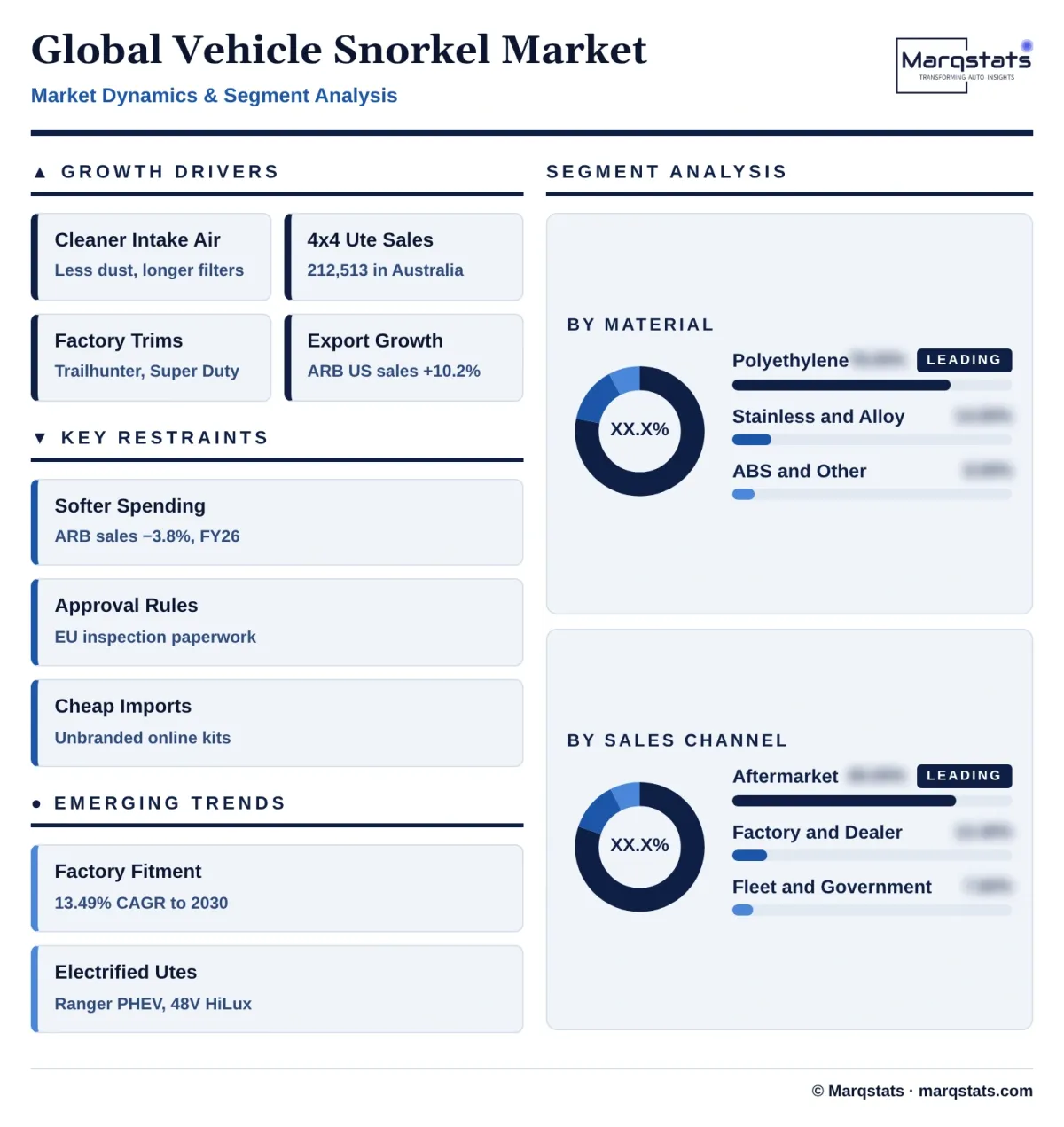
- Cleaner, cooler intake air. Air drawn from roof height carries much less dust than air drawn near the front wheels on gravel and desert roads, so filters last longer and turbocharged diesel engines are better protected. Fleet operators in mining, agriculture and remote area services fit snorkels for this reason more than for water crossings.
- Strong four-wheel-drive ute and wagon sales. Australia sold 212,513 new four-wheel-drive utes in 2025, and pickups and off-road SUVs remain popular in North America, the Middle East, South Africa and South-East Asia, keeping the base of new vehicles that receive a snorkel large.
- Factory off-road trims. Toyota's Tacoma and 4Runner Trailhunter, Ford's Ranger Super Duty and Ineos's Grenadier Trialmaster editions include raised air intakes as standard, bringing snorkels to buyers who would not have fitted one themselves.
- Overland touring culture. Long-distance touring with roof racks, drawers and recovery gear has grown in Australia, North America and Europe, and a snorkel is one of the first accessories owners fit when preparing a vehicle for remote travel.
- Export growth by Australian accessory makers. ARB's export sales reached 38.2% of its total in the year to June 2026, with sales to the United States up 10.2%, carrying Safari snorkels and the wider 4x4 accessory range into new markets.
Key Restraints
Four constraints limit how fast snorkel sales and prices can rise.
- Softer Australian accessory spending. ARB's sales fell 3.8% to AUD 702.0 million in the year to June 2026 and its Australian aftermarket sales fell 3.3%, showing that higher living costs and interest rates slow discretionary accessory purchases in the largest snorkel market.
- Roadworthiness and approval rules. In Europe, raised air intakes must meet rules on external projections and, in countries such as Germany and Spain, pass vehicle inspections, so suppliers need engineering documentation for each kit and uncertified imports face rejection.
- Low-cost imports. Unbranded plastic snorkels sold online for a fraction of the price of branded kits pressure prices, though poor fit, weak UV resistance and leaking joints limit their appeal to serious off-road users.
- Engineering cost for every new model. Each vehicle needs its own snorkel shape and ducting, and hybrid and plug-in hybrid powertrains add packaging constraints, so suppliers must spend on design, tooling and testing before they can sell into a new platform.
Key Trends
Four shifts are changing how snorkels are designed, sold and fitted.
- Snorkels move into factory specifications. Carmakers are working with accessory makers to offer snorkels on off-road trims, as with Ford's bespoke Safari snorkel for the Ranger Super Duty and Toyota's standard high-mounted intake on Trailhunter models.
- High-flow designs. Larger 4-inch snorkels such as the Safari ARMAX and aluminium designs such as the K&N elevated intake kits, launched in the United States in August 2025, suit tuned diesel and turbocharged petrol engines that need more air.
- Electrified utes. Plug-in hybrid and 48-volt mild-hybrid utes need new snorkel routing and ducting, and suppliers such as ARB already offer kits for the Ranger PHEV and the 48-volt HiLux.
- Metal and custom styles. Stainless steel and aluminium snorkels with polished or powder-coated finishes are growing among custom ute builders in Australia, Thailand and the Philippines.
Strategic Implications
- For accessory makers, carmaker partnerships are the growth channel. Suppliers that can engineer to factory standards, meet carmaker validation and deliver kits to assembly or port-fitment lines will win the fastest-growing part of the market.
- For carmakers, a factory snorkel is a low-cost way to make off-road trims credible. A raised air intake adds visual identity and real capability for buyers who tour or work on gravel roads, and keeps accessory revenue within the dealer network.
- For distributors and fitters, vehicle-specific range depth matters. Being first with kits for new models such as the 2026 HiLux, Ranger PHEV and Ranger Super Duty captures the early wave of buyers in each platform's first years on sale.
- For fleet buyers, snorkels are a maintenance decision. In dusty operations, longer filter life and better engine protection can justify a snorkel on every vehicle, so fleets should compare total maintenance cost rather than kit price.
- For new entrants, certification is the barrier. Kits sold in Europe and to fleet and government buyers need engineering documentation and proven durability, which favours established brands over low-cost importers.
- For investors, the snorkel category shows the strength of vehicle-specific accessory engineering. Its value is small next to the wider 4x4 accessories market, but carmaker partnerships, export growth and new electrified platforms give established brands steady demand and pricing power through 2030.
Market Segmentation
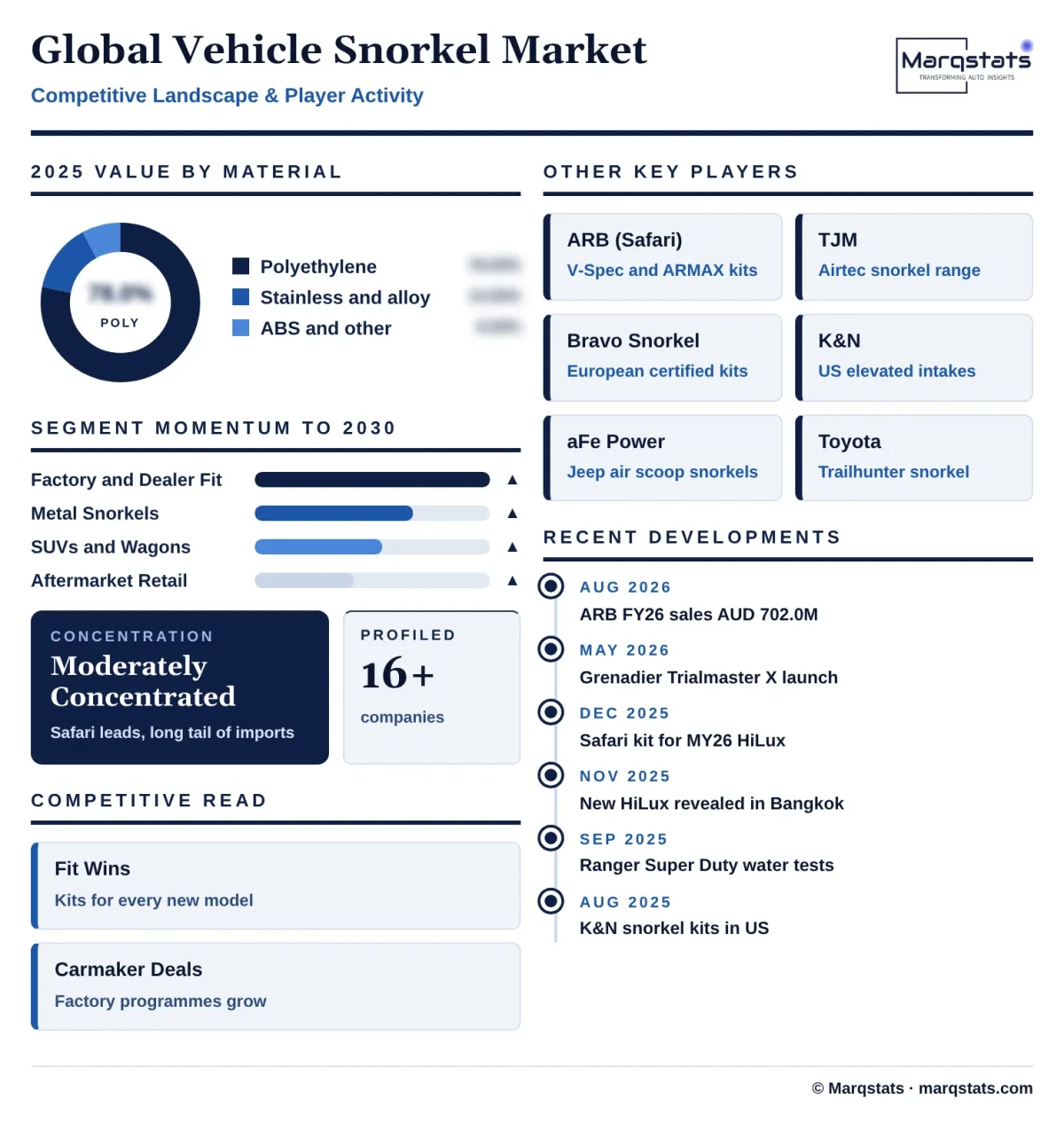
UV-stabilised rotationally moulded polyethylene snorkels account for 78.00% of 2025 value, USD 122.42 million, and grow at 6.67% a year to USD 169.04 million, 77.50% of 2030 value. Safari, TJM Airtec, Bravo and most other vehicle-specific brands use this material because it absorbs impacts from branches, resists sunlight and can be moulded to follow each vehicle's body.
Metal snorkels account for 14.00% of 2025 value, USD 21.97 million, and grow fastest at 9.00% a year to USD 33.81 million and 15.50% of 2030 value. They include custom 4-inch stainless steel snorkels popular on utes in Australia and South-East Asia and aluminium high-flow intake kits sold in North America.
Low-cost ABS and generic plastic snorkels account for 8.00% of 2025 value, USD 12.56 million, and grow at 3.98% a year to USD 15.27 million, 7.00% of 2030 value. They sell in high volumes online and in emerging markets at low prices, but poorer fit and UV resistance limit their share of value.
Specialist 4x4 retailers, fitting centres, brand stores and online sellers account for 80.00% of 2025 value, USD 125.56 million, and grow at 5.66% a year to USD 165.34 million, 75.80% of 2030 value. ARB's own store network and partner fitters in Australia, North America and the Middle East lead this channel.
Snorkels fitted at the factory, at port or by dealers as part of a carmaker accessory programme account for 12.40% of 2025 value, USD 19.46 million and about 69,500 kits, and grow fastest at 13.49% a year to USD 36.64 million and 16.80% of 2030 value, through the Toyota Trailhunter models, Ford Ranger Super Duty, Ineos Grenadier Trialmaster editions and dealer accessory programmes.
Snorkels bought by mining companies, utilities, agricultural businesses, defence forces and government fleets account for 7.60% of 2025 value, USD 11.93 million, and grow at 6.23% a year to USD 16.14 million. These buyers fit snorkels to protect engines in dusty work and often specify them on every vehicle.
Pickups and utes account for 54.00% of 2025 value, USD 84.75 million, and grow at 6.41% a year to USD 115.60 million, led by the Toyota HiLux and Tacoma, Ford Ranger, Isuzu D-Max, Mitsubishi Triton, Nissan Navara and Jeep Gladiator.
Off-road SUVs and four-wheel-drive wagons account for 39.00% of 2025 value, USD 61.21 million, and grow at 7.35% a year to USD 87.25 million and 40.00% of 2030 value, led by the Land Cruiser, Prado, 4Runner, Everest, Bronco, Wrangler, Defender and Grenadier.
4x4 vans, light trucks and other vehicles account for 7.00% of 2025 value, USD 10.99 million, and grow at 6.80% a year to USD 15.27 million. They include four-wheel-drive Mercedes-Benz Sprinter and other adventure vans, Toyota Land Cruiser 70 cab chassis and light commercial trucks.
By Geography
Australia and New Zealand
Australia and New Zealand are the largest market, with 30.49% of 2025 value, USD 47.85 million and about 165,000 kits, rising to USD 58.32 million by 2030, a 4.04% CAGR, while their share falls to 26.74%. Australia sold 212,513 new four-wheel-drive utes in 2025, outback touring and work on unsealed roads make snorkels a common first accessory, and ARB, TJM and other local brands design kits for every major platform. Softer discretionary spending slowed growth in 2025 and 2026, with ARB's Australian aftermarket sales down 3.3% in the year to June 2026. The vehicle snorkel market sits within the broader Australian 4x4 accessories market, which Marqstats sizes at USD 1,316.45 million in 2025.
North America
North America accounts for 25.23% of 2025 value, USD 39.60 million and about 120,000 kits, and grows at 8.60% a year to USD 59.83 million by 2030, becoming the largest region with 27.43% of value. Jeep Wrangler and Gladiator, Ford Bronco, Toyota Tacoma and 4Runner owners drive aftermarket demand, Toyota fits a high-mounted snorkel as standard on Trailhunter models, and US companies such as K&N, aFe and Rugged Ridge sell their own snorkel and elevated intake kits. ARB's exports to the United States rose 10.2% in the year to June 2026, and its 50% stake in Off Road Warehouse widens its US retail reach.
Middle East and Africa
The Middle East and Africa account for 15.42% of 2025 value, USD 24.20 million and about 110,000 kits, and grow at 7.08% a year to USD 34.07 million. Desert driving in the Gulf states, mining and agriculture in Southern Africa and humanitarian and government fleets across Africa rely on Land Cruiser 70 and 300 Series, Patrol, HiLux and Ranger vehicles, many of them fitted with snorkels to protect engines from sand and dust.
Rest of Asia-Pacific
The rest of Asia-Pacific, including South-East Asia, India, Japan and China, accounts for 13.38% of 2025 value, USD 21.00 million and about 140,000 kits, and grows fastest, at 9.11% a year, to USD 32.48 million and 14.89% of 2030 value. Thailand builds most of the world's one-tonne utes and hosted the world premiere of the new HiLux in November 2025, while custom ute culture in Thailand, Malaysia and the Philippines supports demand for metal snorkels. Low average prices reflect a large share of locally made and imported budget kits.
Europe
Europe accounts for 10.90% of 2025 value, USD 17.10 million and about 45,000 kits, and grows at 6.57% a year to USD 23.51 million. Demand comes from Defender, Grenadier, Ranger, HiLux and Jimny owners, overland van builders and forestry and utility fleets. Kits must meet rules on external projections and pass national inspections, which keeps average prices the highest of any region at about USD 380 per kit. The Ineos Grenadier Trialmaster X, launched in May 2026, includes a raised air intake as standard.
Latin America
Latin America accounts for 4.59% of 2025 value, USD 7.20 million and about 40,000 kits, and grows at 6.57% a year to USD 9.91 million. Demand centres on HiLux, Ranger and Amarok utes used in agriculture and mining in Argentina, Brazil, Chile and Peru.
How Competition Is Evolving
The vehicle snorkel market is moderately concentrated. ARB Corporation's Safari brand is the leading name in vehicle-specific polyethylene snorkels and supplies kits for most major 4x4 platforms through ARB stores and distributors worldwide. TJM, with its Airtec range, Bravo Snorkel in Europe and US intake makers such as K&N, aFe and Rugged Ridge make up the next tier, while many small manufacturers and online sellers offer low-cost kits.
Vehicle coverage and fit decide competition. A snorkel must follow the exact shape of the guard, A-pillar and bonnet, connect cleanly to the airbox and stay sealed through years of vibration, heat and water. Brands that have the most kits for current models, and that are first with kits for new models, capture the largest share of buyers.
Carmaker partnerships are becoming more important. Ford developed a bespoke Safari snorkel for the Ranger Super Duty with ARB, Toyota fits a high-mounted snorkel and ARB and Old Man Emu components on Trailhunter models, and Ineos fits raised air intakes on Grenadier Trialmaster editions. These programmes give established brands long production runs but require them to meet carmaker quality and validation standards.
Scale gives the leaders an advantage in a softer market. ARB earned net profit after tax of AUD 92.4 million on sales of AUD 702.0 million in the year to June 2026, held net cash and continued to invest in engineering and new products, while smaller competitors have less capacity to fund new tooling for every model launch.
Price tiers are clearly separated. Branded vehicle-specific polyethylene kits sell at retail for roughly USD 350 to 700, high-flow and metal designs for more, and factory-fitted systems are bundled into trim prices, while unbranded imported kits sell online for well under USD 150. Leading brands defend their prices with fit guarantees, multi-year warranties, engineering documentation and fitting networks.
Companies Covered
Companies covered in the report include:
Recent Market Activity
Table of Contents
Coverage & Segmentation
The study covers the global vehicle snorkel market, with 2025 as the base year, 2021 – 2025 as the historical period and 2026 – 2030 as the forecast period. Values are in US dollars at supplier selling prices, and volumes are annual kit sales. The market is segmented by material, sales channel, vehicle type and region, and Australian dollar figures are converted at USD 0.6451 per AUD, the 2025 average.
Under-bonnet cold air intakes without a raised pillar, standalone air filters and pre-cleaners, marine and industrial engine snorkels, fitting labour, retail mark-up and sales taxes are excluded. Snorkels form part of the broader 4x4 and off-road accessories markets that Marqstats covers for Australia and the UAE, and their value should not be added to those totals. Segment and regional splits are Marqstats estimates built on vehicle sales, kit fitment rates, company disclosures and kit price benchmarks.