Market Snapshot
Middle bar: base-year value × (1 + CAGR), rounded to two decimals. This is a calculated illustration, not a separately researched annual estimate.
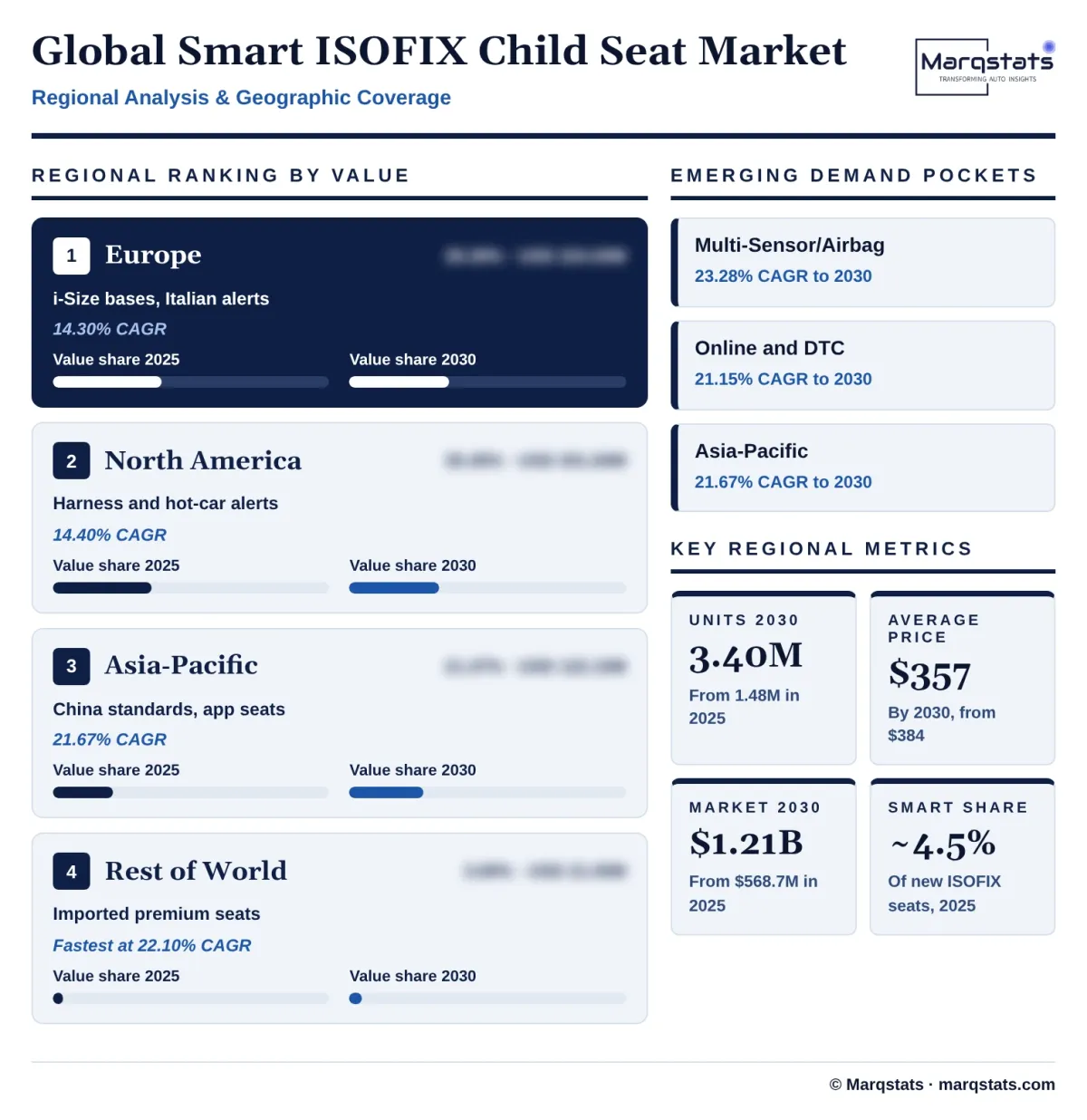
The global smart ISOFIX child seat market size is estimated at USD 568.70 million in 2025 and is projected to reach USD 1,214.50 million by 2030, growing at a CAGR of 16.39% over 2026 – 2030. Annual shipments rise from about 1.48 million to 3.40 million seats, an 18.10% annual rate, while the average manufacturer selling price eases from about USD 384 to USD 357 per seat as sensor, wireless and battery costs fall and smart features move into mid-priced seats.
Marqstats defines the market as the value, at manufacturer selling prices to retailers and distributors, of new child car seats and seat bases that attach to the vehicle through rigid ISOFIX connectors under UN Regulation No. 129 (i-Size) or through lower anchors under US FMVSS 213 and 225, and that carry built-in electronics. These electronics include installation indicators that sense latch engagement, support-leg contact or rotation lock, harness and buckle sensors, child-left-behind alerts, temperature monitoring, Bluetooth links to a phone app and sensor-triggered airbags. Passive ISOFIX seats with purely mechanical indicators, belt-only seats and clip-on alarm cushions sold separately are excluded.
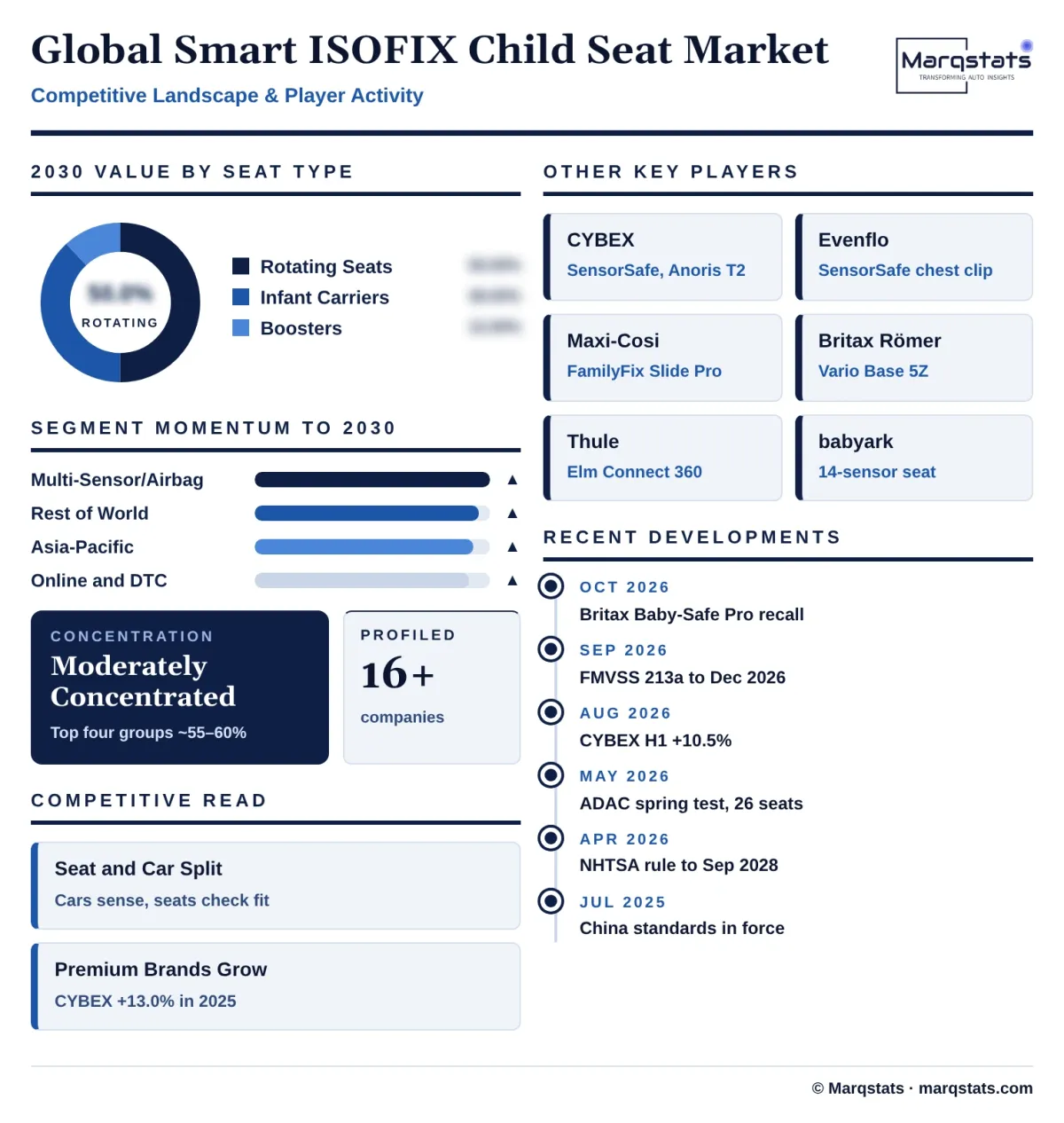
Rotating and multi-stage seats account for an estimated 47.00% of 2025 value, harness and buckle alert systems for 40.00% and specialist juvenile retailers for 46.00% of sales. Europe accounts for 39.39% of 2025 value and North America for 35.45%. The study segments the market by seat type, sensing function, sales channel and region.
Key Takeaways
Market Overview & Analysis
Report Summary
Marqstats sizes the smart ISOFIX child seat market as the value of new ISOFIX and lower-anchor child seats and bases with built-in electronics, at manufacturer selling prices. About 1.48 million such seats were shipped worldwide in 2025, worth an estimated USD 568.70 million at an average selling price of about USD 384. That is a small share of all child seats sold: Marqstats estimates that only about one in twenty new ISOFIX seats carries electronic sensing, against near-universal ISOFIX use for new seats in Europe.
A smart seat does three jobs that a mechanical seat cannot. First, it checks installation: switches and sensors confirm that both ISOFIX connectors are latched, that the support leg touches the floor and that a rotating shell is locked, and show a green signal or sound an alarm if not. Second, it checks the child: buckle and chest-clip sensors confirm that the harness is closed and, on some seats, tight enough. Third, it warns the parent: if the car stops and the child is still in the seat, a phone app, a key-fob unit or an alarm in the seat warns the parent within seconds, and some systems also report cabin temperature.
Different regions favour different functions. European buyers mainly pay for installation checks on i-Size bases and for anti-abandonment alerts, especially in Italy, where the law has required an alarm device for children under four since 2019. US buyers mainly pay for harness and child-left-behind alerts, where hot-car deaths are a public concern; Evenflo's SensorSafe range, which pairs a chest clip with a phone app, is one of the best-known examples. In China, Korea and Japan, connected seats with app control and premium materials sell to urban buyers willing to spend more per child.
Prices vary widely. Smart infant carriers and bases sell at retail from about USD 350 to 700, rotating smart seats from about USD 450 to 1,000 and flagship connected seats with many sensors, such as babyark's 14-sensor convertible seat, at the top of the range. The Thule Elm Connect 360, which uses a Holmbergs eBuckle and harness tightening support, retails at GBP 349 in the United Kingdom. Manufacturer selling prices are about 55% to 65% of retail prices.
The market grew from about USD 212.40 million in 2021 to USD 271.30 million in 2022, USD 345.80 million in 2023 and USD 449.10 million in 2024, a period when connected harness alerts spread in the United States, Italy enforced its anti-abandonment law and European brands added electronic installation checks to new i-Size bases. Growth slowed slightly in 2025 to 26.63%, to USD 568.70 million, as tariffs on Chinese-made seats raised US prices and Evenflo's car seat sales fell.
Rules shape the product in each region. In the European Union, UN Regulation No. 129 sets crash tests with Q-series dummies, including a side-impact test, and classifies seats by child height, and older R44 seats can no longer be sold. In the United States, FMVSS 213 sets frontal crash tests, FMVSS 225 sets vehicle anchorages and FMVSS 213a adds a side-impact test from 5 December 2026. China revised its child restraint standards in 2024, effective July 2025. None of these rules requires electronics in a child seat; smart features are a choice that brands make to win buyers and reduce misuse, except where national law requires an anti-abandonment device, as in Italy.
Child seats are electronics products with a long life. Most brands set a use life of six to ten years from manufacture, and smart seats need batteries, firmware updates and an app that works with new phone systems over that period. Brands that sell smart seats therefore take on a service obligation that mechanical seat brands do not, which favours large companies with app teams and spare-part networks over small importers.
Global Smart ISOFIX Child Seat Market Size and Forecast
The global smart ISOFIX child seat market grows from USD 568.70 million in 2025 to USD 1,214.50 million in 2030, a CAGR of 16.39%. Marqstats expects USD 671.00 million in 2026, USD 790.40 million in 2027, USD 920.10 million in 2028 and USD 1,062.30 million in 2029. Annual growth slows from about 18.0% in 2026 to 14.3% in 2030 as smart seats move from early buyers into the mainstream and prices fall.
Units grow faster than value. Shipments rise from about 1.48 million seats to 3.40 million, an 18.10% annual rate. The average manufacturer selling price falls from about USD 384 in 2025 to USD 357 in 2030 because the cost of Bluetooth Low Energy chips, sensors and coin-cell or rechargeable batteries keeps falling and because brands add smart features to mid-priced seats. Flagship seats with airbags and many sensors keep high prices, which slows the fall in the average.
Smart seats remain a small share of the wider child seat market. Marqstats estimates that about 4.5% of new ISOFIX and lower-anchor child seats sold worldwide in 2025 carried electronic sensing, rising to about 9.5% by 2030. Europe is furthest ahead, with about 7% of new ISOFIX seats sold with electronics in 2025, followed by North America at about 5%.
Births set the ceiling. Child seat demand depends on the number of children of car-seat age and on how many seats each family buys. Births are falling in China, Korea, Japan, Europe and North America, so growth comes from higher spending per child and from replacing seats that expire after six to ten years, not from more children. Marqstats tracks four indicators: births, the share of ISOFIX seats in new seat sales, the share of seats with electronics in each brand's range and the price gap between smart and mechanical versions of the same seat.
The regional mix shifts toward Asia. Europe remains the largest region but its share falls from 39.39% to 35.98%, and North America from 35.45% to 32.52%. Asia-Pacific rises from 21.47% to 26.80% and the Rest of World from 3.69% to 4.69%. The average selling price falls in every region, most in Asia-Pacific, where domestic brands sell smart seats at lower prices.
Car-based systems are the main risk to the forecast. If carmakers fit direct child presence detection across most new cars faster than expected and parents see seat alerts as redundant, demand for harness and alert seats would grow more slowly, while installation-checking bases would be less affected because cars do not check how a seat is fitted.
Market Dynamics
Key Drivers
Five forces lift demand for ISOFIX child seats with built-in electronics.
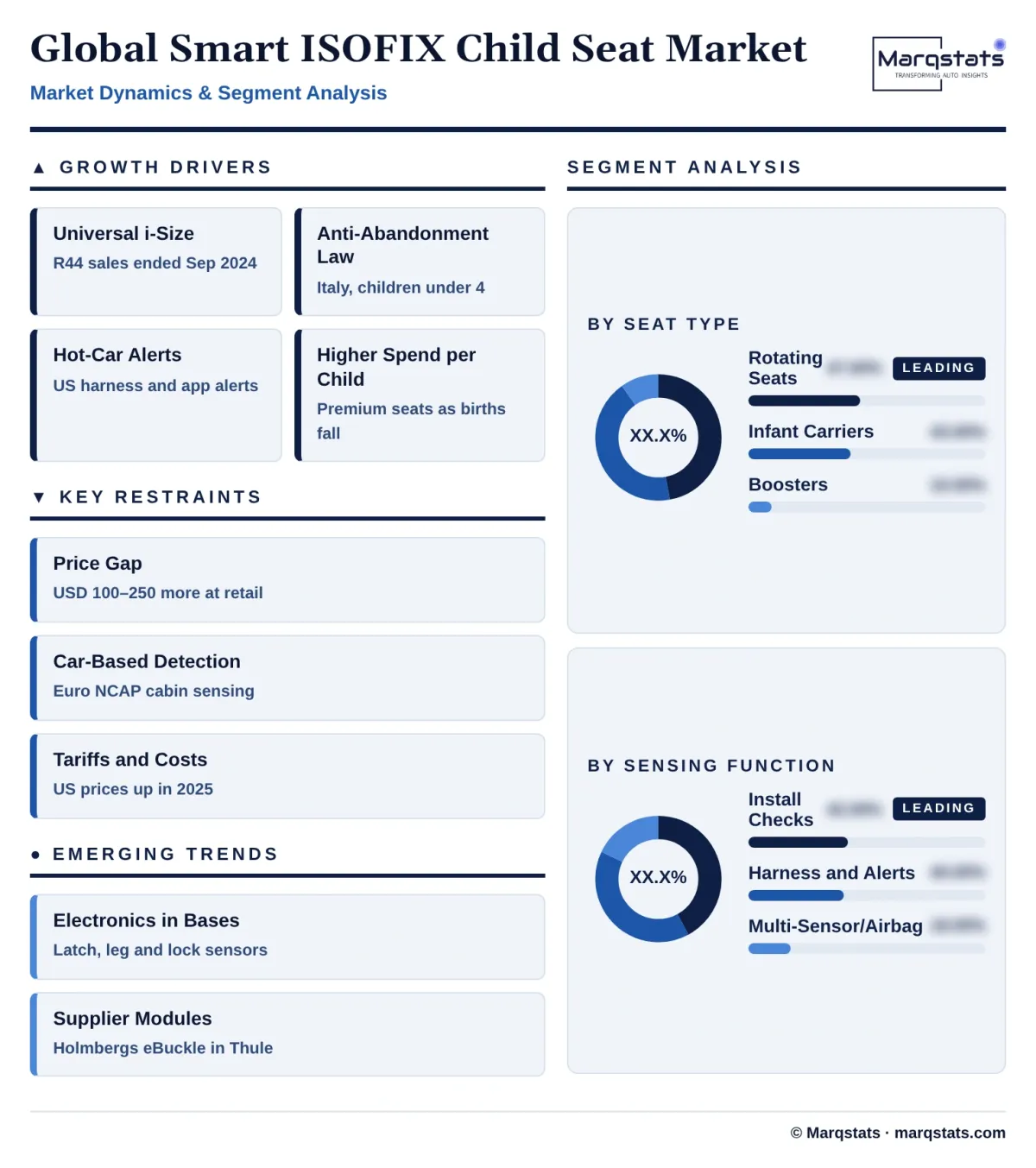
- Universal ISOFIX in Europe. Since 1 September 2024 only UN R129 i-Size seats may be sold in the European Union, and R129 favours rigid ISOFIX installation with a support leg or top tether for young children, which gives every new seat a place for electronic installation checks.
- Anti-abandonment rules. Italian Law 117 of 2018 and Ministerial Decree 122 of 2019 require drivers carrying children under four to use an anti-abandonment device, with fines of EUR 83 to 333 and five penalty points since 6 March 2020.
- Hot-car concern in the United States. Public campaigns on children left in vehicles and the slow rollout of car-based rear-seat systems keep demand high for seats that send a phone alert when a child is left buckled in.
- Fewer installation errors. Installation errors remain common in child seats, and electronic indicators that confirm latching, support-leg contact and harness closure give parents a simple check every trip.
- Higher spending per child. With fewer children per family in China, Korea, Japan and Europe, parents spend more on each seat, which supports premium connected models.
Key Restraints
Four constraints slow the move from mechanical to smart child seats.
- Price gap. A smart version of a seat typically costs USD 100 to 250 more at retail than the same seat without electronics, which limits demand among cost-conscious buyers.
- Cars are adding their own systems. Euro NCAP rewards direct child presence detection by the vehicle, and carmakers are fitting cabin radar that can replace the alert function of a smart seat for some buyers.
- Battery and app friction. Seats need battery changes or charging and app pairing, and parents who stop using the app lose part of the benefit, which weighs on repeat purchases.
- Tariffs and costs. US tariffs on imported seats and parts raised prices in 2025 and pushed some buyers to cheaper mechanical seats; Evenflo's car seat sales fell in 2025.
Key Trends
Four shifts are changing how smart child seats are designed, sold and used.
- Electronics move into bases. Brands put sensors, batteries and displays into ISOFIX bases shared by an infant carrier and a toddler seat, so one base serves several years and several children.
- Specialist suppliers for buckles and hubs. Holmbergs supplies its eBuckle and harness tightening support to other brands, as in the Thule Elm Connect 360, letting seat makers add smart features without building their own electronics.
- Airbags and many-sensor seats. CYBEX's Anoris T2 i-Size uses a full-body airbag in its impact shield, and babyark's convertible seat uses 14 sensors to check installation and buckling each trip.
- Stricter crash testing. Consumer tests in Europe and the US side-impact rule FMVSS 213a, now due on 5 December 2026, push designers to keep electronics out of load paths and to prove that bases and buckles hold in severe crashes.
Strategic Implications
- For child seat brands, installation sensing is now a standard feature in premium ISOFIX bases. Brands that add harness tightening and child alert features at mid-range prices will win share as electronics costs fall.
- For brands selling in Europe, car-based child presence detection is both a threat and an opening. Seats that pass data to the car's display or app through standard Bluetooth profiles can work alongside cabin radar rather than compete with it.
- For electronics suppliers, buckle, latch and hub modules sold to many brands offer scale. Suppliers that meet automotive-grade temperature, vibration and battery-life targets can sell to brands that do not want to develop electronics in-house.
- For retailers, smart seats need installation help and app setup. Specialist stores that offer fitting checks keep an advantage, while online sellers need clear setup guides and video support to keep return rates low.
- For safety engineers, electronics should add no weak points to the seat. Recent consumer test failures in buckles and support legs show that every load path needs testing in the most extreme recline and installation settings.
- For investors, the market offers fast growth from a small base tied to premium juvenile brands. Results at CYBEX and Dorel Juvenile in 2025 and 2026 show that premium seats with new features can grow while total child seat demand is flat, but recalls and crash-test failures can quickly hit a brand.
Market Segmentation
Rotating and multi-stage seats used from birth or from about 40 cm up to about four to seven years account for 47.00% of 2025 value, USD 267.29 million, and grow at 17.84% a year to USD 607.25 million and 50.00% of 2030 value. Their large ISOFIX bases house rotation-lock sensors, batteries and displays, and most flagship smart seats from CYBEX, Maxi-Cosi, Evenflo and Thule fall in this group.
Infant carriers and their ISOFIX bases account for 43.00% of 2025 value, USD 244.54 million, and grow at 13.54% a year to USD 461.51 million, while their share falls to 38.00%. Electronic bases that confirm latching and support-leg contact are the main smart feature, and one base often serves several children.
ISOFIX high-back boosters for children from about 100 cm to 150 cm account for 10.00% of 2025 value, USD 56.87 million, and grow fastest, at 20.71% a year, to USD 145.74 million and 12.00% of 2030 value, as brands add child alerts and connector checks to booster seats.
Seats and bases whose main electronic feature is installation checking, covering ISOFIX latching, support-leg contact, rotation lock and recline position, account for 42.00% of 2025 value, USD 238.85 million, and grow at 12.85% a year to USD 437.22 million, while their share falls to 36.00% as these checks become standard.
Seats with buckle or chest-clip sensors and child-left-behind alerts to a phone or key unit account for 40.00% of 2025 value, USD 227.48 million, and grow at 16.39% a year to USD 485.80 million, holding a 40.00% share. Evenflo SensorSafe, CYBEX SensorSafe and Holmbergs eBuckle are leading systems.
Seats with many sensors, temperature monitoring, app control or sensor-triggered airbags account for 18.00% of 2025 value, USD 102.37 million, and grow fastest, at 23.28% a year, to USD 291.48 million and 24.00% of 2030 value.
Specialist baby and juvenile stores account for 46.00% of 2025 value, USD 261.60 million, and grow at 13.18% a year to USD 485.80 million, while their share falls to 40.00%. Trained staff who fit seats and demonstrate apps remain important for high-priced smart seats.
Online marketplaces and brand-owned web stores account for 27.00% of 2025 value, USD 153.55 million, and grow fastest, at 21.15% a year, to USD 400.79 million and 33.00% of 2030 value.
Mass retailers, department stores and hypermarkets account for 27.00% of 2025 value, USD 153.55 million, and grow at 16.39% a year to USD 327.92 million, holding a 27.00% share, mainly through mid-priced smart seats.
By Geography
Europe
Europe is the largest market, with 39.39% of 2025 value, USD 224.00 million and about 560,000 seats at an average selling price of about USD 400, rising to USD 437.00 million and about 1.15 million seats by 2030, a 14.30% CAGR, while its share falls to 35.98%. Since 1 September 2024 only UN R129 i-Size child seats may be sold in the European Union, so almost all new seats for young children use ISOFIX. Italy is the strongest single market for alerts, because Law 117 of 2018 and Ministerial Decree 122 of 2019 require drivers carrying children under four to use an anti-abandonment device, enforced with fines of EUR 83 to 333 and five penalty points since March 2020. Germany, the Nordic countries and the United Kingdom lead in electronic installation bases and long rear-facing use. Consumer crash tests by ADAC, ÖAMTC, TCS and Stiftung Warentest shape buying; in autumn 2026 the Britax Römer Baby-Safe Pro on the Vario Base 5Z was rated poor after its buckle failed in the lie-flat setting, and Britax Römer began a recall of shells made from 26 December 2025 to 30 September 2026.
North America
North America accounts for 35.45% of 2025 value, USD 201.60 million and about 480,000 seats, and grows at 14.40% a year to USD 395.00 million and about 1.00 million seats by 2030, a 32.52% share. US seats are tested under FMVSS 213 and attach through lower anchors, with a growing share of rigid connectors on premium and rotating seats. Harness and child-left-behind alerts are the main smart feature, led by Evenflo's SensorSafe range, CYBEX SensorSafe and babyark. NHTSA delayed the compliance date of its new side-impact standard, FMVSS 213a, from 30 June 2025 to 5 December 2026, and moved the compliance date of its rear seat belt warning rule to 1 September 2028. Dorel builds a large share of its US car seats at Columbus, Indiana, which helped it manage tariff pressure in 2025.
Asia-Pacific
Asia-Pacific accounts for 21.47% of 2025 value, USD 122.10 million and about 370,000 seats, and grows fastest among the large regions, at 21.67% a year, to USD 325.50 million and 26.80% of 2030 value. China is the largest country market, with about 250,000 smart seats in 2025. China's revised national child restraint standards, adopted on 29 September 2024 and in force from 1 July 2025, require rear- or side-facing seats for children under 15 months, use height as the main selection measure and include guidance on ISOFIX installation. Chinese brands and CYBEX, the premium brand of Goodbaby, sell app-connected seats in large cities. Korea, Japan and Australia add premium demand from parents who spend more per child as births fall.
Rest of World
The Rest of World accounts for 3.69% of 2025 value, USD 21.00 million and about 70,000 seats, and grows at 22.10% a year to USD 57.00 million and 4.69% of 2030 value. Gulf states, Israel, Brazil and other Latin American markets buy mostly imported premium seats, and stronger child seat laws and rising ownership of ISOFIX-equipped cars support growth from a small base.
How Competition Is Evolving
The smart ISOFIX child seat market is moderately concentrated. Goodbaby International, through CYBEX and Evenflo, Dorel Juvenile, through Maxi-Cosi and Safety 1st, Newell Brands, through Graco, and Britax Römer hold the largest shares of premium child seat sales, while Joie, Nuna, BeSafe, Thule, Kiddy, Chicco and babyark compete in specific regions or price ranges. Marqstats estimates that the four largest groups hold about 55% to 60% of smart seat value.
Goodbaby is the largest premium player. Group revenue was about HK$8,659.2 million in 2025, down from HK$8,765.9 million in 2024, as CYBEX revenue rose 13.0% to about HK$5,047.4 million while Evenflo fell to about HK$2,118.1 million, mainly because of lower car seat sales. In the first half of 2026, group revenue rose 5.8% to HK$4,551.0 million and CYBEX revenue rose 10.5% to HK$2,709.5 million. At about HK$7.80 per US dollar, CYBEX revenue in 2025 was about USD 647 million across car seats, strollers and other products.
Dorel Juvenile improved results for a third year. Dorel Juvenile revenue rose 2% in 2025, with fourth-quarter revenue up 6.6% to USD 226.8 million, and adjusted operating profit rose 84.7% to USD 33.8 million. Management credited rotating car seats, Maxi-Cosi products and strong US car seat sales supported by the Columbus, Indiana plant.
Suppliers and newcomers shape the smart layer. Holmbergs, based in Sweden, supplies its eBuckle and harness tightening support to other brands, including the Thule Elm Connect 360, a Red Dot 2026 winner that pairs with the Thule app for installation guidance and child alerts. babyark sells a convertible seat with 14 sensors that check installation and buckling and send forgotten-child alerts to a phone. CYBEX sells SensorSafe seats in the United States and the Anoris T2 i-Size, a forward-facing seat with an airbag in its impact shield, in Europe.
Crash tests are a key competitive arena. In the spring 2026 ADAC and Stiftung Warentest test of 26 seats, six were rated good and no PFAS were found in any seat. In the autumn 2026 test the Britax Römer Baby-Safe Pro on the Vario Base 5Z was rated poor after its buckle tongue broke in the lie-flat setting, and Britax Römer recalled shells made between 26 December 2025 and 30 September 2026, offering a replacement or free update; the ÖAMTC rated seven seats good in the same round, including CYBEX Cloud G3 and Sirona G3 seats with Base G3 and the Maxi-Cosi Coral Slide Pro with FamilyFix Slide Pro.
Companies Covered
Companies covered in the report include:
Recent Market Activity
Table of Contents
Coverage & Segmentation
The study covers the global smart ISOFIX child seat market, with 2025 as the base year, 2021 – 2025 as the historical period and 2026 – 2030 as the forecast period. Values are in US dollars at manufacturer selling prices to retailers and distributors, and volumes are annual shipments of new seats and bases. Hong Kong dollar values are converted at about HK$7.80 per US dollar and euro values at EUR 1 = USD 1.13, the 2025 averages.
The market includes child seats and seat bases with ISOFIX or lower-anchor connectors and built-in electronics for installation checks, harness and buckle sensing, child alerts, temperature monitoring, app links or sensor-triggered airbags. Passive ISOFIX seats, belt-only seats, standalone alarm cushions and clip-on alarm devices, strollers and car-based child presence detection systems are excluded. Segment and regional splits are Marqstats estimates built on births, child seat sales and brand ranges.