Market Snapshot
Middle bar: base-year value × (1 + CAGR), rounded to two decimals. This is a calculated illustration, not a separately researched annual estimate.
The global rotator and heavy-duty wrecker market size is estimated at USD 805.73 million in 2025 and is projected to reach USD 1,067.79 million by 2030, growing at a CAGR of 5.79% over 2026 – 2030. Shipments rise from about 4,572 to 5,559 bodies a year, a 3.99% annual rate.
Marqstats defines the market as the installed value of new heavy-duty recovery bodies fitted to Class 7 and Class 8 chassis: continuous-rotation rotators, integrated heavy wreckers and independent heavy wreckers, including installation. The chassis, light and medium wreckers, rollback carriers, repossession bodies, used equipment, parts and recovery services are excluded, so the market is the body and not the truck.
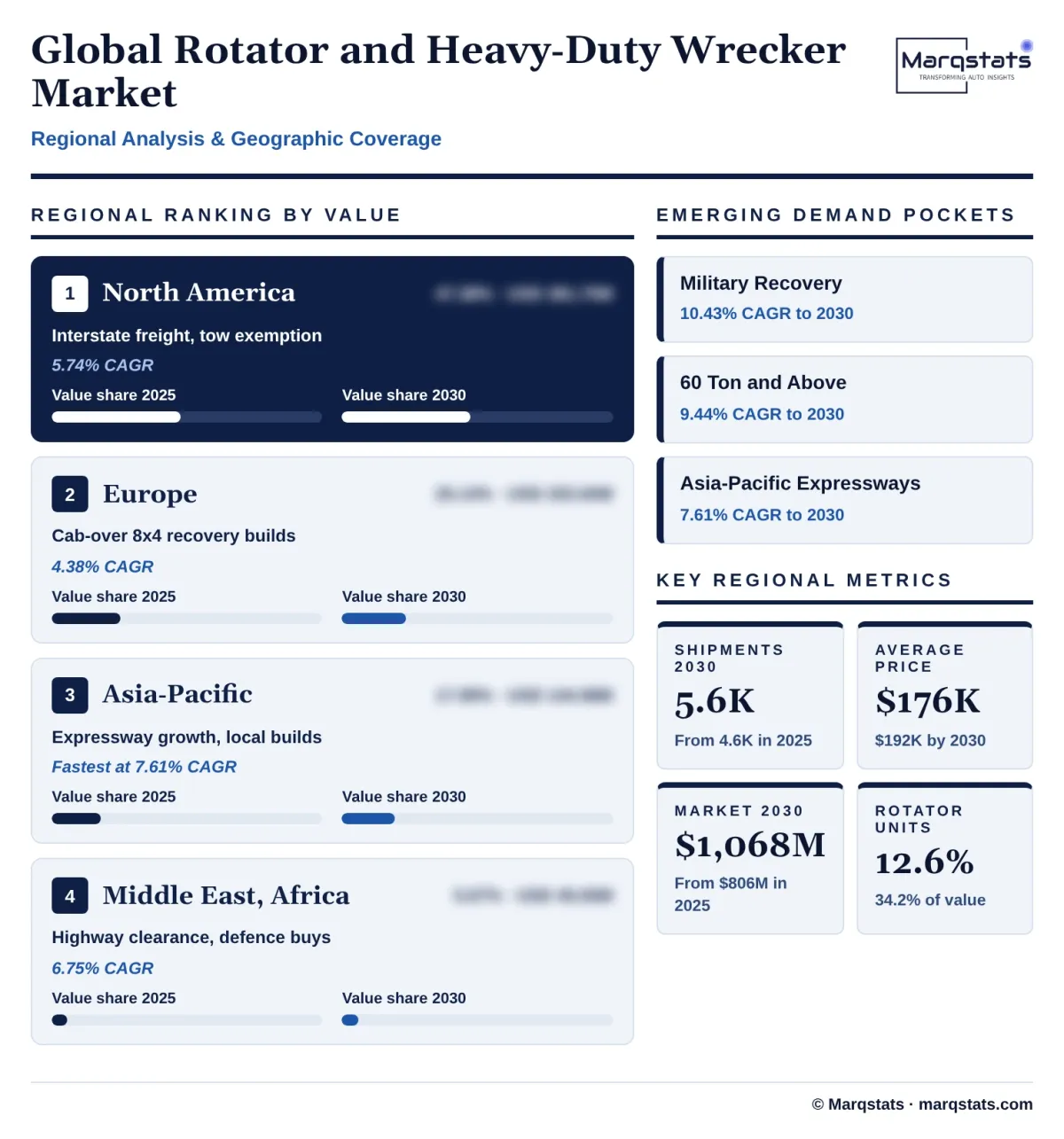
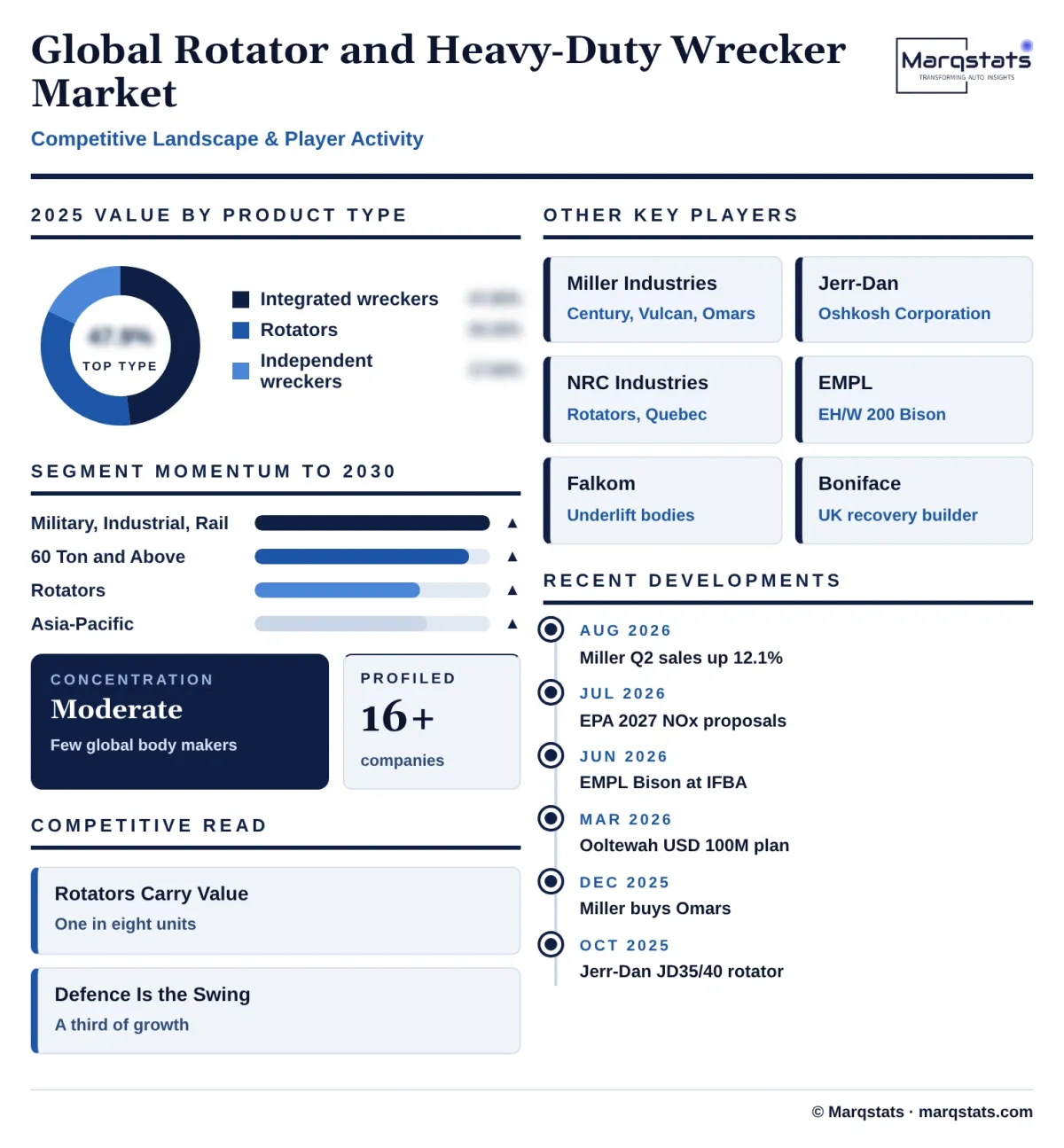
Integrated heavy wreckers account for 47.90% of 2025 value and North America for 47.38%. Rotators are 12.64% of units but 34.16% of value. The study segments the market by product type, capacity class, end user and region, and sizes each from shipments multiplied by installed body prices.
Key Takeaways
Market Overview & Analysis
Report Summary
Marqstats sizes the global rotator and heavy-duty wrecker market as the installed value of new heavy recovery bodies that upright, extricate and tow disabled Class 7 and Class 8 trucks, buses and heavy equipment. In 2025 about 4,572 bodies shipped worldwide, worth an estimated USD 805.73 million at an average installed price of about USD 176,231.
Three product families make up the market. Rotators carry a telescopic boom on a continuous 360-degree turntable with outriggers, so they lift a rolled-over truck from beside the carriageway and upright it without closing extra lanes. Miller Industries calls the Century M100 the world's largest rotator truck, and its Holmes line includes a 16-ton rotator. Integrated heavy wreckers combine the recovery boom and underlift in one structure and are the standard fleet unit for highway towing. Independent heavy wreckers keep the boom and underlift as separate assemblies, which suits winching and off-road recovery. Miller Industries classes wreckers of 16 tons and above as heavy-duty and sells wreckers from 4 to 100 tons.
The boundary is the body. Marqstats excludes the donor chassis, light and medium wreckers and rollback carriers, repossession self-loaders and wheel-lifts, used equipment, parts and recovery services. The distinction matters at the top of the range: the body of a Century M100 costs about USD 1.31 million according to the Heavy Duty Journal equipment guide of December 2025, while a complete M100 rig costs more than USD 1.5 million according to The Drive, so the body is at most 87% of the top-end truck and a much smaller share of a mid-size unit.
The market moves with the vocational truck cycle. Chassis shortages in 2021 to 2023 held back body makers, distributors then built stock, and 2025 became a correction year. Miller Industries reported 2025 net sales of USD 790.3 million, 37.2% below USD 1,257.5 million in 2024, and said distributor inventory returned to historical levels by early 2026. Those totals include light and medium wreckers, car carriers, parts and chassis, so they describe the cycle and not the size of this market.
Marqstats estimates the market at USD 851.97 million in 2026, 5.74% above 2025, with about 4,753 bodies. The 2025 base is a trough year for channel orders, which is why growth resumes without a policy trigger, and the largest new source of demand after 2026 is military production that Miller Industries expects to begin in 2027.
Global Rotator and Heavy-Duty Wrecker Market Size and Forecast
The global rotator and heavy-duty wrecker market grows from USD 805.73 million in 2025 to USD 1,067.79 million in 2030, a CAGR of 5.79%. Volume contributes roughly three quarters of the growth: shipments rise at 3.99% a year from about 4,572 to 5,559 bodies, and the average installed price rises at 1.74% a year from USD 176,231 to USD 192,083. Marqstats expects USD 900.88 million in 2027, USD 953.35 million in 2028 and USD 1,008.67 million in 2029.
The 2025 value is built bottom-up from shipments and installed prices by region and product. In North America Marqstats estimates 330 rotators at about USD 540,000, 870 integrated heavy wreckers at about USD 175,000 and 250 independent heavy wreckers at about USD 205,000, which gives USD 381.70 million. Europe ships 1,100 bodies at lower prices, about USD 430,000 for a rotator, or EUR 380,531 at EUR 1 = USD 1.13. Asia-Pacific, Latin America and the Middle East and Africa ship 1,550, 210 and 262 bodies, with Asia-Pacific pulled down by locally built integrated wreckers at about USD 76,000.
The price anchors come from named sources. The Century M100 body is about USD 1.31 million. Used Century units are listed at USD 599,900 for a 2015 Kenworth T880 with a Century 1075, USD 619,900 for a 2018 Kenworth T880 with a Century 1150 and USD 794,900 for a 2020 Peterbilt 389 with a Century 1075, and those asking prices include the chassis. Marqstats prices new bodies below complete-rig levels by deducting a Class 8 vocational chassis and converts European prices at EUR 1 = USD 1.13.
Prices rise more slowly than volume. Marqstats expects the North American rotator body to move from about USD 540,000 to USD 585,000 by 2030 as mix shifts to 50-ton and larger units, the integrated heavy wrecker from USD 175,000 to USD 188,000 and the independent heavy wrecker from USD 205,000 to USD 219,000, so the blended price gains 1.74% a year.
The forecast follows the replacement cycle and the defence order book more than freight volume. A heavy recovery body works for a decade or more, so the 2025 shipment trough implies a rebound in 2026 and 2027 as operators that deferred orders return, and military production from 2027 adds a second leg. Marqstats expects shipments of about 4,753 in 2026 and 4,941 in 2027.
Marqstats tracks four indicators: quarterly net sales and commentary from Miller Industries and Oshkosh Corporation, heavy chassis allocations from PACCAR, Daimler Truck and Volvo Group, state and national incident-clearance policy, and military recovery tenders in North America and Europe.
Market Dynamics
Key Drivers
Five forces return fleets and governments to the heavy end of the recovery market after the 2025 destocking trough.
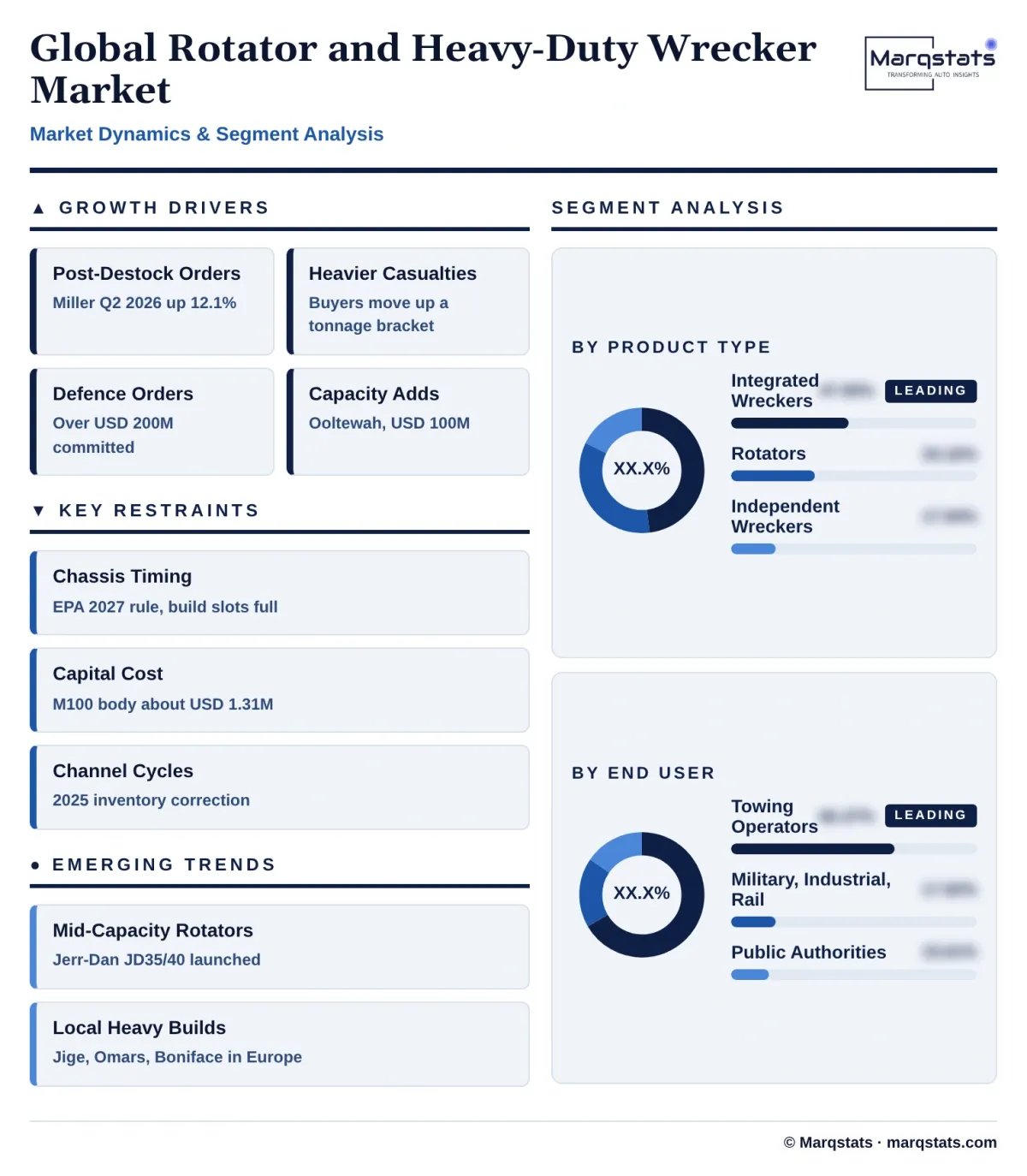
- Replacement follows the distributor correction. Miller Industries net sales fell 37.2% in 2025 to USD 790.3 million as distributors cut stock, then rose 12.1% in the second quarter of 2026 to USD 240.0 million, and the company guided to USD 850 million to USD 900 million for 2026 with about USD 250 million a quarter in the second half. Management said in August 2026 that distributor inventory was close to historical averages, which lets retail demand set production again.
- Heavier casualties push buyers up a tonnage bracket. Jerr-Dan, part of Oshkosh Corporation, described the JD35/40 rotator, launched in October 2025, as an option between traditional heavy wreckers and the largest rotators, responding to evolving weight and performance expectations, and fitted it with two 35,000 lb winches, a 50,000 lb drag winch and an optional 42,000 lb spreader bar. Marqstats expects the 45 to 55 ton and 60 ton and above classes to outgrow the 25 to 40 ton class.
- Government and military programmes add a demand layer that follows contracts and not freight. Miller Industries reported more than USD 150 million of military commitments for heavy-duty recovery products in March 2026 and more than USD 200 million at its second quarter call in August 2026, with production beginning in 2027 and the majority of revenue in 2028 and 2029.
- Quick-clearance policy rewards single-lane recovery. The Federal Highway Administration traffic incident management programme trains responders on quick-clearance requirements, and a rotator parks beside the casualty and lifts it over the shoulder, so authorities that set clearance targets in towing contracts prefer rotator-equipped contractors. The federal exemption in 23 U.S.C. 127(m) exempts a covered heavy tow and recovery vehicle from the Interstate weight limits while it carries a disabled vehicle to the nearest appropriate repair facility, provided its own gross weight is at least that of the disabled vehicle.
- Manufacturers are adding capacity. Miller Industries plans a 200,000 square foot Ooltewah, Tennessee facility costing about USD 100 million, production-ready in late 2027, a EUR 8 million expansion in France to double heavy-duty integration capacity by mid-2027, and bought Omars S.p.A. of Cuneo, Italy, on 2 December 2025 for about EUR 17.5 million.
Key Restraints
Four constraints hold back volume and decide how fast operators can turn demand into delivered trucks.
- Chassis allocation and emissions rules decide delivery dates. The EPA 2027 low-NOx standard of 35 mg per horsepower-hour is scheduled to start on 1 January 2027, EPA published proposals in July 2026 to cancel the warranty increase, defer the useful-life increase and allow non-conformance penalties, and FleetOwner reported in September 2026 that most 2026 Class 8 build slots were already committed. A body maker cannot ship a rotator without a chassis, so every uncertainty about engine pricing moves orders between quarters.
- Capital cost keeps many operators in the used market. A complete Century M100 costs more than USD 1.5 million, and used Century 1075 and 1150 units on Kenworth and Peterbilt chassis are listed at USD 599,900 to USD 794,900. A towing firm needs rotation-list contracts and steady heavy jobs to justify new equipment, so smaller operators buy used or share rotators between yards.
- The channel is cyclical. Miller Industries said its backlog of manufactured equipment was affected by inflated inventory in distribution channels, reduced production in the second half of 2025 and expected production to rise through the first half of 2026. When distributors overbuy, factory orders fall by more than retail demand.
- Trade policy adds cost and uncertainty. Miller Industries lists new or increased tariffs and resulting trade wars as a risk, and heavy recovery bodies use imported steel plate, hydraulic valves and winches, so duty changes move quotes on every rotator order.
Key Trends
Four shifts are changing what heavy recovery bodies are built, on which chassis and for whom.
- Mid-capacity rotators. Jerr-Dan launched the JD35/40 in October 2025 with a 37-foot boom, continuous 360-degree rotation and a tri-axle layout, aimed at operators who need single-lane uprighting without the tare weight of the largest units.
- Local heavy-duty production in Europe. Miller Industries management said about half of the heavy-duty product sold by its French and British businesses is built in the United States, and it is doubling French integration capacity by mid-2027 and added Omars in Italy, which contributed USD 16.2 million of net sales in the first half of 2026.
- Digital control and safety systems. EMPL fits proportional radio remote controls with a 12-inch operator display and outrigger cameras on its EH/W 200 Bison, and the JD35/40 carries a CAN-Bus electrical system and a tip alarm that triggers at one degree of unevenness.
- Heavier-casualty rigging. Spreader bars rated at 42,000 lb, coach booms such as the UL565 and long-reach underlifts are becoming standard options, because heavier tractors, loaded refuse trucks and coaches carry weight that standard wrecker underlifts were not specified for.
Strategic Implications
- For body makers, the profit pool is the rotator and the 45 ton and above wrecker, where price per unit is three to four times that of an integrated heavy wrecker. Capacity added in Ooltewah and France should be sequenced to military production from 2027 without starving commercial dealers.
- For towing operators, the purchase decision is a utilisation question. A rotator earns its cost only if rotation-list and highway-authority contracts supply steady heavy jobs, so operators in thin markets should share a rotator across yards or hold an integrated 50-ton wrecker with a heavy underlift.
- For chassis suppliers, vocational build slots are a competitive lever. Allocating slots to body makers that hold military or authority contracts locks in volume ahead of the EPA 2027 transition and reduces the risk that completed bodies wait for chassis.
- For distributors and lenders, inventory discipline decides the cycle. The 2025 correction shows that stock built ahead of retail demand turns into a factory trough, so floor-plan limits and shorter ordering cycles reduce risk.
- For highway and transit authorities, contract specifications should name lane-clearance performance and minimum lift ratings rather than equipment types, because the weight of the vehicles being recovered is rising and contractors will otherwise under-specify.
Market Segmentation
Rotators account for 34.16% of 2025 value, USD 275.26 million and about 578 bodies, and grow fastest among products, at 7.29% a year, to USD 391.37 million. A rotator is a telescopic boom on a continuous 360-degree turntable with front and rear outriggers, built by Miller Industries under the Century name, Jerr-Dan, NRC Industries and European builders. They lead on value per unit, about USD 476,228, and on strategic importance because highway authorities and military buyers specify them for complex recoveries.
Integrated heavy wreckers account for 47.90% of 2025 value, USD 385.92 million and about 3,000 bodies, and grow at 4.77% a year to USD 487.16 million. The boom and underlift form one structure, which lowers tare weight and shortens the vehicle, so integrated bodies are the standard fleet unit for highway towing, bus recovery and European urban work. The average installed price is about USD 128,640, which makes this the volume core of the market.
Independent heavy wreckers account for 17.94% of 2025 value, USD 144.55 million and about 994 bodies, and grow at 5.54% a year to USD 189.26 million. The boom and underlift work as separate assemblies, so heavy winch pulls do not pass through the underlift crossbar. They serve industrial salvage, mining and oilfield recovery and military vehicles, at about USD 145,423 a body.
The 25 to 40 ton class accounts for 49.86% of 2025 value, USD 401.69 million, and grows at 4.12% a year to USD 491.45 million. It holds most integrated wreckers and mid-capacity rotators such as the JD35/40, and it is the entry point for fleets that recover tractor-trailers and buses.
The 45 to 55 ton class accounts for 35.02% of 2025 value, USD 282.20 million, and grows at 6.41% a year to USD 385.06 million. Marqstats treats it as the standard highway rotator and heavy wrecker bracket, where underlift and winch ratings cover loaded Class 8 combinations and refuse and concrete trucks.
The 60 ton and above class accounts for 15.12% of 2025 value, USD 121.84 million, and grows fastest, at 9.44% a year, to USD 191.28 million. It includes 75-ton and 100-ton rotators such as the Century M100, whose body costs about USD 1.31 million, and military heavy recovery vehicles, so a small number of orders moves the class.
Commercial towing and recovery operators account for 66.47% of 2025 value, USD 535.59 million, and grow at 4.09% a year to USD 654.60 million. They buy through distributors, finance equipment on rotation-list income and are the group most exposed to the 2025 destocking cycle.
Highway, municipal and transit authorities account for 15.61% of 2025 value, USD 125.76 million, and grow at 6.97% a year to USD 176.11 million. Most buy indirectly through concession towing contracts, so their policies on clearance time and lift capacity shape the specification more than their own purchases.
Military, industrial and rail buyers account for 17.92% of 2025 value, USD 144.38 million, and grow fastest, at 10.43% a year, to USD 237.08 million. Defence recovery programmes, mining and oilfield salvage and rail rerailing work buy independent and integrated heavy bodies built for severe duty, and Miller Industries expects its military production to start in 2027.
By Geography
North America
North America accounts for 47.38% of 2025 value, USD 381.70 million and about 1,450 bodies, and grows at 5.74% a year to USD 504.51 million. The Interstate System, a large Class 8 tractor fleet and the federal tow and recovery weight exemption in 23 U.S.C. 127(m) make the United States the centre of demand, and Miller Industries and Jerr-Dan supply most heavy units. Miller Industries North American sales were USD 325.2 million in the first half of 2026 against USD 362.3 million a year earlier, which shows the destocking that Marqstats expects to reverse in the second half.
Europe
Europe accounts for 25.14% of 2025 value, USD 202.60 million and about 1,100 bodies, and grows at 4.38% a year to USD 251.03 million. Heavy recovery bodies are built on cab-over chassis from Scania, Mercedes-Benz, MAN, DAF, Iveco and Volvo, with 8x4 layouts such as the Scania S 770 and the Mercedes-Benz Arocs 4163 that EMPL showed at IFBA in June 2026. Weights and dimensions follow Directive 96/53/EC, and in the United Kingdom heavier combinations operate under the special types order, with Category 2 up to 80,000 kg and Category 3 up to 150,000 kg gross weight.
Asia-Pacific
Asia-Pacific accounts for 17.99% of 2025 value, USD 144.98 million and about 1,550 bodies, and grows fastest, at 7.61% a year, to USD 209.25 million. Expressway networks in China, India and Southeast Asia raise the cost of blocked lanes and move operators from mechanical winch trucks to hydraulic integrated wreckers, mostly built locally at low prices, about USD 76,000 for an integrated body. Rotators are imported or built in small numbers for expressway operators and mines, which is why the region ships 1,550 bodies but only 17.99% of value.
Latin America
Latin America accounts for 3.82% of 2025 value, USD 30.80 million and about 210 bodies, and grows at 5.21% a year to USD 39.71 million. Mining haulage, mountain passes and concession highways drive demand for independent and integrated wreckers on all-wheel-drive and 6x4 chassis, and import costs keep rotators rare.
Middle East and Africa
The Middle East and Africa account for 5.67% of 2025 value, USD 45.65 million and about 262 bodies, and grow at 6.75% a year to USD 63.29 million. Gulf highway authorities, petrochemical transport and desert industrial corridors buy heavy wreckers for rapid accident clearance and rotators for concession operators, and defence procurement adds occasional large orders.
How Competition Is Evolving
The market is concentrated at the top and fragmented below. Marqstats describes competition by layer and states no company shares, because body makers report towing and recovery equipment as one line. Miller Industries, Inc. of Ooltewah, Tennessee, employs about 1,535 people in eleven plants in the United States, France, Italy and the United Kingdom, sells through about 76 distributor locations in North America and more than 30 distributors abroad, and builds heavy bodies under the Century, Vulcan, Boniface, Jige, Omars and Holmes names. Oshkosh Corporation sells the Jerr-Dan range of integrated and independent wreckers and rotators.
The second layer is specialist rotator and heavy recovery builders. NRC Industries of Quebec builds rotators, and in Europe EMPL Fahrzeugwerk GmbH of Austria builds custom heavy recovery vehicles such as the EH/W 200 Bison on 8x4 chassis, while Falkom B.V. of the Netherlands builds underlift bodies. These firms win on chassis fit, short wheelbases and compliance with national weight rules.
The third layer is regional builders that mount imported or locally made booms and underlifts on domestic chassis in Asia-Pacific, Latin America and the Middle East. Local content, price and service reach decide the sale, and quality varies widely.
Competition is moving from boom ratings to lead time and system integration. The body maker that holds chassis allocations, offers mid-capacity rotators with heavy underlifts and secures military and authority contracts will take the replacement orders of 2026 to 2028, when Marqstats expects shipments to rise from 4,572 to 5,139 bodies.
Companies Covered
Companies covered in the report include:
Recent Market Activity
Table of Contents
Coverage & Segmentation
The study covers the global rotator and heavy-duty wrecker market, with 2025 as the base year, 2021 – 2025 as the historical period and 2026 – 2030 as the forecast period. Values are in US dollars at the installed price of the recovery body including installation, and volumes are annual shipments of new bodies. The market is segmented by product type, capacity class, end user and region. Rotators start at 35 tons and wreckers at 25 tons of manufacturer-rated capacity on Class 7 and Class 8 chassis.
The donor chassis, light and medium wreckers, rollback carriers and car carriers, repossession self-loaders and wheel-lifts, used equipment, parts and recovery services are excluded, so the market does not overlap the Marqstats Global Self-Loader and Wheel-Lift Repossession Truck Market, which covers Class 3 to 6 bodies. Wreckers rated between 16 and 24 tons, including the 16-ton Holmes rotator, sit below the thresholds and are also excluded. Miller Industries net sales and the Omars deal are context only, and segment and regional splits are Marqstats estimates built on shipments, installed price points and distributor and operator interviews.