Market Snapshot
Middle bar: base-year value × (1 + CAGR), rounded to two decimals. This is a calculated illustration, not a separately researched annual estimate.
The global electric snow plough and winter service truck market size is estimated at USD 116.38 million in 2025 and is projected to reach USD 624.45 million by 2030, growing at a CAGR of 39.93% over 2026 – 2030. Deliveries of battery-electric winter service trucks rise from about 426 vehicles to 2,290, a 39.99% annual rate, and sales of battery-powered and ePTO-driven winter equipment rise from about 830 units to 4,050.
Marqstats defines the market as the delivered value of new battery-electric trucks in UNECE categories N2 (3.5 to 12 tonnes) and N3 (above 12 tonnes) supplied as winter service vehicles with a snow plough, spreader or both, valued with their winter body and equipment, plus battery-powered and high-voltage ePTO-driven spreaders and plough power units sold separately for any carrier vehicle. Diesel, renewable diesel and gas winter trucks, conventional spreaders driven by engine PTO or the vehicle 12 V system, pickup plough kits, consumer and walk-behind snow blowers, airport runway snow blowers and sweepers, and compact sidewalk carriers are excluded.
Heavy N3 trucks account for an estimated 43.35% of 2025 value, medium N2 trucks for 34.50% and separately sold electric winter equipment for 22.15%. Europe accounts for 47.80% of 2025 value and Asia-Pacific for 39.61%. The study segments the market by product type, road network and region.
Key Takeaways
Market Overview & Analysis
Report Summary
Marqstats sizes the electric snow plough and winter service truck market as the delivered value of new battery-electric N2 and N3 trucks supplied for winter road maintenance with ploughs, spreaders or both, plus battery-powered and ePTO-driven winter equipment sold separately. In 2025 about 426 electric winter service trucks were delivered worldwide, worth an estimated USD 90.60 million with their winter equipment, and about 830 electric spreaders and plough power units worth USD 25.78 million were sold separately, giving a market of USD 116.38 million.
Winter road maintenance is one of the hardest duties for an electric truck. A plough truck pushes snow with a 3 to 4 m blade, carries 6 to 9 m³ of salt or grit and brine, drives the spreader disc and conveyor, runs hydraulic pumps to lift and angle the blade, and may have to work all night or through a multi-day storm. Diesel trucks handle this with a large fuel tank and a refuel in minutes. An electric truck must carry enough battery for the longest shift on the route or have a charger on the route.
Field tests now show what works. Statens vegvesen tested a Designwerk truck built on a Volvo FH chassis with an 864 kWh net battery on the E6 over Dovrefjell from January to February 2024 and measured an average of 1.56 kWh per km, rising to 1.82 kWh per km at the highest, giving 380 to 443 km and 12.6 to 14.7 hours of clearing between 90% and 10% charge. It concluded that the technology is mature enough for use in its maintenance contracts with small changes to cycle-time rules. In the 2024/25 winter, Presis Vegdrift ran a series-built Scania 45 R with a fixed sand spreader and rear grader blade over Riksveg 7 on Hardangervidda, covering about 7,000 km at an average of 2.02 kWh per km, or about 208 km and 6.5 hours per charge.
Undersized batteries fail. DSNY tested a Mack LR Electric, a Class 8 refuse truck with a 72,000 lb gross vehicle weight, as a plough truck and found about 3.5 hours of plough duty per charge, against a 12-hour requirement; the commissioner told the New York City Council the trucks conked out after four hours, while DSNY staff reported no noticeable cold-weather effect on range. In February 2026 the New York City Department of Citywide Administrative Services (DCAS) said there is currently no viable way to plough with electric trucks, and ran its diesel plough, spreader and emergency fleet, which covered more than 4.6 million miles in a month, on renewable diesel.
The market grew from an estimated USD 18.50 million in 2021 to USD 31.20 million in 2022, USD 49.60 million in 2023 and USD 79.40 million in 2024, as Chinese municipal suppliers added snow equipment to electric sanitation trucks and European road authorities and contractors moved from conversions to series-built electric trucks. Marqstats expects the market to reach USD 168.00 million in 2026.
Regulation shapes demand indirectly. The EU Clean Vehicles Directive sets public procurement targets for clean trucks of 6% to 10% for August 2021 to 2025 and 7% to 15% for 2026 to 2030, varying by member state, and defines clean trucks to include plug-in hybrids and trucks on hydrogen, natural gas, biomethane, synthetic fuels or unblended biofuels. Regulation (EU) 2019/1242 sets CO2 standards for new heavy trucks, which push truck makers to sell more electric vehicles but do not apply to the buyer. In Norway, Statens vegvesen writes environmental requirements into operation and maintenance contracts, and its contracts already included 12 electric and 15 biogas vehicles in 2025, mostly in lowland urban areas. In New York City, Local Law 140 sets a fleet electrification goal, but DCAS uses renewable diesel as the main tool for heavy winter vehicles.
Global Electric Snow Plough and Winter Service Truck Market Size and Forecast
The global electric snow plough and winter service truck market grows from USD 116.38 million in 2025 to USD 624.45 million in 2030, a CAGR of 39.93%. Marqstats expects the market to reach USD 239.00 million in 2027, USD 330.00 million in 2028 and USD 455.00 million in 2029.
Truck deliveries grow from about 426 vehicles in 2025 to 2,290 in 2030, a 39.99% annual rate, made up of 143 to 1,075 heavy N3 trucks and 283 to 1,215 medium N2 trucks. The average delivered price of an electric winter service truck rises from about USD 213,000 to USD 224,000 because heavier trucks take a larger share, even though Marqstats estimates the average heavy truck price falls from about USD 353,000 to USD 329,000 and the average medium truck price from about USD 142,000 to USD 131,000 as battery costs fall.
Energy use sets the battery a truck needs. At the 1.56 to 2.02 kWh per km measured in Norway, a 10-hour shift at typical working speeds of 30 to 35 km per hour uses about 470 to 700 kWh. Marqstats expects most heavy winter service trucks ordered from 2027 to carry 600 kWh or more, or to combine a smaller pack with fast charging at maintenance depots on the route, as Presis Vegdrift did with a charging container at Leiro.
Separately sold electric equipment grows from about 830 units in 2025 to 4,050 in 2030, a 37.30% annual rate, worth USD 25.78 million and USD 111.15 million. Battery spreaders remove the spreader load from the truck battery and can be fitted to diesel trucks, so equipment sales grow even where chassis stay on diesel.
Marqstats tracks four indicators to monitor the forecast: the number of public road maintenance contracts that allow or reward electric ploughing, battery capacities offered on vocational N3 chassis, charging capacity at maintenance depots on mountain and highway routes, and the price gap between electric trucks and diesel trucks running on renewable diesel.
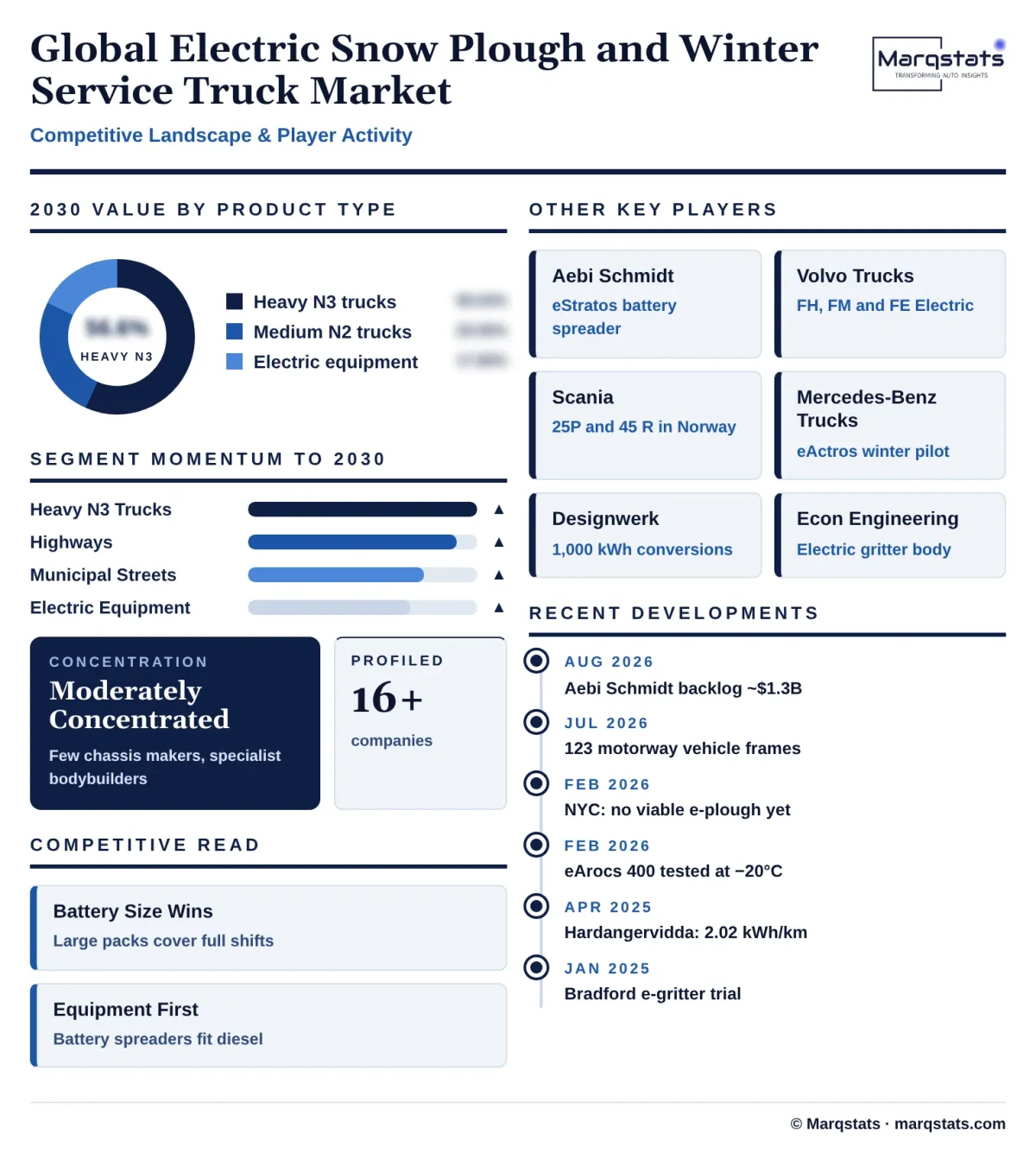
The mix changes over the forecast. Heavy N3 trucks rise from 43.35% to 56.64% of value, while medium N2 trucks fall from 34.50% to 25.56% and separately sold equipment from 22.15% to 17.80%. Highways and national roads rise from 46.60% to 52.38% of value as road authorities extend electric ploughing from urban areas to main roads. Europe rises from 47.80% to 53.17% of value and North America from 10.31% to 13.84%, while Asia-Pacific falls from 39.61% to 30.31% because its trucks are smaller and cheaper.
Market Dynamics
Key Drivers
Five forces are pulling battery-electric trucks into snow ploughing, gritting and salting.
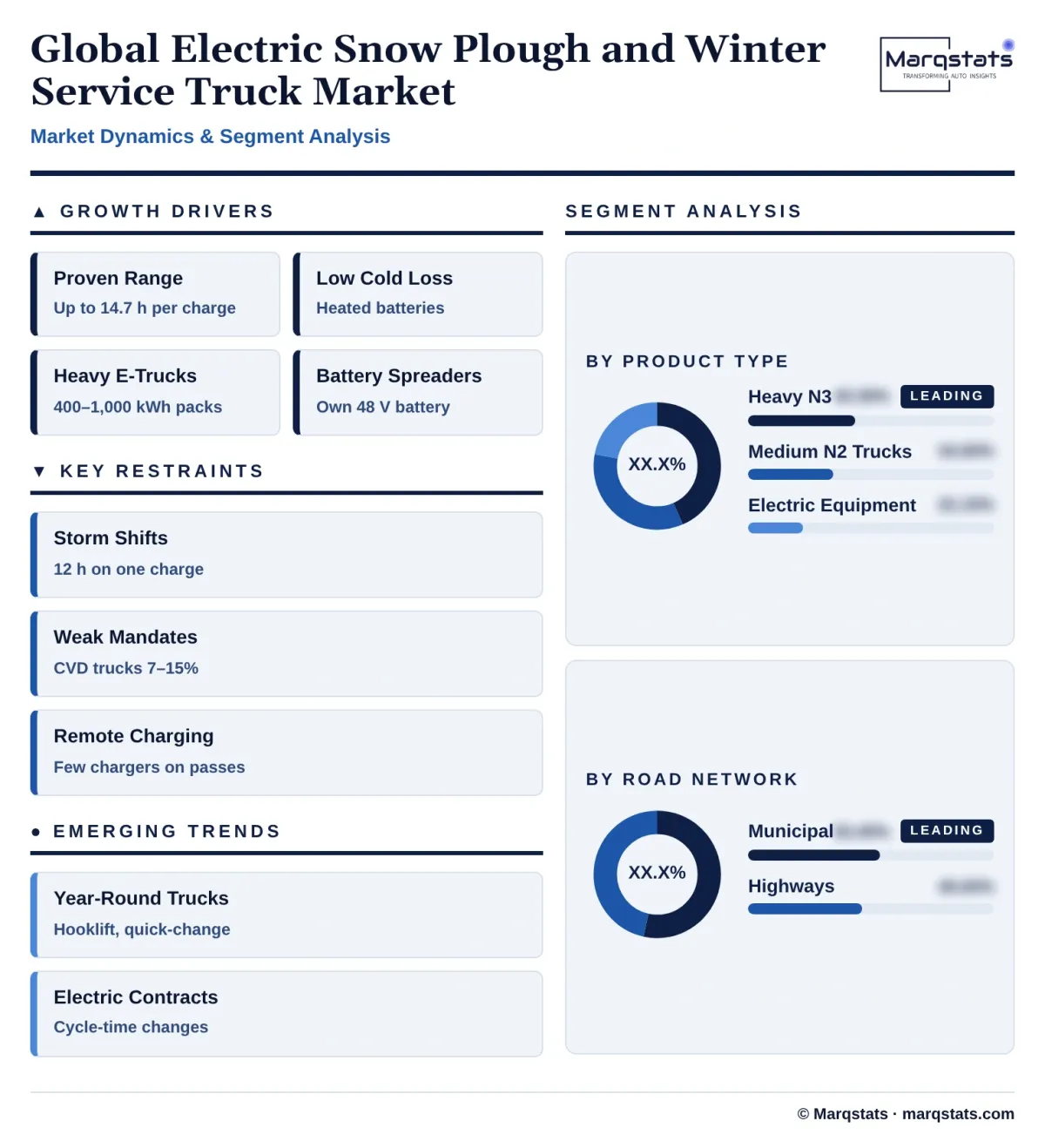
- Proven range in real winter service. Statens vegvesen measured 1.56 to 2.02 kWh per km for ploughing, grading and spreading, and up to 14.7 hours of clearing per charge with a large battery, removing the main doubt about electric ploughing on main roads.
- Low cold-weather loss. Heated batteries kept range losses small: Statens vegvesen reported only a marginal temperature effect on Hardangervidda and minimal loss on Dovrefjell, and DSNY saw no noticeable cold effect on its Mack LR Electric.
- Series-built heavy electric trucks. Volvo Trucks, Scania, Mercedes-Benz Trucks and Designwerk now offer heavy electric chassis with 400 to 1,000 kWh batteries, and Daimler Truck tested the eArocs 400 at minus 20°C in Finland before sales began in April 2026.
- Battery-powered spreaders. Spreaders with their own battery, such as the Schmidt eStratos and Icebear VP360e, leave the truck range unchanged and can be bought first and moved to an electric chassis later.
- Quiet night work. Electric trucks are much quieter than diesel trucks, which matters for gritting and ploughing in towns at night, and Autobahn GmbH drivers singled out quiet operation in the eActros 400 winter service pilot.
- Specialist suppliers with strong order books. Aebi Schmidt, Douglas Dynamics and other winter equipment makers report record backlogs and are adding electric products, so equipment for electric chassis is available as soon as fleets order it.
Key Restraints
Four constraints keep most winter service fleets on diesel and renewable diesel.
- Long storm shifts. DSNY needs 12 hours of plough duty on one charge and multi-day storms can need more, so vehicles with refuse-truck batteries fail, and agencies keep diesel for storm reserves.
- Weak procurement pressure. Clean Vehicles Directive truck targets of 7% to 15% for 2026 – 2030 can be met with biofuels or biomethane, and New York City meets its emission goals for ploughs with renewable diesel.
- Charging on remote routes. Mountain passes and rural highways have few chargers, and Statens vegvesen reported a lack of charging infrastructure in mountain areas and early charger compatibility problems on Hardangervidda.
- High purchase price for low annual use. Winter trucks may plough for only a few hundred hours a year, so fuel savings recover the battery premium slowly unless the truck also works in summer as a tipper, hooklift or mower carrier.
Key Trends
Four shifts are changing how electric winter service vehicles are specified and bought.
- Year-round multi-purpose trucks. Hooklift and interchangeable body systems, such as the JOAB EcoDrive hooklift on a Scania 25P in Norway and the Econ quick-change body on a Volvo FE Electric, let one electric truck plough in winter and haul in summer.
- Contracts written for electric operation. Statens vegvesen concluded that small changes to cycle-time and section-length rules would allow electric ploughing without extra vehicles or lower service levels.
- Depot and route charging. Contractors use 50 to 90 kW depot charging for most shifts and fast-charging containers, such as the Elywhere unit at Leiro, for the longest routes.
- Electric drive for equipment. Spreaders, conveyors and plough hydraulics move from engine PTO to electric drive from the truck battery or the equipment's own battery, which also suits diesel trucks with start-stop engines.
Strategic Implications
- For truck makers, battery capacity options decide entry. Vocational N3 chassis offered with 600 kWh or more, a heated battery and a high-voltage ePTO can win winter tenders that refuse-truck and distribution platforms cannot.
- For bodybuilders, electric equipment is the near-term opportunity. Battery spreaders and electric plough power units can be sold to today's diesel fleets and moved to electric trucks later, giving Aebi Schmidt, Bucher Municipal, Econ and others a bridge product.
- For road authorities, contract design matters more than vehicle mandates. Allowing short charging stops in cycle times, providing chargers at maintenance depots and rewarding electric operation in tenders brings electric ploughing into service faster than procurement quotas.
- For contractors, year-round use pays for the battery. Specifying hooklift or quick-change bodies so the same electric truck works in summer spreads the battery premium over many more operating hours.
- For investors, the winter attachment business is the safer exposure. Specialist suppliers grow on diesel demand today and gain from electric chassis later, while pure electric winter truck volumes stay small until 2027.
- For policymakers, renewable diesel is the real competitor. Where procurement rules count biofuels as clean, electric winter trucks must win on operating cost, noise and year-round use, so support for depot chargers on maintenance routes does more than vehicle quotas.
Market Segmentation
Battery-electric trucks above 12 tonnes with ploughs and spreaders account for 43.35% of 2025 value, USD 50.45 million and about 143 vehicles, rising to USD 353.70 million and 1,075 vehicles by 2030, a 47.62% CAGR and 56.64% of the market. This is the fastest-growing product type because highway and national-road authorities need large batteries for long shifts, using chassis such as the Volvo FH and FM Electric, Scania 25P and 45 R, Mercedes-Benz eActros and Designwerk trucks.
Battery-electric trucks of 3.5 to 12 tonnes with ploughs, spreaders or brushes account for 34.50% of 2025 value, USD 40.15 million and about 283 vehicles, and grow at 31.79% a year to USD 159.60 million and 25.56% of 2030 value. Most are municipal trucks for urban streets and cycle paths, led by Chinese electric sanitation trucks with snow equipment, while European examples include 19-tonne-class Volvo FE Electric and lighter municipal chassis.
Separately sold spreaders and plough power units with electric drive account for 22.15% of 2025 value, USD 25.78 million and about 830 units, and grow at 33.94% a year to USD 111.15 million by 2030 and 17.80% of the market. The Schmidt eStratos range covers 4.0 to 9.0 m³ hoppers with a 48 V battery of 6.2, 12.4 or 18.6 kWh heated for use down to minus 20°C, and the Icebear VP360e carries 6 m³ of material and 2,640 litres of brine with its own 48 V battery that charges from 20% to 80% in about 20 minutes.
Motorways, national roads and mountain passes account for 46.60% of 2025 value, USD 54.23 million, and grow at 43.25% a year to USD 327.10 million and 52.38% of 2030 value. Statens vegvesen, Autobahn GmbH and national highway contractors drive this segment with heavy trucks that need large batteries and route charging.
City streets, cycle paths and depots account for 53.40% of 2025 value, USD 62.15 million, and grow at 36.76% a year to USD 297.35 million, 47.62% of 2030 value. Shorter routes, depot charging and the value of quiet night work make electric trucks easier to adopt, which is why most early deliveries are municipal.
By Geography
Europe
Europe is the largest market, with 47.80% of 2025 value, USD 55.63 million and about 105 trucks, rising to USD 332.00 million by 2030, a 42.94% CAGR and 53.17% of the market. Statens vegvesen has tested electric ploughing on the E6 over Dovrefjell and on Riksveg 7 over Hardangervidda, and Veidekke took delivery of the first electric plough truck with a JOAB EcoDrive hooklift on a Scania 25P in October 2023. In Germany, Autobahn GmbH tested a Mercedes-Benz eActros 400 with a 448 kWh battery, a 4 m Bucher plough and an Icebear VP360e spreader on the A9 near Münchberg, and in July 2026 Aebi Schmidt won an order of about EUR 10 million for hydraulic and interchangeable frame systems for 123 federal motorway maintenance vehicles. In the United Kingdom, Econ Engineering built an electric quick-change gritter on a 19-tonne Volvo FE Electric, and Bradford Council began trialling an Econ electric gritter in January 2025.
Asia-Pacific
Asia-Pacific accounts for 39.61% of 2025 value, USD 46.10 million and about 300 trucks, and grows at 32.64% a year to USD 189.30 million and 30.31% of 2030 value. Northern Chinese cities buy electric multi-purpose sanitation trucks that switch between sweeping and snow clearing with ploughs and rolling brushes, which keeps average prices low. Japan and South Korea are smaller markets where electric winter trucks are still at the trial stage.
North America
North America accounts for 10.31% of 2025 value, USD 12.00 million and about 16 trucks, and grows fastest, at 48.41% a year, to USD 86.40 million and 13.84% of the market by 2030. Large city fleets need 12-hour storm shifts, which ruled out early electric refuse trucks used as ploughs in New York City, but Class 8 chassis with larger packs and battery spreaders allow municipal fleets in states and provinces with electrification goals to start with shorter urban routes.
Rest of World
The rest of the world accounts for 2.28% of 2025 value, USD 2.65 million, and grows at 44.60% a year to USD 16.75 million and 2.68% of 2030 value, from early municipal and toll-road trials in mountain and northern regions outside the three main markets.

How Competition Is Evolving
The electric snow plough and winter service truck market is moderately concentrated. Truck chassis come from a small group of heavy truck makers, Volvo Trucks, Scania, Mercedes-Benz Trucks and Mack Trucks, with Designwerk converting Volvo trucks for very large batteries, while winter bodies and equipment come from specialist bodybuilders led by Aebi Schmidt, Bucher Municipal, Econ Engineering, Douglas Dynamics and Alamo Group.
Value is split between chassis and body. The truck maker supplies the electric chassis and, increasingly, a high-voltage ePTO to drive hydraulics and conveyors, while the bodybuilder supplies the plough, spreader, hooklift or quick-change body and integrates controls. Marqstats estimates winter bodies and equipment account for roughly a fifth to a quarter of the delivered value of a heavy electric winter truck.
Road contractors are key buyers. In Norway, Germany and the United Kingdom, much winter service is run by contractors such as Veidekke, Presis Vegdrift and Ringway under multi-year maintenance contracts, so tender rules on cycle times, charging and emissions decide which trucks they buy.
Competition will be decided by battery size, ePTO integration and service in winter. Suppliers that offer large heated batteries, proven electric drive for equipment and fast repair during storm season will win the main highway contracts.
Product launches are moving fast. Mercedes-Benz Trucks tested the eActros 400 in winter service with Autobahn GmbH, where it ran up to three tours per 8-hour shift on a range of up to 400 km, and began selling the eArocs 400, a construction truck built in a small series of about 150 a year with final powertrain integration by Paul Nutzfahrzeuge. Volvo Trucks and Designwerk supplied the Volvo FH-based truck for Statens vegvesen's Dovrefjell test, Scania supplied the 25P and 45 R trucks used in Norway, and Econ Engineering offers its quick-change gritter body on the Volvo FE Electric.
Companies Covered
Companies covered in the report include:
Recent Market Activity
Table of Contents
Coverage & Segmentation
The study covers the global electric snow plough and winter service truck market, with 2025 as the base year, 2021 – 2025 as the historical period and 2026 – 2030 as the forecast period. Values are in US dollars at delivered prices to fleets, including winter bodies and equipment, and volumes are annual deliveries of trucks and of separately sold equipment. The market is segmented by product type, road network and region. Euro values are converted at USD 1.13 per euro, the 2025 average.
Diesel, renewable diesel, biogas and hydrogen winter trucks, conventional spreaders driven by engine PTO or the 12 V vehicle system, pickup and light-truck plough kits, consumer and walk-behind snow blowers, airport runway snow blowers and sweepers, compact sidewalk carriers and fuel are excluded. The market overlaps with the winter-service share of the Marqstats Europe Electric Medium and Heavy-Duty Truck and Electric Refuse Truck reports, and the figures should not be added together. Segment and regional splits are Marqstats estimates built on road authority test reports, truck maker and bodybuilder disclosures, company financial results and vehicle price benchmarks.