Market Snapshot
Middle bar: base-year value × (1 + CAGR), rounded to two decimals. This is a calculated illustration, not a separately researched annual estimate.
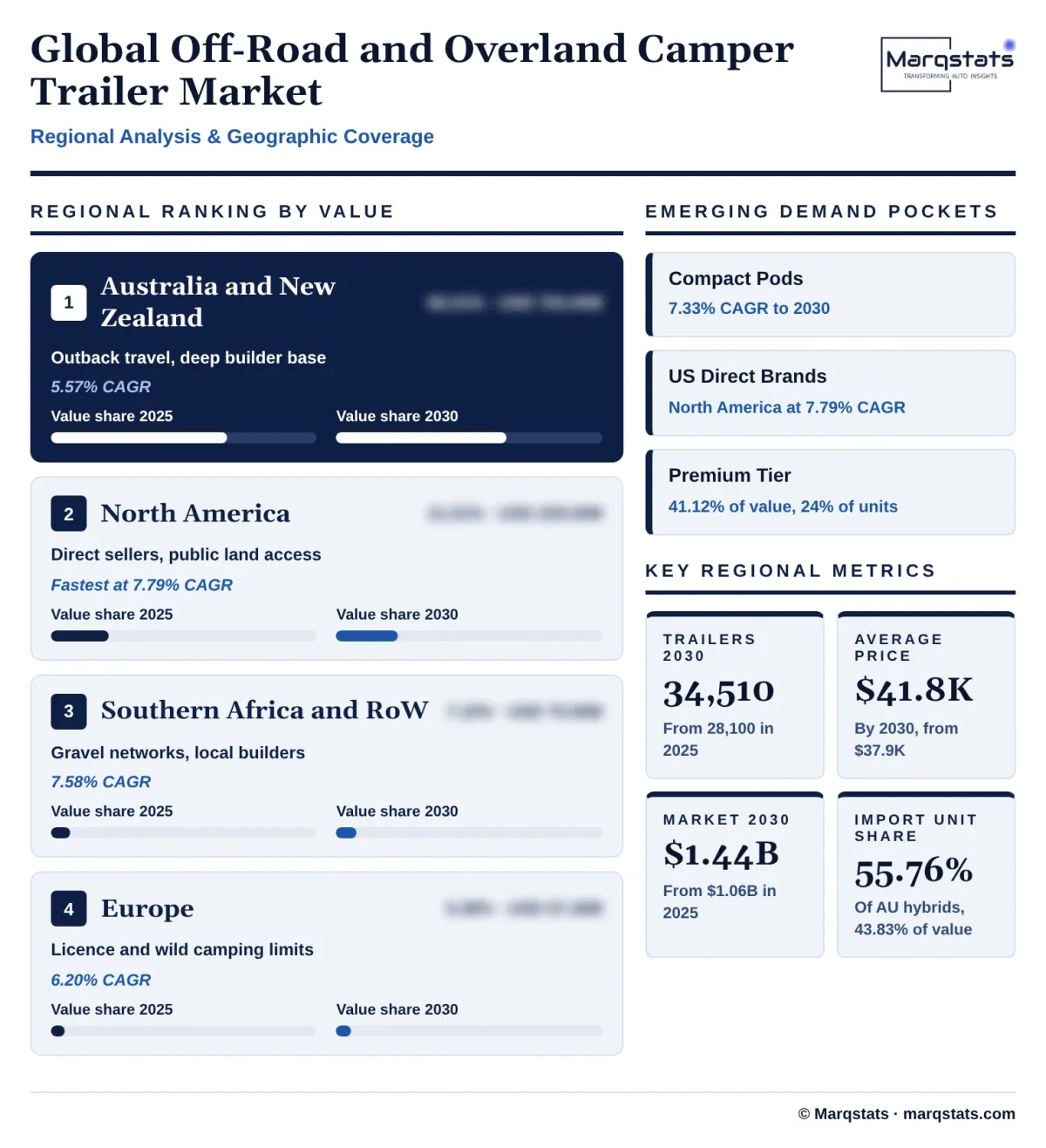
The global off-road and overland camper trailer market size is estimated at USD 1,064.81 million in 2025 and is projected to reach USD 1,441.17 million by 2030, growing at a CAGR of 6.24% over 2026 – 2030. Annual deliveries rise from about 28,100 trailers to 34,510, while the average selling price climbs from USD 37,894 to USD 41,761.
Marqstats defines the market as the retail transaction value, excluding sales taxes and on-road costs, of new off-road camper trailers sold to end users. It covers hybrid off-road caravans with independent suspension and off-road couplings, off-road teardrops and compact pods, and soft-floor and forward-fold off-road campers. Standard on-road caravans and travel trailers, fifth wheels, truck campers, motorhomes, used trailers, accessories and rental income are excluded.
Hybrid off-road caravans account for an estimated 68.80% of 2025 value, and Australia and New Zealand together account for 66.01%. The study segments the market by product architecture, price tier and region, and sizes each from trailer deliveries multiplied by realised prices.
Key Takeaways
Market Overview & Analysis
Report Summary
Marqstats sizes the off-road and overland camper trailer market as the retail value, excluding sales taxes and on-road costs, of new trailers engineered for sustained travel on unsealed roads and tracks. In 2025 about 28,100 trailers were sold worldwide at an average realised price of USD 37,894, worth an estimated USD 1,064.81 million.
The category sits inside a much larger towable industry, and the scale gap is the reason sizing has to be built from the bottom. The RV Industry Association (RVIA) recorded 342,220 recreational vehicle shipments in North America in 2025, of which 306,191 were towables. The Caravan Industry Association of Australia (CIAA) recorded 23,963 locally built vehicles, about 23,053 of them towables once 910 motorhomes are removed, and 23,244 imported caravan trailers and components in Australia. The European Caravan Federation (ECF) and the Caravaning Industrie Verband (CIVD) registered about 54,200 caravans in Europe. None of these series separates off-road designs, so Marqstats counts the off-road share of each supply line from builder volumes, price points and specification.
Three product architectures qualify. Hybrid off-road caravans combine a rigid insulated body and an ensuite with independent trailing-arm or coil suspension, a 360-degree off-road coupling and an aggregate trailer mass of roughly 2,500 to 3,500 kg. Off-road teardrops and compact pods are rigid, light bodies with a rear galley, typically under 1,500 kg. Soft-floor and forward-fold campers open from a compact box into a canvas or roof-tent living space. All three are built on chassis, couplings and suspension that tolerate corrugations, creek crossings and articulation, which is what separates them from highway caravans.
Marqstats estimates that 30% of Australian caravan supply, 12,500 of 41,682 locally built and imported caravans, meets the hybrid off-road definition, together with 3,700 camper trailers, giving 16,200 trailers in Australia and 350 in New Zealand. North American specialist overland builders add about 4,850 trailers, equal to 1.58% of RVIA towable shipments. Europe contributes about 2,100 trailers, equal to 3.87% of caravan registrations, and Southern Africa and the rest of the world about 4,600.
Demand follows tow vehicles and public land. Australia sold 235,614 new utes in 2025, 212,513 of them four-wheel drive, and its light commercial fleet reached 4,195,833 vehicles in January 2025. North America has the Bureau of Land Management and US Forest Service networks that allow dispersed camping, while Southern Africa has gravel networks across Namibia, Botswana and the Karoo. Europe has few comparable rights, which is why its share is small.
Global Off-Road and Overland Camper Trailer Market Size and Forecast
The global off-road and overland camper trailer market grows from USD 1,064.81 million in 2025 to USD 1,441.17 million in 2030, a CAGR of 6.24%. Marqstats expects USD 1,085.96 million in 2026, USD 1,142.46 million in 2027, USD 1,225.16 million in 2028 and USD 1,324.86 million in 2029. Annual growth accelerates from 1.99% in 2026 to 5.20% in 2027, 7.24% in 2028, 8.14% in 2029 and 8.78% in 2030.
The path is back-loaded for a reason. RVIA shipments fell 13.9% to 183,592 units in January to July 2026, Australian local production was already 5% lower in 2025, and two off-road caravan builders have failed within ten months. Marqstats therefore holds 2026 deliveries almost flat, at about 28,170 trailers, and assumes underlying volume growth of 2.0% to 4.5% a year in Australia and New Zealand and 4.0% to 11.0% a year in North America from 2027, before product-mix adjustments, as financing costs ease and replacement of failed capacity completes.
Deliveries grow at 4.20% a year, from 28,100 to 34,510 trailers, while the average realised price rises from USD 37,894 to USD 41,761. Marqstats assumes annual price growth of 2.00% for hybrid caravans, 1.50% for teardrops and pods, and 1.00% for soft-floor campers, reflecting lithium battery banks of 100 Ah to 500 Ah, composite wall panels and air suspension moving from options to standard, partly offset by import competition at the entry end.
Realised prices differ widely by region and product. Marqstats estimates an imported hybrid in Australia at about USD 38,120 ex-tax, a locally built hybrid at USD 61,578, an Escapod-class teardrop in North America at about USD 41,000, a forward-fold camper in Australia at about USD 19,353 and a Southern African trailer with a tent at about USD 11,186. The Patriot Campers GEN3 X1, launched in October 2026 from AUD 57,900 or USD 37,353, shows how builders are re-pricing to protect volume.
Two sensitivities decide the headline. A one percentage point change in the share of Australian caravan supply that meets the off-road definition moves global 2025 volume by about 417 trailers and value by USD 20.21 million. A 10% change in North American specialist volume moves the global figure by about 485 trailers and USD 22.90 million. Marqstats tracks four indicators for the forecast: CIAA production and import counts, RVIA monthly shipments, ECF and CIVD registrations, and builder price lists.
Market Dynamics
Key Drivers
Five forces are pulling buyers from road caravans and tent trailers toward purpose-built off-road campers.
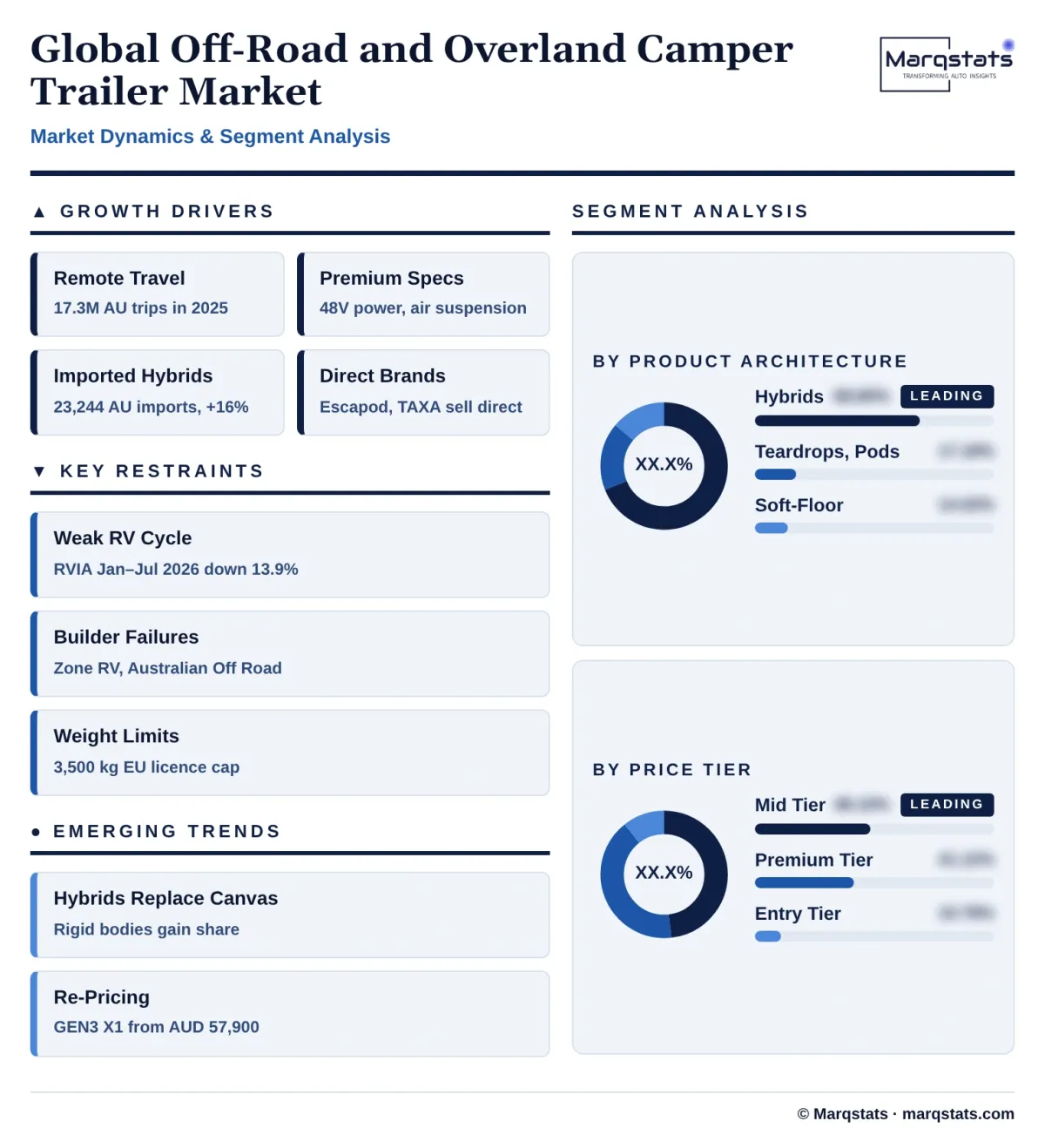
- Rising demand for remote travel. Australians took 17.3 million caravan and camping trips in 2025 and spent AUD 12.6 billion, while caravan park revenue reached a record AUD 3.3 billion, and a growing share of that travel is on unsealed roads that road caravans cannot handle.
- Premium specification as standard. The Track Trailer T4 lists at AUD 108,500 with an aggregate trailer mass of 2,500 kg, and the BruderX EXP-8 carries a 20 kWh battery and a 3,500 kg rating at AUD 317,500, so lithium power and independent suspension lift the average price and create room for suppliers such as REDARC Electronics, Victron Energy and Cruisemaster.
- Imported hybrids widen the entry point. Australia imported 23,244 caravan trailers and components in 2025, up 16%, at an average free-on-board price of AUD 26,638, and importers such as Market Direct Campers sell entry hybrids well below the locally built premium range, bringing off-road capability to buyers who would otherwise buy a tent trailer.
- Direct-to-consumer overland brands in North America. Escapod Trailers builds about 120 to 180 TOPO2 teardrops a year from USD 33,990, and Storyteller Overland owns TAXA Outdoors, whose Mantis starts around USD 45,000, giving buyers a path outside dealer floorplans that fell 13.9% in 2026.
- Light, towable, rigid bodies for electric tow vehicles. Pods and teardrops under 1,500 kg cut towing range loss for mid-size pickups and SUVs, supporting the 7.33% growth of the pod segment.
Key Restraints
Four constraints slow the market and explain why growth is back-loaded toward 2028 – 2030.
- Weak caravan and RV cycle. RVIA shipments fell 13.9% to 183,592 units in January to July 2026, European caravan registrations fell about 11% to roughly 54,200 in 2025, and Amotiv Limited booked a AUD 190 million non-cash impairment on AutoPacific Group in August 2025 citing a more conservative Caravan and RV outlook.
- Local builder failures. Zone RV, an off-road caravan builder at Coolum with about 250 staff, entered administration on 1 December 2025, and Australian Off Road at Caloundra, with about 100 staff, followed on 15 September 2026, reducing warranty confidence and local capacity.
- Licensing and weight ceilings. The 3,500 kg combined-mass limit for category B licences under Directive 2006/126/EC, extended to 4,250 kg only with a B96 endorsement, limits heavy hybrids in Europe, and Australian braking rules require breakaway systems above 2.0 tonnes of aggregate trailer mass.
- Price pressure from imports. About 98% of Australian caravan imports, 22,779 of 23,244 units, were made in China in 2025, and Australian Off Road blamed imports and product copying for its failure, compressing prices for mid-tier local builders.
Key Trends
Four shifts are changing how off-road camper trailers are designed, built, imported and sold.
- Hybrids replace canvas. Rigid hybrid caravans with ensuites and 270-degree awnings are absorbing buyers who would once have bought tent trailers, which is why soft-floor campers lose share from 14.02% to 12.70% of value.
- Re-pricing for volume. Patriot Campers set the GEN3 X1 at AUD 57,900 in October 2026, roughly AUD 17,000 below the GEN2 X1, and Track Trailer launched the Tvan MK6 from AUD 69,900 in March 2026.
- 48-volt and lithium power. Premium builds carry battery banks of 10 kWh to 20 kWh, solar arrays and DC-DC charging, making power electronics suppliers more important than body builders in the bill of materials.
- Australian builders sell abroad. Patriot Campers and Market Direct Campers have opened US showrooms, and Escapod, TAXA and others sell direct in North America, so the same four or five designs now compete in three continents.
Strategic Implications
- For builders, price position decides survival. The 38.10% price gap between imported and locally built hybrids in Australia means a local builder must justify a USD 23,458 premium with suspension, chassis and warranty evidence, or move to the premium tier where 41.12% of value sits.
- For importers, compliance and service are the moat. Importers that earn type approval and build a service network under the Road Vehicle Standards Act 2018 can hold the entry hybrid segment, but the administration of Zone RV and Australian Off Road shows how quickly buyers lose confidence in warranties.
- For component suppliers, the 48-volt kit is the growth lever. Suspension, couplings, DC-DC chargers, inverters and batteries follow the fastest-growing price tiers, so suppliers that sell pre-wired power and suspension packages to several builders earn more per trailer than any single builder does.
- For North American entrants, direct sales and a narrow design win. Builders that fit Toyota Tacoma, Jeep Wrangler and Ford Bronco tow ratings and sell without dealer floorplans can grow while RVIA wholesale shipments fall, but they should plan for a weaker 2026.
- For lenders and dealers, tier matters more than segment. The premium tier above USD 45,000 holds 41.12% of value from only 24.13% of units, so lenders and dealers underwriting stock should size inventory by realised price tier rather than by trailer type.
Market Segmentation
Hybrid off-road caravans dominate because they carry the highest price per trailer and are the preferred format in the largest market. They account for 68.80% of 2025 value, USD 732.61 million and about 14,750 trailers at an average price of USD 49,668, rising to USD 997.69 million, 69.23% of value and 18,115 trailers by 2030, a 6.37% CAGR. Australia supplies about 12,500 of the 2025 trailers, split between 6,970 imports and 5,530 local builds, and builders such as Track Trailer, BruderX, Market Direct Campers and Patriot Campers anchor a range that runs from importer entry models to the AUD 317,500 BruderX EXP-8.
Teardrops and pods are the fastest-growing product because they suit electric and mid-size tow vehicles and need no dealer service network. They account for 17.18% of 2025 value, USD 182.90 million and about 5,590 trailers at USD 32,719, rising to USD 260.45 million, 18.07% of value and 7,416 trailers by 2030, a 7.33% CAGR. Escapod Trailers builds about 120 to 180 TOPO2 units a year from USD 33,990, TAXA Outdoors sells the Mantis from around USD 45,000, and the Track Trailer Tvan MK6 starts at AUD 69,900.
Soft-floor and forward-fold campers are the slowest-growing product because rigid bodies are replacing canvas. They account for 14.02% of 2025 value, USD 149.30 million and about 7,760 trailers at USD 19,240, rising to USD 183.03 million by 2030, a 4.16% CAGR, while their share falls to 12.70%. They still lead in Southern Africa, where about 1,950 trailers are sold, and in Australia, where importers and local builders sell entry forward-fold models, including the Market Direct Campers Explorer FF.
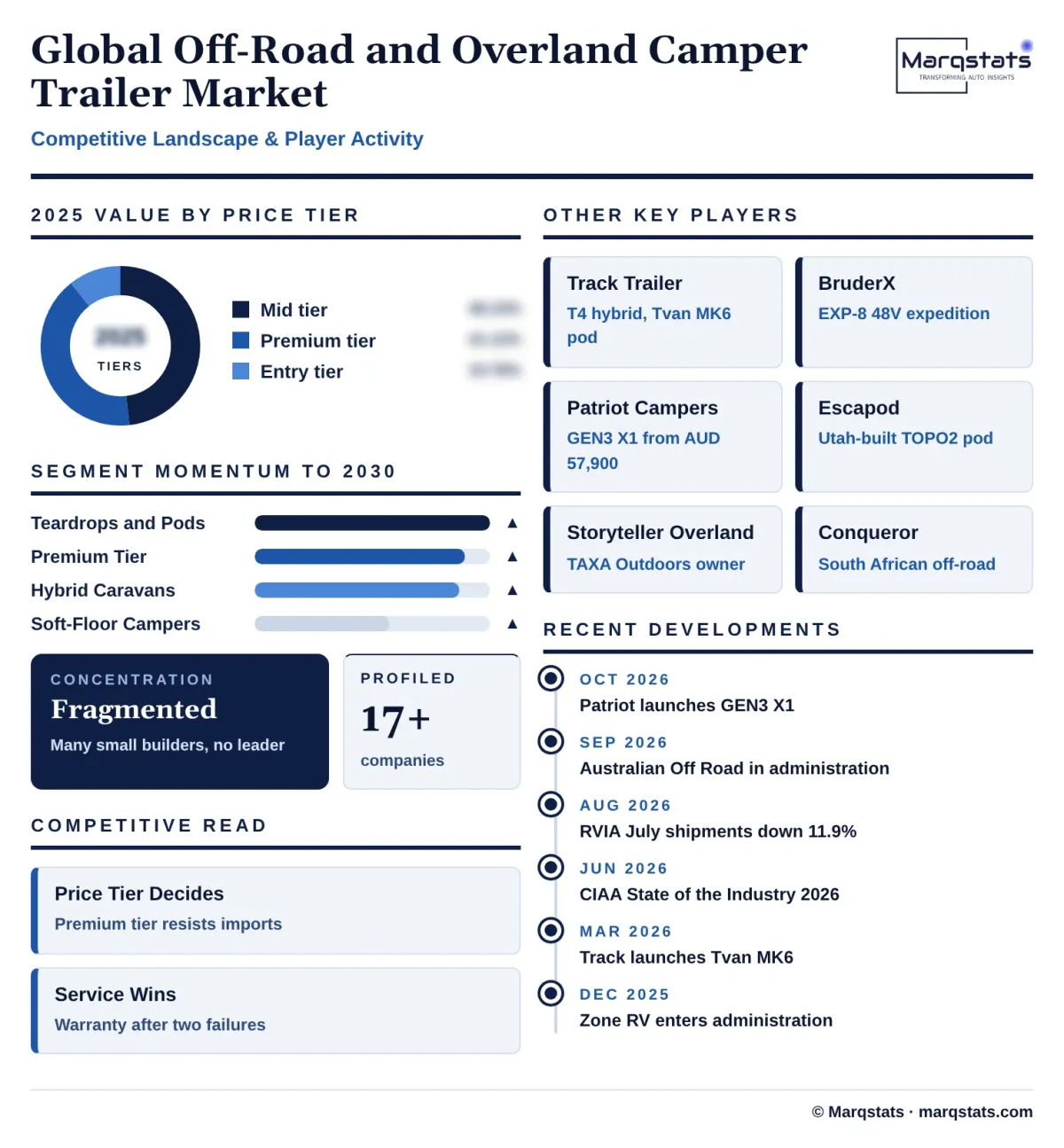
The entry tier, with realised ex-tax prices below USD 25,000, accounts for 10.78% of 2025 value, USD 114.83 million and about 7,310 trailers, rising to USD 142.83 million and 8,651 trailers by 2030, a 4.46% CAGR. It holds Australian soft-floor campers, European trailer tents, Southern African pods and soft-floor trailers, and Chinese-built pods in the rest of the world, and its share falls to 9.91% as buyers trade up.
The mid tier, from USD 25,000 to USD 45,000, is the largest by value at 48.10% of 2025, USD 512.16 million and about 14,010 trailers, rising to USD 698.49 million, 48.47% of value and 17,496 trailers by 2030, a 6.40% CAGR. It contains the imported Australian hybrids at USD 38,120, Australian and European pods, North American pods and soft-floor campers, and hybrids in Southern Africa and the rest of the world.
The premium tier, above USD 45,000, accounts for 41.12% of 2025 value, USD 437.82 million, from only 6,780 trailers at an average of USD 64,575, rising to USD 599.85 million, 41.62% of value and 8,363 trailers by 2030, a 6.50% CAGR. It holds locally built Australian hybrids at USD 61,578, North American and European hybrids and the BruderX and Track Trailer ranges, and it is the tier least exposed to import competition.
By Geography
Australia and New Zealand
Australia and New Zealand are the centre of the market because buyers tow on unsealed roads and the fleet is large. The region accounts for 66.01% of 2025 value, USD 703.00 million and about 16,550 trailers, rising to USD 921.69 million by 2030, a 5.57% CAGR, while its share falls to 63.95%. Australia alone accounts for about 16,200 trailers and USD 692.30 million, and New Zealand about 350 trailers and USD 10.70 million. The CIAA counted about 937,000 registered recreational vehicles in 2025, local production of 23,963 vehicles down 5%, and 23,244 caravan imports up 16%, about half of them landed in Queensland. The Track Trailer T4 at AUD 108,500, the BruderX EXP-8 at AUD 317,500 and the Patriot Campers GEN3 X1 from AUD 57,900 define the local premium range, while the failures of Zone RV and Australian Off Road show the strain on mid-priced builders.
North America
North America is the growth region because specialist builders sell direct and the public land network allows remote camping. It accounts for 21.51% of 2025 value, USD 229.00 million and about 4,850 trailers at USD 47,216, rising to USD 333.28 million by 2030, a 7.79% CAGR, and its share climbs to 23.13%. The 4,850 trailers equal 1.58% of the 306,191 towables shipped in 2025, well below the share of Australia. RVIA shipments fell 13.9% to 183,592 in January to July 2026, so Marqstats expects value to dip to about USD 226 million in 2026 before recovering. Escapod Trailers, Storyteller Overland with TAXA Outdoors, Patriot Campers and Market Direct Campers sell from USD 34,000 upward, while narrow trails in the Mountain West and Pacific Northwest favor compact pods that follow the wheel ruts of mid-size trucks.
Europe
Europe is a small market because licences and land rules cap trailer weight and wild camping is mostly prohibited. It accounts for 5.38% of 2025 value, USD 57.26 million and about 2,100 trailers, rising to USD 77.35 million by 2030, a 6.20% CAGR, with its share almost flat at 5.37%. The 2,100 trailers equal 3.87% of the roughly 54,200 caravans registered in 2025, which fell about 11%, with Germany down 13.4% to 18,766 and the United Kingdom down about 19% to roughly 9,250. Directive 2006/126/EC limits combined mass to 3,500 kg on a category B licence, so European demand centres on light pods, trailer tents and a few imported hybrids sold for use in Scandinavia, Spain and the Balkans.
Southern Africa and Rest of World
Southern Africa and the rest of the world are small but diverse, with local builders serving corrugated gravel and exporters serving Asia, the Middle East and Latin America. The region accounts for 7.10% of 2025 value, USD 75.55 million and about 4,600 trailers, rising to USD 108.85 million by 2030, a 7.58% CAGR. Southern Africa contributes USD 40.90 million from about 2,800 trailers at low prices, as the Conqueror Comfort Platinum starts at ZAR 290,665, the Summit Everest sells for ZAR 279,999 to ZAR 300,000 and the Echo 4 trailer alone costs ZAR 92,000. The rest of the world contributes USD 34.65 million from about 1,800 trailers, led by Chinese-built pods and imported hybrids.
How Competition Is Evolving
The off-road and overland camper trailer market is fragmented. Dozens of builders across four continents each sell from around a hundred to a few thousand trailers a year, so no single company holds a dominant share. Marqstats describes competition by layer, using named builders and dated actions rather than share rankings.
Four layers compete. Australian premium specialists such as Track Trailer, BruderX and Patriot Campers compete on suspension, power systems and build quality at prices from AUD 57,900 to AUD 317,500. Importers such as Market Direct Campers bring Chinese-built hybrids at lower prices, about 98% of Australian caravan imports coming from China in 2025. North American direct sellers such as Escapod Trailers and Storyteller Overland sell compact pods without dealer networks. South African builders such as Conqueror Off Road Campers and Bush Lapa Offroad Caravans serve Southern Africa on welded steel bodies and local repair networks.
Component suppliers hold pricing power. Amotiv Limited sells Cruisemaster couplings and suspension, REDARC Electronics sells DC-DC chargers and power management, AL-KO Vehicle Technology and DexKo Global supply axles and braking, Victron Energy supplies solar charge controllers and inverters, and Dometic Group supplies refrigeration and awnings. Amotiv reported 4WD Accessories and Trailering revenue of AUD 354.9 million in FY25, which shows the scale of the supply layer relative to builders.
Mainstream recreational vehicle manufacturers such as Thor Industries and Forest River offer off-road trim and off-grid packages on conventional frames, and Airstream, Inc. sells compact adventure-oriented towables. These products sit mostly outside the scope of the analysis because they keep highway-grade running gear, but they cap the premium that specialists can charge in North America.
Competition will be decided by price discipline and service. Local builders that hold a premium position, and importers that fund service and warranty, are most likely to survive a cycle in which two Queensland builders have failed. Builders that scale across Australia and North America with the same design gain purchasing leverage on suspension and power electronics.
Companies Covered
Companies covered in the report include:
Recent Market Activity
Table of Contents
Coverage & Segmentation
The study covers the global off-road and overland camper trailer market, with 2025 as the base year, 2021 – 2025 as the historical period and 2026 – 2030 as the forecast period. Values are in US dollars at retail transaction prices excluding sales taxes and on-road costs, and volumes are annual new trailer sales to end users. The market is segmented by product architecture, price tier and region.
Standard on-road caravans and travel trailers, fifth wheels, truck campers, motorhomes and campervans, used trailers, rental income and aftermarket accessories are excluded, as are truck-bed shells and slide-in campers covered in the North America Truck Cap and Camper Shell Market study. Segment and regional splits are Marqstats estimates built on trade association counts, builder disclosures, price lists and import statistics. Trade bodies record caravans and trailers by type and weight, not by off-road capability, so the off-road share of each supply line is a Marqstats construction, and a one percentage point change in the Australian share moves global value by USD 20.21 million.