Market Snapshot
Middle bar: base-year value × (1 + CAGR), rounded to two decimals. This is a calculated illustration, not a separately researched annual estimate.
The global double deck trailer market size is estimated at USD 691.06 million in 2025 and is projected to reach USD 974.56 million by 2030, growing at a CAGR of 7.12% over 2026 – 2030. Annual deliveries rise from about 6,650 to 8,980 trailers, a 6.19% annual rate, while the average selling price rises from about USD 103,900 to USD 108,500 as moving-deck and refrigerated trailers take a larger share of orders.
Marqstats defines the market as the ex-works value of new semi-trailers built to carry freight on two load levels, either on a fixed upper floor, on a hydraulic or cable-driven moving (lifting) deck, or on factory-fitted internal decking and mezzanine systems that create a full second tier inside a box, curtain-sided or refrigerated body. It covers ambient, chilled and frozen trailers used by grocery retailers, parcel and postal operators, pallet networks and contract logistics providers.
Moving-deck trailers account for 52.00% of 2025 value, box van bodies for 51.00% and grocery retail and FMCG fleets for 43.00%. The United Kingdom accounts for 58.65% of 2025 value and Continental Europe for 20.31%. The study segments the market by deck type, body type, end use and region.
Key Takeaways
Market Overview & Analysis
Report Summary
Marqstats sizes the double deck trailer market as the ex-works value of new semi-trailers built to carry freight on two levels. In 2025 about 6,650 such trailers were delivered worldwide, worth an estimated USD 691.06 million. That is well under 1% of global semi-trailer output, but the segment matters far more than its unit count suggests, because each double deck replaces close to two single-deck trailer loads on the routes where it fits and is among the highest-priced van trailers built.
A double deck works by using the height of the vehicle. A standard 13.6 m trailer carries 26 UK pallets (1,200 x 1,000 mm) or 33 Euro pallets (1,200 x 800 mm) on one floor. A second floor can lift that to about 52 to 54 UK pallets, as in the Tiger trailers Romac Logistics ordered with up to 54 pallets each, or about 55 to 66 Euro pallets in Continental designs such as the Van Eck Twindeck and the Schmitz Cargobull S.KO COOL with a double-deck loading system. The gain only holds where loads are light enough and short enough to stack: roll cages of chilled food, parcels, bread baskets, flowers, automotive parts and empty packaging.
The deck can be fixed, moving or internal. A fixed double deck has a permanent upper floor reached by a tail lift or a dock lift. A moving or lifting deck is a full-length or part-length platform raised by hydraulic rams or cables, so the operator loads the lower deck, raises the platform, loads it, and can then lower it for a tall single-tier load on the next trip. Internal decking systems, such as beams or panels that lock into the side walls, create a second tier inside an otherwise standard trailer and are common in Continental Europe and North America.
Height rules set the shape of the market. The United Kingdom does not cap vehicle height, so its fleets run double decks about 4.90 to 4.95 m tall, as in the 4.95 m Don-Bur lifting-deck box vans built for Alliance Automotive, on routes planned around bridges and depots. Most of Continental Europe applies the 4.00 m limit of Council Directive 96/53/EC, which leaves each deck about 1.80 m tall. North American states usually allow 13 ft 6 in to 14 ft (about 4.11 to 4.27 m), and Australia allows some vehicles up to 4.6 m, so two-tier loading there is mostly done with internal decking or drop-frame designs.
The market grew from an estimated USD 548.00 million in 2021 to USD 691.06 million in 2025, a 5.97% CAGR over 2021 – 2025, as UK grocers rebuilt fleets after the driver shortage of 2021 and 2022, parcel carriers added hub capacity and refrigerated double decks moved from frozen trunking into chilled and multi-temperature work.
Double Deck Trailer Market Size and Forecast
The global double deck trailer market grows from USD 691.06 million in 2025 to USD 974.56 million in 2030, a 7.12% CAGR, with deliveries rising from about 6,650 to 8,980 trailers a year. Value grows faster than units because the mix shifts towards moving-deck and refrigerated trailers, which sell at higher prices than fixed-deck ambient trailers.
The 2025 value is built bottom-up from regional deliveries and prices. Marqstats estimates about 3,450 UK trailers at an average of about GBP 89,000 (USD 117,480 at GBP 1 = USD 1.32), about 1,350 Continental European trailers at about EUR 92,000 (USD 103,960 at EUR 1 = USD 1.13), about 1,050 North American trailers with double-deck or full internal decking at about USD 76,000 and about 800 trailers in Australasia and the rest of the world at about USD 82,000. These add up to USD 691.06 million.
The base is calibrated against manufacturer results and fleet orders. Don-Bur, a leading UK builder of lifting-deck trailers, reported turnover of GBP 100.0 million for the year to September 2025, up from GBP 93.3 million, with 504 staff. Tiger Trailers said it had supplied 485 trailers to Asda before the retailer added 55 dual-temperature double decks in May 2026, and Romac Logistics added 100 Tiger moving double-deck reefers in 2026. Marqstats estimates the UK double-deck fleet at about 30,000 trailers, replaced on cycles of about eight to ten years.
The average price rises from about USD 103,900 in 2025 to USD 108,500 in 2030. Marqstats estimates a fixed double deck at about GBP 55,000 to 65,000 in the United Kingdom and a refrigerated moving-deck trailer at about GBP 110,000 to 135,000, against about USD 42,000 to 52,000 for a standard single-deck van trailer in North America. The mix shift towards moving decks and reefers, rather than list price inflation, drives most of the increase.
Marqstats tracks four indicators to monitor the forecast: UK grocery and parcel fleet renewal orders, the share of refrigerated and dual-temperature double decks in builder order books, the progress of the EU weights and dimensions revision through trilogue, and the take-up of 15.65 m longer semi-trailers with two decks in the United Kingdom.
Market Dynamics
Key Drivers
Five forces are pushing grocers, parcel carriers and pallet networks towards two-tier trailers.
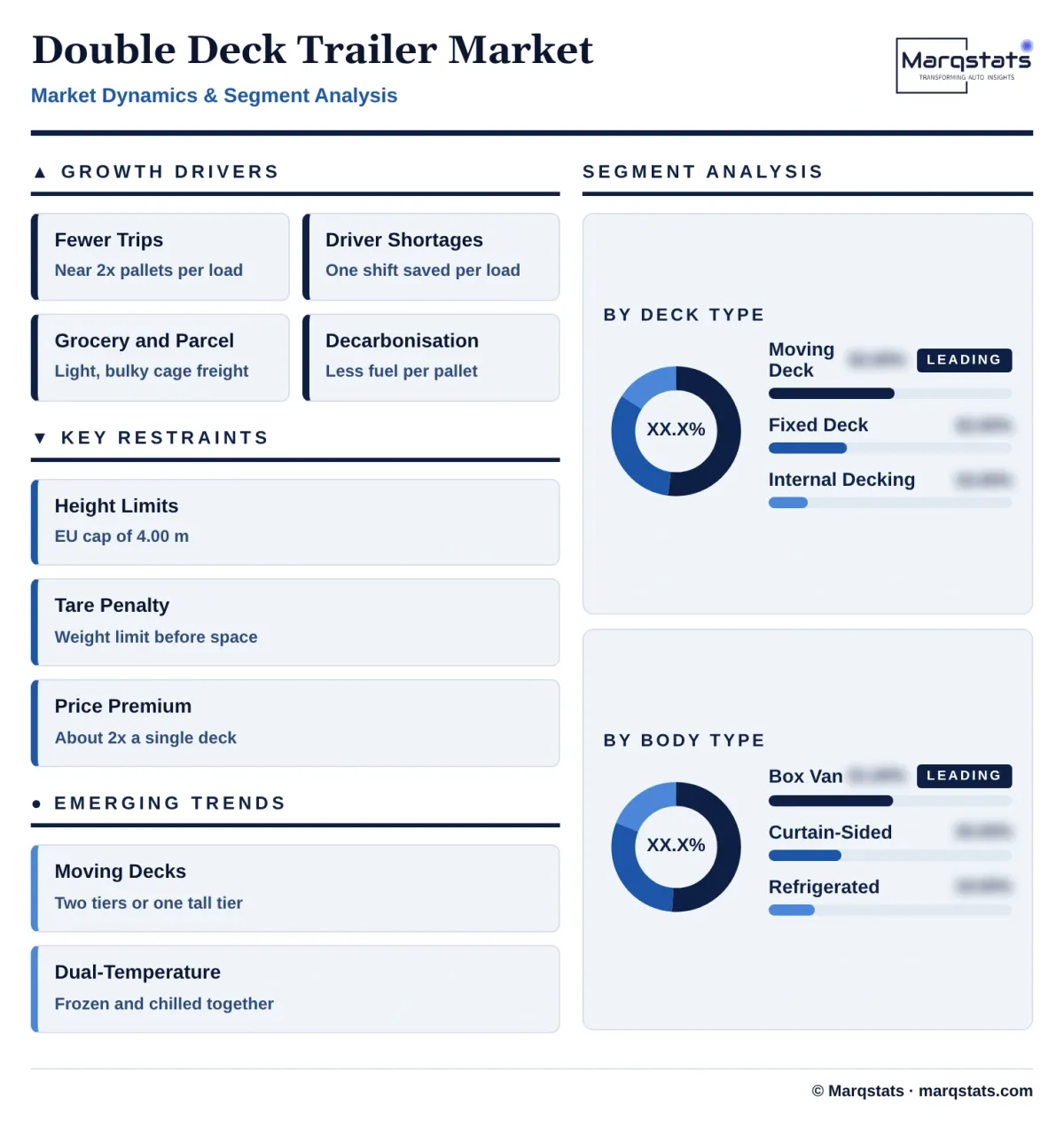
- Fewer trips for the same freight. A double deck carries close to twice the pallets or roll cages of a single-deck trailer on loads that are light and short, so operators run fewer tractor units and drivers for the same volume. Van Eck says its Twindeck carries 60% more than a standard trailer and cuts fuel use and CO2 emissions by up to 40% per load, and UK grocers plan store deliveries around full two-deck loads.
- Driver shortages and wage costs. Each trailer load saved also saves a driver shift, and that has made double decks a response to the HGV driver shortages that hit the United Kingdom and much of Europe in 2021 and 2022. Fleets that converted trunking routes to double decks have kept that capacity as driver costs stayed high.
- Grocery and parcel network growth. Online grocery, store replenishment in roll cages and parcel hub trunking all move light, bulky freight that fills a trailer by volume before it reaches the weight limit. Retailers such as Asda, parcel carriers such as Whistl and postal operators such as Royal Mail run large double-deck fleets for this freight.
- Decarbonisation targets. Moving more freight per trip cuts fuel and emissions per pallet without waiting for zero-emission tractors, and the gain adds to any later switch to battery or hydrogen tractors. Shippers with reported scope 3 targets increasingly ask carriers for two-tier loading on suitable routes.
- Refrigerated and dual-temperature designs. Builders now offer moving decks inside insulated bodies with dual-temperature compartments, such as the Tiger trailers Asda began introducing in May 2026 with 43 pallets or 72 cages of capacity, so frozen, chilled and ambient goods can share one trailer.
Key Restraints
Four constraints keep double deck trailers a specialist niche of the semi-trailer market.
- Height limits outside the United Kingdom. The EU 4.00 m limit leaves each deck about 1.80 m tall, which does not suit standard pallet heights, and most North American states cap height at 13 ft 6 in to 14 ft. This keeps two-tier trailers a niche wherever the law caps vehicle height.
- Weight and tare penalty. A moving deck and its lifting system add weight to the trailer, and two full decks of dense freight can exceed the 44-tonne UK or 40-tonne EU gross weight before the space is full, so double decks only pay on light, bulky loads.
- Higher price and maintenance. A moving-deck trailer costs about twice a standard single-deck van trailer, and its lifting deck needs periodic thorough examination under lifting equipment rules, which adds downtime and inspection cost.
- Route and depot constraints. Tall double decks need routes cleared of low bridges, depots with dock levellers or dock lifts and stores with suitable yards, so fleets cannot simply swap them onto any route.
Key Trends
Four shifts are changing how double deck trailers are built, specified and bought.
- Moving decks replace fixed decks. Operators prefer decks they can raise and lower, so one trailer can carry two-tier cage loads, tall single-tier loads or mixed loads, and builders such as Don-Bur and Tiger now sell more lifting-deck than fixed-deck trailers.
- Dual-temperature double decks. Insulated double decks with movable bulkheads let grocers carry frozen and chilled goods on one trip, and Tiger delivered its first dual-temperature lifting-deck order to Asda in 2026.
- Weight saving in deck and body design. Builders are using composite panels, aluminium deck structures and lighter lifting systems to recover payload, such as the lightweight composite panels on Tiger trailers for Hovis.
- Longer double decks. The United Kingdom allowed 15.65 m longer semi-trailers into general use in 2023, and builders now combine the extra length with two decks to add more pallet or cage positions per trip.
Strategic Implications
- For trailer builders, the deck mechanism is the product. Reliability, lift speed, weight and inspection intervals of the moving deck decide repeat orders more than body design, so builders that make their own lifting systems keep an edge.
- For grocers and parcel carriers, route data decides the business case. Measuring which routes fill by volume before weight, and which depots and stores can take a 4.95 m trailer, shows where double decks save trips.
- For Continental European builders, low-deck designs are the opportunity. Trailers that fit two tiers of roll cages or low pallets inside 4.00 m, with movable floors and light structures, can grow as shippers look for fewer trips.
- For refrigeration unit suppliers, two-tier loading changes airflow and power needs. Units and ducting that cool two decks evenly, and dual-temperature systems, become standard specifications.
- For leasing and rental companies, double decks are long-life assets. Specialist fleets that offer double decks on contract hire help smaller carriers try two-tier loading without buying high-priced trailers.
Market Segmentation
Moving-deck trailers account for 52.00% of 2025 value, USD 359.35 million, and grow fastest among deck types at 8.33% a year to USD 536.01 million and 55.00% of value by 2030. A full-length or part-length platform raised by hydraulic rams or cables lets one trailer switch between two-tier loads and tall single-tier loads. The 10-tonne three-quarter-length deck on the Tiger dual-temperature trailers for Asda and the 10-tonne full-length deck on Don-Bur box vans for Alliance Automotive are typical.
Fixed double decks account for 32.00% of 2025 value, USD 221.14 million, and grow at 5.39% a year to USD 287.50 million by 2030. A permanent upper floor reached by a tail lift or dock lift is lighter and cheaper than a moving deck, and suits routes that always run full two-tier cage loads, such as postal and grocery trunking.
Internal decking and mezzanine systems account for 16.00% of 2025 value, USD 110.57 million, and grow at 6.44% a year to USD 151.05 million by 2030. Wall-integrated beams and panels, such as the Schmitz Cargobull double-deck loading system for the S.KO COOL that holds 66 Euro pallets on two levels, create a second tier inside standard-height trailers in Continental Europe and North America.
Box van double decks account for 51.00% of 2025 value, USD 352.44 million, and grow at 6.48% a year to USD 482.41 million by 2030. Rigid sides support upper deck loads and suit parcel, postal and roll-cage work, as in the wedge-shaped box van double decks used by Hovis and Alliance Automotive.
Curtain-sided double decks account for 30.00% of 2025 value, USD 207.32 million, and grow at 6.39% a year to USD 282.62 million by 2030. Side access speeds pallet loading by forklift, and pallet networks and FMCG suppliers use them for mixed pallet loads.
Refrigerated double decks account for 19.00% of 2025 value, USD 131.30 million, and grow fastest at 9.80% a year to USD 209.53 million and 21.50% of value by 2030, as moving decks move into insulated bodies for frozen, chilled and dual-temperature grocery work.
Grocery retail and FMCG fleets account for 43.00% of 2025 value, USD 297.16 million, and grow at 6.61% a year to USD 409.32 million by 2030. Store replenishment in roll cages and dollies is the core double-deck application, and UK grocers such as Asda run some of the largest fleets.
Parcel and postal operators account for 33.00% of 2025 value, USD 228.05 million, and grow at 7.76% a year to USD 331.35 million and 34.00% of value by 2030, as hub-to-hub trunking of cages and containers grows with online retail, with fleets such as Whistl and Royal Mail.
Pallet networks, contract logistics providers and other users, including automotive parts, bakery, flowers and packaging, account for 24.00% of 2025 value, USD 165.85 million, and grow at 7.12% a year to USD 233.89 million by 2030.
By Geography
United Kingdom
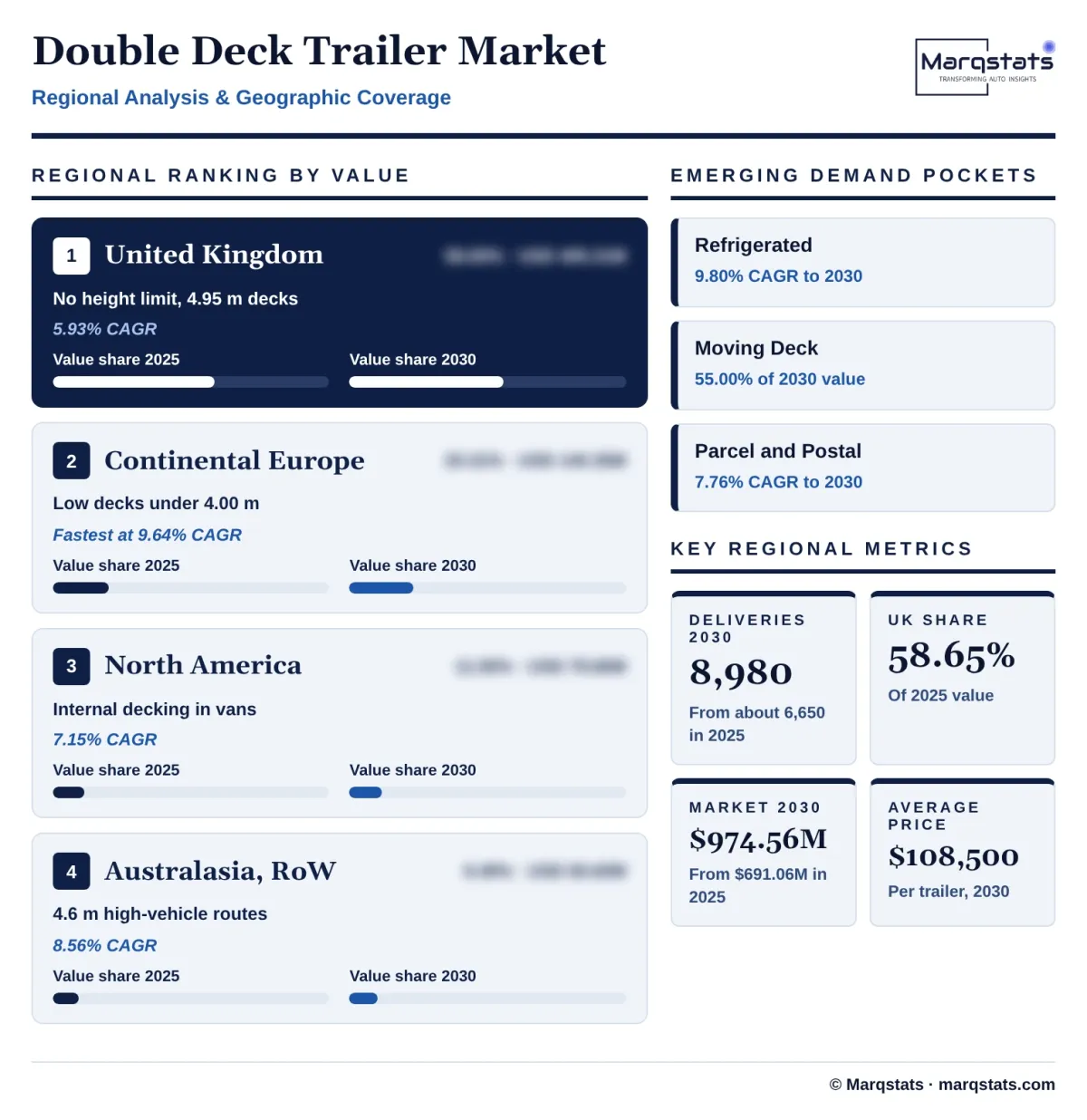
The United Kingdom is the largest market, with 58.65% of 2025 value, USD 405.31 million, from about 3,450 trailers, rising to an estimated USD 540.58 million and 4,380 trailers by 2030, a 5.93% CAGR. No statutory height limit allows double decks of about 4.90 to 4.95 m, and grocers, parcel carriers and pallet networks run an estimated fleet of about 30,000. Don-Bur, Tiger Trailers, SDC Trailers, Gray & Adams, Cartwright and Montracon are the main builders.
Continental Europe
Continental Europe accounts for 20.31% of 2025 value, USD 140.35 million, from about 1,350 trailers, and grows fastest at an estimated 9.64% a year to USD 222.38 million by 2030. The 4.00 m height limit pushes builders towards low two-tier designs and internal decking, such as the Van Eck Twindeck, Schmitz Cargobull double-deck loading systems and Chereau double-deck reefers, used mainly in the Netherlands, Belgium, Germany and France.
North America
North America accounts for 11.55% of 2025 value, USD 79.80 million, from about 1,050 trailers with double-deck or full internal decking, and grows at an estimated 7.15% a year to USD 112.70 million by 2030. State height limits of 13 ft 6 in to 14 ft keep most two-tier loading to load-bar and mezzanine decking systems in dry vans and reefers.
Australasia and Rest of World
Australasia and the rest of the world account for 9.49% of 2025 value, USD 65.60 million, from about 800 trailers, and grow at an estimated 8.56% a year to USD 98.90 million by 2030. Australia allows some vehicles up to 4.6 m and builders such as Vawdrey supply drop-deck and two-tier designs, while Ireland, the Middle East and South Africa buy smaller volumes, often from UK builders.
How Competition Is Evolving
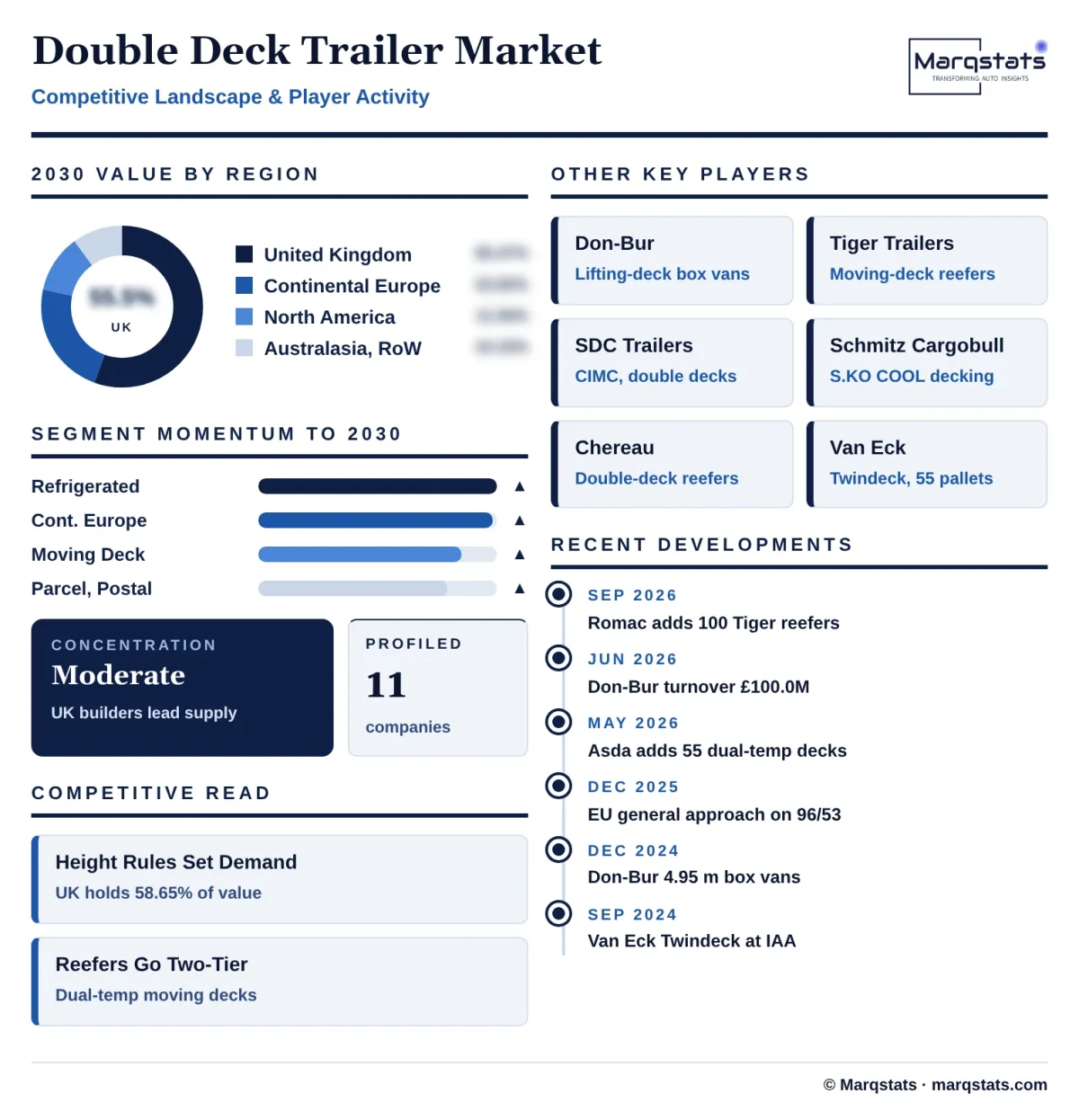
The market is moderately concentrated. A handful of UK builders supply most double decks in the largest national market, while Continental Europe is split between large semi-trailer makers that offer double-deck options and specialist Dutch and Belgian builders. Marqstats profiles 11 companies.
Don-Bur and Tiger Trailers lead UK moving-deck supply. Don-Bur reported turnover of GBP 100.0 million and pre-tax profit of GBP 16.6 million for the year to September 2025, with 504 staff, and builds lifting-deck box vans and trailers for parcel, retail and automotive fleets. Tiger Trailers supplies moving-deck reefers and ambient double decks to Asda, Romac Logistics and Hovis.
SDC Trailers and Gray & Adams bring scale from wider trailer ranges. SDC Trailers, part of CIMC, reported turnover of GBP 229.2 million for 2023 and builds double decks among its curtain-sided and box trailers, while Gray & Adams, a leading UK refrigerated body and trailer builder, reported sales above GBP 208 million for the year to April 2024.
Continental makers compete with low-deck designs. Schmitz Cargobull offers a wall-integrated double-deck loading system on its S.KO COOL reefer, Chereau builds double-deck refrigerated semi-trailers, and Van Eck sells the Twindeck with a full-length movable floor rated at 15 tonnes and up to 55 Euro pallets.
Companies Covered
Companies covered in the report include:
Recent Market Activity
Table of Contents
Coverage & Segmentation
The study covers the global double deck trailer market, with 2025 as the base year, 2021 – 2025 as the historical period and 2026 – 2030 as the forecast period. Values are in US dollars at ex-works prices, and volumes are new semi-trailers delivered. It includes fixed double decks, moving and lifting-deck trailers and factory-fitted internal decking and mezzanine systems that create a full second load tier, in box, curtain-sided and refrigerated bodies, by deck type, body type, end use and region.
Car transporters, livestock trailers, double-deck buses, rigid trucks and drawbar trailers, single-deck trailers with tail lifts only, aftermarket load bars and straps, dock lifts, refrigeration units sold separately, and trailer leasing and rental revenue are excluded.