Market Snapshot
Middle bar: base-year value × (1 + CAGR), rounded to two decimals. This is a calculated illustration, not a separately researched annual estimate.
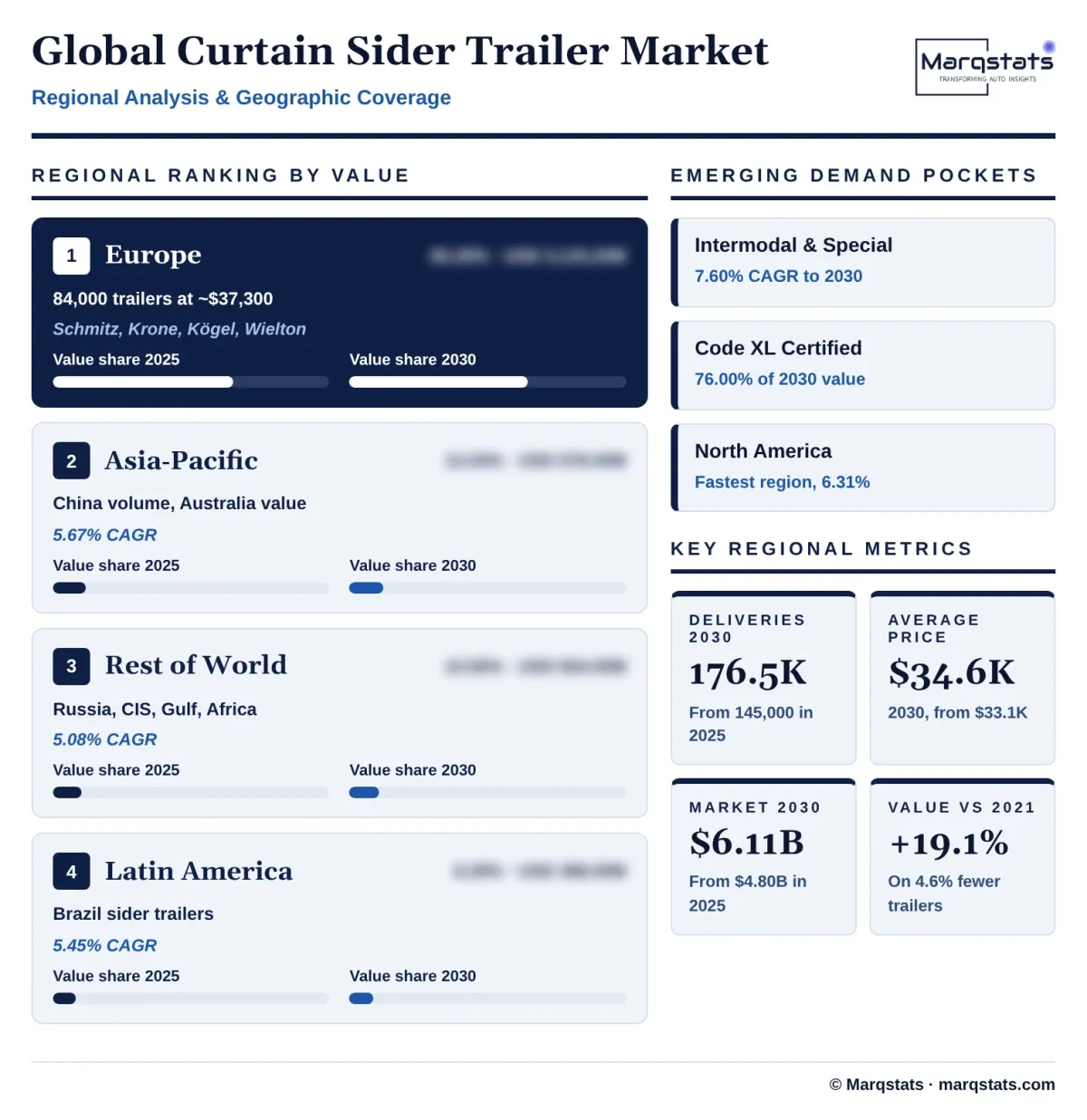
The global curtain sider trailer market size is estimated at USD 4.80 billion (USD 4,798.80 million) in 2025 and is projected to reach USD 6.11 billion (USD 6,107.95 million) by 2030, growing at a CAGR of 4.94% over 2026 – 2030. Annual deliveries rise from about 145,000 trailers to 176,500, a 4.01% annual rate, while the average ex-factory price rises from about USD 33,100 to USD 34,600 as Code XL certification, mega and intermodal designs and lightweight specifications take a larger share.
Marqstats defines the market as the ex-factory value of new curtain-sided trailers for road freight: semi-trailers, drawbar and centre-axle trailers with sliding or tautliner side curtains, a fixed or sliding roof and rear doors. It covers standard 13.6-metre curtainsiders, mega and high-cube volume trailers, intermodal and craneable (P400) curtainsiders, coil-well, double-deck and other special curtain-sided designs. Curtain-sided rigid truck bodies, box vans and reefers, flatbeds and platform trailers without curtains, used trailers, rental and leasing revenue and aftermarket curtain replacement are excluded.
Europe accounts for 65.29% of 2025 value and North America grows fastest at 6.31% a year from a small base. Standard 13.6-metre curtainsiders hold 58.00% of 2025 value, Code XL certified trailers 68.00% and semi-trailers 88.00%. The study segments the market by design, load-securing certification, coupling type and region. EUR values are converted at a 2025 annual average rate of EUR 1 = USD 1.13.
Key Takeaways
Market Overview & Analysis
Report Summary
Marqstats sizes the global curtain sider trailer market as the ex-factory value of new curtain-sided trailers delivered to road freight operators. In 2025 about 145,000 curtainsiders were delivered worldwide, worth an estimated USD 4,798.80 million at an average ex-factory price of about USD 33,100. Europe took about 84,000 of these trailers at an average of about EUR 33,000, or USD 37,300, per trailer.
The curtainsider combines the protection of a box trailer with the side access of a flatbed. Sliding side curtains and a sliding or lifting roof allow forklifts to load pallets from the side and cranes to load from above, while rear doors allow dock loading. That flexibility makes it the default general-cargo trailer in Europe for palletised consumer goods, beverages, building materials, paper, steel coils and automotive parts. In North America and much of Asia, by contrast, dry vans and flatbeds dominate and curtainsiders are a niche.
Europe sets the volume. Marqstats estimates about 180,000 new heavy trailers and semi-trailers were registered in the European Union, the United Kingdom and EFTA countries in 2025, based on the European share of about 25% that Schmitz Cargobull reports for its new trailer registrations and its sales of 42,620 trailers in 2024/25 and more than 47,000 in 2025/26. Curtainsiders account for about 42% of that total, with Turkey, the Balkans and Ukraine adding further volume. Spain registered 17,518 semi-trailers in 2025, up 16.7%, and Italy 15,425 trailers and semi-trailers, up 14.7%, while registrations in Germany and France fell sharply.
Prices rose while volumes fell. Marqstats estimates global curtainsider deliveries fell from about 152,000 in 2021 and 160,000 in 2022 to 158,000 in 2023 and 146,000 in 2024, while the average ex-factory price rose from about USD 26,500 in 2021 to USD 33,200 in 2024. New trailer prices in Europe have risen by at least 25% since 2022. The market value therefore rose from USD 4,028.00 million in 2021 to a peak of USD 5,182.40 million in 2023 before falling to USD 4,847.20 million in 2024 and USD 4,798.80 million in 2025.
Outside Europe, curtainsiders serve specific niches. China builds the largest number of curtainsiders outside Europe, about 22,000 a year, mostly low-cost domestic designs at about USD 9,500 each. Australia and New Zealand use heavy B-double and road-train-capable curtainsiders, about 4,300 a year at about USD 72,000 each. Brazil uses sider trailers for consumer goods and beverages, and North America uses curtainsiders mainly for building materials, beverages and cross-border Mexican freight.
Load-securing rules shape trailer design. The EN 12642 standard sets two strength levels for trailer bodies. Code L requires side walls to withstand 30% of the payload, while Code XL requires 40% for the side walls, 50% for the front wall and 30% for the rear wall, so that loads can be secured with fewer lashings. EU Directive 2014/47/EU sets common rules for roadside inspections of cargo securing, and inspectors and shippers increasingly treat Code XL certified curtainsiders as the standard for palletised goods. Makers also offer additional certificates for beverages, paper rolls and other specific loads.
Climate rules reach the trailer. The EU heavy-duty CO2 Regulation (EU) 2019/1242, amended in 2024, brings trailers and semi-trailers into the CO2 standards with reduction targets from 2030, measured with the VECTO trailer tool. Curtainsiders gain from lighter chassis, side skirts, boat tails and low-rolling-resistance tyres, and the EcoDuo pilot showed that two semi-trailers on a 31.7-metre combination can cut diesel use and CO2 emissions by 27.6%. Germany allowed the EcoDuo at 44 tonnes, while Spain allows up to 72 tonnes and Scandinavian countries up to 76 tonnes on approved routes, and Sweden approved 74-tonne combinations from December 2023.
Makers are restructuring. Schmitz Cargobull, the largest maker, reported negative EBIT of EUR 13.3 million in 2025/26 after negative EBIT of EUR 8.2 million the year before, despite higher sales, and started a plant in Oradea, Romania with capacity of up to 4,000 curtainsiders and tippers a year. Krone took over its Polish dealer Pozkrone, and Wielton reduced its losses while growing strongly in the United Kingdom and Poland. Production and distribution are moving towards Central and Eastern Europe, where hauliers buy most new trailers.
Global Curtain Sider Trailer Market Size and Forecast
The global curtain sider trailer market grows from USD 4,798.80 million in 2025 to USD 6,107.95 million in 2030, a CAGR of 4.94%. Marqstats expects deliveries of about 151,500 trailers worth USD 5,059.70 million in 2026, 160,000 worth USD 5,391.92 million in 2027, 168,000 worth USD 5,712.28 million in 2028 and 172,500 worth USD 5,917.40 million in 2029, before reaching 176,500 trailers in 2030.
The average price rises slowly. The average ex-factory price moves from about USD 33,095 in 2025 to about USD 33,397 in 2026, USD 34,002 in 2028 and USD 34,606 in 2030. In Europe it rises from about USD 37,300 to USD 40,100 as Code XL, mega and lightweight specifications gain share, while the global average is held down by the growing weight of lower-priced Chinese curtainsiders.
Volume growth follows the freight cycle. Trailer forecasters expect West European heavy trailer demand to rise by about 6% in 2026 after a 0.5% fall in 2025, with stronger growth in 2027 and 2028. East European demand, which reached a record of more than 120,000 trailers in 2023, fell by about 9,300 units in 2025 and is not expected to pass its record until 2028. Marqstats expects European curtainsider deliveries to rise from 84,000 in 2025 to 98,000 in 2030, a 3.13% annual rate.
Replacement drives most demand. The European Union, EFTA and United Kingdom semi-trailer parc stood at about 3 million units in 2022. With a typical first-life of eight to twelve years, replacement of the trailers bought in the 2017 to 2019 boom supports deliveries from 2026, while fleet growth comes mainly from Central and Eastern European and Turkish hauliers.
Marqstats tracks four indicators to monitor the forecast: monthly heavy trailer registrations in Germany, France, Poland, Spain, Italy and the United Kingdom; order books and results of the largest trailer makers; European road freight rates and haulier insolvencies; and steel and aluminium prices.
The mix changes over the forecast. Mega and high-cube curtainsiders rise from 27.00% to 29.00% of value and intermodal and special designs from 15.00% to 17.00%, Code XL certified trailers from 68.00% to 76.00%, and drawbar and centre-axle trailers from 12.00% to 13.00%. Europe remains dominant but its share eases from 65.29% to 64.34%, while Asia-Pacific rises from 12.04% to 12.47% and North America from 3.87% to 4.12%.
Value grew while volume fell. Between 2021 and 2025 Marqstats estimates deliveries fell by about 4.6% while value rose by about 19.1%, because the average price rose by about 24.9%, from about USD 26,500 to USD 33,100. Over 2025 to 2030 the pattern changes: volume grows at 4.01% a year and the average price at only 0.90%, so growth now depends on fleets buying more trailers rather than paying more for each one.
Market Dynamics
Key Drivers
Five forces keep the curtainsider the default general-cargo trailer in Europe and spread it to new regions.
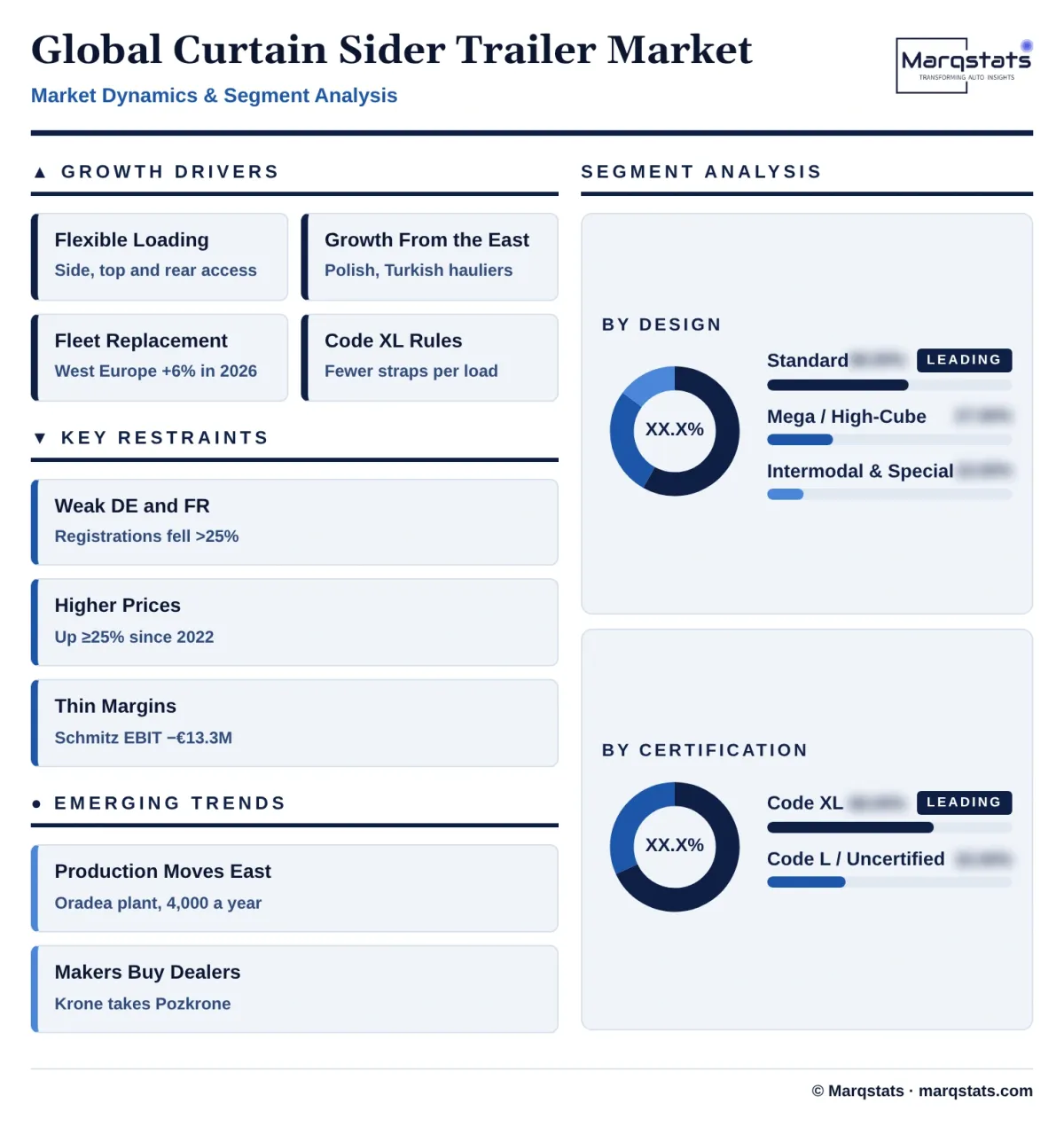
- Flexible loading. Curtainsiders can be loaded from the side, top and rear, so one trailer can carry pallets, long goods, steel coils and machinery, and hauliers can switch between customers and loads without changing trailers.
- European freight growth from the East. Polish, Lithuanian, Romanian and Turkish hauliers carry a large share of international road freight in Europe and keep adding curtainsiders, and Poland is now the second-largest market for Krone after Germany.
- Fleet replacement after the 2023 peak. Trailers bought in the 2017 to 2019 boom reach the end of their first life from 2026, and West European demand is expected to rise by about 6% in 2026 after two weak years.
- Load-securing rules. EU roadside inspection rules for cargo securing and shipper requirements for Code XL certified side walls favour new certified curtainsiders over older trailers, and certified trailers command higher prices.
- Intermodal and longer combinations. Shippers moving semi-trailers by rail need craneable P400 curtainsiders, and trials of longer and heavier combinations, such as the EcoDuo pilot that cut diesel use and CO2 emissions per tonne by 27.6%, open new uses for curtainsiders.
Key Restraints
Four constraints hold back volume growth and squeeze trailer maker margins.
- Weak freight demand in Germany and France. Heavy trailer registrations in Germany and France fell more than 25% short of early-2025 expectations, and weak industrial output and haulier insolvencies hold back orders in Western Europe's two largest markets.
- Higher prices and costly finance. New trailer prices have risen by at least 25% since 2022 and interest rates remain higher than before 2022, so small hauliers keep older trailers longer or rent instead of buying.
- Thin margins for makers. Schmitz Cargobull reported negative EBIT of EUR 13.3 million in 2025/26 and Wielton a net loss in the first half of 2026, which limits investment and pushes makers to cut capacity in Western Europe and move production east.
- Competition from box trailers. Box trailers, including reefers, overtook curtainsiders in Germany in 2020, and shippers seeking security, temperature control and better aerodynamics can choose box trailers instead.
Key Trends
Four shifts are changing how curtainsider trailers are specified, built and sold.
- Production moves east. Schmitz Cargobull started a plant in Oradea, Romania in early 2026 that builds curtainsiders and tipper semi-trailers for Central Europe, with capacity of up to 4,000 trailers a year, and other makers expand in Poland, Turkey and Lithuania.
- Makers buy their dealers. Krone took over its long-standing Polish partner Pozkrone at the end of November 2025, which has sold about 70,000 Krone trailers since 1994, mostly curtainsiders, and has added its rental fleet service in Poland.
- Lighter and more aerodynamic trailers. Makers offer lighter chassis, aluminium components and side skirts and boat tails to meet the EU heavy-duty CO2 rules for trailers and to raise payload for hauliers paid by weight.
- Telematics and electrified axles. Curtainsiders increasingly come with telematics, tyre-pressure monitoring, curtain-opening sensors and, on some models, electric generator axles, so fleets can track loads and trailers can help power reefers and support truck CO2 reduction.
Strategic Implications
- For trailer makers, price discipline matters more than volume. With deliveries still below the 2022 peak and costs higher, makers that hold prices for Code XL, mega and intermodal specifications and cut cost through eastern production can restore margins as volumes recover.
- For hauliers and fleet owners, timing the replacement cycle matters. Prices are unlikely to fall back to 2021 levels, so fleets planning to replace trailers from the 2017 to 2019 boom can lock in prices ahead of the expected 2027 and 2028 recovery, or use rental to bridge demand.
- For shippers, certified trailers cut handling cost. Requiring Code XL curtainsiders reduces the number of straps and checks needed per load and lowers the risk of fines at roadside inspections.
- For component suppliers, the curtain is the high-value wear part. Curtains, roof systems, posts, slats and locking systems are replaced several times in a trailer life, so suppliers of these parts can grow with the parc even when new trailer sales are weak.
- For rail and intermodal operators, P400 curtainsiders are the gateway. As more shippers buy craneable curtainsiders, intermodal terminals and rail operators can win road freight that does not need a dedicated container.
- For investors, Central and Eastern European registrations are the key indicator. Polish, Romanian, Lithuanian and Turkish hauliers buy a growing share of European curtainsiders, so registrations and haulier finance in those countries show earlier than West European data whether the recovery is on track.
Market Segmentation
Standard 13.6-metre curtain-sided semi-trailers with an internal height of about 2.7 metres account for 58.00% of 2025 value, USD 2,783.30 million, rising to USD 3,298.29 million by 2030, a 3.45% CAGR, while their share falls to 54.00%. This is the standard European general-cargo trailer for palletised loads, built by Schmitz Cargobull, Krone, Kögel, Wielton and most other makers.
Mega and high-cube curtainsiders with an internal height of about 3 metres, used with low-deck tractors for volume freight such as automotive parts, packaging and white goods, account for 27.00% of 2025 value, USD 1,295.68 million, and grow at 6.45% a year to USD 1,771.31 million and 29.00% of 2030 value, as automotive and e-commerce shippers seek more volume per trip.
Craneable P400 intermodal curtainsiders, coil-well trailers for steel coils, double-deck curtainsiders, beverage trailers and other special curtain-sided designs account for 15.00% of 2025 value, USD 719.82 million, and grow fastest, at 7.60% a year, to USD 1,038.35 million and 17.00% of 2030 value. Double-deck curtainsiders are also covered by the Marqstats double deck trailer study, so the two sets of figures should not be added.
Curtainsiders certified to EN 12642 Code XL, whose side walls, rear doors and headboard can carry a defined share of the payload so that fewer lashings are needed, account for 68.00% of 2025 value, USD 3,263.18 million, and grow at 7.30% a year to USD 4,642.04 million and 76.00% of 2030 value. Code XL is now standard on most new European curtainsiders, often with additional certification for beverages or paper rolls.
Curtainsiders certified only to the basic EN 12642 Code L level or without certification account for 32.00% of 2025 value, USD 1,535.62 million, and decline by 0.92% a year to USD 1,465.91 million and 24.00% of 2030 value. Most Chinese, Latin American and many North American curtainsiders fall into this group.
Curtain-sided semi-trailers account for 88.00% of 2025 value, USD 4,222.94 million, rising to USD 5,313.92 million by 2030, a 4.70% CAGR, and 87.00% of the market. Semi-trailers dominate in every region because they suit the tractor and semi-trailer combinations used for long-distance freight.
Curtain-sided drawbar and centre-axle trailers, used behind rigid trucks in road trains, swap-body combinations and Australian B-double and road-train configurations, account for 12.00% of 2025 value, USD 575.86 million, and grow at 6.64% a year to USD 794.03 million and 13.00% of 2030 value, supported by longer combinations in Scandinavia and Australia.
By Geography
Europe
Europe, including the European Union, the United Kingdom, EFTA countries, Turkey, the Balkans and Ukraine, is the largest market, with 65.29% of 2025 value, USD 3,133.20 million, on about 84,000 curtainsiders at an average of about USD 37,300 each. It grows at 4.63% a year to USD 3,929.80 million and 64.34% of 2030 value, with deliveries rising to 98,000. Germany, Poland, Spain, Italy, France, the United Kingdom and Turkey are the largest national markets. Spain registered 17,518 semi-trailers in 2025, up 16.7%, and Italy 15,425 trailers and semi-trailers, up 14.7%, while German and French registrations fell. In the United Kingdom, Wielton raised its first-half 2026 registrations by 73.7% to 1,805 trailers and became second in the market. Russia is covered under Rest of World.
Asia-Pacific
Asia-Pacific accounts for 12.04% of 2025 value, USD 578.00 million, on about 29,000 curtainsiders, and grows at 5.67% a year to USD 761.40 million and 12.47% of 2030 value. China builds about 22,000 low-cost curtainsiders a year, mainly for domestic express and consumer goods freight, while Australia and New Zealand take about 4,300 high-specification curtainsiders a year for B-double and road-train operation at about USD 72,000 each. Freighter, Vawdrey and CIMC Vehicles lead in Australia, and Japan, Southeast Asia and India use side-opening wing-body designs more than curtainsiders.
Latin America
Latin America accounts for 8.29% of 2025 value, USD 398.00 million, on about 12,000 curtainsiders, and grows at 5.45% a year to USD 519.00 million and 8.50% of 2030 value. Brazil is the largest market, with about 9,500 sider trailers in 2025, but Brazilian sales of heavy trailers and semi-trailers fell 19.9% in 2025 to about 71,000 units as high interest rates held back fleet purchases, while exports rose. Randon, Librelato and other Brazilian makers lead the region.
North America
North America accounts for 3.87% of 2025 value, USD 185.60 million, on about 3,200 curtainsiders at about USD 58,000 each, and grows fastest, at 6.31% a year, to USD 252.00 million and 4.12% of 2030 value. Dry vans and flatbeds dominate the region, but curtainsiders serve building materials, beverages and cross-border Mexican freight, where side loading saves time. United States trailer production fell to about 196,000 units in 2025 across all types, so curtainsiders remain below 2% of the market.
Rest of World
The rest of the world, covering Russia and the CIS, the Middle East and Africa, accounts for 10.50% of 2025 value, USD 504.00 million, on about 16,800 curtainsiders, and grows at 5.08% a year to USD 645.75 million and 10.57% of 2030 value. Russian and Kazakh demand is served increasingly by Chinese, Belarusian and Turkish makers, Gulf hauliers buy European and Turkish curtainsiders for regional freight, and South Africa uses curtainsiders on its main corridors. Regional shares are rounded so that they sum to 100.00%.
How Competition Is Evolving
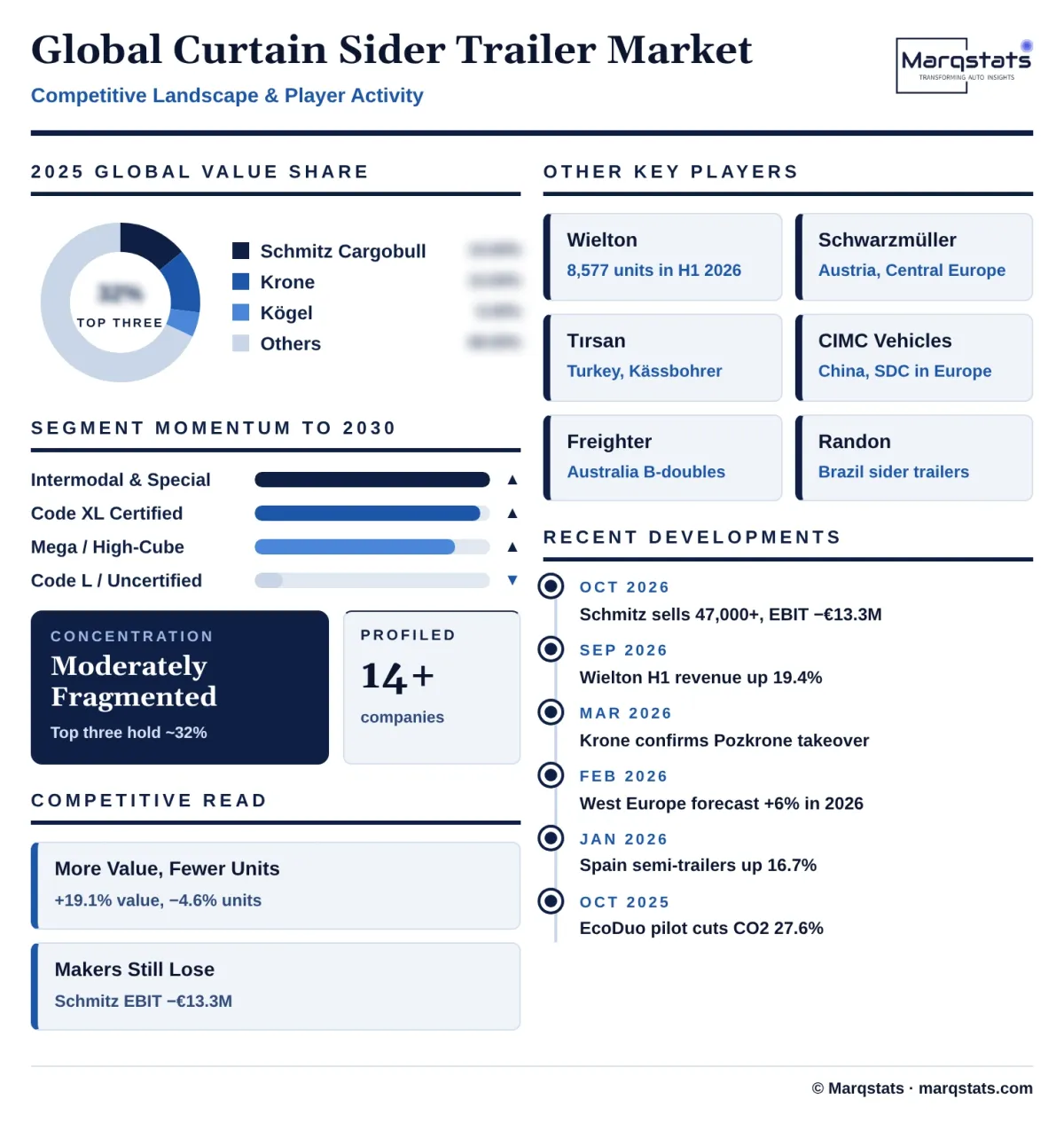
The global curtain sider trailer market is moderately fragmented. Schmitz Cargobull and Krone lead, with Marqstats estimates of about 14% and 13% of 2025 global value, followed by Kögel at about 5%. The three leading German makers hold about 32% of global value but a much larger share of Western Europe, while China, Turkey, Brazil and Australia have their own national leaders.
Scale varies widely. Schmitz Cargobull sold more than 47,000 trailers and truck bodies in its 2025/26 financial year, up from 42,620, on turnover of about EUR 2.25 billion, and reports a share of about 25% of new trailer registrations in Europe. The Krone Group, which also makes agricultural machinery, reported revenue of about EUR 2.3 billion for 2024/25. Wielton, which owns Fruehauf, Lawrence David, Langendorf and Viberti, delivered 8,577 trailers in the first half of 2026 and leads the French market through Fruehauf with a 16.1% share.
Makers compete on certification, weight and service. Code XL certification, low tare weight, curtain and roof systems that open quickly, telematics, and dealer and rental networks decide most fleet orders, while price matters most in Central and Eastern Europe and outside Europe.
Competition will be decided by cost and distribution. Makers that build in lower-cost plants in Poland, Romania, Turkey and Lithuania, control their dealers and rental fleets, and keep prices for certified and special designs will gain share as volumes recover.
Regional leaders matter outside Germany. Tırsan, which owns the Kässbohrer brand, leads in Turkey and exports across Europe, Schwarzmüller is strong in Austria and Central Europe, Fliegl in German mid-market fleets, Lecitrailer in Spain, Don-Bur in the United Kingdom, CIMC Vehicles in China and in Europe through SDC Trailers, Freighter and Vawdrey in Australia, and Randon in Brazil. In the United Kingdom, Wielton brands reached a 13.3% share in the first half of 2026, second behind Schmitz Cargobull.
Companies Covered
Companies covered in the report include:
Recent Market Activity
Table of Contents
Coverage & Segmentation
The study covers the global curtain sider trailer market, with 2025 as the base year, 2021 – 2025 as the historical period and 2026 – 2030 as the forecast period. Values are in US dollars at ex-factory prices, with euro prices converted at the 2025 annual average rate of EUR 1 = USD 1.13 and other currencies at 2025 annual average rates, and volumes are annual deliveries of new trailers. The market is segmented by design, load-securing certification, coupling type and region.
Curtain-sided rigid truck bodies, box vans and reefers, flatbeds and platform trailers without curtains, used trailers, rental and leasing revenue, and aftermarket curtain and roof replacement are excluded. Double-deck curtainsiders are included here and in the Marqstats double deck trailer study, so the two should not be added. Curtainsiders are a part of the wider semi-trailer and truck trailer market covered by other Marqstats trailer studies. Segment and regional splits are Marqstats estimates built on maker results, national registration data, trade body statistics and price benchmarks.