Market Snapshot
Middle bar: base-year value × (1 + CAGR), rounded to two decimals. This is a calculated illustration, not a separately researched annual estimate.
The global car transport trailer market size is estimated at USD 2.33 billion in 2025 and is projected to reach USD 3.06 billion by 2030, growing at a CAGR of 5.60% over 2026 – 2030. The market grew from about USD 1.96 billion in 2021 to a peak of USD 2.52 billion in 2023, then eased to USD 2.45 billion in 2024 and USD 2.33 billion in 2025 as North American trailer demand fell, and Marqstats expects growth to return from 2026 as fleets in North America and Europe replace ageing rigs and as vehicle exports from China and India add capacity in Asia and emerging markets.
Marqstats defines the market as the annual value of new commercial car transport equipment that carries two or more passenger cars or light trucks on public roads. It covers stinger-steered and high-mount car hauler trailers in North America, including the headrack mounted on the tractor, European truck-and-trailer road trains and semi-trailer car transporters, Chinese centre-axle car carrier sets, and two- to three-car gooseneck and wedge trailers used by independent haulers, together with enclosed car carriers. Values are at manufacturer selling prices and exclude the tractor or truck chassis. Single-car utility and consumer car hauler trailers, rollback and wrecker bodies, rail autoracks, Ro-Ro vessels and aftermarket parts are excluded.
About 42,700 units were built in 2025, an average of about USD 54,600 per unit. Heavy units carrying seven or more vehicles account for 68.32% of 2025 value, open car carriers for 91.00% and carriers serving manufacturer finished-vehicle logistics for 66.01%. North America accounts for 39.35% of 2025 value and Asia-Pacific for 28.93%. The study segments the market by vehicle capacity, configuration, end user and region.
Key Takeaways
Market Overview & Analysis
Report Summary
Marqstats sizes the car transport trailer market as the annual value of new equipment built to move finished passenger cars and light trucks by road between plants, ports, rail ramps, dealers and auctions. In 2025 this value was an estimated USD 2.33 billion across about 42,700 units, ranging from three-car gooseneck trailers that sell for about USD 30,000 to nine- and ten-car stinger rigs whose trailer and headrack cost well over USD 150,000.
Car carriers differ by region because road rules differ. In the United States and Canada the dominant heavy design is the stinger-steered rig, in which the fifth wheel sits behind the rear axle of the tractor so that a vehicle can be carried over the cab on a headrack and the trailer deck can drop low between the axles. High-mount rigs, with a conventional fifth wheel, are used where overhangs or turning rules favour them. The FAST Act of 2015 raised the overall length allowance for stinger-steered auto transporters from 75 to 80 feet and the front and rear overhang allowances from 3 to 4 feet and from 4 to 6 feet, which lets a typical rig carry nine to ten cars.
In Europe the standard heavy unit is a truck-and-trailer road train in which a rigid truck carries an upper and lower deck superstructure and tows a centre-axle or twin-axle trailer, or a tractor pulls a semi-trailer car transporter. Kässbohrer, Lohr and Rolfo are the leading builders. A Kässbohrer Metago Pro twin-axle trailer weighs 6,850 kg to 7,750 kg on its own, with an overall length of 10,300 mm and a width of 2,550 mm, which shows how much of the legal gross weight the equipment itself consumes. National rules on loaded length, height and overhang differ, and many countries allow longer loaded car transporters than the base 18.75 m road-train limit of Directive 96/53/EC.
In China the market was reshaped by GB 1589-2016, which set new maximum dimensions for vehicles and ended the use of the over-length double-deck car carriers that had dominated vehicle logistics. Fleets replaced non-compliant carriers with centre-axle car carrier sets in a short replacement wave that ended in 2018, so most of the Chinese fleet is now seven to nine years old. A Special Action Plan for Car Carrier Regulation took effect in July 2025, and CIMC Vehicles launched its Stellar Storm car carrier at the China International Commercial Vehicle Show in Wuhan in October 2025 to meet it.
Demand follows vehicle movements and fleet age rather than general freight. Car carriers are bought by finished-vehicle logistics companies working on manufacturer contracts, by dealer groups, auctions and remarketing companies moving used vehicles, and by independent owner-operators with two- and three-car hotshot trailers. Their purchases rise when new vehicle production and imports grow, when rigs reach the end of a service life of roughly ten to fifteen years and when road rules allow more cars per load.
The market is a small, specialised part of the trailer industry. Wabash, the largest United States trailer maker, reported in its 2025 annual report that total United States trailer production fell to about 196,000 units in 2025 and was expected to be about 183,000 units in 2026. Car carriers account for only a few thousand of these units, but each carries a much higher price than a dry van, so their share of trailer value is larger than their share of units.
Global Car Transport Trailer Market Size and Forecast
The global car transport trailer market grows from USD 2.33 billion in 2025 to USD 3.06 billion in 2030, a CAGR of 5.60%. Marqstats expects value of USD 2.46 billion in 2026, USD 2.60 billion in 2027, USD 2.75 billion in 2028 and USD 2.90 billion in 2029.
The historical series follows vehicle production and the North American trailer cycle. Value was about USD 1.96 billion in 2021, when chassis and component shortages held back trailer output, rose to USD 2.24 billion in 2022 and peaked at USD 2.52 billion in 2023 as vehicle production recovered and fleets caught up with deferred orders. It eased to USD 2.45 billion in 2024 and fell to USD 2.33 billion in 2025 as United States trailer demand weakened and Chinese replacement demand stayed low. Over 2021 – 2025 the market grew by 4.45% a year.
Marqstats builds the estimate from units and prices by region rather than from a share of total trailer output. North America accounts for about 14,400 units in 2025: roughly 2,400 heavy stinger and high-mount rigs at about USD 165,000 including the headrack, roughly 3,000 four- to six-car units at about USD 90,000 and roughly 9,000 two- and three-car gooseneck and wedge trailers at about USD 32,000. China accounts for about 12,000 centre-axle car carrier sets at about USD 30,000, Europe for about 5,800 units, India for about 3,000 units and other markets for the rest. These figures are Marqstats estimates.
Published figures of more than USD 12 billion and 160,000 units a year are not consistent with this unit base. It can only be reached by counting single-car utility car hauler trailers sold to consumers and small businesses, which are a different product sold through trailer dealers and are excluded here, or by counting the value of the tractor and truck chassis.
Growth to 2030 rests on three assumptions. North American fleets replace rigs bought in the 2018 – 2019 and 2021 – 2023 upcycles as finance costs ease, European operators order longer and lighter road trains once national length rules converge, and Chinese and Indian fleets add capacity as vehicle exports and domestic sales grow. Marqstats tracks four indicators: light vehicle production and imports, United States trailer orders, the length and weight rules for auto transporters and the age of carrier fleets.
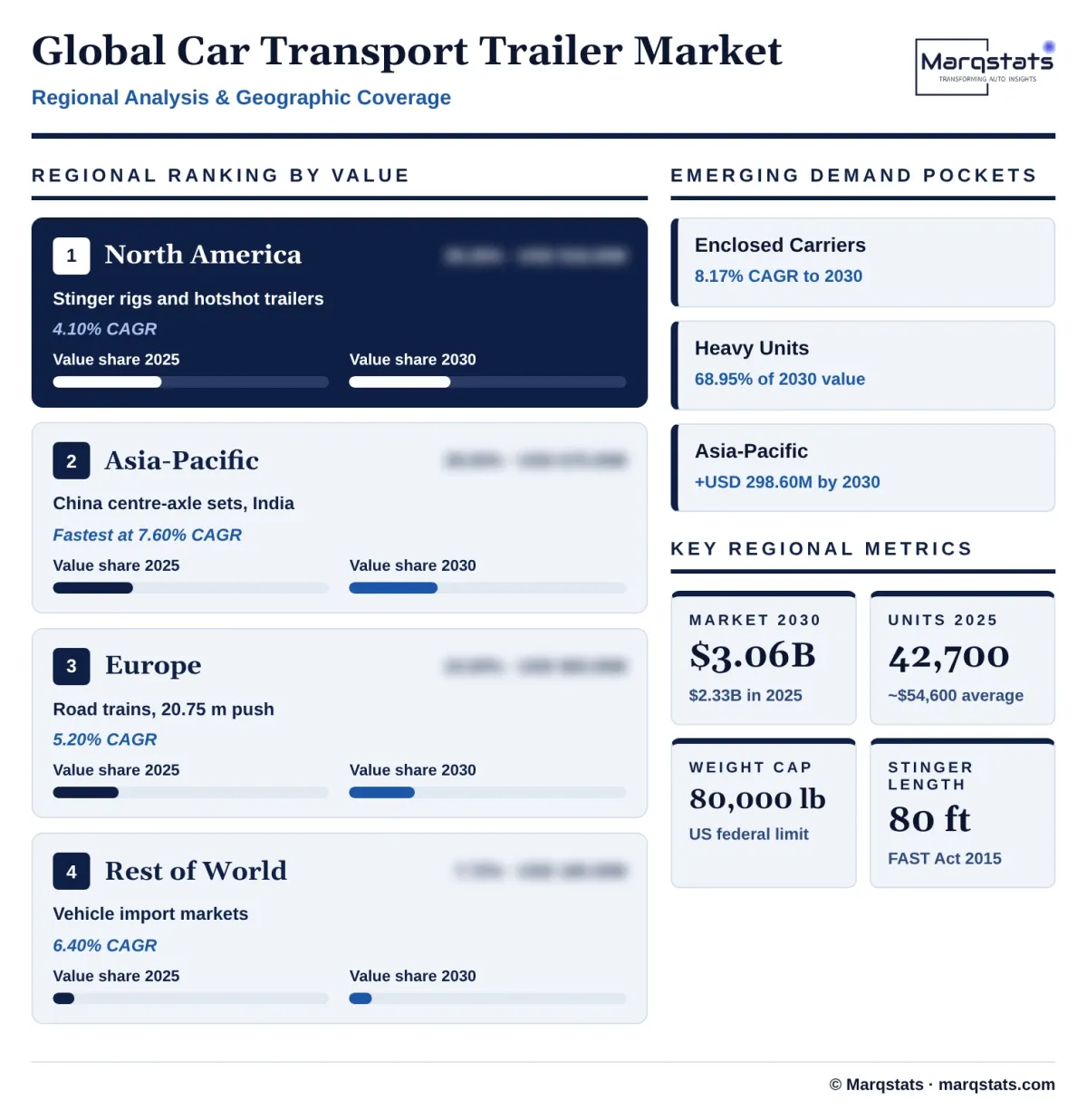
Regional growth differs in source. North America grows at 4.10% a year on replacement demand from a large installed base, Europe at 5.20% on replacement and length harmonisation, Asia-Pacific at 7.60% on vehicle exports, Indian highway logistics and a new compliance cycle in China, and the rest of the world at 6.40% as vehicle imports into the Middle East, Africa and Latin America grow. By 2030 North America accounts for 36.64% of value and Asia-Pacific for 31.79%.
Prices are rising faster than units. Aluminium decks, electro-hydraulic deck controls, LED lighting, electronic braking and telematics add cost, while steel and aluminium prices and labour costs remain high, so Marqstats expects the average unit price to rise by about 2% a year and units by about 3.5% a year over the forecast period.
Market Dynamics
Key Drivers
Six forces keep fleets buying new car transport trailers and truck-mounted car carrier bodies through the freight cycle.
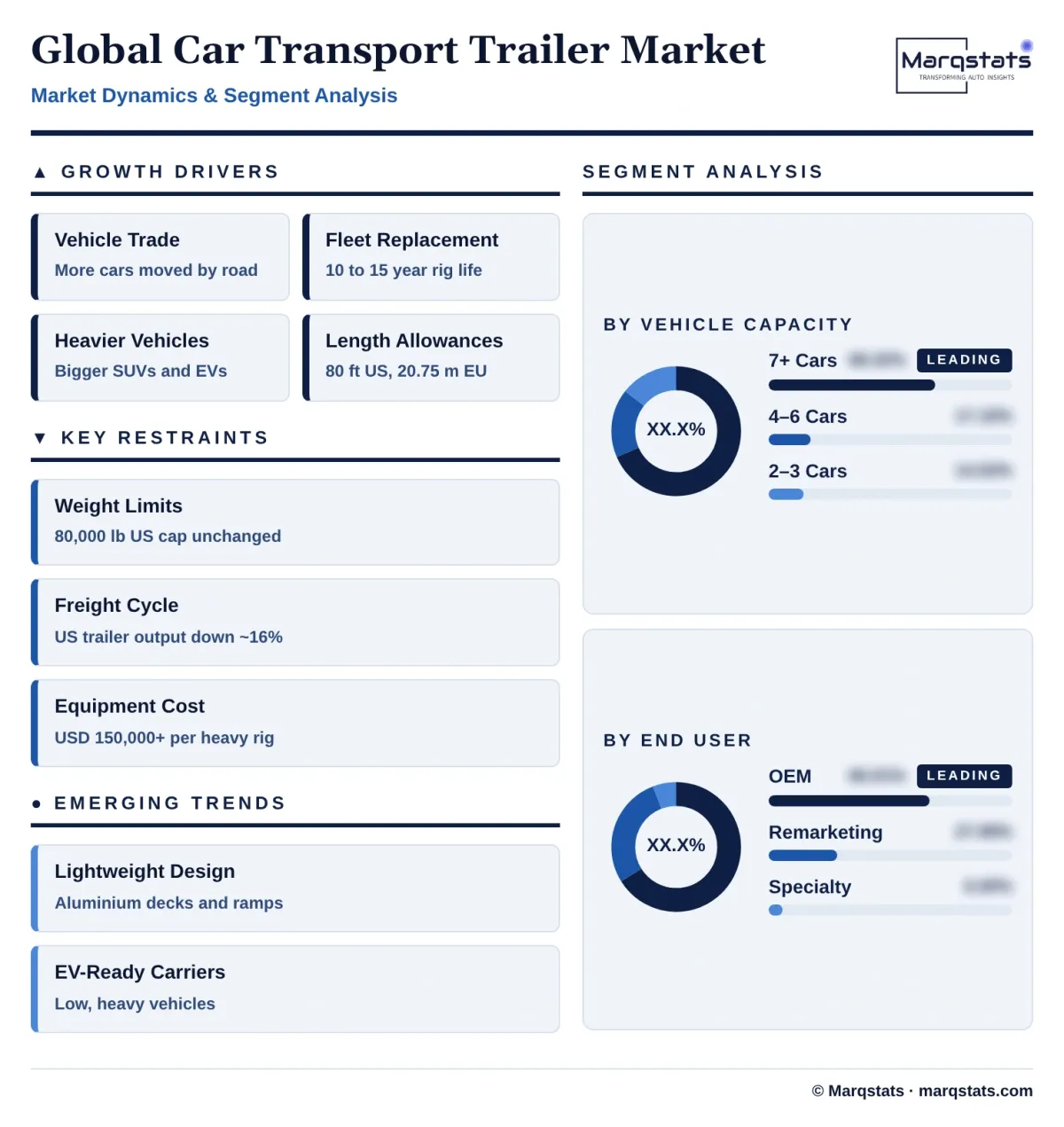
- Vehicle production and trade. Every new car moved from a plant, port or rail ramp to a dealer travels on a car carrier at least once, so growth in global light vehicle production and exports, led by China, adds directly to the number of loads that must be moved.
- Replacement of ageing fleets. Car carriers wear quickly because hydraulic decks, ramps and fifth-wheel structures are loaded and unloaded several times a day, so fleets replace rigs after roughly ten to fifteen years, and the large Chinese fleet bought in 2016 – 2018 reaches that age before 2030.
- Heavier vehicles. Average new vehicle weights have risen with larger SUVs, pickups and electric vehicles whose batteries add hundreds of kilograms, so fleets need lighter trailers to keep the number of cars per load.
- Length allowances. The FAST Act allowance of 80 feet for stinger-steered auto transporters and the push for a 20.75 m loaded length in Europe let builders design rigs that carry one more vehicle, which improves cost per car moved.
- Used vehicle remarketing. Dealer groups, auctions, rental fleets and online used car retailers move millions of used vehicles each year, which supports demand for two- to six-car trailers run by independent haulers.
- Finished-vehicle logistics contracts. Manufacturers tender multi-year road transport contracts that specify fleet age, damage rates and emissions, pushing logistics companies to renew equipment to win and keep business.
Key Restraints
Five constraints limit how fast fleets replace equipment and how much each rig can earn.
- Fixed gross weight limits. The 80,000 lb United States federal limit and national limits in Europe and Asia cap the cargo a rig can carry, so heavier vehicles reduce the number of cars per load and the revenue each rig earns.
- Freight and finance cycles. Car carrier orders follow vehicle production and the wider trailer cycle, and high interest rates in 2024 – 2025 made fleets defer purchases, as United States trailer production fell by about 16% in 2025.
- High equipment cost. A heavy stinger rig with headrack costs well over USD 150,000 before the tractor, which is a large commitment for owner-operators and small fleets.
- Driver shortages. Car haul drivers need specialised loading skills and spend long hours loading and securing vehicles, and a shortage of qualified drivers limits how many rigs fleets can put on the road.
- Different national rules. Length, height, overhang and weight limits differ between countries and, in the United States, between states, so builders must offer many variants and cannot spread design costs across a single global product.
Key Trends
Five shifts are changing how car carriers are designed, built and specified.
- Lightweight design. Builders are using aluminium decks and ramps, high-strength steel frames and lighter hydraulics to cut tare weight and keep payload as vehicles get heavier.
- Equipment for electric vehicles. Car carriers are being adapted for heavier electric vehicles with low ground clearance, and Rolfo presented a car transporter for electric trucks at IAA Transportation 2026.
- Modular and multi-purpose designs. Kässbohrer and Lohr promote modular superstructures and trailers that can be reconfigured for cars, vans and light commercial vehicles, so fleets can serve changing vehicle mixes.
- Compliance-driven replacement in China. The Special Action Plan for Car Carrier Regulation in force from July 2025 has led Chinese builders such as CIMC Vehicles to launch new compliant car carriers.
- Enclosed transport for high-value vehicles. More dealers, auctions and collectors pay for enclosed carriers to protect electric, luxury and collector vehicles from road debris and weather.
Strategic Implications
- For trailer builders, tare weight is the main selling point. Every kilogram removed from the trailer and headrack adds payload, so lightweight materials and lighter hydraulics win orders more readily than added features.
- For finished-vehicle logistics companies, fleet renewal is a contract requirement. Manufacturer tenders increasingly score equipment age, damage rates and emissions, so a renewal plan supports contract wins as well as reliability.
- For owner-operators, two- and three-car trailers are the entry point. Lower prices and simpler licensing make gooseneck and wedge trailers the way most independent haulers enter the market, but their demand is the most sensitive to used vehicle prices and finance costs.
- For policymakers, weight rules decide productivity. Length allowances alone no longer add vehicles per load when vehicles are heavier, so the debate over auto hauler weight limits in the United States and length harmonisation in Europe directly affects the cost of moving cars.
- For suppliers in China and India, export growth opens a new market. Rising vehicle exports need port and inland car carrier capacity, and Chinese builders have grown overseas semi-trailer sales, so local suppliers can sell compliant carriers at home and in emerging markets.
Market Segmentation
Stinger-steered and high-mount rigs, European road trains and Chinese centre-axle car carrier sets that carry seven or more vehicles account for 68.32% of 2025 value, USD 1.59 billion, and grow at 5.79% a year to USD 2.11 billion and 68.95% of the market by 2030, because manufacturer and port logistics contracts reward the largest legal load.
Four- to six-car trailers and truck-mounted bodies used for regional dealer deliveries and short-haul remarketing account for 17.15% of 2025 value, USD 400.00 million, and grow at 4.81% a year to USD 506.00 million by 2030.
Two- and three-car gooseneck and wedge trailers used by hotshot owner-operators account for 14.53% of 2025 value, USD 339.00 million, and grow at 5.59% a year to USD 445.00 million by 2030. Single-car utility car haulers are excluded.
Open multi-deck car carriers account for 91.00% of 2025 value, USD 2.12 billion, and grow at 5.33% a year to USD 2.75 billion by 2030, remaining the standard for new vehicle deliveries because they carry the most vehicles at the lowest cost per vehicle.
Enclosed trailers that protect vehicles from weather and road debris account for 9.00% of 2025 value, USD 210.00 million, and grow fastest, at 8.17% a year, to USD 311.00 million and 10.15% of the market by 2030, driven by electric, luxury, collector and motorsport vehicles.
Logistics companies moving new vehicles on manufacturer contracts from plants, ports and rail ramps to dealers account for 66.01% of 2025 value, USD 1.54 billion, and grow at 5.87% a year to USD 2.05 billion by 2030.
Dealer groups, auctions, rental fleets and independent haulers moving used and remarketed vehicles account for 27.99% of 2025 value, USD 653.00 million, and grow at 4.66% a year to USD 820.00 million by 2030.
Specialist operators moving collector, luxury, prototype and motorsport vehicles account for 6.00% of 2025 value, USD 140.00 million, and grow at 6.85% a year to USD 195.00 million by 2030.
By Geography
North America
North America is the largest region, with 39.35% of 2025 value, USD 918.00 million, rising to USD 1.12 billion by 2030 at 4.10% a year. The United States accounts for most of it. About 2,400 heavy stinger and high-mount rigs, 3,000 four- to six-car units and 9,000 two- and three-car trailers were built in 2025, based on Marqstats estimates. Cottrell and Boydstun are the main builders of heavy rigs, and Sun Country, Kaufman, Gatormade and Wally-Mo are among the many builders of light and enclosed trailers. The FAST Act length allowance supports nine- to ten-car rigs, but the 80,000 lb federal gross weight limit is the binding limit as vehicles get heavier. Total United States trailer production fell to about 196,000 units in 2025 and is expected at about 183,000 units in 2026, so car carrier demand recovers mainly from 2027.
Asia-Pacific
Asia-Pacific accounts for 28.93% of 2025 value, USD 675.00 million, and grows fastest, at 7.60% a year, to USD 973.60 million by 2030, adding USD 298.60 million. China built about 12,000 centre-axle car carrier sets in 2025 at low unit prices, after the GB 1589-2016 replacement wave left a fleet that is now seven to nine years old, and the Special Action Plan for Car Carrier Regulation that took effect in July 2025 starts a new compliance cycle. CIMC Vehicles reported road transport vehicle sales of 101,583 units in the first three quarters of 2025, up 7.21%, with overseas semi-trailer volume up 21.39%. India adds about 3,000 units a year as passenger vehicle sales grow, and Japan, South Korea, Australia and Southeast Asia add higher-value units.
Europe
Europe accounts for 24.00% of 2025 value, USD 560.00 million, and grows at 5.20% a year to USD 721.60 million by 2030. About 2,800 heavy road trains and semi-trailer car transporters were built in 2025, along with lighter units for dealer and van deliveries. Kässbohrer, Lohr and Rolfo lead the region. Germany allows longer loaded car transporters, and the European Car Transport Group has called for a harmonised minimum loaded length of 20.75 m, with the Council general approach on the revision of Directive 96/53/EC adopted in December 2025. Heavy trailer demand in Western Europe was roughly flat in 2025 and is expected to grow in 2026. Values are converted at USD 1.13 per EUR.
Rest of World
The rest of the world accounts for 7.72% of 2025 value, USD 180.00 million, and grows at 6.40% a year to USD 245.50 million by 2030. The Middle East, Africa and Latin America import growing numbers of vehicles from China and other producers, which need port-to-dealer car carrier capacity. Turkey, Brazil, Mexico and South Africa have local builders, while Gulf markets import units from Europe and China.
How Competition Is Evolving
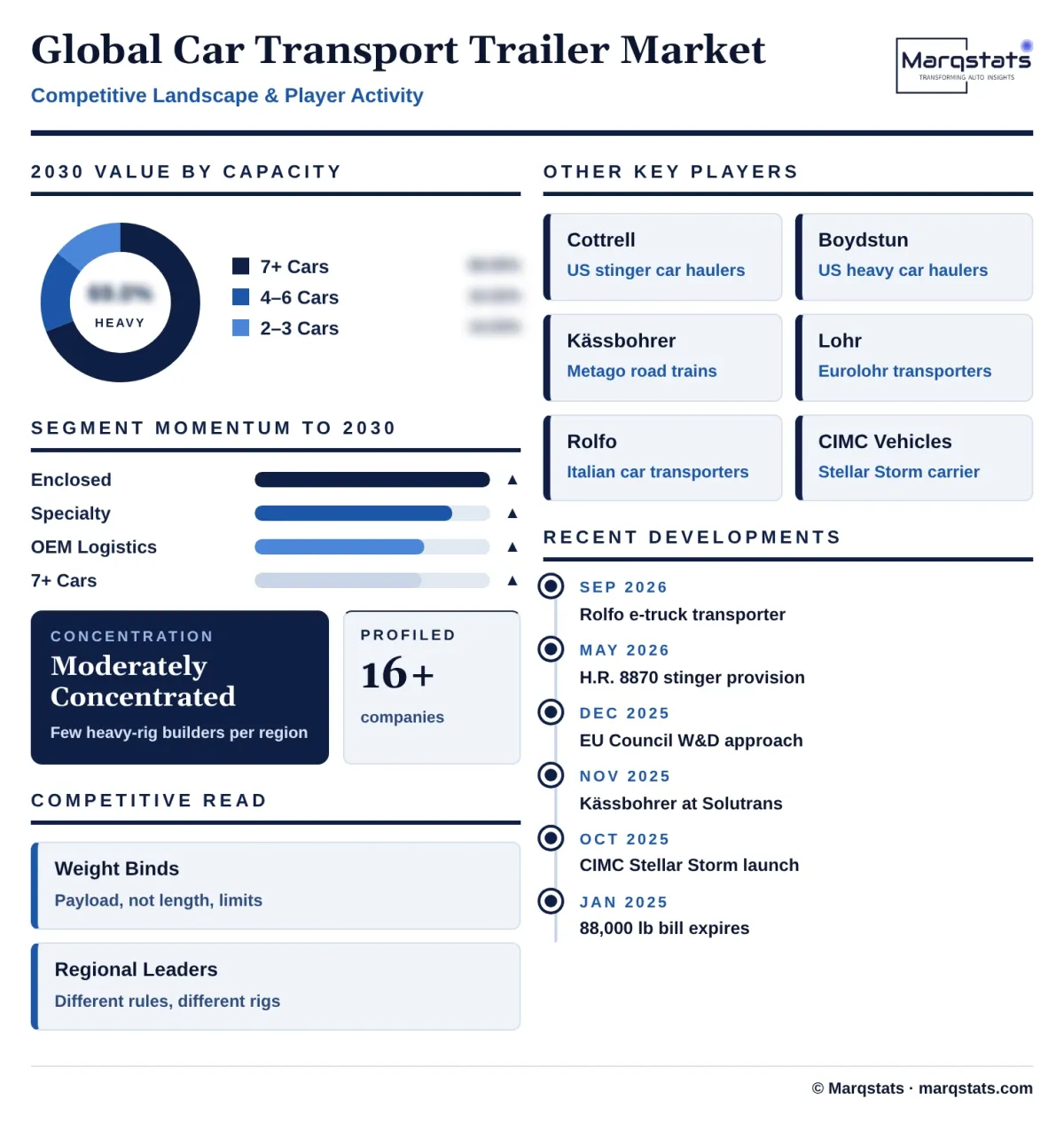
The car transport trailer market is moderately concentrated. In each region a few specialist builders supply most heavy units: Cottrell and Boydstun in North America, Kässbohrer, Lohr and Rolfo in Europe and CIMC Vehicles among a group of Chinese makers. The light trailer segment is fragmented, with many regional builders of gooseneck, wedge and enclosed trailers.
Heavy car carriers are built to order. Each rig is specified for a customer, a tractor or truck chassis and national rules, so builders compete on tare weight, loading speed, durability, dealer and parts support and the ability to deliver within a fleet renewal programme.
European builders combine trailers and truck-mounted superstructures. Kässbohrer and Lohr build upper-deck superstructures that are mounted on truck chassis from Daimler Truck, Volvo, Scania, MAN, DAF and Iveco, as well as matching trailers, so they work closely with truck makers and their dealers. Lohr, based at Duppigheim in Alsace, also builds rail and other transport equipment.
Chinese builders compete on scale and price. CIMC Vehicles, the largest Chinese semi-trailer maker, sells car carriers alongside other semi-trailers and is growing its overseas sales, which brings price competition to emerging markets in Asia, the Middle East and Africa.
Competition through 2030 depends on weight, rules and fleet relationships. Builders that cut tare weight, design for heavier electric vehicles and adapt quickly to new length and compliance rules will win most heavy orders, while light trailer builders compete on price and dealer networks.
Companies Covered
Companies covered in the report include:
Recent Market Activity
Table of Contents
Coverage & Segmentation
The study covers the global car transport trailer market, with 2025 as the base year, 2021 – 2025 as the historical period and 2026 – 2030 as the forecast period. Values are in US dollars at manufacturer selling prices and measure new commercial car transport trailers and truck-mounted car carrier superstructures that carry two or more passenger cars or light trucks, including North American headracks. The market is segmented by vehicle capacity, configuration, end user and region.
Single-car utility and consumer car hauler trailers, rollback and wrecker bodies, rail autoracks, Ro-Ro vessels, aftermarket parts and the value of the tractor or truck chassis are excluded. Car carriers are a subset of the semi-trailer and truck body markets, so values must not be added to total trailer figures, and finished-vehicle logistics service revenue is a separate market that must not be added. Values are converted at USD 1.13 per EUR and CNY 7.18 per USD, the 2025 averages used by Marqstats. Unit counts, prices, segment and regional splits and the forecast are Marqstats estimates built on manufacturer disclosures, trailer production data, road rules and vehicle production.