Statistics & Highlights

Market Snapshot

Market size in USD Billion
$0.61B
2025
Base year
$0.66B
2026
Estimated
  
$0.88B
2030
Forecast
Largest market
North India (Delhi NCR)
Fastest growing
South India (Bengaluru, Chennai, Hyderabad)
Dominant segment
Manual / Local Washers & Service Centers
Concentration
Fragmented
CAGR
7.52%
2026 – 2030
GROWTH
+$0.27B
Absolute
STUDY PARAMETERS
Base year2025
Historical period2021 – 2025
Forecast period2026 – 2030
Units consideredValue (USD BN)
REPORT COVERAGE
Segments covered4 segments
Regions covered5 regions
Companies profiled16++
Report pages260+
DeliverablesPDF, Excel, PPT
Executive Summary

Key Takeaways

India car wash services market valued at USD 613.33 million in 2025, projected to reach USD 881.31 million by 2030 at a 7.52% CAGR.
A four-wheel parc of roughly 52 million (MoRTH VAHAN) anchors demand at about 13 paid washes per vehicle each year, the highest frequency of any major market.
Manual washing by local washers and service centers dominates with about 88% of 2025 revenue, easing toward 85% by 2030.
Doorstep and mobile washing holds about 18% of revenue, and doorstep subscription plans grow near 17% annually, the fastest stream.
Blended tickets near INR 115 are the lowest of any major market, keeping wash intensity at about 15% of the United States level.
Water-scarcity rules, including Bengaluru's 2024 potable-water washing ban, accelerate waterless, steam, and recycled-water methods.
Market Insights

Market Overview & Analysis

Report Summary

The India car wash services market comprises professional and informal operators cleaning four-wheel vehicles across four service formats — manual washing by local washers and service centers, in-bay automatic (roll-over), tunnel/conveyor, and self-service — monetized through pay-per-wash and doorstep subscription plans. The 2025 market of USD 613.33 million sits against a four-wheel parc of roughly 52 million, with paid-wash penetration near 55% and the highest wash frequency of any major market at about 13 washes per vehicle annually, sustained by tickets near INR 115.

Informality defines the market's structure. Local washers serving apartment blocks and offices, roadside washing points, and washes bundled into workshop and dealer service visits account for about 88% of 2025 revenue, delivered by a workforce with no national trade association and minimal formal organization. The organized layer — mechanized chains such as Exppress Car Wash, detailing-led studio networks such as CarzSpa, 3M Car Care, and Detailing Devils, doorstep app services, and forecourt installations — holds a small share yet grows well ahead of the market.

India's channel mix is distinctive. Doorstep and mobile washing already accounts for about 18% of revenue, far above other major markets, because daily or alternate-day cleaning at the customer's parking spot is an established habit that app platforms are formalizing into subscription plans. Automated formats remain nascent — roll-overs at about 7% of revenue, tunnels below 3%, and self-service under 2% — constrained by land costs, low tickets, and the wage economics that keep manual washing viable. Each automated format nonetheless grows steadily as chains and fuel retailers install machines at metros and highway sites.

Water is the market's emerging constraint and catalyst. Groundwater stress and municipal restrictions on potable-water vehicle washing — enforced in Bengaluru during the 2024 supply crisis and applied in Delhi and other metros — push operators toward waterless products, steam cleaning, and recycled-water systems, and give organized, compliant operators a structural advantage. Wash intensity per vehicle sits near USD 10, about 15% of the United States level, framing a long formalization and premiumization runway as incomes, parc, and organized supply expand through 2030.

Wage economics explain why India automates last and formalizes first. At tickets near INR 115, a manual wash remains cheaper to deliver than an automated one wherever labour is abundant, so the organized shift runs through franchising, branding, doorstep subscriptions, and water compliance rather than machinery alone. Detailing, ceramic coating, and paint-protection services provide the margin that funds organized expansion, pulling basic washing into studio formats, while roll-overs and early tunnels take hold only at high-throughput metro and highway sites where land and volumes align. This sequencing — formalize, premiumize, then automate — distinguishes India's growth path from every other market in this series.

Market Dynamics

Key Drivers

  • Four-wheel parc growth above 5% annually, supported by record passenger-vehicle sales reported by SIAM, expands the addressable base faster than any major market.
  • Formalization adds about 1.2 percentage points of annual growth as chains, studios, and doorstep platforms organize informal demand.
  • Real pricing gains lift tickets from a very low base as premium foam, steam, and detailing-linked washes spread.
  • Doorstep subscription plans convert daily-cleaning habits into recurring revenue, growing near 17% annually.
  • Rising fleet, taxi, and delivery activity sustains commercial washing at about 20% of revenue, the highest share of any major market.
  • Water-scarcity rules favour organized operators with waterless, steam, and recycled-water capabilities.

Key Restraints

  • Very low tickets near INR 115 cap revenue per wash and stretch payback periods for automated equipment.
  • Abundant low-cost labour keeps manual washing economically dominant, slowing the automated shift.
  • High urban land costs constrain tunnel and roll-over site development in the largest metros.
  • Absence of a national trade association and minimal licensing leave standards, water use, and wages largely unregulated.

Key Trends

  • Doorstep apps formalize daily-cleaning subscriptions across Bengaluru, Delhi NCR, Mumbai, and Hyderabad.
  • Franchise expansion accelerates, led by Exppress Car Wash, CarzSpa, Detailing Devils, and 5K Car Care across metros and Tier-2 cities.
  • Waterless, steam, and recycled-water methods spread in response to municipal potable-water washing bans.
  • Detailing, ceramic-coating, and paint-protection services pull washing into higher-value studio formats.
  • Fuel retailers add mechanized washes at premium and highway outlets as non-fuel revenue lines.
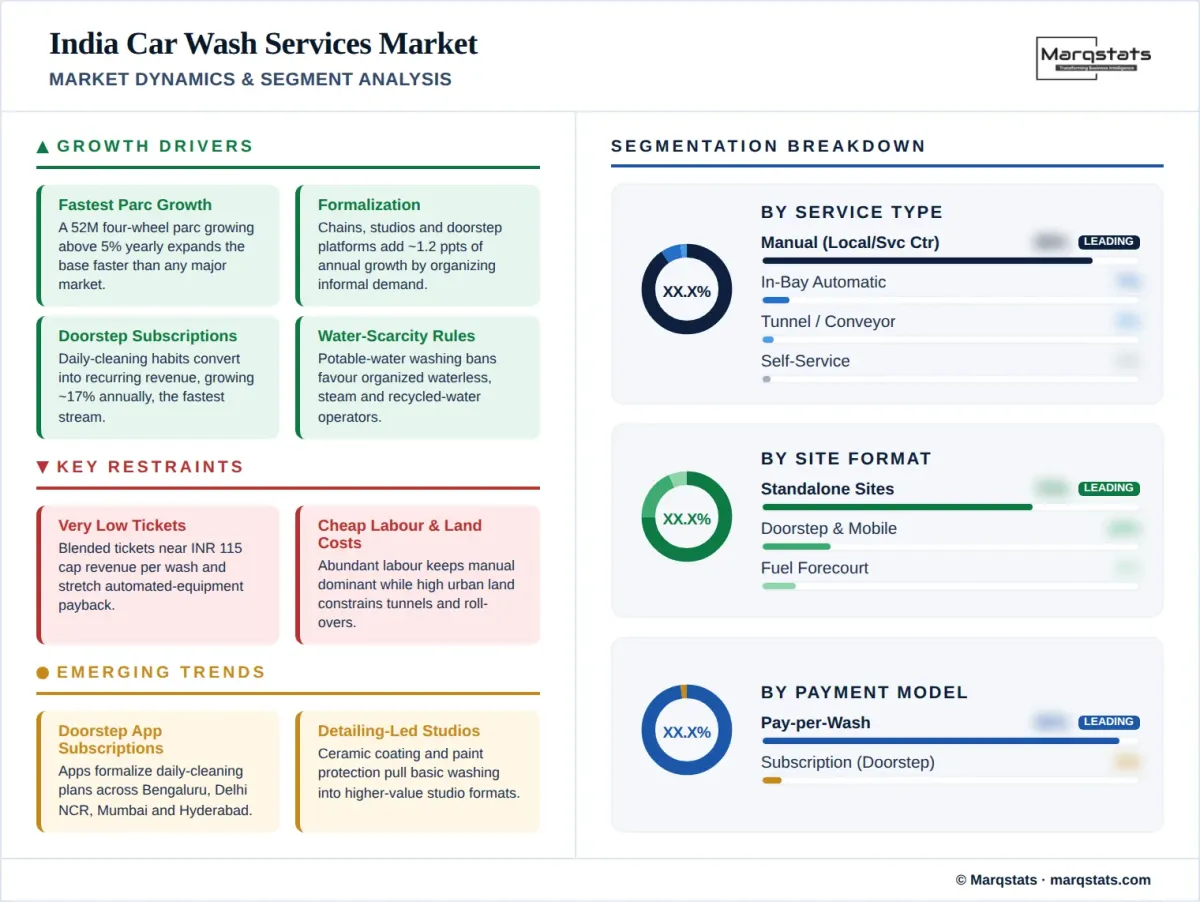
India Car Wash Services Market Market Dynamics Segment Analysis Infographic
Segment Analysis

Market Segmentation

Manual / Local Washers & Service Centers
Leading

Manual washing holds the dominant revenue share at about 88% in 2025, equal to USD 541.78 million, spanning local washers who clean cars daily at homes and apartment blocks, roadside washing points, and washes bundled into workshop and dealer service visits. The share eases toward 85% by 2030 as organized formats expand, while the segment itself grows in absolute terms with the parc. Low wages and daily-cleaning habits keep the model viable, and platform aggregation gradually formalizes its upper tier. Service-center washing adds a semi-organized layer, with dealers and multi-brand workshops bundling cleaning into periodic maintenance visits at standardized quality.

In-Bay Automatic (Roll-over)

In-bay automatic roll-overs hold about 7% of 2025 revenue, USD 44.98 million, and rise toward 9% by 2030, the largest automated format. Machines concentrate at organized chain outlets, dealer workshops, and premium fuel stations in metros, with mechanized chains such as Exppress Car Wash anchoring adoption. Compact footprints suit Indian site economics better than tunnels, making roll-overs the default automation step, and falling equipment prices from domestic and imported suppliers gradually improve payback at higher-throughput sites.

Tunnel / Conveyor

Tunnel/conveyor washes hold about 3% of 2025 revenue, USD 17.72 million, and rise toward 4% by 2030, the fastest-growing service format at roughly 15% annually from a small base. Early express-tunnel sites concentrate in Delhi NCR, Bengaluru, and Hyderabad, where throughput and membership economics can justify land and capital costs.

Self-Service

Self-service bays hold under 2% of 2025 revenue, USD 8.86 million, rising toward 2% by 2030. The format grows from a minimal base at fuel stations and highway plazas, constrained by the availability of cheap full-service manual alternatives, and serves enthusiasts and commercial drivers seeking controlled, high-pressure cleaning at their own convenience.

Standalone (incl. Informal & Service Centers)
Leading

Standalone locations, spanning informal washing points, organized outlets, and workshop and service-center washes, hold about 72% of 2025 revenue, USD 442.96 million, easing toward 70% by 2030. The channel includes the bulk of manual washing alongside chain and studio outlets, and consolidates gradually around franchised, branded formats.

Others (Doorstep / Mobile)

Doorstep and mobile washing holds about 18% of 2025 revenue, USD 113.13 million, rising toward 19% by 2030 — the highest doorstep share of any major market. Local washers serving residential parking, app-based doorstep services, and mobile steam and waterless vans define the channel, which water restrictions and subscription plans are steadily formalizing. High-rise societies in Bengaluru, Gurugram, and Mumbai anchor the channel's growth, with residents' associations increasingly contracting compliant, low-water providers for building-wide cleaning programs.

Fuel-Station Forecourt

Forecourt washes hold about 9% of 2025 revenue, USD 57.24 million, and gain share toward 11% by 2030, the fastest-growing site format. Indian Oil, Shell, and Jio-bp add mechanized washes at premium urban and highway outlets as fuel retailers build non-fuel revenue, extending organized washing beyond metro cores and along major highway corridors.

Pay-per-Wash
Leading

Single-visit payment accounts for about 95% of 2025 revenue, USD 581.30 million, reflecting cash and UPI payment at informal and organized outlets alike. The share declines toward 92% by 2030 as doorstep subscriptions expand, while UPI rails keep single-payment friction minimal across every format and city tier. The near-universal reach of digital payment has been a quiet enabler of formalization, letting even small operators accept cashless payment and letting platforms track and bill recurring services reliably.

Subscription (Doorstep Plans)

Doorstep subscription plans reach about 5% of 2025 revenue, USD 32.03 million, and grow near 17% annually to 8% of revenue by 2030, worth USD 70.50 million — the fastest-growing revenue stream in the market. Monthly plans covering daily or alternate-day exterior cleaning plus periodic interior service formalize a long-standing residential habit, with app platforms and organized chains converting local-washer arrangements into billed, recurring relationships. Subscription pricing near INR 400 to 800 per month per vehicle makes the model accessible to the urban middle class, and building-level contracts with residents' associations add a scalable acquisition channel.

Passenger Cars
Leading

Passenger vehicles generate about 80% of 2025 revenue, USD 487.94 million, reflecting household demand for frequent, low-cost cleaning. The share eases slightly across the forecast period as commercial washing grows faster.

Commercial Vehicles (incl. Fleet)

Commercial washing holds about 20% of 2025 revenue, USD 125.39 million, rising toward 21% by 2030 — the highest commercial share of any major market. Taxi and ride-hailing fleets, including mobility-as-a-service operators, together with delivery and logistics vehicles, sustain high-frequency washing at depots, airports, and transport hubs across the metros.

Regional Analysis

By Geography

North India (Delhi NCR)

North India, anchored by Delhi NCR with Gurugram and Noida, is the largest regional market, combining the country's biggest premium-vehicle base with dense organized supply. Detailing studios and mechanized chains cluster across NCR, doorstep services scale in high-rise societies, and restrictions on potable-water washing push compliant, low-water methods. Winter dust and pollution sustain high cleaning frequency, and the region's premium and luxury parc supports the deepest detailing and coating demand in the country.

West India (Mumbai, Pune & Gujarat)

West India, spanning Mumbai, Pune, Ahmedabad, and Surat, is a major market where coastal humidity, monsoon grime, and dense apartment living sustain frequent washing. Surat hosts CarzSpa's home base, Pune's automotive industry supports workshop washing, and Mumbai's space constraints make doorstep and mobile formats especially prominent. Gujarat's industrial cities add commercial and fleet washing, and the region's affluent metros support a growing detailing and paint-protection segment alongside everyday cleaning.

South India (Bengaluru, Chennai & Hyderabad)

South India is the fastest-growing region, led by Bengaluru, Chennai, and Hyderabad. App-based doorstep subscriptions scale fastest here, 5K Car Care anchors an extensive Tamil Nadu network, and technology-sector incomes support premium detailing. Bengaluru's 2024 potable-water washing ban made the region the national proving ground for waterless and recycled-water methods, and compliant doorstep providers gained share as informal hose washing was penalized.

East & Central India

East and Central India, including Kolkata, Bhubaneswar, Indore, and Raipur, is a smaller market dominated by informal washing and service-center washes. Organized chains and doorstep services are entering the largest cities, and rising vehicle ownership across the region supports steady growth from a low base. Lower organized penetration leaves substantial headroom for franchise networks as incomes and car ownership rise across the eastern and central states.

Tier-2 & Tier-3 Cities

Tier-2 and Tier-3 cities hold a growing share of the national parc and are the structural frontier for organized washing. Franchise models from Exppress Car Wash, CarzSpa, and Detailing Devils target these markets with lower-cost formats, and rising incomes lift demand for branded, standardized cleaning beyond the metros through 2030. Lower land and labour costs improve franchise unit economics, and thinner competition from organized rivals lets early entrants build local brand recognition ahead of metro-based chains expanding outward.
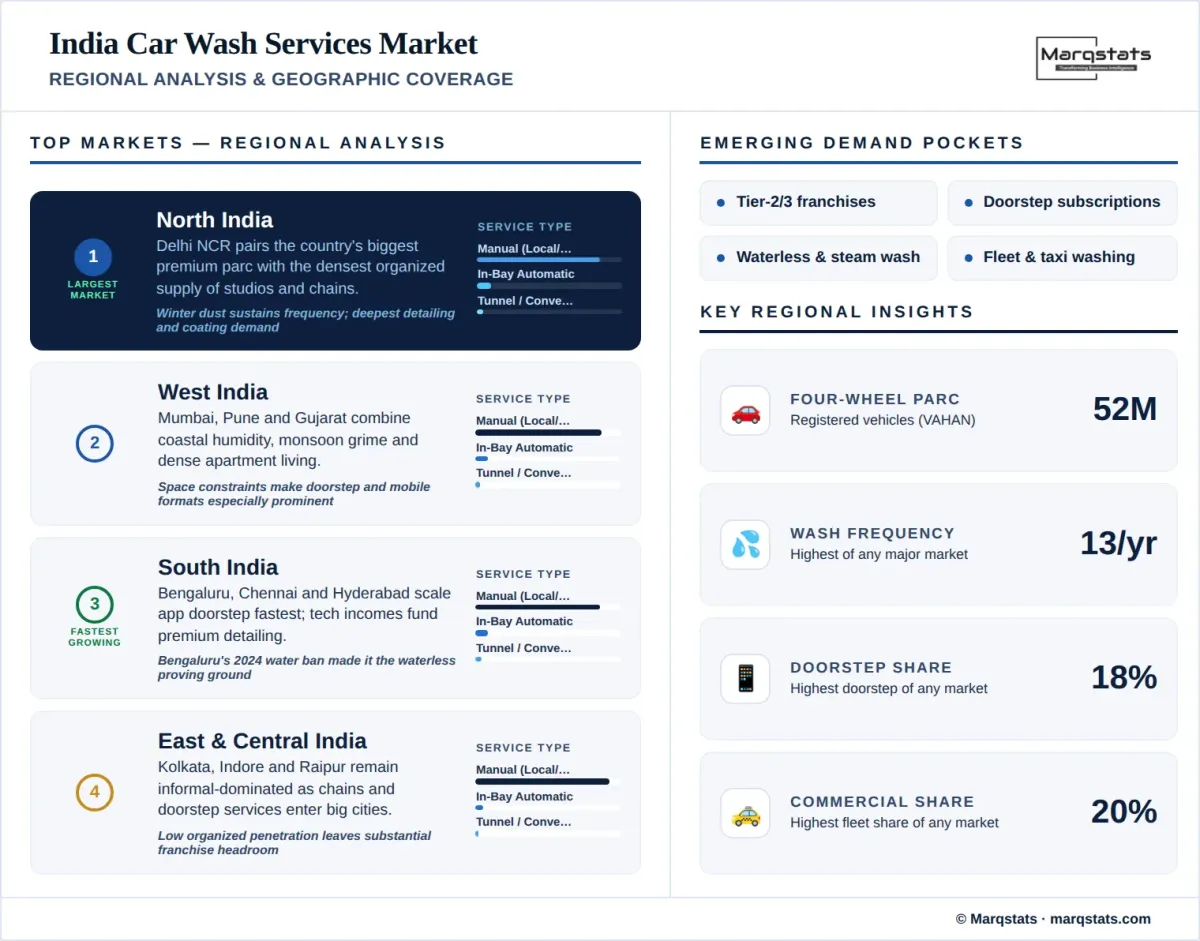
India Car Wash Services Market Regional Analysis Geographic Coverage Infographic
Competitive Landscape

How Competition Is Evolving

The India car wash services market is intensely fragmented, with informal local washers and service centers delivering the overwhelming majority of washes and no operator holding a material national share. The organized layer is led by franchise networks: Exppress Car Wash of the Manmachine Group in mechanized washing, CarzSpa, 3M Car Care, Detailing Devils, and The Detailing Mafia in detailing-led studios, 5K Car Care across South India, and AutozSpa and Speed Car Wash among emerging chains.

Service aggregators and workshops form a second organized channel. GoMechanic and myTVS bundle washing into multi-service workshop visits, Bosch Car Service outlets add standardized cleaning, and doorstep platforms convert residential daily-cleaning arrangements into app-managed subscriptions. Fuel retailers — Indian Oil, Shell, and Jio-bp — install mechanized washes at premium and highway outlets, while Karcher's Indian retail expansion supplies the pressure-washer and steam equipment underpinning both organized and semi-organized operators.

Competition in the organized segment turns on franchise economics, water compliance, and service breadth. Detailing, ceramic coating, and paint-protection services anchor studio revenue and pull washing upmarket, doorstep players compete on subscription price and reliability, and water restrictions increasingly separate compliant operators from informal rivals. Formalization is expected to advance steadily through franchising and platform aggregation, while the informal base keeps the market fragmented through 2030.
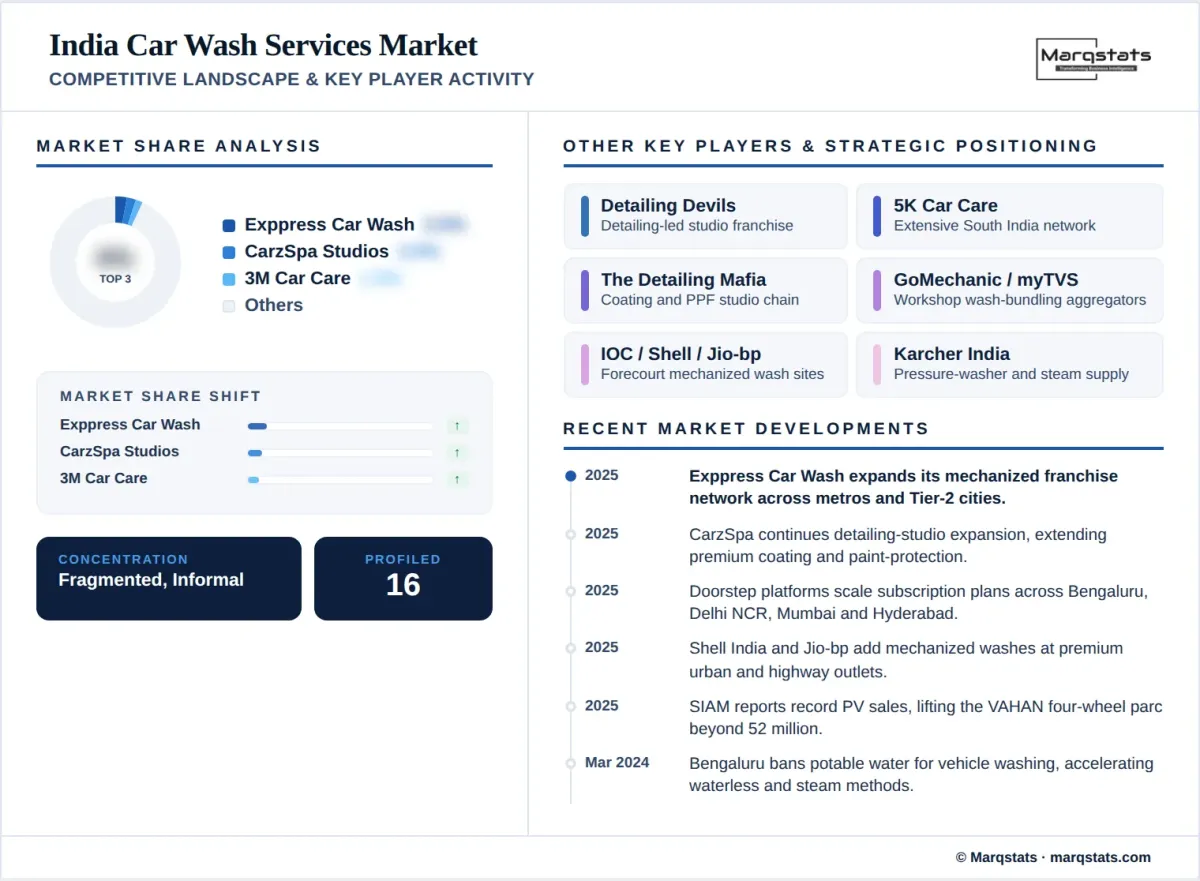
India Car Wash Services Market Competitive Landscape Key Player Activity Infographic
Major Players

Companies Covered

The report profiles 16++ companies with full strategy and financials analysis, including:

Exppress Car Wash (Manmachine Group)
CarzSpa Detailing Studios
3M India Limited (3M Car Care)
Detailing Devils
The Detailing Mafia
5K Car Care
AutozSpa
The Car Laundry
Speed Car Wash
GoMechanic
myTVS (TVS Mobility)
Bosch Car Service (India)
Indian Oil Corporation Limited (Forecourt Services)
Shell India Markets Private Limited
Jio-bp (Reliance BP Mobility Limited)
Alfred Karcher (India)
Note: Full company profiles include revenue analysis, product portfolio, SWOT, and recent strategic developments.
Latest Developments

Recent Market Activity

2025
Exppress Car Wash expanded its mechanized franchise network across metros and Tier-2 cities under the Manmachine Group.
2025
CarzSpa continued detailing-studio expansion across Indian cities, extending premium washing, coating, and paint-protection services.
2025
Doorstep car-cleaning platforms scaled subscription plans across Bengaluru, Delhi NCR, Mumbai, and Hyderabad.
2025
Fuel retailers, including Shell India and Jio-bp, added mechanized washes at premium urban and highway outlets.
2025
SIAM reported record passenger-vehicle sales, lifting the MoRTH VAHAN four-wheel parc beyond 52 million.
Mar 2024
Bengaluru's water authority banned potable water for vehicle washing during the supply crisis, accelerating waterless and steam methods.
Report Structure

Table of Contents

1. Introduction
1.1 Study Assumptions & Market Definition
1.1.1 Scope — Professional & Informal Car Wash Services (Four-Wheel)
1.1.2 Formats Covered — Manual/Local, In-Bay Automatic, Tunnel, Self-Service
1.1.3 Inclusions — Basic Interior Cleaning, Tickets, Doorstep Subscriptions
1.1.4 Exclusions — Two-Wheeler (Qualitative), Full Detailing, Coating & Equipment Sales
1.1.5 Market Metric — Annual Service Revenue (USD)
1.2 Scope of the Study
1.3 Currency, FX Treatment & Base Year (2025)
1.4 Key Definitions & Industry Terminology
1.4.1 Local Washers, Roadside Points & Service-Center Washes
1.4.2 Doorstep & Mobile Washing
1.4.3 Doorstep Subscription Plans
1.4.4 Organized Chains, Studios & Franchise Models
2. Research Methodology
2.1 Analysis Framework
2.2 Bottom-Up Base — Parc × Penetration × Frequency × Ticket
2.2.1 MoRTH VAHAN Four-Wheel Parc (~52M)
2.2.2 Paid-Wash Penetration (~55%)
2.2.3 Wash Frequency (~13/Vehicle/Yr) & Blended Ticket (~INR 115)
2.3 SIAM Sales Cross-Reference
2.4 Informality Note — No National Car Wash Trade Association
2.5 FX Treatment — USD Terms, INR Effects, Constant-FX Forecast
2.6 Wash-Intensity Cross-Check vs. United States (~15%)
2.7 Primary Research — 40+ Interviews
2.8 Assumptions & Limitations
3. Executive Summary
3.1 Market Size & Forecast Snapshot 2021–2030
3.2 Key Findings & Analyst Takeaways
3.3 Fastest-Growing Major Market (7.52% CAGR)
3.4 Most Informal Structure of Any Major Market (~88% Manual)
3.5 Doorstep-Native Channel & Subscription Growth
4. Market Overview & Definitions
4.1 Industry Structure & Universe of Operators
4.1.1 Informal Local Washers, Roadside Points & Service Centers
4.1.2 Organized Chains, Detailing Studios & Doorstep Platforms
4.1.3 Fragmentation & Formalization Runway
4.2 Value Chain & Ecosystem
4.2.1 Franchise Networks & Detailing Studios
4.2.2 Doorstep App Platforms & Service Aggregators
4.2.3 Fuel Retailers & Equipment Suppliers
4.2.4 UPI Digital-Payment Rails
4.3 Consumer Behavior — Highest Wash Frequency (~13/Yr) & Daily Cleaning
4.4 Unit Economics — Wage Advantage & the Formalize-Premiumize-Automate Path
5. Market Dynamics
5.1 Key Drivers
5.1.1 Four-Wheel Parc Growth (>5%/Yr; SIAM Record Sales)
5.1.2 Formalization & Organized Expansion
5.1.3 Real Pricing Gains from a Low Base
5.1.4 Doorstep Subscription Adoption (~17% CAGR)
5.1.5 Fleet, Taxi & Delivery Demand
5.1.6 Water-Scarcity Rules Favouring Compliant Operators
5.2 Key Restraints
5.2.1 Very Low Tickets (~INR 115) & Equipment Payback
5.2.2 Abundant Low-Cost Labour Sustaining Manual Washing
5.2.3 High Urban Land Costs
5.2.4 Minimal Regulation & No National Association
5.3 Key Trends
5.3.1 Doorstep Subscription Formalization Across Metros
5.3.2 Franchise Expansion (Exppress, CarzSpa, Detailing Devils, 5K)
5.3.3 Waterless, Steam & Recycled-Water Methods
5.3.4 Detailing, Ceramic Coating & Paint-Protection Pull-Through
5.3.5 Fuel-Retailer Mechanized Washes
5.4 Porter's Five Forces Analysis
5.5 Industry Value Chain Analysis
6. Regulatory & Environmental Framework
6.1 Municipal Potable-Water Washing Bans (Bengaluru 2024, Delhi)
6.2 Groundwater-Stress & Water-Use Norms
6.3 Wastewater & Recycled-Water Requirements
6.4 Licensing, Trade & Establishment Compliance
6.5 Absence of Sector-Specific Standards & Implications
7. Technology & Format Innovation
7.1 Waterless & Steam Cleaning Systems
7.2 Recycled-Water & Reclamation Technology
7.3 Mechanized Roll-Over & Early Tunnel Systems
7.4 Doorstep App Platforms & Subscription Management
7.5 Detailing, Ceramic-Coating & PPF Technologies
8. Formalization & Subscription Economics
8.1 Doorstep Subscription Model & Recurring Revenue
8.2 Subscription Penetration Trend 2021–2030 (3% → 8%)
8.3 Franchise Unit Economics & Studio Margins
8.4 Residents' Association & Building-Level Contracts
9. India Car Wash Services Market Sizing & Forecast
9.1 Total Market Size & Forecast 2021–2030
9.1.1 Historical Revenue 2021–2025 (incl. FX Effect)
9.1.2 Forecast Revenue 2026–2030 (Constant FX)
9.1.3 CAGR & Absolute Growth
9.2 Growth Driver Decomposition
9.2.1 Parc-Growth Contribution
9.2.2 Formalization Contribution
9.2.3 Real-Pricing Contribution
10. Market Segmentation — By Service Type
10.1 Manual / Local Washers & Service Centers
10.1.1 Revenue & Share 2021–2030 (91% → 85%)
10.1.2 Local Washers, Roadside Points & Service-Center Washes
10.2 In-Bay Automatic (Roll-over)
10.2.1 Revenue & Share 2021–2030 (6% → 9%)
10.2.2 Chain Outlets, Dealer Workshops & Premium Forecourts
10.3 Tunnel / Conveyor
10.3.1 Revenue & Share 2021–2030 (2% → 4%)
10.3.2 Early Express-Tunnel Sites in Metros
10.4 Self-Service
10.4.1 Revenue & Share 2021–2030 (1% → 2%)
11. Market Segmentation — By Site Format
11.1 Standalone (incl. Informal & Service Centers)
11.1.1 Revenue & Share 2021–2030 (74% → 70%)
11.2 Others (Doorstep / Mobile)
11.2.1 Revenue & Share 2021–2030 (18% → 19%)
11.2.2 App-Based Doorstep & Mobile Steam/Waterless Vans
11.3 Fuel-Station Forecourt
11.3.1 Revenue & Share 2021–2030 (8% → 11%)
11.3.2 Indian Oil, Shell & Jio-bp Mechanized Washes
12. Market Segmentation — By Payment Model
12.1 Pay-per-Wash
12.1.1 Revenue & Share 2021–2030 (97% → 92%)
12.1.2 Cash & UPI Transaction Rails
12.2 Subscription (Doorstep Plans)
12.2.1 Revenue & Share 2021–2030 (3% → 8%)
12.2.2 Recurring-Revenue Growth (~17% CAGR)
13. Market Segmentation — By Vehicle Type
13.1 Passenger Cars
13.1.1 Revenue & Share 2021–2030 (~80%)
13.2 Commercial Vehicles (incl. Fleet)
13.2.1 Revenue & Share 2021–2030 (20% → 21%)
13.2.2 Taxi, Ride-Hailing, Delivery & Logistics Demand
14. Regional Analysis
14.1 North India (Delhi NCR) — Largest Market — Premium Parc & Organized Density
14.1.1 Market Size & Forecast 2021–2030
14.1.2 Demand Drivers & Key Operators
14.2 West India (Mumbai, Pune & Gujarat) — Coastal Humidity, Doorstep & Studio Demand
14.2.1 Market Size & Forecast 2021–2030
14.2.2 Demand Drivers & Key Operators
14.3 South India (Bengaluru, Chennai & Hyderabad) — Fastest Growing — Doorstep & Water-Compliance Frontier
14.3.1 Market Size & Forecast 2021–2030
14.3.2 Demand Drivers & Key Operators
14.4 East & Central India — Informal-Led, Emerging Organized Entry
14.4.1 Market Size & Forecast 2021–2030
14.4.2 Demand Drivers & Key Operators
14.5 Tier-2 & Tier-3 Cities — Franchise Frontier & Lower-Cost Formats
14.5.1 Market Size & Forecast 2021–2030
14.5.2 Demand Drivers & Key Operators
15. Competitive Landscape
15.1 Market Structure & Intense Fragmentation
15.2 Organized Franchise Networks & Detailing Studios
15.3 Doorstep Platforms & Service Aggregators
15.4 Fuel-Retailer & Equipment Channels
15.5 Competitive Variables — Franchise Economics, Water Compliance, Service Breadth
16. Company Profiles
16.1 Exppress Car Wash (Manmachine Group)
16.1.1 Company Overview
16.1.2 Format & Service / Franchise Portfolio
16.1.3 Network Footprint & Regional Presence
16.1.4 Subscription / Water-Compliance / Technology Approach
16.1.5 Recent Strategic Developments
16.2 CarzSpa Detailing Studios
16.2.1 Company Overview
16.2.2 Format & Service / Franchise Portfolio
16.2.3 Network Footprint & Regional Presence
16.2.4 Subscription / Water-Compliance / Technology Approach
16.2.5 Recent Strategic Developments
16.3 3M India Limited (3M Car Care)
16.3.1 Company Overview
16.3.2 Format & Service / Franchise Portfolio
16.3.3 Network Footprint & Regional Presence
16.3.4 Subscription / Water-Compliance / Technology Approach
16.3.5 Recent Strategic Developments
16.4 Detailing Devils
16.4.1 Company Overview
16.4.2 Format & Service / Franchise Portfolio
16.4.3 Network Footprint & Regional Presence
16.4.4 Subscription / Water-Compliance / Technology Approach
16.4.5 Recent Strategic Developments
16.5 The Detailing Mafia
16.5.1 Company Overview
16.5.2 Format & Service / Franchise Portfolio
16.5.3 Network Footprint & Regional Presence
16.5.4 Subscription / Water-Compliance / Technology Approach
16.5.5 Recent Strategic Developments
16.6 5K Car Care
16.6.1 Company Overview
16.6.2 Format & Service / Franchise Portfolio
16.6.3 Network Footprint & Regional Presence
16.6.4 Subscription / Water-Compliance / Technology Approach
16.6.5 Recent Strategic Developments
16.7 AutozSpa
16.7.1 Company Overview
16.7.2 Format & Service / Franchise Portfolio
16.7.3 Network Footprint & Regional Presence
16.7.4 Subscription / Water-Compliance / Technology Approach
16.7.5 Recent Strategic Developments
16.8 The Car Laundry
16.8.1 Company Overview
16.8.2 Format & Service / Franchise Portfolio
16.8.3 Network Footprint & Regional Presence
16.8.4 Subscription / Water-Compliance / Technology Approach
16.8.5 Recent Strategic Developments
16.9 Speed Car Wash
16.9.1 Company Overview
16.9.2 Format & Service / Franchise Portfolio
16.9.3 Network Footprint & Regional Presence
16.9.4 Subscription / Water-Compliance / Technology Approach
16.9.5 Recent Strategic Developments
16.10 GoMechanic
16.10.1 Company Overview
16.10.2 Format & Service / Franchise Portfolio
16.10.3 Network Footprint & Regional Presence
16.10.4 Subscription / Water-Compliance / Technology Approach
16.10.5 Recent Strategic Developments
16.11 myTVS (TVS Mobility)
16.11.1 Company Overview
16.11.2 Format & Service / Franchise Portfolio
16.11.3 Network Footprint & Regional Presence
16.11.4 Subscription / Water-Compliance / Technology Approach
16.11.5 Recent Strategic Developments
16.12 Bosch Car Service (India)
16.12.1 Company Overview
16.12.2 Format & Service / Franchise Portfolio
16.12.3 Network Footprint & Regional Presence
16.12.4 Subscription / Water-Compliance / Technology Approach
16.12.5 Recent Strategic Developments
16.13 Indian Oil Corporation Limited (Forecourt Services)
16.13.1 Company Overview
16.13.2 Format & Service / Franchise Portfolio
16.13.3 Network Footprint & Regional Presence
16.13.4 Subscription / Water-Compliance / Technology Approach
16.13.5 Recent Strategic Developments
16.14 Shell India Markets Private Limited
16.14.1 Company Overview
16.14.2 Format & Service / Franchise Portfolio
16.14.3 Network Footprint & Regional Presence
16.14.4 Subscription / Water-Compliance / Technology Approach
16.14.5 Recent Strategic Developments
16.15 Jio-bp (Reliance BP Mobility Limited)
16.15.1 Company Overview
16.15.2 Format & Service / Franchise Portfolio
16.15.3 Network Footprint & Regional Presence
16.15.4 Subscription / Water-Compliance / Technology Approach
16.15.5 Recent Strategic Developments
16.16 Alfred Kärcher (India)
16.16.1 Company Overview
16.16.2 Format & Service / Franchise Portfolio
16.16.3 Network Footprint & Regional Presence
16.16.4 Subscription / Water-Compliance / Technology Approach
16.16.5 Recent Strategic Developments
17. Investment, Formalization & Franchise Analysis
17.1 Franchise Network Expansion & Unit Economics
17.2 Doorstep Platform & Subscription Investment
17.3 Fuel-Retailer Non-Fuel Wash Investment
17.4 Water-Compliance & Equipment Capex
18. Opportunities, Risks & Strategic Recommendations
18.1 Growth Opportunities by Region & Format
18.2 Ticket, Labour & Water Risk Assessment
18.3 Formalization, Subscription & Tier-2/3 Strategy
18.4 Strategic Recommendations for Operators & Investors
19. Appendix
19.1 Research Methodology Detail
19.2 Data Triangulation & Confidence Flags
19.3 Abbreviations & Glossary
19.4 List of Tables
19.5 List of Figures
19.6 Disclaimer & Legal Notice
Study Scope & Focus

Coverage & Segmentation

This report provides a comprehensive analysis of the India car wash services market covering the historical period 2021 to 2025 and the forecast period 2026 to 2030, with 2025 as the base year. The study defines the market as annual revenue earned by professional and informal operators cleaning four-wheel vehicles through manual, in-bay automatic, tunnel/conveyor, and self-service formats, inclusive of basic interior cleaning; two-wheeler washing is addressed qualitatively, and full detailing, coating, and equipment or chemical sales are excluded. Market size is presented in value terms (USD), with historical figures reflecting rupee exchange effects and forecasts assuming constant exchange rates.

The study segments the market by service type, site format, payment model, and vehicle type, and examines regional demand across North India, West India, South India, East and Central India, and Tier-2 and Tier-3 cities, alongside formalization, doorstep subscriptions, water regulation, and franchise competition. Market sizing uses a bottom-up model anchored to MoRTH VAHAN registration data and SIAM sales, noting that no national car wash trade association exists, cross-checked against wash intensity per vehicle. The competitive section profiles 16 chains, platforms, workshops, fuel retailers, and equipment suppliers.
Frequently Asked Questions

FAQs About the India Car Wash Services Market

The India car wash services market is valued at approximately USD 613 million in 2025 and is projected to reach USD 881 million by 2030, expanding at a 7.52% CAGR — the fastest of any major market.
The market is expected to grow at a 7.52% CAGR between 2025 and 2030, driven by four-wheel parc expansion above 5% annually, formalization, and real pricing gains from a very low base.
Manual washing by local washers and service centers dominates with about 88% of 2025 revenue, easing toward 85% by 2030 as organized chains, doorstep platforms, and automated formats expand.
Doorstep and mobile washing holds about 18% of 2025 revenue — the highest of any major market — and doorstep subscription plans grow near 17% annually, the fastest-growing revenue stream, as apps formalize daily-cleaning habits.
Major organized players include Exppress Car Wash (Manmachine Group), CarzSpa, 3M Car Care, Detailing Devils, The Detailing Mafia, and 5K Car Care, alongside aggregators GoMechanic and myTVS, fuel retailers Indian Oil, Shell, and Jio-bp, and equipment supplier Kärcher.
Municipal restrictions on potable-water vehicle washing — enforced in Bengaluru during the 2024 supply crisis and applied in Delhi — accelerate waterless, steam, and recycled-water methods and give compliant organized operators a structural advantage.
The report is delivered as a PDF report (260+ pages), Excel data tables with market sizing across 2021–2030 by segment and region, and a PowerPoint summary deck, with analyst email support included in every licence tier.