Market Snapshot
Middle bar: base-year value × (1 + CAGR), rounded to two decimals. This is a calculated illustration, not a separately researched annual estimate.
The global electric telehandler market size is estimated at USD 835.19 million in 2025 and is projected to reach USD 2,009.00 million by 2030, growing at a CAGR of 19.19% over 2026 – 2030. Annual shipments rise from about 7,200 machines to 18,100, a 20.25% annual rate, while the average ex-factory price eases from about USD 116,000 to USD 111,000 as battery packs get cheaper and compact machines from new entrants such as SANY add volume.
Marqstats defines the market as the ex-factory value of new battery-electric telescopic handlers, covering fixed-boom telehandlers of all lift heights and rotating telehandlers, sold for construction, rental, agriculture and industrial use. Diesel telehandlers, diesel-electric hybrids that need an engine to complete a shift, telescopic wheel loaders, forklifts and industrial counterbalance trucks, aftermarket battery conversions, rental revenue and charging hardware sold separately are excluded.
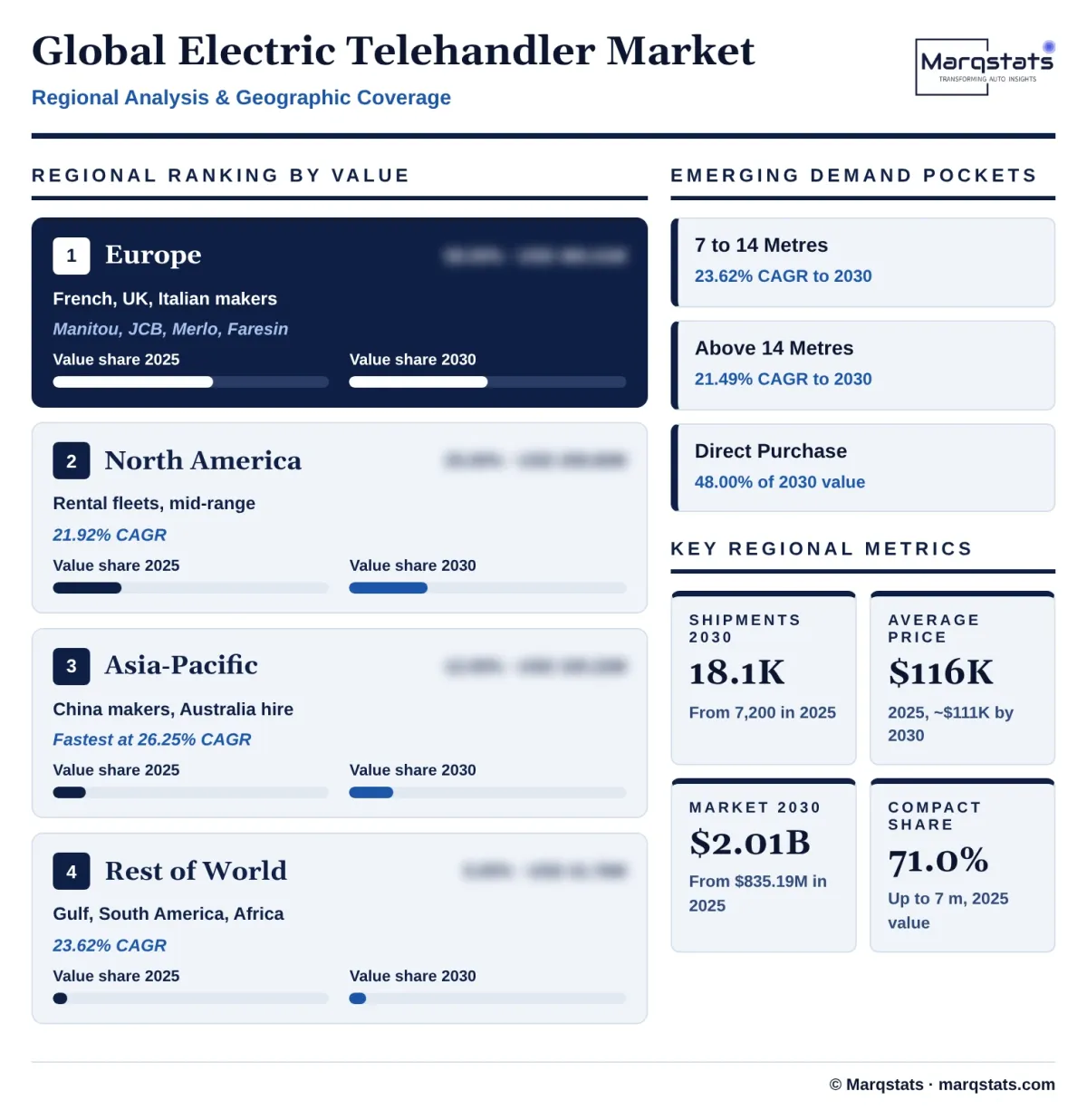
Compact machines with a lift height of up to 7 metres account for an estimated 70.99% of 2025 value and construction and rental users for 60.00%. Europe accounts for 58.00% of 2025 value and Asia-Pacific grows fastest at 26.25% a year. The study segments the market by lift-height class, application, sales channel and region.
Key Takeaways
Market Overview & Analysis
Report Summary
Marqstats sizes the global electric telehandler market as the ex-factory value of new battery-electric telescopic handlers. In 2025 about 7,200 machines were shipped worldwide, worth an estimated USD 835.19 million at an average ex-factory price of about USD 116,000. Marqstats estimates that electric machines were close to 4% of global telehandler shipments in 2025, so diesel still dominates the product category.
Telehandlers lift and place pallets, bricks, roof trusses, bales, feed and bulk material on building sites, farms and industrial yards. Compact models lift about 2.5 tonnes to 5 to 7 metres and are the most common machine in European farm and hire fleets, mid-range fixed models lift 3 to 4 tonnes to 9 to 14 metres and dominate North American construction rental, and high-reach and rotating models lift 4 to 6 tonnes to 17 metres and more, often with work platforms or winches. Almost all of these machines still run on diesel engines of 55 to 130 kW.
Compact telehandlers suit batteries well. They work in short loading cycles, idle between lifts and travel only a few kilometres a day, so packs of 18 to 35 kWh can run a working shift. Most electric models use one motor for traction and one for the hydraulic pump, so the pump runs only when the boom moves. The JLG E313 stores 18.6 kWh and lifts 3,500 lb to 13 ft 1 in, the JCB 525-60E carries a 24 kWh, 96 V pack and lifts 2.5 tonnes to 6 metres, the Manitou MT 625e offers 25 or 33 kWh packs, and the Manitou MLT 625e carries 34.8 kWh with 40 kW traction and 30 kW hydraulic motors.
Launches show where the market sits. JCB launched the 525-60E, its first electric Loadall, in November 2020, Manitou followed with the MT 625e for construction and the MLT 625e for farms, Merlo offers the e-WORKER with a 2.5 tonne capacity and a 5 metre lift height, Dieci launched the Mini Agri-e with a 22 kWh lithium iron phosphate pack in November 2024 and JLG introduced the E313 in October 2024. Larger machines followed: Faresin showed 14.42, 17.40 and 17.45 Full Electric models at bauma in April 2025, and Manitou offers electric versions of its MRT rotating telehandlers with a 65 kWh, 700 V pack.
The market grew from about 2,100 machines worth USD 238.00 million in 2021 to 3,000 worth USD 338.50 million in 2022, 4,300 worth USD 489.00 million in 2023 and 5,700 worth USD 655.40 million in 2024, as European makers put compact electric models into series production and large hirers began to add them to fleets. Marqstats expects about 8,700 shipments worth USD 995.46 million in 2026.
Safety and emission rules shape machine design. Telehandlers sold in Europe must meet the EN 1459 standards for variable-reach rough-terrain trucks, which set requirements for stability, load-moment indication and controls that apply to battery machines as they do to diesel ones. Diesel models above 56 kW must meet EU Stage V engine limits, adding exhaust after-treatment cost that battery machines avoid. The new EU Machinery Regulation (EU) 2023/1230, which applies from January 2027, adds requirements for software, connectivity and autonomous functions.
Public buyers and hirers create the first large orders. Oslo has required fossil-free and increasingly zero-emission machinery on municipal construction sites, Copenhagen and Amsterdam use zero-emission criteria in public tenders, and UK and French contractors and hirers have set fleet targets. Because telehandlers are among the most common machines on a building site and in a farm fleet, battery versions are a visible way for a hirer, contractor or farm to cut site emissions and noise.
The market sits within the wider Marqstats Off-Highway Electric Vehicle market, valued at USD 6.38 billion in 2025, and accounts for about 13% of that value. Electric telehandlers carry a higher average price than most compact electric machines, about USD 116,000 against about USD 27,500 for an electric site dumper, because they combine a boom, a cab and a heavy counterweight with a larger battery pack.
Global Electric Telehandler Market Size and Forecast
The global electric telehandler market grows from USD 835.19 million in 2025 to USD 2,009.00 million in 2030, a CAGR of 19.19%. Marqstats expects shipments of about 10,400 machines worth USD 1,186.49 million in 2027, 12,500 worth USD 1,414.17 million in 2028 and 15,100 worth USD 1,685.55 million in 2029, before reaching 18,100 machines in 2030.
Average price eases. The average ex-factory price moves from about USD 113,300 in 2021 to USD 116,000 in 2025 and about USD 111,000 in 2030. Compact machines fall from about USD 98,000 to USD 92,000, mid-range fixed machines from about USD 165,000 to USD 150,000 and high-reach and rotating machines from about USD 340,000 to USD 300,000, but mid-range and high-reach machines rise from 16.0% of units in 2025 to 19.9% in 2030, so value grows only slightly more slowly than volume.
Battery cost is the main lever. Marqstats estimates the battery accounts for 20% to 30% of the ex-factory price of a compact electric telehandler and that prices for small lithium iron phosphate packs fall by about 6% to 8% a year to 2030. That narrows the list-price premium over diesel from about 35% to 45% in 2025 to about 20% to 30% by 2030, before any saving on fuel, servicing and noise restrictions.
Operating savings close the gap. A compact diesel telehandler burns about 4 to 6 litres of diesel an hour, while an electric one draws about 5 to 7 kWh an hour, so energy cost per hour falls by around 65% to 75% at typical European prices. Electric machines also avoid engine oil changes, filters, exhaust after-treatment and diesel particulate maintenance; Manitou claims 56% lower maintenance cost for its electric models. Marqstats estimates a compact electric telehandler reaches cost parity with diesel in five to seven years at 800 to 1,000 working hours a year, within the seven- to ten-year life of most fleet machines.
Marqstats tracks four indicators to monitor the forecast: battery telehandler share of new orders at the largest European and North American hirers, zero-emission machinery clauses in public construction tenders, small lithium iron phosphate pack prices, and the number of mid-range and high-reach battery models in series production.
The mix changes over the forecast. Mid-range fixed machines rise from 16.80% to 20.16% of value and high-reach and rotating machines from 12.21% to 13.44%, agriculture from 25.00% to 26.00% and direct purchase from 45.00% to 48.00%. Europe remains the largest region but its share falls from 58.00% to 50.00% as North America rises to 28.00%, Asia-Pacific to 16.00% and the rest of the world to 6.00%.
Market Dynamics
Key Drivers
Five forces are moving telehandlers from diesel engines to battery packs.
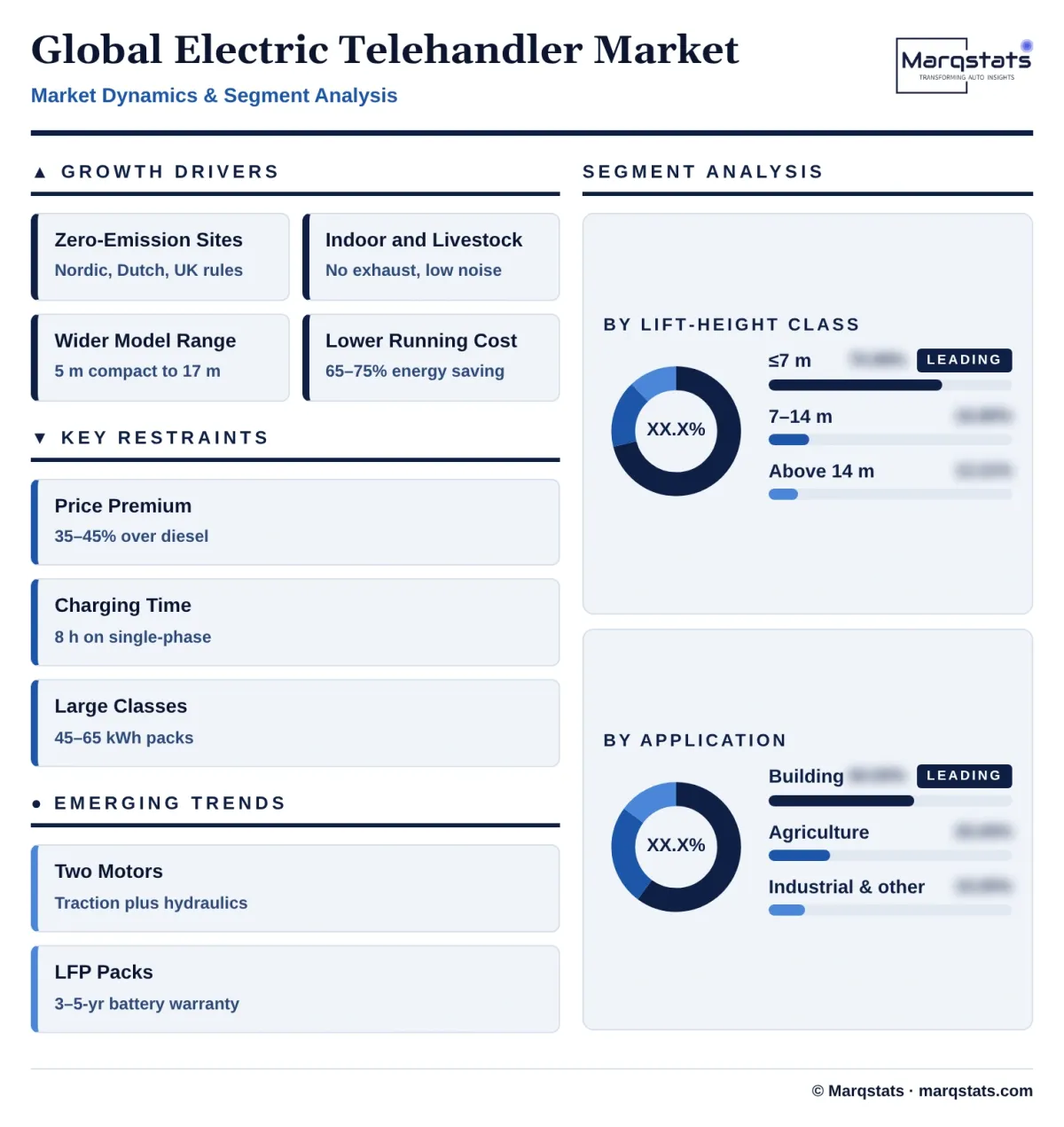
- Zero-emission site requirements. Oslo, Copenhagen, Amsterdam and other Nordic and Dutch cities require or reward zero-emission machinery on municipal construction contracts, and large UK and French contractors set fleet targets, so hirers need electric telehandlers to bid for that work.
- Indoor, urban and livestock work. Electric telehandlers produce no exhaust and little noise, so they can work inside warehouses, factories, tunnels and animal sheds and near homes at night, where diesel machines need ventilation or are not allowed.
- More battery models in more sizes. Manitou, JCB, Merlo, Faresin, Dieci, JLG, Wacker Neuson and SANY now offer electric models from compact 5 to 6 metre machines to 17 metre fixed and rotating machines, giving buyers a choice of suppliers in the sizes they use most.
- Lower running cost. Electric telehandlers cut energy cost per working hour by around 65% to 75% and remove most engine servicing, reaching cost parity with diesel within the life of a fleet machine.
- Farm demand for clean, quiet loading. Livestock and dairy farms use compact telehandlers for feeding and bedding several times a day, and battery models such as the Manitou MLT 625e and Dieci Mini Agri-e run the short daily cycles of a farmyard without fumes in enclosed sheds.
Key Restraints
Four constraints limit how fast and how far up the lift-height range electric telehandlers can go.
- Higher purchase price. A compact electric telehandler costs about 35% to 45% more than its diesel equivalent in 2025, and farmers and small contractors that buy rather than hire find the premium hard to justify.
- Site power and charging time. Many sites have only single-phase power or a generator; the JCB 525-60E needs about eight hours to recharge on a 240 V single-phase supply against about 110 minutes on a 415 V three-phase supply with an optional charger.
- Larger classes are harder to electrify. A 17 metre fixed machine needs a pack of about 45 kWh and a rotating machine 65 kWh or more, which raises price and weight and limits runtime on heavy duty cycles.
- Resale value. Used electric telehandlers have a short trading history, so hirers and lenders are cautious about the value of machines and batteries after seven to ten years of use.
Key Trends
Four shifts are changing how electric telehandlers are designed, sold and used.
- Two motors instead of one. Most electric telehandlers use separate traction and hydraulic motors, as on the Manitou MLT 625e with 40 kW and 30 kW motors, so the hydraulic pump runs only when the boom moves and battery energy lasts longer.
- Lithium iron phosphate packs. Dieci and SANY use lithium iron phosphate cells, and makers now offer battery warranties of three to five years, such as the five-year or 3,000-hour cover on the Manitou MLT 625e with at least 70% of capacity guaranteed.
- Fast and flexible charging. Makers add three-phase on-board chargers and DC fast charging; the Manitou MLT 625e charges from 0% to 100% in four hours on a three-phase supply or in about an hour on DC charging of up to 30 kW, so a machine can top up at lunch on a double shift.
- New entrants and new channels. SANY launched the STH625e compact electric telehandler in the UK and Ireland in November 2025, and Haulotte returned to telehandlers in August 2026 as exclusive Australian distributor for Faresin, widening the routes by which electric machines reach rental fleets.
Strategic Implications
- For telehandler makers, the compact class is the volume opportunity. Machines lifting 2.5 tonnes to 5 to 7 metres, with 22 to 35 kWh packs, two motors and single-phase charging, match what hirers and farms buy most and what batteries can power economically.
- For rental companies, electric telehandlers are a route to urban, indoor and public contracts. Hirers that hold enough battery machines to meet zero-emission tender clauses can charge higher rates and keep utilisation high, while spreading the purchase premium over many short hires.
- For contractors and farmers, hire and trial are the low-risk way in. Hiring electric telehandlers for indoor, night-time and low-emission-zone work, or trialling farm models through dealer demonstration fleets, avoids the purchase premium and resale risk while proving the machines in real work.
- For battery and drive suppliers, standard low-voltage packs are the opportunity. Most compact telehandlers run at about 80 to 96 V, so modular lithium iron phosphate packs, motor controllers and chargers that fit several machine types and brands can win volume across the compact equipment market.
- For makers of mid-range and high-reach machines, timing matters. Larger electric models need bigger packs and three-phase or DC charging, so these machines will grow quickly but stay about a third of market value until battery prices fall further and site power improves.
- For investors, the hire channel and farm dealers are the key indicators. Electric telehandler volumes depend on how fast large hirers replace diesel fleets and how fast farm dealers sell battery models, so hire fleet orders, utilisation rates of electric machines and their resale values after five to seven years show earlier than sales statistics whether the forecast is on track.
Market Segmentation
Compact telehandlers with a lift height of up to 7 metres account for 70.99% of 2025 value, USD 592.90 million and about 6,050 machines, rising to USD 1,334.00 million by 2030, a 17.61% CAGR, while their share falls to 66.40%. This class includes the JCB 525-60E, Manitou MT 625e, MLT 625e and MTA 519 e, Merlo e-WORKER, Faresin 6.26 Full Electric, Dieci Mini Agri-e, JLG E313, Wacker Neuson TH412e and SANY STH625e, most with packs of 18 to 35 kWh.
Mid-range fixed telehandlers lifting above 7 and up to 14 metres account for 16.80% of 2025 value, USD 140.29 million and about 850 machines, and grow fastest, at 23.62% a year, to USD 405.00 million and 20.16% of 2030 value. This is the most common class in North American construction rental, and makers are extending their battery platforms into it, as Faresin did with its 14.42 Full Electric model.
High-reach fixed and rotating telehandlers lifting above 14 metres account for 12.21% of 2025 value, USD 102.00 million and about 300 machines, and grow at 21.49% a year to USD 270.00 million and 13.44% of 2030 value. The Faresin 17.40 and 17.45 Full Electric models with packs of up to 45 kWh and the Manitou MRT 2260 e and 2660 e rotating machines with a 65 kWh, 700 V pack lead this class.
Machines used in construction, including those bought by rental companies for construction hire, account for 60.00% of 2025 value, USD 501.11 million, rising to USD 1,165.22 million by 2030, an 18.38% CAGR, while their share falls to 58.00%. Urban building, refurbishment, indoor fit-out and public-sector projects with zero-emission rules drive most demand.
Agricultural machines account for 25.00% of 2025 value, USD 208.80 million, and grow at 20.13% a year to USD 522.34 million and 26.00% of 2030 value. Livestock, dairy and mixed farms use compact telehandlers for feeding, bedding and handling bales in enclosed sheds, and models such as the Manitou MLT 625e, Dieci Mini Agri-e and Merlo e-WORKER are aimed at this work.
Industrial, logistics, waste, municipal and other users account for 15.00% of 2025 value, USD 125.28 million, and grow at 20.74% a year to USD 321.44 million and 16.00% of 2030 value, led by warehouses, recycling plants, factories and port yards that need a machine able to work both indoors and outdoors.
Machines sold to rental and plant hire companies account for 55.00% of 2025 value, USD 459.35 million, rising to USD 1,044.68 million by 2030, a 17.86% CAGR, while their share falls to 52.00%. Hirers buy most electric telehandlers because they can spread the purchase premium over many short hires and need zero-emission machines for urban and public contracts.
Machines bought directly by contractors, farms, industrial users and municipalities account for 45.00% of 2025 value, USD 375.84 million, and grow faster, at 20.74% a year, to USD 964.32 million and 48.00% of 2030 value, as price premiums narrow and farm dealers add electric models to their ranges.
By Geography
Europe
Europe is the largest market, with 58.00% of 2025 value, USD 484.41 million, rising to USD 1,004.50 million by 2030, a 15.70% CAGR, while its share falls to 50.00%. France, the United Kingdom and Ireland, Germany, Italy, the Benelux countries and the Nordic countries account for most demand, supported by zero-emission rules on municipal contracts and large hire fleets. Manitou builds in France, JCB in the UK, and Merlo, Faresin and Dieci in Italy, and Manitou reported H1 2026 European revenue of €1.2 billion, up 16.5%. This study covers all battery telehandlers, while the Marqstats Europe Electric Construction Equipment report groups a narrower set of telehandlers with wheel loaders, so the two sets of figures should not be compared directly or added.
North America
North America accounts for 25.00% of 2025 value, USD 208.80 million, and grows at 21.92% a year to USD 562.52 million and 28.00% of 2030 value. Mid-range fixed telehandlers are the core of United States rental fleets, and JLG with the E313 and Manitou with the MTA 519 e, designed for North America and delivered from the second quarter of 2026, bring battery models into that channel, while California air district incentives support zero-emission off-road machines. Manitou reported North American revenue down 8.4% in H1 2026, so near-term demand is soft.
Asia-Pacific
Asia-Pacific accounts for 12.00% of 2025 value, USD 100.22 million, and grows fastest, at 26.25% a year, to USD 321.44 million and 16.00% of 2030 value. Chinese makers such as SANY add lower-priced compact electric telehandlers for domestic and export markets, Australian rental fleets add European machines, helped by the August 2026 agreement under which Haulotte Australia distributes the Faresin range, and Japan and South Korea use compact electric handlers on urban and indoor sites.
Rest of World
The rest of the world accounts for 5.00% of 2025 value, USD 41.76 million, and grows at 23.62% a year to USD 120.54 million and 6.00% of 2030 value, led by Gulf contractors working on indoor and mixed-use projects, South American agribusiness and mining towns, and South Africa.
How Competition Is Evolving
The global electric telehandler market is moderately concentrated. About ten makers supply most machines: Manitou in France, JCB in the United Kingdom, Merlo, Faresin and Dieci in Italy, JLG in the United States, Wacker Neuson in Germany and Austria, and SANY in China. Manitou has the broadest electric range, from compact construction and farm machines to rotating telehandlers, and is the market leader by Marqstats estimates.
Makers compete on runtime, charging and lift height. Merlo claims up to eight hours of use for the e-WORKER, Faresin up to eight hours for its 17 metre models, Manitou up to five hours for the MTA 519 e and five hours forty minutes in farmyard use for the MLT 625e, and SANY four to eight hours for the STH625e. Three- to five-year battery warranties have become standard on new models.
Rental companies shape the market. Large European and North American hirers set specifications, negotiate volume prices and decide which models reach sites, so makers with strong hire relationships, telematics and parts networks win most construction orders, while farm dealers decide the agricultural channel.
Competition will be decided by price premium, lift height and charging. Makers that bring compact machines to within about 25% of the diesel price, offer charging that works from ordinary site power and extend battery platforms into mid-range machines will capture most of the growth to 2030.
New models and channels keep arriving. Manitou began delivering the MTA 519 e in North America from mid-2026 and won an award for the MLT 625e in September 2026, Faresin added 14 to 17 metre Full Electric models and an Australian distributor, SANY entered the UK and Ireland with the STH625e, and Dieci extended deliveries of the Mini Agri-e to the Nordic countries. Manitou reported order intake up 15.3% in H1 2026, showing European demand for its machines remains firm.
Mid-range diesel specialists will need battery models. Genie, part of Terex, and other makers whose telehandler sales centre on mid-range machines for North American rental compete with JLG and Manitou as both bring battery models into that channel, while Haulotte has re-entered telehandlers as a distributor rather than a maker.
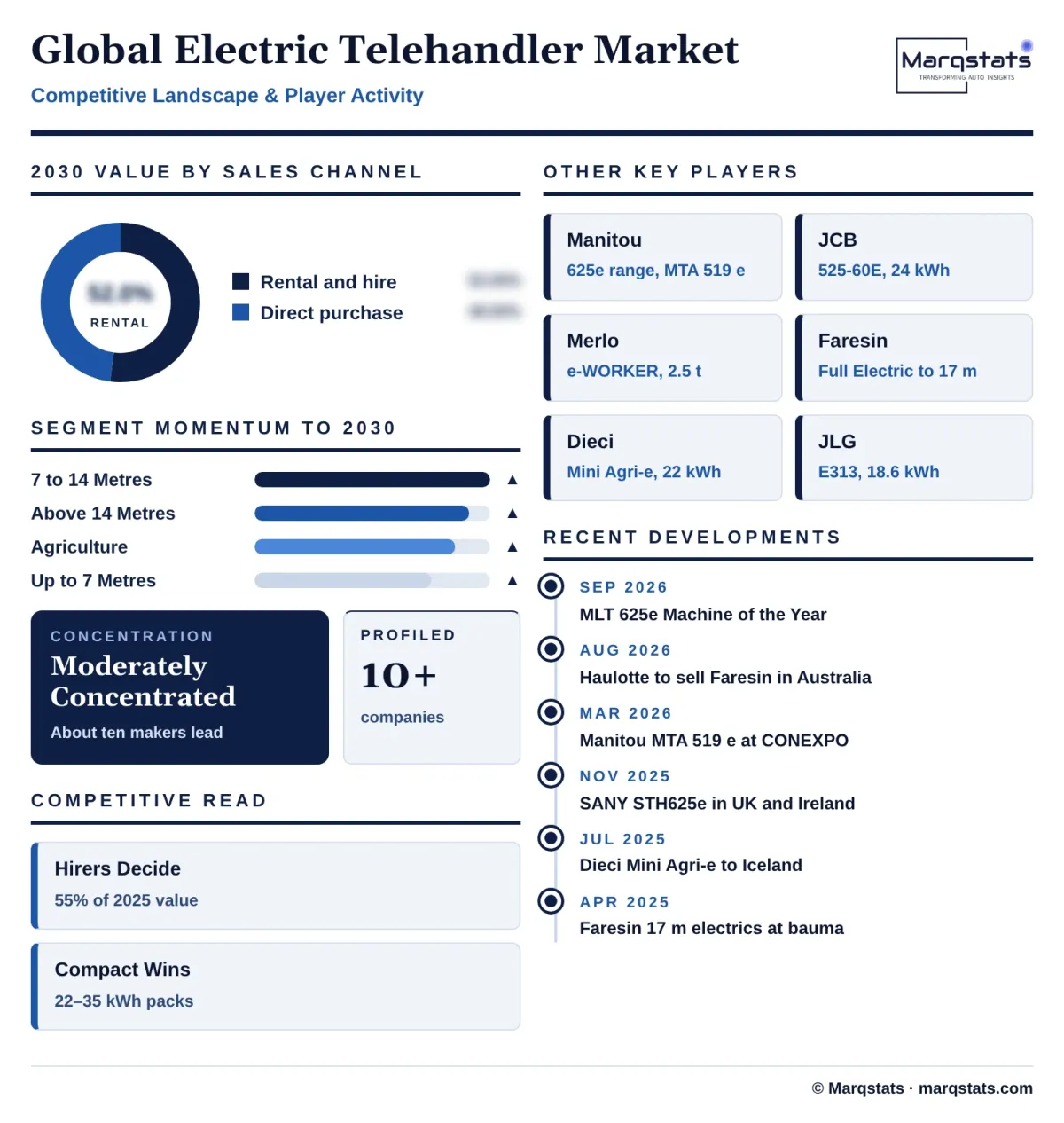
Companies Covered
Companies covered in the report include:
Recent Market Activity
Table of Contents
Coverage & Segmentation
The study covers the global electric telehandler market, with 2025 as the base year, 2021 – 2025 as the historical period and 2026 – 2030 as the forecast period. Values are in US dollars at ex-factory prices, with euro prices converted at the 2025 annual average rate of EUR 1 = USD 1.13, and volumes are annual shipments of new machines. The market is segmented by lift-height class, application, sales channel and region.
Diesel telehandlers, diesel-electric hybrids that need an engine to complete a shift, telescopic wheel loaders, forklifts and industrial counterbalance trucks, aftermarket battery conversions, rental revenue and charging hardware sold separately are excluded. This market falls within the scope of the Marqstats Off-Highway Electric Vehicle market and should not be added to it. Segment and regional splits are Marqstats estimates built on manufacturer product data, launch announcements, company results, dealer and hire fleet information and price benchmarks.