Market Snapshot
Middle bar: base-year value × (1 + CAGR), rounded to two decimals. This is a calculated illustration, not a separately researched annual estimate.
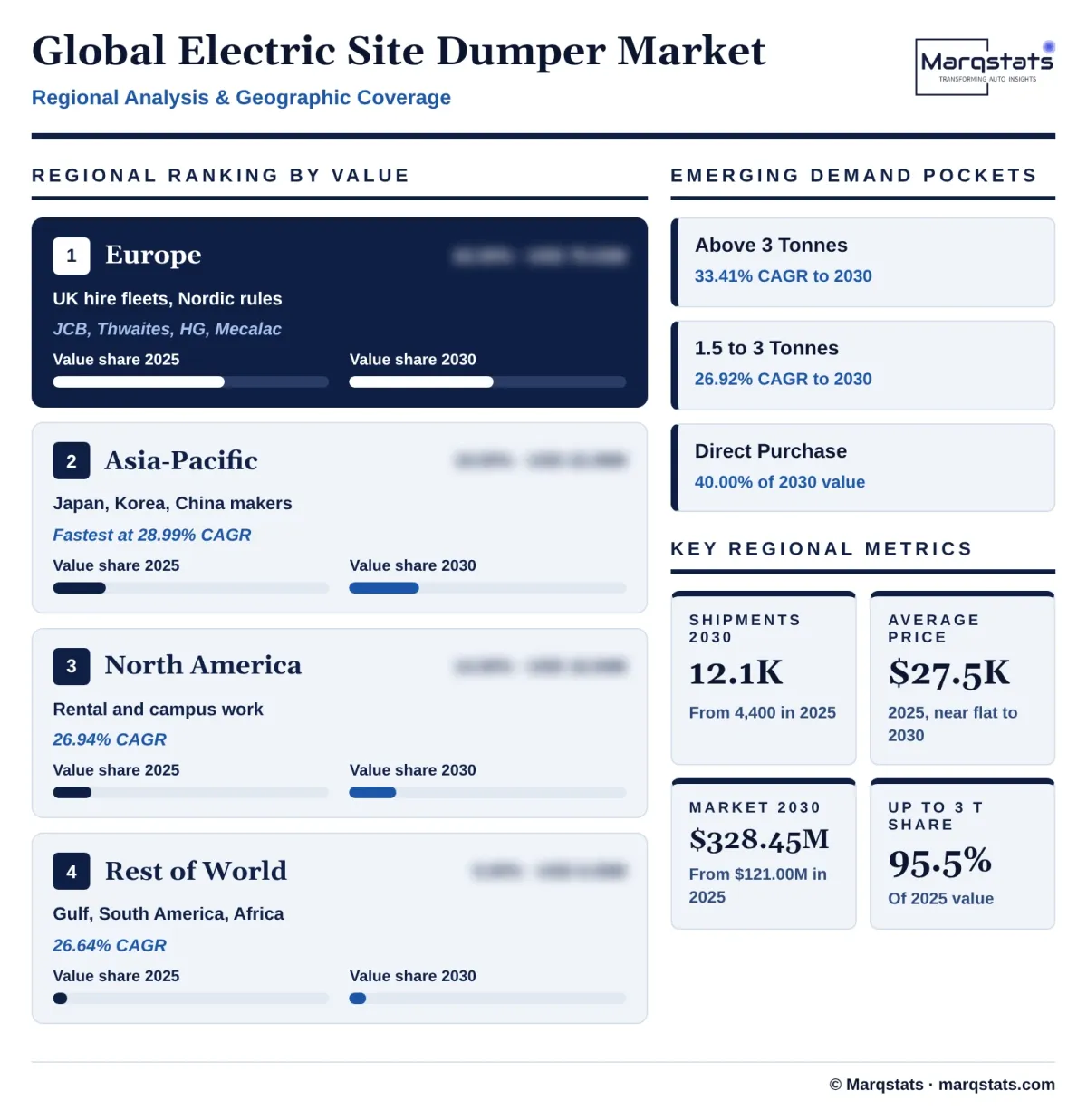
The global electric site dumper market size is estimated at USD 121.00 million in 2025 and is projected to reach USD 328.45 million by 2030, growing at a CAGR of 22.11% over 2026 – 2030. Annual shipments rise from about 4,400 machines to 12,100, a 22.42% annual rate, while the average ex-factory price stays close to USD 27,000 as cheaper battery packs are offset by a shift towards larger wheeled machines.
Marqstats defines the market as the ex-factory value of new battery-electric site dumpers with a rated payload of 0.5 to 9 tonnes, covering wheeled ride-on dumpers with swivel, high-tip and forward-tip skips and tracked mini dumpers, whether ride-on, stand-on or pedestrian-controlled. Diesel and petrol dumpers, diesel-electric hybrids, articulated haulers and rigid trucks above 9 tonnes payload, power barrows below 0.5 tonne payload, aftermarket battery conversions, rental revenue and charging hardware sold separately are excluded.
Machines with a payload of up to 1.5 tonnes account for an estimated 58.00% of 2025 value and wheeled dumpers for 64.09%. Europe accounts for 62.00% of 2025 value and Asia-Pacific grows fastest at 28.99% a year. The study segments the market by payload class, product format, sales channel and region.
Key Takeaways
Market Overview & Analysis
Report Summary
Marqstats sizes the global electric site dumper market as the ex-factory value of new battery-electric dumpers with a rated payload of 0.5 to 9 tonnes. In 2025 about 4,400 machines were shipped worldwide, worth an estimated USD 121.00 million at an average ex-factory price of about USD 27,500, roughly 1.9% of the value of the Marqstats Off-Highway Electric Vehicle market.
Site dumpers carry spoil, aggregate, concrete and waste over short distances on building, utility and landscaping sites. Wheeled dumpers from one to nine tonnes, with front-tip, high-tip or 180-degree swivel skips, dominate British, Irish and continental European hire fleets, while tracked mini dumpers of 0.5 to 2 tonnes, made mainly in Italy and Japan, work in gardens, demolition interiors and on soft ground. Almost all of these machines still run on small diesel engines.
Small dumpers suit batteries well. They work in short cycles, idle between loads, travel only a few kilometres a day and draw high power only when driving loaded uphill or tipping. A two-tonne electric dumper uses one motor for traction and one for hydraulics, so the hydraulic pump runs only when the skip moves. Packs of 10 to 30 kWh cover a working day, and lithium iron phosphate chemistry gives more than 3,000 charge cycles, roughly the life of a hire machine.
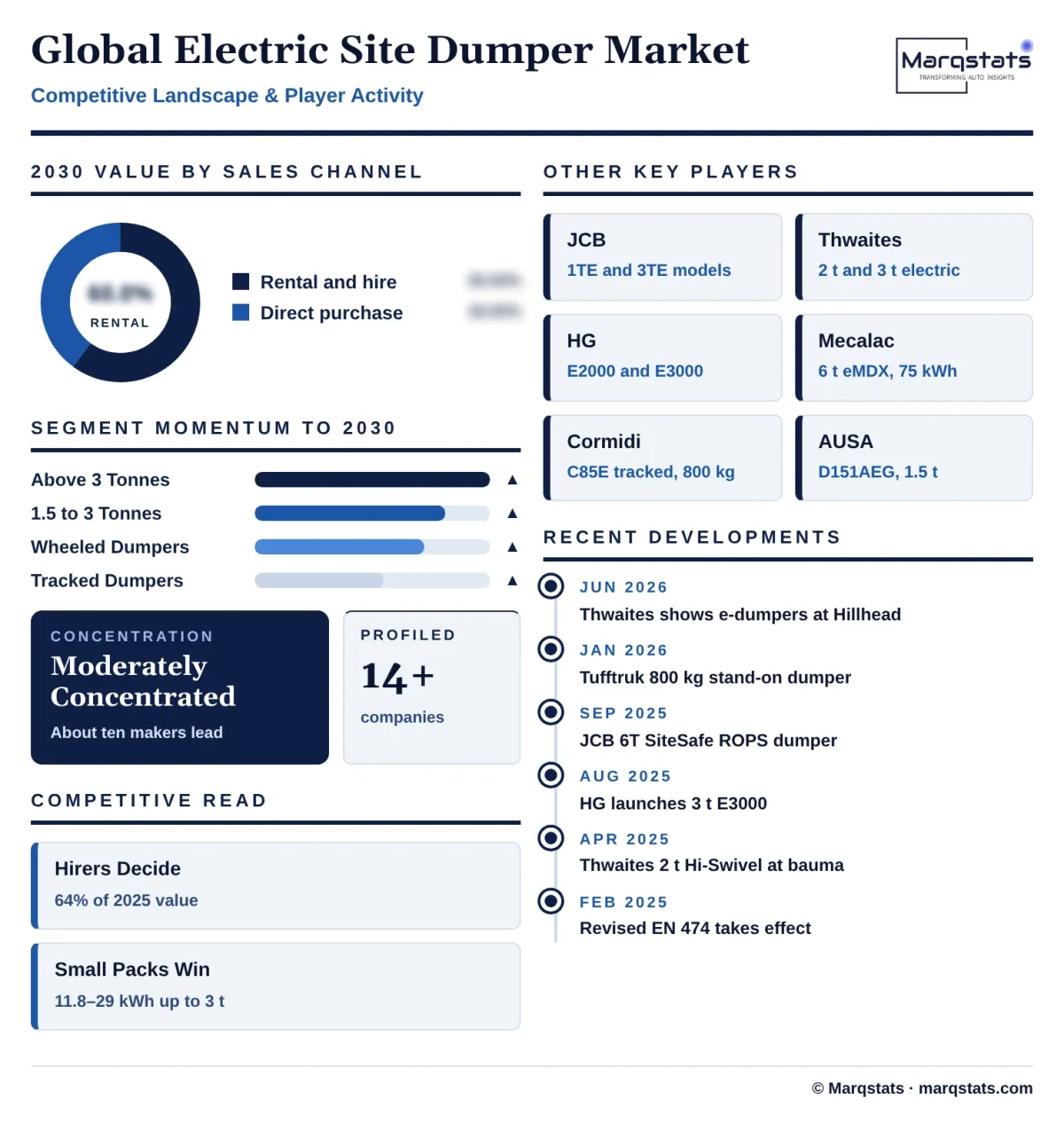
Product launches show where the market sits. JCB launched its 1TE electric dumper in 2020 and followed it with the 3TE, a three-tonne swivel-tip machine with two electric motors of 38.4 kW combined and a 20 kWh lithium-ion pack that charges from 0% to 100% in about two hours on a 415 V supply. Thwaites showed a two-tonne electric Hi-Swivel with a 22 kWh, 48 V pack at bauma in April 2025. HG of Denmark, which has more than 500 electric dumpers in service, added the two-tonne E2000 and in August 2025 the three-tonne E3000 with a 29 kWh pack. Cormidi builds the 800 kg C85E tracked dumper with an 11.8 kWh lithium iron phosphate pack, and Mecalac offers the only series six-tonne electric dumper, the eMDX, with a 75 kWh pack.
The market grew from about 1,250 machines worth USD 33.10 million in 2021 to 1,800 in 2022, 2,500 in 2023 and 3,350 in 2024, worth USD 92.60 million, as JCB, AUSA, Cormidi, Hinowa, Kubota and HG put battery models into series production and European hirers began to add them to fleets. Marqstats expects about 5,450 shipments worth USD 148.90 million in 2026.
Safety rules shape machine design. The 2022 editions of EN 474-1 and EN 474-6 became mandatory for new machines in the European Economic Area and the United Kingdom from 1 February 2025. Dumpers weighing more than 3.5 tonnes and up to 4.5 tonnes now need roll-over protection, front-tip dumpers above 4.5 tonnes need a full cab with roll-over and falling-object protection, and new machines need a front camera, mirrors and an inclinometer. Makers responded with ROPS frames, seat-belt interlocks and cabbed models, and are adding these features to electric machines as they extend their ranges. The new EU Machinery Regulation (EU) 2023/1230, which applies from January 2027, adds requirements for software, connectivity and autonomous functions.
Public buyers create the first large orders. Oslo has required fossil-free and increasingly zero-emission machinery on municipal construction sites, Copenhagen and Amsterdam use zero-emission criteria in public tenders, and UK contractors and hirers have set fleet targets. Because dumpers are among the cheapest and simplest machines on a site, they are often the first machines a hirer or contractor electrifies to meet these rules.
Global Electric Site Dumper Market Size and Forecast
The global electric site dumper market grows from USD 121.00 million in 2025 to USD 328.45 million in 2030, a CAGR of 22.11%. Marqstats expects shipments of about 6,800 machines worth USD 184.60 million in 2027, 8,350 worth USD 225.20 million in 2028 and 10,150 worth USD 273.00 million in 2029, before reaching 12,100 machines in 2030.
Average price is stable. The average ex-factory price moves from about USD 26,480 in 2021 to USD 27,500 in 2025 and about USD 27,145 in 2030. Tracked mini dumpers fall from about USD 15,800 to USD 14,500 and wheeled dumpers from about USD 47,000 to USD 44,500, but wheeled machines rise from 37.50% of units in 2025 to 42.15% in 2030, so value and volume grow at almost the same rate.
Battery cost is the main lever. Marqstats estimates the battery accounts for 25% to 35% of the ex-factory price of a two- to three-tonne electric dumper and that pack prices for small lithium iron phosphate packs fall by about 6% to 8% a year to 2030. That narrows the premium over a diesel dumper from about 60% to 90% in 2025 to about 35% to 50% by 2030, before any saving on fuel, servicing and noise restrictions.
Operating savings close the gap. A three-tonne diesel dumper burns about 2 to 3 litres of diesel an hour, while an electric one uses about 2 to 3 kWh an hour, so energy cost per hour falls by around 70% to 80% at typical European prices. Electric machines also avoid engine services, filters, belts and diesel particulate maintenance. Marqstats estimates a two- to three-tonne electric dumper reaches cost parity with diesel in four to six years at 800 to 1,000 working hours a year, within the five- to eight-year life of a hire fleet machine.
Marqstats tracks four indicators to monitor the forecast: battery dumper share of new hire fleet orders at the largest UK and Nordic hirers, zero-emission machinery clauses in public construction tenders, small lithium iron phosphate pack prices, and the number of six- to nine-tonne battery models in series production.
The mix changes over the forecast. Machines above 1.5 and up to 3 tonnes rise from 37.50% to 45.50% of value and above 3 tonnes from 4.50% to 7.00%, wheeled dumpers from 64.09% to 69.10% and direct purchase by contractors and municipalities from 36.00% to 40.00%. Europe remains the largest region but its share falls from 62.00% to 52.00% as Asia-Pacific rises to 25.00% and North America to 17.00%.
Market Dynamics
Key Drivers
Five forces are moving compact site dumpers from diesel to batteries.
- Zero-emission site requirements. Oslo, Copenhagen, Amsterdam and other Nordic and Dutch cities require or reward zero-emission machinery on municipal construction contracts, and large UK contractors set fleet targets, so hirers need electric dumpers to bid for that work.
- Indoor and confined-space work. Electric dumpers produce no exhaust and little noise, so they can work inside buildings, in basements, tunnels and hospitals and near homes at night, where diesel machines need ventilation or are not allowed.
- Battery models across the range. JCB, Thwaites, HG, AUSA, Cormidi, Hinowa, Kubota and Mecalac now offer electric models from 0.7 to 6 tonnes payload, giving hirers a choice of suppliers for the sizes they rent most.
- Lower running cost. Electric dumpers cut energy cost per working hour by around 70% to 80% and remove most engine servicing, reaching cost parity with diesel within the life of a hire machine.
- Longer working hours near homes. Electric dumpers run at much lower sound levels than diesel machines, so contractors can start earlier or finish later on sites with noise limits, adding productive time each day.
Key Restraints
Four constraints limit how fast and how far up the size range electric dumpers can go.
- Higher purchase price. A two- to three-tonne electric dumper costs about 60% to 90% more than its diesel equivalent in 2025, and small contractors that buy rather than hire find the premium hard to justify.
- Site power. Many sites have only single-phase power or a generator, so recharging a 20 to 30 kWh pack overnight is easy but fast charging or larger machines need three-phase connections that are not always available.
- Heavier classes are harder to electrify. A six-tonne electric dumper needs a pack of about 75 kWh, which raises price and weight, and from February 2025 the revised EN 474 standard requires roll-over protection on dumpers weighing more than 3.5 tonnes and full ROPS and FOPS cabs on front-tip dumpers above 4.5 tonnes, adding further cost to the heavier classes.
- Resale value. Used electric dumpers have a short trading history, so hirers and lenders are cautious about the value of machines and batteries after five to eight years of hire.
Key Trends
Four shifts are changing how electric site dumpers are designed, sold and used.
- Two motors instead of one. Most new electric dumpers use separate traction and hydraulic motors, as on the Thwaites 2-tonne Hi-Swivel and JCB 3TE, so the hydraulic pump runs only when the skip moves and battery energy lasts longer.
- Lithium iron phosphate packs. Cormidi, Thwaites and other makers use lithium iron phosphate cells with more than 3,000 cycles and five-year battery warranties, replacing the lead-acid batteries used on early models such as the Wacker Neuson DW15e.
- Fast-charge options. Makers add optional fast chargers, such as the Thwaites unit that takes the 2-tonne Hi-Swivel from 20% to 80% in under 50 minutes, so a dumper can top up at lunch on a double shift.
- Safety and electrification together. New models combine battery drive with roll-over protection, seat-belt interlocks, cameras and telematics, as hirers renew fleets to meet the 2025 EN 474 changes and zero-emission tender rules at the same time.
Strategic Implications
- For dumper makers, the one- to three-tonne class is the volume opportunity. Swivel-tip and high-tip machines in this range, with 20 to 30 kWh lithium iron phosphate packs, two motors and single-phase charging, match what hirers rent most and what batteries can power economically.
- For rental companies, electric dumpers are a route to urban and public contracts. Hirers that hold enough battery machines to meet zero-emission tender clauses can charge higher rates and keep utilisation high, while spreading the purchase premium over many short hires.
- For contractors, hire is the low-risk way in. Hiring electric dumpers for indoor, night-time and low-emission-zone work avoids the purchase premium and resale risk while proving the machines on real sites.
- For battery and drive suppliers, standard low-voltage packs are the opportunity. Most compact dumpers run at 24 to 80 V, so modular lithium iron phosphate packs and motor controllers that fit several machine types and brands can win volume across the compact equipment market.
- For makers of six- to nine-tonne dumpers, timing matters. Larger electric models need bigger packs, three-phase charging and the protective structures required since 2025, so these machines will stay a small share of the market until battery prices fall further and site power improves.
- For investors, the hire channel is the key indicator. Electric dumper volumes depend on how fast large hirers replace diesel fleets, so hire fleet orders, utilisation rates of electric machines and their resale values after five years show earlier than sales statistics whether the forecast is on track.
Market Segmentation
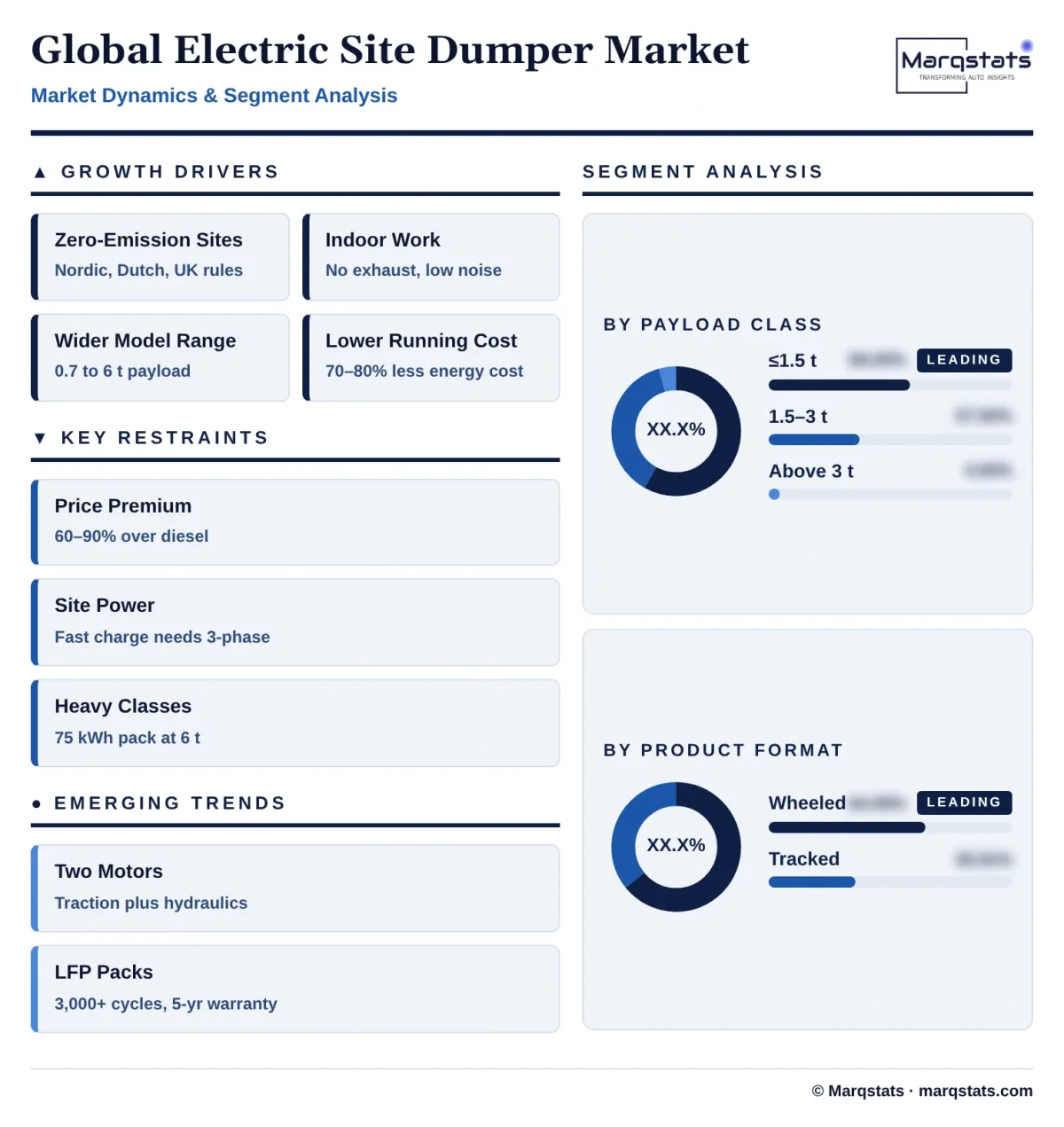
Dumpers with a payload of up to 1.5 tonnes account for 58.00% of 2025 value, USD 70.18 million, rising to USD 156.02 million by 2030, a 17.33% CAGR, while their share falls to 47.50%. This class includes most tracked mini dumpers, such as the 800 kg Cormidi C85E and 700 kg Kubota KC70VSL-4 e, and small wheeled dumpers such as the JCB 1TE and the 1.5-tonne AUSA D151AEG.
Dumpers with a payload above 1.5 and up to 3 tonnes account for 37.50% of 2025 value, USD 45.38 million, and grow at 26.92% a year to USD 149.44 million and 45.50% of 2030 value. The Thwaites 2-tonne Hi-Swivel and 3-tonne Power Swivel, the JCB 3TE and the HG E2000 and E3000 make this the class where most new launches are aimed.
Dumpers with a payload above 3 tonnes account for 4.50% of 2025 value, USD 5.44 million, and grow fastest, at 33.41% a year, to USD 22.99 million and 7.00% of 2030 value. The six-tonne Mecalac eMDX with a 75 kWh pack is the main series model, and heavier classes need larger packs, three-phase charging and the protective structures required by the 2025 EN 474 changes.
Wheeled ride-on electric dumpers account for 64.09% of 2025 value, USD 77.55 million and about 1,650 machines, and grow at 23.96% a year to USD 226.95 million and 69.10% of 2030 value. Their average ex-factory price falls from about USD 47,000 to USD 44,500 as two- and three-tonne swivel-tip models reach volume production.
Tracked mini dumpers account for 35.91% of 2025 value, USD 43.45 million and about 2,750 machines, rising to USD 101.50 million by 2030, an 18.49% CAGR, and 30.90% of the market. Italian makers such as Cormidi, Hinowa and Messersi, Japanese makers such as Kubota and Chinese makers supply most of these machines, which use low-voltage packs of about 6 to 12 kWh.
Machines sold to rental and plant hire companies account for 64.00% of 2025 value, USD 77.44 million, rising to USD 197.07 million by 2030, a 20.54% CAGR, while their share falls to 60.00%. Hirers buy most electric dumpers because they can spread the purchase premium over many short hires and need zero-emission machines for urban and public contracts.
Machines bought directly by contractors, landscapers, utilities and municipalities account for 36.00% of 2025 value, USD 43.56 million, and grow faster, at 24.71% a year, to USD 131.38 million and 40.00% of 2030 value, as price premiums narrow and public owners buy electric machines for parks, cemeteries and street works.
By Geography
Europe
Europe is the largest market, with 62.00% of 2025 value, USD 75.02 million, rising to USD 170.79 million by 2030, a 17.88% CAGR, while its share falls to 52.00%. The United Kingdom and Ireland, where site dumpers are the most common hire machine, Norway, Denmark, Sweden and the Netherlands, where cities require or reward zero-emission machinery on public contracts, and Italy, home to the tracked dumper makers, account for most demand. JCB, Thwaites and Mecalac build electric dumpers in the UK and France, HG in Denmark, AUSA in Spain and Cormidi, Hinowa and Messersi in Italy. This study covers smaller machines, including tracked and stand-on mini dumpers, than the dumper line of the Marqstats Europe Electric Construction Equipment report, so the two sets of figures should not be compared directly or added.
Asia-Pacific
Asia-Pacific accounts for 19.00% of 2025 value, USD 22.99 million, and grows fastest, at 28.99% a year, to USD 82.11 million and 25.00% of 2030 value. Japan and South Korea use electric tracked carriers and mini dumpers on urban and residential sites, Chinese makers add low-cost electric tracked dumpers for domestic and export markets, and Australia and New Zealand hirers add European electric models for indoor and low-noise work.
North America
North America accounts for 14.00% of 2025 value, USD 16.94 million, and grows at 26.94% a year to USD 55.84 million and 17.00% of 2030 value. Site dumpers are less common in North America than skid steers and compact track loaders, but JCB and AUSA sell electric models through rental channels, and California air district grants and city zero-emission construction pilots support indoor, campus and utility work.
Rest of World
The rest of the world accounts for 5.00% of 2025 value, USD 6.05 million, and grows at 26.64% a year to USD 19.71 million and 6.00% of 2030 value, led by Gulf contractors working on indoor and mixed-use projects, South American mining-town and tunnelling work, and South Africa.
How Competition Is Evolving
The global electric site dumper market is moderately concentrated. About ten makers supply most machines: JCB and Thwaites in the United Kingdom, HG in Denmark, AUSA in Spain, Mecalac in France, Cormidi, Hinowa and Messersi in Italy, Kubota in Japan and a group of Chinese tracked dumper makers. Wheeled machines are led by the British and Danish makers, while tracked mini dumpers are led by the Italian and Japanese makers.
Makers compete on runtime, charging and payload. Thwaites offers a 22 kWh pack and optional fast charger on its 2-tonne Hi-Swivel, HG claims up to 12 hours of effective runtime on its E2000 and E3000, JCB offers two-hour charging on a 415 V supply for the 3TE, and Mecalac offers six tonnes of payload. Five-year battery warranties have become standard on new models.
Rental companies shape the market. Large UK and European hirers set specifications, negotiate volume prices and decide which models reach sites, so makers with strong hire relationships, telematics and parts networks win most orders.
Competition will be decided by price premium, payload and charging. Makers that bring three-tonne swivel-tip machines to within about 35% of the diesel price, and offer charging that works from ordinary site power, will capture most of the growth to 2030.
New models keep arriving. HG began deliveries of the three-tonne E3000 in early 2026, Thwaites moved its two- and three-tonne electric dumpers into production after showing them at bauma 2025 and Hillhead 2026, Tufftruk added the 800 kg TRUXTA EB800PTP stand-on dumper, and Altrad Belle and other compact equipment makers extend battery models across mini dumpers and power barrows. Component suppliers such as ZAPI supply motors, controllers and battery systems to several of these makers.
Companies Covered
Companies covered in the report include:
Recent Market Activity
Table of Contents
Coverage & Segmentation
The study covers the global electric site dumper market, with 2025 as the base year, 2021 – 2025 as the historical period and 2026 – 2030 as the forecast period. Values are in US dollars at ex-factory prices, with local-currency prices converted at 2025 annual average exchange rates, and volumes are annual shipments of new machines. The market is segmented by payload class, product format, sales channel and region.
Diesel and petrol dumpers, diesel-electric hybrids, articulated haulers and rigid trucks above 9 tonnes payload, power barrows and wheelbarrows below 0.5 tonne payload, aftermarket battery conversions, rental revenue and charging hardware sold separately are excluded. This market is a part of the Marqstats Off-Highway Electric Vehicle market and should not be added to it. Segment and regional splits are Marqstats estimates built on manufacturer product data, launch announcements, dealer and hire fleet information and price benchmarks.