Market Snapshot
Middle bar: base-year value × (1 + CAGR), rounded to two decimals. This is a calculated illustration, not a separately researched annual estimate.
The global electric mobile and all-terrain crane market size is estimated at USD 285.00 million in 2025 and is projected to reach USD 880.00 million by 2030, growing at a CAGR of 25.29% over 2026 – 2030. Annual deliveries rise from about 470 to 1,450 cranes, a 25.27% annual rate, while the average value per crane stays close to USD 607,000 as lower-priced Chinese truck cranes and higher-priced European all-terrain models both scale up.
Marqstats defines the market as the ex-works value of new self-propelled mobile cranes whose lifting functions can run from an on-board battery or from a site power connection: all-terrain and city cranes, truck-mounted cranes, rough-terrain cranes and crawler cranes. It covers fully battery-electric cranes and plug-in hybrid or mains-electric cranes that keep a diesel engine for road travel but lift on electric power. Tower cranes, port and ship-to-shore cranes, overhead and gantry cranes, loader and knuckle-boom cranes, mini crawler and spider cranes, diesel cranes run on HVO, charging equipment sold separately and crane rental revenue are excluded.
Crawler cranes account for 38.33% of 2025 value, fully battery-electric models for 50.70% and cranes rated up to 50 tonnes for 34.74%. Europe accounts for 42.00% of 2025 value and Asia-Pacific for 40.00%. The study segments the market by crane type, drive architecture, lifting capacity and region.
Key Takeaways
Market Overview & Analysis
Report Summary
Marqstats sizes the electric mobile and all-terrain crane market as the ex-works value of new mobile cranes that can lift on electric power from a battery or a site connection. In 2025 about 470 such cranes were delivered worldwide, worth an estimated USD 285.00 million, against a total mobile crane market of roughly 41,000 units.
A mobile crane has two power users. The carrier must drive the crane to the job, often at highway speed and with a gross weight of 60 tonnes or more on a five-axle chassis, while the superstructure powers the slewing, hoisting, luffing and telescoping functions once the crane is set up. Lifting is intermittent: a crane draws high power for short peaks and very little between lifts. That load profile suits electric drive, because a battery can cover the peaks while a small site connection refills it, but it does not solve road travel, where a heavy all-terrain crane needs several hundred kilowatts of continuous power.
Manufacturers have therefore split their designs. Liebherr launched the LTM 1150-5.4E at bauma in April 2025, a 150-tonne five-axle all-terrain crane with a 98 kWh battery at the rear, a 111 kW electric motor for the crane drive and a 400 kW six-cylinder Stage V diesel engine that can run on HVO for road travel. The battery can be charged from a CEE socket of up to 64 A and 44 kW, from a standard socket or by CCS DC charging up to 80 kW, and allows about four hours of lifting without any connection. Manitowoc showed the Grove GMK5150L-1e and GMK5150XLe at the same fair, with an electric superstructure, a battery of about 180 kWh, about five hours of battery-only lifting and a 170 kW generator on the carrier that recharges the battery while driving.
Cranes that travel short distances can drop the diesel engine entirely. Tadano's EVOLT eGR-1000XLL-1, a 100-ton rough-terrain crane introduced to the United States and Canada in March 2025, carries up to 226 kWh in six lithium-ion packs and lifts for up to seven hours, or five hours plus about 5.5 miles of travel around the site. Liebherr's LR 1250.1 unplugged, a 250-tonne battery crawler crane, runs a full shift on battery and recharges in about 4.5 hours, and Sarens took delivery of a fully electric 200-tonne SANY SCC2000A-EV crawler crane in February 2026. In China, Zoomlion's ZTC250N-EV 25-tonne pure electric truck crane claims about 230 km of road range and a charge from 10% to 80% in under an hour.
The market grew from an estimated USD 85.00 million in 2021, when about 120 electric cranes were delivered, to USD 160.00 million in 2023 and USD 215.00 million in 2024, a 35.30% CAGR over 2021 – 2025, as electric crawler cranes and Chinese electric truck cranes moved from prototypes to small series. Marqstats expects about 610 deliveries worth USD 360.00 million in 2026.
Global Electric Mobile and All-Terrain Crane Market Size and Forecast
The global electric mobile and all-terrain crane market grows from USD 285.00 million in 2025 to USD 880.00 million in 2030, a CAGR of 25.29%. Marqstats expects the market to reach USD 360.00 million in 2026, USD 455.00 million in 2027, USD 565.00 million in 2028 and USD 710.00 million in 2029, with deliveries of about 790 cranes in 2027, 1,000 in 2028 and 1,220 in 2029.
The 2025 value is built bottom-up from model families and prices. Marqstats estimates about 50 electric all-terrain and city cranes at an average of about USD 1.30 million, including early LTM 1150-5.4E units, LTC 1050-3.1E compact cranes and Grove plug-in hybrids; about 270 electric truck cranes at about USD 300,000, mostly 25- to 55-tonne Chinese models; about 115 electric crawler cranes at about USD 950,000, from 50-tonne telescopic crawlers to 250-tonne lattice crawlers; and about 35 battery rough-terrain cranes at about USD 850,000, mainly Tadano EVOLT models.
The base is calibrated against total crane sales. Tadano estimates the 2025 mobile crane market outside China at about 15,970 units, including 3,140 all-terrain, 4,600 rough-terrain and 8,230 truck cranes. In China, the China Construction Machinery Association recorded 18,063 truck cranes and 3,030 crawler cranes sold in January to November 2025. Adding December and crawler cranes elsewhere gives a world market of roughly 41,000 mobile cranes, so electric models were about 1.15% of units and a smaller share of value, because the largest lattice crawlers and all-terrain cranes are still almost all diesel.
The average price of an electric crane stays broadly flat over the forecast, at about USD 606,000 in 2025 and USD 607,000 in 2030. Two effects offset each other: Chinese electric truck cranes, the cheapest type, add the most units, while series production of 150-tonne hybrid all-terrain cranes adds high-value units. Battery cost falls, but battery size per crane rises as buyers move from 98 kWh buffers toward 180 to 226 kWh packs for longer battery-only operation.
Marqstats tracks four indicators to monitor the forecast: series delivery rates of the LTM 1150-5.4E and the Grove GMK5150 e-models, monthly Chinese sales of electric truck and crawler cranes, the number of public tenders in Europe and North America that require zero-emission lifting equipment, and the availability of 32 A or larger site connections and mobile battery units on urban job sites.
Market Dynamics
Key Drivers
Five forces are pulling electric drive into mobile, all-terrain and crawler cranes.
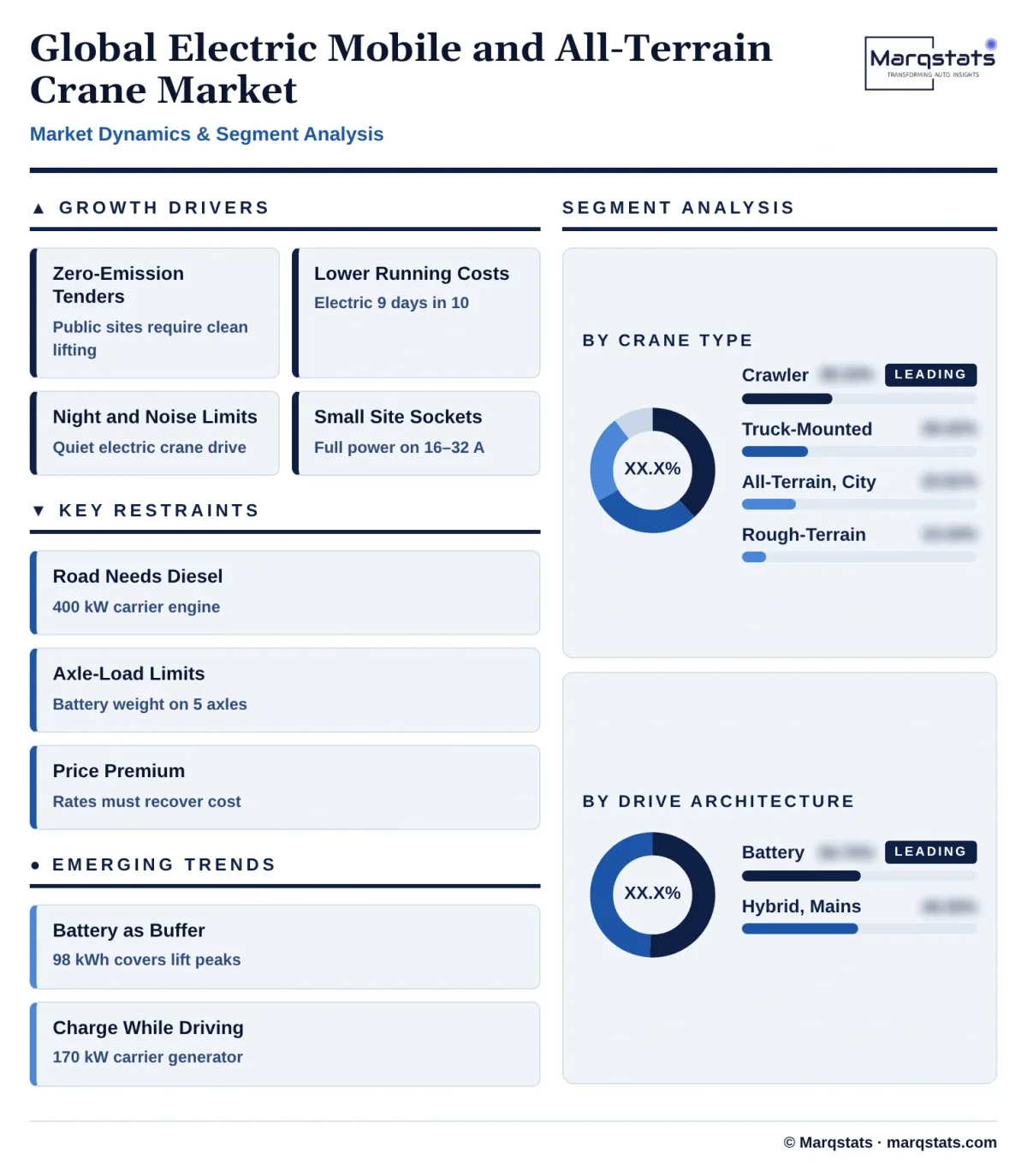
- Zero-emission public tenders. Public clients in Norway, the Netherlands, Denmark and other European countries increasingly score or require emission-free machinery on construction sites, and rental companies such as Mammoet and Sarens buy electric cranes to keep winning that work.
- Rental companies want lower running costs. Mammoet estimates its LTM 1150-5.4E can run fully electrically on nine days out of ten, cutting diesel use, engine hours and maintenance on the crane superstructure.
- Night work and noise limits. Electric crane drives are much quieter than diesel engines, which lets contractors lift at night and in residential areas where diesel cranes face time limits.
- Low-power site connections are enough. Because the battery buffers peaks, the LTM 1150-5.4E reaches full performance on a 16 or 32 A socket, so contractors avoid the cost of large temporary grid connections.
- Chinese makers electrify their lines. Zoomlion developed nearly 60 new-energy products in 2025 and offers about 240, and Chinese makers sell electric truck and crawler cranes in volume at home and to export customers.
Key Restraints
Four constraints keep electric cranes a small share of mobile crane sales.
- Road travel needs diesel power. Large all-terrain cranes need several hundred kilowatts for highway driving, so even the newest electric models keep a diesel carrier engine.
- Weight and axle limits. Battery packs add weight to cranes that are already close to axle-load limits, forcing makers to remove counterweight or carry the battery as a removable pack.
- Higher purchase prices. Electric versions cost more than their diesel equivalents, and rental companies must recover the premium through rates that customers are not always willing to pay.
- Site power is uneven. Many sites lack a 32 A or larger connection when the crane arrives, which forces operators back onto the diesel engine or onto separate mobile battery units.
Key Trends
Four shifts are changing how electric cranes are designed, powered and sold.
- Battery as a buffer. Designs such as the LTM 1150-5.4E size the battery to cover lifting peaks while a small socket recharges it, rather than to run all day without power.
- Electric superstructures on proven carriers. Grove builds its e-models on existing GMK5150L-1 and GMK5150XL carriers with the same boom lengths and load charts as the diesel versions, so rental fleets can mix them freely.
- Charging while driving. The Grove e-models recharge their battery from a 170 kW generator on the carrier while travelling, and the LTM 1150-5.4E engine can recharge its battery during road travel.
- Fully electric crawlers at heavy-lift scale. Battery and cable-electric crawlers now reach 200 to 250 tonnes, such as the SANY SCC2000A-EV and the Liebherr LR 1250.1 unplugged.
Strategic Implications
- For crane makers, electric versions of best-selling models sell faster than new platforms. Keeping load charts, boom lengths and transport dimensions identical to diesel models lets rental fleets use electric cranes without new route planning or operator training.
- For rental companies, data on site power decides the business case. Recording which sites have 32 A or larger connections helps fleets place electric cranes where they can run on electricity most days.
- For contractors, planning site power early pays off. Installing a 32 A or 63 A connection, or booking a mobile battery unit, before the crane arrives lets electric cranes meet zero-emission tender rules without diesel backup.
- For Chinese makers, export certification is the next step. Electric truck and crawler cranes that meet European machinery and road rules can follow SANY into rental fleets such as Sarens.
- For component suppliers, crane duty cycles need their own batteries and motors. Packs must handle high peak power, frequent partial charges and outdoor vibration, and removable packs need fast and safe connectors.
Market Segmentation
Electric crawler cranes account for 38.33% of 2025 value, USD 109.25 million, and grow at 22.39% a year to USD 300.00 million, while their share falls to 34.09% by 2030. Crawlers work for long periods on one site, so a cable connection or a battery charged overnight covers their needs. Products include the Liebherr LR 1250.1 unplugged, the Sennebogen 653 E battery telescopic crawler with a 210 kWh pack and a 22 kW on-board charger, the SANY SCC2000A-EV and electric crawlers from XCMG and Zoomlion.
Electric truck cranes account for 28.42% of 2025 value, USD 81.00 million, and grow at 22.67% a year to USD 225.00 million and 25.57% by 2030. Nearly all are Chinese 25- to 55-tonne models, such as the Zoomlion ZTC250N-EV with about 230 km of road range, and their low price per unit keeps their value share below their share of units.
Electric all-terrain and city cranes account for 22.81% of 2025 value, USD 65.00 million, and grow fastest, at 31.95% a year, to USD 260.00 million and 29.55% by 2030. The Liebherr LTC 1050-3.1E compact crane, the LTM 1150-5.4E, the Grove GMK5150L-1e and GMK5150XLe and the Marchetti Trio 0E 15-tonne city crane lead the category.
Battery rough-terrain cranes account for 10.44% of 2025 value, USD 29.75 million, and grow at 26.14% a year to USD 95.00 million and 10.80% by 2030. Tadano leads with its EVOLT range, including the 100-ton eGR-1000XLL-1 with up to 226 kWh of battery and a two-hour full charge on a 150 kW DC charger.
Cranes with no combustion engine account for 50.70% of 2025 value, USD 144.50 million, and grow at 28.71% a year to USD 510.40 million and 58.00% by 2030. They include battery crawlers, Tadano EVOLT rough-terrain cranes, Chinese pure electric truck cranes and small electric city cranes, all of which drive only short distances or at moderate speed.
Cranes that keep a diesel carrier engine but lift on electric power from a battery or a site connection account for 49.30% of 2025 value, USD 140.50 million, and grow at 21.34% a year to USD 369.60 million, while their share falls to 42.00% by 2030. This group holds 93.85% of 2025 all-terrain value, because large all-terrain cranes still need diesel power for highway travel.
Cranes rated up to 50 tonnes account for 34.74% of 2025 value, USD 99.00 million, and grow at 22.22% a year to USD 270.00 million and 30.68% by 2030. Chinese 25-tonne electric truck cranes, compact city cranes and smaller rough-terrain cranes make up most of this group.
Cranes rated from 51 to 150 tonnes account for 37.46% of 2025 value, USD 106.75 million, and grow fastest, at 27.52% a year, to USD 360.00 million and 40.91% by 2030, led by 150-tonne hybrid all-terrain cranes and 100-ton battery rough-terrain cranes.
Cranes rated above 150 tonnes account for 27.81% of 2025 value, USD 79.25 million, and grow at 25.83% a year to USD 250.00 million and 28.41% by 2030, almost all of them lattice crawler cranes such as the 200-tonne SANY SCC2000A-EV and the 250-tonne Liebherr LR 1250.1 unplugged.
By Geography
Europe
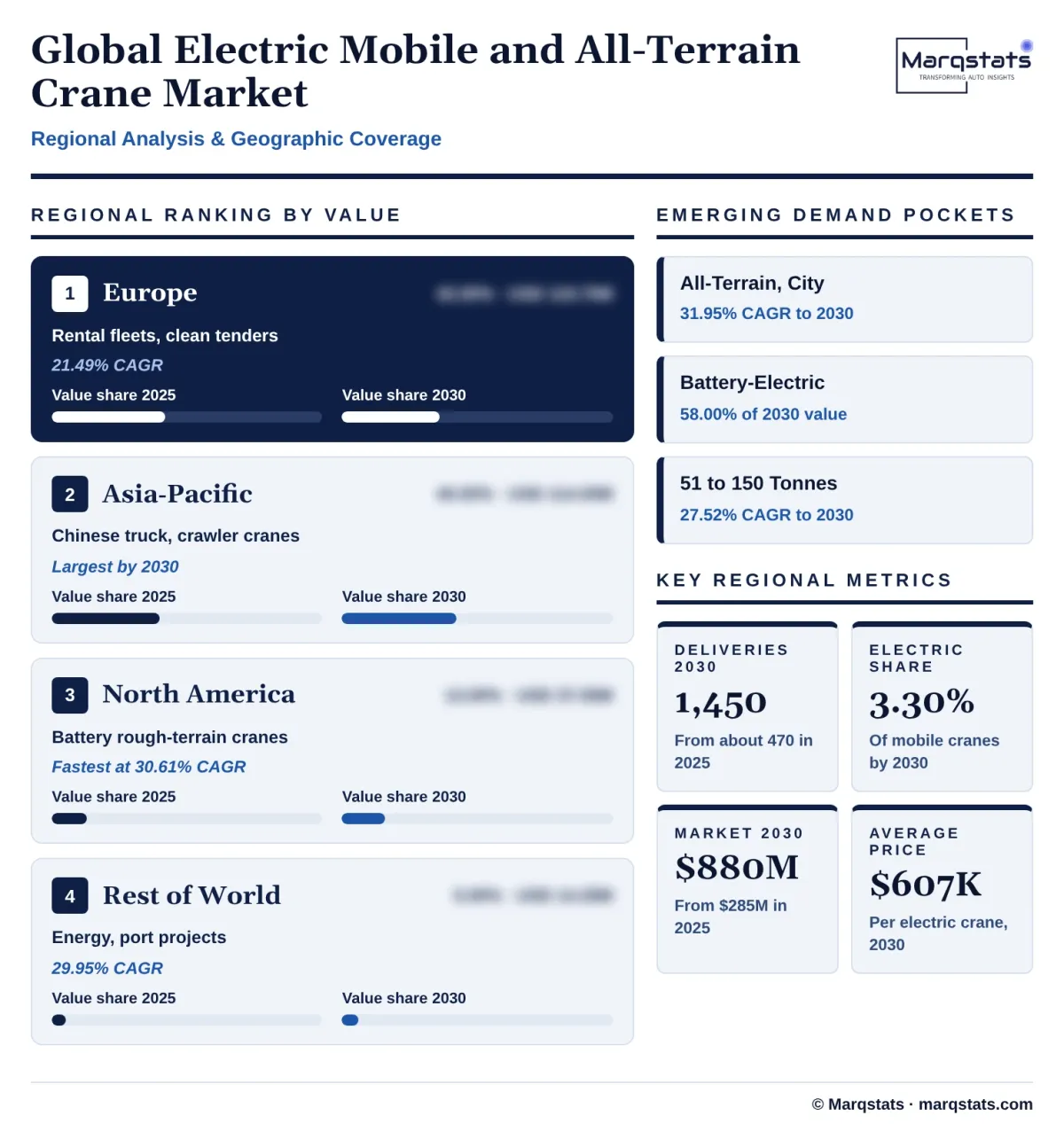
Europe is the largest market, with 42.00% of 2025 value, USD 119.70 million, rising to an estimated USD 316.80 million by 2030, a 21.49% CAGR, while its share falls to 36.00%. Rental and heavy-lift companies in the Netherlands, Belgium, Norway, Germany and the UK, including Mammoet, Sarens and Select, are the main buyers, and Liebherr, Manitowoc and Sennebogen build their electric models in Germany. Public zero-emission tenders and noise limits in city centres drive demand.
Asia-Pacific
Asia-Pacific accounts for 40.00% of 2025 value, USD 114.00 million, and grows at an estimated 26.52% a year to USD 369.60 million, becoming the largest region with 42.00% of value by 2030. China supplies most units through Zoomlion, XCMG and SANY electric truck and crawler cranes, and Japan is the home market of the Tadano EVOLT rough-terrain range.
North America
North America accounts for 13.00% of 2025 value, USD 37.05 million, and grows fastest, at an estimated 30.61% a year, to USD 140.80 million and 16.00% by 2030. Tadano introduced the EVOLT eGR-1000XLL-1 to the United States and Canada in 2025, and rough-terrain cranes, which dominate North American job sites, are the easiest type to electrify fully.
Rest of World
The rest of the world accounts for 5.00% of 2025 value, USD 14.25 million, and grows at an estimated 29.95% a year to USD 52.80 million and 6.00% by 2030, led by renewable energy and port projects in the Middle East and by Chinese electric crane exports to Latin America and Southeast Asia.
How Competition Is Evolving
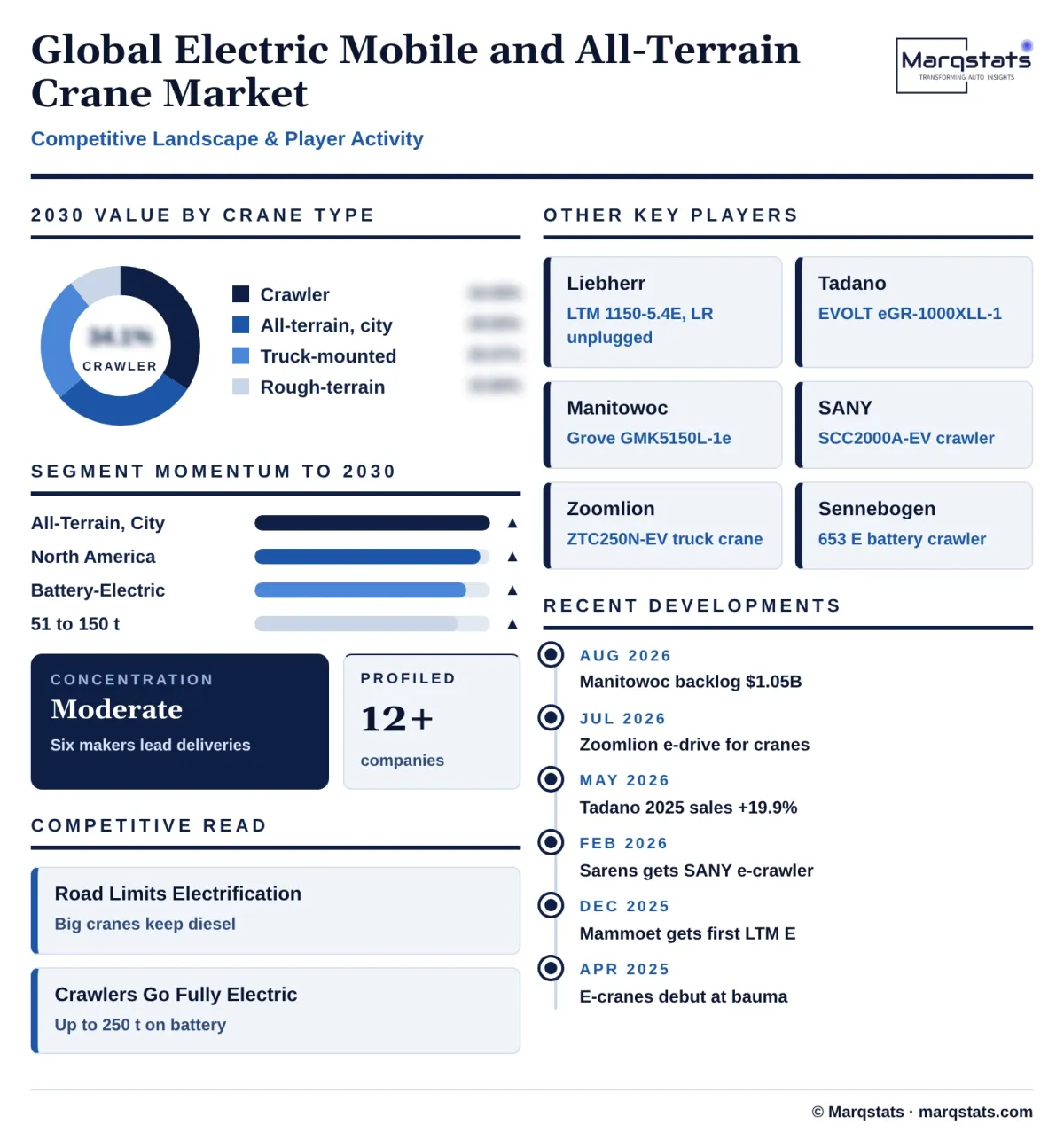
The market is moderately concentrated. Liebherr, Tadano, Manitowoc, Zoomlion, XCMG and SANY account for most electric crane deliveries, with Sennebogen, Kobelco, Kato Works and Marchetti competing in particular crane types.
Liebherr is the largest mobile crane maker. In 2025 its mobile and crawler crane division had revenue of EUR 3.65 billion, down 6.8%, out of group revenue of EUR 14.77 billion. Its electric line includes the LTC 1050-3.1E, the LTM 1150-5.4E and the LR 1250.1 unplugged and LR 1130.1 unplugged crawlers, and it plans series delivery of the LTM 1150-5.4E from spring 2026.
Tadano is the second global supplier. Its 2025 revenue rose 19.9% to JPY 349.5 billion, with mobile cranes at JPY 207.1 billion, and its EVOLT range covers battery rough-terrain cranes in Japan and North America. Manitowoc, owner of the Grove brand, reported second-quarter 2026 net sales of USD 594.9 million, up 10.3%, and a backlog of USD 1,050.1 million.
Chinese makers supply most units at lower prices. Zoomlion, XCMG and SANY sell electric truck and crawler cranes at home and abroad, and SANY's delivery of a 200-tonne electric crawler to Sarens shows they can now sell into European heavy-lift fleets.
Companies Covered
Companies covered in the report include:
Recent Market Activity
Table of Contents
Coverage & Segmentation
The study covers the global electric mobile and all-terrain crane market, with 2025 as the base year, 2021 – 2025 as the historical period and 2026 – 2030 as the forecast period. Values are in US dollars at ex-works prices, and volumes are new cranes delivered. Euro and yen figures are converted at 2025 average rates of EUR 1 = USD 1.13 and USD 1 = JPY 150. The market is segmented by crane type, drive architecture, lifting capacity and region.
Tower cranes, port, ship-to-shore and gantry cranes, overhead cranes, loader and knuckle-boom cranes, mini crawler and spider cranes, diesel cranes running on HVO, separately sold charging equipment and mobile battery units, and crane rental revenue are excluded. Electric cranes are not part of the Marqstats Europe Electric Construction Equipment study, which covers excavators, loaders, dumpers and compaction machines, so the two can be read side by side. Segment splits, 2030 regional values and the delivery forecast are Marqstats estimates built on manufacturer specifications and disclosures, industry sales statistics, customer delivery announcements and price benchmarks.