Market Snapshot
Middle bar: base-year value × (1 + CAGR), rounded to two decimals. This is a calculated illustration, not a separately researched annual estimate.
The global electric maxi-scooter market size is estimated at USD 549.99 million in 2025 and is projected to reach USD 1,285.00 million by 2030, growing at a CAGR of 18.50% over 2026 – 2030. Annual deliveries rise from about 48,500 to 118,500 scooters, a 19.56% annual rate, while the average ex-factory price eases from about USD 11,340 to USD 10,844.
Marqstats defines the electric maxi-scooter as a battery-electric, step-through scooter with a long wheelbase, full bodywork with a windscreen, a flat footboard, under-seat storage, a peak motor output above 11 kW and the ability to cruise at more than 100 km/h. The market is measured as the ex-factory wholesale value of new vehicles. Low-speed mopeds, small commuter scooters below 11 kW peak, straddle-type electric motorcycles, electric bicycles and used vehicles are excluded.
Scooters in the 11 kW to 35 kW continuous power class, matching the European A2 licence, account for an estimated 63.41% of 2025 value. Fixed-battery scooters charged from a plug account for 91.88% of value. Western Europe accounts for 59.07% of 2025 value and East Asia for 22.65%. The study segments the market by continuous power class, charging architecture, end use and region.
Key Takeaways
Market Overview & Analysis
Report Summary
Marqstats sizes the electric maxi-scooter market as the ex-factory value of new battery-electric touring scooters that can sustain highway speeds. In 2025 about 48,500 such scooters were delivered worldwide, worth an estimated USD 549.99 million at an average ex-factory price of about USD 11,340.
The category sits at the top of the electric two-wheeler market. Of more than 10 million electric two-wheelers sold globally each year, most are electric bicycles, low-speed mopeds and small commuter scooters with motors below 5 kW. Only a small share are homologated for highway use, and maxi-scooters are a subset of those, combining a long wheelbase, weather protection, storage space and the power to cruise at 100 to 120 km/h.
European type approval shapes the product. Regulation (EU) No 168/2013 places two-wheeled motorcycles in Category L3e and divides them by power. A1 vehicles are limited to 11 kW, A2 vehicles to 35 kW and A3 vehicles have no limit. For electric motors the limit applies to continuous rated power measured over 30 minutes, not to short peak output. A scooter can therefore deliver about 31 kW for acceleration while being rated at about 15 kW continuous, and versions limited to 11 kW continuous can be ridden in several countries on a car licence with an A1 extension, such as code B196 in Germany or the 125 cc equivalence in France.
BMW Motorrad defined the premium segment with the CE 04, launched in 2022 and built in Berlin. The scooter uses an 8.9 kWh battery and about 31 kW peak output, reaches 120 km/h, covers up to 130 km and charges from 20% to 80% in about 45 minutes on a 6.9 kW public charger. It was updated in July 2025 with new trims, heated grips and seat on the top version and an optional dynamic package. In India it sells as an import at about INR 15.25 lakh.
The market grew from about 18,200 scooters worth USD 189.28 million in 2021 to 24,100 worth USD 256.67 million in 2022, 31,800 worth USD 346.62 million in 2023 and 41,200 worth USD 459.38 million in 2024, a historical value growth rate of 30.56% a year between 2021 and 2025. Marqstats expects about 58,000 deliveries worth USD 649.60 million in 2026.
Two technical approaches compete. High-voltage scooters such as the BMW CE 04 and the Horwin Senmenti 0 use fixed liquid-cooled battery packs of 8.5 to 17 kWh and plug into car charging points. Low-voltage scooters such as the Silence S01, the Segway E300SE and the Zeeho AE8 S use removable battery packs of 3.7 to 5.6 kWh that can be carried indoors or swapped, trading highway range for convenience.
Global Electric Maxi-Scooter Market Size and Forecast
The global electric maxi-scooter market grows from USD 549.99 million in 2025 to USD 1,285.00 million in 2030, a CAGR of 18.50%. Marqstats expects about 69,500 deliveries worth USD 767.98 million in 2027, 83,200 worth USD 911.04 million in 2028 and 99,600 worth USD 1,083.65 million in 2029, before reaching about 118,500 deliveries in 2030.
Prices ease slowly. The average ex-factory price rose from about USD 10,400 in 2021 to USD 11,340 in 2025 as BMW's CE 04 and larger batteries raised the mix. Marqstats expects it to ease to about USD 11,200 in 2026, USD 11,050 in 2027 and USD 10,844 in 2030, about 4.4% below 2025, as battery pack costs fall and Asian makers add volume, partly offset by more electronics, connectivity and rider-assistance content.
Range at speed is the central engineering trade-off. Marqstats estimates that a maxi-scooter with about 8.5 kWh of usable battery consumes about 6.5 kWh per 100 km in mixed urban riding, giving about 130 km of range, about 8.5 kWh per 100 km at a steady 100 km/h, giving about 100 km, and about 11.5 kWh per 100 km at 120 km/h, giving about 74 km. Doubling highway range would need a battery about twice as large, adding 70 to 90 kg.
Weight follows battery size. A 400 cc petrol maxi-scooter weighs about 200 kg with a fuel tank that gives more than 300 km of range. An electric maxi-scooter with about 130 km of rated range weighs about 230 kg, because the battery alone weighs 70 to 90 kg. More weight reduces the load the scooter can carry with two riders and luggage and needs firmer suspension.
Licence rules define the customer base. Because European categories use continuous rather than peak power, many maxi-scooters can be homologated in an A1 version for car-licence holders and an A2 version for motorcyclists from the same hardware. Marqstats tracks four indicators to monitor the forecast: European L3e electric registrations, national purchase incentives, battery pack prices for two-wheelers, and the number of highway-capable electric scooter models on sale in each region.
The forecast also reflects a recovery from a weak 2025. New Euro 5+ emission rules for two-wheelers from January 2025 led manufacturers to pre-register petrol models in late 2024, which depressed registrations in early 2025. Marqstats expects electric maxi-scooter deliveries to rise by about 20% in 2026 as new models arrive, Italian incentives reopen and buyers return, with growth of 18% to 20% a year thereafter as model choice widens and battery prices fall.
Market Dynamics
Key Drivers
Five forces are pulling commuters towards highway-capable electric scooters.
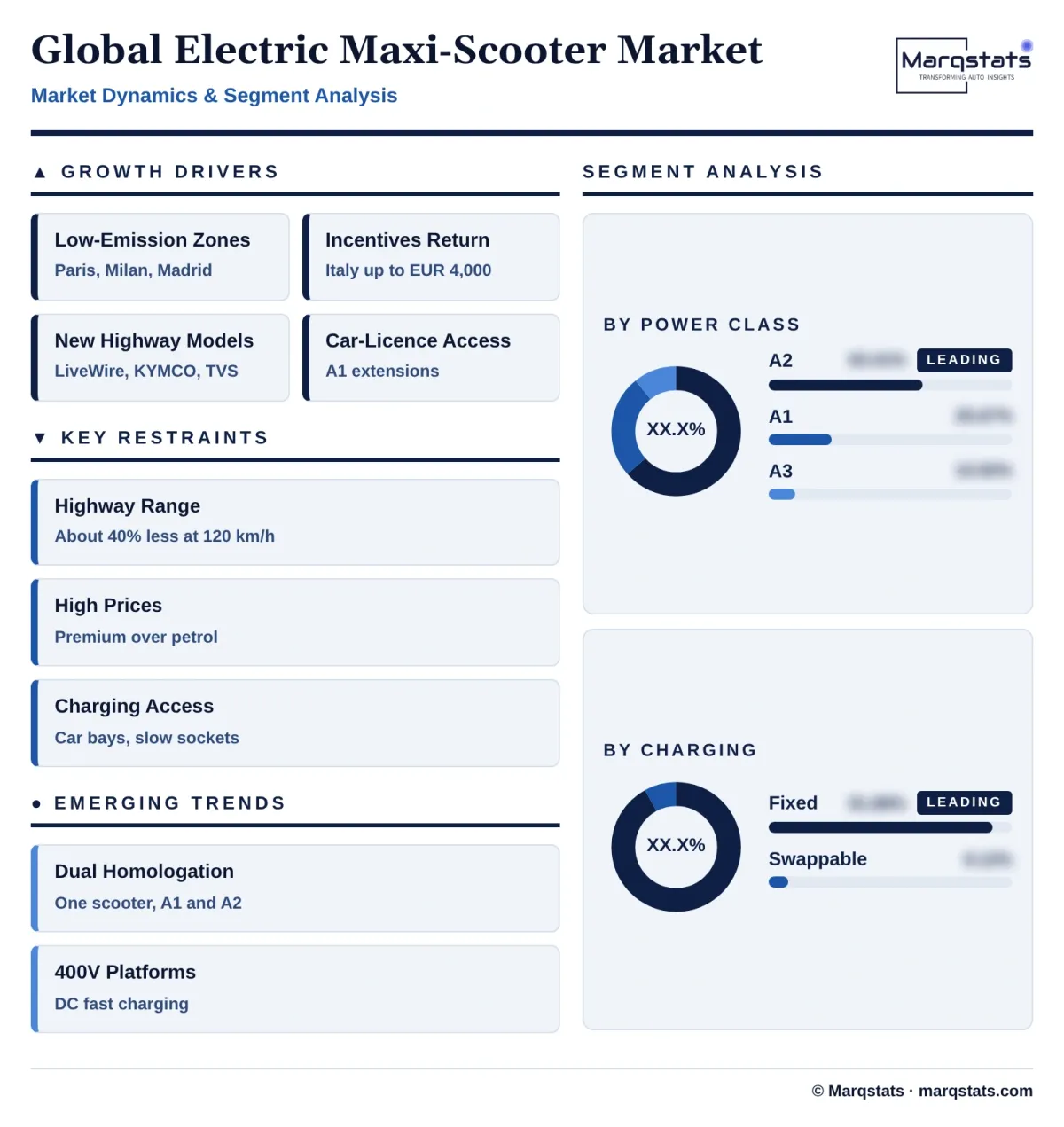
- Low-emission zones are tightening. Paris, Milan, Madrid, Barcelona and other European cities restrict older petrol two-wheelers and charge for their parking, pushing daily commuters towards electric models that keep access to city centres.
- Purchase incentives return. Italy reopened its Ecobonus on 18 March 2026, offering 40% of the price up to EUR 4,000 with scrapping of an old vehicle or 30% up to EUR 3,000 without, for electric and hybrid L-category vehicles, from a EUR 30 million fund.
- More models with real highway capability. The LiveWire and KYMCO maxi-scooter shown at EICMA in November 2025 uses a platform with 63 kW peak and 30 kW continuous power, and TVS Motor unveiled its M1-S electric maxi-scooter with a 4.3 kWh battery and 105 km/h top speed at the same show.
- Car-licence access widens the customer base. Licence extensions such as B196 in Germany and the 125 cc equivalence in France let car drivers ride A1-class scooters after short training, and electric scooters rated at 11 kW continuous can offer strong acceleration within this class.
- Shared parts with cars cut costs. BMW uses battery and electronics technology from its car business in the CE 04, and Chinese makers draw on local cell supply chains, lowering costs and improving reliability.
Key Restraints
Four constraints keep the electric maxi-scooter a premium, urban-focused product.
- Range falls at highway speed. Marqstats estimates range drops by around 40% at 120 km/h compared with mixed urban riding, limiting long commutes on motorways.
- High prices. Premium electric maxi-scooters cost well above comparable petrol models, and in India the BMW CE 04 sells at about INR 15.25 lakh as an import, making the category a luxury purchase outside Europe.
- Charging access for two-wheelers. Large fixed batteries need a plug, but public charging bays are designed and priced for cars, and charging from a household socket takes more than four hours, so buyers without private parking face obstacles.
- Weak two-wheeler demand and fragile start-ups. Motorcycle registrations in Europe's five largest markets fell 12.9% in 2025 and moped registrations fell 20.7%, while start-ups such as Zapp have had to rebuild supply chains, leaving the category dependent on a few large manufacturers.
Key Trends
Four shifts are changing how electric maxi-scooters are designed, sold and used.
- One scooter, two licence classes. Manufacturers use software to homologate the same hardware as both an A1 and an A2 vehicle, reaching car-licence holders and motorcyclists without separate development.
- Higher-voltage platforms and DC charging. Flagship models such as the Horwin Senmenti 0 use 400V systems that can use car DC fast chargers, and the LiveWire and KYMCO scooter uses a motorcycle powertrain with 30 kW continuous output.
- More connectivity and safety electronics. Riders expect TFT displays, smartphone links, cornering ABS, traction control and emergency call functions, and UN Regulations No. 155 and No. 156 require cybersecurity and software update management for connected vehicles.
- Battery regulation raises the bar. The EU Batteries Regulation (EU) 2023/1542 applies in stages from February 2024, adding durability, state-of-health and labelling rules for light means of transport batteries and a digital battery passport from February 2027.
Strategic Implications
- For established motorcycle and car groups, shared parts are the cost advantage. Using battery modules, power electronics and software from car programmes lowers the cost of low-volume scooters and supports quality and warranty commitments.
- For new entrants, efficiency matters more than battery size. Better aerodynamics, wind protection and efficient drive units can cut highway consumption more cheaply than a larger and heavier battery.
- For component suppliers, compact drive units are the opportunity. Integrated motor, inverter and gearbox units with liquid cooling that fit under a step-through frame and sustain highway power without derating can be sold to several scooter makers.
- For cities, charging and parking rules decide adoption. Allowing electric two-wheelers to use car charging bays without penalties, or adding dedicated two-wheeler charging points, would widen the customer base beyond homeowners.
- For fleet operators, total cost of ownership supports electric scooters. Police, municipal and delivery fleets with depot charging and predictable routes can benefit from lower energy and maintenance costs.
Market Segmentation
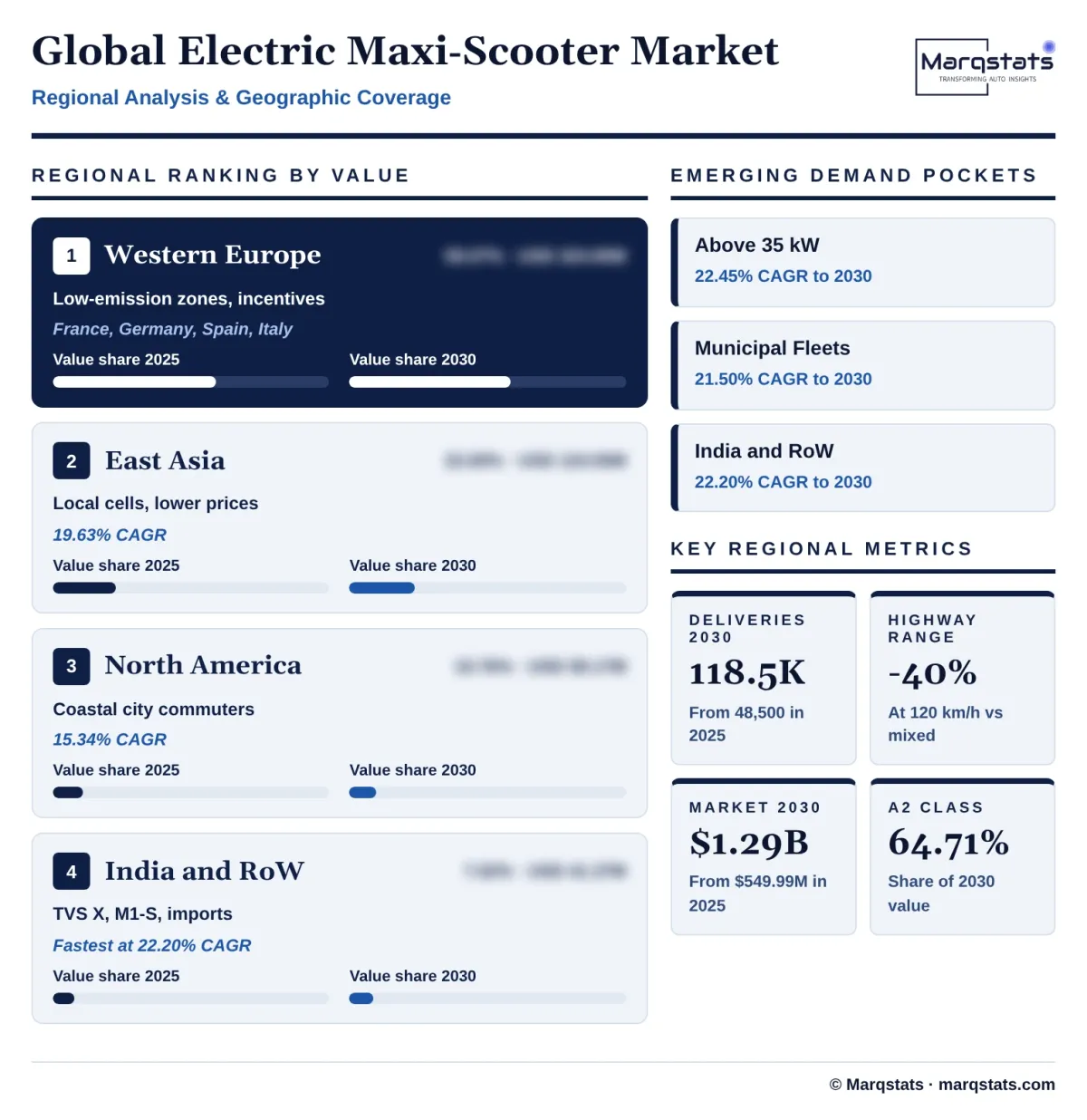
Scooters rated at up to 11 kW continuous power, which car-licence holders with an A1 extension can ride in several European countries, account for an estimated 25.67% of 2025 value, USD 141.16 million and about 17,215 scooters, rising to USD 288.19 million by 2030, a 15.34% CAGR, while their share falls to 22.43% as buyers seek more highway capability.
Scooters rated between 11 kW and 35 kW continuous power, including the BMW CE 04 in its standard form, account for 63.41% of 2025 value, USD 348.77 million and about 27,645 scooters, and grow at 18.98% a year to USD 831.50 million, 64.71% of 2030 value. This class holds motorway speeds without overheating and is open to A2 licence holders.
High-performance scooters above 35 kW continuous power account for 10.92% of 2025 value, USD 60.06 million and about 3,640 scooters, and grow fastest, at 22.45% a year, to USD 165.31 million, 12.86% of 2030 value, as high-voltage flagship models enter the market.
Scooters with fixed battery packs charged from household sockets or car charging points account for 91.88% of 2025 value, USD 505.35 million, and grow at 19.00% a year to USD 1,206.08 million, 93.86% of 2030 value, because only fixed packs can hold enough energy for highway range.
Scooters with removable battery packs that riders carry indoors or exchange at swap stations account for 8.12% of 2025 value, USD 44.64 million, and grow at 12.07% a year to USD 78.92 million, used mainly by urban commuters and fleets that value quick battery changes over highway range.
Private buyers account for an estimated 80.00% of 2025 value, USD 439.99 million, rising to USD 1,015.15 million by 2030, an 18.20% CAGR, led by suburban commuters in European metropolitan areas.
Delivery and courier fleets account for 12.50% of 2025 value, USD 68.75 million, rising to USD 160.62 million by 2030, an 18.50% CAGR, using maxi-scooters for longer suburban delivery routes.
Police, municipal and emergency services account for 7.50% of 2025 value, USD 41.25 million, and grow fastest, at 21.50% a year, to USD 109.23 million, 8.50% of 2030 value, valuing quiet operation and quick acceleration in city traffic.
By Geography
Western Europe
Western Europe is the largest market, with an estimated 59.07% of 2025 value, USD 324.90 million and about 28,130 scooters, rising to USD 746.36 million by 2030, an 18.10% CAGR. France, Germany, Spain and Italy are the main markets, supported by city low-emission zones, car-licence extensions and incentives such as Italy's 2026 Ecobonus. Motorcycle registrations in the five largest markets fell 12.9% to 1,002,848 in 2025, with Spain the only one to grow, at 8.3%, while Silence registered 1,179 electric scooters in Spain in the first half of 2026, up 78.4%.
East Asia
East Asia accounts for an estimated 22.65% of 2025 value, USD 124.55 million and about 11,640 scooters, and grows at 19.63% a year to USD 305.14 million by 2030. Chinese makers such as CFMOTO's Zeeho brand, Segway-Ninebot and Horwin draw on local battery supply chains to offer highway-capable scooters at lower prices than European brands, and export them to Europe.
North America
North America accounts for an estimated 10.76% of 2025 value, USD 59.17 million and about 4,850 scooters, rising to USD 120.79 million by 2030, a 15.34% CAGR. Long commuting distances and high highway speeds limit demand, so electric maxi-scooters sell mainly in congested coastal cities, while the LiveWire and KYMCO partnership gives a US brand a route into the segment.
India and Rest of World
India and the rest of the world account for an estimated 7.52% of 2025 value, USD 41.37 million and about 3,880 scooters, and grow fastest, at 22.20% a year, to USD 112.71 million by 2030. Imported premium models such as the BMW CE 04 sell at about INR 15.25 lakh in India, while TVS Motor sells the TVS X with 11 kW peak power at about INR 2.50 lakh and unveiled the M1-S maxi-scooter, developed with ION Mobility, for Indonesia and other markets.
How Competition Is Evolving
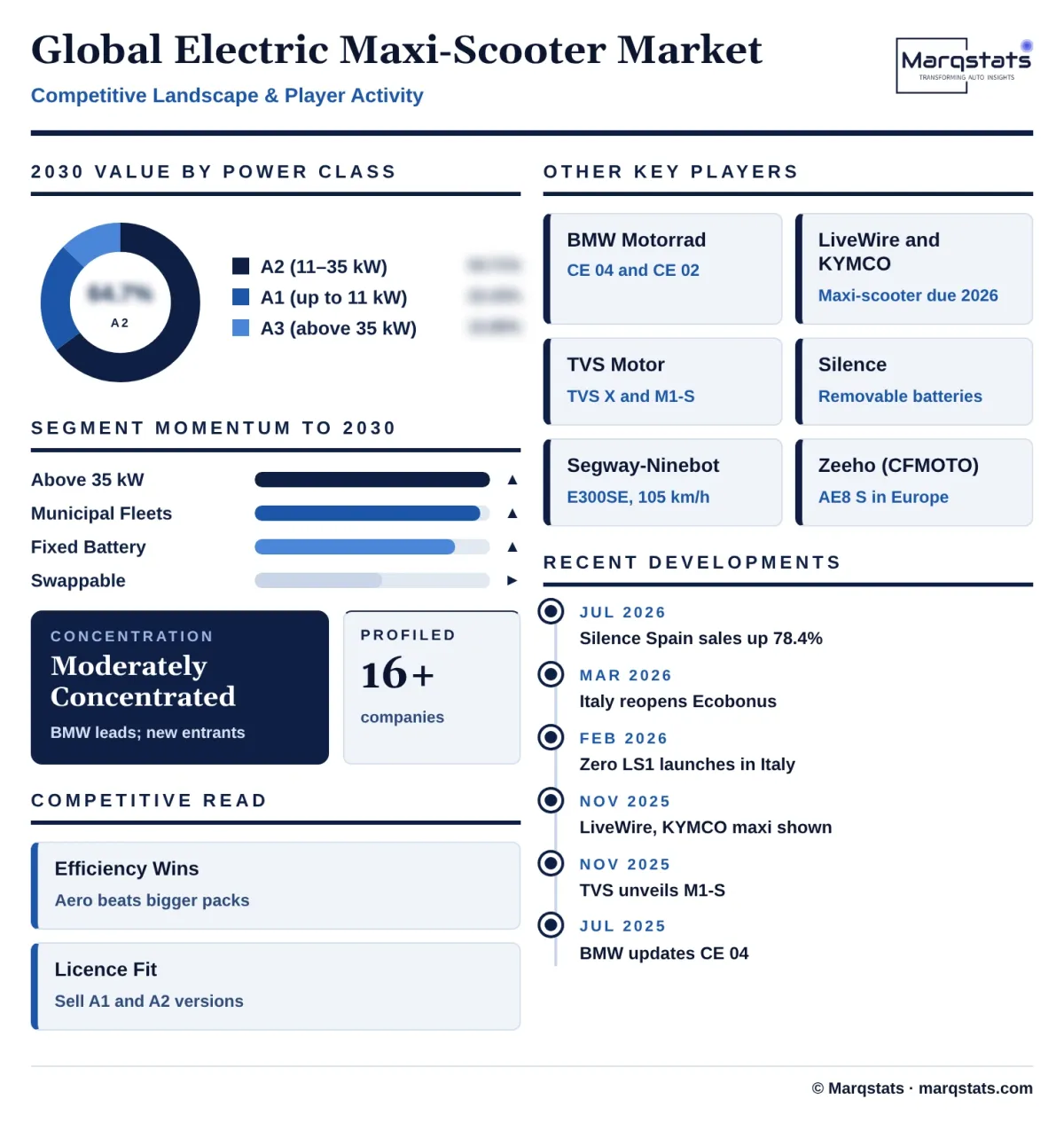
The electric maxi-scooter market is moderately concentrated. BMW Motorrad leads the premium segment by value with the CE 04 and CE 02, and its urban mobility range, which also includes petrol C 400 models, recorded more than 18,400 sales in 2025 within total deliveries of 202,563 motorcycles.
Chinese makers compete on power and price. Horwin showed its Senmenti 0 flagship with a 400V system at EICMA 2022 and CES 2024, Segway-Ninebot sells the E300SE with 10 kW peak power and up to 130 km of range, and CFMOTO's Zeeho AE8 S with 12.5 kW peak power sells in Spain at about EUR 4,990 through KTM's parent company.
New partnerships are entering the segment. LiveWire and KYMCO showed a near-production electric maxi-scooter at EICMA in November 2025, based on the LiveWire S2 Arrow platform, with launch expected in 2026. TVS Motor unveiled the M1-S at the same show. Spain's Silence leads the removable-battery segment and its home market.
Start-ups face funding pressure. Zapp, maker of the i300, moved its shares to the OTCQB market in August 2025 while it rebuilt its supply chain, showing how hard it is for small companies to fund homologation and distribution. Competition will be decided by battery cost, efficiency at highway speed, dealer networks and the ability to sell one model in several licence classes.
Established Japanese and European scooter makers have so far focused their electric efforts on smaller 125-class models such as Honda's CUV e: and Zero's LS1, leaving the highway-capable segment to BMW and new entrants. Their entry into the maxi class would add dealer networks and brand reach that most start-ups lack.
Companies Covered
Companies covered in the report include:
Recent Market Activity
Table of Contents
Coverage & Segmentation
The study covers the global electric maxi-scooter market, with 2025 as the base year, 2021 – 2025 as the historical period and 2026 – 2030 as the forecast period. Values are in US dollars at ex-factory wholesale prices and volumes are annual deliveries. The market is segmented by continuous power class, charging architecture, end use and region.
Electric mopeds limited to 45 km/h, small commuter scooters below 11 kW peak, straddle-type electric motorcycles, electric bicycles, three-wheelers and used vehicles are excluded. Segment, regional and price figures are Marqstats estimates built on type-approval categories, registration data, manufacturer disclosures and vehicle price benchmarks.