Market Snapshot
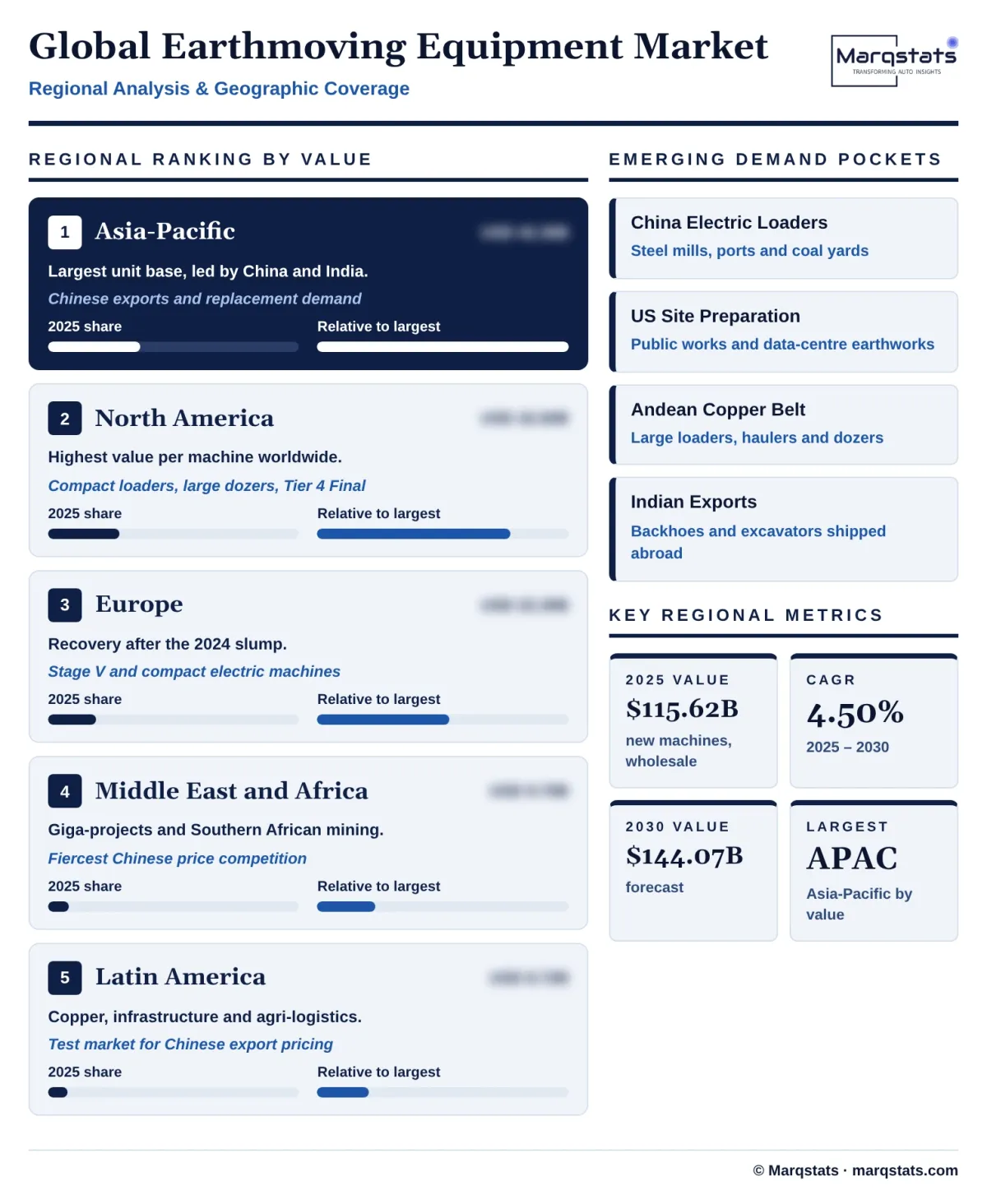
The global earthmoving equipment market is valued at USD 115.62 billion in 2025 and is forecast to reach USD 144.07 billion by 2030, a CAGR of 4.50%. Marqstats sizes it from 1,027,067 new machines in 2025, led by excavators, with Chinese wheel loaders setting the pace of electrification.
The number to watch is not the headline. In 2025 Chinese manufacturers shipped 235,257 excavators and 128,067 wheel loaders, according to the China Construction Machinery Association (CCMA), and roughly half of each went abroad. Those machines carry a fraction of the price of a North American or European equivalent, so China dominates the unit count while North America and Europe still hold close to half of global value.
Marqstats values the market at the OEM and dealer wholesale layer for new machines only: excavators of every size, wheel loaders, compact track and skid-steer loaders, crawler dozers, articulated and quarry-class rigid haulers, motor graders and backhoe loaders. Ultra-class mining trucks and shovels, rental revenue, parts, service and used machines sit outside the total.
Key Takeaways
Market Overview & Analysis
Report Summary
Earthmoving is the core of the construction machinery business and the most cyclical part of it. Marqstats sizes the market from the bottom up, machine class by machine class, using association unit data from the China Construction Machinery Association (CCMA), the Indian Construction Equipment Manufacturers Association (ICEMA) and the Committee for European Equipment Manufacturers (CECE), checked against the 2025 filings of Caterpillar Inc., Komatsu Ltd., Deere & Company, AB Volvo and XCMG Construction Machinery Co., Ltd.
The analysis answers three questions. How much new earthmoving machinery the world actually buys once Chinese exports are counted at their destination. Why value and volume diverge by region. And where the electric transition is real in units rather than in press releases. The answer to the third question is the Chinese wheel loader, which already sells in tens of thousands of units a year.
The market recovered in 2025 after two years of decline. China returned to growth on replacement demand and exports, Europe grew 4.6% across all construction equipment according to CECE, and India held flat on volume as CEV Stage V emissions rules raised machine prices. North America stayed the most valuable region even with a soft housing market, because public works and data-centre site preparation kept heavy machines busy.
Global Earthmoving Equipment Market Size and Forecast
Marqstats values the global earthmoving equipment market at USD 118.40 billion in 2021, USD 124.90 billion in 2022, USD 121.30 billion in 2023, USD 109.80 billion in 2024 and USD 115.62 billion in 2025. The forecast runs to USD 120.10 billion in 2026, USD 125.30 billion in 2027, USD 131.00 billion in 2028, USD 137.40 billion in 2029 and USD 144.07 billion in 2030. The 2025 to 2030 CAGR is 4.50%, and absolute growth over the period is USD 28.45 billion.
The 2024 trough was a volume event more than a price event. Dealer destocking in North America and Europe and the long downturn in Chinese property construction cut unit sales, while list prices held because emissions hardware, cab electronics and steel costs did not fall. The 2025 rebound came from China first. CCMA reported excavator sales up 17.0% and loader sales up 18.4%, with domestic excavator demand up 17.9% and exports up 16.1%.
Unit deliveries rise from 1,027,067 machines in 2025 to 1,204,000 in 2030, a unit CAGR of 3.23%. The gap between the 4.50% value CAGR and the 3.23% unit CAGR is the mix effect. Electric machines, grade-control systems and larger excavators carry higher prices, while backhoe loaders, the cheapest machine class in the total, lose share. The average machine value rises from USD 112,573 to USD 119,659.
The trajectory is gradual for a reason. The 2026 step to USD 120.10 billion is held back by Middle East and mining softness that Komatsu Ltd. flagged in its April 2026 outlook, and by tariffs that keep Western machine prices high but squeeze volumes. Growth then accelerates to about 4.9% a year in 2029 and 2030 as replacement of the 2021 and 2022 peak fleet arrives and Chinese electric loader volumes keep compounding.
China Sets the Unit Count While the West Sets the Value
Counting machines and counting dollars produce two different maps of this market. Chinese manufacturers sold 235,257 excavators in 2025, of which 116,739 were exported, and 128,067 loaders, of which 61,737 were exported, according to CCMA. On units that makes China the centre of the global industry. On value it is not, because a Chinese 5-tonne diesel wheel loader realises around RMB 340,000 at the factory gate on Marqstats estimates, about USD 47,000 at the fixed rate of RMB 7.18 per US dollar, against roughly USD 188,000 for the average non-Chinese wheel loader.
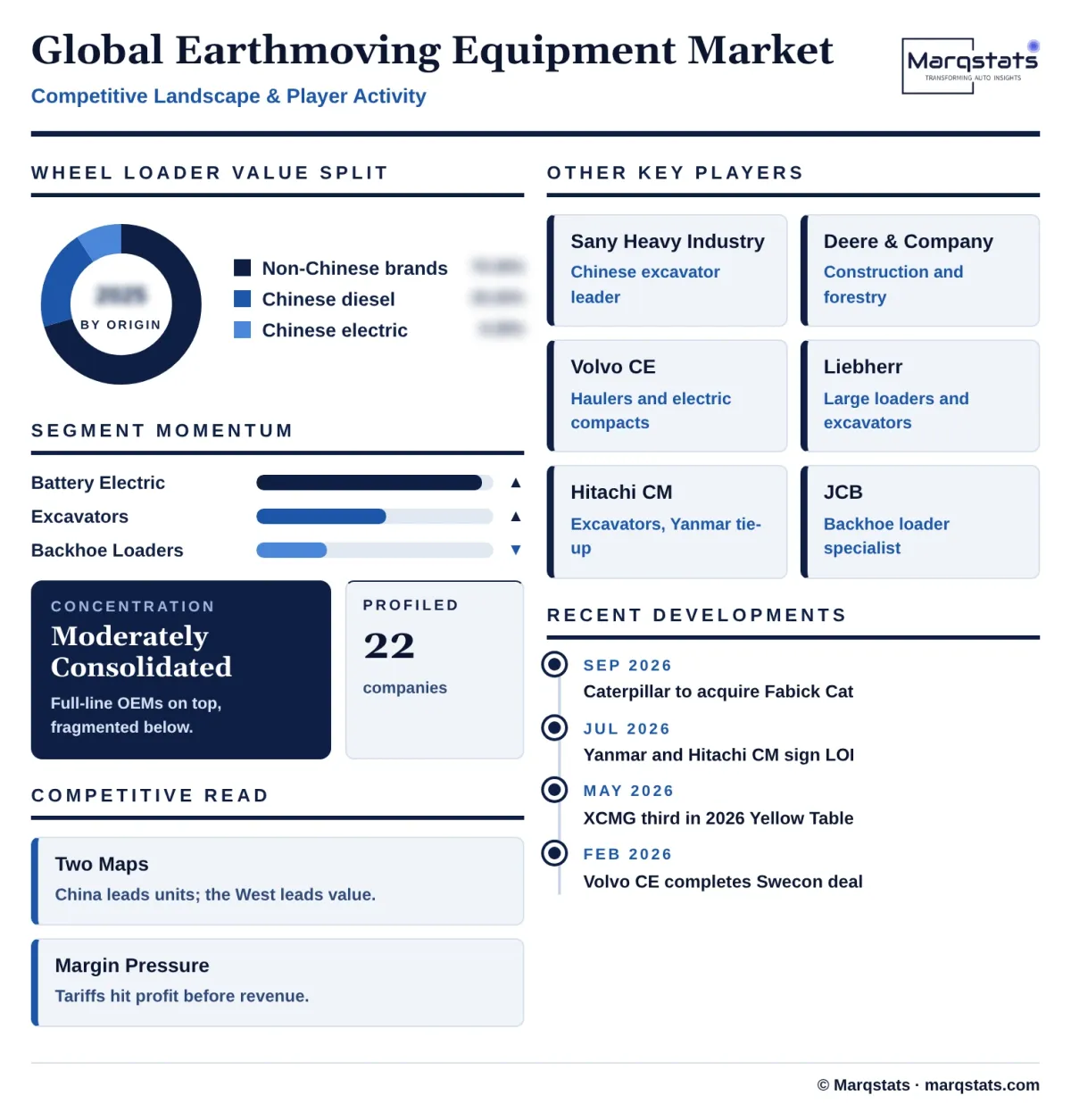
Marqstats builds the 2025 wheel-loader pool at 214,067 units and USD 22.98 billion. Chinese brands supply 128,067 of those machines and about USD 6.81 billion of the value. The 86,000 machines from Caterpillar Inc., Komatsu Ltd., Volvo Construction Equipment, Liebherr-International AG, Deere & Company, HD Hyundai Construction Equipment Co., Ltd., J.C. Bamford Excavators Limited and the European compact-loader specialists supply the remaining USD 16.17 billion. The result is a 59.83% unit share against a 29.64% value share. Split three ways, non-Chinese brands hold 70.36% of wheel-loader value, Chinese diesel loaders 20.26% and Chinese battery-electric loaders 9.38%.
The non-Chinese unit count and every price per machine in this split is a Marqstats estimate, built from OEM filings and dealer price evidence; the Chinese unit count is CCMA data. The implication for anyone sizing a supplier opportunity is direct. A component maker that prices by the machine should read the Chinese numbers. One that prices by content per machine, such as an emissions aftertreatment supplier or a telematics vendor, should read the Western numbers, because that is where the content is fitted and paid for.
Electrification Has Already Happened in One Machine Class
Battery-electric earthmoving is not a forecast in the wheel-loader class. The live Marqstats China Electric Wheel Loader Market page records 29,771 battery-electric wheel loaders sold in 2025 at a blended RMB 520,000 each, RMB 15.48 billion in total, with domestic penetration of 43.70% and export penetration of only 1.27%. That makes electric machines 13.91% of all wheel loaders sold worldwide.
The rest of earthmoving is far behind. Marqstats estimates battery-electric machines of all types at USD 3.00 billion in 2025, 2.59% of market value, rising to USD 9.20 billion and 6.39% in 2030. The gap exists because the economics that work for a Chinese 5-tonne loader working a single shift at a steel mill or port, with cheap lithium iron phosphate cells and depot charging, do not yet work for a 36-tonne excavator on a remote highway job.
The conclusion is that electric earthmoving will be led by loaders and compact machines working at fixed sites, and that Chinese suppliers will hold the cost lead in those classes through 2030. Western OEMs will sell electric compact excavators into municipal and rental tenders in Europe, but those volumes are measured in thousands, not tens of thousands.
Market Dynamics
Key Drivers
Four forces lift earthmoving demand through 2030, and each carries a named instrument or a measured volume.
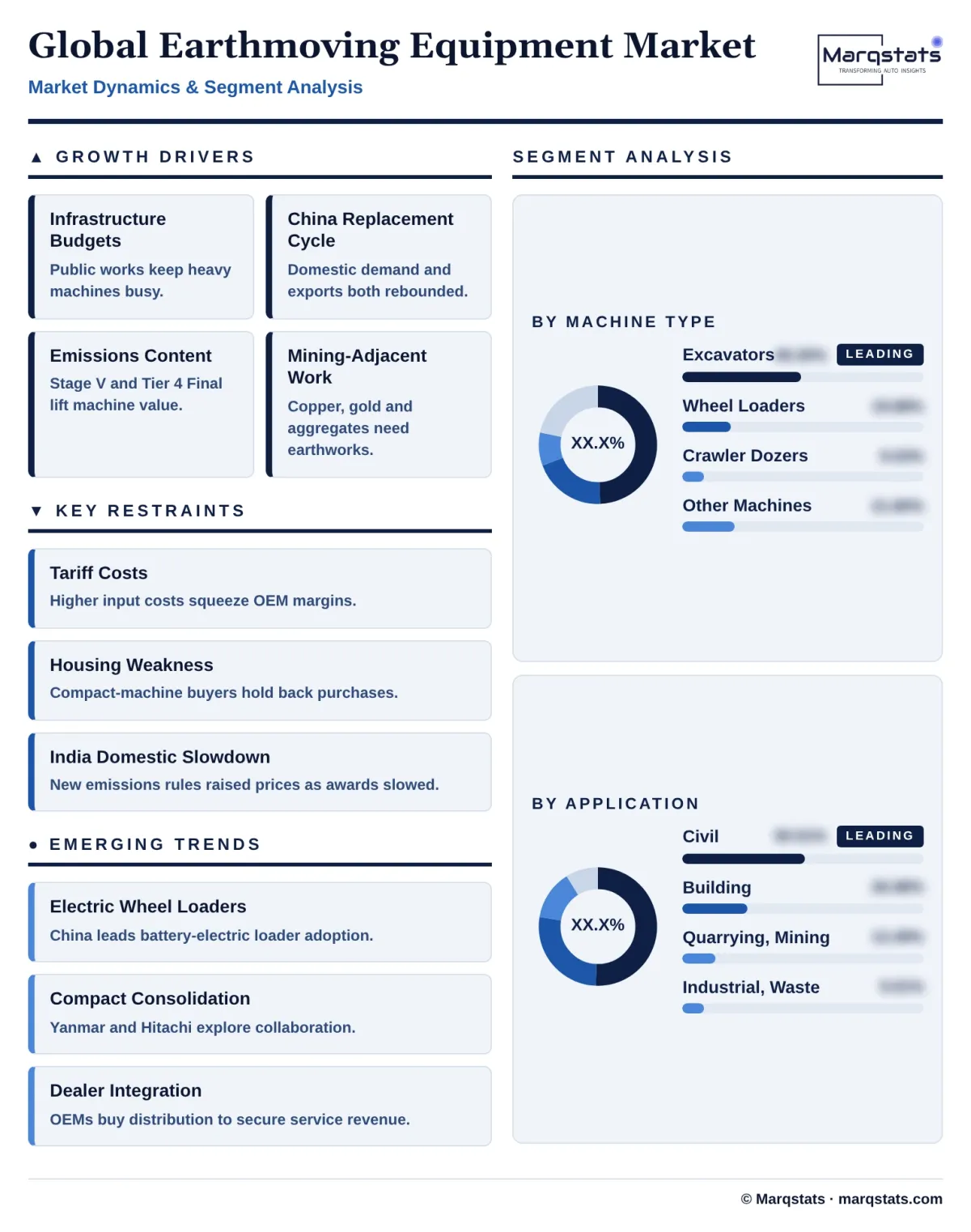
- Public infrastructure spending: civil engineering activity in Europe grew around 3% in 2025 according to CECE, and US highway and water programmes funded under the Infrastructure Investment and Jobs Act keep crawler excavators, graders and haulers working. Infrastructure absorbs USD 58.40 billion of 2025 earthmoving value, 50.51% of the total, which makes public budgets the single largest demand lever.
- Chinese replacement and export cycle: CCMA data show domestic excavator sales up 17.9% in 2025 to 118,518 units after four years of decline, and exports up 16.1% to 116,739. Machines bought in the 2020 and 2021 peak are reaching replacement age, and Chinese manufacturers now treat export markets as a second home market, which adds volume to the global count.
- Emissions rules raise the value of every machine: Regulation (EU) 2016/1628 (Stage V), US EPA Tier 4 Final under 40 CFR Part 1039, China non-road Stage IV from 1 December 2022 and India CEV Stage V from January 2025 all require particulate filters, selective catalytic reduction or both. Rating agency ICRA estimated the Indian switch would add up to about 15% to machine prices, and every such step lifts market value even when units stand still.
- Mining-adjacent and energy-transition earthworks: Caterpillar Inc. expects Resource Industries sales to users to rise in 2026, driven by copper and gold, and grid, renewable and data-centre sites need mass earthworks. Quarrying and mining-adjacent work holds USD 15.60 billion in 2025 and grows to USD 19.80 billion by 2030, faster than the market as a whole.
Key Restraints
Three restraints hold the market below its 2022 value peak until 2027.
- Tariffs squeeze margins and volumes together: Caterpillar Inc. paid USD 1.8 billion in new tariffs in 2025, and its Construction Industries profit fell 12% to USD 1.030 billion in the fourth quarter even as segment sales rose 15% to USD 6.926 billion. Komatsu Ltd. cited US tariffs when it forecast lower segment profit for the year to March 2027. Higher prices protect revenue but defer fleet purchases by smaller contractors.
- Housing weakness removes the compact-machine buyer: CECE identified residential building as the main area of weakness in Europe in 2025, and Komatsu Ltd. described North American residential demand as sluggish, with rental companies cutting machine purchases. Residential and commercial building is 26.98% of 2025 earthmoving value and grows below the market average.
- Indian domestic demand slipped under new rules: ICEMA reported total construction equipment sales of 136,995 units in FY26, down 2%, with earthmoving at 97,236 units and domestic demand down about 7%, while exports rose 31.5%. Slower highway awards and the CEV Stage V price step shrank the domestic market at exactly the moment the world expected India to carry growth.
Key Trends
Three trends change what an earthmoving machine is and who sells it.
- Electric wheel loaders go mainstream in China: 29,771 battery-electric wheel loaders sold in 2025, 43.70% of domestic loader sales, and the live China Electric Wheel Loader page forecasts about 101,550 units by 2030. The machine class that leads electrification is the mid-size loader, not the mini excavator.
- Compact equipment consolidation: Yanmar Holdings Co., Ltd. and Hitachi Construction Machinery Co., Ltd. signed a letter of intent on 23 July 2026 to explore collaboration in compact equipment while keeping separate brands and dealer networks. Compact machines need volume to fund electric and autonomous platforms, and partnerships are the cheaper route to it.
- Dealer and service integration: Volvo Construction Equipment completed its acquisition of the Swecon dealer business on 1 February 2026, and Caterpillar Inc. agreed to acquire the Fabick Cat dealership on 29 September 2026. OEMs are buying distribution to secure parts and service revenue, which Caterpillar put at USD 24 billion in 2025.
Strategic Implications
- For entrants: compete where the price gap is narrow and the duty cycle is fixed. A battery-electric wheel loader for ports, steel mills, recycling yards and aggregate plants is a proven product with 29,771 annual units in China alone; a heavy electric excavator for remote highway work is not. Distribution through rental fleets and port operators avoids the cost of building a dealer network.
- For incumbents: price for content, not for units. non-Chinese OEMs hold 70.36% of wheel-loader value on 40.17% of units, and that premium rests on emissions compliance, uptime, financing and dealer service. Protecting it means bundling telematics and service contracts with the machine, and defending Latin American, African and Southeast Asian markets with a simpler, lower-cost machine line rather than conceding them to Chinese exports.
- For suppliers: the two maps of the market need two sales plans. Hydraulic, driveline and steel suppliers should follow Chinese unit volumes and export routes. Aftertreatment, sensor, grade-control and battery-system suppliers should follow the regulated markets of North America, Europe, Japan, Korea and now India, where content per machine is highest.
- For investors and lenders: treat the 2026 step as a pause, not a peak. Marqstats expects 3.87% growth in 2026 followed by about 4.9% a year in 2029 and 2030 as the 2021 and 2022 fleet comes up for replacement. Tariff costs and Chinese price pressure will show up in margins before they show up in revenue.
Market Segmentation
Excavators are the largest machine class at USD 57.00 billion in 2025, 49.30% of market value, rising to USD 72.75 billion and 50.50% in 2030 at a CAGR of 5.00%. These figures equal the live Marqstats Global Excavator Market page, which sizes crawler, wheeled and mini excavators on the same new-equipment basis, so the excavator slice here is a sub-slice and must not be added on top.
Marqstats counts about 575,000 excavators sold worldwide in 2025, rising to 690,000 by 2030. Chinese brands supplied 235,257 of them according to CCMA, half exported. Outside excavators, wheel loaders and crawler dozers, the remaining classes (haulers, compact track and skid-steer loaders, graders and backhoe loaders) make up 21.80% of value, or USD 25.20 billion. Excavators keep gaining share because one machine with quick-coupler attachments now does work that once needed a backhoe, a dozer and a breaker.
Wheel loaders are worth USD 22.98 billion in 2025, 19.88% of the market, from 214,067 units including compact wheel loaders. By 2030 the class reaches USD 27.97 billion and 248,000 units, a value CAGR of 4.01% and a unit CAGR of 2.99%. Chinese brands supply 128,067 units in 2025 per CCMA, of which 61,737 were exported.
This is the class where electrification is measurable. Battery-electric loaders were 13.91% of global wheel-loader units in 2025, almost all of them sold in China. Value growth runs ahead of unit growth because electric loaders carry about a 53% premium over Chinese diesel equivalents, on Marqstats estimates of RMB 520,000 against RMB 340,000.
Crawler dozers account for USD 10.44 billion in 2025, 9.03% of value, from about 29,000 units, and reach USD 12.60 billion in 2030. The class is concentrated in North America, Australia and mining-adjacent work, where Caterpillar Inc. and Komatsu Ltd. dominate large machines and Shantui Construction Machinery Co., Ltd. leads Chinese volume. Ultra-class mining dozers sold directly to mine operators remain inside the total because they are sold through the same dealer channel, while mining trucks above 100 tonnes are excluded.
Articulated dump trucks and quarry-class rigid haulers up to 100 tonnes are worth USD 9.51 billion in 2025, 8.23% of value, from about 16,000 units, rising to USD 11.90 billion in 2030. Articulated haulers are a European-led product, with Volvo Construction Equipment, Caterpillar Inc., Komatsu Ltd., Deere & Company and Bell Equipment the principal suppliers. The class grows faster than the market because quarrying and energy-transition earthworks need haulage more than digging.
Compact track and skid-steer loaders contribute USD 6.51 billion in 2025, 5.63% of value, from about 105,000 units, and USD 8.30 billion in 2030 at a CAGR of 4.98%. North America takes most of these machines, which is a large part of why the region's value per machine is the highest in the world. Doosan Bobcat Inc., Caterpillar Inc., Deere & Company, Kubota Corporation and Takeuchi Mfg. Co., Ltd. lead, and Hitachi Construction Machinery Co., Ltd. is entering through its Yanmar collaboration.
Motor graders are worth USD 5.10 billion in 2025, 4.41% of the market, from about 20,000 units, and USD 5.95 billion in 2030. Demand tracks road building and mine haul-road maintenance. Grade-control automation is moving value per machine up faster than units, but the class grows below the market at 3.13% a year.
Backhoe loaders are the smallest class at USD 4.08 billion in 2025, 3.53% of value, from about 68,000 units, and USD 4.60 billion in 2030, the slowest growth of any class at 2.43%. India is the largest backhoe market in the world and ICEMA names backhoe loaders as the leading earthmoving product there; in North America and Europe the machine keeps losing ground to mini excavators paired with compact loaders.
Diesel machines, including those running hydrotreated vegetable oil, make up USD 111.42 billion in 2025, 96.37% of value, and USD 132.87 billion in 2030, 92.23%. Diesel keeps its hold on machines above 100 kW running multi-shift duty cycles, where refuelling speed and remote-site energy density still decide the purchase.
Battery-electric machines are worth USD 3.00 billion in 2025, 2.59% of value, and USD 9.20 billion in 2030, 6.39%, a CAGR of 25.12%, the fastest in the market. Chinese battery-electric wheel loaders, at RMB 15.48 billion in 2025, are by far the largest part. The rest comes from compact electric excavators and loaders sold into European municipal and rental fleets.
Hybrid machines, mostly 20-to-40-tonne excavators with electric swing or energy recovery, are worth USD 1.20 billion in 2025, 1.04% of value, and USD 2.00 billion in 2030, 1.39%. Hybrids save fuel on repetitive swing cycles but carry a price premium that many buyers outside Japan and North America will not pay.
Infrastructure is the largest application at USD 58.40 billion in 2025, 50.51% of value, rising to USD 74.20 billion and 51.50% in 2030. Highways, rail, water, energy transmission and data-centre site preparation absorb medium and large excavators, graders, dozers and haulers. Public budgets in the United States, Europe and India set the pace.
Residential and commercial building takes USD 31.20 billion in 2025, 26.98% of value, and USD 37.60 billion in 2030, 26.10%. This is the home of the compact machine and the most interest-rate-sensitive buyer. Recovery depends on housing starts in Europe and North America, which CECE expects to turn up in 2026 after two years of steep decline.
Quarrying, aggregates and mining-adjacent work account for USD 15.60 billion in 2025, 13.49% of value, rising to USD 19.80 billion and 13.74% in 2030. Copper, gold and aggregates demand lift large wheel loaders, haulers and dozers, while ultra-class mining fleets are excluded from the total.
Industrial, waste handling, forestry and agricultural uses take USD 10.42 billion in 2025, 9.01% of value, and USD 12.47 billion in 2030, 8.66%. This is where the Chinese electric wheel loader found its first market: steel mills, ports and coal yards with fixed sites and short charging distances.
By Geography
Asia-Pacific
Asia-Pacific is the largest region because it holds the world's two biggest unit markets, China and India, and the most export capacity. Marqstats values regional sales at USD 42.30 billion in 2025, 36.59% of the global total, with China at about USD 14.20 billion of domestic sales and Japan, India, Australia, Indonesia and Korea making up the rest. China's domestic share of value is far below its share of machines: CCMA reports 118,518 domestic excavator sales and 66,330 domestic loader sales, mostly at Chinese prices. Measured against Asia-Pacific, North America is 77.07% as large by value, Europe 52.72%, the Middle East and Africa 22.93% and Latin America 20.61%.
The regional share sits below the close to 44% that the live Marqstats Global Construction Equipment page gives Asia-Pacific for all construction machinery. The difference is scope. Cranes, concrete machinery and road equipment, which are excluded here, are heavily Chinese, while compact track loaders and large dozers, which are included, are heavily North American. India adds volume but not value in 2025; ICEMA reported earthmoving sales of 97,236 units in FY26, down 2%.
North America
North America is the most valuable market per machine and the second largest by total value at USD 32.60 billion in 2025, 28.20% of the global total. Buyers favour larger excavators, high-horsepower dozers, compact track loaders and Tier 4 Final machines with grade control, so every unit carries more content. Caterpillar Inc. reported Construction Industries fourth-quarter sales up 15% on end-user demand and dealer restocking, and Deere & Company reported construction and forestry net sales of USD 11.4 billion for fiscal 2025, down 12%, with about 10% growth expected in fiscal 2026. Tariffs keep prices high and rental fleet buying cautious.
Europe
Europe accounts for USD 22.30 billion in 2025, 19.29% of global value. CECE reported European construction equipment sales up 4.6% in 2025 after the 2024 slump, with civil engineering up about 3% and residential building the main weakness, and it expects growth of 2% to 2.5% in 2026. Stage V compliance and the strongest market for compact electric machines keep European prices high. Volvo Construction Equipment, with 2025 net sales of SEK 81,641 million, about USD 8.31 billion at SEK 9.8191, is the largest European-headquartered OEM in the mix.
Middle East and Africa
The Middle East and Africa represent USD 9.70 billion in 2025, 8.39% of value. Saudi Arabian giga-project site preparation and Southern African mining sustain demand for heavy dozers and haulers, but this is also the region where Chinese exports compete hardest on price. Komatsu Ltd. expects weaker Middle East demand in the year to March 2027, which is one reason the 2026 global step is modest.
Latin America
Latin America represents USD 8.72 billion in 2025, 7.54% of global value, driven by Brazilian infrastructure, Chilean and Peruvian copper and agricultural logistics. The region is the clearest test of Chinese export pricing. XCMG Construction Machinery Co., Ltd. lists Brazil among its overseas manufacturing bases, and Chinese loaders and excavators now compete directly with machines from Caterpillar Inc., Komatsu Ltd. and Deere & Company in public tenders.
How Competition Is Evolving
The market is moderately consolidated at the top and fragmented underneath. Caterpillar Inc., Komatsu Ltd., XCMG Construction Machinery Co., Ltd., Sany Heavy Industry Co., Ltd., Deere & Company, Volvo Construction Equipment, Liebherr-International AG and Hitachi Construction Machinery Co., Ltd. sell the broadest ranges. Dozens of Chinese manufacturers compete in wheel loaders and excavators alone. Marqstats describes competition by layer rather than by market share, because no regulator publishes earthmoving share data.
The first layer is the full-line global OEM with its own dealer network and captive finance. Caterpillar Inc. reported 2025 sales and revenues of USD 67.6 billion and services revenue of USD 24 billion, with a USD 30 billion services goal for 2030. Komatsu Ltd. reported consolidated net sales of JPY 4,132.8 billion for the year to March 2026, up 0.7%, with operating income down 13.7% to JPY 567.3 billion. Both are using dealer and remanufacturing acquisitions, such as Komatsu's planned purchase of the SRC of Lexington remanufacturing business announced on 5 February 2026, to lock in aftermarket revenue.
The second layer is the Chinese full-line exporter. XCMG Construction Machinery Co., Ltd. reported 2025 operating revenue of RMB 100.823 billion, up 8.37%, with overseas revenue up 16.58% to RMB 48.599 billion, 48.20% of the total, and announced on 4 May 2026 that it ranked third globally among construction equipment makers in the 2026 Yellow Table, the only Chinese company in the top five. Sany Heavy Industry Co., Ltd., Zoomlion Heavy Industry Science and Technology Co., Ltd., Guangxi LiuGong Machinery Co., Ltd. and Shandong Lingong Construction Machinery Co., Ltd. follow the same route.
The third layer is the regional and compact specialist. J.C. Bamford Excavators Limited dominates Indian backhoe loaders, Doosan Bobcat Inc. and Kubota Corporation lead compact loaders and mini excavators, and Wacker Neuson SE and Takeuchi Mfg. Co., Ltd. serve European and rental compact fleets. This layer is consolidating. Yanmar Holdings Co., Ltd. and Hitachi Construction Machinery Co., Ltd. signed a letter of intent in July 2026 to explore compact-equipment collaboration, a move that adds scale without merging brands.
The competitive conclusion is that price competition comes from the second layer and margin pressure from tariffs. Western OEMs keep the high-content markets, Chinese OEMs win the price-sensitive ones, and the battleground through 2030 is Latin America, Africa, the Middle East and Southeast Asia, where both layers sell into the same tenders.
Companies Covered
Companies covered in the report include:
Recent Market Activity
Table of Contents
Coverage & Segmentation
Inclusions: new earthmoving machines at OEM and dealer wholesale value in US dollars, covering excavators of all sizes (crawler, wheeled, mini and midi), wheel loaders including compact wheel loaders, compact track and skid-steer loaders, crawler dozers, articulated dump trucks, quarry-class rigid haulers up to 100 tonnes, motor graders and backhoe loaders. Segmentation runs by machine type, propulsion (diesel, battery electric, hybrid) and application, across Asia-Pacific, North America, Europe, the Middle East and Africa, and Latin America. Base year 2025, history 2021 to 2025, forecast 2026 to 2030.
Exclusions: ultra-class mining haul trucks above 100 tonnes, rope shovels, draglines and underground load-haul-dump machines; cranes, concrete, compaction and road-paving machinery; telehandlers and forklifts; attachments sold separately; used machines; rental revenue; parts, service and remanufacturing.
Sibling boundaries: the live Marqstats Global Excavator Market page (USD 57.00 billion in 2025, USD 72.75 billion in 2030) is the excavator slice of this market, so do not add it. This market is itself a sub-slice of the live Global Construction Equipment Market page (USD 246.60 billion in 2025), which also covers cranes, concrete and road machinery and is based on OEM sales; do not add. The live China Electric Wheel Loader Market page sits inside the wheel-loader and battery-electric segments here. Repair and maintenance of these machines belongs to the Global Construction Equipment Maintenance market (USD 124.60 billion in 2025) and is not part of this total.