Market Snapshot
The global construction equipment repair and maintenance services market is valued at USD 124.60 billion in 2025 and is forecast to reach USD 168.45 billion by 2030, a CAGR of 6.22%. Growth rests on an active machine parc rising from 8.85 million to 10.15 million units and on older, emissions-heavy machines costing more to keep working.
Marqstats sizes the market as active machine parc multiplied by blended annual service spend per machine, because no official body publishes a global service-revenue total. The parc of 8.85 million units and the blended spend of USD 14,079 per machine in 2025 are Marqstats constructions, calibrated against audited product support disclosures from Caterpillar Inc., Finning International Inc., Toromont Industries Ltd., AB Volvo and United Rentals, Inc. The input that moves the total most is machine utilization, which the model sets at 1,420 operating hours a year; a 5% change in hours shifts the 2025 value by USD 6.23 billion.
The service market is roughly half the size of new-machine sales and far steadier. In 2025 Volvo Construction Equipment net sales fell 7.5% to SEK 81.64 billion and Deere and Company construction and forestry sales fell 12% to USD 11.4 billion, yet Finning product support revenue rose 8.3% to CAD 5.934 billion and Caterpillar booked USD 24 billion of services revenue.
Ownership of the service bay is now the contested asset. Volvo Construction Equipment completed its SEK 7 billion purchase of its own dealer Swecon on 1 February 2026, and Caterpillar Inc. agreed on 29 September 2026 to buy the 37-location Fabick Cat dealership. Manufacturers are buying the channel that earns the recurring margin.
Key Takeaways
Market Overview & Analysis
Report Summary
Construction equipment service is where the money stays when machine sales turn down. The 2025 results proved it: whole-goods sales fell at two of the five largest Western manufacturers while dealer product support kept growing. Contractors who delay replacement keep older machines running harder, and older machines need more parts, more labour and more aftertreatment work. The question for 2026 to 2030 is who captures that spend, because manufacturers, franchised dealers, independent shops and rental fleets are all moving on the same service bay.
The measure is invoiced repair and maintenance value on in-service construction machinery: diagnostic and repair labour, scheduled maintenance, unscheduled field repair, component overhaul and remanufactured-component installation, condition-monitoring contracts, and the parts and fluids fitted during those jobs. In-house contractor shops are valued at the cost of the work they perform. The measure excludes new and used machine sales, which the Marqstats Global Construction Equipment Market sizes at USD 246.60 billion in 2025; it excludes rental revenue, sized by Marqstats at USD 165.00 billion in 2025; and it excludes over-the-counter parts sold without installation, financing charges and agricultural, forestry and dedicated mine-fleet machinery.
The analysis serves four decision makers. Manufacturers deciding whether to buy dealers or build direct service need the size of the bay they would own. Dealer groups pricing customer value agreements need the post-warranty spend they are losing to independents. Independent workshop chains and investors weighing a roll-up need the channel split and its trajectory. Contractors and rental fleets setting maintenance budgets need a benchmark for spend per machine.
Global Construction Equipment Repair and Maintenance Services Market Size and Forecast
The market rises from USD 98.40 billion in 2021 to USD 104.80 billion in 2022, USD 111.50 billion in 2023, USD 117.80 billion in 2024 and USD 124.60 billion in 2025, a 6.08% compound rate over the history period. Marqstats forecasts USD 132.35 billion in 2026, USD 140.57 billion in 2027, USD 149.31 billion in 2028, USD 158.59 billion in 2029 and USD 168.45 billion in 2030, a 6.22% CAGR. The 2026 to 2029 values sit on that compound path.
The build is two series multiplied together. The active parc is a Marqstats construction, built from cumulative deliveries less retirements; it grows from 7.82 million machines in 2021 to 8.85 million in 2025 and 10.15 million in 2030, a 2.78% CAGR over the forecast. Blended spend per machine grows from USD 12,583 in 2021 to USD 14,079 in 2025 and USD 16,596 in 2030, a 3.34% CAGR. Parc is the primary series; spend per machine is derived from a weight-class mix in which compact machines under 6 tonnes cost USD 2,800 to USD 4,500 a year to maintain, medium earthmovers of 7 to 25 tonnes cost USD 9,500 to USD 16,000, and heavy machines of 26 to 90 tonnes cost USD 28,000 to USD 55,000. These bands are Marqstats engineering estimates.
Value grows faster than the parc because the price and age effects compound. Technician wages and dealer shop rates rise every year, and the parc ages when contractors defer replacement, so each machine accumulates more hours past its first overhaul. Marqstats treats about half of the per-machine growth as price and half as a heavier mix of mid-life rebuilds and aftertreatment work.
Caterpillar provides the cross-check. Its services revenues of USD 24 billion in 2025, about 35.5% of total sales and revenues of USD 67.6 billion, include parts sold over the counter and Power and Energy work, so they are not a slice of this market. Its goal of USD 30 billion by 2030 implies a 4.56% CAGR. The Marqstats rate is higher because it includes dealer labour, independent shops and in-house fleets, the three layers where hourly rates and fleet age drive spend.
Service Revenue Has Decoupled From the Machine Cycle
In 2025 the machine and service lines of the same companies moved in opposite directions. Volvo Construction Equipment net sales fell to SEK 81,641 million from SEK 88,305 million, a 7.5% decline, or about USD 8.31 billion at the Riksbank 2025 average of SEK 9.8191 per US dollar. In the fourth quarter its service sales rose 8% on a currency- and structure-adjusted basis. Deere and Company construction and forestry net sales fell 12% to USD 11.4 billion in fiscal 2025.
Dealers saw the other side. Finning International Inc. grew revenue 6.9% to CAD 10.591 billion, about USD 7.58 billion at CAD 1.3978, while product support grew 8.3% to CAD 5.934 billion, or USD 4.25 billion. Product support is now 56.0% of Finning revenue. Toromont Industries Ltd. grew revenue 4% to CAD 5,202.8 million, with Equipment Group product support up 4% for the year and up 9% in the fourth quarter.
The mechanism is replacement deferral. When a contractor postpones a new excavator, the old one keeps working past its first major rebuild, and every extra thousand hours brings undercarriage, hydraulic and aftertreatment work. Weak machine sales therefore feed service demand with a lag, which is why Marqstats places service growth above new-equipment growth for the forecast period: 6.22% against the 5.75% Marqstats forecasts for new construction equipment.
Manufacturers Are Buying the Service Bay
The 2026 deal flow shows manufacturers moving down the channel. Volvo Construction Equipment completed the purchase of Swecon on 1 February 2026 at an enterprise value of SEK 7 billion, about USD 0.71 billion, taking in roughly 1,400 employees and the workshops, rental and aftermarket operations that serve Sweden, Germany and the Baltic states. Swecon reported SEK 10 billion of revenue for 2024, the latest year the buyer disclosed.
Caterpillar Inc. followed on 29 September 2026 with an agreement to buy Fabick Cat, a dealer with 37 locations across parts of Missouri and Illinois, all of Wisconsin and the Upper Peninsula of Michigan. Caterpillar framed it as continuity of local service during an ownership change. Komatsu Ltd. moved upstream in service, announcing on 5 February 2026 that Komatsu America Corp. would buy the remanufacturing business of SRC of Lexington, Inc. in Kentucky.
The logic is the margin mix. Parts and labour carry more margin than whole goods, and service revenue arrives every year a machine runs. A manufacturer that owns the bay earns that margin directly and keeps the machine data. Marqstats expects more selective dealer purchases where succession or performance opens a door, not a wholesale end to the independent dealer model.
Right-to-Repair Law Has Not Reached Construction Machinery Yet
Much commentary assumes that right-to-repair statutes are already opening construction equipment diagnostics to independent shops. The statutes in force say otherwise. Colorado HB23-1011, signed on 25 April 2023 and effective 1 January 2024, is titled Consumer Right to Repair Agricultural Equipment and covers agricultural machinery only. Texas HB 2963, in force from 1 September 2026, covers digital electronic equipment such as computers, phones, televisions and wearables.
In Europe, Directive (EU) 2024/1799 had a transposition deadline of 31 July 2026, but its repair obligation applies to the consumer products listed in Annex II, such as washing machines, dishwashers, refrigerators, phones and tablets. Construction machinery is not on the list. Regulation (EU) 2016/1628, the Stage V emissions rule for non-road mobile machinery, does the opposite: it adds particulate filters and selective catalytic reduction that need dealer-grade diagnostics.
For 2026 to 2030 the regulatory balance therefore favours authorized dealers. Marqstats models the dealer share rising from 58.0% to 59.5% on that basis. A future statute that names construction machinery would change the split between dealers and independents, but not the total, because the work still has to be done.
Market Dynamics
Key Drivers
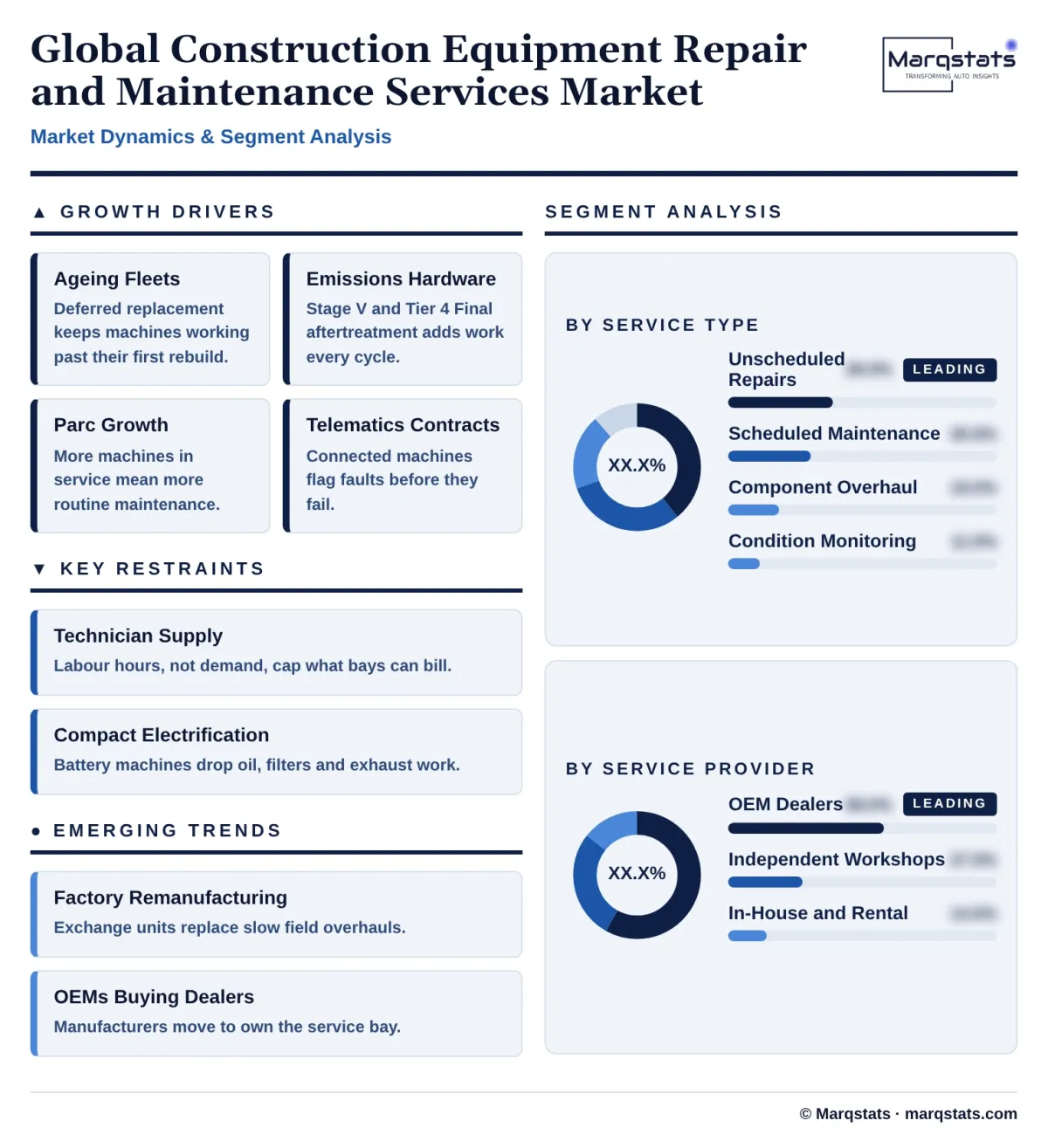
Four drivers carry the forecast, each tied to a dated figure.
- Ageing fleets from deferred replacement: Volvo CE net sales fell 7.5% and Deere construction and forestry sales fell 12% in 2025, so more machines run past their first rebuild and need mid-life overhaul work.
- Emissions hardware on Stage V and Tier 4 Final machines: Regulation (EU) 2016/1628 and US EPA Tier 4 Final standards put particulate filters and urea dosing on most diesel machines, adding cleaning, sensor and calibration work every service cycle.
- Parc growth: the active parc rises from 8.85 million machines in 2025 to 10.15 million in 2030 on Marqstats estimates, adding 1.30 million machines that each need routine maintenance from their first 250 hours.
- Telematics-led service contracts: Caterpillar targets USD 30 billion of services revenue by 2030 from USD 24 billion in 2025, and condition-monitoring services grow at 9.68% a year as connected machines flag faults before failure.
Key Restraints
Three constraints cap how fast spend can rise.
- Technician supply: dealers in North America and Europe cannot hire heavy-equipment technicians fast enough, so labour hours, not demand, limit how much work bays can bill in any year to 2030.
- Electrification of compact machines: battery-electric mini excavators and loaders drop engine oil, fuel filters and exhaust aftertreatment, and the Marqstats Europe Electric Construction Equipment Market sizes that fleet at USD 325.5 million of 2025 sales, small now but growing at 22.53% a year.
- Construction cycle exposure: utilization drives wear, and a 5% fall in machine hours from the modelled 1,420 a year would remove USD 6.23 billion from 2025 spend.
Key Trends
Three trends change how the work is sold and delivered.
- Factory remanufacturing replaces field overhaul: Komatsu reports its remanufacturing transaction volume rose about fourfold from fiscal 2010 to fiscal 2024, and it agreed to buy SRC of Lexington, Inc. in February 2026.
- Rental companies sell service: United Rentals, Inc. booked USD 369 million of service and other revenues in 2025 on USD 16.099 billion total, and Sunbelt Rentals Holdings, Inc. moved its primary listing to the New York Stock Exchange on 2 March 2026.
- Dealers add technology teams: Wheeler Machinery Co. agreed on 15 October 2026 to acquire SITECH Intermountain, folding grade-control and fleet-software support into a Cat dealer service offer.
Strategic Implications
- For manufacturers: the Swecon and Fabick transactions set the template. Where a dealer faces succession or underperforms, buying it captures the 58.0% dealer share of service spend directly, but the capital is better spent in territories with dense, ageing parcs than in thin markets.
- For franchised dealers: post-warranty machines are where share leaks. Tiered service agreements that bundle remanufactured components with lower labour rates for machines past their first overhaul defend the USD 72.27 billion dealer layer better than price cuts on new-machine work.
- For independent workshops and investors: the USD 34.26 billion independent layer grows at 5.44% a year, slower than dealers, because emissions diagnostics stay proprietary. Roll-ups that invest in multi-brand diagnostic tools and focus on older, pre-Stage V machines face the least dealer competition.
- For contractors and rental fleets: spend per machine rises 3.34% a year to USD 16,596 by 2030. Fleets that log every intervention digitally and compare dealer, independent and rental service quotes protect residual values and control the largest controllable cost after fuel.
Market Segmentation
Unscheduled field and workshop repairs are the largest service type at USD 48.60 billion, 39.0% of 2025 spend, rising to USD 61.48 billion and 36.5% by 2030 at a 4.81% CAGR. Hydraulic hose failures, electrical faults and aftertreatment derates stop machines without warning, and the cost of an idle site makes these jobs price-inelastic. Share falls because telematics shifts work into planned slots.
Scheduled maintenance, covering 250-, 500- and 1,000-hour services, fluid analysis and filter changes, is worth USD 38.00 billion, 30.5% of 2025 spend, and reaches USD 51.38 billion in 2030 at 6.22%, holding its 30.5% share. Every machine in the parc generates this work from its first month, so it tracks parc growth plus price.
Component overhaul and remanufactured-component installation is worth USD 23.67 billion, 19.0% of 2025 spend, rising to USD 32.85 billion and 19.5% by 2030 at 6.77%. Engines, transmissions, final drives, hydraulic pumps and undercarriage are increasingly swapped for factory remanufactured units rather than rebuilt in the field, which shortens downtime and keeps the core inside the manufacturer loop.
Condition-monitoring services, meaning telematics-based health monitoring, remote diagnostics and fluid-analysis programmes billed as a service, are worth USD 14.33 billion, 11.5% of 2025 spend, and reach USD 22.74 billion and 13.5% by 2030. At a 9.68% CAGR this is the fastest-growing service type. Scheduled work delivered under a customer value agreement is counted in scheduled maintenance, so the dimension does not double count.
Earthmoving machinery, which covers excavators, wheel and backhoe loaders, dozers and articulated haulers, accounts for USD 69.78 billion, 56.0% of 2025 spend, rising to USD 93.49 billion and 55.5% in 2030 at 6.02%. Ground contact and continuous hydraulic cycling make it the heaviest wear category. The Marqstats Global Excavator Market sizes new excavator sales at USD 57.00 billion in 2025; this segment is the service spend on the machines already working.
Material handling and lifting machinery, meaning mobile cranes, telehandlers and rough-terrain forklifts, accounts for USD 26.17 billion, 21.0% of 2025 spend, rising to USD 36.22 billion and 21.5% by 2030 at 6.72%. Statutory lifting inspections and certification add a compliance layer of work that earthmovers do not carry, which lifts its growth above the market average.
Road building and compaction machinery, covering pavers, cold planers, rollers and motor graders, accounts for USD 18.69 billion, 15.0% of 2025 spend, and USD 25.27 billion in 2030 at 6.22%, holding a 15.0% share. Highway programmes in the United States, India and the Gulf states keep these fleets on steady utilization.
Concrete and specialty equipment, including truck-mounted boom pumps, mixers, horizontal directional drills and trenchers, accounts for USD 9.96 billion, 8.0% of 2025 spend, and USD 13.47 billion, 8.0%, in 2030 at 6.22%. Boom and pump wear parts dominate the invoice, and specialist service providers hold a larger share here than in any other category.
OEM-authorized franchised dealers hold USD 72.27 billion, 58.0% of 2025 spend, rising to USD 100.23 billion and 59.5% by 2030 at 6.76%. Warranty work, customer value agreements, remanufactured component exchange and proprietary emissions diagnostics all route through the dealer bay, and the Swecon and Fabick transactions show manufacturers placing a value on owning it.
Independent workshops and mobile mechanics hold USD 34.26 billion, 27.5% of 2025 spend, and reach USD 44.64 billion, 26.5%, in 2030 at 5.44%. They win on hourly rates and response time for older, multi-brand fleets, but lose ground on Stage V and Tier 4 Final machines whose diagnostics remain dealer-controlled.
Contractor in-house shops and rental-company service operations hold USD 18.07 billion, 14.5% of 2025 spend, and reach USD 23.58 billion, 14.0%, in 2030 at 5.47%. Large civil contractors maintain their own fleets at cost, and rental companies such as United Rentals, Inc. sell service to customer-owned fleets. Maintenance of rental-owned machines is counted here as work performed, while its recovery inside rental rates belongs to the rental market.
By Geography
Asia-Pacific
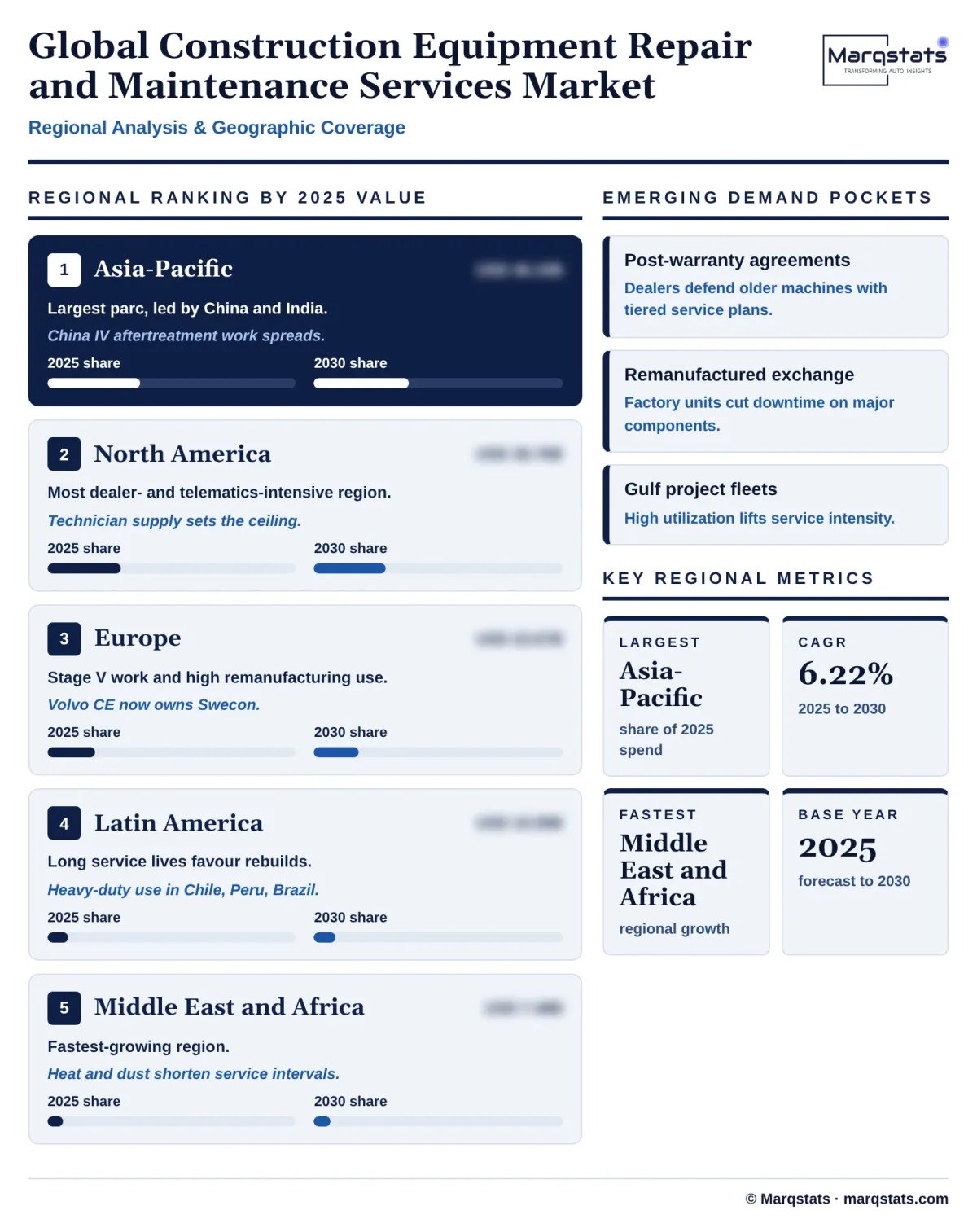
Asia-Pacific is the largest region at USD 46.10 billion, 37.0% of 2025 spend, rising to USD 64.01 billion and 38.0% by 2030 at a 6.78% CAGR. China holds the largest parc in the world, and its China IV non-road emissions standard, in force since 1 December 2022, is pushing particulate-filter and fuel-system work into a fleet that used to be maintained mostly by component-level field repair. India adds parc faster than any large market on highway and urban-transit spending. Labour is cheaper than in the West, so parts make up a larger share of the invoice.
North America
North America accounts for USD 36.76 billion, 29.5% of 2025 spend, and USD 48.85 billion, 29.0%, in 2030 at 5.85%. It is the most dealer-intensive and telematics-intensive region: Finning, Toromont, Wheeler Machinery Co. and the other Cat dealers run dense branch and field-truck networks, and United Rentals, Inc. and Sunbelt Rentals Holdings, Inc. compete for service on customer fleets. High shop rates mean labour dominates the invoice, so technician supply sets the growth ceiling.
Europe
Europe accounts for USD 23.67 billion, 19.0% of 2025 spend, and USD 30.32 billion, 18.0%, in 2030 at 5.08%, the slowest regional rate. Stage V aftertreatment work and high remanufacturing use support value, but parc growth is slow and compact electric machines are spreading fastest here. Volvo Construction Equipment's ownership of Swecon since 1 February 2026 puts a manufacturer directly into the Swedish, German and Baltic service markets.
Latin America
Latin America accounts for USD 10.59 billion, 8.5% of 2025 spend, and USD 14.32 billion, 8.5%, in 2030 at 6.22%. Long service lives and heavy-duty use in Chile, Peru and Brazil favour component rebuilds, and Finning operates the Cat dealership across Chile, Argentina and Bolivia, where mining-adjacent construction fleets run long shifts at altitude.
Middle East and Africa
Middle East and Africa is the smallest region at USD 7.48 billion, 6.0% of 2025 spend, but the fastest growing, reaching USD 10.95 billion and 6.5% by 2030 at a 7.92% CAGR. Gulf giga-projects keep large fleets on high utilization, and heat and dust shorten filter, seal and cooling-system intervals. Saudi Arabia and the United Arab Emirates carry most of the regional parc, and dealer networks there are adding field-service capacity to match.
How Competition Is Evolving
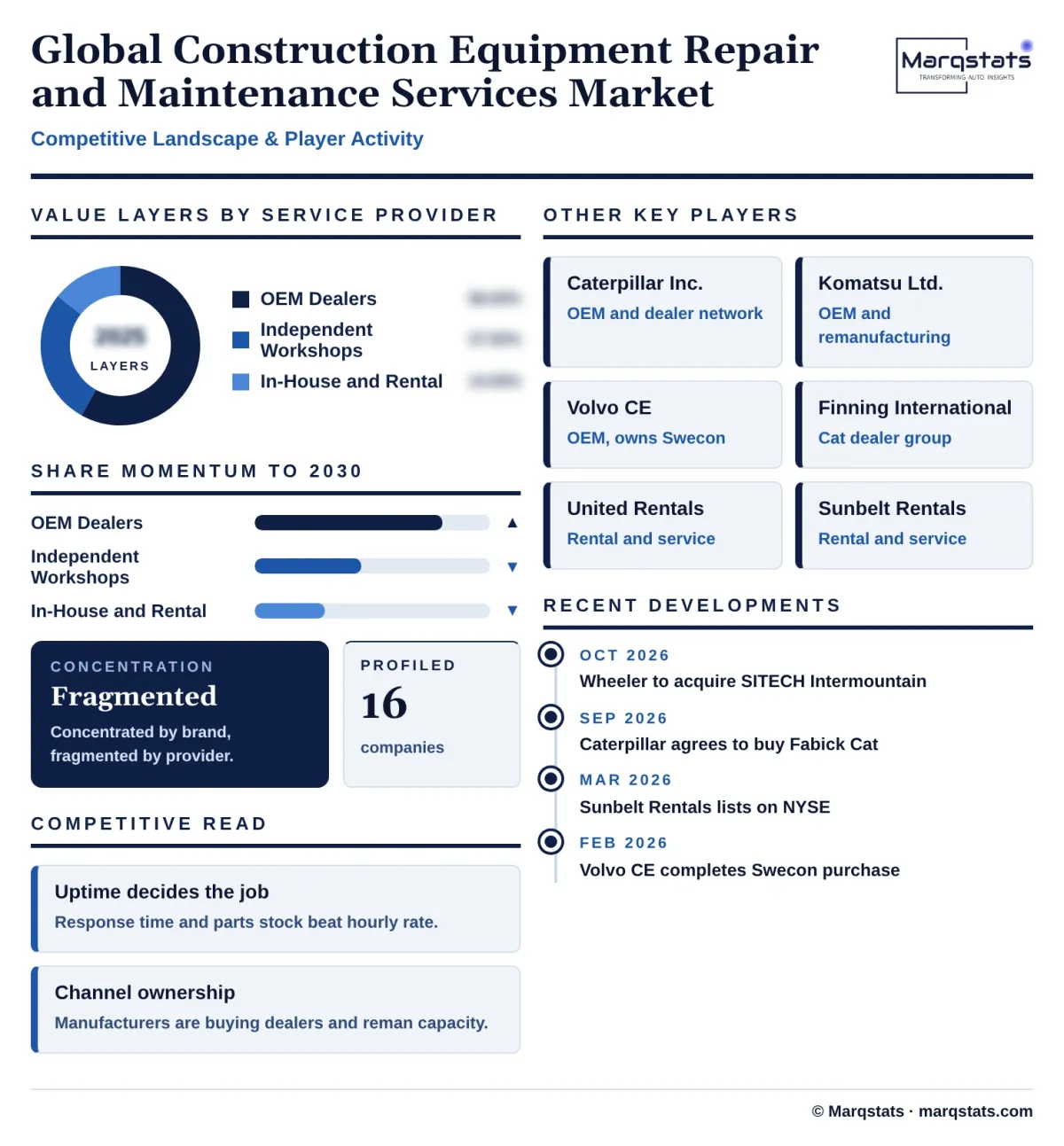
The market is fragmented at the level of the service provider but concentrated by brand. OEM-authorized dealers hold 58.0% of 2025 spend, independent workshops 27.5% and in-house and rental fleets 14.5%. Within the dealer layer, the Caterpillar dealer network is the largest single system, and Caterpillar reports USD 24 billion of services revenue across its businesses. No regulator or trade body publishes company shares of service spend, so Marqstats describes competition by layer and by dated actions rather than by ranking.
Providers compete on uptime, not hourly rate. A contractor losing a production excavator for two weeks loses more than the repair costs, so response time, parts availability, remanufactured exchange stock and remote diagnostics decide who gets the job. Dealers win complex and emissions-related work; independents win on older machines and on price for routine service; rental companies win where a customer wants one contract for owned and rented fleets.
Channel ownership is the structural variable. Volvo Construction Equipment bought Swecon, Caterpillar Inc. agreed to buy Fabick Cat, Komatsu Ltd. bought a remanufacturing business, and dealers such as Wheeler Machinery Co. are adding technology teams. Each move pulls more of the service bay, the machine data or the component core loop under one owner, and Marqstats expects that consolidation to continue through 2030.
Companies Covered
Companies covered in the report include:
Recent Market Activity
Table of Contents
Coverage & Segmentation
Coverage is invoiced repair and maintenance value on in-service construction machinery worldwide, 2021 to 2030, base year 2025, in nominal US dollars. Included: scheduled maintenance, unscheduled repair, component overhaul and remanufactured-component installation, condition-monitoring services, and the parts and fluids fitted during those jobs, whether performed by dealers, independent workshops, rental companies or contractor in-house shops. Excluded: new and used machine sales, rental revenue, financing, over-the-counter parts sold without installation, and agricultural, forestry and dedicated mine-fleet machinery.
Sibling boundaries. The Marqstats Global Construction Equipment Market (USD 246.60 billion in 2025) sizes new-equipment sales and excludes aftermarket service; do not add the two as one market, since they measure different transactions on the same machines. The Marqstats Global Construction Equipment Rental Market (USD 165.00 billion in 2025) includes the cost of maintaining rental fleets inside rental rates; do not add rental-fleet maintenance from this page to that figure. The Marqstats Global Excavator Market and Europe Electric Construction Equipment Market size new machine sales; service on those machines sits here.
Regional and segment values for 2030 are Marqstats estimates. Company figures are quoted as reported in filings and converted at fixed 2025 average rates of CAD 1.3978 and SEK 9.8191 per US dollar.


