Market Snapshot
Middle bar: base-year value × (1 + CAGR), rounded to two decimals. This is a calculated illustration, not a separately researched annual estimate.
The India two-wheeler ABS market was valued at approximately USD 205 million in 2025 and is projected to reach USD 1,010 million by 2030, expanding at a CAGR of 37.57% over 2026–2030. Growth is attributed to a regulatory step-change: an amendment to the Central Motor Vehicle Rules extends mandatory anti-lock braking systems to every new two-wheeler manufactured on or after January 1, 2026, regardless of engine capacity. The mandate widens ABS coverage from the above-125cc segment to the sub-125cc mass market, which accounts for close to 78% of domestic two-wheeler sales.
India recorded around 19.6 million two-wheeler sales in FY2025, per Society of Indian Automobile Manufacturers data, of which roughly 15.3 million units were 125cc or below and equipped with combined braking systems rather than ABS. Demand is increasing owing to the near-universal fitment requirement, which is expected to lift annual ABS installation volumes several-fold across 2026–2028. The forecast-period CAGR is front-loaded, as the mandate ramp concentrates incremental content in 2026 and 2027.
Scope covers original-equipment single-channel and dual-channel ABS, comprising the electronic control unit, hydraulic modulator, and wheel-speed sensors, together with enabling disc-brake hardware for L-category two-wheelers. The market is supply-constrained in the near term, as merchant ABS output is scaling against a requirement several times current capacity. Robert Bosch and Endurance Technologies together account for the majority of installed capacity, making expansion the defining supply dynamic of the period.
Two counter-forces temper the demand step-change. First, the per-vehicle price increase of ₹3,000–6,000 raises affordability risk in a segment where entry-model prices have risen faster than household incomes, and independent assessments estimate a 2–4% reduction in two-wheeler demand in the near term. Second, the September 2025 reduction in the goods and services tax rate on smaller two-wheelers partly offsets the ABS cost, cushioning the transition. On balance, the compliance-driven volume gain dominates the affordability drag over the forecast, and the market moves from an estimated USD 205 million in 2025 toward the USD 1.0 billion mark by 2030.
Key Takeaways
Market Overview & Analysis
Report Summary
The India two-wheeler ABS market covers anti-lock braking systems fitted to L-category motorcycles, scooters, and mopeds sold in India, spanning single-channel and dual-channel configurations and the associated control electronics, hydraulic actuation, and wheel-speed sensing hardware. The market is defined by original-equipment fitment, and the aftermarket is excluded from the base estimate. India is the largest two-wheeler market worldwide by volume, and the transition from combined braking systems to ABS across the entry segment reshapes component demand for the domestic supplier base, an adjacency to the Marqstats India electric scooter and motorcycle market report.
Anti-lock braking systems prevent wheel lock during hard braking, allowing the rider to retain steering control and reducing skidding on wet and uneven surfaces. Independent assessments suggest ABS can reduce two-wheeler accident severity by an estimated 35–45%. The rationale for the mandate rests on road-safety data, as two-wheeler users account for close to 44% of India's road fatalities, with around 74,900 two-wheeler occupants killed in 2022 according to Ministry of Road Transport and Highways data.
The regulatory extension converts a discretionary premium feature into a statutory requirement across the mass market. Single-channel ABS, which acts on the front wheel, becomes the standard configuration for entry motorcycles, many of which also require the addition of a front disc brake. The resulting content increase raises per-vehicle cost by ₹3,000–6,000, equivalent to a 3–6% rise in entry-model prices. Growth is therefore attributed to compliance-driven volume rather than discretionary upgrade demand, which front-loads the forecast and compresses the ramp into 2026 and 2027.
Market structure follows directly from this transition. At full enforcement, close to 20 million two-wheelers a year require ABS content, against roughly 3 million units already fitted in the base year. The incremental fitment requirement therefore centres on more than 15 million previously non-ABS units, and the market value at maturity is set by the blend of low-cost single-channel systems on entry models and higher-value dual-channel systems on premium motorcycles. This mix, combined with disc-brake pull-through, underpins the reconciled estimate of USD 205 million in 2025 rising toward USD 1,010 million by 2030. The near-term determinant of realised value is the pace at which supplier capacity closes the gap between mandated demand and installed output.
Market Dynamics
The India two-wheeler ABS market is governed by a single dominant variable: statutory fitment. Unlike discretionary feature markets, demand is set by regulation rather than by consumer preference, which makes the enforcement timeline the primary sensitivity. The dynamics below therefore separate the compliance-driven demand base from the affordability and capacity constraints that shape the pace of adoption.
Key Drivers
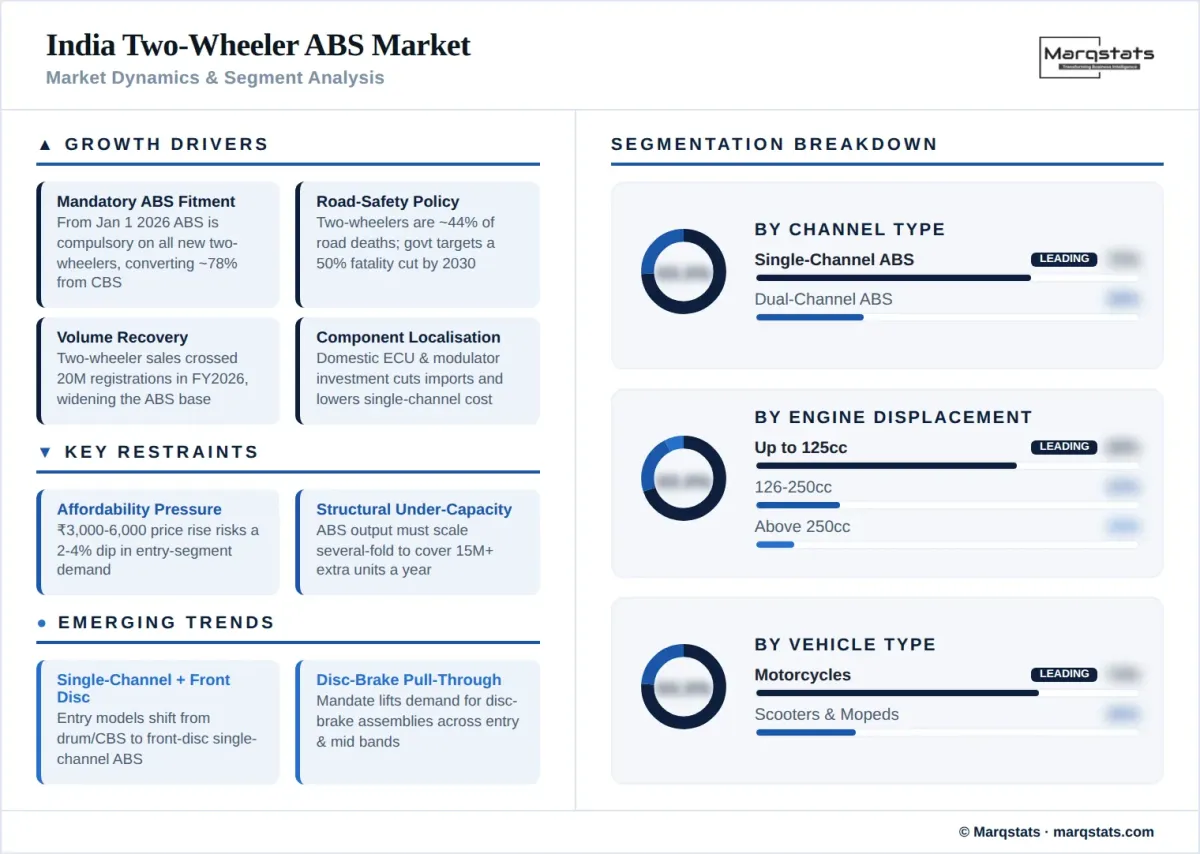
- Mandatory ABS fitment on all new two-wheelers from January 1, 2026 converts roughly 78% of the market from combined braking systems to ABS, creating structural, non-cyclical demand.
- Road-safety policy anchors the mandate, as two-wheeler users represent close to 44% of India's road deaths and the government targets a 50% reduction in fatalities by 2030.
- Recovery in two-wheeler sales, which crossed 20 million registrations in FY2026 for the first time, expands the installed base requiring ABS content each year.
- Alignment with global safety norms, where the European Union mandated motorcycle ABS above 125cc from 2016, supports harmonisation of Indian standards to IS 14664:2010.
- Component localisation and capacity investment by domestic suppliers reduce import dependence and improve the cost position of single-channel systems for entry models.
Key Restraints
- Affordability pressure in the entry segment, where a ₹3,000–6,000 price increase risks dampening demand; independent assessments estimate a 2–4% reduction in two-wheeler sales.
- Structural under-capacity in the near term, as ABS output must scale several-fold to meet a requirement covering more than 15 million additional units per year.
- Certification and homologation bottlenecks at testing agencies, which face a concentrated approval workload ahead of the mandate deadline.
- Regulatory uncertainty for the sub-125cc category, where industry sought deferral and the ministry referred ABS effectiveness testing to the national testing agency.
Key Trends
- Shift toward single-channel ABS with front-disc conversion in the entry segment, moving away from drum-brake and combined-braking-system configurations.
- In-house electronic control unit production and traction-control add-ons for 160–250cc motorcycles, extending supplier content per vehicle.
- Disc-brake content pull-through, as ABS fitment raises demand for disc-brake assemblies and brake discs across the entry and mid-size bands.
- Partial cost offset from the September 2025 GST reduction on two-wheelers, which cushions the affordability impact of mandatory ABS.
Market Segmentation
Channel type is the primary axis of segmentation, as it maps directly onto the mandate's incremental demand. The split between single-channel and dual-channel systems determines both the unit mix and the value mix of the market over 2026–2030.
Single-channel ABS acts on the front wheel only and represents the highest-growth configuration owing to the entry-segment mandate. The system pairs a front disc brake with a single wheel-speed sensor and modulator channel, minimising cost for price-sensitive models. It is expected to account for the majority of incremental units across 2026–2030.
Dual-channel ABS regulates both wheels independently and remains standard on premium motorcycles above 250cc. Growth is attributed to replacement demand and rising premium-motorcycle penetration rather than the new mandate. The configuration carries higher content value per vehicle, supporting its disproportionate share of market value.
Engine displacement determines both the pre-mandate ABS penetration and the incremental fitment requirement. The up-to-125cc band carries the entire incremental demand pool, while higher-displacement bands already comply and contribute value through richer content.
The up-to-125cc band contains the incremental demand pool, as these models currently use combined braking systems. The mandate converts an estimated 15.3 million annual units toward single-channel ABS fitment. This band defines both the volume opportunity and the near-term capacity gap that shapes supplier investment.
The 126–250cc band already carries ABS on models above 125cc and adds traction-control content on 160–250cc motorcycles. Growth is attributed to premiumisation and feature escalation within the commuter-plus and sports segments. Content value per vehicle rises as suppliers bundle traction control with dual-channel ABS.
Motorcycles above 250cc are fully ABS-equipped and increasingly adopt dual-channel systems with cornering functionality. This band contributes disproportionately to market value owing to higher per-unit content. Demand is increasing owing to expanding premium and touring-motorcycle sales.
Component-level segmentation isolates where value concentrates and where localisation is hardest. The electronic control unit anchors electronic value, the hydraulic modulator anchors mechanical value and capacity, and wheel-speed sensors scale with the channel mix.
The electronic control unit governs modulation logic and represents the highest-value electronic component. Domestic in-house ECU production is scaling to reduce import reliance and improve single-channel cost economics. Localisation of the ECU is a determinant of the achievable price point for entry models.
The hydraulic modulator executes brake-pressure pulsing and forms the mechanical core of the system. It is the most capacity-intensive component to localise, making modulator supply a determinant of overall fitment capacity. Investment in modulator lines therefore governs the pace of the mandate ramp.
Wheel-speed sensors detect impending lock and feed the control unit. Single-channel systems use one front sensor, while dual-channel systems use two, scaling sensor demand with the channel mix. Sensor volumes rise faster than vehicle volumes as dual-channel penetration increases in the mid-size band.
Vehicle-type segmentation separates motorcycle from scooter demand, which differ in displacement mix and braking configuration. Motorcycles span the full displacement range and therefore both channel types, while scooters concentrate in the sub-125cc single-channel band.
Motorcycles constitute the largest share of ABS demand, spanning entry commuters through premium models. Entry motorcycles drive single-channel volume, while premium motorcycles anchor dual-channel value. The displacement mix within motorcycles governs the overall channel split of the market.
Scooters and mopeds above 50cc fall within the mandate and shift from combined braking systems to single-channel ABS. Growth is attributed to the high scooter share of urban two-wheeler demand. Fitment on scooters broadens the addressable base beyond motorcycles and reinforces single-channel volume.
By Geography
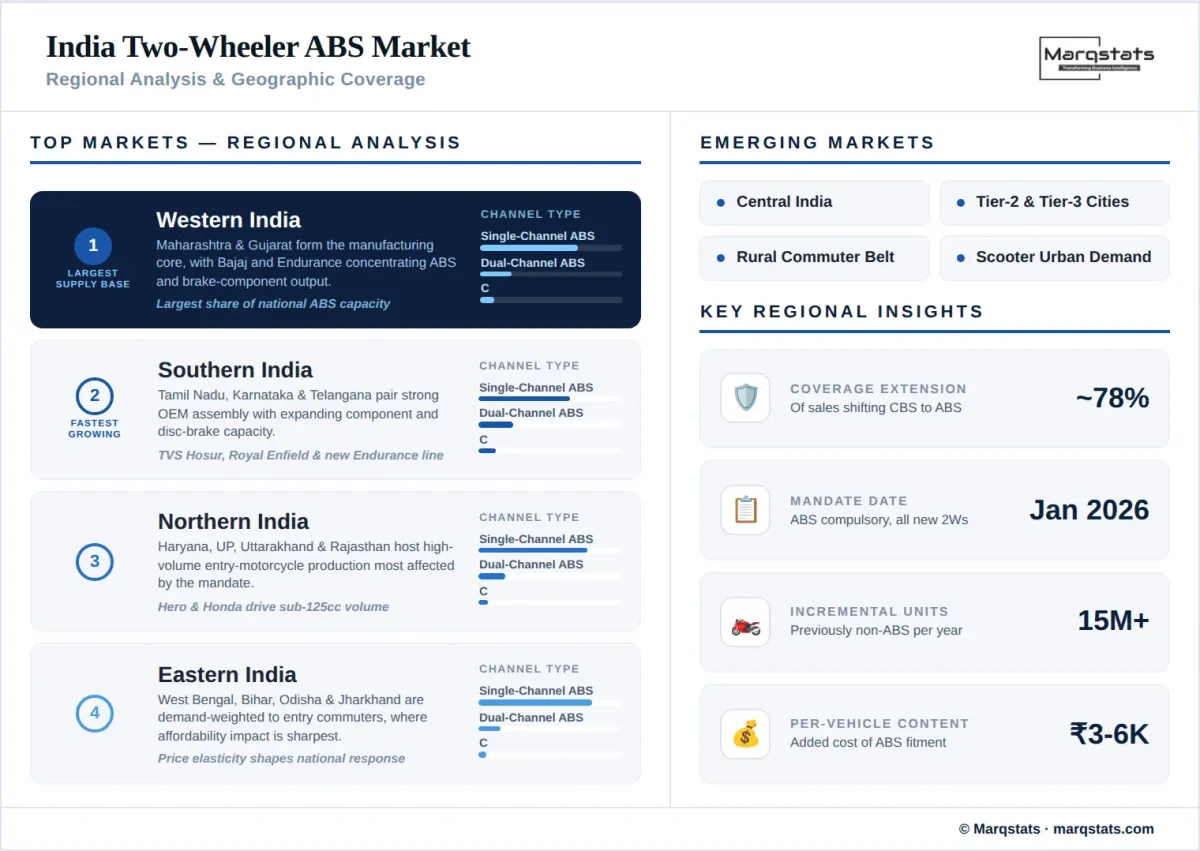
Regional distribution reflects two distinct geographies: the supply geography of ABS and brake-component manufacturing, concentrated in Western and Southern India, and the demand geography of entry-motorcycle consumption, weighted toward Northern, Eastern, and Central India. The interaction between these geographies determines where capacity investment concentrates and where the affordability impact of mandatory ABS is most acute.
Western India
Western India, anchored by Maharashtra and Gujarat, is the manufacturing core of the two-wheeler ABS supply chain. Bajaj Auto's Pune and Chakan facilities and Endurance Technologies' Aurangabad operations concentrate ABS and brake-component production in the region. Western India therefore holds the largest share of national ABS output capacity.
Southern India
Southern India, spanning Tamil Nadu, Karnataka, and Telangana, combines strong OEM assembly with expanding component capacity. TVS Motor's Hosur base, Royal Enfield's Chennai plants, and a new Endurance disc-brake facility near Chennai deepen the regional supply base. The region ranks among the fastest-growing for ABS and disc-brake content.
Northern India
Northern India, covering Haryana, Uttar Pradesh, Uttarakhand, and Rajasthan, hosts high-volume entry-motorcycle production. Hero MotoCorp's Gurugram, Haridwar, and Neemrana plants and Honda's Manesar operations position the region as the primary source of sub-125cc units affected by the mandate. Single-channel ABS adoption is therefore concentrated in Northern India output.
Eastern India
Eastern India, including West Bengal, Bihar, Odisha, and Jharkhand, is demand-weighted toward entry commuter motorcycles. The mandate's affordability impact is most pronounced here, where price sensitivity is highest and single-channel ABS defines the volume shift. Demand elasticity in the region is a determinant of the national sales response to price increases.
Central India
Central India, comprising Madhya Pradesh and Chhattisgarh, contributes rural and semi-urban commuter demand. Growth is attributed to replacement cycles and first-time buyers migrating to mandated ABS-equipped models. The region reflects the broader rural adoption pattern for entry motorcycles.
How Competition Is Evolving
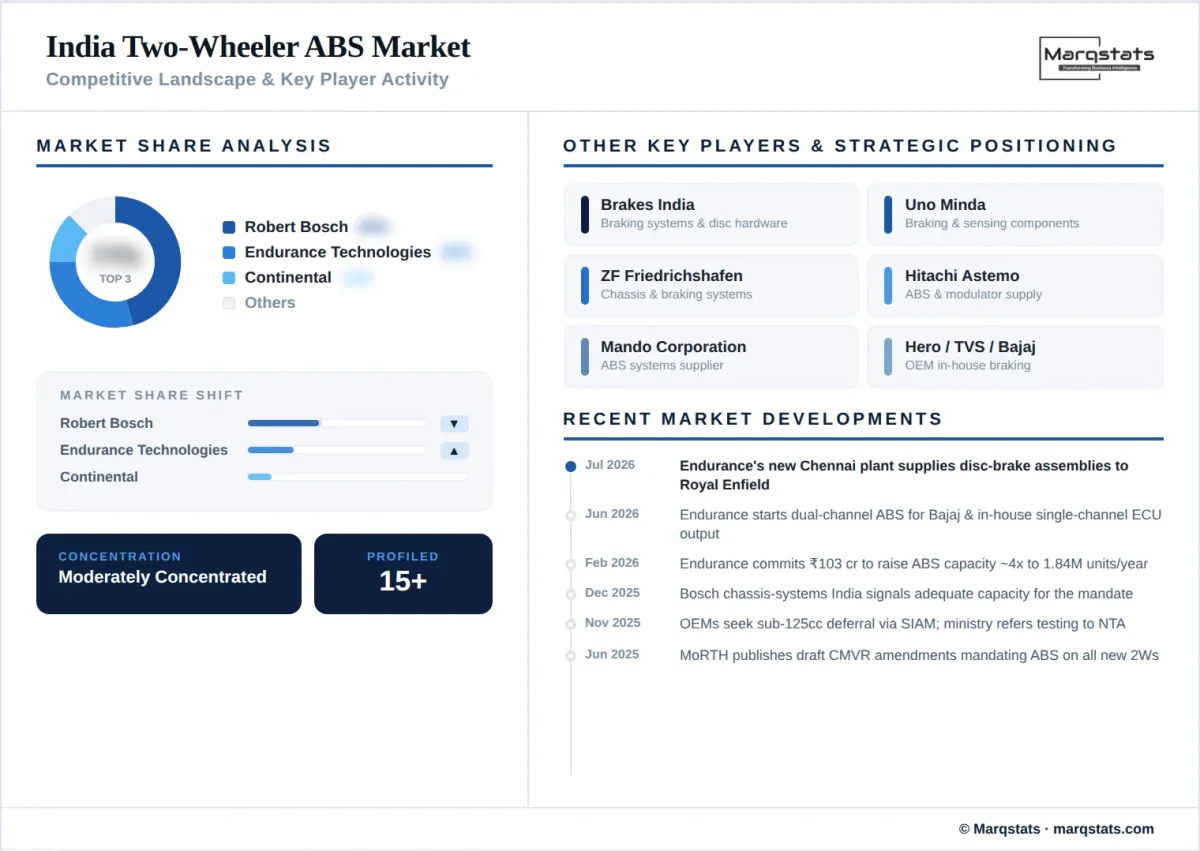
The India two-wheeler ABS market is moderately concentrated at the component-supply level. Robert Bosch and Endurance Technologies together account for an estimated 60–70% of two-wheeler ABS supply, with Continental, Brakes India, and Uno Minda holding secondary positions. Concentration is attributable to the capital intensity of hydraulic-modulator and electronic-control-unit manufacturing, which raises barriers to entry.
Competition centres on capacity expansion, localisation depth, and OEM programme wins ahead of the mandate. Endurance Technologies committed ₹103 crore to raise two-wheeler ABS capacity roughly fourfold to 1.84 million units per year, began dual-channel ABS supply for Bajaj Auto, and started in-house single-channel ECU production, according to Endurance Technologies disclosures. Robert Bosch's chassis-systems operations in India have signalled adequate capacity to meet the expanded requirement.
Original-equipment manufacturers shape the competitive structure through sourcing strategy and in-house braking-system development. Growth is attributed to multi-year supply agreements that lock in modulator and sensor volumes, alongside disc-brake content pull-through that extends supplier revenue per vehicle. The near-term determinant of share is the ability to close the structural gap between installed output and mandated demand, which favours suppliers with committed capacity investment.
Competitive positioning is also sensitive to the regulatory scenario. Under full enforcement from January 2026, suppliers with early capacity commitments capture disproportionate programme wins, whereas a phased enforcement for the sub-125cc category would extend the ramp and reduce first-mover advantage. Suppliers are therefore hedging through modular capacity additions and in-house ECU localisation, which lower the per-unit cost of single-channel systems and improve resilience across enforcement paths. Vertical integration into disc-brake assemblies further differentiates suppliers able to offer bundled braking content to OEMs.
Companies Covered
Companies covered in the report include:
Recent Market Activity
Table of Contents
Coverage & Segmentation
This report provides a comprehensive analysis of the India two-wheeler ABS market for the historical period 2021–2025 and the forecast window 2026–2030, with 2025 as the base year. Coverage spans single-channel and dual-channel anti-lock braking systems, the electronic control unit, hydraulic modulator, and wheel-speed sensors, and enabling disc-brake hardware, across motorcycles, scooters, and mopeds. The study examines market sizing by value, segment-level forecasts by channel type, engine displacement, component, and vehicle type, regional distribution across Indian zones, competitive positioning, and regulatory impact.
Aftermarket ABS is excluded from the base estimate unless stated. The scope reflects the transition from combined braking systems to ABS across the sub-125cc segment as the defining demand event of the period, and it models the near-term capacity gap between installed supplier output and mandated fitment. Forecasts incorporate a regulatory-scenario framework covering full enforcement from January 2026 and a phased-enforcement alternative for the sub-125cc category.
Deliverables include market sizing and forecasts by value, segment-level splits across channel type, engine displacement, component, and vehicle type, regional distribution across Indian zones, company profiles of principal ABS and braking-system suppliers, and a regulatory-impact assessment. The forecast provides annual estimates across the 2026–2030 window with sensitivity to the enforcement timeline, per-vehicle content value, and two-wheeler volume recovery. The study is intended for component suppliers, OEM sourcing and strategy teams, investors, and policy stakeholders assessing the transition to mandatory two-wheeler ABS in India.