Market Snapshot
Key Takeaways
Market Overview & Analysis
Report Summary
The Japan car wash services market comprises professional operators cleaning passenger and light commercial vehicles across four service formats — in-bay automatic drive-through machines, tunnel/conveyor, self-service coin wash, and manual hand wash — monetized through pay-per-wash and membership plans. The 2025 market of USD 1.68 billion sits against a four-wheel parc of roughly 78 million, with professional-wash penetration near 55% and frequency of about 6.2 washes per vehicle each year, supported by blended tickets near JPY 850.
The market's defining feature is machine automation at fuel stations. Japan's service stations, numbering in the tens of thousands and operated largely on a self-service basis, installed drive-through wash machines decades ago, and these in-bay automatic systems now generate about 62% of revenue — the highest machine share of any major market. Drivers select a wash tier on a panel, pay by cash or IC card, and complete a five-to-ten-minute cycle, with wax and air-dry options widely available. Self-service coin-wash parks, offering high-pressure guns, foam, and vacuum bays, add about 20% of revenue.
Japan's format structure is unusually stable. Machine share has held near 62% for years, and tunnels remain a modest 10% concentrated at larger sites, while manual hand wash is a small 8% niche for premium and enthusiast cleaning. The market's site economics run through fuel retailers: ENEOS, the largest network with over 12,000 stations, together with Idemitsu apollostation and Cosmo, operate the majority of drive-through machines, making forecourt service stations the backbone of supply at about 62% of site revenue. Coin-wash parks account for about 27% and are gradually gaining share.
The market's economics reflect two decades of deflation. Local revenue fell sharply in 2022 on yen depreciation in dollar terms, and recovery is modest: a flat parc contributes nothing to volume, so growth comes from pricing normalization as Japan exits deflation, small premiumization gains, and membership adoption. Wash intensity per vehicle sits near USD 20, about 31% of the United States level. Rising demand for paint-safe washing, driven by fine-brush and touch-free machine upgrades from domestic makers such as Daifuku, supports gradual value growth through 2030.
Japan's maturity distinguishes it from every growth market in this series. Where India and China grow on parc expansion and formalization, Japan grows on price and product mix alone, having automated and organized decades ago. The structural questions are therefore different: how quickly memberships convert loyal machine-wash customers into recurring revenue, how far post-deflation pricing can lift a historically low ticket, and how service-station rationalization reshapes the installed machine base. These dynamics make Japan a bellwether for how mature, machine-led wash markets sustain value once volume growth ends, a pattern Western European markets are beginning to approach.
Market Dynamics
Key Drivers
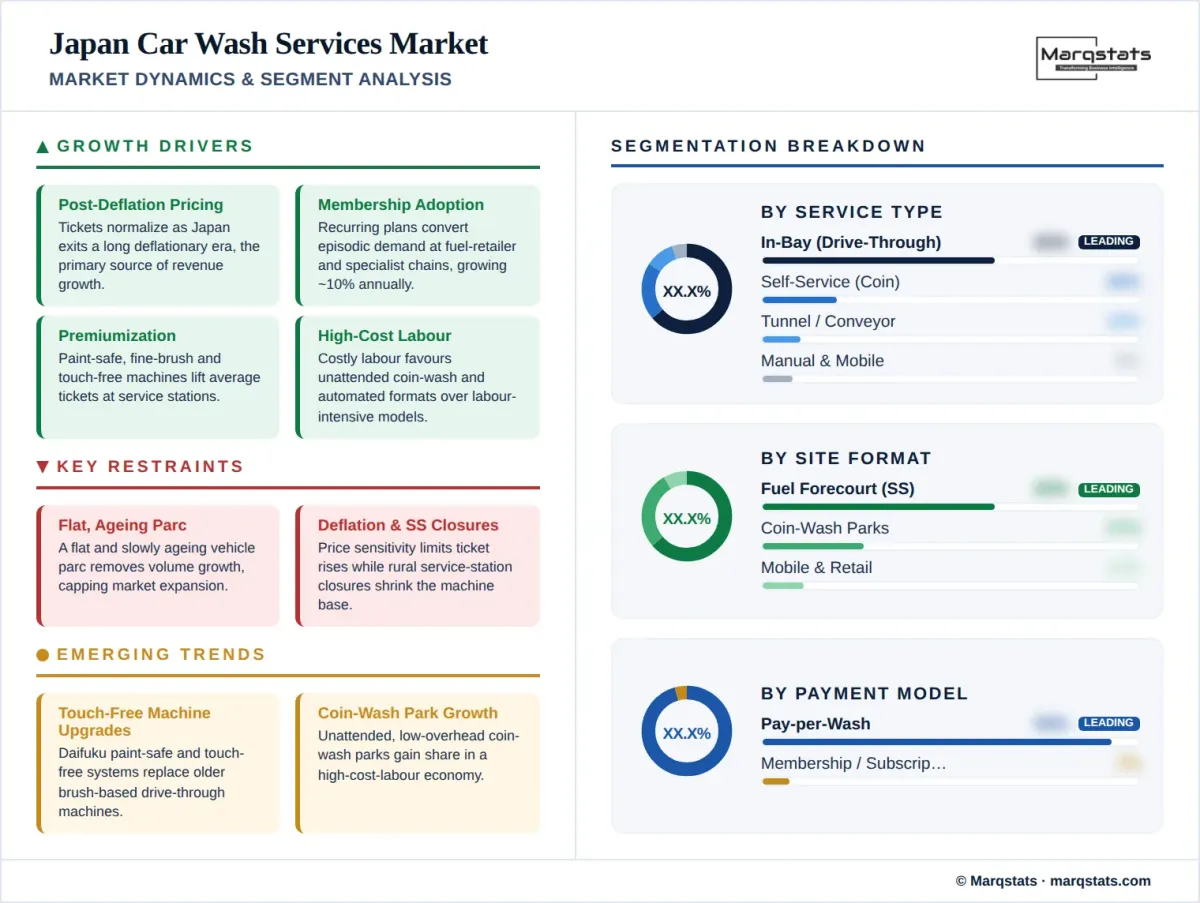
- Post-deflation pricing normalization lifts tickets as Japan exits a long deflationary period, the primary source of revenue growth.
- Membership adoption converts episodic demand into recurring revenue, growing near 10% annually through fuel-retailer and specialist plans.
- Premiumization toward paint-safe, fine-brush, and touch-free machines lifts average tickets at service stations.
- Seasonal demand from winter road salt and spring pollen sustains high wash frequency across regions.
- Fuel retailers treat washing as core non-fuel revenue as fuel volumes decline, sustaining machine investment across service-station networks.
- High-cost labour favours unattended coin-wash and automated formats, sustaining machine and self-service investment over labour-intensive models.
Key Restraints
- A flat and slowly ageing vehicle parc removes volume growth, capping the market's expansion.
- Long-run price deflation and consumer price sensitivity limit ticket increases despite premiumization.
- Service-station closures across rural Japan reduce the installed base of drive-through machines.
- High machine penetration leaves limited room for format-mix upgrades to drive revenue.
Key Trends
- Wash memberships expand through fuel-retailer and specialist chains such as ENEOS and Wash Plus, at JPY 2,500 to 10,000 per month.
- Paint-safe and touch-free machine upgrades from domestic makers, led by Daifuku, replace older brush systems.
- IC-card and app-based payment standardize across service-station and coin-wash sites.
- Coin-wash parks gain share as unattended, low-overhead formats suit a high-cost labour market.
- Service-station rationalization concentrates machine-wash volume at surviving high-throughput forecourts.
Market Segmentation
In-bay automatic drive-through machines hold the dominant revenue share at about 62% in 2025, equal to USD 1.04 billion, installed at the majority of Japan's service stations. Drivers select a wash tier on a panel, pay by cash or IC card, and complete a five-to-ten-minute cycle with optional wax and air-dry. The share holds steady near 62% through 2030 as paint-safe and touch-free upgrades from domestic makers sustain the format's dominance, and machine washing remains the default choice for routine cleaning nationwide. Concerns about brush micro-scratching on dark or sensitive paint drive continued investment in softer materials and touch-free options, protecting the format's premium tier.
Self-service coin-wash parks hold about 20% of 2025 revenue, USD 328.20 million, offering high-pressure guns, foam, and vacuum bays activated by coins or IC cards. The share eases toward 19% by 2030 yet remains a substantial, resilient format, favoured by enthusiasts and drivers who prefer to wash their own vehicles. Unattended, low-overhead economics suit Japan's high-cost labour market and support steady coin-wash park development, with individual bays typically priced around JPY 100 per five minutes.
Tunnel/conveyor washes hold about 10% of 2025 revenue, USD 175.29 million, and rise toward 11% by 2030. Conveyor systems concentrate at larger standalone sites and high-throughput locations, offering longer wash programs and integration with membership plans, and grow modestly as premiumization advances. The format's higher throughput suits urban sites where drive-through machine capacity is constrained by queueing at peak times.
Manual and mobile hand-wash services hold about 8% of 2025 revenue, USD 134.26 million, a small and stable niche. The segment serves premium detailing, luxury vehicles, and enthusiasts who prefer hand finishing, and includes mobile providers serving corporate and residential clients in major cities. Specialist chains such as KeePer LABO anchor the premium hand-wash and coating end of the market, commanding higher tickets than machine washing.
Forecourt washes at service stations hold the largest site share at about 62% of 2025 revenue, USD 1.04 billion. National fuel networks — ENEOS, with over 12,000 stations, together with Idemitsu apollostation and Cosmo — operate the majority of drive-through machines, bundling washing with fuel and offering membership plans. The share eases toward 60% by 2030 as coin-wash parks expand, yet service stations remain the market's backbone. As fuel demand declines with an ageing, shrinking population and electrification, retailers increasingly treat washing and other non-fuel services as essential to station economics.
Standalone coin-wash parks hold about 27% of 2025 revenue, USD 451.28 million, and gain share toward 28% by 2030. Unattended parks with self-service bays and drive-through machines suit high land-efficiency and low-labour operation, and independent operators expand the format in suburban and roadside locations. Falling attendant staffing and rising land productivity make coin-wash parks the most economically resilient standalone format in a shrinking-labour economy.
Mobile and retail-parking formats hold about 11% of 2025 revenue, USD 182.75 million, and gain share toward 12% by 2030. Mobile detailing, corporate fleet washing, and retail-centre sites serve convenience-oriented and premium demand across major metros. Automotive-goods retailers and shopping-centre operators host washing as an added-service draw, and app-booked mobile detailing serves time-pressed urban owners who value doorstep convenience.
Single-visit payment accounts for about 92% of 2025 revenue, USD 1.55 billion, reflecting the walk-up nature of service-station and coin-wash formats. The share declines toward 89% by 2030 as memberships expand, with IC-card and cash payment dominant at machine and coin-wash sites. Contactless IC cards such as those used across Japan's transit and retail networks make single-visit machine washing fast and frictionless, sustaining the format's convenience advantage.
Wash memberships reach about 7% of 2025 revenue, USD 128.67 million, and grow near 10% annually to about 11% of revenue by 2030, worth USD 207.45 million. Fuel-retailer plans from ENEOS and specialist chains such as Wash Plus, priced at JPY 2,500 to 10,000 per month, offer unlimited or discounted washing and are the fastest-growing revenue stream, converting routine machine washing into recurring revenue. Membership suits Japan's high-frequency, habit-driven washing culture, and fuel retailers use it to defend forecourt footfall as fuel volumes decline.
Passenger vehicles generate about 90% of 2025 revenue, USD 1.50 billion, reflecting the consumer orientation of drive-through and coin-wash formats. The share eases slightly across the forecast period as commercial washing grows faster, though private-vehicle machine washing remains the market's core.
Commercial and fleet washing holds about 10% of 2025 revenue, USD 175.29 million, rising toward 11% by 2030. Growth is driven by logistics, delivery, and mobility fleets — including mobility-as-a-service operators — that maintain vehicle presentation through service-station and dedicated commercial washing. Taxi operators and corporate fleets in the major metros sustain steady contract washing demand.
By Geography
Kanto (Greater Tokyo)
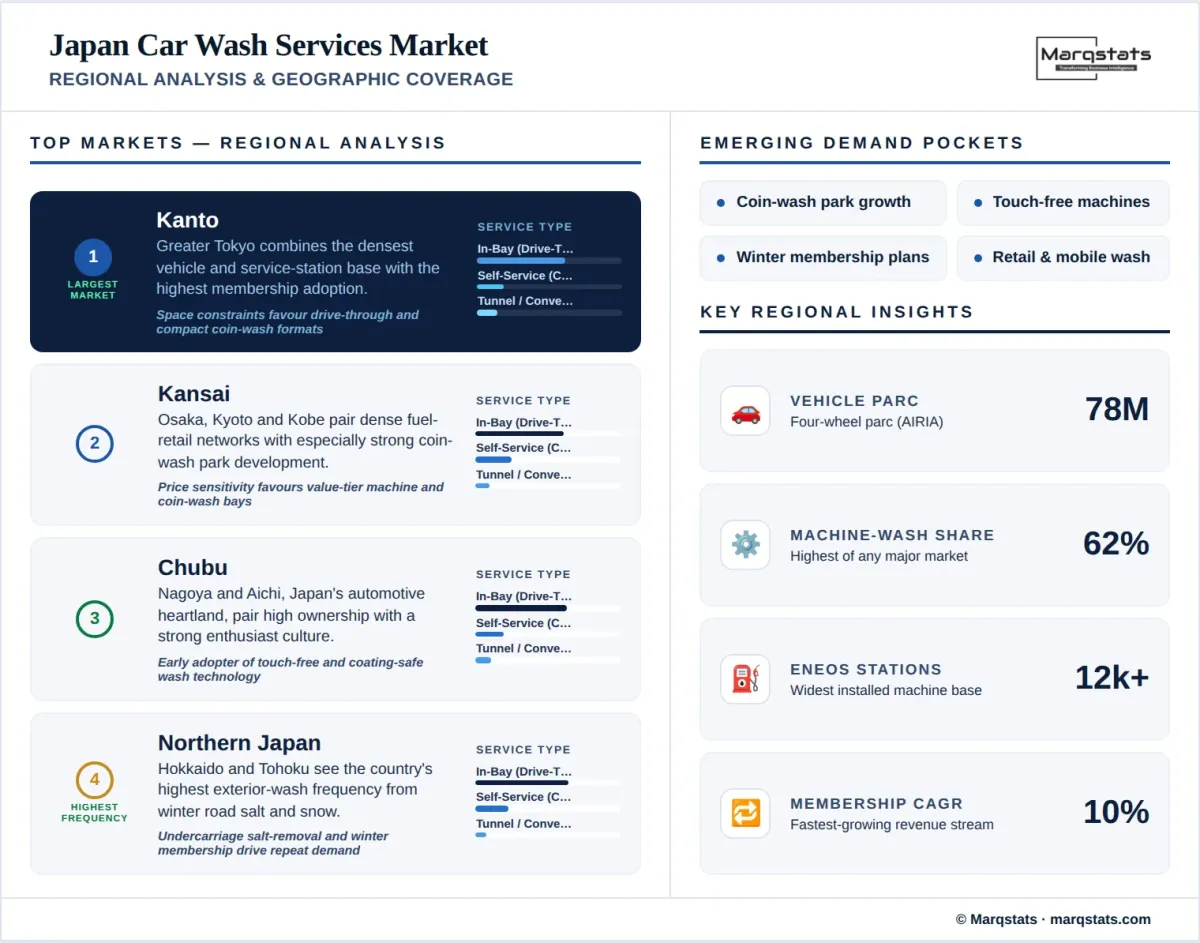
Kanto, centred on Tokyo, Yokohama, and Saitama, is the largest regional market, combining the densest vehicle and service-station base with the highest membership adoption. Space constraints in central Tokyo favour drive-through machines and compact coin-wash parks, and premium demand supports touch-free and hand-wash formats. Spring pollen and urban grime sustain frequent washing across the region, and high incomes support the deepest premium and coating demand in the country.
Kansai (Osaka, Kyoto & Kobe)
Kansai, led by Osaka, Kyoto, and Kobe, is a major market with dense fuel-retail networks and strong coin-wash park development. The region's large commuter and commercial base sustains high machine-wash volumes, and independent coin-wash operators are especially active across suburban Osaka and Hyogo. Price sensitivity in the region favours value-tier machine washes and coin-wash bays, while urban density supports membership uptake among frequent washers.
Chubu (Nagoya)
Chubu, anchored by Nagoya and Aichi, is Japan's automotive heartland, home to major automakers and their supply chains. High vehicle ownership and enthusiast culture support premium washing, paint-safe machines, and hand-wash detailing, and the region's manufacturing fleets add commercial washing demand. Proximity to automakers and detailing specialists makes Chubu an early adopter of touch-free and coating-safe wash technology.
Northern Japan (Hokkaido & Tohoku)
Northern Japan, including Hokkaido and Tohoku, is a substantial market where winter road salt and snow sustain the country's highest exterior-wash frequency. Drivers wash frequently to protect against corrosion, supporting drive-through machine and coin-wash demand, though service-station closures in rural areas constrain the installed base. Undercarriage and salt-removal washing is a distinct seasonal driver, and operators promote winter membership plans to capture repeat demand.
Western & Southern Japan (Chugoku, Shikoku & Kyushu)
Western and Southern Japan, spanning Chugoku, Shikoku, and Kyushu, form a dispersed market led by Hiroshima, Fukuoka, and regional cities. Lower density favours service-station machines and roadside coin-wash parks, and milder conditions moderate wash frequency relative to the north, with steady demand across the region's mid-sized metros. Fukuoka anchors organized demand in Kyushu, and highway coin-wash parks serve inter-city traffic across the western corridors.
How Competition Is Evolving
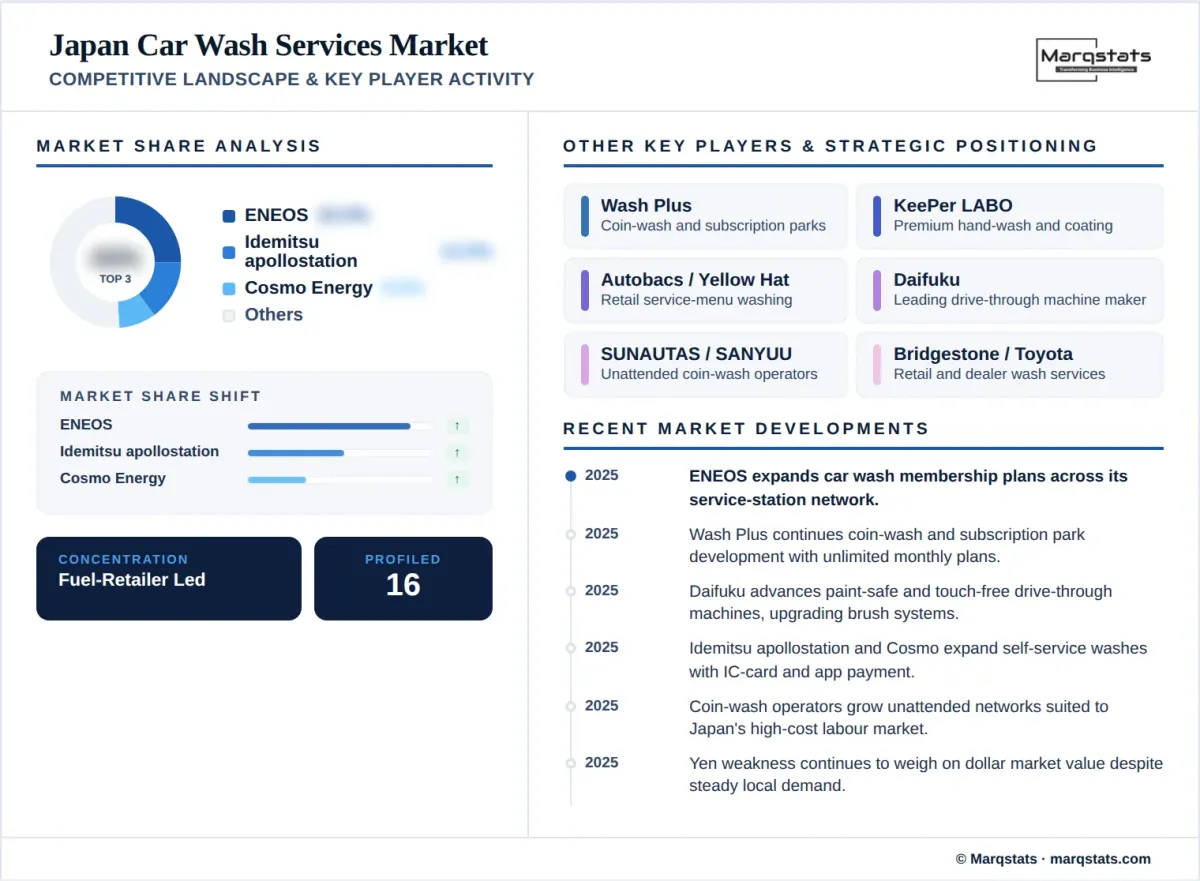
The Japan car wash services market is organized around fuel retailers rather than dedicated wash chains. ENEOS, the country's largest service-station network with over 12,000 outlets, operates the widest installed base of drive-through wash machines, followed by Idemitsu apollostation and Cosmo Energy. These networks integrate washing with fuel, convenience, and membership programs, and account for the majority of machine-wash revenue nationwide. Their scale and brand recognition make service-station washing the default, and their membership programs increasingly anchor customer relationships as fuel purchases decline.
Coin-wash parks form a distinct competitive segment. Independent operators and specialist chains, including Wash Plus, run unattended self-service and drive-through parks that compete on convenience, price, and location rather than fuel bundling. Membership plans, priced at JPY 2,500 to 10,000 per month, are the principal competitive lever, converting routine washing into recurring revenue and building customer loyalty across both fuel-retail and specialist networks. Automotive-goods retailers such as Autobacs and Yellow Hat add washing and detailing to their service menus, extending competition into the retail-parking channel.
Equipment makers form a globally significant tier. Daifuku, a major domestic manufacturer, supplies drive-through and conveyor wash machines drawing on its material-handling engineering, and competes with other Japanese and international makers on paint-safe brush technology, touch-free systems, and reliability. Competition across the market turns on machine quality, membership penetration, and site convenience, with format shares expected to stay broadly stable as the market grows slowly through pricing and premiumization to 2030.
Companies Covered
The report profiles 16++ companies with full strategy and financials analysis, including:
Recent Market Activity
Table of Contents
Coverage & Segmentation
This report provides a comprehensive analysis of the Japan car wash services market covering the historical period 2021 to 2025 and the forecast period 2026 to 2030, with 2025 as the base year. The study defines the market as annual revenue earned by professional operators cleaning passenger and light commercial vehicles through in-bay automatic drive-through, tunnel/conveyor, self-service coin-wash, and manual formats, inclusive of basic interior cleaning; full detailing and equipment or chemical sales are excluded. Market size is presented in value terms (USD billion), with historical figures reflecting yen exchange effects and forecasts assuming constant exchange rates.
The study segments the market by service type, site format, payment model, and vehicle type, and examines regional demand across Kanto, Kansai, Chubu, Northern Japan, and Western and Southern Japan, alongside fuel-retailer networks, coin-wash parks, and membership adoption. Market sizing uses a bottom-up model anchored to AIRIA vehicle-parc data and service-station wash-machine penetration, cross-checked against wash intensity per vehicle. The competitive section profiles 16 fuel retailers, coin-wash operators, and equipment makers spanning the market.