Market Snapshot
Key Takeaways
Market Overview & Analysis
Report Summary
The United States car wash services market comprises professional operators that clean passenger and light commercial vehicles across four service formats — tunnel/conveyor, in-bay automatic (roll-over), self-service, and manual or mobile hand wash — monetized through pay-per-wash tickets and recurring unlimited-membership subscriptions. The 2025 market of USD 20.59 billion sits against a base of roughly 62,750 car wash and detailing outlets nationwide, of which about 17,584 operate with paid employees. Professional washing has become the norm: roughly 77% of drivers now favor professional washes over home washing, up from under half two decades earlier.
The market has moved through three phases. A pandemic-era reopening and services-price surge lifted revenue more than 10% in 2022; a rapid build-out of express tunnels — peaking at 943 new sites in 2022 — expanded capacity; and a 2025 correction, marked by more selective construction and one high-profile bankruptcy, ushered in a discipline-focused phase. New-site development has since settled to 600 to 700 tunnels per year, concentrated in high-traffic suburban corridors that carry 25,000 or more vehicles per day.
Revenue concentrates in express-exterior conveyor tunnels, which pair high throughput — often above 100 cars per hour — with free vacuums and app-based membership entry using license-plate recognition. Owing to these unit economics, private-equity-backed platforms have consolidated the top tier of operators, while independent single-site owners still hold the majority of locations. Membership penetration, recurring revenue quality, and site throughput now define competitive strength more than headline site count alone.
Operating economics vary sharply by format. Express tunnels achieve the strongest margins through automation and optimized throughput, whereas full-service and hand-wash models carry labor at 40% to 50% of revenue. Utilities, water, chemicals, and prime real estate along commuter corridors form the balance of the cost base, with total express-tunnel development ranging from USD 3 million to USD 5 million per site. Rising labor and land costs, alongside tightening water regulation, continue to push the format mix toward automated exterior tunnels and to reward operators that recycle wash water and shorten cycle times.
Demand carries a seasonal and weather-dependent profile that subscriptions are designed to smooth. Northern markets see winter road-salt spikes, while dry Sun Belt states support year-round volumes and the highest site densities. Recurring memberships convert this episodic behavior into predictable monthly cash flow; at mature tunnels, membership can supply 40% to 60% of revenue, insulating operators from rainfall variability and reinforcing the format's appeal to institutional capital.
Market Dynamics
Key Drivers
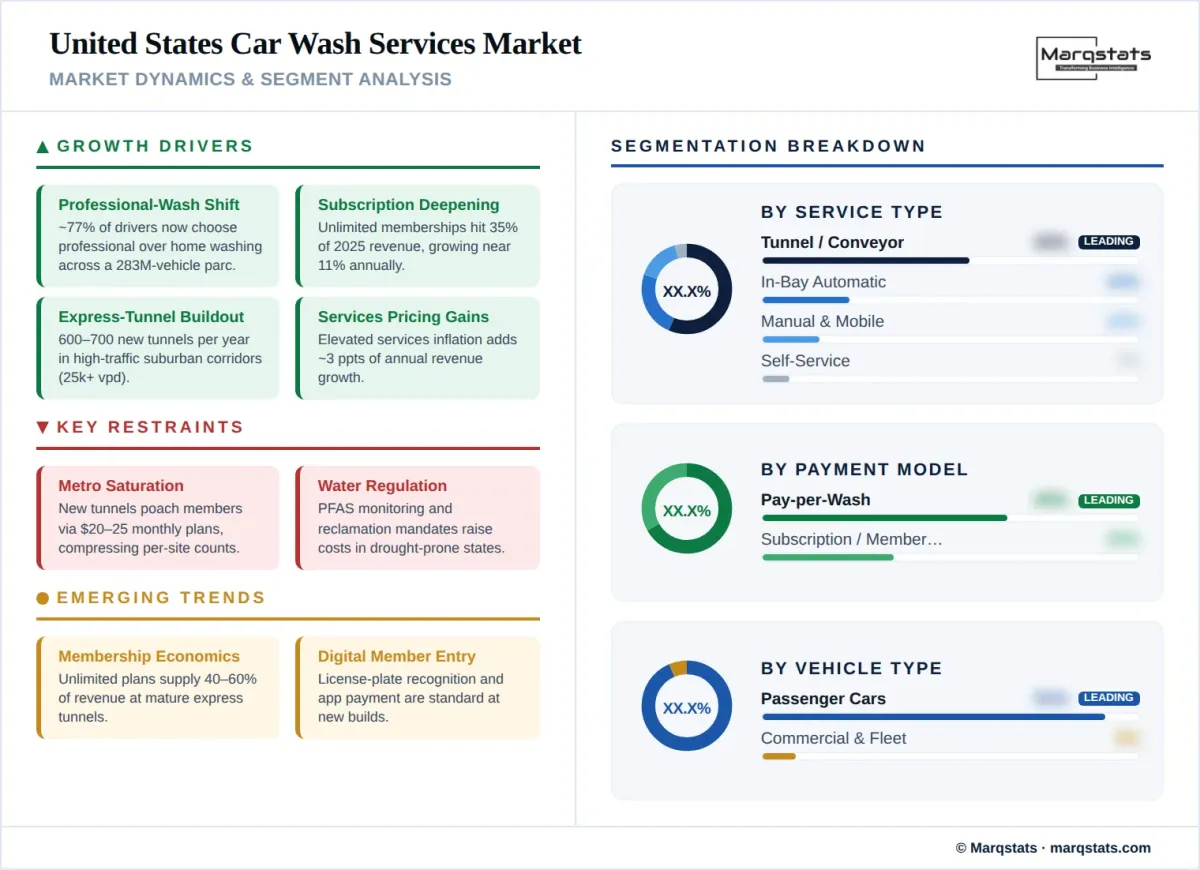
- The professional-wash shift lifts demand, with roughly 77% of drivers choosing professional washes over home washing, expanding the addressable base across a parc of 283 million registered vehicles.
- Subscription deepening converts episodic demand into recurring revenue; unlimited-membership sales reached 35% of 2025 market revenue and grow near 11% annually.
- New express-tunnel capacity of 600 to 700 sites per year sustains volume growth, concentrated in high-traffic suburban corridors with strong daytime traffic counts.
- Services pricing gains, tracking elevated services inflation, add roughly 3 percentage points of annual revenue growth across the format mix.
- Private-equity capital funds greenfield development and roll-up acquisitions, professionalizing operations and accelerating membership adoption.
- Commercial and fleet demand rises as last-mile delivery, logistics, and rideshare operators outsource washing or install dedicated bays to meet image and compliance standards.
Key Restraints
- Market saturation in built-out metros compresses per-site car counts, as new express tunnels draw members from incumbents through USD 20 to USD 25 monthly plans.
- Tightening water-use and discharge rules, including PFAS monitoring and reclamation mandates, raise construction and operating costs, especially in drought-prone states.
- High site costs, with total express-tunnel development of USD 3 million to USD 5 million per location, plus debt-funded expansion elevate financial risk, as the Zips Chapter 11 demonstrated.
- Structural decline of self-service and full-service formats drags roughly 2 percentage points from headline growth each year.
Key Trends
- Unlimited memberships now anchor operator economics, contributing 40% to 60% of revenue at mature tunnels and stabilizing weather-dependent demand.
- License-plate recognition and app-based payment are standard at new tunnels, streamlining member entry and retention analytics.
- Sustainability differentiates operators, with water reclamation systems recycling 75% or more of wash water, alongside waterless and steam methods addressing regulatory and cost pressures.
- Consolidation continues through private-equity roll-ups, though lenders have grown cautious on highly leveraged deals following the 2025 correction.
- Electric-vehicle owners expect sensor-safe cleaning, encouraging touch-free and soft-touch equipment and closer ties between wash operators and mobility platforms.
Market Segmentation
Express-exterior tunnels hold the largest revenue share at roughly 55% in 2025, equal to USD 11.39 billion, and are set to reach 62% by 2030. High throughput, free vacuums, and membership integration make the format the focus of nearly all new-site development. Mister Car Wash, Whistle Express, Club Car Wash, Quick Quack, and Tidal Wave Auto Spa all operate exclusively or predominantly in this format.
In-bay automatic washes hold about 23% share in 2025 at USD 4.69 billion. Many sit on fuel-station forecourts and convenience-retail sites, where a single rollover bay complements fuel and store sales. The segment grows slowly in absolute terms while ceding revenue share to tunnels through 2030, owing to lower throughput and a weaker fit with unlimited-membership models. Operators upgrading forecourt estates increasingly replace aging rollovers with express mini-tunnels to lift capacity.
Self-service wand bays account for roughly 7% of 2025 revenue, USD 1.37 billion. The format is in structural decline as express tunnels capture convenience-oriented customers seeking speed and consistency. Absolute revenue plateaus and then edges down across the forecast period, though self-service retains relevance for oversized vehicles, motorcycles, and price-sensitive users in rural and secondary markets where tunnel density is low.
Manual and mobile hand-wash services hold about 15% share, USD 3.13 billion, concentrated among independent operators, full-service family businesses such as Autobell Car Wash, and app-based on-demand providers. The segment loses share to automated formats yet retains a durable base in premium detailing, interior-focused cleaning, and affluent metros where customers pay for a hands-on service. Labor intensity caps scalability, keeping the segment fragmented.
Single-visit tickets account for roughly 65% of 2025 revenue, USD 13.34 billion, and remain the primary acquisition channel that operators convert into memberships through first-visit promotions. The share declines toward 52% by 2030 as subscription adoption deepens, yet pay-per-wash stays essential for occasional users, travelers, and fleet accounts that do not fit a recurring plan. Blended tickets average near USD 12 to USD 18, rising with premium ceramic and paint-protection add-ons.
Unlimited-membership plans reach about 35% of 2025 revenue, USD 7.25 billion, and grow near 11% annually to 48% of revenue by 2030, worth USD 12.44 billion. Recurring membership is the fastest-expanding revenue stream and the metric private-equity sponsors prioritize; Mister Car Wash alone counts roughly 2.3 million members, with membership at 79% of its wash sales.
Purpose-built standalone washes hold roughly 65% of 2025 revenue, USD 13.32 billion, and gain share toward 68% by 2030 as express-tunnel greenfield development continues. The format supports the highest throughput, the largest vacuum arrays, and the strongest membership economics, making it the preferred model for private-equity-backed platforms. Site selection targets commuter arterials with heavy daily traffic, and land plus construction costs of USD 3 million to USD 5 million per site raise the barrier to entry, favoring capitalized operators.
Forecourt washes attached to fuel and convenience retail hold about 22% share in 2025, USD 4.48 billion, and cede share as standalone tunnels expand. These sites increasingly integrate retail energy services, including EV charging deployments across United States retail networks that reshape site economics for fuel-retailer operators.
Mobile and retail-parking formats account for roughly 14% of 2025 revenue, USD 2.79 billion, serving on-demand, fleet, and shopping-center demand. App-based mobile providers add convenience-oriented capacity in dense metros, and waterless methods lower the water and permitting burden for operators without fixed sites. The channel remains niche relative to fixed tunnels yet fits underserved urban and corporate-campus locations.
Passenger vehicles generate about 91% of 2025 revenue, USD 18.65 billion, reflecting the consumer orientation of express-tunnel and membership models. Individual commuters and households drive membership sign-ups, and the segment underpins the recurring-revenue base that anchors sector valuations. The share eases slightly across the forecast period as commercial washing expands at a faster pace.
Commercial and fleet washing holds roughly 9% share, USD 1.94 billion, rising toward 10% by 2030. Growth is driven by last-mile delivery, logistics, and rideshare fleets that outsource washing or install dedicated wash bays to meet image and compliance standards. Fleet accounts favor volume contracts and off-peak scheduling, and larger vehicles command premium pricing, supporting faster revenue growth than the passenger segment.
By Geography
Southwest
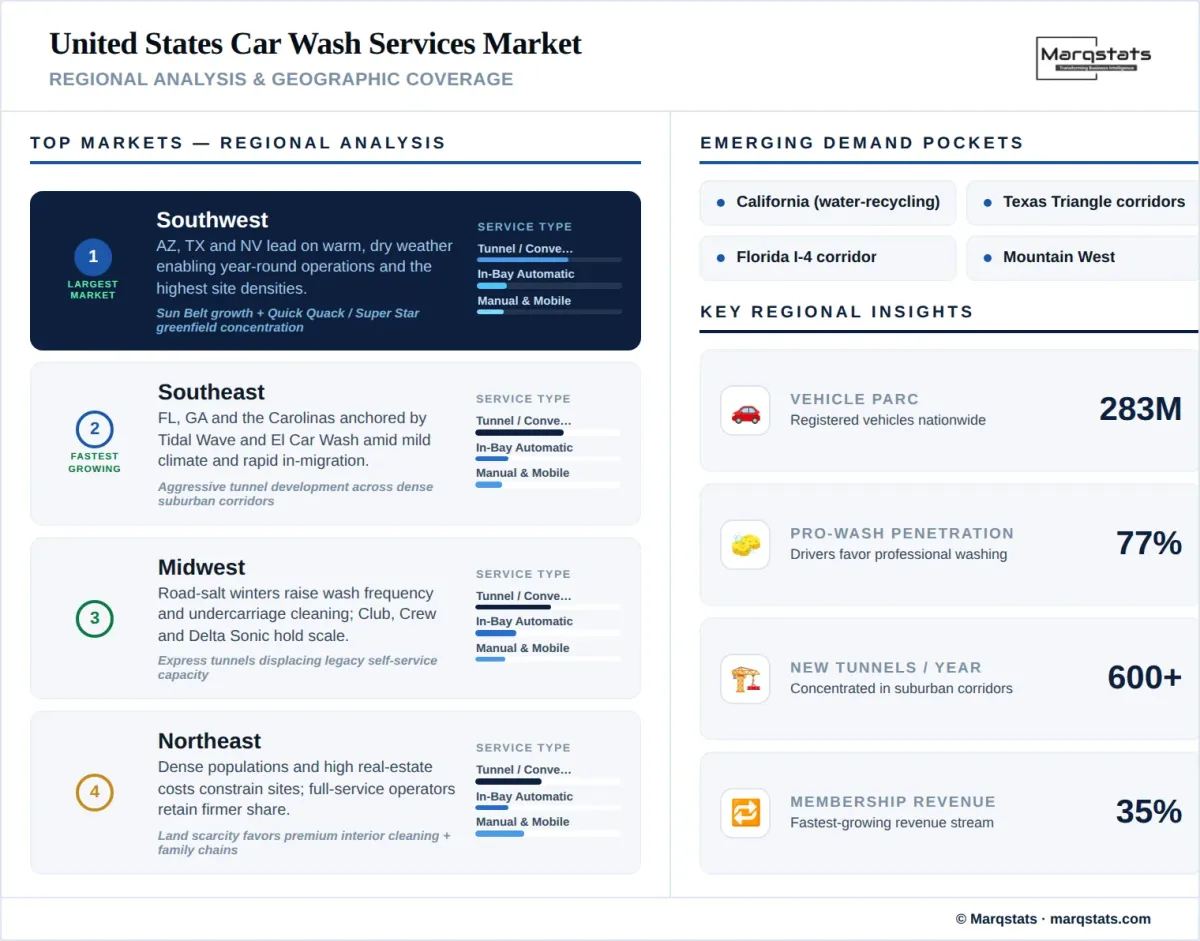
The Southwest, including Arizona, Texas, and Nevada, holds the largest regional revenue share, supported by warm, dry weather that enables year-round operations and the highest site densities. Sun Belt population growth and multi-state greenfield expansion by chains such as Quick Quack and Super Star Car Wash concentrate here, sustaining strong per-site car counts and membership uptake.
Southeast
The Southeast, spanning Florida, Georgia, and the Carolinas, is a fast-growing region anchored by Tidal Wave Auto Spa in Georgia and El Car Wash in Florida. A mild climate, rapid in-migration, and dense suburban corridors support high volumes and aggressive tunnel development.
Midwest
The Midwest sustains steady demand, with road-salt winters raising exterior-wash frequency and undercarriage cleaning to protect paint and chassis. Club Car Wash, Crew Carwash, and Delta Sonic operate large regional footprints, and express tunnels continue to displace older self-service capacity. Seasonal peaks in late winter and early spring lift walk-in volumes, while memberships smooth revenue across milder months.
Northeast
The Northeast combines dense populations with high real-estate costs that constrain site availability. Full-service and family-owned operators such as Autobell Car Wash, Splash Car Wash, and Delta Sonic retain share alongside expanding express tunnels, and premium interior cleaning holds a firmer base than in Sun Belt markets.
West
The West, anchored by California, faces the strictest water-reclamation and discharge rules in the country, raising construction and operating costs. Operators emphasize water recycling and reclamation to comply while serving large urban vehicle parcs; regulatory capital requirements accelerate consolidation toward better-capitalized platforms. Drought cycles periodically shift consumers from home washing to professional sites that recycle water, supporting the structural case for organized operators across the region.
How Competition Is Evolving
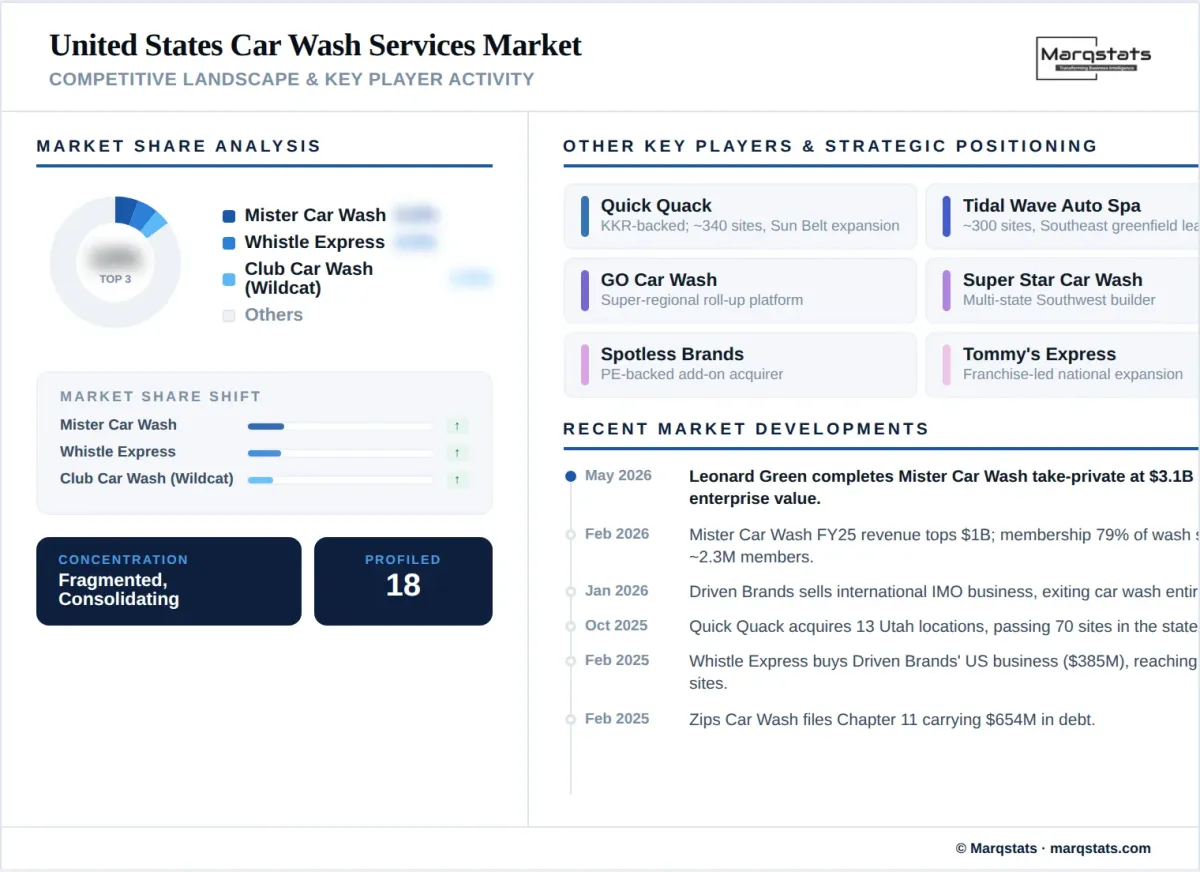
The United States car wash services market is fragmented at the ownership level yet consolidating rapidly among national platforms. Private equity now controls nearly every national express-tunnel chain, drawn by recurring subscription revenue and roll-up economics. Following 2025 M&A, the ranking by site count is anchored by Mister Car Wash (548), Whistle Express (530), the Wildcat platform combining Club Car Wash and Express Wash Concepts, Quick Quack (about 340), and Tidal Wave Auto Spa (about 300).
Operators compete on membership penetration, site throughput, and location quality rather than price alone. Unlimited monthly plans priced between USD 15 and USD 40 anchor customer retention, while license-plate recognition and mobile apps reduce friction at member entry. Mister Car Wash ended 2025 with roughly 2.3 million members, with membership representing 79% of wash sales, and surpassed USD 1 billion in annual revenue for the first time.
The operator base tiers into three groups. National platforms — Mister Car Wash, Whistle Express, the Wildcat platform, Quick Quack, and Tidal Wave Auto Spa — combine multi-state scale with large membership bases and are all private-equity backed. Super-regional roll-ups, including GO Car Wash, WhiteWater Express, Spotless Brands, Mammoth Holdings, El Car Wash, Super Star Car Wash, and the franchise-led Tommy's Express, expand through greenfield builds and add-on acquisitions. Independent and family-owned operators such as Autobell Car Wash, Splash Car Wash, Crew Carwash, and Delta Sonic retain regional strength, several through full-service models that command premium pricing. Active private-equity sponsors across the sector include Oaktree, KKR, Leonard Green, Warburg Pincus, Golden Gate, and TSG Consumer.
The 2025 correction reset expansion discipline across the sector. Zips Car Wash filed for Chapter 11 in February 2025 with USD 654 million in debt, exposing the risk of sale-leaseback-funded growth, while Driven Brands exited the sector entirely, selling its US business to Whistle Express and its international IMO operations to Franchise Equity Partners. Consolidation continues among well-capitalized platforms, however lenders have grown more cautious on highly leveraged transactions, and operators now compete on membership retention and per-site profitability rather than site count alone.
Companies Covered
The report profiles 18++ companies with full strategy and financials analysis, including:
Recent Market Activity
Table of Contents
Coverage & Segmentation
This report provides a comprehensive analysis of the United States car wash services market covering the historical period 2021 to 2025 and the forecast period 2026 to 2030, with 2025 as the base year. The study defines the market as annual revenue earned by professional operators cleaning passenger and light commercial vehicles through tunnel/conveyor, in-bay automatic, self-service, and manual or mobile formats, inclusive of basic interior cleaning; full detailing and equipment or chemical sales are excluded. Market size is presented in value terms (USD billion).
The study segments the market by service type, payment model, site format, and vehicle type, and examines United States sub-regional demand, competitive concentration, and private-equity activity. Market sizing anchors to US Census Bureau Service Annual Survey revenue for the car wash industry, adjusted for full-detailing scope and nonemployer receipts, and is cross-checked bottom-up against vehicle parc, professional-wash penetration, wash frequency, and blended ticket. The competitive section profiles 18 operators spanning national platforms, super-regional roll-ups, and independent chains.