Market Snapshot
Key Takeaways
Market Overview & Analysis
Report Summary
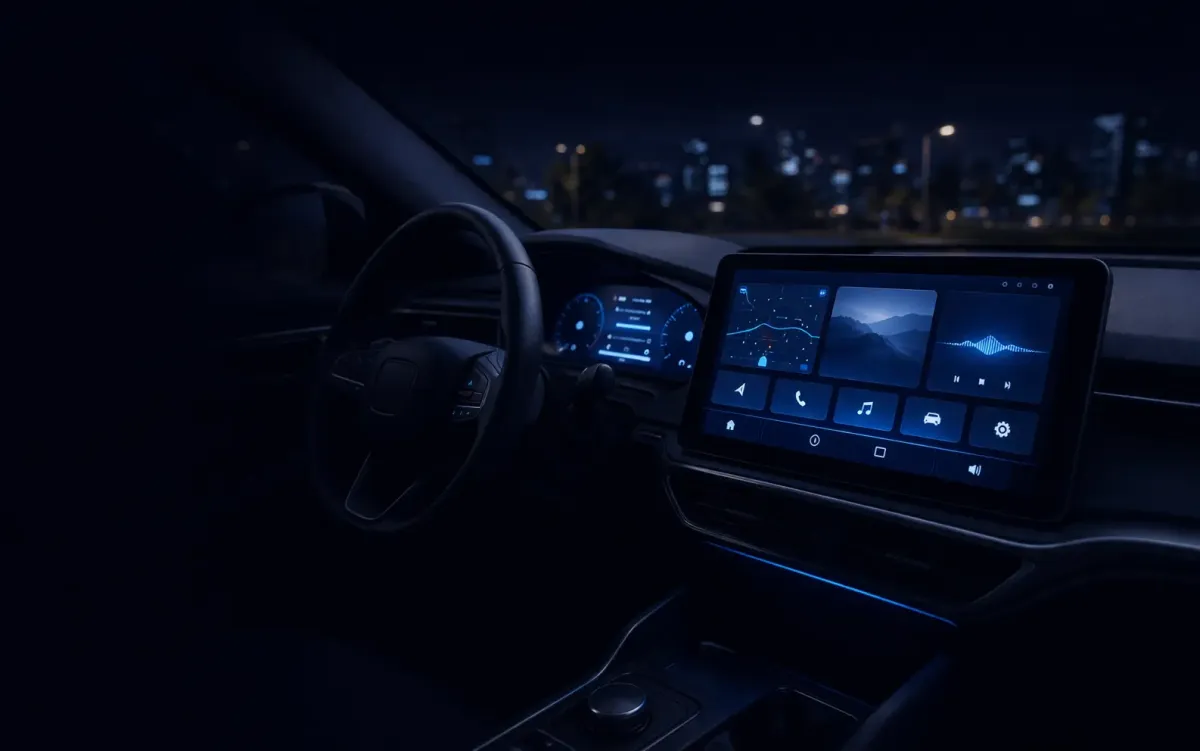
The global automotive display market comprises the physical display panels and associated hardware installed in vehicles, spanning digital instrument clusters, center-stack infotainment screens, head-up displays, passenger and rear-seat entertainment screens, and digital rearview mirrors. This study segments the market by product type, display technology, and vehicle type, with a 2025 base year, historical coverage from 2021 to 2025, and forecasts to 2030. Market size is stated as display panel and hardware revenue in United States dollars, distinct from the infotainment software and platform layer covered separately.
Digital cockpit consolidation is the defining structural trend in this market: automakers are increasingly specifying instrument cluster, center-stack, and head-up display hardware as a single integrated system controlled by one domain computer, rather than as separate modules from separate suppliers. This consolidation has concentrated large hardware contracts with a smaller number of Tier-1 cockpit integrators, even as the underlying display panels continue to be sourced from a competitive, globally distributed panel-manufacturing base concentrated in South Korea, Japan, and China. The pace of this consolidation varies materially by automaker and platform, with some manufacturers moving directly to fully integrated domain architectures while others continue sourcing cluster and center-stack hardware from separate suppliers even as software integration proceeds ahead of hardware consolidation.
Electric vehicles are a structural demand driver independent of overall vehicle production volume, since electric vehicle cockpits carry meaningfully more display area on average than comparable internal-combustion models, reflecting both a premiumisation positioning choice by electric vehicle manufacturers and the additional energy and charging-status information that electric vehicle dashboards must communicate. Chinese electric vehicle manufacturers in particular have standardised on larger cluster and center-stack panels than the global average, reinforcing Asia-Pacific's share of both production and display revenue.
The competitive structure of this market differs meaningfully from most automotive component categories in that two distinct supplier tiers compete for different parts of the value chain: display panel manufacturers, concentrated among a small number of large-scale South Korean, Japanese, and Chinese producers, and Tier-1 cockpit integrators, who purchase panels and integrate them into complete hardware-software systems for automakers. This two-tier structure means panel technology decisions and cockpit integration decisions are made by different companies with different competitive dynamics, a distinction this report tracks separately throughout the competitive analysis and company-profile sections. A panel manufacturer's competitive position depends primarily on manufacturing yield and technology roadmap, while a Tier-1 integrator's position depends on systems-engineering capability and the depth of its relationships with automaker cockpit-engineering teams, two largely independent competitive games played within the same overall market.
Market Dynamics
Key Drivers
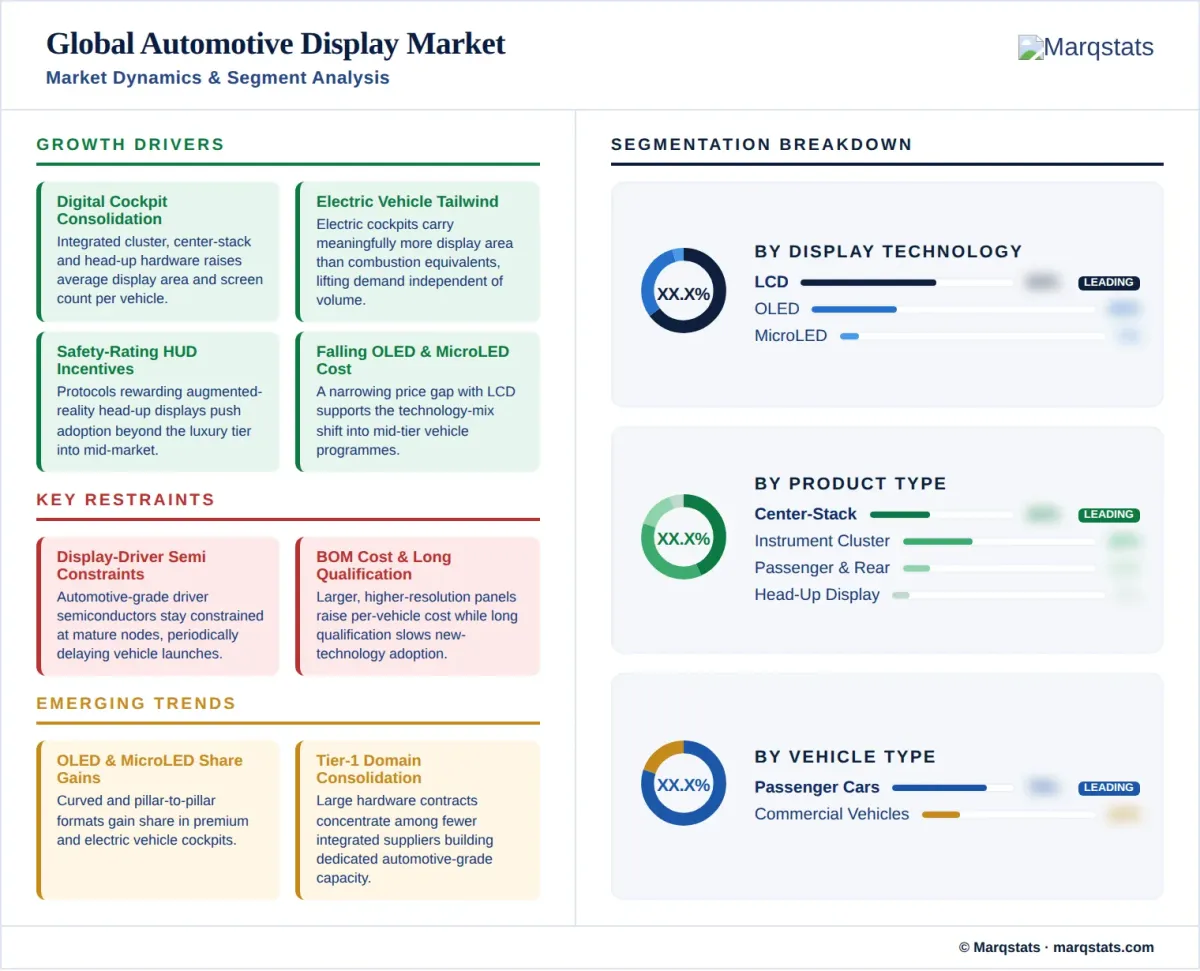
- Digital cockpit consolidation is increasing average display area and screen count per vehicle across every vehicle segment.
- Electric vehicle production growth is a structural tailwind, given higher average display area per vehicle than internal-combustion equivalents.
- Safety-rating protocols that reward augmented-reality head-up displays are accelerating adoption beyond the luxury segment.
- Falling OLED and microLED production costs are narrowing the price gap with LCD, supporting technology-mix shift in mid-tier vehicles.
- Rear-seat and passenger entertainment displays are expanding beyond luxury vehicles into premium mass-market segments.
Key Restraints
- Automotive-grade display driver semiconductor capacity remains constrained at mature process nodes, periodically delaying vehicle launches.
- Higher-resolution and larger panels raise per-vehicle bill-of-materials cost, creating pressure in price-sensitive vehicle segments.
- Long automotive qualification and validation cycles slow the pace at which new display technologies reach volume production relative to consumer electronics.
Key Trends
- OLED and microLED panels are gaining share in premium and electric vehicles, led by curved and pillar-to-pillar display formats.
- Head-up display adoption is accelerating beyond luxury vehicles as safety-rating protocols reward driver-attention-preserving interfaces.
- Digital cockpit domain consolidation is shifting large hardware contracts toward a smaller number of integrated Tier-1 suppliers.
- Panel manufacturers are expanding dedicated automotive-grade production capacity separate from consumer-electronics display lines.
Market Segmentation
Center-stack infotainment displays represent the largest product segment by revenue, roughly 40% to 43% of the market, reflecting their role as the primary human-machine interface surface in modern cockpits. Screen sizes in this category have expanded steadily, with panels exceeding 10 inches now common in mid-tier and premium vehicles and pillar-to-pillar formats emerging in flagship electric vehicles. This segment also carries the highest average bill-of-materials cost per unit among the four product categories, since center-stack panels combine larger physical size with touch-sensing hardware absent from most instrument-cluster installations.
Digital instrument clusters remain a large, mature product segment as analog dial clusters continue to be phased out across nearly every vehicle category. Growth in this segment is increasingly driven by resolution and technology upgrades within an already largely digitised installed base, rather than by new digital adoption, since most new vehicles sold in developed markets now ship with a digital cluster as standard rather than optional equipment.
Head-up displays remain a small segment, under 5% of total revenue, but are among the fastest-growing product categories as safety-rating protocols that reward augmented-reality overlays push adoption beyond the luxury tier into mainstream mid-market vehicles. Optical unit cost remains the primary barrier to faster mass-market adoption, though windshield-integrated combiner designs are gradually reducing the cost premium relative to legacy combiner-glass architectures.
Passenger and rear-seat entertainment displays remain concentrated in luxury and premium vehicles, though the category is expanding into upper-mid-market SUVs and minivans as manufacturers use rear-seat entertainment as a differentiating comfort feature. Digital rearview mirrors, a smaller sub-category within this segment, are gaining share as camera-monitor systems replace optical mirrors in an increasing number of premium vehicle programmes.
LCD panels retain the majority of shipments by value, roughly 61% to 65%, reflecting an established manufacturing base, predictable cost roadmap, and continuous incremental improvement through Mini-LED backlighting that narrows the visual gap with OLED at a materially lower cost. LCD's dominant position is most durable in mass-market and commercial-vehicle applications, where total cost of ownership considerations weigh more heavily than peak visual performance.
OLED is the fastest-growing display technology, expanding at over 10% CAGR, driven by superior contrast and its suitability for curved and flexible form factors increasingly favoured in premium and electric vehicle cockpits. Automotive OLED shipment volumes remain small in absolute unit terms relative to LCD, yet are growing from that small base at a materially faster rate as automotive-grade production yields improve and more manufacturers qualify automotive OLED production lines. MicroLED remains an early-stage technology in automotive applications, with production volumes still measured in the low millions of units, but is positioned as the next technology transition once automotive-grade production yields and costs improve, following a similar adoption curve to OLED's own automotive introduction roughly a decade earlier. Component-level cost remains the primary barrier separating microLED from broader adoption, since individual micro-scale emitters must be transferred and bonded at extremely high yield to be commercially viable at automotive volumes, a manufacturing challenge distinct from and more difficult than either LCD or OLED production.
Passenger cars account for the large majority of display market demand, roughly three-quarters to four-fifths of revenue, reflecting both higher unit volumes and the concentration of premium display features in this vehicle category. Luxury and electric passenger vehicle sub-segments carry disproportionately higher display content per vehicle than mass-market internal-combustion passenger cars, meaning this category's revenue share exceeds its unit-volume share of total vehicle production.
Commercial vehicles, spanning trucks and buses, represent the fastest-growing vehicle-type segment as fleet-management and driver-assistance display requirements extend digital cockpit adoption beyond the passenger-car segment where it originated. Fleet telematics integration, rather than consumer-facing infotainment features, is the primary driver of commercial-vehicle display adoption, distinguishing its growth drivers from the passenger-car segment even as both contribute to overall LCD-to-digital cluster conversion.
By Geography
Asia-Pacific
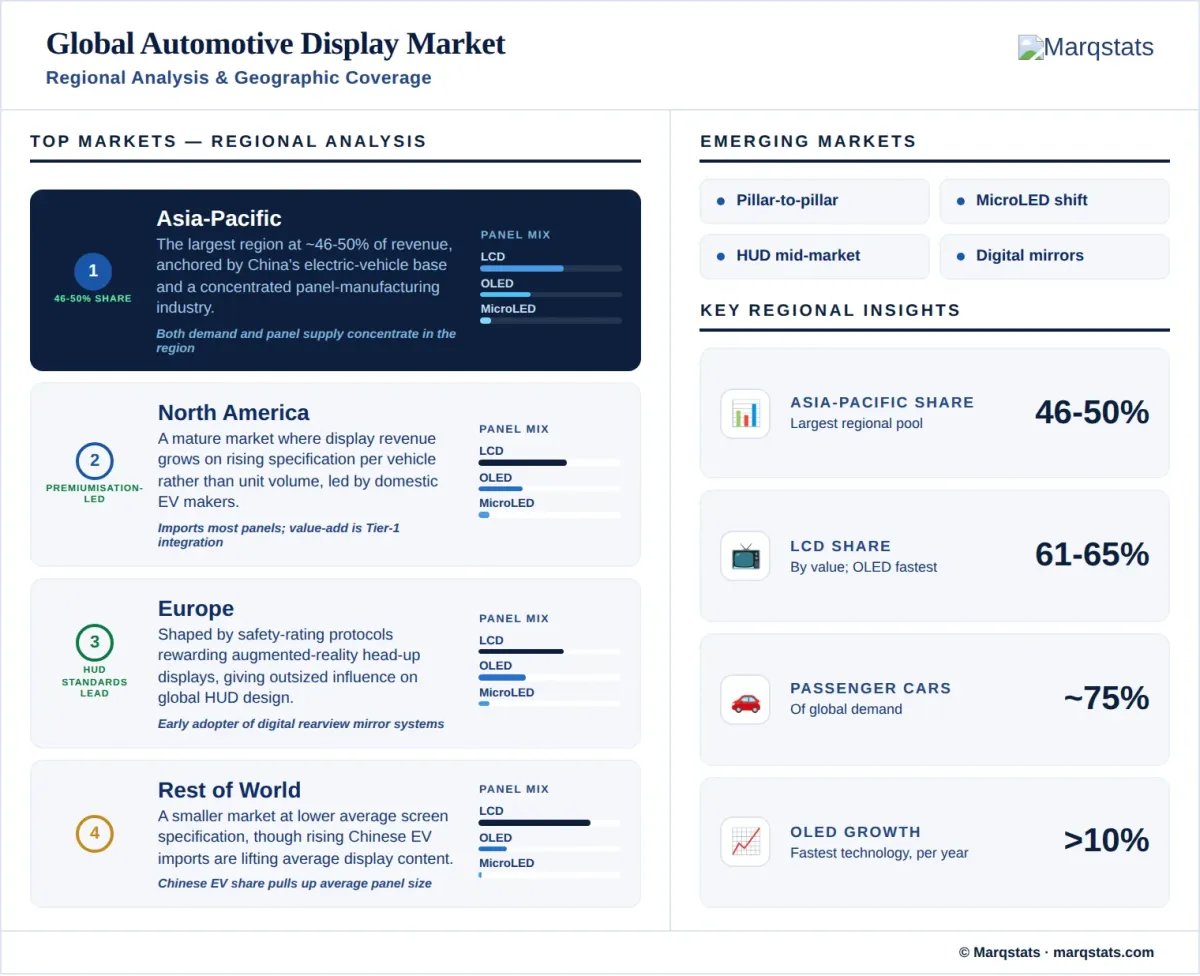
Asia-Pacific holds the largest regional share, roughly 46% to 50% of global revenue, anchored by China's electric vehicle production base and a concentrated regional panel-manufacturing industry spanning South Korea, Japan, and China. Chinese electric vehicle manufacturers have standardised on larger-than-average cluster and center-stack displays, reinforcing the region's share of both production and revenue, while South Korean and Japanese panel manufacturers supply much of the region's and the world's automotive-grade OLED and advanced LCD capacity. This regional concentration of both demand and supply is unusual among automotive component categories and gives Asia-Pacific panel manufacturers a structural cost and lead-time advantage when supplying the region's own vehicle production.
North America
North America is a mature, premiumisation-led market where display revenue growth is driven more by rising specification per vehicle than by unit volume growth, with domestic electric vehicle manufacturers among the earliest adopters of large-format pillar-to-pillar center-stack displays. The region imports the substantial majority of its automotive display panels from Asia-Pacific manufacturers, with domestic value-add concentrated in Tier-1 cockpit systems integration rather than panel manufacturing itself.
Europe
Europe's display market is shaped disproportionately by safety-rating protocols that reward augmented-reality head-up displays and penalise poorly positioned touchscreens, giving the region an outsized influence on global head-up display design standards relative to its share of vehicle production. European premium automakers have also been early adopters of digital rearview mirror systems, a smaller display sub-category that continues to expand from a luxury-vehicle base into upper-mid-market programmes.
Rest of World
Latin America, the Middle East, and Africa represent a smaller display market concentrated in lower average screen specification, though rising import and local-assembly volumes of Chinese electric vehicles are beginning to lift average display content in these markets as well. This shift is most visible in markets where Chinese electric vehicle brands have achieved meaningful new-vehicle market share, since these vehicles typically arrive with larger-than-regional-average display specifications regardless of local market positioning norms.
How Competition Is Evolving
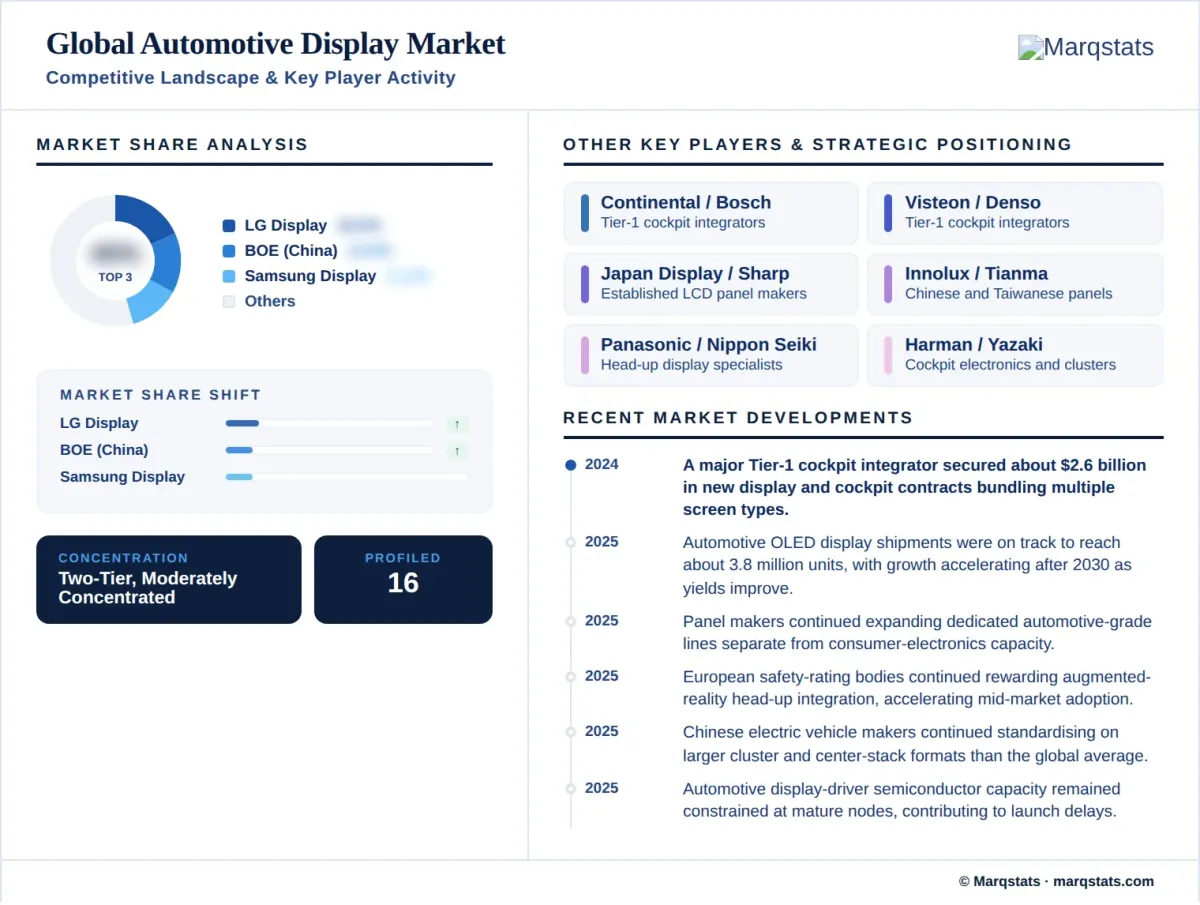
The market is moderately concentrated and structured across two distinct competitive layers: display panel manufacturers, who compete on manufacturing scale, yield, and underlying technology, and Tier-1 cockpit integrators, who compete on systems integration, software-hardware bundling, and automaker relationships. Panel manufacturers are concentrated in South Korea, Japan, and China, while Tier-1 integration contracts increasingly bundle multiple display types into a single hardware-software stack that simplifies validation and shortens launch timelines for automakers. This two-tier structure means a single automaker cockpit programme typically involves a panel-supply relationship and a separate, larger integration contract, and the two are negotiated and awarded through different processes.
Competitive strategy among panel manufacturers centers on expanding dedicated automotive-grade production capacity, since automotive qualification standards differ materially from consumer-electronics display lines and cannot simply reuse existing capacity. Automotive-grade panels must meet wider operating-temperature ranges, longer qualified-lifetime requirements, and more stringent vibration and shock tolerances than consumer-electronics equivalents, meaning capacity cannot be freely reallocated between the two end markets even when technically similar panel technology is involved. Among Tier-1 integrators, competitive strategy centers on winning multi-year, multi-vehicle-platform cockpit contracts that bundle cluster, center-stack, and head-up display hardware together, since these bundled awards are larger and stickier than single-display component contracts, and switching costs for automakers rise once a domain-controller architecture has been jointly developed with a specific integration partner. This switching-cost dynamic is becoming a more explicit part of Tier-1 sales strategy, with several integrators now pricing early-programme engineering support below cost in exchange for the multi-year production contract that typically follows a successful joint-development relationship.
Companies Covered
The report profiles 16+ companies with full strategy and financials analysis, including:
Recent Market Activity
Table of Contents
Coverage & Segmentation
This report provides a comprehensive assessment of the global automotive display market across a 2025 base year, historical data from 2021 to 2025, and forecasts spanning 2026 to 2030. Market size is stated as display panel and hardware revenue in United States dollars. Segmentation covers three dimensions: product type, display technology, and vehicle type, alongside regional analysis spanning Asia-Pacific, North America, Europe, and the rest of world.
The scope covers digital instrument clusters, center-stack infotainment screens, head-up displays, passenger and rear-seat entertainment displays, and digital rearview mirrors, across LCD, OLED, and microLED panel technologies. The study excludes the infotainment software platform, operating system, voice assistant, connectivity services, and app ecosystem layer, which Marqstats covers in its companion in-vehicle infotainment report; readers researching the software and platform side of the digital cockpit should refer to that companion study. Motorcycle and two-wheeler displays, aftermarket retrofit screens, and non-vehicle-integrated navigation devices are also excluded, since each serves a distinct buyer and competitive set from OEM-installed automotive display hardware. Country-level detail beyond the four-region split covered here is available under customization, alongside deeper cuts by product type, display technology, or vehicle platform.