Market Snapshot
Middle bar: base-year value × (1 + CAGR), rounded to two decimals. This is a calculated illustration, not a separately researched annual estimate.
Automotive B2B E-Commerce Market Overview
The automotive B2B e-commerce market covers the digital transaction layer through which automotive parts, components, accessories, tyres, consumables, and services are procured, ordered, invoiced, and returned across the automotive supply chain — from manufacturer to tier-1 supplier, tier-1 to distributor, distributor to workshop, and fleet operator to supplier. This market is best understood as digital trade infrastructure rather than a simple online sales channel. It encompasses five interlocking layers: product and fitment data standards that enable catalog accuracy; ordering and procurement platforms where buyers search, price, and purchase; live inventory and availability visibility that connects supplier stock to buyer intent; invoicing and payment automation including EDI-type message exchange; and access to vehicle and repair data that underpins accurate parts matching, diagnostic-linked ordering, and warranty compliance. No single layer creates commercial value in isolation — the market's defining characteristic is the integration of all five into workflows that reduce procurement friction for repair shops, fleet operators, distributors, and independent aftermarket operators.
The global automotive B2B e-commerce market was valued at approximately USD 58 billion in 2025 and is projected to reach approximately USD 128 billion by 2030, expanding at a CAGR of approximately 17.16% during the 2026–2030 forecast period. These figures represent the gross merchandise value transacted through B2B digital channels — including supplier-to-distributor EDI and platform ordering, distributor-to-workshop e-commerce and customer portals, fleet procurement digital channels, B2B auto parts marketplaces, and integrated repair-shop ordering platforms — and exclude B2C online automotive retail. North America is the largest regional market: independent assessments suggest US e-commerce sales of automotive aftermarket parts reached approximately USD 42 billion in 2025 including B2B-influenced marketplace channels, with B2B-specific digital procurement representing the majority of that figure by value. Europe is the second-largest market and the most advanced in regulatory infrastructure — ViDA e-invoicing mandates, the EU Data Act (applying from September 2025), and the RMI framework for vehicle repair data access are all accelerating the digitisation of automotive distribution trade flows. Asia-Pacific is the fastest-growing region.
The market's structural growth driver is the irreversible shift from manual, phone-based, and email-driven parts ordering to digitally integrated procurement workflows. Auto Care Association data show the total US automotive aftermarket at approximately USD 440 billion in addressable spend — a pool of commercial transactions that is only partially digitised today but where B2B digital ordering is gaining share at an accelerating rate. Europe's automotive service and maintenance market is estimated at approximately EUR 245 billion in annual transaction value, with the same digitisation dynamic underway as workshop management systems, fleet telematics platforms, and distributor ERP systems increasingly integrate B2B e-commerce ordering at the point of repair or maintenance decision rather than as a separate procurement step.
Key Takeaways
Market Overview & Analysis
Report Summary
The automotive B2B e-commerce market is at an inflection point between early digital adoption and workflow-integrated digital trade infrastructure. The study period is 2021–2030 with 2025 as base year. The market's defining trajectory is away from 'having a catalogue online' toward owning the transaction layer that sits on top of vehicle data, fitment accuracy, workshop workflow integration, and invoice compliance. This distinction matters commercially because it shifts competitive advantage from web development and cataloguing effort toward data standards integration, supplier network connectivity, and system-level procurement embedding — capabilities that take years to build and create durable switching costs once established inside a repair shop's management system or a distributor's ERP.
The market sits within the broader global automotive aftermarket ecosystem — a spend pool of approximately USD 440 billion in the US addressable market alone and approximately EUR 245 billion in annual European service and maintenance transaction value. B2B e-commerce's share of this total remains in the early-to-mid adoption phase: Eurostat reports that approximately 18.5% of EU enterprise turnover came from e-sales in 2024, with EDI-type transactions representing a larger share than web/app-based transactions in manufacturing and wholesale — indicating that structured B2B electronic transactions are already widespread, but less visible than consumer-facing commerce. The OECD reports that the share of wholesale SMEs receiving online orders rose from approximately 31% in 2013 to approximately 41% in 2023 — a decade of directional shift that shows the adoption curve is genuine and sustained, even if the reported figures only partially capture the B2B digital transaction base.
The most commercially important structural shift in the period 2025–2030 is the convergence of automotive B2B e-commerce with vehicle data access, diagnostic integration, and regulatory compliance. Connected vehicles generate diagnostic, telematics, battery state-of-health, and software-linked service data that increasingly determines which part is correct, which repair workflow applies, and which warranty condition applies to a given transaction. The EU Data Act — entering force January 2024, applying from September 2025 — gives businesses rights to access data generated by connected products, explicitly including for repair and maintenance services. The Commission's vehicle-data guidance published September 2025 provides the automotive-specific implementation framework. The RMI (Repair and Maintenance Information) framework requires manufacturers to provide independent operators with easy, restriction-free, and standardised vehicle data access. Together, these create a regulatory foundation on which automotive B2B e-commerce platforms can build richer, data-integrated procurement workflows — and a competitive advantage for platforms that integrate this data access versus those that remain catalogue-only.
Market Dynamics
Key Drivers
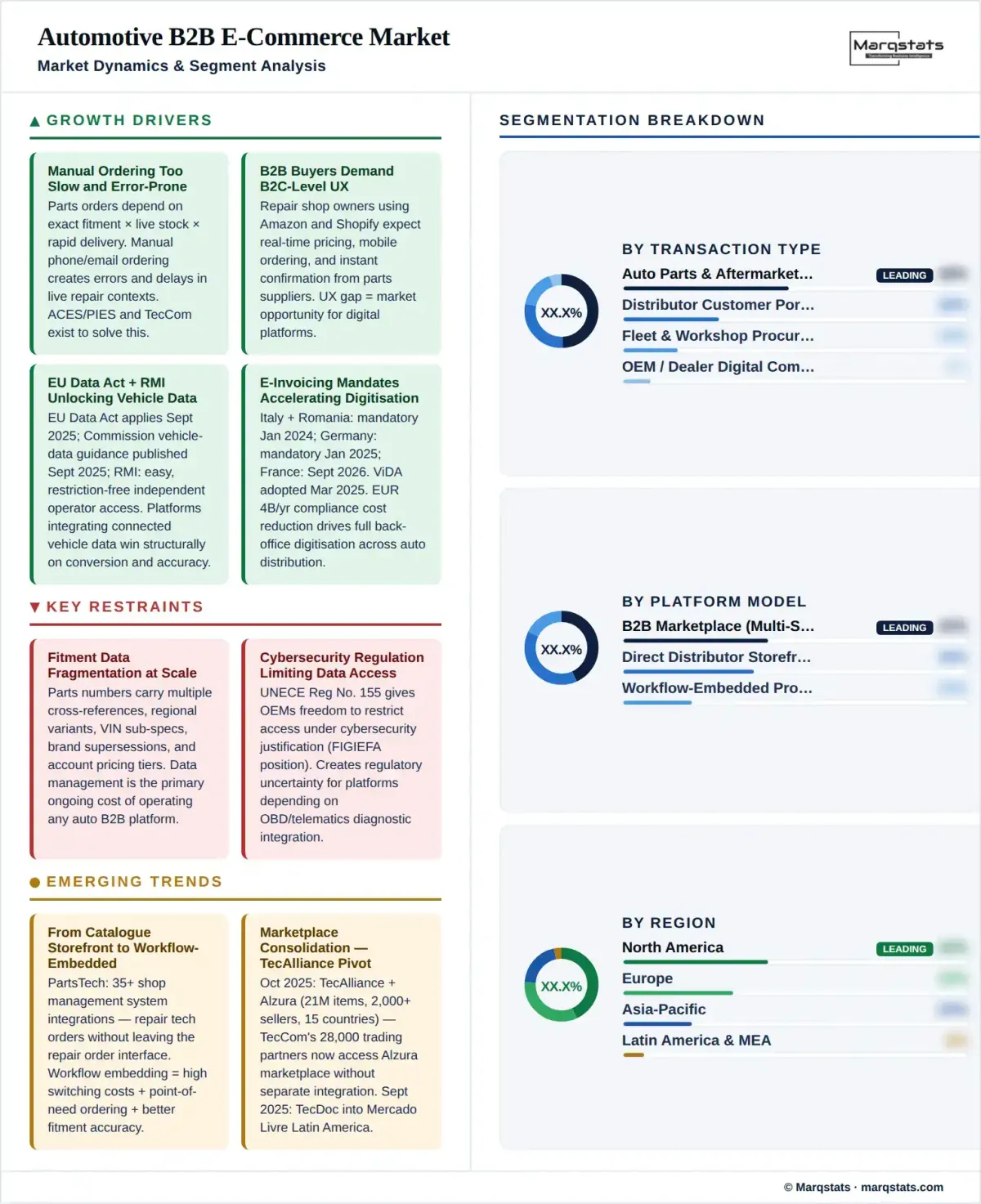
- Parts procurement complexity creating structural demand for digital ordering over manual workflows: Automotive B2B ordering is inherently more complex than most industrial procurement because it depends on exact fitment (vehicle make, model, year, engine variant, trim level, VIN decode), live stock availability across potentially hundreds of supplier locations, returns handling for wrong-fitment errors, rapid delivery requirements in live repair contexts, and accurate invoicing across multi-brand, multi-supplier, multi-currency transactions. Manual catalogue, telephone, and email-based ordering creates errors, delays, and cost at every step of this process. Auto Care Association frames ACES and PIES as the industry's solution to this communication problem — machine-readable standards for fitment and product information that let systems exchange data without human translation. TecAlliance similarly positions TecCom around standardising order, invoice, and returns flows to eliminate manual processing. The market grows because manual ordering is too slow and error-prone for modern repair operations where a vehicle may be waiting on a part, and where incorrect parts incur both immediate return costs and downstream customer satisfaction damage.
- B2B buyers expecting B2C-like UX — self-service, real-time pricing, mobile access, instant availability: Why B2B automotive buyers expect B2C-like UX is one of the market's defining structural dynamics. TecAlliance explicitly notes that B2B buyers increasingly expect seamless and intuitive shopping experiences similar to major consumer platforms. Repair shop owners and fleet procurement managers who use Amazon, Uber, and Shopify in their personal lives bring those UX expectations to their parts ordering workflows — they want real-time pricing, visible stock levels, mobile ordering, saved vehicle profiles, account-specific pricing, and instant confirmation without a sales representative intermediary. This expectation gap — between the UX quality of consumer e-commerce and the legacy telephone/email ordering systems used by most automotive distributors and OEM parts networks — is the market opportunity that B2B auto parts marketplace platforms are exploiting. Platforms that close this gap (PartsTech for workshop-facing procurement, TecCom for distributor-to-supplier flows) are capturing share from traditional phone-based ordering at accelerating rates.
- EU Data Act and RMI framework expanding independent operator access to vehicle data that powers accurate B2B ordering: The EU Data Act (applying from September 2025) and the RMI framework are structurally important because they expand who can access the vehicle data that accurate automotive B2B e-commerce depends on. Connected vehicles now generate real-time diagnostic codes, parts-wear indicators, software version records, battery state-of-health, and service history — all of which can trigger parts and service procurement decisions at the exact right moment. Platforms that can translate this vehicle data into purchase recommendations, fitment validation, and parts pre-authorisation have a structural advantage in conversion rate and order accuracy over platforms relying on static catalogue matching alone. The Commission's September 2025 vehicle-data guidance and the explicit RMI requirement for easy, restriction-free, standardised data access to independent operators both reduce the legal and technical barriers to this data integration — expanding the addressable base for data-integrated B2B e-commerce platforms.
- E-invoicing mandates accelerating back-office digitisation that B2B auto e-commerce platforms must integrate: The EU's ViDA (VAT in the Digital Age) package — adopted March 2025, rolling out to January 2035 — and the spread of national B2B e-invoicing mandates across Europe are accelerating the digitisation of the back-office transaction layer that automotive B2B e-commerce depends on. Italy mandated B2G, B2B and B2C e-invoicing for all businesses from January 2024. Germany made e-invoicing the default for B2B transactions from January 2025. Romania mandated B2B e-invoicing from January 2024. France is preparing a phased rollout from September 2026. In practical commercial terms, these mandates push automotive distributors, spare-parts suppliers, and workshop networks to build or buy digital invoice processing capability — infrastructure that naturally extends to B2B ordering platforms that integrate invoicing as a workflow component. The Commission estimates e-invoicing could reduce VAT fraud by up to EUR 11 billion per year and reduce compliance costs for EU traders by more than EUR 4 billion per year over ten years — a cost-efficiency case that accelerates adoption across the automotive distribution chain.
- Automotive aftermarket scale providing the spend pool that justifies B2B e-commerce platform investment: The raw addressable spend in automotive aftermarket parts, services, and accessories is vast — approximately USD 440 billion in US addressable market alone (Auto Care Association data cited in O'Reilly 2025 filings), with O'Reilly's own served addressable market approximately USD 165–175 billion. The total US automotive aftermarket is projected to reach approximately USD 664 billion by 2028. Europe's service and maintenance market is approximately EUR 245 billion in annual value. These are the spend pools that B2B e-commerce platforms are intermediating. Even a 10–15% shift from manual to digital ordering across these markets represents tens of billions in digital transaction volume — and the directional evidence from OECD SME ordering data (wholesale SMEs receiving online orders rising from 31% to 41% over the 2013–2023 decade) confirms the shift is underway and sustained.
Key Restraints
- Data fragmentation across fitment databases, brand tables, regional catalogs, and pricing systems: Fitment data, brand tables, product attributes, regional catalogue differences, pricing, stock visibility, returns rules, and workshop-system integrations must all align for a B2B automotive e-commerce transaction to complete accurately. Auto Care explicitly frames ACES and PIES as solutions to this communication problem — and the existence of these standards is itself evidence that fragmentation remains a major cost in the market. In practice, a parts number may have multiple cross-references across brands, vary in fitment by sub-variant or regional specification, require VIN decode to confirm application, and carry different pricing tiers for different buyer account types. Managing this complexity at scale — across thousands of SKUs, hundreds of brands, and multiple supplier relationships — requires significant ongoing data management investment that constrains the speed at which new platforms can reach production-quality ordering accuracy.
- Vehicle cybersecurity regulation potentially limiting independent aftermarket platform access to diagnostic data: FIGIEFA argues that UNECE Regulation No. 155 — the vehicle cybersecurity framework — gives vehicle manufacturers wide freedom to implement proprietary cybersecurity controls that could prevent use of independent spare parts or make aftermarket digital integration harder. For B2B automotive e-commerce platforms that depend on OBD, telematics, or software-based diagnostic data to validate fitment, trigger orders, or verify repair workflows, cybersecurity-justified data access restrictions create a practical barrier. This is not a settled interpretation — the Commission, CLEPA, and independent aftermarket bodies have different views on where cybersecurity ends and anti-competitive access restriction begins — but it creates regulatory uncertainty that can slow investment in data-integrated ordering platforms.
- Automotive distribution channel complexity and traditional buyer relationships slowing digitisation: The automotive aftermarket distribution chain involves multiple tiers — OEM to warehouse distributor, warehouse distributor to jobber, jobber to repair shop — with established personal relationships, negotiated pricing, extended credit terms, and complex returns procedures that are difficult to replicate in a digital channel without significant process re-engineering. Many distributor-to-workshop relationships depend on the distributor's counter staff knowing the repair shop's preferences, creditworthiness, and preferred brands. Digitising this relationship layer requires both platform capability and cultural change at the buyer and seller level, which in many markets (particularly mid-market and regional distributors) progresses slowly regardless of technical capability.
- Right to repair legislation inconsistency across geographies creating compliance complexity for cross-border platforms: The right to repair and vehicle data access landscape is inconsistent across major automotive markets. The EU has the RMI framework and is implementing the Data Act. Massachusetts has a state-level right-to-repair mandate for OBD-compatible data (model year 2022 onward). The US lacks a federal equivalent. Japan and China have different access frameworks. Platforms seeking to build globally consistent vehicle-data-integrated ordering capabilities face a patchwork of national requirements that create engineering and legal complexity — potentially delaying or limiting the most data-rich product features to compliant markets only.
Key Trends
- Auto parts ecommerce shifting from catalogue storefronts to workflow-embedded procurement: The most commercially significant trend in automotive B2B e-commerce is the migration from standalone ordering websites toward procurement embedded directly in the tools where automotive buyers work — shop management systems, fleet telematics platforms, distributor ERP systems, and OEM dealer management systems. PartsTech's model illustrates this precisely: integrating with 35+ shop management systems means that a repair technician can search, price, and order from 210+ parts suppliers without leaving the repair order interface. This workflow embedding creates high switching costs (the integration itself is the product), increases order frequency (ordering happens at the point of need rather than as a separate step), and improves fitment accuracy (the shop management system already knows the vehicle). Platforms competing primarily on catalogue quality or website design are structurally disadvantaged against workflow-embedded procurement players.
- Auto parts marketplace consolidation — TecAlliance/Alzura, TecAlliance/Mercado Livre, ACES/PIES 8.0 — creating integrated data-and-order infrastructure: The October 2025 TecAlliance/Alzura partnership — connecting TecCom's approximately 28,000 B2B trading partners to Alzura's 2,000+ sellers and approximately 21 million items across 15 countries — is a structural consolidation event in the European B2B auto parts marketplace. It allows manufacturers and wholesalers using TecCom to access Alzura's broader marketplace distribution without separate integration work. The September 2025 TecAlliance/Mercado Livre integration — bringing TecDoc fitment data into the Latin American e-commerce platform — extends the same logic globally: fitment data providers are becoming the backbone of digital parts commerce across channels and geographies. Auto Care's April 2026 release of ACES 5.0 and PIES 8.0 — adding Extended Producer Responsibility packaging data, richer digital asset handling, and improved validation — signals that North American parts data standards are evolving toward regulatory and content richness beyond pure fitment matching.
- Omnichannel strategy in automotive commerce — digital and physical channels converging rather than replacing: Large automotive distributors are building omnichannel capabilities that combine digital ordering platforms with physical branch networks, call centre support, and field sales relationships. O'Reilly's professional customer programme integrates proprietary mobile ordering apps and the OReillyPro.com B2B e-commerce platform with its physical store network. Genuine Parts/NAPA increasingly invests in digital sales platforms and omni-channel capabilities alongside its traditional wholesale distribution infrastructure. LKQ integrates e-commerce tools within customer operating systems while maintaining physical distribution centres. The strategic insight is that for many professional automotive B2B buyers — repair shop owners, fleet managers, trade counter professionals — digital and physical channels are complementary rather than substitutes: digital for routine reorders and price comparison, physical or assisted for complex, urgent, or high-value orders.
- Marketplace models versus direct supplier storefronts — the strategic architecture question in automotive aftermarket ecommerce: The automotive B2B e-commerce market is structurally divided between marketplace models (single platform aggregating multiple suppliers, enabling buyer comparison) and direct supplier storefronts (brand-controlled portals with account pricing and product depth). Marketplaces — TecCom/Alzura, PartsTech, Mercado Livre's automotive category — offer buyers multi-supplier price and availability comparison with a single login and checkout. Direct storefronts — distributor customer portals, OEM dealer e-commerce — offer deeper integration with the supplier's pricing, promotion, and account management structure. The competitive tension is real: marketplaces win on convenience and comparison; direct portals win on account-based pricing, relationship, and proprietary product data. Most large distributors operate both: a marketplace-listed presence for discovery and a customer portal for account management and repeat orders.
Market Segmentation
Automotive aftermarket e-commerce — covering the digital sale of spare parts, accessories, tyres, lubricants, and consumables through B2B channels — is the largest individual segment of the automotive B2B e-commerce market and the segment driving the fastest growth. Auto parts B2B marketplaces and aftermarket e-commerce platforms operate at the intersection of catalogue management, fitment intelligence, supplier network connectivity, and buyer workflow integration. The US automotive aftermarket e-commerce channel is estimated at approximately USD 42 billion in 2025 including B2B-influenced marketplace channels — a figure that reflects both the scale of the spend base and the accelerating shift from telephone and counter-based ordering to digital. Europe's comparable figure is at a similar or larger scale given the EU aftermarket's estimated EUR 245 billion service and maintenance transaction base. Auto parts e-commerce platforms that operate at scale — whether specialist B2B ordering platforms like TecCom or broader marketplace players like Amazon Business — are competing primarily on fitment accuracy, supplier breadth, availability visibility, account pricing, and integration with the tools buyers already use.
VIN lookup and fitment tools are the trust infrastructure of automotive B2B e-commerce — the mechanisms that answer the fundamental procurement question: 'Is this the right part for this specific vehicle?' In consumer automotive retail, incorrect fitment drives returns, customer complaints, and lost revenue. In professional B2B automotive procurement — where a repair shop may have a vehicle on the lift, a tech waiting, and a customer committed to a repair time — an incorrect part creates cascading operational costs: lost labour time, re-ordering delay, re-delivery cost, and customer relationship damage. For fleet operators procuring across hundreds of mixed-fleet vehicles, fitment errors at scale represent significant cost. The economic case for precision fitment tools in B2B automotive e-commerce is therefore stronger than in almost any other B2B e-commerce category, and it directly determines platform NPS and repeat usage rates.
In North America, ACES (Aftermarket Catalog Exchange Standard) and PIES (Product Information Exchange Standard) — maintained by Auto Care Association — are the machine-readable standards used by most companies in the automotive aftermarket. ACES manages fitment/application data, linking parts to specific vehicle applications by year, make, model, sub-model, engine type, and other attributes. PIES manages product content, including pricing, descriptions, digital assets, and — as of the April 2026 ACES 5.0 and PIES 8.0 update — Extended Producer Responsibility packaging data and richer digital-asset handling. In Europe, TecDoc (maintained by TecAlliance) serves the equivalent function — covering more than 1,000 brands and providing the fitment reference database that European platforms integrate for parts application validation. VIN decode — translating a 17-digit VIN number into the specific vehicle configuration needed for accurate fitment matching — is the B2B buyer-facing entry point to this data infrastructure, and its accuracy and speed directly determine whether a buyer completes a purchase or abandons to a phone call.
Product data, catalog management, and fitment complexity represent the primary ongoing cost of operating a B2B auto parts e-commerce platform. Every new parts number, brand addition, regional variant, or supersession requires data management activity that must be synchronised across multiple catalogue databases, pricing feeds, supplier inventory systems, and customer-facing interfaces. Platforms that build or acquire a differentiated data management capability — as TecAlliance has done with TecDoc, or as Auto Care has with ACES/PIES — create structural barriers to entry that pure technology platforms cannot easily replicate.
Self-service ordering for distributors and repair shops through dedicated customer portals is the B2B e-commerce model that large automotive distributors are investing most heavily in as they transition from traditional counter sales to digital-first service models. An automotive customer portal — in the context of B2B e-commerce — is a private, account-specific ordering interface that surfaces account-based pricing (negotiated pricing tiers specific to the buyer's account), bulk ordering capability, purchase history, open invoices, and credit status alongside the catalogue search and ordering functions available to all buyers. This account specificity is the key differentiator of B2B automotive customer portals from consumer-facing auto parts websites — professional buyers see their contract prices, not list prices, which makes the portal the primary commercial interaction surface rather than a supplementary channel.
O'Reilly Automotive's professional customer programme integrates a proprietary mobile ordering app and the OReillyPro.com business e-commerce platform — enabling professional repair shops to order with account pricing, track delivery, and manage invoices within a single digital interface tied to their O'Reilly account relationship. Genuine Parts (NAPA) increasingly invests in digital sales platforms and omni-channel capabilities for its commercial DIFM (Do It For Me) customer base. LKQ integrates e-commerce tools within customer operating systems, allowing customers to search, price, and order within their own systems. These investments reflect the growing expectation among professional automotive buyers that their B2B digital buying experience should match the UX quality and self-service capability of consumer platforms they use personally.
Fleet procurement platform digitisation is a high-value, high-complexity segment of the automotive B2B e-commerce market that combines the standard parts ordering capability of aftermarket e-commerce with fleet-specific requirements: multi-vehicle management, VIN-based ordering across mixed fleets, maintenance scheduling integration, fuel and tyre contract management, warranty tracking, and consolidated invoicing across potentially thousands of vehicles. Fleet operators — logistics companies, utilities, rental fleets, local government vehicle fleets, construction companies — have historically managed parts and service procurement through fragmented manual processes or dedicated fleet management system modules that connected only partially to supplier ordering systems. The convergence of connected fleet telematics (which provides real-time vehicle health data) with digital procurement platforms (which execute the parts or service purchase) is creating a structurally more efficient fleet procurement model where maintenance orders are generated automatically or semi-automatically based on vehicle diagnostics rather than scheduled time intervals.
Workshop ordering platforms — such as PartsTech — represent the repair-shop-facing equivalent of fleet procurement platforms, integrating multi-supplier ordering within the shop management system used to manage repair orders, technician scheduling, and customer invoicing. PartsTech reports approximately 23,000 repair shops using its platform, connected to approximately 210 parts and tyre suppliers across approximately 28,000 supplier locations, supporting approximately 15 million parts, and integrating with approximately 35 shop management systems. The platform's commercial value proposition — saving approximately 15 minutes per repair order through eliminating manual catalogue searching and phone ordering — translates directly to repair shop profitability, making it one of the clearest examples of workflow-embedded B2B procurement delivering measurable ROI.
The digital transformation of automotive distribution — the structural shift of distributor-to-workshop and manufacturer-to-distributor trade flows from manual and telephone-based processes to digitally integrated platforms — is both the largest growth opportunity in the automotive B2B e-commerce market and the segment where progress is most uneven by geography and distributor tier. Large national distributors in North America and Europe are well advanced in digital customer portal deployment, EDI-type supplier integration, and mobile ordering capability. Mid-market regional distributors are at varied stages depending on their technology investment capacity and the competitive pressure from digitally native competitors. Small independent parts distributors and jobbers are often still dependent on telephone and counter-based workflows for the majority of their transaction volume, representing the market opportunity that platform consolidation and SaaS-based ordering tools are targeting.
TecAlliance's TecCom platform represents the most clearly disclosed scale achievement in European automotive B2B distribution digitisation — approximately 28,000 trading partners, 350+ suppliers, and approximately 750 million annual transactions processed through the order-to-invoice-to-returns platform. This scale reflects over a decade of network building in which TecCom progressively onboarded suppliers and buyers to a standardised transaction format that eliminated the bilateral integration work required for each new trading relationship. The network-effect dynamic — each additional supplier makes the platform more valuable to buyers, each additional buyer makes it more valuable to suppliers — is the primary competitive moat in B2B automotive e-commerce platform economics.
By Geography
North America — Largest Market, Most Advanced Digital Retail
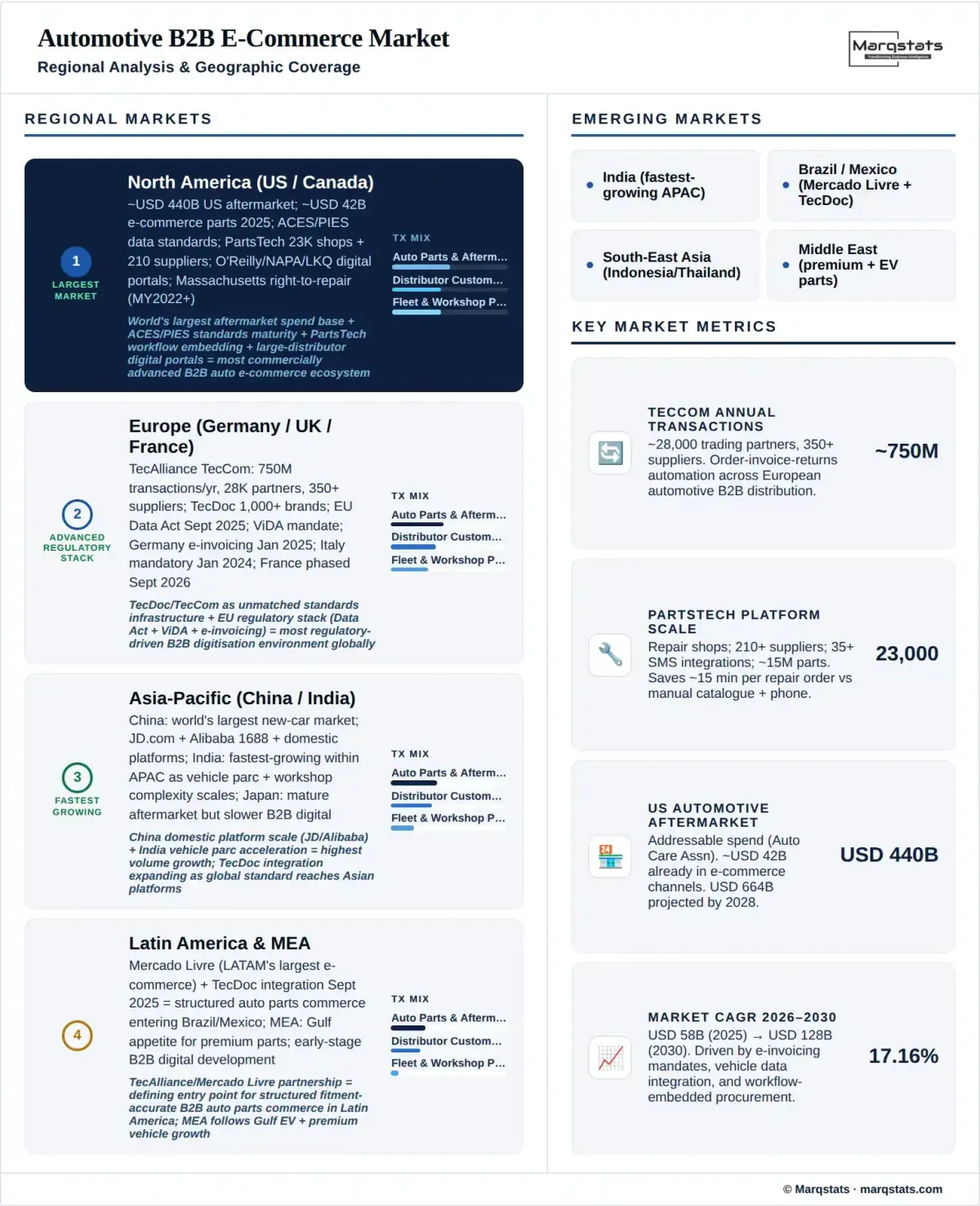
North America — primarily the United States with Canada as a secondary market — is the world's largest automotive B2B e-commerce market by absolute digital transaction volume. The US automotive aftermarket is approximately USD 440 billion in addressable spend (Auto Care Association data cited in O'Reilly 2025 annual report), with e-commerce sales of automotive aftermarket parts estimated at approximately USD 42 billion in 2025 including B2B-influenced marketplace channels. Auto Care Association and MEMA project total channel e-commerce sales growing at approximately 6.7% annualised from 2020 to 2030 including marketplace channels. The US market is characterised by a mature large-distributor digital layer (O'Reilly, Advance Auto Parts, AutoZone, Genuine Parts/NAPA with national digital platforms), an active B2B auto parts marketplace layer (Amazon Business, eBay Motors Professional, CarParts.com), and an emerging workshop-integrated procurement layer (PartsTech, PartSmart, Shop-Ware integrations). ACES and PIES are the North American data standards that underpin all platform fitment accuracy, and the April 2026 release of ACES 5.0 and PIES 8.0 advances regulatory compliance data capabilities alongside the existing fitment and product content functions.
Europe — Advanced Regulatory Infrastructure, Accelerating Digitisation
Europe is the world's second-largest automotive B2B e-commerce market and the most advanced in regulatory infrastructure relevant to the digital automotive trade layer. The EU's total service and maintenance market is estimated at approximately EUR 245 billion in annual transaction value — the spend pool that digital B2B platforms are intermediating. TecAlliance's TecCom and TecDoc platforms are the primary digital infrastructure for European automotive B2B e-commerce — TecCom handling approximately 750 million transactions per year across 350+ suppliers and approximately 28,000 trading partners, TecDoc covering more than 1,000 parts brands. Germany is the largest national automotive B2B e-commerce market in Europe, hosting the headquarters of TecAlliance, the Alzura marketplace (with approximately 21 million items, 2,000+ sellers, across 15 countries), CLEPA (the European association of automotive suppliers), and the German automotive OEM group. The October 2025 TecAlliance/Alzura partnership consolidation and the September 2025 TecAlliance/Mercado Livre integration are both commercially significant events that reinforce Germany's role as the structural hub of European automotive B2B digital commerce. The EU Data Act (September 2025 application), the RMI framework, ViDA e-invoicing mandates, and national B2B e-invoicing requirements in Italy, Germany, Romania, and France collectively represent the most comprehensive regulatory stack for automotive B2B digital commerce of any major market globally.
Asia-Pacific — Fastest-Growing Region
Asia-Pacific is the fastest-growing region in the automotive B2B e-commerce market, driven by rapid automotive sales growth (particularly in China, India, and South-East Asia), expanding independent aftermarket ecosystems, and digital infrastructure investment by both domestic and international platform players. China is the largest Asia-Pacific market — with the world's largest new-car sales volume generating a large and growing aftermarket — and the most advanced in domestic B2B e-commerce infrastructure, with platforms including JD.com's industrial and automotive category, Alibaba's 1688 B2B platform, and domestic automotive aftermarket platforms integrating fitment data with procurement. India is the fastest-growing national market within Asia-Pacific, with the independent aftermarket growing at above-GDP rates as vehicle parc expansion and rising vehicle complexity drive workshop demand for organised spare-parts supply. Japan has a mature aftermarket but slower B2B digital adoption, while South-East Asian markets (Indonesia, Thailand, Vietnam, Malaysia) are at earlier stages of digital automotive distribution with significant growth potential as vehicle parc expands and internet penetration in workshop operations improves.
Latin America and Middle East/Africa — Emerging Markets
Latin America is an emerging automotive B2B e-commerce market where Mercado Livre — the region's largest e-commerce platform — is becoming a significant auto parts digital channel. The September 2025 TecAlliance/Mercado Livre integration to bring TecDoc fitment data into Latin American parts listings is a direct indicator that fitment-data providers see Latin America as a growth region for structured B2B automotive digital commerce. Brazil, Mexico, and Argentina are the three largest national markets. The Middle East and Africa region is early-stage but growing, supported by expanding vehicle parc, strong Gulf state appetite for premium automotive products, and digital-first distribution models being developed by international parts distributors.
How Competition Is Evolving
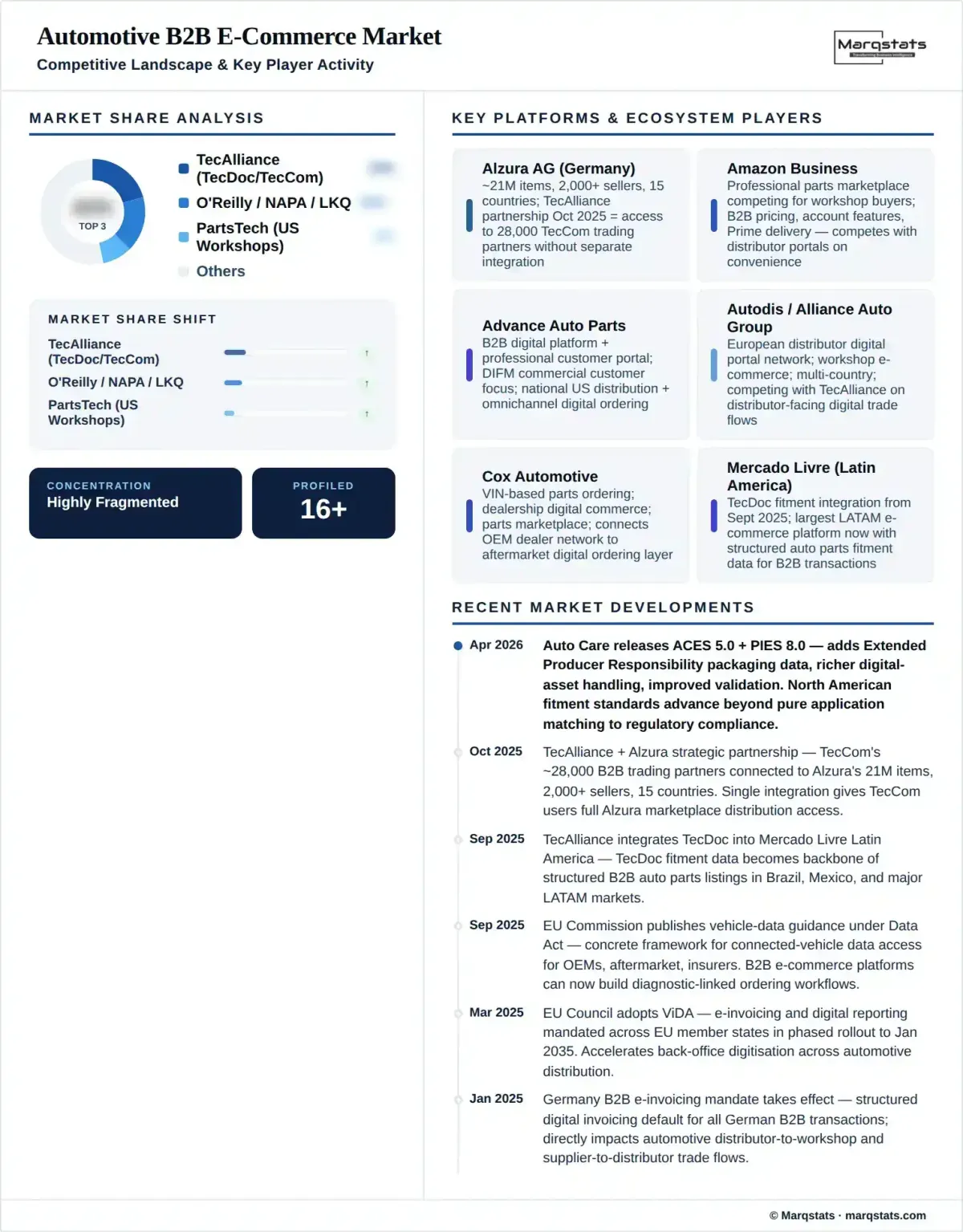
The automotive B2B e-commerce competitive landscape is most usefully understood by platform role rather than by conventional market-share ranking, because the market has no single dominant player across all geographies and no official share data. The competitive structure comprises four categories: data standards and infrastructure providers, platform and order management specialists, distributor-led digital commerce players, and marketplace operators.
In data standards and infrastructure, TecAlliance is the global leader by disclosed ecosystem scale — TecDoc covering 1,000+ parts brands as the European reference catalogue, TecCom processing approximately 750 million transactions per year across approximately 28,000 trading partners. Auto Care Association occupies the equivalent role in North America through ACES and PIES, which are used by the majority of North American aftermarket companies for fitment and product data exchange. These standards bodies do not compete with each other commercially — their ecosystems serve different primary geographies — but convergence is occurring through cross-referencing and integration partnerships.
In workshop-facing B2B procurement platforms, PartsTech is the most clearly disclosed specialist — approximately 23,000 repair shops, 210+ suppliers, 35+ shop management system integrations — occupying a differentiated position as procurement embedded in the repair workflow rather than a standalone ordering website. This integration model creates high switching costs and strong network effects: each additional supplier integration makes PartsTech more valuable to shops, and each additional shop makes it more attractive to suppliers.
In distributor-led digital commerce, the major US aftermarket distributors (O'Reilly, Genuine Parts/NAPA, LKQ, Advance Auto Parts, AutoZone) are all investing in proprietary B2B customer portal and mobile ordering infrastructure. Their competitive advantage is account relationship depth, physical distribution proximity, and credit relationship management — but their technical differentiation from platform specialists is declining as SaaS-based B2B commerce platforms (Magento B2B, SAP Commerce, Commercetools, and automotive-specialist platforms) provide enterprise-grade ordering capability at scale. In Europe, equivalent investments are underway at Autodis Group, Parts Alliance, Alliance Automotive Group, and Euro Car Parts.
In marketplace operations, the October 2025 TecAlliance/Alzura consolidation is the most significant recent development — connecting TecCom's structured B2B infrastructure with Alzura's broader marketplace distribution in a single partnership that neither platform could have built independently. Amazon Business and eBay Motors Professional compete in the marketplace layer in North America, with Amazon Business in particular competing for the professional workshop buyer segment that traditionally ordered through distributor portals. Independent assessments suggest the automotive B2B e-commerce platform market will consolidate around five to ten major platform ecosystems by 2030, as the capital requirements for standards integration, supplier network connectivity, and workshop system integration create barriers to fragmented competition.
Companies Covered
Companies covered in the report include:
Recent Market Activity
Table of Contents
Coverage & Segmentation
This report provides a comprehensive analysis of the global automotive B2B e-commerce market covering the gross merchandise value transacted through B2B digital channels — including supplier-to-distributor EDI and platform ordering, distributor-to-workshop e-commerce and customer portals, fleet procurement digital channels, B2B auto parts marketplaces, and integrated workshop ordering platforms — across the 2021–2030 study period with 2025 as base year. Market scope covers spare parts, accessories, tyres, lubricants, consumables, and maintenance services transacted through B2B digital channels; platform and data standards infrastructure enabling automotive B2B digital commerce (ACES, PIES, TecDoc, TecCom); customer portal and mobile ordering technology for distributor professional programmes; fleet procurement and telematics-linked digital ordering; and invoicing, payment, and returns automation including EDI-type and e-invoicing compliance. Market scope excludes B2C automotive e-commerce (consumer-facing online parts retail) and new-vehicle B2B sales. Geographic coverage spans North America (US primary, Canada secondary), Europe (Germany, UK, France, Italy, Spain, other EU), Asia-Pacific (China, India, Japan, South-East Asia), and Latin America. Regulatory analysis covers EU Data Act, EU RMI framework, ViDA e-invoicing, national B2B e-invoicing mandates (Italy, Germany, Romania, France), US right-to-repair framework (Massachusetts, federal), and UNECE Regulation No. 155 vehicle cybersecurity. Primary research includes 40+ interviews with B2B e-commerce platform managers, automotive aftermarket distributors, workshop ordering platform executives, data standards body representatives, and fleet procurement managers across North America, Europe, and Asia-Pacific.