Market Snapshot
Key Takeaways
Market Overview & Analysis
Report Summary
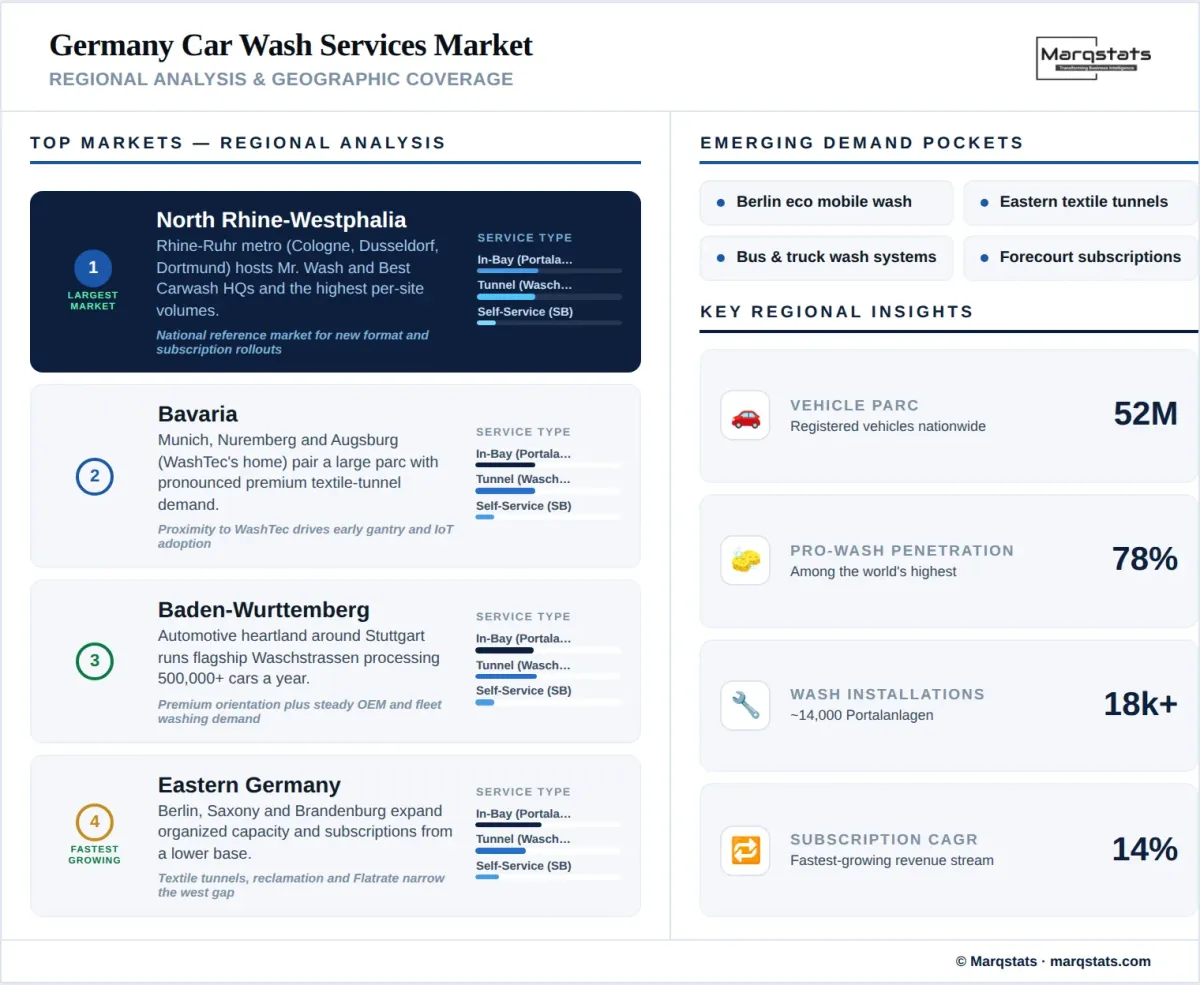
The Germany car wash services market comprises professional operators that clean passenger and light commercial vehicles across four service formats — in-bay automatic roll-over (Portalanlage), tunnel/conveyor (Waschstrasse), self-service (SB-Waschanlage), and manual or mobile hand wash — monetized through pay-per-wash tickets and subscription wash plans. The 2025 market of USD 2.25 billion sits against a vehicle parc of roughly 52 million and about 18,000 to 18,800 wash installations nationwide, of which around 14,000 are Portalanlagen. Roughly 2,800 operator companies form the organized base, alongside extensive fuel-retailer forecourt networks.
The defining feature of the German market is regulation. Home and street car washing is restricted across most municipalities under water-protection rules that limit detergent runoff into soil and groundwater, and authorities enforce these bans strictly. As a result, professional-wash penetration reaches about 78%, one of the highest levels of any major market, and wash frequency of roughly six washes per vehicle each year is anchored by a culture that values washing and drying performance over convenience.
The German format mix differs from North America. In-bay automatic Portalanlagen hold the largest revenue share at about 43% in 2025, reflecting an installed base of roughly 14,000 units, while tunnel Waschstrassen hold about 37% and rise toward 40% by 2030 as high-throughput sites expand. Self-service SB-Waschanlagen hold about 14%, and manual hand wash a small 6%. Fuel-station forecourts dominate the site-format mix at about 56%, far above North American levels, because Tankstellen have historically bundled washing with fuel across the country.
Wash intensity per vehicle sits near USD 40, about 61% of the United States level, reflecting a mature parc, moderate tickets near EUR 8, and a format mix weighted to Portalanlagen rather than higher-ticket express tunnels. Growth is therefore driven less by volume and more by pricing, premiumization toward textile and tunnel formats, and the adoption of wash subscriptions, which convert episodic demand into recurring revenue.
Germany's operator base benefits from an unmatched domestic equipment ecosystem. WashTec of Augsburg is the world's largest wash-equipment maker, with more than 30,000 systems installed across Europe and around 12,000 in Germany alone, alongside Otto Christ and Karcher. This proximity accelerates adoption of IoT management, high-throughput gantry systems, water reclamation, and eco chemistry, and helps German operators sustain the cleaning and drying performance that domestic customers prioritize over speed. The result is a market that competes on quality and technology rather than the convenience-led express model prevailing in North America.
Market Dynamics
Key Drivers
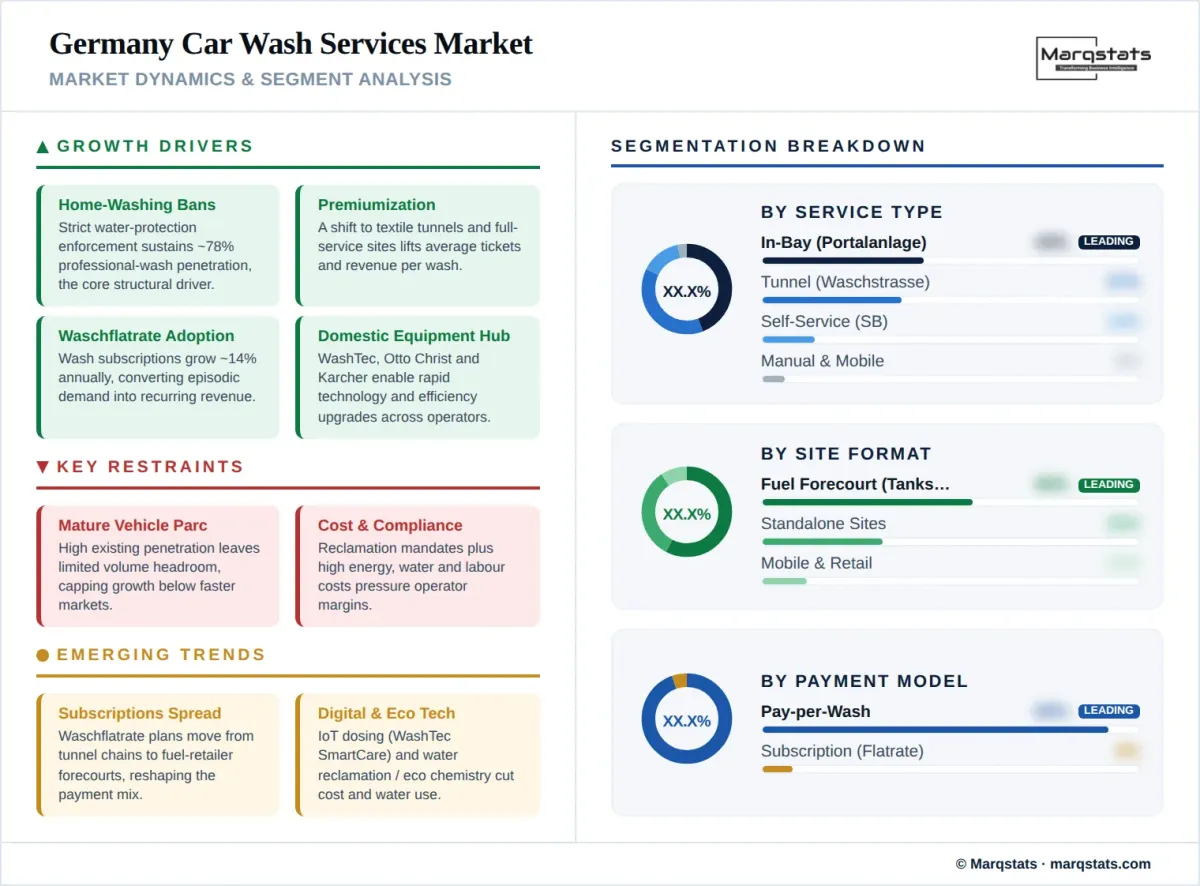
- Strict enforcement of home-washing bans under water-protection rules sustains professional-wash penetration near 78%, the core structural driver.
- Services pricing gains, tracking elevated inflation, add roughly 2 percentage points of annual revenue growth across the format mix.
- Network premiumization toward textile tunnels and full-service sites lifts average tickets and revenue per wash.
- Wash-subscription (Waschflatrate) adoption converts episodic demand into recurring revenue, growing near 14% annually from a low base.
- A domestic equipment ecosystem led by WashTec, Otto Christ, and Karcher enables rapid technology and efficiency upgrades across operators.
- Commercial and fleet demand grows with logistics and mobility operators adopting dedicated bus and truck wash systems, adding volume above the mature passenger base.
Key Restraints
- A mature vehicle parc and high existing penetration leave limited volume headroom, capping growth below faster-formalizing markets.
- Water-protection and wastewater-discharge rules require reclamation systems, raising construction and operating costs for new sites.
- High energy, water, and labour costs pressure operator margins, particularly at self-service and full-service formats.
- Weather and seasonality, with lower winter frequency in some regions, constrain year-round utilization outside subscription bases.
Key Trends
- Wash subscriptions (Waschflatrate) spread from tunnel operators to fuel-retailer forecourts, reshaping the payment mix toward recurring revenue.
- Premiumization advances through textile soft-cloth tunnels, touch-free options, and full-service amenities at flagship sites.
- Digital and IoT systems, including WashTec's SmartCare Connect, optimize brush pressure, chemical dosing, and cycle times.
- Water reclamation and eco chemistry, such as Otto Christ's ECO Line, address tightening water rules and rising utility costs.
- Rising electric-vehicle ownership lifts demand for touch-free and sensor-safe washing, a strength of German gantry and tunnel technology.
Market Segmentation
In-bay automatic roll-over washes, known in Germany as Portalanlagen, hold the largest revenue share at about 43% in 2025, equal to USD 974.09 million, from an installed base of roughly 14,000 units. The format is the backbone of German washing, common at fuel-station forecourts and standalone sites, and prized for cleaning and drying performance. Its revenue share eases toward 41% by 2030 as tunnel Waschstrassen gain share, though it remains the single largest format throughout the forecast period. Portalanlagen suit the many mid-density sites where land and throughput do not justify a full tunnel, and modern gantry systems from WashTec, Otto Christ, and Istobal deliver longer wash programs, touch-free options, and integrated water recycling.
Tunnel/conveyor washes (Waschstrassen) hold about 37% of 2025 revenue, USD 826.35 million, and rise toward 40% by 2030 as high-throughput sites and premium textile tunnels expand. Chains such as Mr. Wash and Best Carwash operate flagship Waschstrassen, some processing over 500,000 cars per year, and the format integrates most readily with wash subscriptions and full-service amenities. Waschstrassen capture a growing share of premiumization spend, offering longer wash programs, textile soft-cloth cleaning, and driverless conveyor systems that improve throughput and consistency.
Self-service bays (SB-Waschanlagen) account for about 14% of 2025 revenue, USD 318.02 million, a larger base than in the United States. The format eases toward 13% by 2030, retaining a durable role for cost-conscious users, motorcycles, and detailed cleaning, and increasingly adds cashless and app-based payment. Operators upgrade older SB sites with high-pressure lances, foam programs, and reclamation to defend volumes as automated formats capture convenience-oriented demand.
Manual and mobile hand-wash services hold about 6% of 2025 revenue, USD 135.22 million, a small and stable share. The segment serves premium detailing and on-site fleet cleaning, including eco steam and low-water mobile providers, and does not materially shift over the forecast period. Demand concentrates in urban centres where convenience and premium finishing justify higher tickets, and where paint-protection-film and high-end vehicles favour careful touch-free or hand methods.
Forecourt washes attached to fuel stations (Tankstellen) hold the largest site share at about 56% of 2025 revenue, USD 1.27 billion, far above North American levels. National fuel retailers — Aral, Shell, Esso, TotalEnergies, JET, and Agip — operate extensive Portalanlage networks bundled with fuel and convenience retail. The share eases toward 54% by 2030 as standalone tunnel development advances, yet Tankstellen washing remains the backbone of the market, benefiting from high footfall, established sites, and integration with fuel loyalty and payment systems.
Standalone dedicated sites hold about 32% of 2025 revenue, USD 716.17 million, and gain share toward 34% by 2030 as chains such as Mr. Wash, IMO Car Wash, Best Carwash, and Clean Car expand high-throughput Waschstrassen and full-service centres. The format supports the strongest subscription and premiumization economics, and captures the bulk of new organized investment as operators build larger, amenity-rich sites in and around major cities.
Mobile and retail-parking formats account for about 12% of 2025 revenue, USD 270.44 million, serving on-demand, fleet, and shopping-centre demand. Eco steam and low-water mobile providers add convenience-oriented capacity in major metros such as Berlin, Munich, and Hamburg.
Single-visit tickets account for about 92% of 2025 revenue, USD 2.06 billion, and remain the dominant channel. The share declines toward 86% by 2030 as wash subscriptions gain traction, though pay-per-wash stays central for occasional users and forecourt customers combining washing with fuel purchases. Ticket prices near EUR 8 for a standard Portalanlage wash, with premium tunnel programs commanding more, anchor the segment's value.
Wash subscriptions (Waschflatrate) reach about 8% of 2025 revenue, USD 190.31 million, and grow near 14% annually to about 14% of revenue by 2030, worth USD 371.12 million. Recurring subscription is the fastest-expanding revenue stream, introduced first by tunnel chains and now spreading to fuel-retailer forecourts, and is the primary lever operators use to stabilize demand.
Passenger vehicles generate about 92% of 2025 revenue, USD 2.06 billion, reflecting the consumer orientation of Portalanlage and tunnel formats. The share eases slightly across the forecast period as commercial washing grows faster.
Commercial and fleet washing holds about 8% share in 2025, USD 190.31 million, rising toward 9% by 2030. Growth is driven by logistics, delivery, and mobility fleets — including mobility-as-a-service operators — and by dedicated commercial-vehicle systems such as Otto Christ's NOVA articulated-brush units for bus and truck profiles.
By Geography
North Rhine-Westphalia
North Rhine-Westphalia is the largest regional market, anchored by the Rhine-Ruhr metropolitan area and cities such as Cologne, Dusseldorf, and Dortmund. The region hosts the headquarters and flagship sites of major chains, including Mr. Wash and Best Carwash near Cologne, and its dense population and vehicle parc support the highest per-site volumes in the country. Heavy commuter traffic, extensive motorway coverage, and a large forecourt network make the region the reference market for new format and subscription rollouts.
Bavaria
Bavaria combines a large vehicle parc with premium demand across Munich, Nuremberg, and Augsburg, the home city of equipment maker WashTec. Mr. Wash operates high-capacity sites in the region, including a Nuremberg location with dozens of indoor self-cleaning stations, and premiumization toward textile tunnels is pronounced. Proximity to WashTec supports early adoption of new gantry and IoT systems, and strong household incomes sustain demand for premium wash programs and subscriptions.
Baden-Wurttemberg
Baden-Wurttemberg, Germany's automotive heartland around Stuttgart and Mannheim, supports strong demand for high-quality washing. Flagship Waschstrassen in the region, including a Stuttgart site processing more than 500,000 cars per year, illustrate the scale of German tunnel operations and the market's premium orientation. Home to major automakers and suppliers, the region also sustains steady commercial and fleet washing demand.
Northern Germany
Northern Germany, including Hamburg, Bremen, and Lower Saxony, is a substantial market where chains such as Clean Car operate extensive networks. Coastal salt exposure and steady urban demand support washing, and forecourt networks are dense across the region's motorway corridors. Hamburg anchors organized standalone development, while port and logistics activity sustains commercial-vehicle washing above the national average.
Eastern Germany
Eastern Germany, including Berlin, Saxony, and Brandenburg, is a fast-growing region as organized capacity and subscription adoption expand from a lower base. Berlin anchors on-demand and mobile eco washing, while cities such as Dresden and Leipzig see continued standalone and forecourt development. Newer sites in the region increasingly adopt textile tunnels, water reclamation, and Waschflatrate subscriptions, narrowing the gap with western states.
How Competition Is Evolving
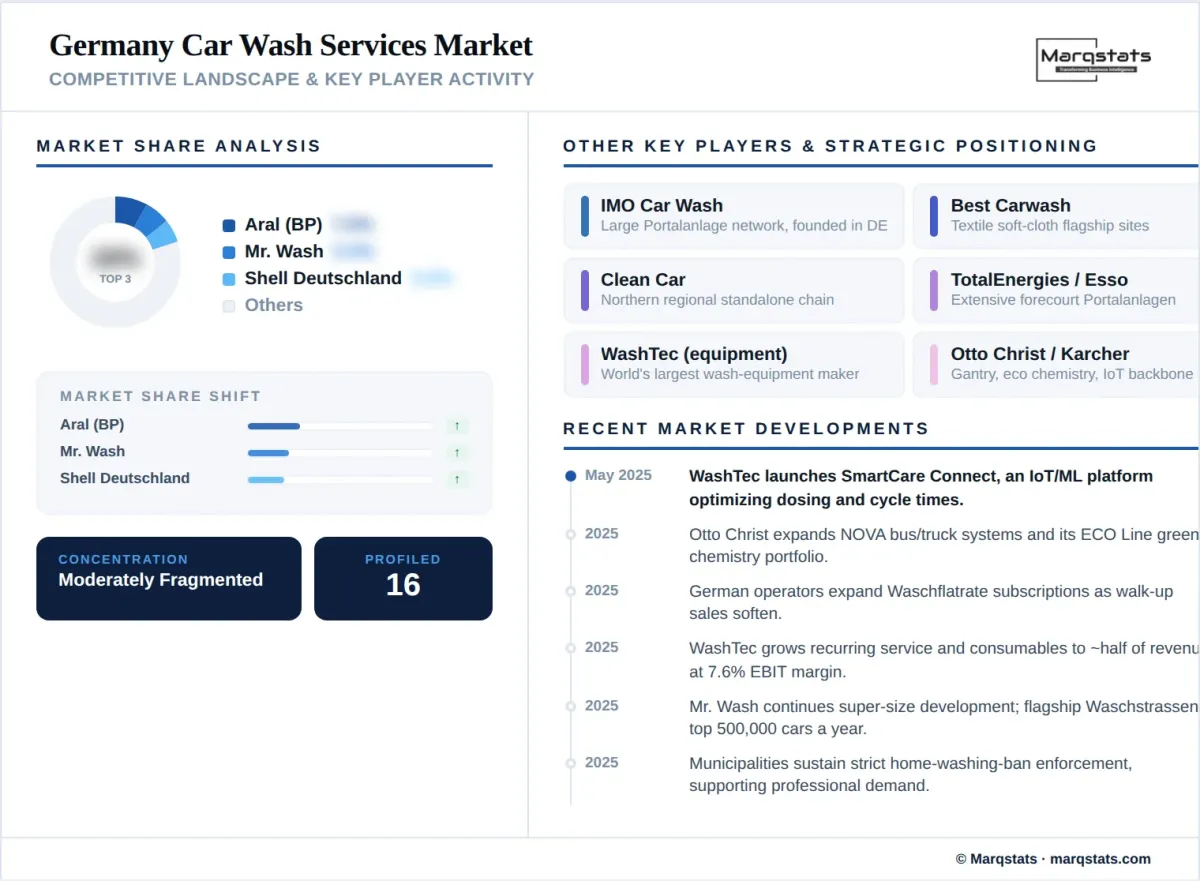
The Germany car wash services market is moderately fragmented, with roughly 2,800 operator companies alongside extensive fuel-retailer forecourt networks. Organized chains hold significant share: Mr. Wash Autoservice AG is the premium full-service leader, IMO Car Wash Group operates a large Portalanlage network and was founded in Germany, and Best Carwash competes on textile soft-cloth cleaning and flagship amenities. Clean Car and other regional operators fill out the standalone base.
Fuel retailers are central to German washing. Aral, part of BP, together with Shell, Esso, TotalEnergies, JET, and Agip, operate the largest forecourt Portalanlage networks, bundling washing with fuel and convenience retail. Competition centres on cleaning and drying performance, site throughput, subscription offers, and increasingly on water efficiency and digital management rather than price alone.
Germany is also the global centre of wash equipment, and the domestic operator base benefits from close proximity to WashTec of Augsburg, the world's largest equipment maker, alongside Otto Christ and Karcher. This ecosystem accelerates adoption of IoT management, water reclamation, and eco chemistry. Consolidation is expected to advance gradually through chain expansion and premiumization, while the large forecourt base keeps the market moderately fragmented.
The competitive base tiers into three groups. Organized standalone chains — Mr. Wash, IMO Car Wash, Best Carwash, and Clean Car — lead premiumization and subscription adoption through high-throughput Waschstrassen and full-service centres. Fuel retailers — Aral, Shell, Esso, TotalEnergies, JET, and Agip — operate the widest forecourt Portalanlage networks and hold the largest aggregate site share. German wash-equipment makers — WashTec, Otto Christ, and Karcher — supply the technology backbone across both groups and export it worldwide. Competition among these tiers increasingly turns on subscription penetration, water efficiency, and digital site management.
Companies Covered
The report profiles 16++ companies with full strategy and financials analysis, including:
Recent Market Activity
Table of Contents
Coverage & Segmentation
This report provides a comprehensive analysis of the Germany car wash services market covering the historical period 2021 to 2025 and the forecast period 2026 to 2030, with 2025 as the base year. The study defines the market as annual revenue earned by professional operators cleaning passenger and light commercial vehicles through in-bay automatic (Portalanlage), tunnel/conveyor (Waschstrasse), self-service (SB-Waschanlage), and manual or mobile formats, inclusive of basic interior cleaning; full detailing and equipment or chemical sales are excluded. Market size is presented in value terms (USD billion), with historical figures reflecting euro-to-dollar exchange effects and forecasts assuming constant exchange rates.
The study segments the market by service type, payment model, site format, and vehicle type, and examines regional demand across North Rhine-Westphalia, Bavaria, Baden-Wurttemberg, Northern Germany, and Eastern Germany, alongside competitive concentration and fuel-retailer forecourt networks. Market sizing calibrates to Destatis operator-turnover data for dedicated car wash businesses, adds forecourt-booked and hand-wash revenue, and cross-checks against KBA vehicle parc, professional-wash penetration, wash frequency, and blended ticket. The competitive section profiles 16 operators and equipment providers spanning chains, fuel retailers, and German wash-equipment makers.