Market Snapshot
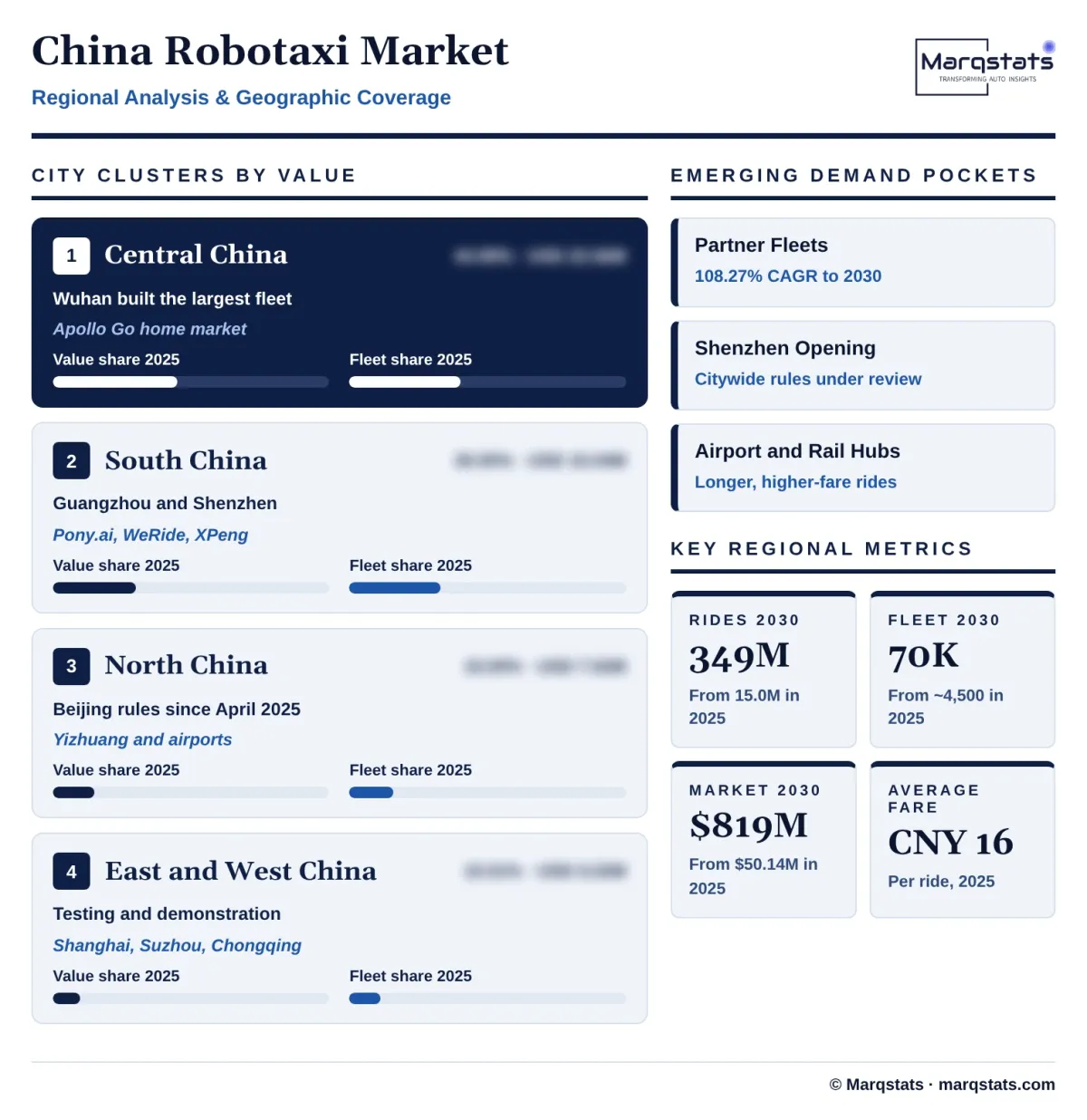
The China robotaxi market size is estimated at USD 50.14 million in 2025 and is projected to reach USD 818.89 million by 2030, growing at a CAGR of 74.83% over 2026 – 2030. Rides grow from about 15.0 million to 349.31 million as the active fleet rises from about 4,500 to 70,000 vehicles.
Marqstats defines the market as the passenger fare revenue earned on Level 4 robotaxi rides in mainland China plus the robotaxi technology and operating service fees that driving system developers charge fleet owners, ride-hailing platforms and carmakers for running those fleets. Vehicle sales, Level 2 driver assistance, robobuses, robotrucks, robosweepers and the overseas business of Chinese developers are excluded.
Passenger fares account for 66.67% of 2025 value and fleets run by the developers themselves for 80.00%. Central China, led by Wuhan, accounts for 44.99% of 2025 value. The study segments the market by revenue stream, operating model, supervision mode and city cluster, with values in US dollars converted at CNY 7.18 per US dollar.
Key Takeaways
Market Overview & Analysis
Report Summary
Marqstats sizes the China robotaxi market as the money that changes hands for Level 4 driverless ride-hailing inside mainland China: the fares riders pay and the technology and operating fees that driving system developers charge the companies that own or dispatch the vehicles. In 2025 about 15.0 million paid robotaxi rides were completed in China, worth an estimated CNY 240.00 million in fares at an average realised fare of about CNY 16.00 a ride, and developers earned about CNY 120.00 million in robotaxi technology and service fees, giving a market of CNY 360.00 million, or USD 50.14 million.
Three developers carry almost all of the volume. Baidu, Inc. runs Apollo Go, known in China as Luobo Kuaipao, and completed 1.4 million fully driverless rides in the first quarter of 2025, 2.2 million in the second, 3.1 million in the third and 3.4 million in the fourth, about 10.1 million in the year, almost all of them in mainland China. Pony AI Inc. ended 2025 with more than 1,400 robotaxis and earned CNY 116 million in robotaxi services revenue. WeRide Inc. earned CNY 148.0 million in robotaxi revenue in 2025 and reported more than 800 commercial and test robotaxis in China in March 2026.
The market is small because fares are low and fleets are still thin. A promotional Apollo Go ride of 19 kilometres in Wuhan cost CNY 33 against a list fare of CNY 92 in May 2025, and Chinese operators have used discounts to build demand. Marqstats estimates that China had about 4,500 active robotaxis at the end of 2025, against about 1,850 a year earlier, and that each vehicle averaged about 12.9 paid rides a day across the year. WeRide reports an average of 15 daily orders per vehicle in its recent operations, rising to 26 at peak.
Revenue for the developers is still mostly outside fares. Robotaxi services accounted for about 18.44% of Pony.ai revenue in 2025 (CNY 116 million of CNY 629 million) and robotaxi revenue for about 21.62% of WeRide revenue (CNY 148.0 million of CNY 684.6 million). Both figures include work outside China and outside fares, such as engineering services and vehicle-related income, so they are larger than the fare and fee pool Marqstats measures for mainland China. The rest of their revenue comes from robotrucks, robobuses, robosweepers and driver assistance programmes.
Regulation is set city by city on a national frame. The Ministry of Transport issued trial guidelines for autonomous vehicle transport safety services dated 21 November 2023, which require a safety officer on board a robotaxi with conditional or high automation and allow fully driverless vehicles to use remote safety officers, at no fewer than one for every three vehicles, where the city government approves. The Beijing Autonomous Vehicle Regulations took effect on 1 April 2025, and Wuhan, Guangzhou and Shenzhen issue their own permits for driverless testing, demonstration and paid service. The March 2026 Wuhan incident showed that national ministries can also pause new permits everywhere at once.
China Robotaxi Market Size and Forecast
The China robotaxi market grows from USD 50.14 million in 2025 to USD 818.89 million in 2030, a CAGR of 74.83%. Marqstats expects USD 70.69 million in 2026, USD 155.23 million in 2027, USD 295.02 million in 2028 and USD 518.75 million in 2029. Rides rise from 15.0 million in 2025 to 21.67 million in 2026, 53.61 million in 2027, 111.14 million in 2028, 209.33 million in 2029 and 349.31 million in 2030.
Fleet growth does most of the work. Marqstats expects the active fleet to reach about 8,000 vehicles at the end of 2026, 15,500 in 2027, 28,000 in 2028, 46,000 in 2029 and 70,000 in 2030, a 73.13% annual rate. The 2026 figure is consistent with Pony.ai's target of more than 3,500 robotaxis by the end of 2026, WeRide's target of 2,600 robotaxis worldwide, and the restart of permit approvals in July 2026.
Utilisation adds the rest. Rides per vehicle per day fall from about 12.9 in 2025 to 9.5 in 2026, because many new vehicles were held back from passenger service during the cooling-off period and Apollo Go operations were adjusted in some cities until August 2026. Marqstats expects utilisation to recover to 12.5 rides a day in 2027 and reach 16.5 by 2030 as service areas widen to airports and railway stations, operating hours lengthen and dispatch through large platforms brings more demand to each vehicle.
Fares stay low. Marqstats assumes the average realised fare rises from CNY 16.00 in 2025 to CNY 16.50 in 2026 and 2027 as promotional discounts are trimmed, then eases to CNY 15.00 by 2030 as competition among operators and with human-driven ride-hailing intensifies. Fare revenue therefore grows at 85.27% a year, a little slower than rides.
Service fees grow more slowly than fares. Developers earn technology and operating service fees of about CNY 120 million in 2025, rising to CNY 640 million by 2030, a 39.77% annual rate in US dollar terms, from licensing driving systems, remote assistance, fleet management and engineering support to partner fleets. Fees per partner vehicle fall as developers compete for carmaker and platform contracts, so their share of the market falls from 33.33% to 10.88%.
Marqstats tracks four indicators to monitor the forecast: the number of cities granting fully driverless paid permits, rides per vehicle per day disclosed by the listed developers, the average realised fare, and the pace of vehicle deliveries from partner plants such as those of Jiangling Motors Corporation, GAC Toyota and Geely Farizon.
Market Dynamics
Key Drivers
Five forces are turning robotaxi pilots in Chinese cities into a paid transport service.
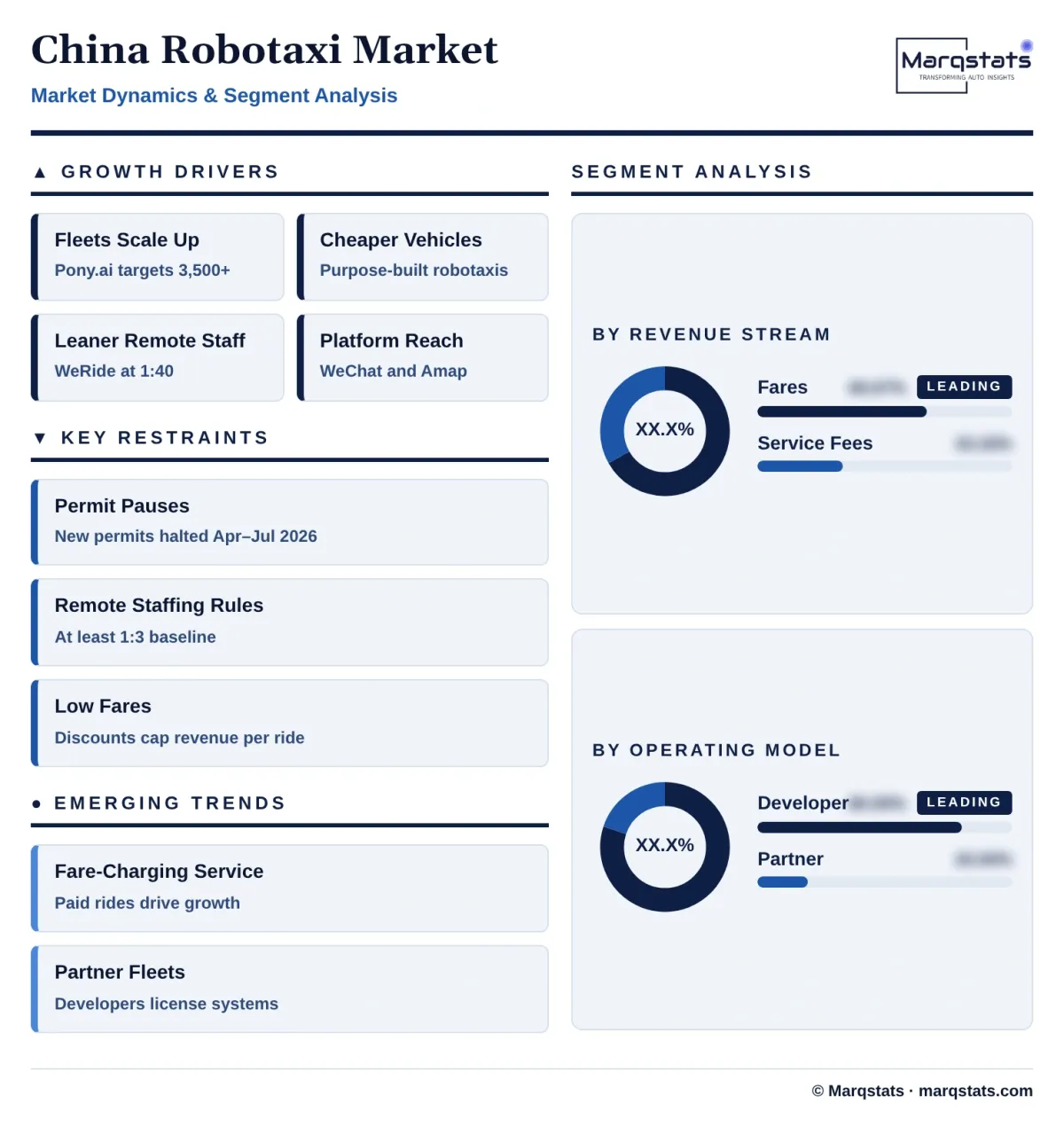
- Developers are scaling their fleets. Pony.ai had 1,975 robotaxis at the end of June 2026 and targets more than 3,500 by the end of the year, WeRide targets 2,600 robotaxis worldwide by the end of 2026, and XPeng won approval for citywide robotaxi demonstration operations in Guangzhou in October 2026.
- Vehicles are cheaper to buy and run. Purpose-built robotaxis such as the Baidu Apollo RT6, the Pony.ai Gen-7 vehicles built with Toyota and GAC, and the WeRide Robotaxi GXR built by Geely Farizon use cheaper Chinese LiDAR and computing hardware; WeRide reports a 15% cut in the bill of materials of its upgraded GXR and a 38% cut in total cost of ownership.
- Remote staffing costs are falling. WeRide improved its remote assistance ratio from one person to ten vehicles in 2024 to one to 40, cutting the largest cost after the vehicle and driving the move to positive unit economics in first-tier cities.
- Large platforms bring riders. WeRide robotaxis are bookable through Tencent Mobility Service in WeChat and through Amap, Pony.ai has more than 1.5 million registered PonyPilot users in China, and Apollo Go served more than 23 million rides to the public by June 2026.
- City rules are opening wider areas. The Beijing Autonomous Vehicle Regulations took effect in April 2025, Shenzhen is revising its intelligent connected vehicle rules to explore opening the whole city to robotaxis, and Guangzhou service now covers airports, railway stations and the Tianhe business district.
Key Restraints
Four constraints decide how fast fleets can add vehicles and how many rides each vehicle can sell.
- National permit pauses. After the 31 March 2026 Wuhan incident the Ministry of Industry and Information Technology, the Ministry of Public Security and the Ministry of Transport held a joint meeting in mid-April that mandated safety rectification, and new robotaxi permits were paused until July 2026.
- Remote staffing rules. The Ministry of Transport trial guidelines require at least one remote safety officer for every three fully driverless robotaxis where cities approve remote supervision, so the lean ratios that make fleets profitable depend on city approvals.
- Low fares. Promotional fares, such as CNY 33 for a 19 kilometre Wuhan ride listed at CNY 92, keep revenue per ride low and put pressure on operators to raise utilisation before raising prices.
- Opposition from drivers. Cheap robotaxi rides in Wuhan have drawn complaints from taxi and ride-hailing drivers about lost income, giving cities a reason to cap fleet growth in dense areas.
Key Trends
Four shifts are changing who runs robotaxi fleets in China and how they are paid.
- From pilots to fare-charging service. Pony.ai's fare-charging revenue rose 849.3% year on year in the second quarter of 2026, showing that paid rides, not test rides, are driving growth.
- Platforms as distribution. Developers are distributing rides through Tencent, Amap and other large apps rather than relying only on their own apps.
- Vision-only entrants. XPeng's Yoyo robotaxi, based on the GX sport utility vehicle, uses cameras without LiDAR or high-definition maps and plans to work with ride-hailing platforms from 2027.
- Developers sell systems, partners own vehicles. Developers increasingly license their driving systems and operating services to carmakers, platforms and transport groups that fund the vehicles.
Strategic Implications
- For driving system developers, regulatory resilience is now a commercial asset. The 2026 pause showed that a single fleet incident can freeze permits for everyone, so redundancy, safe-stop behaviour that does not block traffic and transparent incident reporting protect revenue as well as safety.
- For ride-hailing platforms and transport groups, partner fleets are the cheaper entry route. Licensing a driving system and buying operating services lets a platform add robotaxi supply without building its own technology, and partner fleets are the fastest-growing part of the market.
- For carmakers, robotaxi supply is a contract manufacturing and data opportunity. Jiangling Motors, Toyota with GAC, and Geely Farizon already build purpose-built vehicles for developers, and carmakers such as XPeng are using robotaxi programmes to test their own driving systems.
- For city governments, permit design decides the size of the local market. Clear rules on remote staffing ratios, incident handling and service areas let operators plan fleet additions, while sudden pauses leave purchased vehicles idle.
- For investors, rides per vehicle per day is the metric to watch. Fleet size is easy to announce, but revenue depends on utilisation, which fell during the 2026 pause and must recover for the forecast to hold.
Market Segmentation
Fares paid by riders account for 66.67% of 2025 value, USD 33.43 million from about 15.0 million rides at an average realised fare of about CNY 16.00, and grow at 85.27% a year to USD 729.76 million and 89.12% of the market by 2030. Fares become the core of the market once fleets reach several thousand vehicles per city, because each extra ride adds revenue at little extra cost. The risk is that discounting continues: Apollo Go and other operators have used promotional fares far below taxi prices to build demand in Wuhan.
Fees that developers charge partner fleets for driving systems, remote assistance, fleet management and engineering support account for 33.33% of 2025 value, USD 16.71 million, and grow at 39.77% a year to USD 89.13 million, 10.88% of the market by 2030. Pony.ai and WeRide earn a large part of their robotaxi revenue this way, and Marqstats expects fees per vehicle to fall as more developers bid for carmaker and platform contracts.
Fleets run and dispatched by the developers themselves, through Apollo Go, PonyPilot and WeRide Go, account for 80.00% of 2025 value, USD 40.11 million, and grow at 60.40% a year to USD 425.82 million, while their share falls to 52.00%. Developers keep the full fare in this model but carry the cost of buying, insuring and maintaining every vehicle.
Fleets owned by ride-hailing platforms, carmakers, taxi companies and transport groups and run on developer technology account for 20.00% of 2025 value, USD 10.03 million, and grow fastest, at 108.27% a year, to USD 393.07 million and 48.00% of the market by 2030. Distribution through Tencent Mobility Service and Amap, and fleet deals with carmakers, move capital needs away from the developers.
Rides with no safety officer on board account for an estimated 85.46% of 2025 value, USD 42.85 million, and 96.00% by 2030, growing at 78.94% a year to USD 786.13 million. All Apollo Go rides that Baidu reports are fully driverless, and Pony.ai and WeRide run fully driverless paid service in parts of Beijing, Guangzhou and Shenzhen.
Rides with a safety officer on board account for 14.54% of 2025 value, USD 7.29 million, and grow at 35.06% a year to USD 32.76 million, falling to 4.00% of the market by 2030. Supervised service remains the entry stage in new cities and was used to restore Apollo Go service in Wuhan after the 2026 incident.
By Geography
Central China
Central China is the largest cluster because Wuhan gave Apollo Go the space to build the world's largest fully driverless ride-hailing fleet. Marqstats estimates the cluster at USD 22.56 million, 44.99% of 2025 value, with about 1,800 active robotaxis at the end of 2025. Wuhan's cheap fares made it the volume engine of the market, and it was also the city where the March 2026 incident started the national pause. Baidu says Apollo Go reached unit-economics breakeven there despite low fares, so Wuhan is now the test of whether a mature robotaxi city can keep growing under tighter oversight.
South China
South China, centred on Guangzhou and Shenzhen, accounts for USD 15.04 million, 30.00% of 2025 value, and about 1,485 active vehicles. It is the most contested cluster: Pony.ai serves four districts of Guangzhou covering more than 7 million people and three transport hubs in Shenzhen including Bao'an International Airport, WeRide has expanded into the Tianhe business district, Apollo Go says Shenzhen is one of its largest markets, and XPeng won citywide demonstration approval in Guangzhou in October 2026. Shenzhen's revision of its vehicle rules makes this the cluster most likely to gain share.
North China
North China, led by Beijing, accounts for USD 7.52 million, 15.00% of 2025 value, and about 720 active vehicles. The Beijing Autonomous Vehicle Regulations, in force since 1 April 2025, give operators a legal basis for driverless service in approved areas, and Pony.ai, WeRide and Baidu run services in and around the Beijing Economic-Technological Development Area and towards the capital's airports and railway stations.
East and West China
Shanghai, Suzhou, Wuxi, Hangzhou, Chongqing, Chengdu and other cities account for USD 5.02 million, 10.01% of 2025 value, and about 495 vehicles. Most service here is still testing or supervised demonstration, with Momenta testing in Shanghai, Suzhou and Wuxi and Baidu running Apollo Go in several cities, so the cluster offers the largest number of new permits once approvals resume at scale.
How Competition Is Evolving
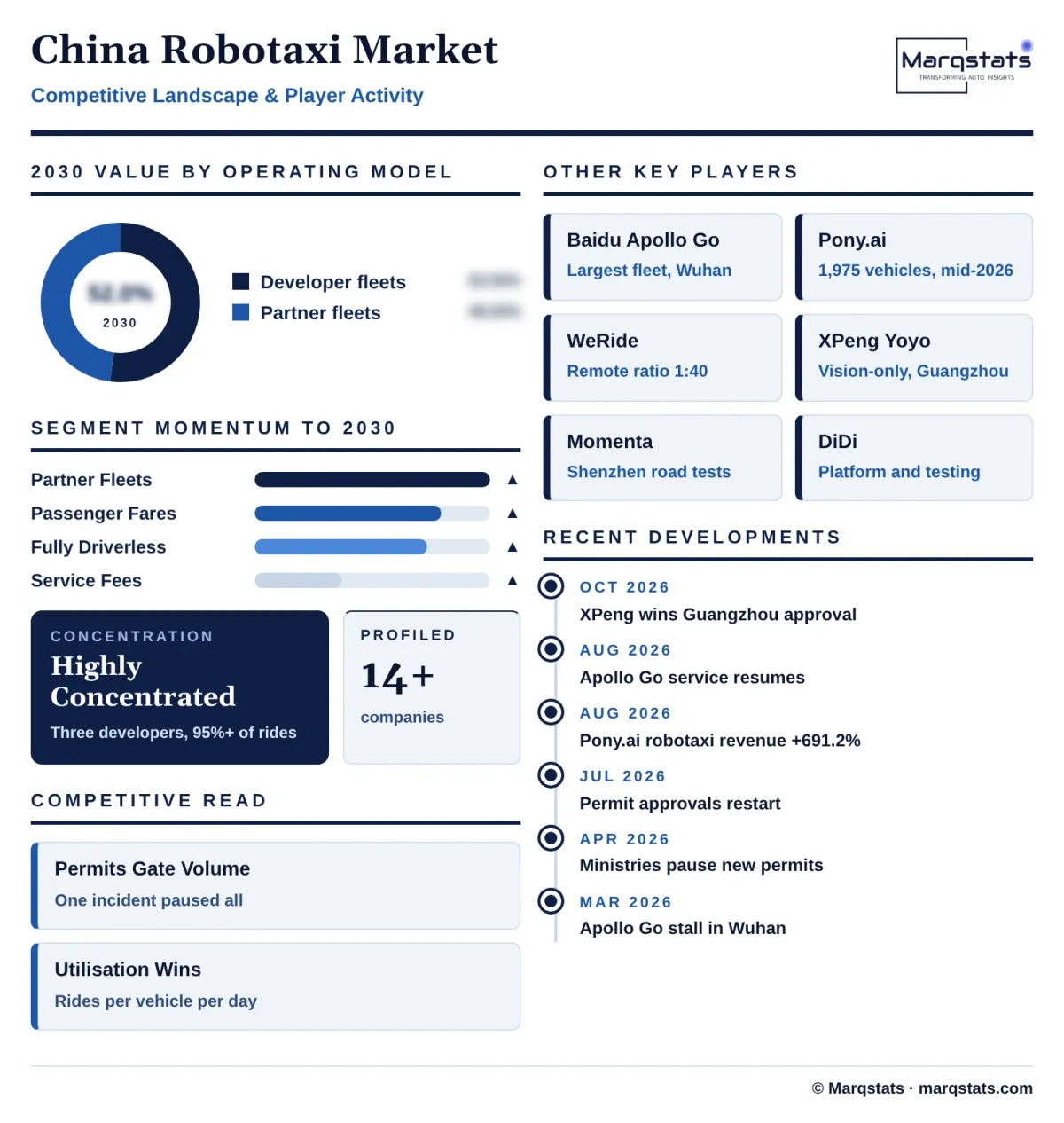
The China robotaxi market is highly concentrated. Marqstats estimates that the fleets of Baidu, Pony.ai and WeRide carried more than 95% of the 15.0 million paid rides in 2025, with Apollo Go alone carrying about 66.67%, based on the ride count Baidu discloses. The other operators, including DiDi Global Inc., XPeng Inc. and partner fleets running Momenta technology, are at the testing or early demonstration stage.
Two business models compete. Baidu runs a vertically integrated model, owning the Apollo Go app and most of its vehicles, built by Jiangling Motors Corporation. Pony.ai and WeRide combine their own fleets with partner fleets and distribution through large apps, and earn a larger share of revenue from technology and operating fees. XPeng plans to earn from vehicle sales, technology services and revenue sharing with ride-hailing platforms.
The 2026 pause changed the order of growth. Apollo Go rides fell from 3.2 million in the first quarter of 2026 to about 1.0 million in the second while Pony.ai's robotaxi revenue rose 691.2% year on year to USD 12.1 million and its fleet reached 1,975 vehicles. WeRide's domestic fleet rose to about 1,000 vehicles by the end of April 2026. Market leadership in rides is therefore less secure than Baidu's cumulative total of more than 23 million rides suggests.
Vehicle partners and suppliers support the developers. Toyota Motor Corporation and GAC build Pony.ai's seventh-generation vehicles, Geely Farizon builds the WeRide Robotaxi GXR, and LiDAR makers Hesai Group and RoboSense supply most sensors. Lower hardware costs from these suppliers are what allow the developers to add fleets at low fares.
Competition will be decided by safety record, permits and utilisation. Operators that avoid incidents, win permits in several cities and keep each vehicle busy for most of the day will take the largest share of fares as the market grows.
Companies Covered
Companies covered in the report include:
Recent Market Activity
Table of Contents
Coverage & Segmentation
The study covers the China robotaxi market, with 2025 as the base year and 2026 – 2030 as the forecast period. Values are in US dollars converted at CNY 7.18 per US dollar, the 2025 average, and cover passenger fare revenue on Level 4 robotaxi rides in mainland China plus robotaxi technology and operating service fees earned by developers from partner fleets in mainland China. The market is segmented by revenue stream, operating model, supervision mode and city cluster.
Vehicle sales, Level 2 and Level 2+ driver assistance, robobuses, robotrucks, robovans, robosweepers and revenue that Chinese developers earn outside mainland China, including in the Middle East, Europe, Singapore and Hong Kong, are excluded. Segment and regional splits are Marqstats estimates built on ride, fleet and revenue disclosures by the developers and on city permit announcements. The live Marqstats UAE Robotaxi report covers a different geography, and the vehicle supply layer is a separate market; their figures should not be added to this one.