Market Snapshot
Middle bar: base-year value × (1 + CAGR), rounded to two decimals. This is a calculated illustration, not a separately researched annual estimate.
The Azerbaijan used car market size is estimated at USD 3,739.94 million in 2025 and is projected to reach USD 4,650.00 million by 2030, growing at a CAGR of 4.45% over 2026 – 2030. Used car transactions rise from 385,000 to 425,000, with gasoline cars leading at 56.40% of 2025 volume.
Azerbaijan assembles only a few thousand passenger cars a year, so its fleet of 1,934,598 registered vehicles at the end of 2025 was built almost entirely on imports. The used car market runs on two flows: used cars imported and cleared by the State Customs Committee, an estimated 92,000 in 2025, and ownership transfers of cars already registered, an estimated 293,000. Marqstats values these 385,000 transactions at an average of AZN 16,514, or USD 9,714 at the pegged rate of AZN 1.70 per US dollar.
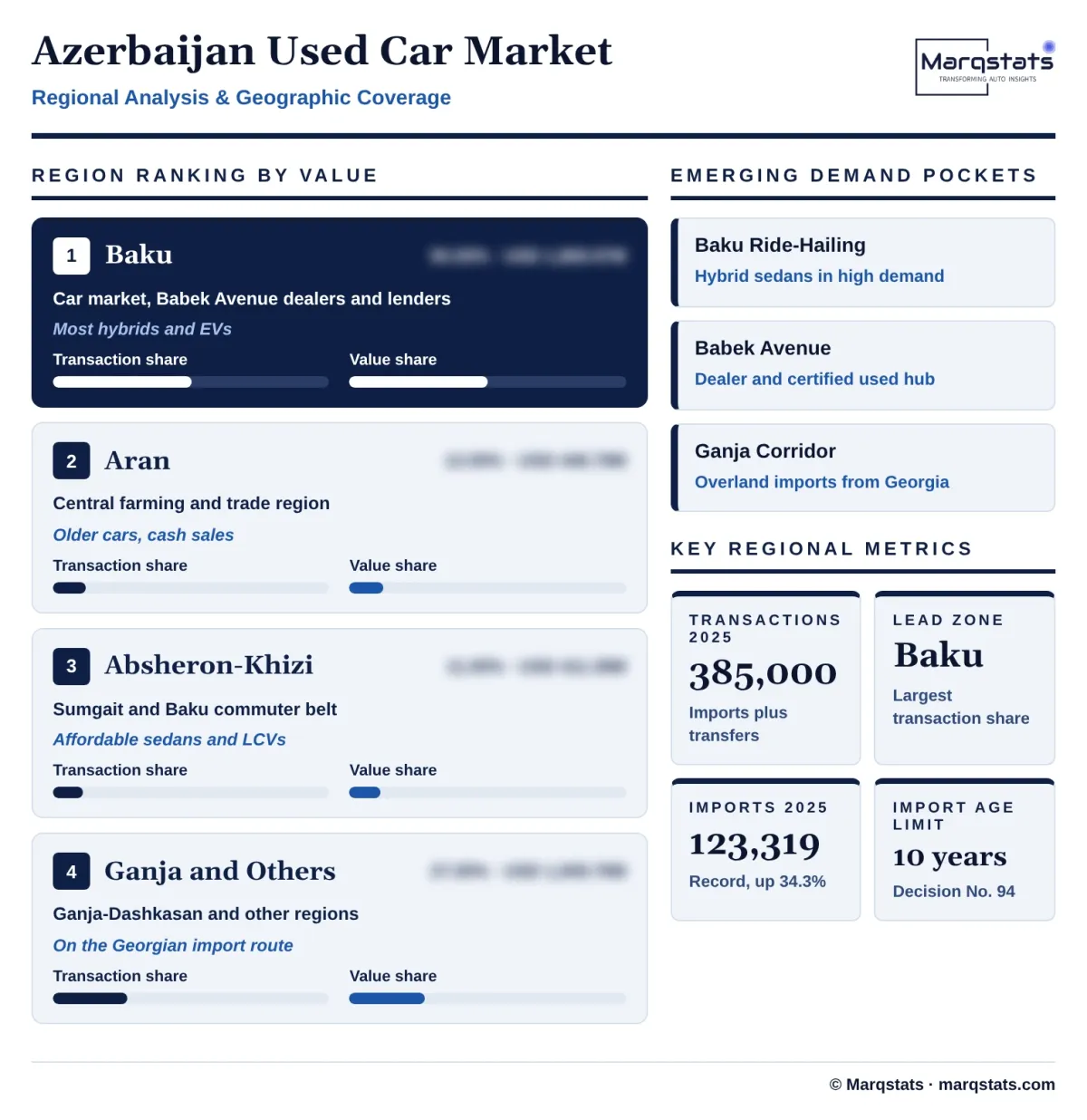
Demand is concentrated on the Absheron Peninsula. Baku accounts for an estimated 50.00% of transactions and the surrounding Absheron-Khizi region, including Sumgait, for 11.00%. The study segments the market by vehicle age, powertrain (gasoline, hybrid, diesel, plug-in hybrid and battery electric) and body type, and covers passenger cars and light commercial vehicles.
Key Takeaways
Market Overview & Analysis
Report Summary
Marqstats sizes the Azerbaijan used car market as the value of all used passenger car and light commercial vehicle transactions in a year: imported used vehicles cleared by the State Customs Committee and registered for the first time by the State Traffic Police, and ownership transfers of vehicles already in the national fleet. In 2025 these totalled an estimated 385,000 transactions, about 92,000 imports and 293,000 domestic transfers. Transactions are valued at an average of AZN 16,514 based on listing and dealer prices and converted at the pegged rate of AZN 1.70 per US dollar.
Imports reach Azerbaijan through several corridors. Late-model cars bought at US insurance auctions are shipped to the Georgian ports of Poti and Batumi, repaired around Rustavi and driven across the border. Korean-market cars such as the Hyundai Sonata, Kia K5 and Kia Sorento arrive by sea through Georgian ports or by rail across Central Asia to the Port of Alat, Chinese cars come along the Middle Corridor, and premium European cars arrive overland through Türkiye. Each corridor serves a different price tier, from repaired US sedans at the low end to certified European SUVs at the top.
Import costs depend on age and engine size. Excise duty rises with engine displacement and steps up sharply for older cars, an 18% VAT applies to the customs value plus duty and excise, and the utilization fee adds up to AZN 800 per car. Electric cars and some hybrids have benefited from tax relief, which shaped the mix of imports between 2023 and 2025.
The forecast rests on three conditions. The ten-year import limit remains in place, the manat stays pegged to the dollar, and tax relief on electrified cars is phased down gradually rather than withdrawn at once. Under these conditions transactions dip in 2026 as 2025 stock is absorbed, then grow to 425,000 in 2030, with market value reaching USD 4,650.00 million.
Azerbaijan Used Car Market Size and Forecast
The Azerbaijan used car market grows from USD 3,739.94 million in 2025 to USD 4,650.00 million in 2030, a CAGR of 4.45%. Because the manat is pegged at AZN 1.70 per dollar, the market grows at the same rate in local currency, from AZN 6,358 million to AZN 7,905 million. Transactions grow from 385,000 to 425,000, a 2.00% annual rate, after a dip in 2026 to about 335,000 as dealers sell stock imported in the 2025 surge.
The average transaction value rises from AZN 16,514 to AZN 18,600. The increase comes from mix rather than price inflation: hybrids, plug-in hybrids and SUVs carry higher prices than the gasoline sedans they replace, and cars up to seven years old rise from 44.70% of transactions in 2025 to 56.50% by 2030 as the utilization fee and the ten-year ban push older cars out of the fleet.
Market Dynamics
Key Drivers
Five conditions support steady growth once the 2025 import surge has been absorbed.
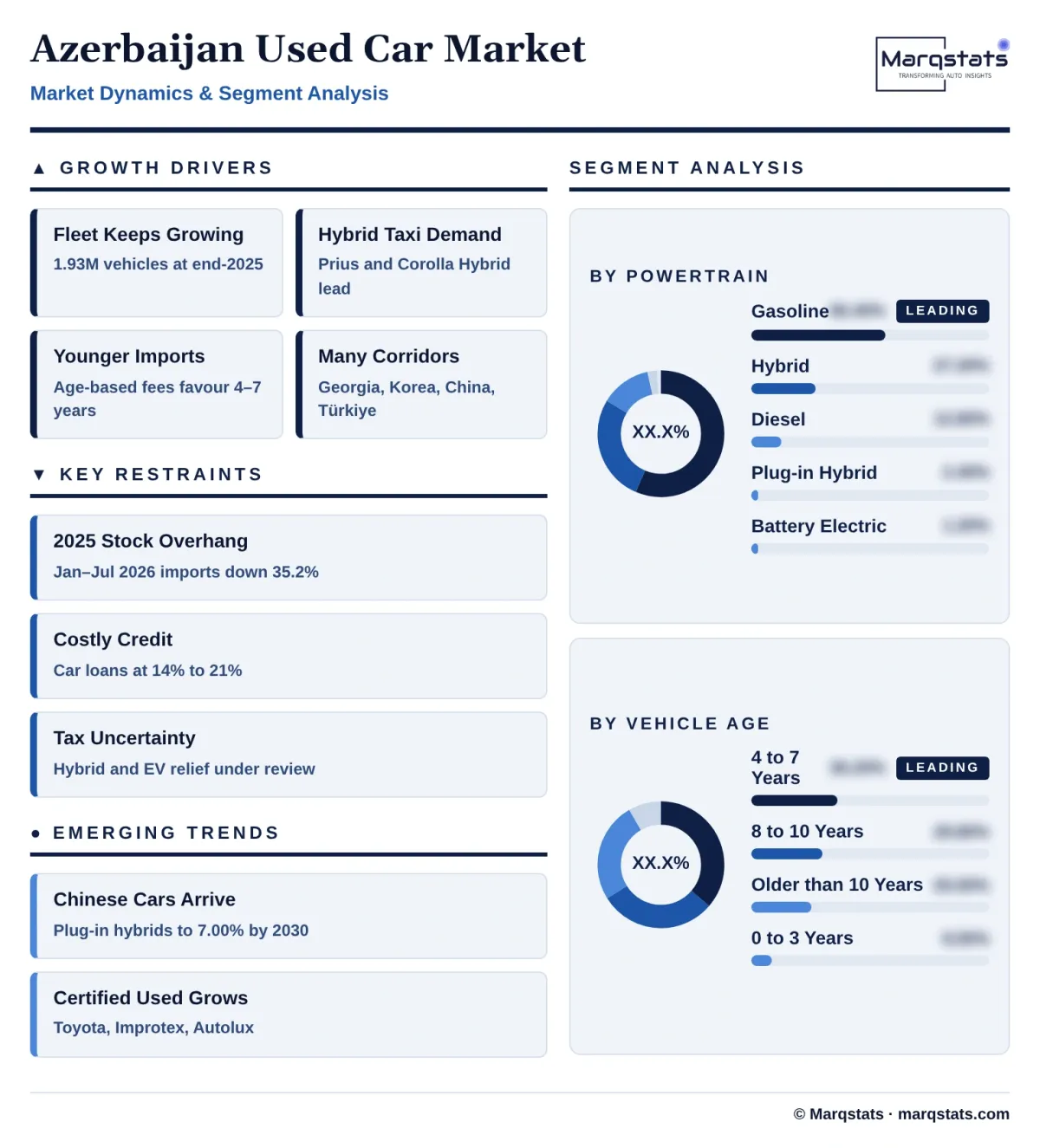
- The fleet keeps growing. The number of registered vehicles rose by 100,724 in 2025 to 1,934,598, including 1,676,080 passenger cars. With domestic assembly limited to a few thousand cars a year, almost every new addition is imported and later becomes used supply.
- Hybrids suit the way Azerbaijanis drive. Taxi and ride-hailing drivers in Baku favour hybrids for their low fuel use, and the Toyota Prius and Corolla Hybrid are among the most traded cars. Hybrid transactions grow from an estimated 104,720 in 2025 to 142,375 by 2030.
- Imports are getting younger. The ten-year import ban and the age-based utilization fee push importers toward four- to seven-year-old cars, which carry higher prices and longer remaining lives. Younger imports raise the average transaction value and improve the quality of the fleet.
- Supply corridors are well established. Georgian ports and repair yards, Korean exporters, Chinese rail freight along the Middle Corridor and overland routes through Türkiye give Azerbaijani importers several sources of supply, which keeps prices competitive.
- Online platforms make prices transparent. Turbo.az dominates online car listings and gives buyers and sellers a common price reference, and dealers on Babek Avenue in Baku increasingly offer inspections and trade-ins that help buyers move up to newer cars.
Key Restraints
Four constraints slow the market and weigh on older stock.
- Stock from the 2025 surge must be absorbed. Imports fell 35.2% in January to July 2026 after the record 2025, and electric car imports halved to 596 units. Until dealers clear the stock bought in 2025, fresh imports and transaction volumes stay below their peak.
- Credit is expensive and hard to get. Car loans cost about 14% to 21% a year and require deposits of 40% to 50% for used cars, so most buyers pay cash. This caps how much buyers can spend and slows the move to newer, more expensive cars.
- Tax changes create uncertainty. Discussion of phasing out tax relief on some hybrids and electric cars drove the 2025 import rush, and further changes could again shift demand between powertrains or between years. Importers hold back stock decisions while rules are unsettled, and buyers delay purchases when they expect prices to fall. The 2025 surge and the 2026 slump show how strongly the market responds to expected tax changes.
- Older cars face rising costs. The utilization fee at technical inspection rises with age, and imports of cars over ten years old are banned. Cars more than eight years old decline from 55.30% of transactions in 2025 to 43.50% by 2030, and their value falls slightly over the period.
Key Trends
Four shifts are changing where used cars come from and how they are sold.
- Chinese cars are entering the used market. Used Changan, Geely, Chery and BYD crossovers and plug-in hybrids are arriving by rail along the Middle Corridor, offering modern features at lower prices than European cars. Plug-in hybrids rise from 2.40% of transactions in 2025 to 7.00% by 2030.
- Korean imports are growing. Korean-market Hyundai and Kia cars, many with LPG or efficient diesel engines, arrive with clean histories and are well supported by parts suppliers in Baku. Hyundai and Kia together account for about a third of used transactions, and their share of imports has grown as buyers look for clean histories instead of repaired US auction cars.
- Dealers are building certified used programmes. Toyota Baku Center, Otokoç Azerbaijan, Improtex Motors and Autolux Azerbaijan offer inspected, warranted used cars and trade-ins. These programmes are growing in the premium tier and are starting to reach mid-market buyers.
- Electric cars remain a small niche. The registered electric car fleet was 5,941 at the start of 2025, and charging outside the Absheron Peninsula is limited. Used electric cars rise from 1.20% of transactions to 4.00% by 2030, mostly in Baku.
Strategic Implications
- For importers, younger and electrified stock is the priority. Four- to seven-year-old cars fall in the lowest utilization fee bracket for eligible imports and are what most buyers want. Importers should source 2018-to-2022 model-year hybrids and crossovers from Korea, the United States and China.
- For franchise dealers, trade-ins are the route into the used market. Toyota, Improtex and Autolux can use trade-ins to secure younger stock and sell it with inspection and warranty, capturing buyers who distrust auction imports.
- For aftermarket and service providers, an ageing domestic fleet and a growing hybrid fleet create steady demand. Cars over ten years old still make up a fifth of transactions in 2030, while hybrids need specialist battery and electronics servicing that independent workshops in Baku are only starting to offer. Workshops that invest in hybrid diagnostics and parts supply can capture this demand.
- For lenders, the used market is under-financed. With most sales in cash, banks and credit organisations that combine Turbo.az pricing data with traffic police registry data can offer used car loans with manageable risk.
- The main uncertainty is tax policy on hybrids and electric cars. The base case assumes gradual phasing of tax relief; a sudden withdrawal would cause another pull-forward of imports followed by a dip, without changing the long-run size of the market much.
Market Segmentation
Cars up to three years old account for an estimated 32,725 transactions in 2025, 8.50% of the market and USD 317.89 million. They are the fastest-growing age group, rising to 61,625 transactions and 14.50% by 2030, with value growing at 16.23% a year to USD 674.25 million, helped by their exemption from the import utilization fee and by dealer trade-ins.
Cars aged four to seven years are the largest age group, with an estimated 139,370 transactions in 2025, 36.20% of the market and USD 1,353.86 million. They rise to 178,500 transactions and 42.00% by 2030, with value growing at 7.60% a year to USD 1,953.00 million, because they balance price, tax and remaining life.
Cars aged eight to ten years account for an estimated 114,730 transactions in 2025, 29.80% of the market and USD 1,114.50 million. Their share falls to 23.50% by 2030 as higher utilization fees and the approaching import age limit weigh on demand, and value eases to USD 1,092.75 million.
Cars more than ten years old account for an estimated 98,175 transactions in 2025, 25.50% of the market and USD 953.68 million. They can no longer be imported and trade only within the domestic fleet, falling to 85,000 transactions and 20.00% by 2030, with value at USD 930.00 million. LADA and older Mercedes-Benz models are common.
Gasoline cars account for an estimated 217,140 transactions in 2025, 56.40% of the market and USD 2,109.32 million. They remain the largest group but their share falls to 46.50% by 2030, with value growing at only 0.50% a year to USD 2,162.25 million.
Conventional hybrids account for an estimated 104,720 transactions in 2025, 27.20% of the market and USD 1,017.26 million. They rise to 142,375 transactions and 33.50% by 2030, with value growing at 8.90% a year to USD 1,557.75 million, led by Toyota and Hyundai models used in taxi and ride-hailing work.
Diesel vehicles account for an estimated 49,280 transactions in 2025, 12.80% of the market and USD 478.71 million, concentrated in light commercial vehicles and older SUVs. Their share falls to 9.00% by 2030 and value declines 2.65% a year to USD 418.50 million as higher excise and emissions rules reduce imports.
Plug-in hybrids account for an estimated 9,240 transactions in 2025, 2.40% of the market and USD 89.76 million. They rise to 29,750 transactions and 7.00% by 2030, with value growing at 29.39% a year to USD 325.50 million, as Chinese and European plug-in crossovers enter the used market.
Battery electric cars account for an estimated 4,620 transactions in 2025, 1.20% of the market and USD 44.88 million, and are the fastest-growing powertrain. They rise to 17,000 transactions and 4.00% by 2030, with value growing at 32.89% a year to USD 186.00 million, concentrated in Baku where charging is available.
Sedans and hatchbacks account for an estimated 53.50% of 2025 transactions, about 205,975 cars worth USD 2,000.87 million. Taxi work and commuting sustain demand for the Toyota Prius, Hyundai Elantra and Kia K5. Their share eases to 49.00% by 2030, with value growing at 2.63% a year to USD 2,278.50 million.
SUVs and crossovers account for an estimated 34.20% of 2025 transactions, about 131,670 vehicles worth USD 1,279.06 million. They are the fastest-growing body type, rising to 39.50% and USD 1,836.75 million by 2030, a 7.51% value CAGR, led by the Hyundai Santa Fe and Tucson, Kia Sportage and Sorento, Toyota RAV4 and Land Cruiser Prado.
Light commercial vehicles and minivans account for an estimated 8.80% of 2025 transactions, about 33,880 vehicles worth USD 329.11 million, rising to USD 395.25 million by 2030, a 3.73% value CAGR. Small businesses and delivery services drive demand, often financed by leasing companies.
Coupes, convertibles and other body types account for an estimated 3.50% of 2025 transactions, about 13,475 vehicles worth USD 130.90 million, rising to USD 139.50 million by 2030. Demand is concentrated among higher-income buyers in Baku.
By Geography
Baku
Baku is the centre of the market, with an estimated 50.00% of 2025 transactions, about 192,500 cars worth USD 1,869.97 million. The capital hosts the Baku car market, the dealer corridor along Babek Avenue, franchise dealers and most lenders. Hybrid, electric and premium cars are concentrated here, and ride-hailing fleets keep demand for efficient sedans strong.
Absheron-Khizi
The Absheron-Khizi region, including Sumgait, accounts for an estimated 11.00% of transactions, about 42,350 cars worth USD 411.39 million. Commuters into Baku and industrial employers in Sumgait support demand for affordable sedans and light commercial vehicles.
Aran
The Aran economic region in central Azerbaijan accounts for an estimated 12.00% of transactions, about 46,200 vehicles worth USD 448.79 million. Farming and regional trade drive demand for older sedans, pickups and light commercial vehicles, and cash sales dominate. Buyers here often travel to Baku to buy younger imported cars, then register them locally, so regional demand is larger than local dealer activity suggests.
Ganja-Dashkasan
The Ganja-Dashkasan region, centred on Ganja, the second-largest city, accounts for an estimated 7.50% of transactions, about 28,875 cars worth USD 280.50 million. Ganja lies on the main road from the Georgian border, so it is a stopping point for cars imported overland. A growing number of dealers in Ganja sell imported sedans and crossovers to buyers across western Azerbaijan, and prices there track Baku listings on Turbo.az closely.
Rest of the Country
The remaining regions account for an estimated 19.50% of transactions, about 75,075 vehicles worth USD 729.29 million. Fleets are older, LADA and older Soviet-era models are still common, and private cash sales dominate. Regional shares are a Marqstats allocation based on fleet distribution.
How Competition Is Evolving
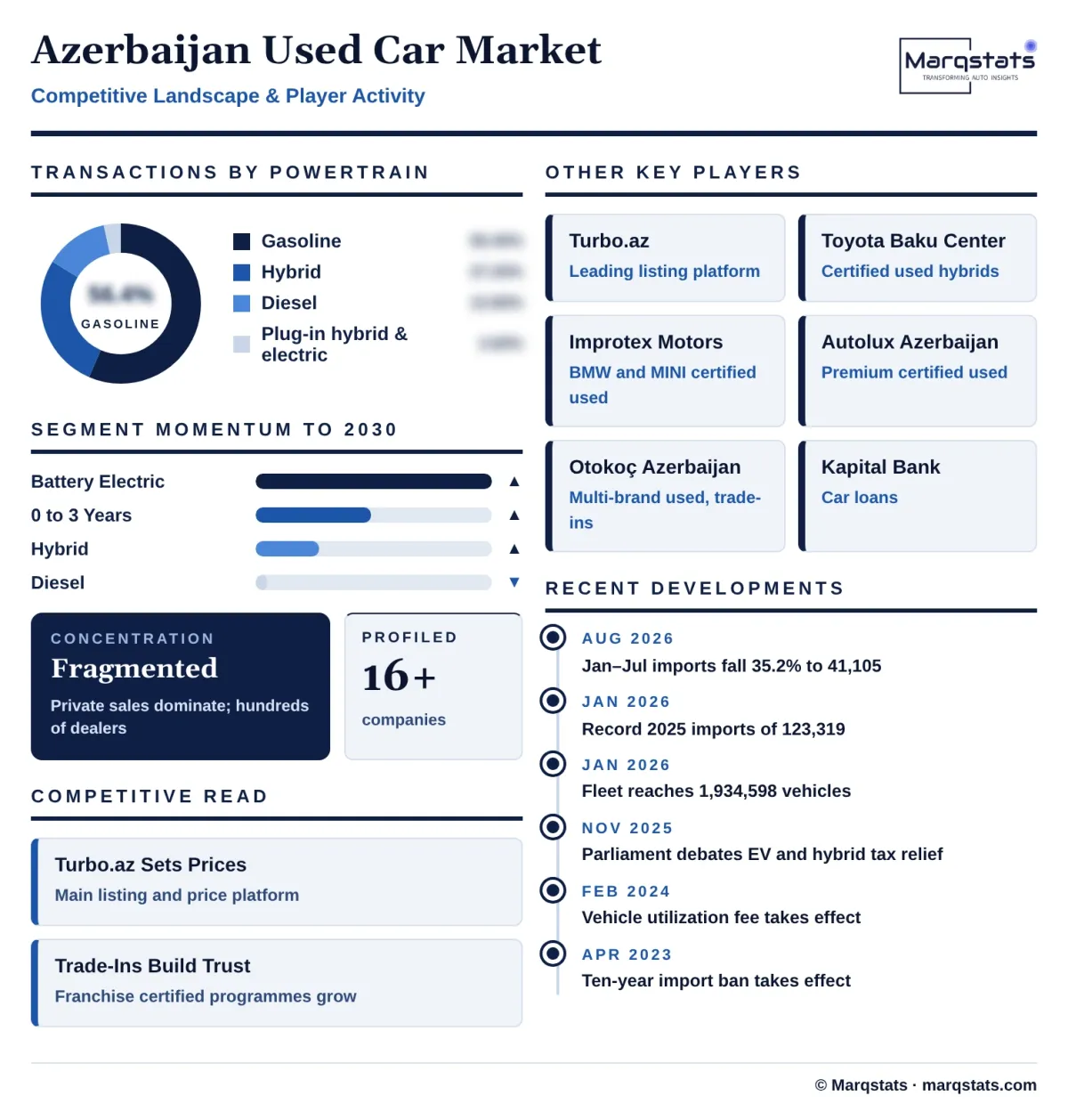
The Azerbaijan used car market is fragmented. Private sales between individuals make up most transactions, and hundreds of independent dealers and import brokers compete for the rest. No single dealer group holds a large share of transactions.
Platforms and physical markets anchor the trade. Turbo.az is the leading online listing platform and the main price reference, with Lalafo.az serving budget private sales. In person, the open-air car market outside Baku and the dealer corridor along Babek Avenue are where most inspections and sales take place.
Franchise dealers are moving into certified used cars. Toyota Baku Center and Toyota Absheron Center run certified used programmes for hybrids and SUVs, Improtex Motors covers BMW and MINI, Autolux Azerbaijan covers Jaguar, Land Rover and other premium brands, and Otokoç Azerbaijan, part of Türkiye's Koç Holding, offers multi-brand used cars with inspection and trade-in.
Lenders and leasing companies shape access to newer cars. Kapital Bank, ABB, Unibank and Bank Respublika provide car loans, while leasing companies serve small businesses buying used light commercial vehicles. Dealers that combine verified stock, warranties and finance partnerships are best placed to grow as the market formalises.
Companies Covered
Companies covered in the report include:
Recent Market Activity
Table of Contents
Coverage & Segmentation
The study covers the Azerbaijan used car market nationally, with 2025 as the base year, 2021 – 2025 as the historical period and 2026 – 2030 as the forecast period. Values are in US dollars, converted from Azerbaijani manat at the pegged rate of AZN 1.70 per US dollar. The market is defined as the value of used passenger car and light commercial vehicle transactions: imported used vehicles registered for the first time and ownership transfers of registered vehicles. It is segmented by vehicle age, powertrain and body type.
New vehicle sales, buses, trucks and motorcycles are excluded, as are finance, insurance and aftersales revenue. The split of imports between new and used vehicles, the domestic transfer count, the average transaction value and the age, powertrain, body type and regional splits are Marqstats estimates built on customs, fleet and listing data.