Market Snapshot
The Africa low bed semi trailer market size is estimated at USD 73.48 million in 2025 and is projected to reach USD 103.60 million by 2030, growing at a CAGR of 7.11% over 2026 – 2030. Annual new supply rises from about 1,910 to 2,530 trailers, a 5.78% annual rate, while the average delivered price per trailer climbs from about USD 38,471 to USD 40,949 as steered multi-axle units take a larger share.
Marqstats defines the market as the value of new low bed semi-trailers sold in Africa for moving excavators, loaders, dozers, cranes, transformers and other indivisible heavy machinery, in step-deck, rear-loading, welldeck, drop-deck, extendable and hydraulic multi-axle designs. Value is counted at the builder gate for locally built units and at the landed in-country price, including freight and customs duty, for imports, in US dollars and before value-added tax and dealer margins. Tractor units, self-propelled modular transporters, container skeletals, flatdecks, tippers, tankers, used trailers and trailer parts are excluded.
Southern Africa accounts for 52.59% of 2025 value, step-deck and rear-loading designs for 44.00% and mining and quarrying for 36.00%. East Africa grows fastest, at 9.60% a year, as the Northern Corridor and Central Corridor fleets move to heavier, better-specified trailers. Chinese exporters ship 41.89% of 2025 units but earn only 21.23% of value.
Key Takeaways
Market Overview & Analysis
Report Summary
Marqstats sizes the Africa low bed semi trailer market as the value of new semi-trailers with a lowered load deck that carry heavy, indivisible machinery on African roads. It counts step-deck and rear-loading units with fixed or detachable necks, welldeck and drop-deck lowboys, and extendable or hydraulically steered multi-axle lowbeds, whether built in South Africa, assembled from kits in another African country, or imported from China, Turkey and Europe. It excludes the tractor that pulls them, self-propelled modular transporters, container skeletals, flatdecks, tippers, tankers and used trailers.
Lowbeds are a small, specialised slice of the African trailer trade. The Marqstats South Africa Truck Trailer report sizes that country at USD 412.22 million in 2025 from about 14,000 new heavy freight trailers, and places all skeletal, low-bed and specialised trailers together at USD 52.50 million. Marqstats estimates South African lowbeds at about 360 units and USD 18.72 million, 35.66% of that segment, and the Africa total at USD 73.48 million, so South Africa carries 25.48% of Africa value and the rest of the continent 74.52%.
Demand follows machinery moves, not freight tonnes. A lowbed is bought to deliver an excavator to a quarry, a dozer to a haul road, a transformer to a substation or a mill liner to a concentrator, so orders track mine expansion, road contracts and energy projects. Zambia produced 890,346 tonnes of copper in 2025, up 8% from 825,513 tonnes in 2024 but short of its 1 million tonne target, and the Democratic Republic of the Congo has been the world second-largest copper producer since 2024, which keeps the Copperbelt corridors from Kitwe and Lubumbashi to Ndola, Lusaka and Durban busy with equipment moves.
Rules decide the shape of the trailer. The East African Community Vehicle Load Control Act 2016 sets overall height at 4.3 metres and width at 2.65 metres, and the Kenya National Highways Authority began enforcing it in early 2024, which led the Kenya Transporters Association to ask for a 0.2 metre tolerance. Uganda made new load control regulations on 11 June 2026 that set a 56 tonne gross limit, a maximum of seven axles and special load classes up to 6 metres wide. South Africa regulates abnormal loads through the National Road Traffic Act 1996 and the Committee of Transport Officials guideline known as TRH11.
Marqstats estimates the market at USD 49.34 million in 2021 from about 1,430 trailers, rising to USD 67.86 million in 2024 from 1,800 trailers, a 10.47% CAGR from 2021 to 2025. Growth of 8.28% in 2025 to USD 73.48 million, about ZAR 1,314 million at the 2025 average rate of ZAR 17.88 per US dollar, came from copper and project demand and from a larger share of steered multi-axle units.
Africa Low Bed Semi Trailer Market Size and Forecast
The Africa low bed semi trailer market grows from USD 73.48 million in 2025 to USD 103.60 million in 2030, a CAGR of 7.11%. Volume contributes most of the growth: new supply rises at 5.78% a year, from about 1,910 to 2,530 trailers, and the average delivered price rises at 1.26% a year, from about USD 38,471 to USD 40,949, as steered and extendable designs take a larger share of value.
The 2025 value is built bottom-up from regions and prices. Marqstats estimates about 840 units in Southern Africa at about USD 46,000 each, 380 in East Africa at USD 31,500, 330 in West and Central Africa at USD 29,500 and 360 in North Africa at USD 36,500. Prices are builder-gate values for locally built units and landed in-country values for imports, before value-added tax. Within Southern Africa, Marqstats places about 360 units in South Africa at about USD 52,000, about 230 in Zambia and the Democratic Republic of the Congo, and about 250 in Zimbabwe, Mozambique, Namibia, Botswana, Angola and neighbouring markets.
The price ladder explains why units and value diverge. A three-axle 80 tonne lowbed from a builder in Jinan, Shandong was listed on the Truck1 South Africa portal in 2026 at EUR 11,640, about USD 13,153, and a three-axle 60 tonne unit at EUR 9,000, about USD 10,170. Turkish builder AREL Trailer listed three-axle, four-axle and six-axle lowbeds at EUR 32,000, EUR 36,000 and EUR 55,000, about USD 36,160, USD 40,680 and USD 62,150, while a Goldhofer STZ-P 6-73/80 six-axle unit was listed in Germany at EUR 79,900 excluding value-added tax, about USD 90,287. Listing prices are ex-works, and Marqstats adds freight, customs duty and clearing to reach landed prices of about USD 19,500 for the Chinese layer, USD 44,000 for the Turkish layer and USD 80,000 for the European layer.
The base is checked against three outside anchors. First, the Marqstats South Africa Truck Trailer report places all skeletal, low-bed and specialised trailers at USD 52.50 million, and the Africa model's South African lowbed value of USD 18.72 million is 35.66% of that. Second, Kenya imported USD 21.13 million of goods under HS heading 8716 in 2023, the latest full-year series used and labelled by year, and the Marqstats estimate of about 100 Kenyan lowbeds at USD 31,500 equals USD 3.15 million, 14.91% of that total, which also covers other trailers and parts. Third, the National Association of Automobile Manufacturers of South Africa (Naamsa) recorded 22,738 heavy trucks and buses and 8,151 medium commercial vehicles sold in South Africa in 2025, a heavy-truck base against which about 360 South African lowbeds is a small, plausible attachment.
Forecast growth rests on four indicators that Marqstats tracks: Copperbelt production against the 7 million tonne a year level that the Democratic Republic of the Congo and Zambia could reach by 2030, the pace of Mozambique LNG construction toward first LNG in 2029, the enforcement of East African axle, height and width limits after the Uganda regulations of June 2026, and the landed price gap between Chinese and Turkish lowbeds and South African or European units.
Market Dynamics
Key Drivers
Five forces are lifting demand for new low bed semi-trailers across Africa.
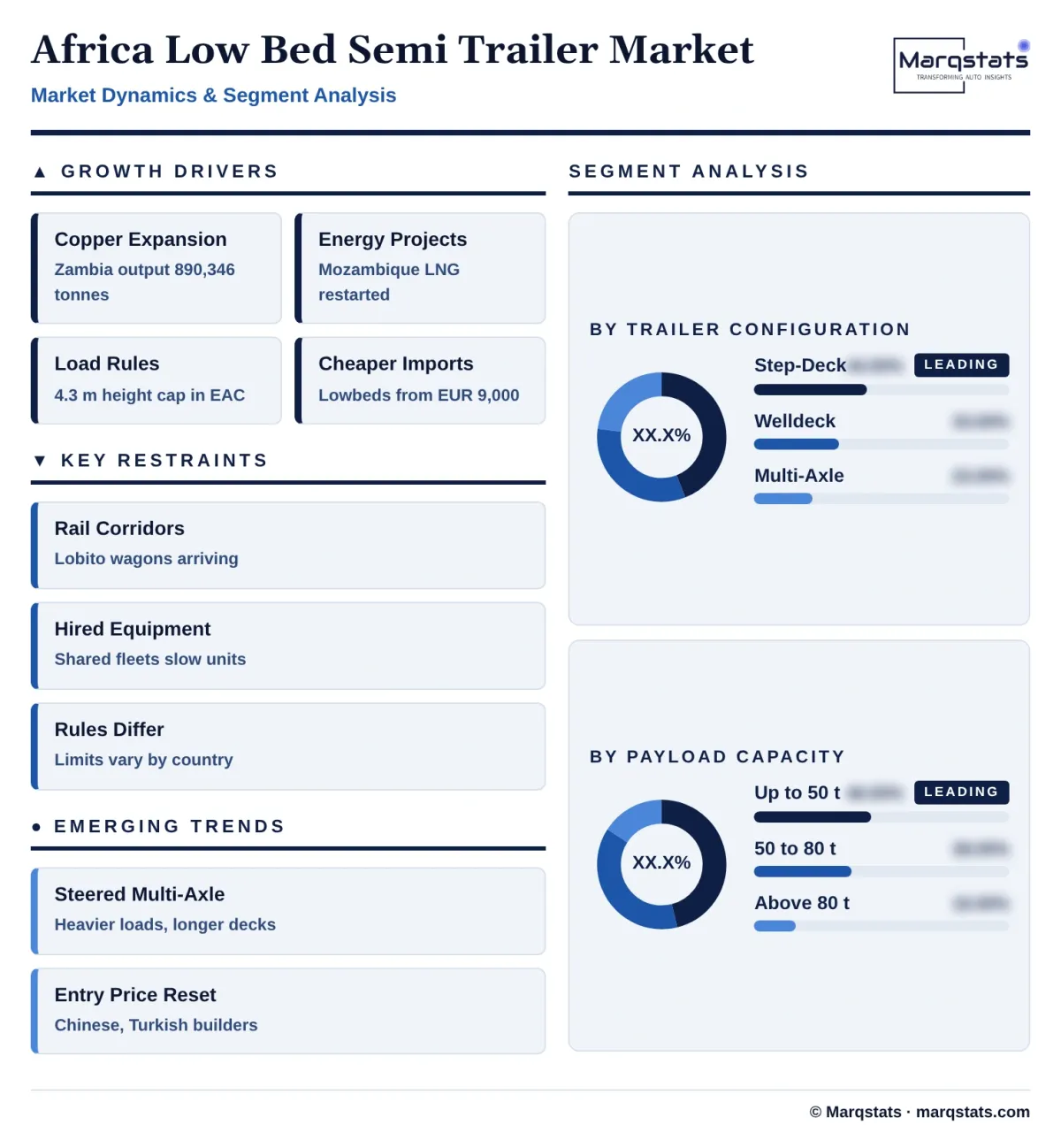
- Copper and mining expansion create steady demand. Zambia produced 890,346 tonnes of copper in 2025, up 8% from 825,513 tonnes in 2024, and the Democratic Republic of the Congo has been the world second-largest producer since 2024. Every new pit, concentrator and haul road needs excavators, dozers and crushers moved on lowbeds, and a Foton Motor order for 800 heavy-duty trucks in Zambia, reported on 26 June 2026 and possibly tied to the copper industry, points to a larger tractor fleet that will pull more trailers.
- Energy and gas projects bring heavy indivisible loads. TotalEnergies announced the full restart of Mozambique LNG at Afungi on 29 January 2026, with more than 4,000 workers mobilised, construction about 40% complete and first LNG targeted for 2029. Modules, pressure vessels and power equipment for sites of that size travel on multi-axle lowbeds and extendable semi-trailers.
- Load rules reward lower, better-specified trailers. The East African Community Vehicle Load Control Act 2016 caps overall vehicle height at 4.3 metres and width at 2.65 metres, and the Kenya National Highways Authority began enforcing it in early 2024. A lower deck leaves more room for tall machines under the 4.3 metre cap, so fleet buyers replace higher decks with welldeck and drop-deck lowbeds.
- Uganda has tightened its own rules. The Roads (Vehicle Dimensions, Vehicle Load Control and Enforcement Measures) Regulations 2026, made on 11 June 2026 and gazetted on 26 June 2026, set a 56 tonne gross vehicle limit, seven axles at most and permit-based special loads up to 6 metres wide, which favours certified multi-axle designs on the Northern Corridor to Kampala.
- Cheaper imports widen the buyer base. A three-axle 80 tonne Chinese lowbed was listed in 2026 at about USD 13,153 and Turkish three-axle units at about USD 36,160, both before freight, duty and clearing, so contractors and small hauliers once priced out of South African or European units can now buy a first lowbed and win equipment-moving work.
Key Restraints
Four constraints keep unit growth below the pace of mining and project spending.
- Rail takes some corridor freight. The Lobito Atlantic Railway received its 200th wagon from Galison Manufacturing on 3 February 2026 under an order of 275 container wagons placed in 2024, and rail on the Copperbelt corridors removes bulk and container loads from trucks. Lowbeds are not displaced directly, but a smaller road freight fleet means fewer tractors renewed and fewer trailers ordered.
- Heavy-haul equipment is hired, not owned. Mining contractors, crane companies and specialist hauliers move machines on shared assets, so one lowbed serves many projects, and Marqstats treats hire-based use as a reason why unit demand grows more slowly than project spending.
- Rules differ by country. East Africa applies a 4.3 metre height cap, Uganda a 56 tonne gross limit and seven axles, and South Africa a permit system under TRH11 and the National Road Traffic Act 1996, so a trailer certified in one market may need modification in the next, which slows cross-border resale and raises engineering cost.
- Market data is thin. HS heading 8716 mixes caravans, trailers of all kinds and parts, and lowbed semi-trailers for goods sit within subheading 8716.39 without a separate line, so buyers, lenders and builders rely on dealer listings, tender awards and company disclosures to judge demand.
Key Trends
Four shifts are changing which low bed trailers are built, imported and specified.
- Multi-axle and steered designs move up the order book. Six-axle and larger lowbeds with hydraulic steering and extendable decks rise from a quarter of value toward a larger share as buyers move transformers, mills and large excavators that standard three-axle units cannot carry within axle limits.
- Chinese and Turkish builders set the entry price. Builders in Shandong and in Turkey list three-axle lowbeds at EUR 9,000 to EUR 32,000, which resets what a first-time buyer expects to pay and pressures local builders to defend on service, parts and finance.
- South Africa remains the export hub for Southern Africa. South Africa exported USD 230 million of trailers and related goods in 2023, with Zambia taking 36%, Zimbabwe 12.6%, Mozambique 11.7%, Namibia 7.34% and Botswana 6.73%, so builders in Gauteng supply the Copperbelt and neighbouring mining markets.
- Project-linked demand grows in gas and energy. Mozambique LNG, grid reinforcement and large solar and wind sites add oversize loads that need steered multi-axle trailers, and lift energy, power and oil and gas projects to the fastest-growing end use.
Strategic Implications
- For trailer builders, the practical route is a three-tier range. A fixed-neck three-axle unit at the Turkish price point defends the entry tier, a welldeck or detachable-neck unit in the 50 to 80 tonne band carries the margin, and a steered extendable unit for loads above 80 tonnes wins project work that imports cannot serve quickly. Builders that keep parts and service depots on the Copperbelt corridors defend price better than builders that compete on list price alone.
- For importers and distributors, landed cost sets the deal. A Chinese three-axle unit at about USD 13,153 before freight and duty can reach roughly USD 19,500 delivered, and a distributor that adds a regional warranty and parts stock earns more than one that ships a container and leaves. Turkish units sit between, and European makers hold the loads above 80 tonnes.
- For mining contractors and heavy haulers, owning a lowbed is a utilisation decision. A unit that serves one project a year is better hired, while a steered multi-axle unit that serves many projects across Zambia, the Democratic Republic of the Congo and Mozambique pays back, and buying a trailer certified for the strictest corridor limit avoids modification costs when the fleet crosses borders.
- For financiers and leasing firms, lowbeds hold value because lead times for imported multi-axle units are long and specifications are narrow. Lenders that accept a trailer as security against a contract, as truck financiers already do for tractors, can reach hauliers that banks turn away.
- For component suppliers, the volume is in axles, suspensions, hydraulic steering and tyres for units that are bought in dozens, not thousands. Suppliers that serve the independent trailer builders of Gauteng and the Turkish exporters with certified, locally stocked parts win the aftermarket that follows each new trailer.
Market Segmentation
Step-deck and rear-loading lowbeds account for 44.00% of 2025 value, USD 32.33 million, and grow at 6.12% a year to USD 43.51 million. This is the general-purpose heavy-haul trailer, with a fixed or detachable gooseneck and rear ramps or a hydraulic tilt bed, bought by contractors and plant hirers to move excavators and loaders of 20 to 60 tonnes. Dealer listings in Germiston, Gauteng include 2026 rear-loading Martin Trailers units rated at about 50 tonnes, and 58 tonnes with a single-axle dolly.
Welldeck and drop-deck lowboys account for 33.00% of 2025 value, USD 24.25 million, and grow at 7.11% a year to USD 34.19 million. The lowered well keeps tall machines under overall height caps such as the East African Community limit of 4.3 metres, so demand is strongest on Kenyan, Tanzanian and Ugandan corridors and in mining areas where excavators are loaded over the rear.
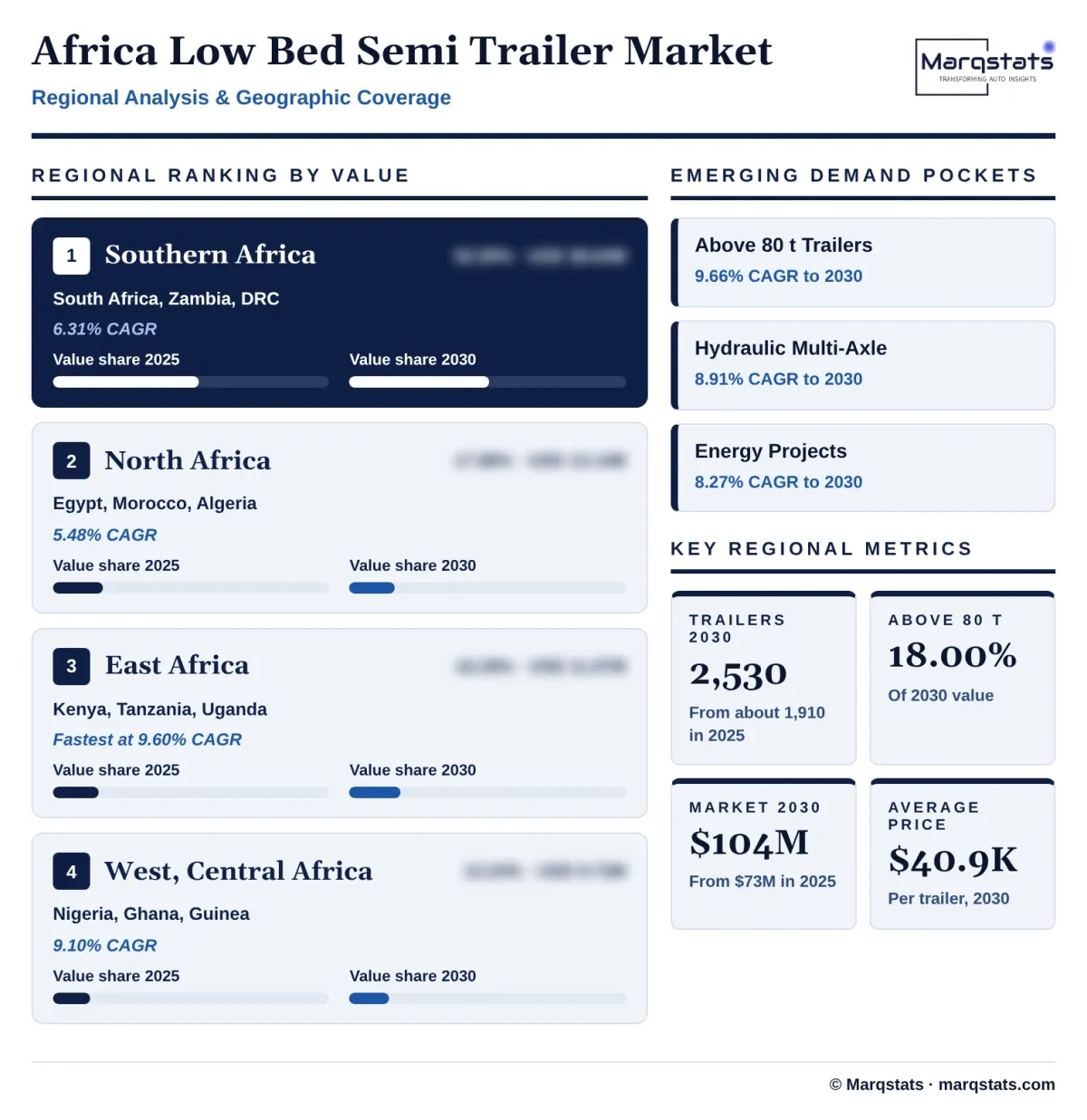
Extendable and hydraulic multi-axle lowbeds account for 23.00% of 2025 value, USD 16.90 million, and grow fastest, at 8.91% a year, to USD 25.90 million and 25.00% of the market. These steered units of four to ten axles, built by makers such as Faymonville, Goldhofer and Nooteboom Trailers, carry transformers, mill shells and crushers on mining and energy projects and sit at the top of the price ladder.
Trailers rated up to 50 tonnes account for 46.00% of 2025 value, USD 33.80 million, and grow at 5.68% a year to USD 44.55 million, while their share falls to 43.00%. Chinese and Turkish three-axle units dominate this band, which serves road builders, quarries and plant hire fleets.
Trailers rated 50 to 80 tonnes account for 38.00% of 2025 value, USD 27.92 million, and grow at 7.67% a year to USD 40.40 million. This is the working core of the mining market, matching the large excavators and rigid dump trucks on Copperbelt sites, and the band where South African builders such as Martin Trailers and Afrit compete hardest.
Trailers above 80 tonnes account for 16.00% of 2025 value, USD 11.76 million, and grow fastest, at 9.66% a year, to USD 18.65 million and 18.00% of the market. Orders are project-driven and placed with European makers or specialist builders, and they depend on gas, power and large mining capital projects.
Mining and quarrying account for 36.00% of 2025 value, USD 26.45 million, and grow at 7.70% a year to USD 38.33 million. Zambian copper output of 890,346 tonnes in 2025 and Congolese expansion keep contractors moving equipment between pits, plants and workshops.
Construction and road infrastructure account for 34.00% of 2025 value, USD 24.98 million, and grow at 6.48% a year to USD 34.19 million. Road, rail, dam and building contractors buy step-deck and rear-loading units, and the segment grows slowest because public works budgets are tight in several markets.
Energy, power and oil and gas projects account for 18.00% of 2025 value, USD 13.23 million, and grow fastest, at 8.27% a year, to USD 19.68 million and 19.00% of the market. Mozambique LNG at Afungi, grid and substation projects and wind and solar sites need long, steered trailers for transformers and large modules.
Ports, agriculture and other heavy freight account for 12.00% of 2025 value, USD 8.82 million, and grow at 5.27% a year to USD 11.40 million. Port operators, grain handlers and sugar and timber estates buy lowbeds for cranes, harvesters and processing equipment, and for moving heavy vehicles between sites.
By Geography
Southern Africa
Southern Africa accounts for 52.59% of 2025 value, USD 38.64 million, and grows at 6.31% a year to USD 52.47 million and 50.65% by 2030. It covers South Africa, Zambia, the Democratic Republic of the Congo, Zimbabwe, Mozambique, Namibia, Botswana and Angola. South African builders supply much of it: the country exported USD 84 million of trailers and related goods under HS 8716 to Zambia in 2023, USD 29 million to Zimbabwe and USD 27 million to Mozambique, and Marqstats allocates value by the market where the trailer works, not where it was built.
North Africa
North Africa accounts for 17.88% of 2025 value, USD 13.14 million, and grows at 5.48% a year to USD 17.16 million. Egypt, Morocco, Algeria and Tunisia buy lowbeds for state infrastructure, industrial zones, phosphate and quarry work, with Turkish and European builders competing closely on price and specification.
East Africa
East Africa accounts for 16.29% of 2025 value, USD 11.97 million, and grows fastest, at 9.60% a year, to USD 18.93 million and 18.27% by 2030. Kenya, Tanzania, Uganda, Ethiopia and Rwanda buy mostly Chinese and Turkish units, and the Northern Corridor from Mombasa to Kampala and the Central Corridor from Dar es Salaam carry the equipment moves for roads, power lines and mines. Kenya imported USD 21.13 million of goods under HS 8716 in 2023, down from USD 39.35 million in 2021.
West and Central Africa
West and Central Africa account for 13.24% of 2025 value, USD 9.73 million, and grow at 9.10% a year to USD 15.04 million. Marqstats expects Nigeria, Ghana, Cote d'Ivoire, Senegal, Guinea and Cameroon to buy mainly entry-priced Chinese and Turkish lowbeds for road, port and mining work, and Rio Tinto and Winning International began shipping Simandou iron ore from Guinea in November 2025 over a 595 kilometre railway, which adds equipment moves around a 120 million tonne a year project.
How Competition Is Evolving
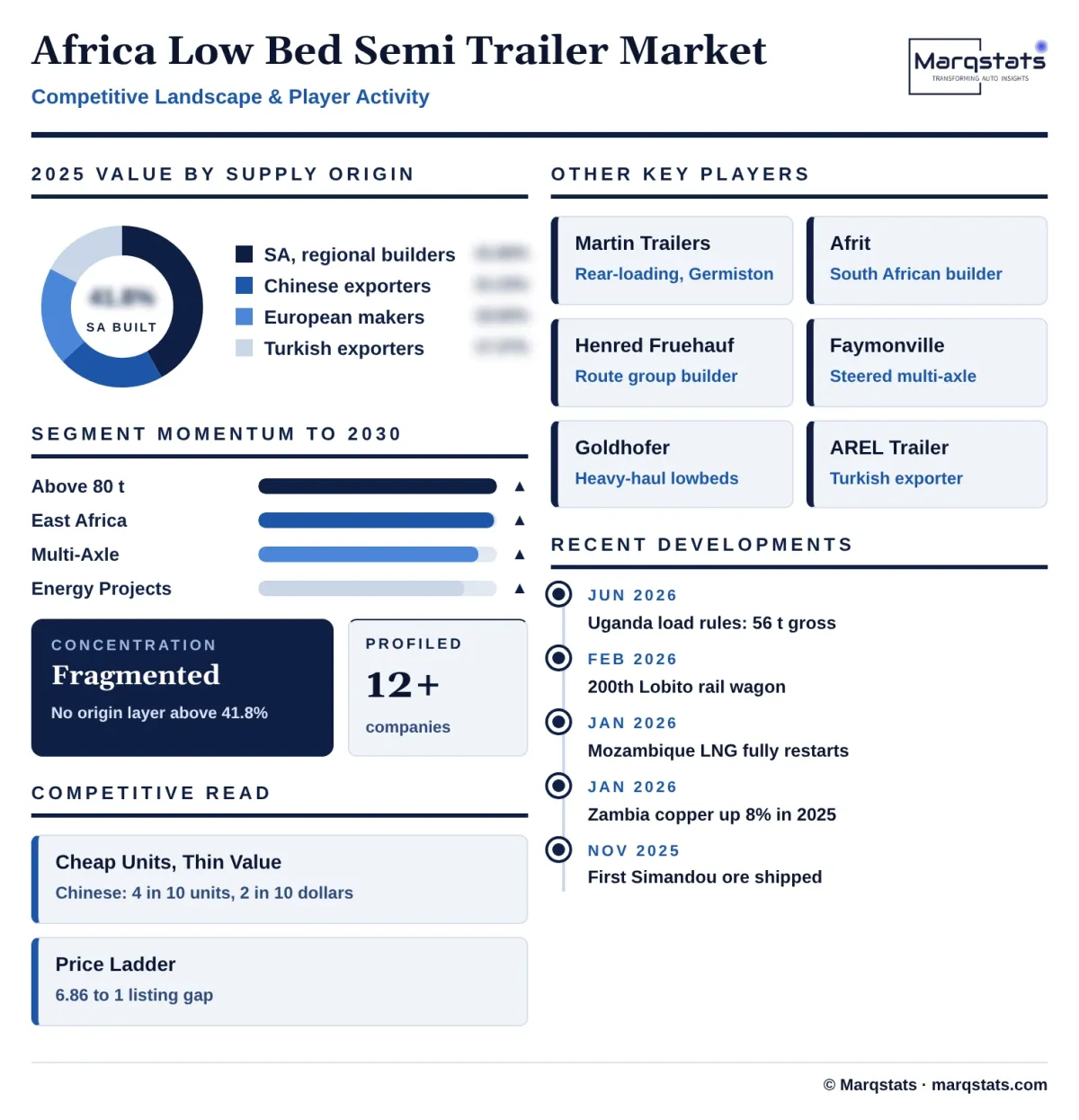
The market is fragmented and layered by supply origin, not led by a few brands. Marqstats estimates that South African and regional builders hold 41.80% of 2025 value from 33.51% of units, Chinese exporters 21.23% of value from 41.89% of units, Turkish exporters 17.37% from 15.18% and European heavy-haul makers 19.60% from 9.42%. These are Marqstats constructions from listing prices, trade flows and plant disclosures, not company shares.
South African builders defend the middle of the market with service and local content. Martin Trailers (Pty) Ltd of Germiston builds rear-loading units rated at about 50 tonnes, or 58 tonnes with a dolly, and Afrit (Pty) Ltd, Henred Fruehauf Trailers (Pty) Ltd, SA Truck Bodies (Pty) Ltd, GRW Engineering (Pty) Ltd and Serco Industries (Pty) Ltd are the trailer builders that the Marqstats South Africa Truck Trailer report profiles. They sell into Zambia, Zimbabwe and Mozambique as well as at home.
Chinese and Turkish exporters set the entry price. CIMC Vehicles (Group) Co., Ltd., Fudeng and other Chinese builders list three-axle lowbeds from EUR 9,000, and AREL Trailer of Turkey lists three-axle units at EUR 32,000. China supplied 51% of South African HS 8716 imports in 2023, Germany 23% and Turkey 5.27%, a pattern Marqstats expects to repeat in lowbeds.
European makers lead the top of the market. Faymonville Group, Goldhofer AG and Nooteboom Trailers B.V. supply steered multi-axle and modular lowbeds for transformers, process plant and large mining equipment, and a six-axle Goldhofer STZ-P 6-73/80 was listed at EUR 79,900. Competition is shifting from price to access, because buyers with a project deadline pay for stocked units, parts and engineering support, and that favours builders and distributors with a depot in Johannesburg, Lusaka, Nairobi or Lagos.
Companies Covered
Companies covered in the report include:
Recent Market Activity
Table of Contents
Coverage & Segmentation
The study covers the Africa low bed semi trailer market, with 2025 as the base year, 2021 – 2025 as the historical period and 2026 – 2030 as the forecast period. It covers new low bed semi-trailers for indivisible heavy loads, built in or imported into Africa, segmented by trailer configuration, payload capacity, end use and region. Values are builder-gate values for locally built units and landed in-country values including freight and customs duty for imports, in US dollars before value-added tax, registration duties and dealer margins, and rand figures use the 2025 average of ZAR 17.88 per US dollar. Regions are Southern Africa, East Africa, West and Central Africa and North Africa.
Tractor units, self-propelled modular transporters, container skeletals, flatdecks, curtainsiders, tippers, tankers, used trailers, drawbar trailers, dollies sold separately and trailer parts are excluded. Lowbed semi-trailers for goods sit within HS subheading 8716.39, which customs series do not split, so segment and regional values are Marqstats estimates built from listing prices, trade flows, company disclosures and project data. The live Marqstats South Africa Truck Trailer report is a broader parent that includes South African lowbeds inside its skeletal, low-bed and specialised segment of USD 52.50 million, and the live Marqstats Skeletal and Container Chassis Trailer report covers container skeletals; neither figure should be added to this market.