Market Snapshot
Middle bar: base-year value × (1 + CAGR), rounded to two decimals. This is a calculated illustration, not a separately researched annual estimate.
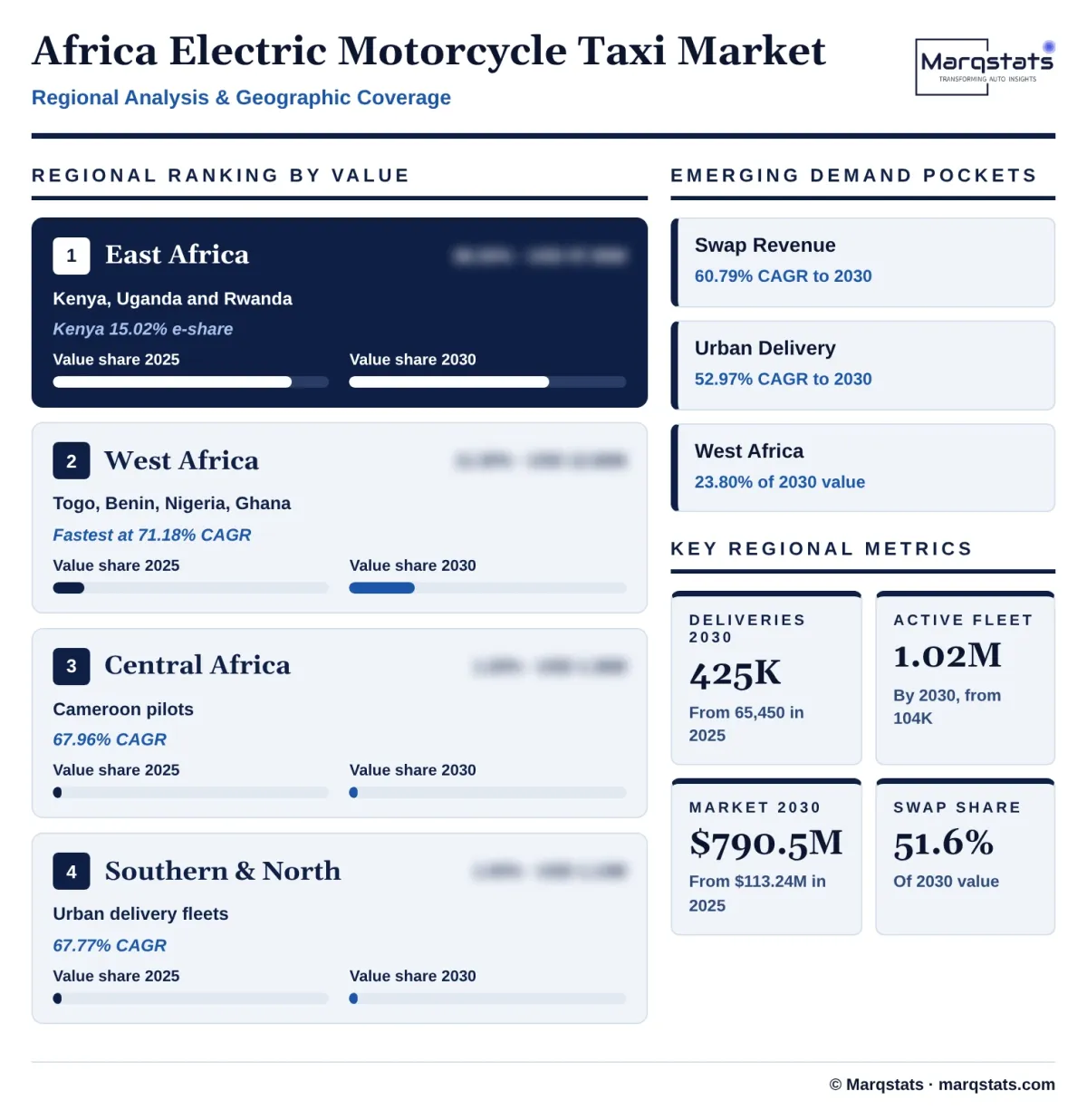
The Africa electric motorcycle taxi market size is estimated at USD 113.24 million in 2025 and is projected to reach USD 790.54 million by 2030, growing at a CAGR of 47.50% over 2026 – 2030. Commercial deliveries rise from about 65,450 motorcycles to 425,000, a 45.38% annual rate, and the active commercial fleet grows from about 104,200 to 1,020,000 vehicles.
Marqstats defines the market as two revenue layers earned from electric motorcycles used for paid passenger rides and urban parcel and food delivery across Africa: sales of the vehicle chassis and drivetrain at wholesale prices, sold without a battery under battery-as-a-service models, and recurring battery swap and charging revenue paid by commercial riders. Privately owned commuter motorcycles, electric mopeds and scooters for personal use, three-wheelers, petrol motorcycles and conversion kits are excluded.
Swappable-battery fleets account for an estimated 91.00% of 2025 value and passenger taxi use for 75.00%. East Africa accounts for 86.50% of 2025 value and West Africa for 11.30%. The study segments the market by value layer, battery architecture, application and region.
Key Takeaways
Market Overview & Analysis
Report Summary
Marqstats sizes the Africa electric motorcycle taxi market as the value of electric motorcycles delivered into commercial passenger and delivery service plus the battery swap and charging revenue those fleets pay. In 2025 about 65,450 motorcycles entered commercial service, worth USD 75.27 million at an average wholesale price of about USD 1,150 without a battery, and an average active fleet of about 77,500 motorcycles paid an estimated USD 37.97 million for swaps and charging, for a total of USD 113.24 million.
Motorcycle taxis are the main form of urban public transport in much of Sub-Saharan Africa. They are called boda bodas in East Africa, okadas in Nigeria and zemidjans in Benin and Togo, and riders typically cover 100 to 190 kilometres a day, six or seven days a week. On petrol motorcycles of 100cc to 150cc, fuel and engine oil are the largest running costs, and fuel subsidy removal in Nigeria and currency weakness across East and West Africa have raised those costs.
Electric motorcycles cut the rider's daily running cost. Marqstats estimates a Nairobi rider covering 120 km a day spends about KES 600 to 700 on petrol, against about KES 350 to 400 for battery swaps, and the World Bank estimates an electric boda boda can save a Ugandan rider about UGX 1 million, roughly USD 255, a year. Lower maintenance adds to the saving, because there are no oil changes, spark plugs or carburettor cleaning.
Most commercial electric motorcycles are sold without a battery. Riders buy or lease the chassis, usually on daily hire-purchase payments through lenders such as M-KOPA and Watu or through the operator, and pay for energy each time they swap a depleted battery for a charged one at a station or kiosk. Swapping takes a few minutes, so riders lose little working time, and operators own and manage the batteries.
The market grew from about 1,120 motorcycles in 2021, worth USD 1.63 million, to 13,800 in 2023 and 31,500 in 2024, worth USD 54.18 million, as Spiro scaled in Benin, Togo, Kenya, Uganda and Rwanda and Ampersand, Roam and ARC Ride expanded in East Africa. Marqstats expects about 112,000 deliveries and USD 199.06 million of value in 2026.
This study covers the commercial part of a wider electric two-wheeler market. Marqstats sizes the total Africa electric two-wheeler market, including private motorcycles and scooters, at about 70,000 units and USD 108.5 million of vehicle sales in 2025. Commercial taxi and delivery motorcycles account for about 93.5% of those units. This report values the same commercial vehicles without batteries and adds recurring swap and charging revenue, so its value is not comparable with, and must not be added to, the total two-wheeler figure.
Battery swapping turns a vehicle sale into a recurring service. Operators earn revenue each time a rider swaps a battery, so the value of a motorcycle to the operator depends on how many kilometres it is ridden over its life. Spiro reported about 26 million cumulative swaps in October 2025 and more than 50 million by September 2026, about 24 million swaps in 11 months on an average fleet of roughly 100,000 motorcycles. Marqstats uses this to estimate about 280 swaps per active motorcycle a year, well below what a full-time rider needs, which shows how much revenue depends on keeping motorcycles on the road.
Regulation and electricity pricing vary by country. Kenya zero-rates VAT on electric motorcycles, charges lower duty on assembly kits than on built-up imports and offers a special e-mobility electricity tariff. Rwanda exempts electric vehicle components and kits from import duty and VAT and offers preferential charging tariffs. Uganda has adopted a National E-Mobility Strategy with fiscal incentives, Benin and Togo exempt registered commercial electric two-wheelers from import duty and VAT, and Nigeria offers duty reductions on assembly kits under its automotive policy.
Africa Electric Motorcycle Taxi Market Size and Forecast
The Africa electric motorcycle taxi market grows from USD 113.24 million in 2025 to USD 790.54 million in 2030, a CAGR of 47.50%. Marqstats expects value of USD 309.60 million in 2027, USD 446.70 million in 2028 and USD 611.08 million in 2029, as deliveries rise to about 170,000, 240,000 and 325,000 motorcycles.
Vehicle sales grow more slowly than deliveries because prices fall. The average wholesale chassis price falls from about USD 1,150 in 2025 to USD 1,080 in 2027 and USD 900 in 2030 as local assembly, larger production runs and cheaper components lower costs. Vehicle sales value therefore grows at 38.42% a year, from USD 75.27 million to USD 382.50 million, while deliveries grow at 45.38%.
Swap and charging revenue grows fastest because it is earned on the whole fleet. The active commercial fleet grows from about 104,200 motorcycles at the end of 2025 to 330,000 in 2027 and 1,020,000 in 2030, a 57.81% annual rate. Marqstats estimates average energy revenue per active motorcycle of about USD 490 in 2025, based on about 280 swaps at about USD 1.75, easing to about USD 465 in 2030 as swap prices fall with cheaper batteries and competition. Energy revenue rises from USD 37.97 million to USD 408.04 million.
Utilisation is the main forecast variable. A full-time rider covering 120 km a day needs one to two swaps a day, or 300 to 600 a year, but fleet-wide averages are lower because some motorcycles are idle, repossessed or ridden part time. Each 10% change in swaps per active motorcycle moves 2030 value by about USD 41 million.
Marqstats tracks four indicators to monitor the forecast: Kenya's monthly electric motorcycle registrations, operator disclosures of fleet size and cumulative swaps, the price of a swap in Kenya, Uganda and Rwanda, and the volume of asset-backed debt raised by operators. Faster debt raising or open battery standards would push the market above the base path, while withdrawal of special electricity tariffs or sharp currency falls would slow it.
The mix of the market changes over the forecast. Energy services rise from 33.53% to 51.62% of value, delivery fleets from 25.00% to 30.00% and swappable motorcycles from 91.00% to 92.50%. East Africa remains the largest region, but its share falls from 86.50% to 72.00% as West Africa rises from 11.30% to 23.80%, supported by Spiro's expansion into Ghana and MAX's growth in Nigeria.
Market Dynamics
Key Drivers
Five forces are moving Africa's motorcycle taxis from petrol to batteries.
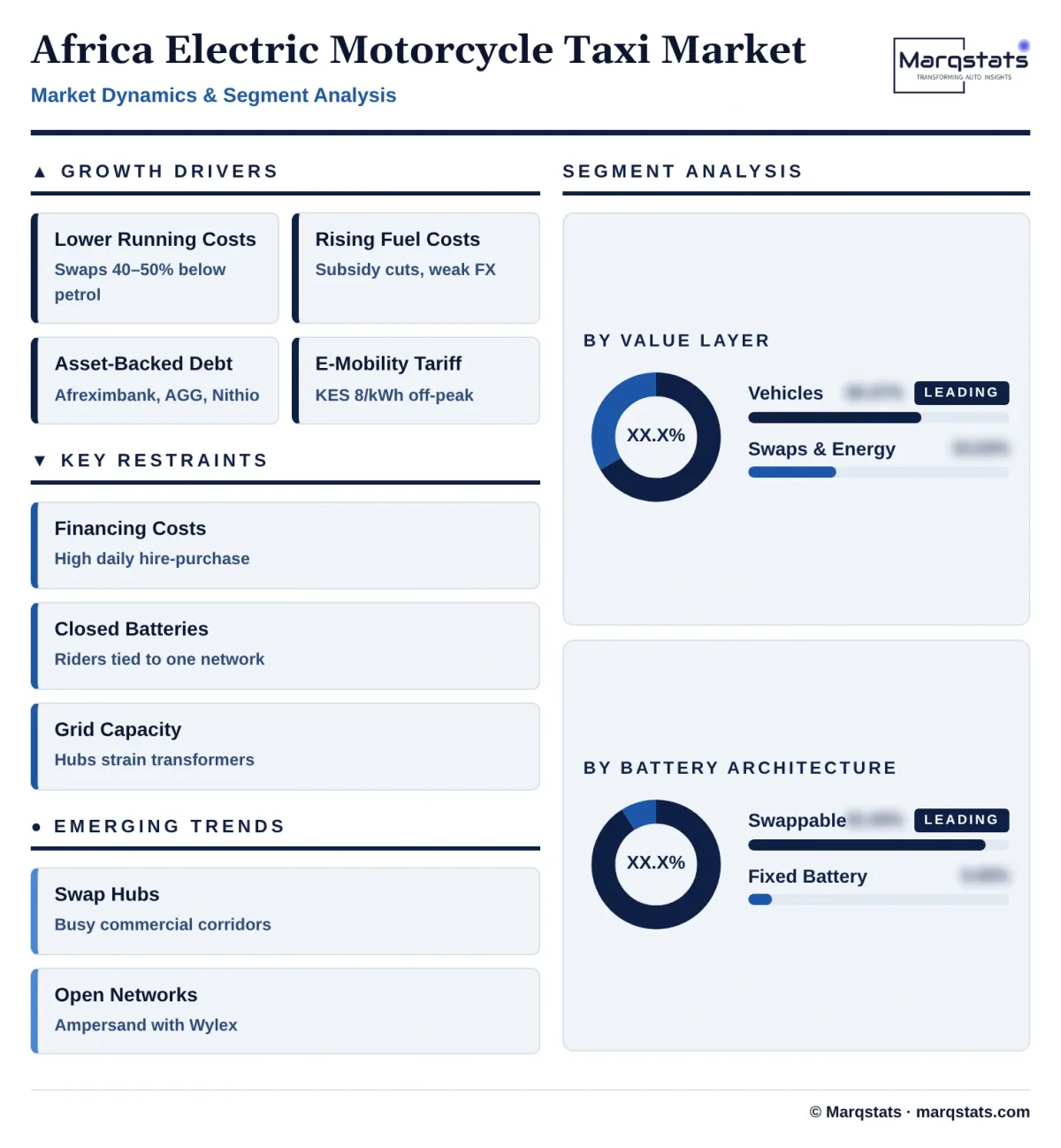
- Lower running costs. Battery swaps cost riders roughly 40% to 50% less per day than petrol for the same distance, and maintenance costs fall because electric drivetrains have few moving parts.
- Rising fuel costs. Removal of fuel subsidies in Nigeria and currency weakness across East and West Africa have raised petrol prices for riders, widening the saving from switching to electric.
- Asset-backed finance. Debt secured on motorcycles and batteries from Afreximbank, the Africa Go Green Fund, Nithio, British International Investment, Proparco and the IFC lets operators fund fleets without issuing new equity for every vehicle.
- Supportive electricity tariffs. Kenya's e-mobility tariff charges KES 16 per kWh at peak and KES 8 off-peak, and in September 2026 EPRA removed the 15,000 kWh monthly ceiling so large swap operators keep the lower rate.
- Local assembly incentives. Lower duties on completely knocked down kits than on fully built imports in Kenya, Rwanda and Nigeria have led Spiro, MAX and Roam to assemble motorcycles and pack batteries locally.
- Investor appetite for scale. Spiro's USD 270 million equity round in June 2026 and the follow-on debt it attracted show investors are prepared to fund continent-wide swap networks, which in turn lowers the cost of entering new cities.
Key Restraints
Four constraints limit how fast commercial riders can switch to electric.
- High financing costs. Most riders buy through daily hire-purchase contracts with high effective interest rates, which absorb part of the fuel saving, and lenders use remote immobilisers to enforce payment.
- Closed battery systems. Most operators use their own battery shape, connectors and electronics, so riders are tied to one network and operators duplicate stations along the same routes.
- Grid capacity. Large swap hubs concentrate charging load on local transformers, and if utilities withdraw special tariffs or add peak charges to manage grid strain, swap prices would rise.
- Policy uncertainty. Companies report uncertainty over incentive eligibility, customs treatment and how long incentives last, and Kenya's 2026 budget process included proposals to change the tax treatment of electric vehicles and batteries.
Key Trends
Four shifts are changing how electric motorcycle taxis are built, financed and powered.
- Large swap hubs on busy corridors. Spiro is building larger battery-swapping hubs along commercial routes in Uganda and Rwanda, funded by the Africa Go Green Fund.
- Open networks. Ampersand opened its swap network to other manufacturers in December 2025, starting with Wylex Mobility, separating the vehicle sale from energy supply.
- New hardware partners. Spiro signed a strategic partnership with Yadea in September 2026 to supply and co-develop motorcycles for African roads, adding to its existing Chinese suppliers.
- Debt replaces equity. Operators now fund vehicles and batteries with asset-backed and climate debt and use equity mainly for software, telematics and entry into new countries.
- Delivery fleets electrify first in cities. Logistics companies and delivery platforms are contracting electric motorcycles with energy included, giving operators predictable fleet demand alongside individual taxi riders.
Strategic Implications
- For operators, utilisation decides profitability. Raising swaps per active motorcycle through rider financing, station density and fleet contracts with delivery platforms lifts revenue on batteries already bought.
- For manufacturers, local assembly is the price of entry. Duty gaps between kits and built-up motorcycles favour suppliers that partner with operators to assemble in Kenya, Uganda, Rwanda and Nigeria.
- For lenders, the battery is the collateral. Telematics, remote immobilisers and swap data give lenders daily visibility of each asset, supporting larger asset-backed facilities at lower cost.
- For utilities and regulators, tariffs shape the swap price. Stable time-of-use tariffs and planned grid connections for large hubs keep the running-cost advantage that drives rider adoption.
- For delivery platforms, electric fleets lower cost per drop. Contracting electric motorcycles with energy included gives platforms predictable costs and helps them meet corporate emission targets.
- For investors, rider retention is the key assumption. Revenue per motorcycle depends on riders staying active and repaying for two to three years, so default rates, repossession and redeployment speed decide fleet returns as much as purchase price does.
Market Segmentation
Electric motorcycle chassis and drivetrains sold into commercial service, without batteries, account for 66.47% of 2025 value, USD 75.27 million and about 65,450 motorcycles, rising to USD 382.50 million by 2030, a 38.42% CAGR, while their share falls to 48.38% as the average price falls from about USD 1,150 to USD 900.
Swap and charging revenue paid by commercial riders accounts for 33.53% of 2025 value, USD 37.97 million, and grows fastest, at 60.79% a year, to USD 408.04 million and 51.62% of 2030 value as the active fleet grows tenfold. Spiro, Ampersand and ARC Ride earn most of this revenue.
Motorcycles built for battery swapping account for 91.00% of 2025 value, USD 103.05 million, rising to USD 731.25 million by 2030, a 47.98% CAGR, and 92.50% of value. Commercial riders cannot afford to wait hours for a charge in the middle of a working day, so swapping dominates passenger taxi fleets. Operators keep ownership of the battery, the most expensive part of the motorcycle, which lowers the rider's upfront cost to about that of a petrol motorcycle.
Motorcycles charged with the battery on board account for 9.00% of 2025 value, USD 10.19 million, and grow at 42.22% a year to USD 59.29 million by 2030. They are used mainly by corporate delivery fleets and riders who charge overnight at depots or at home, through suppliers such as Zembo, Kiri EV and Dodai.
Paid passenger rides account for 75.00% of 2025 value, USD 84.93 million, rising to USD 553.38 million by 2030, a 45.48% CAGR, while the share falls to 70.00%. Spiro, Ampersand and ARC Ride serve mainly boda boda and okada riders, often through ride-hailing apps such as Bolt.
Parcel, grocery and food delivery accounts for 25.00% of 2025 value, USD 28.31 million, and grows at 52.97% a year to USD 237.16 million and 30.00% of value by 2030, as logistics companies and delivery platforms contract whole fleets on fixed routes.
By Geography
East Africa
East Africa is the largest region, with 86.50% of 2025 value, USD 97.95 million and about 56,600 commercial motorcycles, rising to USD 569.19 million by 2030, a 42.18% CAGR, while its share falls to 72.00%. Kenya registered 25,277 electric motorcycles in 2025, 15.02% of new motorcycle registrations, and Uganda sold more than 30,000. Battery-swapping stations in Uganda grew from about 150 in mid-2024 to more than 350 by late 2025, Ampersand handles more than 20,000 swaps a day in Rwanda and Kenya, and Kenya's National Electric Mobility Policy, launched in February 2026, and EPRA's e-mobility tariff support the region's lead. Rwanda is the testbed for policy support, pairing tax exemptions with preferential charging tariffs and priority licensing for commercial electric operators in Kigali, while Ethiopia's restrictions on fuel-powered vehicle imports and Tanzania's early pilots add smaller volumes.
West Africa
West Africa accounts for 11.30% of 2025 value, USD 12.80 million and about 7,400 motorcycles, and grows fastest, at 71.18% a year, to USD 188.15 million and 23.80% of the market by 2030. Spiro began in Benin and Togo, where governments signed operating agreements and exempt commercial electric motorcycles from import duty and VAT, and expanded to Nigeria and to Ghana, where it deployed its first 100 motorcycles in October 2026. MAX reports profitability in Nigeria and has deployed more than USD 56 million of fleet financing.
Central Africa
Central Africa accounts for 1.20% of 2025 value, USD 1.36 million, and grows at 67.96% a year to USD 18.18 million by 2030. Spiro runs pilot operations in Cameroon and MAX operates across West and Central Africa, but limited grid access and financing slow adoption.
Southern and North Africa
Southern and North Africa account for 1.00% of 2025 value, USD 1.13 million, and grow at 67.77% a year to USD 15.02 million by 2030. Demand comes mainly from urban delivery fleets in South Africa, while motorcycle taxis are less common as public transport than in East and West Africa.
How Competition Is Evolving
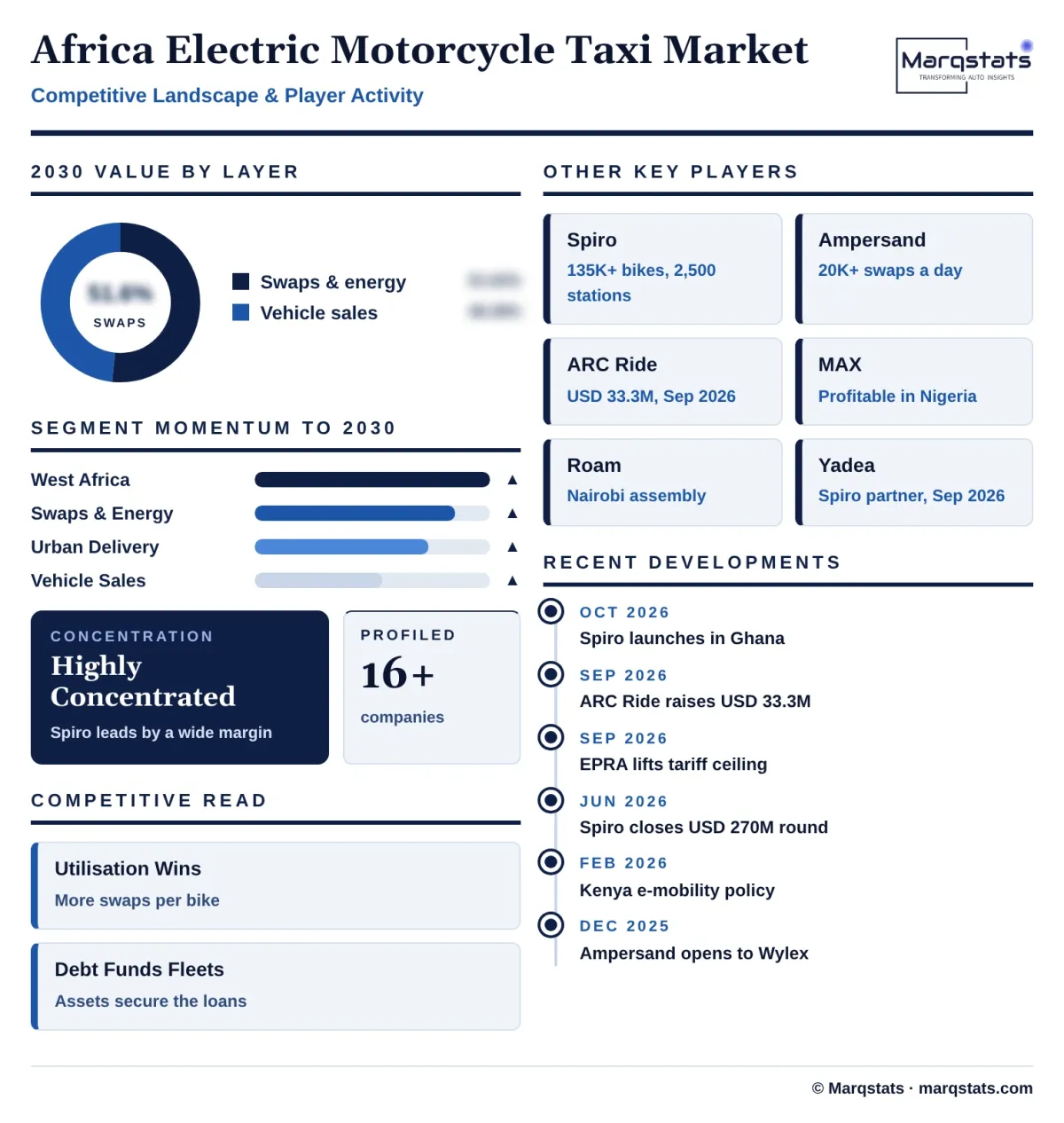
The Africa electric motorcycle taxi market is highly concentrated. Spiro reported more than 60,000 electric motorcycles, 1,200 swap stations and 26 million swaps in October 2025, and more than 135,000 motorcycles, 2,500 stations and more than 50 million swaps across seven countries by September 2026, well ahead of any other operator.
Most leading operators control both the motorcycle and the battery. Spiro, Ampersand, ARC Ride and Roam design or specify their own motorcycles, assemble them locally, own the batteries and run their own swap networks, so riders who buy a motorcycle are tied to that operator's stations. Ampersand's decision in December 2025 to open its network to Wylex Mobility motorcycles is the first move towards shared battery infrastructure.
Finance is part of the product. Operators and specialist lenders such as M-KOPA, Watu and Mogo offer daily payment plans with remote immobilisers, and MAX combines vehicle financing with fleet operations. Access to low-cost debt is now the main competitive advantage, as shown by Spiro's facilities from Afreximbank, Nithio and the Africa Go Green Fund.
Competition will be decided by cost per swap, station density and access to capital. Operators that keep swap prices below petrol, place stations where riders work and raise debt at scale will capture most of the growth.
Capital has concentrated in the leading platform. Spiro's disclosed 2026 funding of USD 50 million of debt in February, a USD 270 million equity round in June and USD 18 million of debt in September totals USD 338 million, many times the amounts raised by ARC Ride, MAX or Ampersand, and lets Spiro add stations and motorcycles faster than rivals.
Hardware supply is concentrated in China. Spiro's motorcycles have been supplied mainly by Horwin and Oxwin, and the Yadea partnership adds the world's largest electric two-wheeler maker. Ampersand uses BYD battery cells and plans about 40,000 motorcycles by the end of 2026. Local assembly in Kenya, Uganda, Rwanda and Nigeria adds frames, battery packs and final assembly to imported components.
Companies Covered
Companies covered in the report include:
Recent Market Activity
Table of Contents
Coverage & Segmentation
The study covers the Africa electric motorcycle taxi market, with 2025 as the base year, 2021 – 2025 as the historical period and 2026 – 2030 as the forecast period. Values are in US dollars and combine wholesale sales of electric motorcycle chassis and drivetrains delivered into commercial passenger and delivery service, valued without batteries, with battery swap and charging revenue paid by commercial riders. Volumes are annual commercial deliveries and year-end active commercial fleet. The market is segmented by value layer, battery architecture, application and region.
Privately owned commuter motorcycles, mopeds and scooters, electric three-wheelers, petrol motorcycles, conversion kits, swap station hardware sales and rider financing interest are excluded. The total Africa electric two-wheeler market, which Marqstats sizes at about 70,000 units and USD 108.5 million of vehicle sales in 2025, includes the commercial motorcycles counted here at a different valuation and without energy revenue, so the two values must not be added. Segment and regional splits are Marqstats estimates built on registration data, operator disclosures, financing announcements and swap price benchmarks.