Market Snapshot
Middle bar: base-year value × (1 + CAGR), rounded to two decimals. This is a calculated illustration, not a separately researched annual estimate.
The Vietnam electric ride-hailing market size is estimated at USD 620.00 million in 2025 and is projected to reach USD 1,850.00 million by 2030, growing at a CAGR of 24.44% over 2026 – 2030. In local currency, gross bookings rise from about VND 15.57 trillion to VND 46.47 trillion. The active electric fleet on ride-hailing and app-taxi platforms grows from about 133,000 vehicles to 500,000, a 30.32% annual rate.
Marqstats defines the market as the gross bookings, meaning the fares passengers pay including platform commission, of app-booked ride-hailing and taxi trips completed in battery-electric cars and electric motorbikes in Vietnam. Trips on Green SM, on Grab, Be and other apps, and on the apps of traditional taxi companies are counted when the vehicle is fully electric. Food and parcel delivery, logistics, buses, street-hail trips in fuel vehicles, hybrid taxis and the value of the vehicles themselves are excluded.
Electric cars account for 77.42% of 2025 bookings, platform-owned fleets for 62.00% and intra-city trips for 82.00%. Southern Vietnam accounts for 46.00% of 2025 bookings. The study segments the market by vehicle type, fleet operating model, trip type and region. US dollar values are converted at VND 25,120 per USD for all years, the rate implied by VinFast's US-dollar translation of its 2025 results.
Key Takeaways
Market Overview & Analysis
Report Summary
Marqstats sizes the Vietnam electric ride-hailing market as the gross bookings of app-booked trips completed in battery-electric cars and electric motorbikes. In 2025 the market was worth an estimated VND 15.57 trillion, or USD 620.00 million at VND 25,120 per USD. Electric cars contributed USD 480.00 million and electric motorbikes USD 140.00 million. Gross bookings include the platform's commission and the driver's share, but exclude tips, delivery orders and in-app advertising.
App-based ride-hailing in Vietnam is regulated as passenger transport by car under Decree 10/2020/ND-CP and its amendments. Platforms that set fares and control drivers are treated as transport businesses rather than software providers, and contract cars with fewer than nine seats booked through apps must meet the same signage, licensing and tax rules as taxis. Motorbike ride-hailing, known as xe ôm công nghệ, is regulated more lightly through local transport rules and the platform's own driver registration.
The market grew from under USD 5 million in 2021 and 2022, when electric vehicles were a handful of e-scooters and pilot taxis, to about USD 95.00 million in 2023, after Xanh SM began operating in Hanoi on 14 April 2023. It reached USD 330.00 million in 2024, as Xanh SM expanded across the country and Gojek left the market, and USD 620.00 million in 2025.
Electric ride-hailing sits inside a wider app-booked transport market. Marqstats estimates that app-booked ride-hailing and taxi trips in Vietnam generated about USD 1,450 million of gross bookings in 2025 from close to 400 million trips, with cars contributing about two-thirds of the value and motorbikes about one-third. Electric vehicles carried about half of car bookings and a little under 30% of motorbike bookings.
Three types of operator run electric fleets. GSM, the Vingroup company behind Green SM, owns and operates a large fleet of VinFast cars and motorbikes and pays or rents to drivers. Transport companies such as Taxi Huong Giang, Lado Taxi and Én Vàng Taxi own their electric cars and run them under the Green SM brand or their own apps. Individual drivers own or lease electric cars and motorbikes and join Green SM, Grab or Be as partners.
The scope here differs from the Marqstats Vietnam Electric Vehicle Market report, which sizes the sale of electric vehicles. The present study sizes the ride services those vehicles deliver, so the two values must not be added together. VinFast delivery figures used here, including 175,099 Vietnam deliveries and 196,919 global deliveries in 2025, are the same as in that report.
VinFast's results show how closely the market is tied to one group. VinFast delivered 196,919 EVs worldwide in 2025, 175,099 of them in Vietnam, and about 27% of global deliveries, roughly 53,200 vehicles, went to related parties. That related-party share rose from 22% in the second quarter to 26% in the third and 33% in the fourth, driven by GSM fleets in Indonesia and the Philippines, while GSM's share of VinFast's Vietnam deliveries fell to 19% in the fourth quarter. VinFast also delivered 406,498 e-scooters and e-bikes in 2025, some of which serve ride-hailing.
Policy sets clear direction. Decision 876/QD-TTg of July 2022 sets a green energy transition programme for transport that targets clean-energy urban taxis by 2030. Decree 51/2025 keeps the 0% registration fee for battery-electric cars until 28 February 2027. Directive 20/CT-TTg of July 2025 asks Hanoi to restrict fuel motorbikes inside Ring Road 1 from 1 July 2026, and Ho Chi Minh City's draft plan would end fuel motorbike ride-hailing by December 2029. Circular 61/2026/TT-BCT then requires public chargers to serve compatible vehicles of all brands from 1 July 2027.
Charging infrastructure has grown with the fleet. V-Green, the Vingroup charging company, operates more than 150,000 charging ports across 34 provinces, along with about 400 service workshops, and plans 99 ultra-fast charging hubs in 2026. Taxi and ride-hailing cars use depot and public fast chargers, while electric motorbikes charge at depots and homes or swap batteries at stations.
Vietnam Electric Ride-Hailing Market Size and Forecast
The Vietnam electric ride-hailing market grows from USD 620.00 million in 2025 to USD 1,850.00 million in 2030, a CAGR of 24.44%. Marqstats expects USD 860.00 million in 2026, USD 1,110.00 million in 2027, USD 1,360.00 million in 2028 and USD 1,610.00 million in 2029. Annual growth slows from about 39% in 2026 to about 15% in 2030 as electric vehicles become the majority of the fleet.
Fleet growth drives the gain. The active electric fleet on ride-hailing and app-taxi platforms rises from about 38,000 cars and 95,000 motorbikes in 2025 to about 120,000 cars and 380,000 motorbikes in 2030. Cars grow at 25.86% a year and motorbikes at 31.95%, so the total fleet grows at 30.32% a year.
Bookings per car fall slightly. Marqstats estimates average gross bookings of about USD 12,630 per electric car in 2025, or roughly VND 0.96 million a day over 330 working days, falling to about USD 10,750 by 2030 as more part-time partner cars join the platforms and fares stay competitive. Bookings per motorbike stay near USD 1,470 a year because many motorbike drivers work part-time.
The share of electric trips rises steeply. Electric vehicles carried about 43% of app-booked ride-hailing and taxi bookings in 2025. Marqstats expects this to pass 70% by 2030, helped by Decision 876/QD-TTg, Hanoi's restrictions on fuel motorbikes and Ho Chi Minh City's plan to stop fuel motorbikes providing ride-hailing by the end of 2029.
The market is sensitive to fares. A 5% change in average fares moves 2025 bookings by about USD 31.00 million and 2030 bookings by about USD 92.50 million. Each 10,000 extra electric cars in 2030 adds about USD 107.50 million of annual bookings at the forecast rate per car.
Currency affects the US dollar figures. All years use VND 25,120 per USD, so dollar growth equals growth in dong. A 5% weaker dong would lower 2030 dollar bookings by about USD 88.10 million while leaving local bookings unchanged.
Each segment adds value at a different pace. Electric cars add about USD 810.00 million of bookings between 2025 and 2030 and electric motorbikes about USD 420.00 million. By operating model, partner-owned fleets add about USD 874.40 million and platform-owned fleets about USD 355.60 million, so partners overtake the platform's own fleet as the larger source of bookings around 2028.
Regional growth is broad. Southern Vietnam adds about USD 510.30 million of bookings to 2030, the Hanoi capital region about USD 412.10 million, central Vietnam about USD 190.70 million and other northern provinces about USD 116.90 million. 2030 regional values are Marqstats estimates based on city transport plans, taxi fleet conversions and Green SM's expansion.
Market Dynamics
Key Drivers
Six forces are moving Vietnam's app-booked rides onto electric cars and motorbikes.
- A captive electric fleet built the market. Vingroup founded GSM in 2023 to run an all-electric taxi and ride-hailing service on VinFast vehicles. By 2025 Green SM ran about 20,000 electric cars and 80,000 electric motorbikes in Vietnam, giving the country one of the largest single electric ride-hailing fleets in the world.
- Low running costs. An electric car or motorbike costs far less to run per kilometre than a petrol vehicle, and electric drivetrains need less maintenance. Drivers who cover 150 to 200 km a day recover the higher price of an electric car within the first years of use, and platform-owned fleets lock in this saving across tens of thousands of vehicles.
- Purpose-built fleet models. VinFast's Green range of cars, designed for taxi and ride-hailing use, sold strongly: the Limo Green seven-seat MPV delivered 27,127 units in 2025 and 32,331 in the first seven months of 2026, and the Herio Green 12,568 units in 2025. Lower prices for fleet models, such as about VND 269 million for the Minio Green, make it easier for taxi companies and drivers to switch.
- Tax and registration incentives. Decree 51/2025 extends the 0% registration fee for battery-electric cars to 28 February 2027, and battery-electric cars with nine seats or fewer pay a 3% special consumption tax over the same period. These measures lower the cost of each new electric taxi compared with a petrol car.
- City rules on fuel motorbikes. The Prime Minister's Directive 20/CT-TTg of July 2025 asks Hanoi to stop fuel motorbikes inside Ring Road 1 from 1 July 2026, and Ho Chi Minh City has drafted a plan to convert 400,000 ride-hailing and delivery motorbikes to electric, with fuel motorbikes barred from ride-hailing by December 2029.
- Taxi companies join platforms. Green SM says it works with nearly 100 transport companies and 11 bus operators. Taxi Huong Giang, which already runs more than 500 VinFast EVs, ordered another 1,500 in May 2026 and plans to convert its whole fleet, and Lado Taxi and Én Vàng Taxi run electric cars in partnership with GSM.
- Overseas growth adds scale. Green SM's expansion to Indonesia, the Philippines and other markets raises VinFast's volumes and lowers the cost of fleet models, which in turn helps Vietnamese taxi companies and drivers buy electric vehicles at lower prices.
Key Restraints
Five constraints limit how fast electric ride-hailing can scale in Vietnam.
- Charging depends on one network. Most public fast chargers belong to V-Green and have mainly served VinFast vehicles. Until Circular 61/2026/TT-BCT takes effect on 1 July 2027, platforms that want to run other brands of electric car must build their own depots, which slows Grab, Be and independent operators.
- Driver economics are tight. Fares are competitive and commissions are high, so drivers who buy or lease an electric car must keep their vehicle busy to repay loans. When demand falls or new vehicles flood a city, earnings per car drop and some drivers leave platforms.
- Hybrids compete for taxi fleets. Some traditional operators prefer hybrids, which cut fuel costs without depending on chargers. Vinasun plans to add about 310 vehicles in 2026, mostly Toyota hybrids, and these trips do not count as electric.
- Grid and depot space in city centres. Charging hundreds of cars and thousands of motorbikes requires grid connections and land in Hanoi and Ho Chi Minh City, where both are scarce and expensive. Battery-swapping for motorbikes eases this, but it needs a dense network of stations.
- Dependence on one group. Vingroup controls the leading vehicle maker, the leading platform and the main charging network. Any change in the group's funding, priorities or pricing would affect the pace of the whole market, and regulators may also scrutinise its position.
- Rising competition between cars and two-wheelers. Lower-priced motorbike rides and public transport, including Ho Chi Minh City's Metro Line 1 and its electric buses, take some short trips away from car ride-hailing, holding back bookings per car in city centres.
Key Trends
Five shifts are changing how electric ride-hailing fleets are owned, charged and run in Vietnam.
- From owned fleets to a platform model. In April 2026 GSM renamed Xanh SM as Green SM and opened its platform to individuals and businesses that own VinFast EVs, first in Indonesia and the Philippines, following the same partner approach it uses with Vietnamese taxi companies.
- Seven-seat cars for airport and group trips. Seven-seat electric MPVs such as the Limo Green suit airport transfers, families and group bookings, and earn more per trip than compact cars. Platforms are adding larger and premium car classes to raise bookings per vehicle.
- Battery swapping for motorbikes. Swapping stations let motorbike drivers replace a battery in about two minutes instead of charging for hours. Selex Motors began supplying 1,000 Selex Camel electric motorbikes with battery swapping to Ahamove in June 2025, showing a model that ride-hailing fleets can also use.
- Vietnamese platforms go abroad. Green SM has expanded to Laos, Indonesia, the Philippines, Denmark, India, Kazakhstan, the Netherlands and the United States, taking its Vietnamese playbook of electric fleets and local partners overseas and increasing VinFast deliveries to related parties.
- Open charging rules. Circular 61/2026/TT-BCT requires public charging stations to serve compatible vehicles from different makers from 1 July 2027 and to show prices and energy delivered for each session, which should make it easier to run mixed-brand electric fleets.
- Fleet conversion by whole companies. Instead of adding a few electric cars at a time, taxi companies are converting entire fleets at once, as Taxi Huong Giang plans with its 1,500-vehicle order, often with lease-to-own schemes that let drivers buy the car over time.
Strategic Implications
- For platforms, owning less and partnering more lowers capital needs. Green SM's shift towards partner-owned cars and the July 2027 charging rule both reward platforms that can recruit owners, keep vehicles busy and price fairly, rather than those that simply buy the most cars.
- For vehicle makers, fleet models and lease-to-own plans matter most. Cheap, durable fleet versions, battery rental and financing packages for drivers decide which brands win taxi and ride-hailing demand once charging opens up.
- For taxi companies, the choice is electric partnership or decline. Operators that join a large platform with electric cars, as Taxi Huong Giang has, gain bookings and lower running costs, while those relying on fuel or hybrid fleets face growing city restrictions and weaker demand.
- For charging and swapping providers, ride-hailing depots are an anchor customer. High-use fleets need fast charging and battery swapping close to demand, and the July 2027 rule creates room for independent operators beside V-Green.
- For lenders and investors, driver financing is the opportunity and the risk. Loans and leases for electric cars and motorbikes, repaid from daily earnings, can scale quickly, but lenders must track utilisation, fares and resale values carefully.
- For city authorities, ride-hailing fleets are a fast route to cleaner air. Because ride-hailing vehicles drive far more than private vehicles, targeting them first, as Ho Chi Minh City's motorbike plan does, cuts emissions faster per vehicle converted.
Market Segmentation
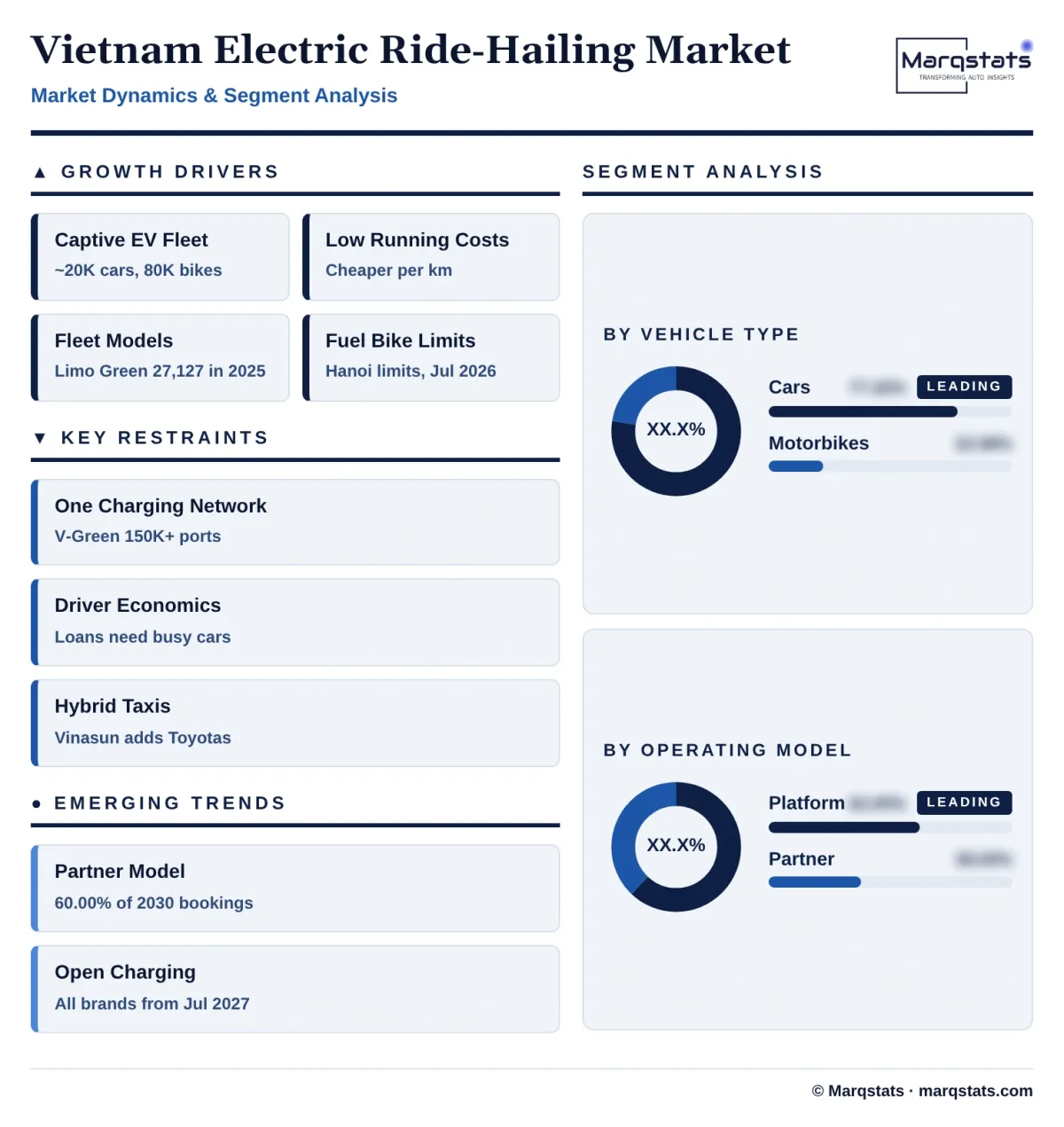
Electric cars account for an estimated 77.42% of 2025 bookings, USD 480.00 million, from about 38,000 cars on ride-hailing and app-taxi platforms, rising to USD 1,290.00 million by 2030, a 21.86% CAGR, while their share falls to 69.73%. VinFast models dominate, led by the VF 5 and Herio Green compact crossovers, the VF 3 and Minio Green mini cars, and the Limo Green seven-seat MPV, which delivered 27,127 units in 2025.
Electric motorbikes account for an estimated 22.58% of 2025 bookings, USD 140.00 million, from about 95,000 vehicles, and grow fastest, at 31.95% a year, to USD 560.00 million and 30.27% of bookings by 2030. Green SM Bike runs about 80,000 electric motorbikes, and Ho Chi Minh City's draft plan to convert 400,000 ride-hailing and delivery motorbikes would add many more.
Fleets owned by the platform, mainly GSM's own VinFast cars and motorbikes, account for an estimated 62.00% of 2025 bookings, USD 384.40 million, rising to USD 740.00 million by 2030, a 14.00% CAGR, while their share falls to 40.00%. GSM's share of VinFast's Vietnam deliveries fell to 19% in the fourth quarter of 2025, a sign that new domestic capacity is coming more from partners.
Cars and motorbikes owned by taxi companies or individual drivers and run on Green SM, Grab, Be or their own apps account for an estimated 38.00% of 2025 bookings, USD 235.60 million. They grow fastest among operating models, at 36.34% a year, to USD 1,110.00 million and 60.00% of bookings by 2030, as GSM opens its platform to owners and taxi companies such as Taxi Huong Giang convert whole fleets.
Trips within cities account for an estimated 82.00% of 2025 bookings, USD 508.40 million, rising to USD 1,424.50 million by 2030, a 22.88% CAGR, and 77.00% of bookings. Short car and motorbike trips in Hanoi, Ho Chi Minh City, Da Nang and Hai Phong make up most of the volume.
Airport transfers and trips between cities and provinces account for an estimated 18.00% of 2025 bookings, USD 111.60 million, rising to USD 425.50 million by 2030, a 30.69% CAGR, and 23.00% of bookings. Longer trips earn more per booking, and seven-seat electric MPVs and longer-range cars make them practical.
By Geography
Southern Vietnam
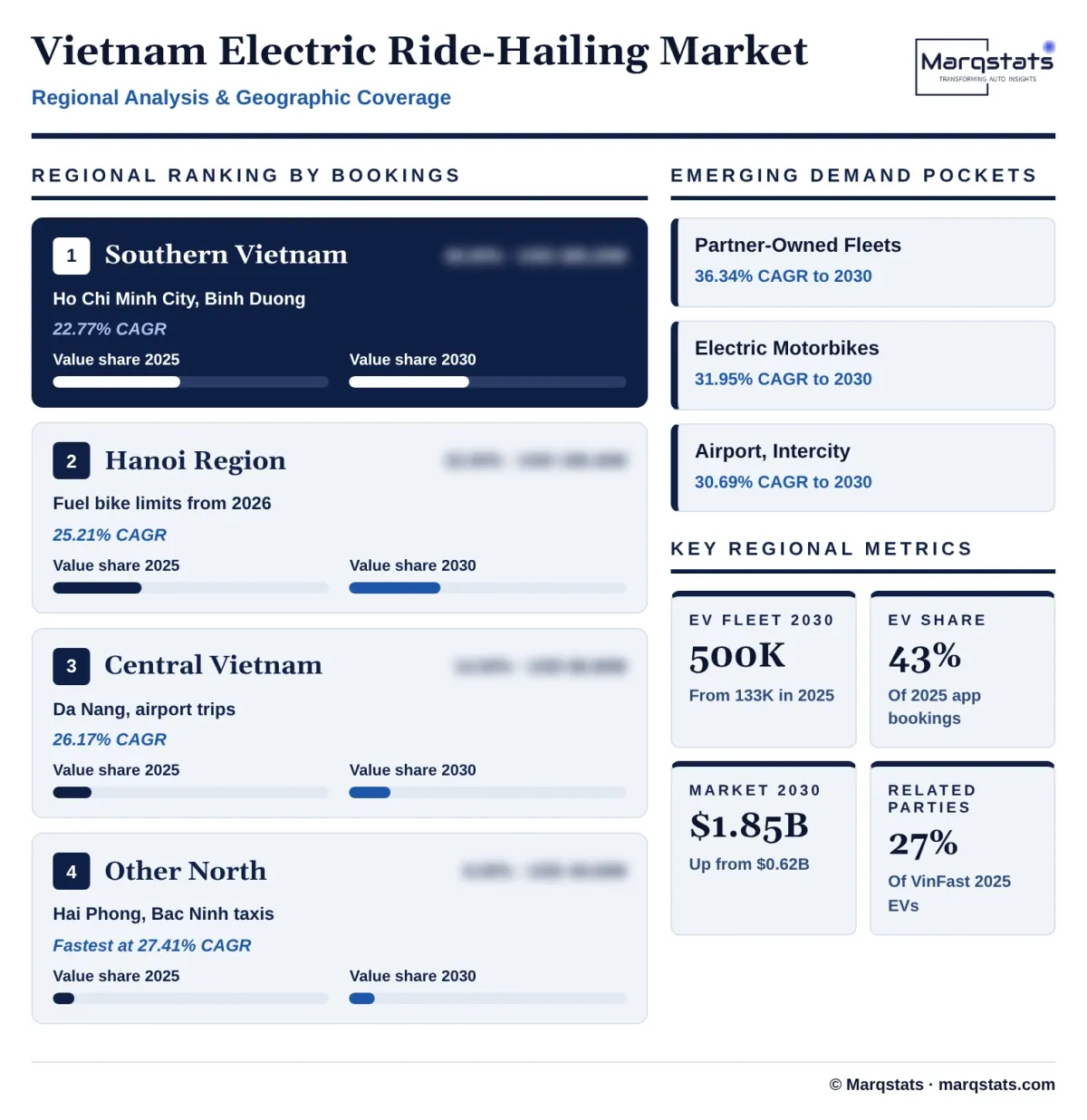
Southern Vietnam, led by Ho Chi Minh City with Binh Duong, Dong Nai and Can Tho, is the largest market, with an estimated 46.00% of 2025 bookings, USD 285.20 million. Bookings rise to USD 795.50 million by 2030, a 22.77% CAGR, while the share eases to 43.00%. Ho Chi Minh City has the country's densest motorbike ride-hailing demand, and its plan to convert 400,000 fuel motorbikes is the largest single driver of electric motorbike growth. The city's draft incentives include registration and VAT exemptions for electric motorbikes registered by ride-hailing drivers and low-interest loans capped at 6% a year.
Hanoi Capital Region
The Hanoi capital region accounts for an estimated 32.00% of 2025 bookings, USD 198.40 million, rising to USD 610.50 million by 2030, a 25.21% CAGR, and 33.00% of bookings. Green SM began operating in Hanoi in April 2023, and the restriction on fuel motorbikes inside Ring Road 1 from July 2026 pushes motorbike ride-hailing towards electric vehicles.
Other Northern Vietnam
The rest of northern Vietnam, including Hai Phong, Quang Ninh and Bac Ninh, accounts for an estimated 8.00% of 2025 bookings, USD 49.60 million, and grows fastest, at 27.41% a year, to USD 166.50 million and 9.00% of bookings by 2030. Local taxi companies such as Én Vàng Taxi in Hai Phong and Taxi Huong Giang in Bac Ninh are converting their fleets to VinFast EVs.
Central Vietnam
Central Vietnam, led by Da Nang with Hue and Nha Trang, accounts for an estimated 14.00% of 2025 bookings, USD 86.80 million, rising to USD 277.50 million by 2030, a 26.17% CAGR. Tourism and airport transfers support demand for larger electric cars.
How Competition Is Evolving
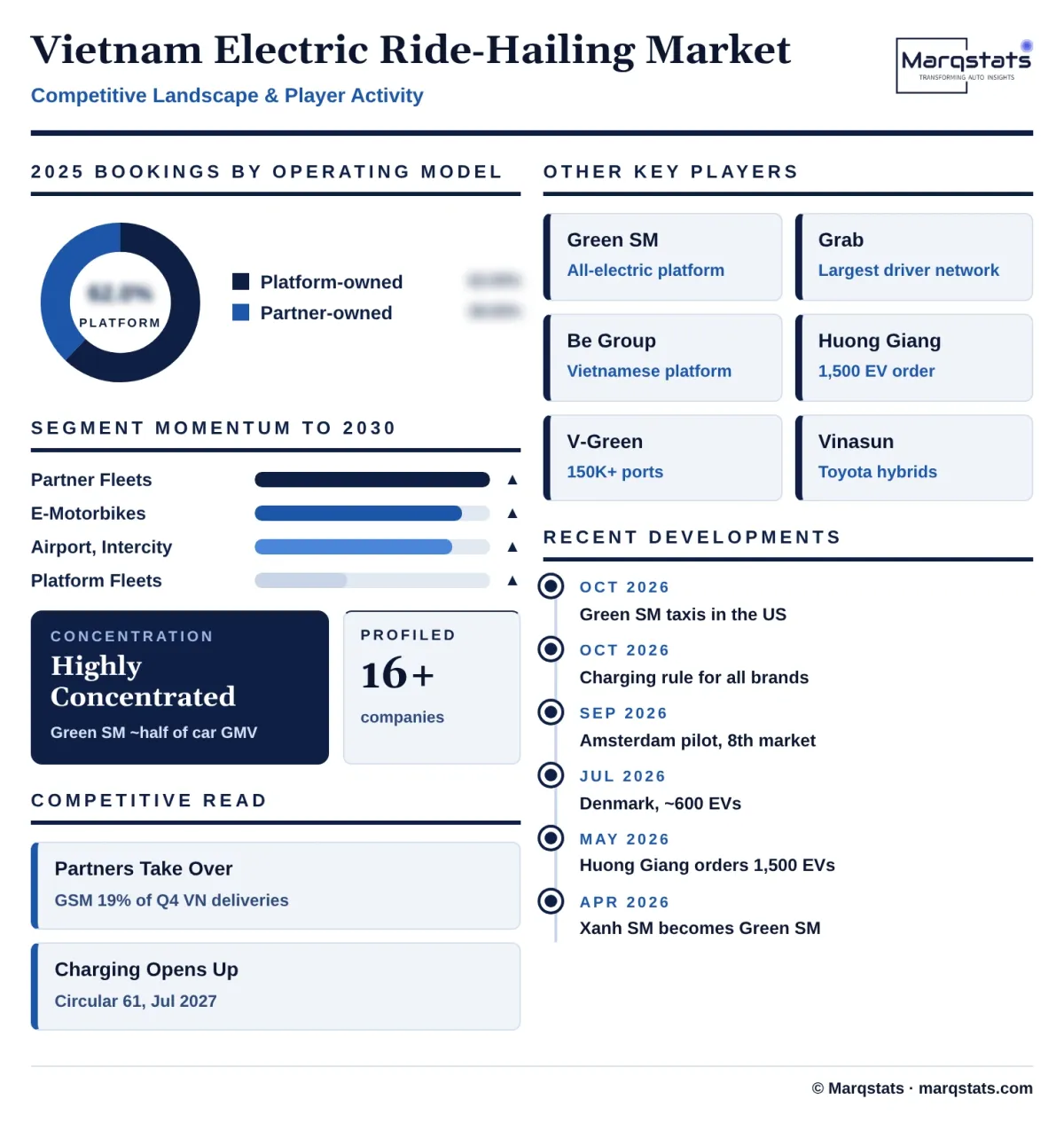
The Vietnam electric ride-hailing market is highly concentrated. Green SM carries most electric trips, and industry tracking reported in April 2026 put it at about half of four-wheel ride-hailing gross bookings in the fourth quarter of 2025, ahead of Grab at a little over 40% and Be at about 6%. Because Green SM's fleet is all-electric, its share of electric bookings is much higher than its share of all bookings.
GSM sets the pace. Founded by Vingroup and backed by VinFast vehicles and V-Green chargers, it runs both its own fleet and partner fleets under the Green SM brand. In April 2026 it renamed Xanh SM as Green SM worldwide and opened its platform to vehicle owners, and it now operates in eight or more markets, from Laos and Indonesia to Denmark, the Netherlands and the United States.
Grab is the main challenger. It runs the largest driver network among platforms and leads motorbike ride-hailing, but its electric share is smaller because most of its partner drivers use petrol vehicles. Wider access to charging from July 2027 and lower prices for imported electric cars give Grab room to grow its electric fleet.
Be Group, a Vietnamese platform, holds a smaller share and works with partners on electric motorbikes and cars. Smaller apps such as Maxim, inDrive and TADA compete on price, mostly with petrol vehicles.
Traditional taxi companies are choosing sides. Mai Linh, Lado Taxi, Én Vàng Taxi and Taxi Huong Giang have added VinFast electric cars, often through partnerships with GSM, while Vinasun is adding mostly Toyota hybrids in 2026. Gojek's exit on 16 September 2024 removed one competitor and pushed more volume to Green SM and Grab.
Competition will be decided by vehicle cost, charging access and driver earnings. Platforms that offer cheap financing for electric vehicles, reliable charging or swapping, and steady earnings for partners can win drivers and passengers as the market grows.
Strategies differ by operator type. GSM competes on an all-electric fleet, depot and charger access and the growing partner model. Grab competes on its driver network, its super-app and its leadership in motorbikes. Taxi companies compete on local relationships, corporate contracts and airport rights, and increasingly do so as partners of a large platform rather than alone.
Companies Covered
Companies covered in the report include:
Recent Market Activity
Table of Contents
Coverage & Segmentation
The study covers the Vietnam electric ride-hailing market, with 2025 as the base year, 2021 – 2025 as the historical period and 2026 – 2030 as the forecast period. Values are gross bookings of app-booked ride-hailing and taxi trips completed in battery-electric cars and electric motorbikes, in Vietnamese dong converted to US dollars at VND 25,120 per USD for all years. The market is segmented by vehicle type, fleet operating model, trip type and region.
Food and parcel delivery, logistics, buses and coaches, street-hail trips in fuel vehicles, hybrid and petrol taxis, vehicle sales and charging revenue are excluded. This market sizes ride services, while the Marqstats Vietnam Electric Vehicle Market report sizes vehicle sales, so the two must not be added. Fleet counts and VinFast deliveries follow company disclosures, while bookings, splits by segment and region, and 2030 regional values are Marqstats estimates.