Market Snapshot
Middle bar: base-year value × (1 + CAGR), rounded to two decimals. This is a calculated illustration, not a separately researched annual estimate.
The Uruguay used car market size is estimated at USD 1,392.12 million in 2025 and is projected to reach USD 1,707.22 million by 2030, growing at a CAGR of 4.17% over 2026 – 2030. Transfers rise from an estimated 108,000 in 2025 to 127,500 by 2030, with SUVs the fastest-growing body type.
Uruguay's used car market is closed to foreign supply. Law 17,887 of 2005 and Law 19,171 prohibit the commercial import of used passenger cars and light commercial vehicles, so every used car sold in the country entered it new. That makes the new-car channel the only source of used inventory. The Asociación del Comercio Automotor del Uruguay (ACAU) reported a record 71,442 new vehicles sold in 2025, up 8.4%, of which 14,443, about 20%, were electric. Marqstats values the 108,000 transfers at the national listing-census median of USD 12,890 (Cambio Uruguay census of 18,756 listings, October 2026).
Demand concentrates in the southern metropolitan corridor. Montevideo accounts for an estimated 52.50% of 2025 transfers, Canelones 20.50%, Maldonado 9.50% and the 16 interior departments 17.50%. The study segments the market by vehicle type (passenger cars, SUVs and crossovers, light commercial vehicles and pickups) and by fuel type (gasoline, diesel, battery electric, hybrid, other), and covers dealer and private-party sales of light vehicles; heavy trucks and buses are excluded.
Key Takeaways
Market Overview & Analysis
Report Summary
Marqstats sizes the Uruguay used car market as the value of ownership transfers of used passenger cars, SUVs and light commercial vehicles, both through dealers and between private parties. Value equals estimated annual transfers multiplied by the national median listing price. The numbers are calculated using the light-vehicle fleet registered with the Sistema Único de Cobro de Ingresos Vehiculares (SUCIVE), a used-to-new ratio of 1.51 against ACAU's 71,442 new sales, and the listing turnover observed on national platforms. The price input, USD 12,890, is the median of 18,756 listings in the Cambio Uruguay national census of October 2026.
Structurally, this is a closed, self-replenishing market. Law 17,887 of 2005, Decree 266/013 and Law 19,171 ban the commercial import of used cars and light commercial vehicles; the only exceptions are returning citizens, new permanent residents, diplomats, adapted vehicles and classic cars over 30 years old. Every used car on sale therefore entered Uruguay as a new car through an authorised importer. The rate of new-car sales sets the supply of used cars, and Uruguay's dollar-linked car pricing, not Argentine or Brazilian price arbitrage, sets their value. Transfers are formal: a notary drafts the contract, the Dirección General de Registros records the title, and the departmental government reissues the circulation document.
The forecast rests on three conditions. New-car sales stay between 73,000 and 79,500 units a year, sustaining the trade-in flow. The ban on used imports stays in place. And the SUCIVE tax differential keeps used electric cars cheaper to own than combustion cars. Under these conditions transfers reach 127,500 in 2030 and value USD 1,707.22 million. Price growth is deliberately modest, 0.76% a year, because the 2026 listing data show a buyer's market, with nine in ten price changes being cuts.
Uruguay Used Car Market Size and Forecast
The Uruguay used car market grows from USD 1,392.12 million in 2025 to an estimated USD 1,448.38 million in 2026 and USD 1,707.22 million in 2030, a CAGR of 4.17%. Transfers rise from 108,000 in 2025 to 111,500 in 2026 and 127,500 in 2030, a 3.38% annual rate, as the record 2024 and 2025 new-car cohorts reach their first resale. The median transaction price moves from USD 12,890 to USD 13,390 over the period. Because Uruguay prices cars in US dollars, the dollar series is the reference; the peso equivalent moves with the exchange rate, which the Texto Ordenado del SUCIVE 2026 fixes at UYU 41.826 per dollar for 2026 tax valuations.
Market Dynamics
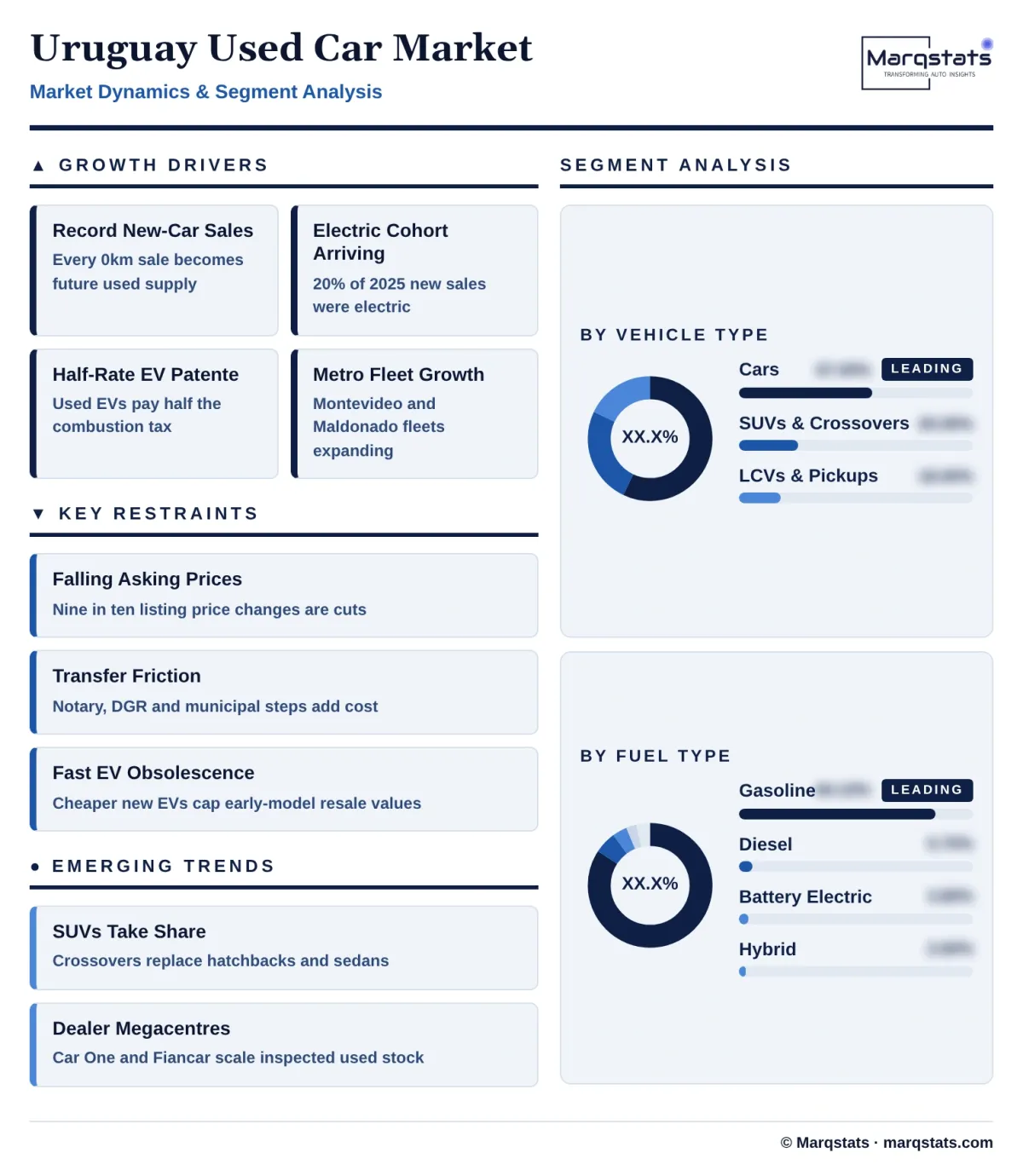
Key Drivers
Five conditions move this market, and the new-car cycle matters more than any other.
- Record new-car sales are refilling the used pool. ACAU recorded 71,442 new vehicles in 2025, up 8.4% on 2024 and the highest on record, according to figures published in January 2026. Because Uruguay prohibits used imports, every one of those cars will eventually be sold on the domestic used market. The trade-in flow from the 2024 and 2025 cohorts gives dealers more late-model stock than at any point in the past decade.
- Electrification is creating a new used segment at speed. Electric vehicles reached 14,443 new sales in 2025, about 20% of the market and up 146.7% on 2024, according to ACAU figures reported by Bloomberg Línea in January 2026. The BYD Seagull ranked fourth among models with 2,061 units and the Dongfeng Nammi seventh with 1,196. Battery-electric cars already make up 3.8% of used listings, and that share will rise as the 2025 cohort turns over.
- Tax policy favours used electric cars. The Texto Ordenado del SUCIVE 2026 sets the annual patente at 2.25% of market value for used electric cars, half the 4.5% rate for used combustion cars. On a car with a USD 15,000 fiscal value the saving is about USD 338 a year, enough to offset part of the uncertainty buyers attach to battery condition.
- Fleet growth in the metropolitan belt is widening the buyer base. Montevideo registered 727,527 vehicles at the end of February 2026, up 100,643 since 2021, including 421,260 cars and pickups, according to the Intendencia de Montevideo. Maldonado added 26,000 vehicles between January 2025 and January 2026, according to its director of mobility. A larger registered fleet means more owners trading up and more cars changing hands.
- Credit is cheaper for buyers who borrow in indexed units. BBVA Uruguay advertises car loans at 6.9% effective annual rate in Unidades Indexadas and 8.0% in US dollars, while Banco de la República Oriental del Uruguay (BROU) quotes 9.0% in UI and 9.5% in dollars, according to April 2026 rate comparisons. Banks typically require 20% down and limit terms to 60 months for used cars, which keeps financing concentrated in the dealer channel and in late-model stock.
Key Restraints
Four constraints limit how fast transfer volume turns into value.
- Prices are falling, not rising. In the week to 16 October 2026, 266 of 295 price changes on tracked listings were reductions, with a median cut of 4.3%, according to the Cambio Uruguay census. Expensive models depreciate 10.8% a year. Marqstats therefore holds price growth to 0.76% a year; any sustained price recovery would add to the forecast, but the 2026 evidence does not support assuming one.
- Transfers carry real cost and friction. A transfer needs a notarised contract, registration with the Dirección General de Registros and a new circulation document from the departmental government. Notary fees and municipal charges add hundreds of dollars to a typical transaction, which pushes some owners to sell informally. The Congreso de Intendentes ran a debt regularisation plan from June to November 2025 that waived re-registration fees and cut late-payment surcharges by 50% to 75%, which shows how many titles had fallen out of order.
- Early electric models face fast obsolescence. Chinese brands keep launching cheaper new electric cars, with models such as the Dongfeng Nammi and BYD Seagull among the 2025 top ten, so a two-year-old electric car competes against a new one at a similar price. Battery state-of-health is not recorded on the title, and buyers discount accordingly. This caps resale values for first-generation electric cars even as their share of listings grows.
- The forecast is exposed to the new-car cycle. Because there is no foreign supply, a fall in new-car sales cuts used supply directly. A peso depreciation or a rise in loan rates that pushed new sales below about 60,000 units a year would reduce late-model trade-ins and slow transfers toward roughly 112,000 by 2030, about 12% below the base path.
Key Trends
Four shifts show where the market is heading and who benefits.
- SUVs are taking share from hatchbacks and sedans. Marqstats estimates SUVs and crossovers at 25.00% of 2025 transfers, rising to 30.00% by 2030, while passenger cars fall from 57.00% to 52.00%. The shift mirrors the new-car market, where ACAU reported that SUVs outsold cars in 2025. Cars such as the Chevrolet Tracker, Nissan Kicks and BYD Yuan Pro will make up a growing share of the used stock.
- Automatic gearboxes are gaining a measurable price premium. Manual transmissions still account for 60.1% of listings against 31.5% for automatics, but an automatic commands a 2.9% premium over the same version with a manual box, and 10.4% over the same model and year, according to the October 2026 census. As automatics dominate new sales, the manual share of used stock will keep falling.
- Dealer groups are building scale formats. Car One, operated by Santa Rosa Automotores S.A. and Ralitor S.A., runs a car megacentre at Ruta Interbalnearia and Camino de los Horneros in Canelones that sold more than 20,000 vehicles in its first three years, 53% of them used. Grupo Fiancar operates multi-brand used-car shopping centres in Montevideo. These formats concentrate inspected stock, financing and paperwork in one place, which private sellers cannot match.
- Price discovery has moved online. Mercado Libre Uruguay carries the largest pool of car listings in the country, and national censuses built on it now track median prices, depreciation by model and weekly price changes across more than 18,000 listings. Buyers and dealers price against the same public data, which narrows the dealer premium to 2.5% and speeds up price cuts when supply rises.
Strategic Implications
- For dealers, stock turn matters more than margin. With prices falling and a dealer premium of only 2.5%, holding late-model stock costs money every week. Expensive models lose 10.8% of value a year, about 0.9% a month. Dealers should price to move within weeks, buy trade-ins below census medians, and add value through inspection, warranty and handling of the transfer paperwork.
- For lenders, the used channel is underserved. Banks set minimum loan amounts and 20% deposits that suit dealer stock but exclude much of the private market, where half of all listings sit. Indexed-unit loans priced near 7% for certified used cars, with collateral values tied to census depreciation curves, would let banks extend into private-party sales without taking on mispriced collateral.
- For buyers of electric cars, the battery is the asset. A used electric car pays half the patente of a combustion car, but its value depends on battery state-of-health, which no registry records. Dealers that can certify battery condition will capture the electric resale premium that the tax differential supports.
- The most likely path is steady volume growth with flat prices. The research identifies no pending, dated decision that would move the 2030 value materially from the base case, and Uruguay's import ban removes the cross-border supply shocks that drive volatility in neighbouring markets. Marqstats therefore states a single base case rather than alternative scenarios.
Market Segmentation
Passenger cars, hatchbacks and sedans, account for an estimated 61,560 transfers, or 57.00% of the 2025 market, worth USD 793.51 million. The segment is anchored by models with strong resale value, such as the Chevrolet Prisma, which loses only 2.6% a year, Volkswagen Gol, Hyundai HB20 and Renault Kwid. Volume grows to 66,300 by 2030 but share falls to 52.00% as buyers move to SUVs, giving a value CAGR of 2.27%.
SUVs and crossovers account for an estimated 27,000 transfers in 2025, 25.00% of the market and USD 348.03 million, and are the fastest-growing segment. Transfers reach 38,250 by 2030, 30.00% of the market, and value grows at 8.03% a year to USD 512.17 million. The Chevrolet Tracker, Nissan Kicks, Volkswagen Nivus and BYD Yuan Pro are the core nameplates, reflecting the new-car market, where SUVs outsold cars in 2025.
Light commercial vehicles and pickups account for an estimated 19,440 transfers, 18.00% of the 2025 market and USD 250.58 million, holding that share through 2030 at 22,950 units. Compact pickups such as the Fiat Strada and Volkswagen Saveiro hold value well, with the Saveiro losing 3.4% a year, while mid-size pickups depreciate fastest of any type: the Volkswagen Amarok 12.3%, Ford Ranger 12.1% and Nissan Frontier 11.7% a year.
Gasoline cars account for 84.1% of listed inventory and, on Marqstats' allocation of transfers in proportion to listings, an estimated 90,828 transfers worth USD 1,170.77 million in 2025. Gasoline remains the standard for the commuter fleet, and the 4.5% patente on used combustion cars is the rate against which every other fuel type is compared.
Diesel vehicles account for 5.7% of listings, an estimated 6,156 transfers worth USD 79.35 million in 2025. Diesel is concentrated in mid-size pickups and SUVs, the segment with the steepest depreciation, so diesel stock loses value faster than the market average.
Battery electric vehicles account for 3.8% of listings, an estimated 4,104 transfers worth USD 52.90 million in 2025, and are the segment set to grow fastest as the 14,443 electric cars sold new in 2025 reach resale. Used electric cars pay a 2.25% patente, half the combustion rate, but resale values are capped by cheaper new models and by uncertainty over battery condition.
Hybrid vehicles account for 2.6% of listings, an estimated 2,808 transfers worth USD 36.19 million in 2025. Models such as the Suzuki Swift Hybrid, ninth among 2025 new-car sales with 985 units, are adding to this pool.
Compressed natural gas conversions and listings without a declared fuel type account for 3.8% of listings, an estimated 4,104 transfers worth USD 52.90 million in 2025.
By Geography
Montevideo
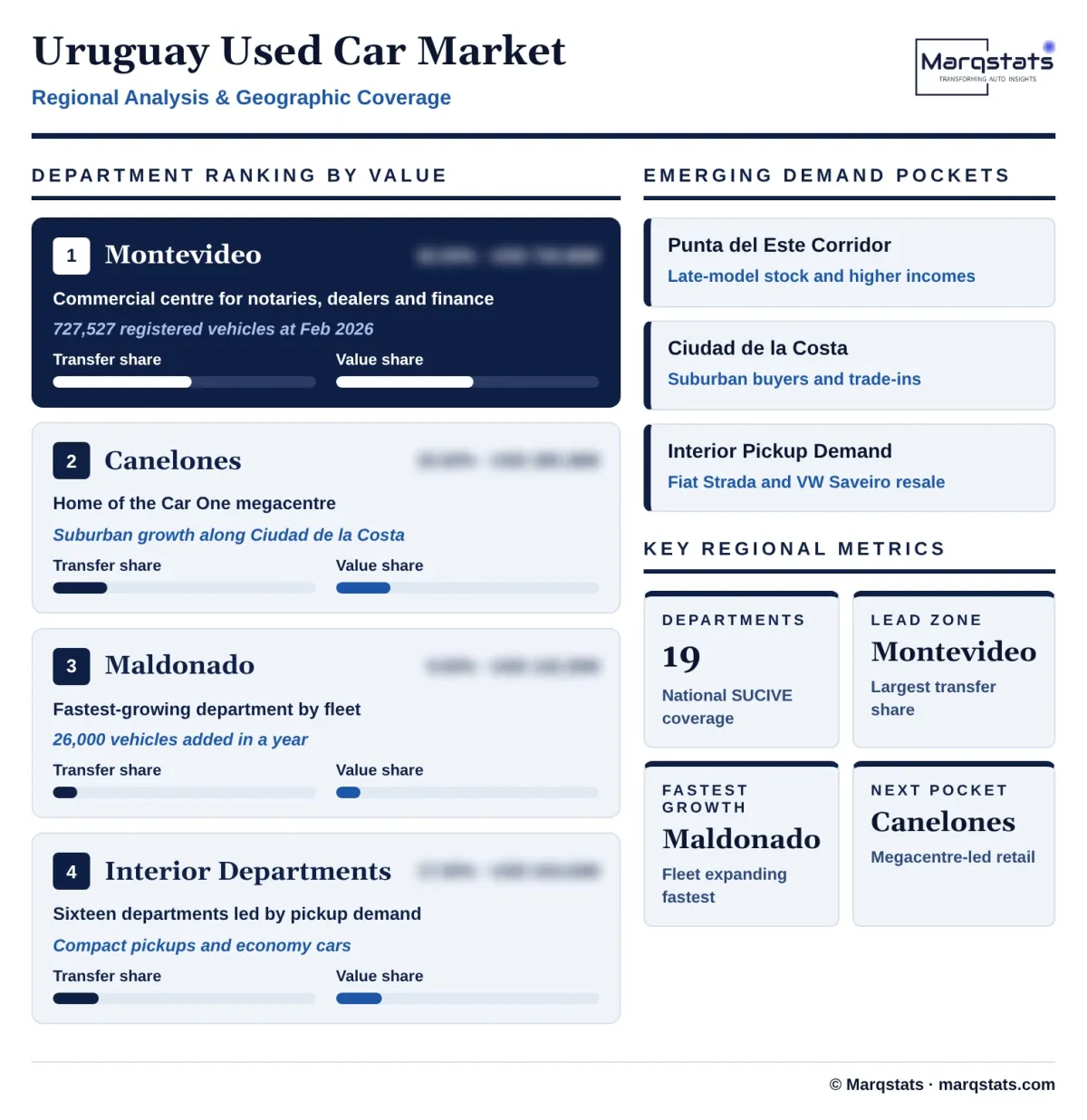
Montevideo is the market's commercial centre, where notaries, the major dealer groups and most financing are based. Marqstats estimates it accounts for 52.50% of 2025 transfers, about 56,700 cars worth USD 730.86 million. The Intendencia de Montevideo counted 727,527 registered vehicles at the end of February 2026, including 421,260 cars and pickups, up 46,248 since 2021. The departmental shares are a Marqstats allocation; no authority publishes transfers by department.
Canelones
Canelones is where the dealer groups build at scale. Marqstats estimates it accounts for 20.50% of 2025 transfers, about 22,140 cars worth USD 285.38 million. Car One's megacentre at Ruta Interbalnearia and Camino de los Horneros sits in the department, and suburban growth along the Ciudad de la Costa corridor adds both buyers and trade-ins.
Maldonado
Maldonado is the fastest-growing department by fleet. It added 26,000 vehicles between January 2025 and January 2026, according to its mobility director, driven by population growth around Punta del Este and higher household incomes. Marqstats estimates it accounts for 9.50% of 2025 transfers, about 10,260 cars worth USD 132.25 million, skewed toward late-model stock.
Interior Departments
The 16 interior departments account for an estimated 17.50% of 2025 transfers, about 18,900 cars worth USD 243.63 million. Demand here leans toward compact pickups, such as the Fiat Strada and Volkswagen Saveiro, and economical cars suited to rural roads, sold mainly through local dealers and private sales. Uniform SUCIVE rates have removed the old incentive to register cars in low-tax departments such as Colonia or Flores.
How Competition Is Evolving
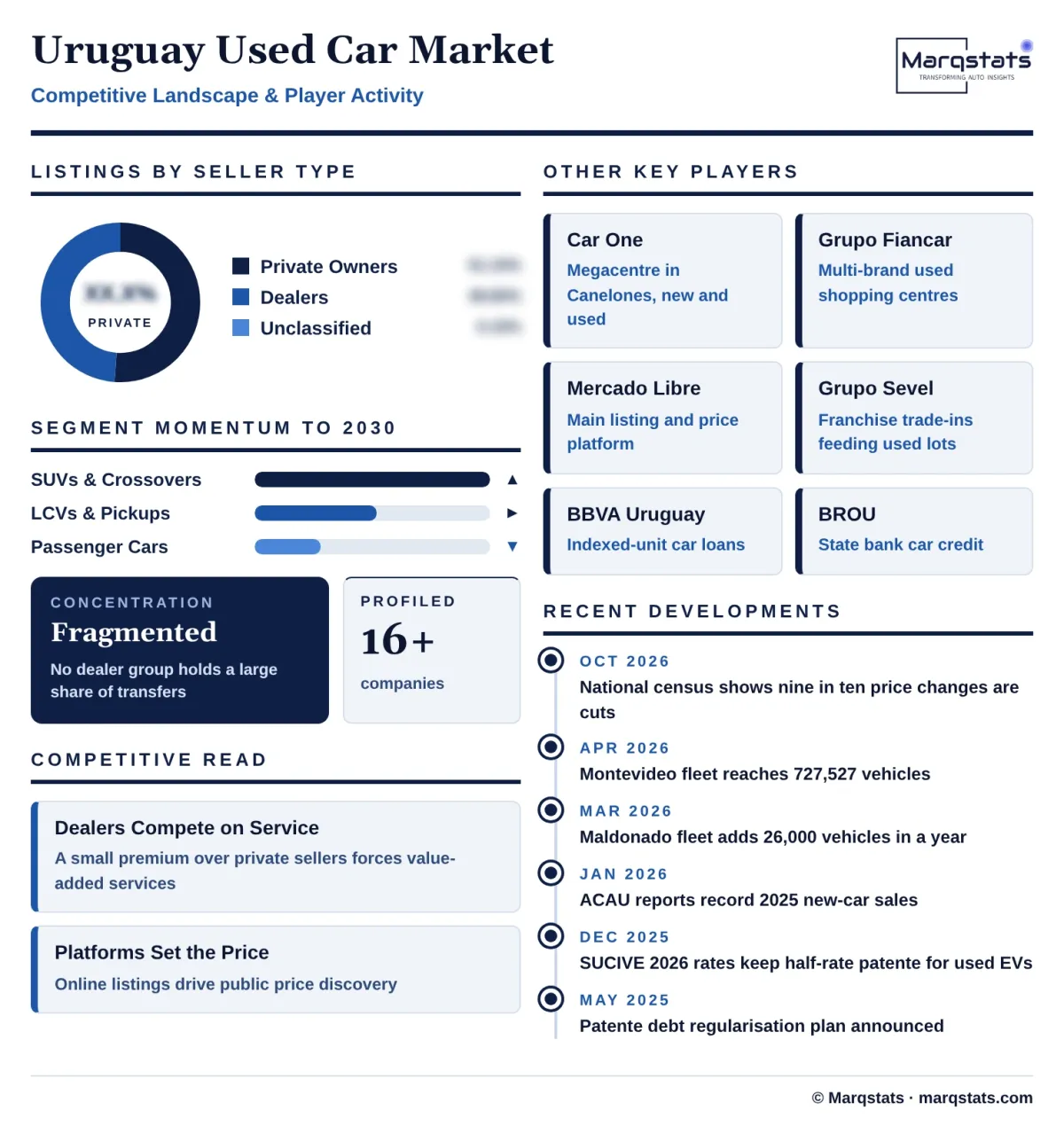
The Uruguay used car market is fragmented. Dealers (automotoras) hold 48.8% of listed inventory and private owners 51.1%, according to the October 2026 census, and no single dealer group handles more than a small fraction of the estimated 108,000 annual transfers. Car One reported used-car sales of 2,700, 3,700 and 4,200 units in its first three years, the largest disclosed volume of any single operator but under 4% of Marqstats' 2025 transfer estimate. Marqstats does not publish market shares for dealer groups because none of them discloses annual used-car volume on a consistent basis.
Dealers compete on service, not price. The 2.5% premium dealers command over private sellers for the same model and year leaves little room to compete on price, so the large groups differentiate through scale and services. Car One combines new and used stock, financing and trade-ins in one megacentre; Grupo Fiancar offers multi-brand used stock with in-house credit. Franchised new-car dealers such as Sevel Uruguay and Homero De León feed trade-ins into their own used lots, and the record 2025 new-car year has given all of them more stock to clear.
Platforms set the price, dealers set the experience. Mercado Libre Uruguay is the main listing platform and the basis for national price censuses, with Gallito Luis, run by Diario El País, and Buscars.uy as secondary channels. Banks such as BBVA Uruguay and BROU shape demand through loan pricing. Trade bodies frame the regulatory debate: ACAU represents new-car importers, and the Asociación de Concesionarios y Comerciantes de Automotores del Uruguay (ASCOMA) represents dealers and used-car traders.
Companies Covered
Companies covered in the report include:
Recent Market Activity
Table of Contents
Coverage & Segmentation
The study covers the Uruguay used car market across all 19 departments, with 2025 as the base year, 2021 – 2025 as the historical period and 2026 – 2030 as the forecast period. Values are in US dollars, the currency in which Uruguayan cars are priced. The market is defined as the value of ownership transfers of used passenger cars, SUVs and crossovers, and light commercial vehicles and pickups, through dealers and between private parties. It is segmented by vehicle type and fuel type and analysed for Montevideo, Canelones, Maldonado and the interior departments.
Heavy trucks, buses and motorcycles are excluded, as are new-car sales and finance, insurance and aftersales revenue. Returning-citizen and resident imports, which are not commercial, are included only after their first domestic transfer. The transfer count, the vehicle-type, fuel-type and departmental splits, and the price path are Marqstats estimates; the listing-census and registration figures are reported as published. Neighbouring markets are covered in other Marqstats used car reports.