Market Snapshot
The Thailand electric truck market size is estimated at USD 46.81 million in 2025 and is projected to reach USD 457.76 million by 2030, growing at a CAGR of 57.78% over 2026 – 2030. Registrations of battery-electric goods vehicles rise from 1,078 to 9,300 units as electric pickups, light trucks and heavy tractors scale up.
Marqstats defines the market as the transaction value of new battery-electric goods vehicles registered in Thailand: electric one-ton pickups and goods vans, light electric trucks below 5 tonnes and medium and heavy electric trucks and tractor heads of 5 tonnes and above, such as the Isuzu D-MAX EV, the Geely Riddara pickup and the Energy Absolute MINE Truck and MINE Tractor. Units follow the Department of Land Transport (DLT) first-registration lines published by the Federation of Thai Industries (FTI), and value is counted before value added tax and registration fees. Electric buses, passenger cars, tuk-tuks, plug-in hybrid pickups and charging equipment are excluded.
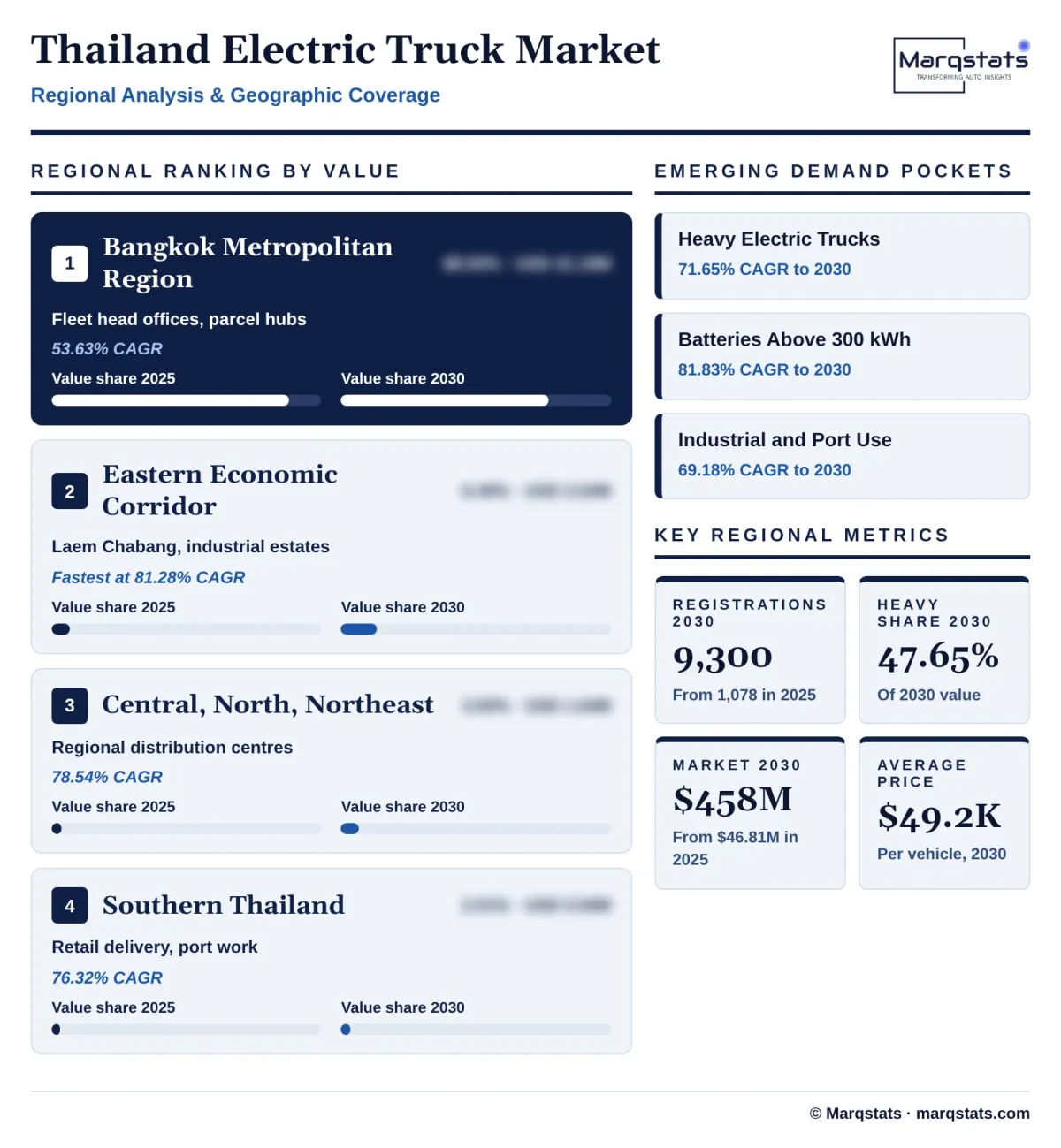
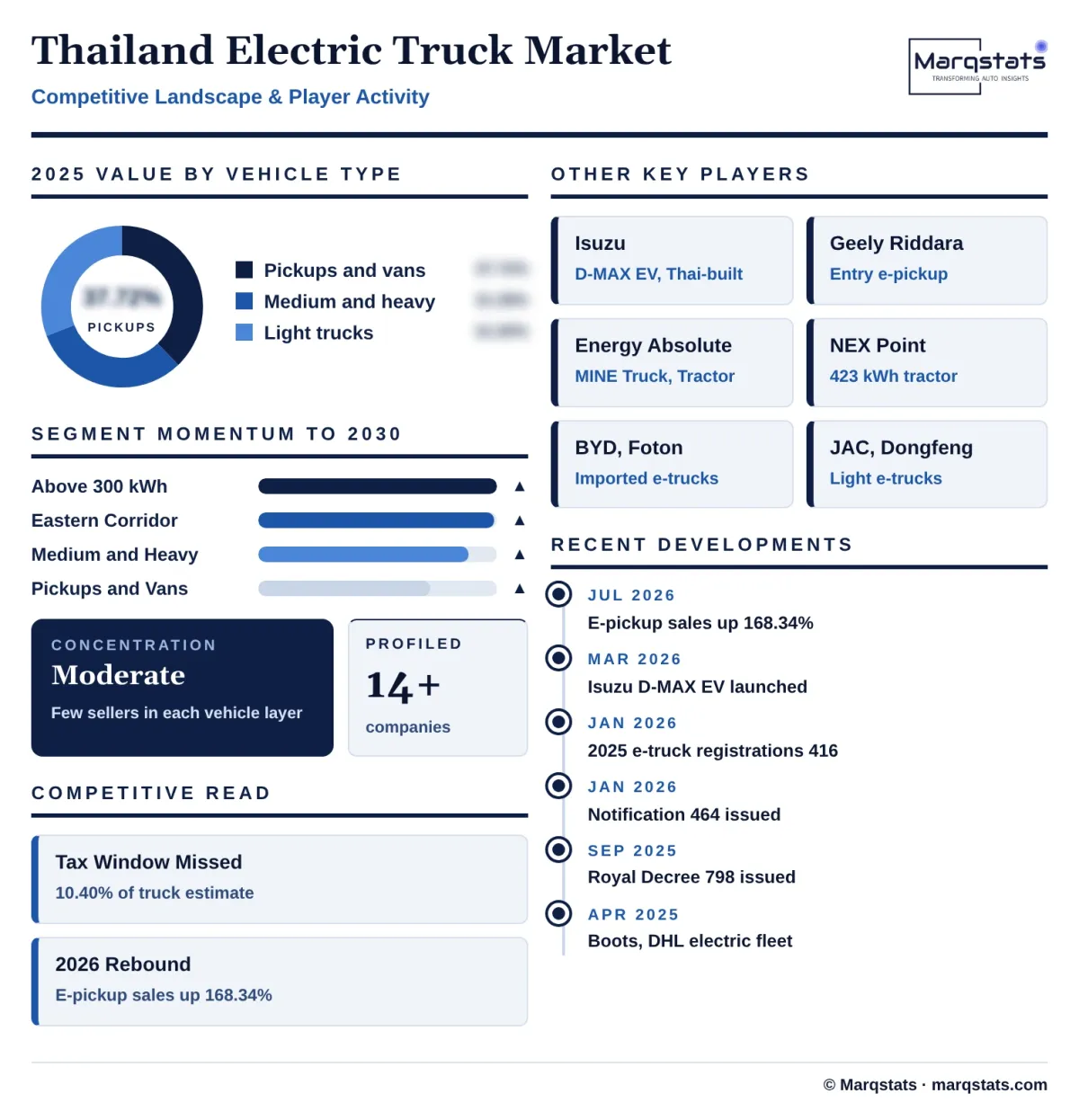
Electric pickups and goods vans account for 37.72% of 2025 value and 61.41% of units, while medium and heavy electric trucks grow fastest, at 71.65% a year, to 47.65% of value by 2030. The Bangkok Metropolitan Region accounts for 88.00% of 2025 value, and the Eastern Economic Corridor grows fastest among regions at 81.28% a year. The Marqstats global electric truck market report covers all regions and truck classes.
Key Takeaways
Market Overview & Analysis
Report Summary
Marqstats sizes the Thailand electric truck market as the value of new battery-electric goods vehicles that Thai buyers register each year. The unit base is the DLT first-registration count of battery-electric vehicles that the FTI Automotive Industry Club publishes with its monthly production and sales statistics. For 2025 the FTI reported 662 new battery-electric pickups and vans, down 9.60% from 2024, and 416 new battery-electric trucks, down 3.93%. Together they give 1,078 electric goods vehicles, against about 1,165 in 2024, a fall of 7.47%.
The trucks line covers every weight class registered as a truck under the Land Transport Act, from 4-wheel light trucks to 10-wheel rigids and tractor heads. Marqstats splits it into about 306 light electric trucks below 5 tonnes and 110 medium and heavy electric trucks of 5 tonnes and above. The second figure is the battery-electric slice of the Marqstats Thailand Truck Market analysis, which sizes trucks of 5 tons and above on the FTI category, so the two analyses share the same 110 heavy units and the same value for them.
The pickup line is close to the FTI sales count. The FTI reported domestic sales of 726 battery-electric pickups in 2025, against none in 2024, plus exports of 363 units and production of 555 double-cab battery-electric pickups. The difference between 726 sales and 662 registrations reflects timing between invoice and plate, and Marqstats uses registrations throughout so that every unit sits on one denominator. History supports the low base: the Electric Vehicle Association of Thailand (EVAT) recorded only 276 new battery-electric trucks in 2023 and a cumulative 303, so the Thai electric truck fleet reached an estimated 1,152 units by the end of 2025.
Value rests on prices as well as units. At the 2025 average rate of THB 33.74 per US dollar, Marqstats estimates the 2025 market at about THB 1.58 billion, which is USD 46.81 million, and the 2026 market at USD 91.19 million, a rise of 94.81% on 99.44% more registrations. The 2025 average transaction value is about USD 43,423, or THB 1.47 million, because cheap electric pickups make up 61.41% of units while one heavy electric tractor costs as much as five pickups.
The scope is a strict subset of the live Marqstats Thailand Electric Commercial Vehicle Market report, which sizes USD 674.90 million and 7,200 units in 2025, including 1,550 electric buses. That page counts about 3,600 light commercial vehicles and 2,050 medium and heavy trucks on a wider commercial registration and fleet basis. The 1,078 goods vehicles here are 19.08% of those 5,650 goods units and 6.94% of that value, and the two series must not be added.
Thailand Electric Truck Market Size and Forecast
The Thailand electric truck market grows from USD 46.81 million in 2025 to USD 457.76 million in 2030, a CAGR of 57.78%. Units supply most of the growth: registrations rise at 53.88% a year, from 1,078 to 9,300, and the average transaction value rises at 2.54% a year, from about USD 43,423 to USD 49,222, because heavy trucks take a larger share of units even as prices for each class fall or hold.
The 2025 value is built bottom-up. Marqstats prices the 662 electric pickups and goods vans at an average of about THB 0.90 million before value added tax, between the Geely Riddara list price of THB 739,000 to THB 1,149,000 and the Isuzu D-MAX EV at THB 1,591,000, which reached showrooms in March 2026. The 306 light electric trucks are priced at THB 1.60 million, and the 110 medium and heavy electric trucks carry an average of about THB 4.49 million, about 1.8 times a diesel truck of the same class, which gives USD 17.66 million, USD 14.51 million and USD 14.64 million.
A cross-check supports the heavy price level. The Cabinet estimated that Royal Decree No. 798 would cost THB 10.6 billion in revenue for about 10,000 large electric buses and trucks. At the 20% corporate income tax rate, an extra 100% deduction is worth 20% of the purchase price, so that estimate implies an average vehicle price of about THB 5.3 million, close to the Marqstats heavy-truck price and the THB 5.0 million per electric bus implied by the Asian Development Bank financing for Energy Absolute.
The year-by-year path starts with a sharp rebound. Marqstats expects 2,150 registrations in 2026, up 99.44%, because the FTI reported 695 electric pickup sales in January – May 2026, up 168.34%, and 71 battery-electric trucks of 5 to 10 tons in the same months, a series the FTI began reporting separately only in 2026. Growth then runs at 54.88% in 2027, 45.65% in 2028, 42.27% in 2029 and 34.78% in 2030. Value follows at USD 91.19 million in 2026, USD 149.48 million in 2027, USD 227.21 million in 2028 and USD 330.80 million in 2029.
The forecast is above the Krungsri Research outlook of about 1,600 electric commercial registrations a year on average from 2026, which the bank set when January – September 2025 registrations had fallen 13.8% to 749 units. Marqstats places more weight on the 2026 sales data and on the arrival of Thai-built electric pickups, and less on the 2025 slump, which coincided with a year in which buyers had few local models to choose from.
Marqstats tracks four indicators to monitor the forecast: the FTI monthly lines for battery-electric pickups and trucks of 5 to 10 tons, the DLT first-registration count of electric trucks, the diesel retail price set by the Oil Fuel Fund and the Ministry of Energy, and the order books of the Thai assembly plants run by Isuzu, Absolute Assembly and Chinese truck makers.
Market Dynamics
Key Drivers
Six forces lift demand for battery-electric goods vehicles in Thailand from the low base of 2025.
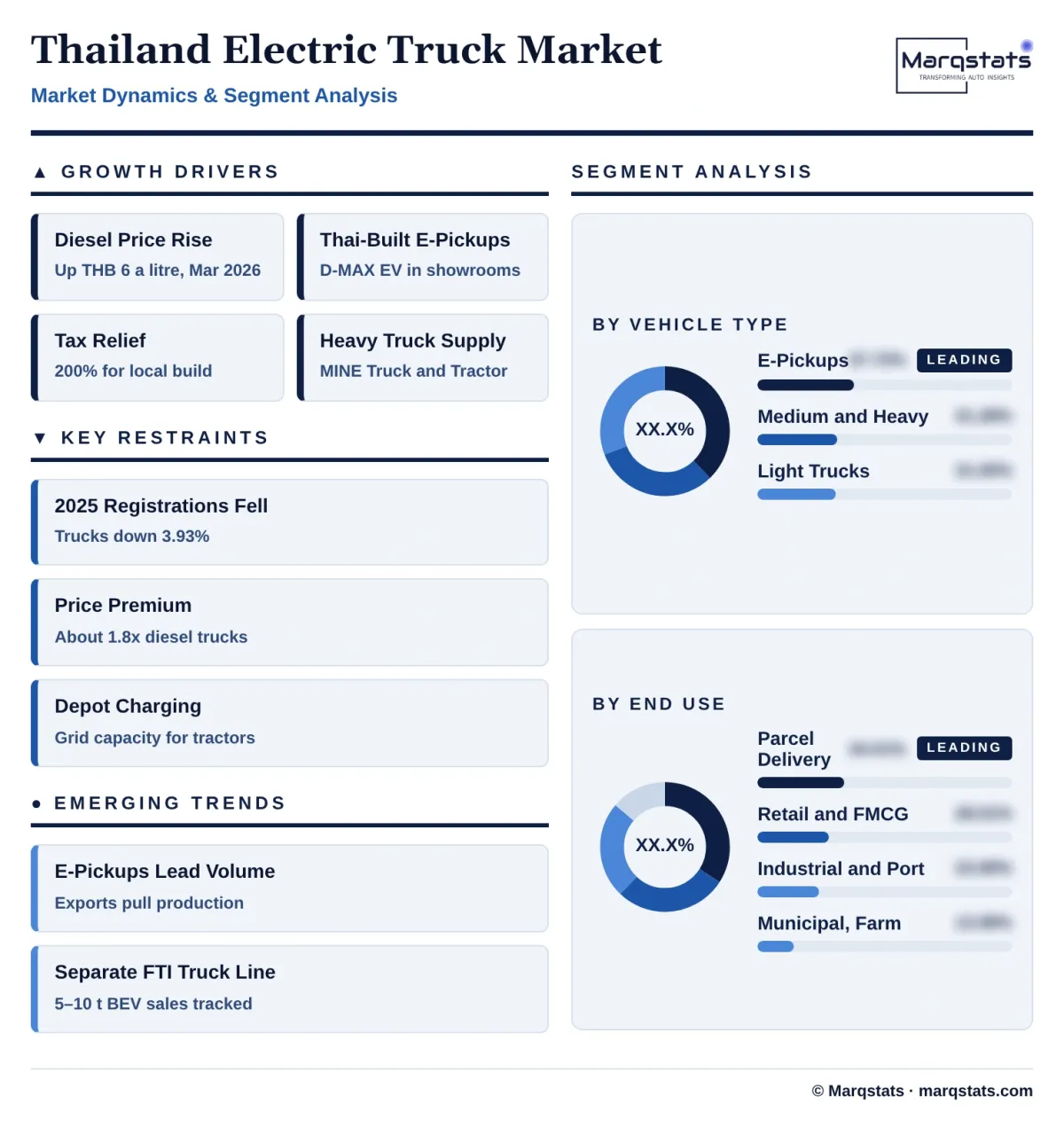
- Diesel became more expensive in 2026. Thai fuel prices rose THB 6 a litre on 26 March 2026 as hostilities in the Middle East lifted oil costs, and the FTI cut its 2026 production outlook to a 3.33% contraction in July 2026 for the same reason. Fuel is the largest running cost for a delivery pickup or a six-wheel truck, so every rise in the diesel price shortens the payback on an electric model for fleets that charge at their own depots.
- Electric pickups finally have Thai-built products. Isuzu launched the D-MAX EV in March 2026 at THB 1,591,000 with a 66.9 kWh battery and 331 km of NEDC range, and Geely sells the Riddara pickup from THB 739,000. The FTI reported production of 1,831 double-cab battery-electric pickups in January – May 2026, up 3,968.89%, and domestic sales of 695 electric pickups, up 168.34%, so the one-ton segment that carries most Thai small-business freight now has supply.
- Corporate tax relief rewards local assembly. Royal Decree No. 798, issued on 9 September 2025, allows a deduction of 200% of the cost of new electric goods vehicles made or assembled in Thailand, including pickups, panel vans, liquid-cargo and dangerous-goods trucks registered under the land transport law, against 150% for fully imported vehicles, for vehicles acquired ready for use between 27 March and 31 December 2025. The Revenue Department set online registration by 31 May 2026 in Director-General Notification No. 464 of 20 January 2026, so claims from the 2025 window flow into 2026 tax filings.
- Purchase subsidies cover electric pickups. Under the EV3.5 package, battery-electric pickups priced below THB 2 million with batteries above 50 kWh qualify for a subsidy of THB 100,000 a unit, and Isuzu sized the D-MAX EV battery at 66.9 kWh, above that threshold. The subsidy lowers the entry price for small operators who buy pickups on instalments.
- A heavy electric truck supply base exists in Thailand. Absolute Assembly Co., Ltd., the Energy Absolute plant of more than 55,000 square metres, builds the MINE Truck with 66 to 282 kWh batteries and the MINE Tractor with 282 to 423 kWh, and NEX Point showed a 423 kWh electric tractor with a 300 km range at the CBA Expo in September 2025. The Board of Investment had approved 21 battery-electric vehicle projects with 386,000 units of yearly capacity and THB 41.08 billion of investment by June 2025.
- Corporate fleets are setting electric delivery targets. Boots Thailand and DHL Supply Chain Thailand launched a 100% electric delivery fleet of three vehicles in April 2025 with a range of up to 250 km per charge and a one-hour recharge, cutting about 74 tonnes of carbon emissions a year on store deliveries. Contract logistics firms that win such retail accounts add electric light trucks in batches, which is how most early volume reaches the road.
Key Restraints
Five constraints explain why registrations fell in 2025 and why heavy trucks remain the slowest layer to convert.
- Registrations fell in 2025 despite the incentives. Electric truck registrations fell 3.93% to 416 units and electric pickup and van registrations fell 9.60% to 662, so the electric goods-vehicle total dropped 7.47% to 1,078. Krungsri Research recorded a 13.8% fall to 749 electric commercial registrations in January – September 2025, which shows that the tax window alone did not move buyers.
- Electric trucks cost far more than diesel trucks. Marqstats estimates that a medium or heavy electric truck sells at about 1.8 times the price of a diesel truck of the same class, and Krungsri Research notes that the purchase price makes up 20% to 25% of the total cost of ownership of an 800 kWh electric truck against about 10% for a large diesel truck. Small hauliers, who own most Thai trucks, cannot finance that premium.
- Credit is tight for small operators. The FTI said in September 2025 that stricter credit approvals cut pickup sales and proposed a THB 5 billion fund to guarantee banks against losses on repossessed pickups, and domestic pickup sales fell 12.41% to 143,072 units in 2025. Banks that are cautious about diesel pickups are more cautious still about electric models with uncertain resale values.
- The deduction window has closed. Royal Decree No. 798 applies only to vehicles acquired ready for use by 31 December 2025, and fleets that buy in 2026 price electric trucks without the extra deduction. The EV3.5 pickup subsidy continues, but at THB 100,000 a unit it is small against the price gap of a medium or heavy truck, so the 2026 rebound in trucks has to rest on fuel savings and new models rather than on tax.
- Charging for heavy trucks sits in depots, not on highways. Krungsri Research finds that 90.0% of electric commercial registrations are in Bangkok and its vicinity, and the BOI-promoted charging projects of 20,080 stations, of which 7,360 are DC, mainly serve passenger cars. A 423 kWh tractor needs a high-power depot charger and grid capacity from the Metropolitan Electricity Authority or the Provincial Electricity Authority, which limits heavy trucks to fixed routes.
Key Trends
Five shifts are changing which electric goods vehicles Thai fleets buy and where they are built.
- Electric pickups carry the volume. Marqstats expects electric pickups and goods vans to rise from 662 to 6,300 registrations a year, 67.74% of 2030 units, because they are cheap, fit existing Thai pickup buyers and share production lines with export models.
- Exports pull Thai electric pickup production ahead of domestic sales. Thailand exported 363 battery-electric pickups in 2025 against none in 2024, and the D-MAX EV is built for Europe as well as Thailand. In January – May 2026 production of double-cab battery-electric pickups reached 1,831 units against domestic sales of 695, so local demand can draw on a supply base that export orders pay for.
- Heavy electric trucks shift toward Thai assembly. Royal Decree No. 798 doubled the deduction for Thai-assembled vehicles against imports, and Absolute Assembly and NEX Point build tractors and rigids in Thailand. Marqstats expects medium and heavy electric trucks to grow from 110 to 1,500 units, with port, cement and fuel distribution fleets as the first large buyers.
- Official data on electric trucks are getting sharper. The FTI began reporting battery-electric trucks of 5 to 10 tons as a separate sales line in 2026, with 71 units in January – May and 35 in May alone, which lets buyers and lenders track the heavy segment month by month instead of relying on annual registration totals.
- Japanese truck makers consolidate while Chinese makers bring electric ranges. Daimler Truck and Toyota unified Hino and Mitsubishi Fuso under Archion Corporation on 1 April 2026, while Chinese makers such as BYD, Beiqi Foton, JAC and Dongfeng hold about 72% of electric commercial value in the live Marqstats Thailand Electric Commercial Vehicle analysis, so the electric segment is where Chinese brands are strongest relative to their diesel share.
Strategic Implications
- For vehicle makers, the 2025 data show that tax relief does not sell trucks a buyer cannot see. Registrations equal to 10.40% of the Cabinet estimate came in a year with few Thai-built electric goods vehicles, and the 2026 rise in pickup sales came with the D-MAX EV. Makers should launch Thai-assembled light and medium electric trucks before asking for the next incentive, because local assembly earns the higher deduction whenever one is offered.
- For fleet operators, the best case for electric trucks in 2026 is a depot-based route with high daily distance and predictable loads, such as parcel hubs, retail store deliveries and port shuttles. Operators that measure daily kilometres and depot power before they tender will buy the right battery size and avoid paying for range they do not use.
- For lenders and lessors, the gap in the market is credit for electric light trucks and pickups. Banks tightened credit for diesel pickups in 2025, and a leasing product with a battery warranty and a residual value guarantee from the maker would reach the small operators who make up most of the market.
- For charging and energy companies, heavy trucks need depot and corridor power, not public chargers. The Laem Chabang to Bangkok and the Chonburi to Rayong corridors will see the first electric tractors, and depot chargers sized for 282 to 423 kWh batteries, with grid connections arranged early with the Provincial Electricity Authority, are the bottleneck worth solving.
- For investors, the value of the market shifts from pickups to heavy trucks. Medium and heavy electric trucks rise to 47.65% of 2030 value from 31.28%, so suppliers of high-voltage batteries, e-axles and thermal systems for trucks will see their share of value grow faster than the unit count suggests.
Market Segmentation
Electric one-ton pickups and goods vans account for 37.72% of 2025 value, USD 17.66 million, and grow at 58.63% a year to USD 177.39 million. Registrations rise from 662 to 6,300 units, 61.41% of 2025 units and 67.74% of 2030 units. The segment covers the Isuzu D-MAX EV, the Geely Riddara and Chinese electric pickups and panel vans, and Marqstats prices it at about THB 0.90 million before value added tax in 2025, rising to THB 0.95 million in 2030 as the Thai-built D-MAX EV lifts the average.
Light electric trucks below 5 tonnes account for 31.00% of 2025 value, USD 14.51 million, and grow at 33.81% a year to USD 62.24 million. Marqstats estimates about 306 units in 2025, the light share of the 416 electric trucks registered, rising to 1,500 units by 2030. These 4-wheel trucks serve parcel hubs, retail distribution and cold-chain routes in Bangkok, and their price falls from THB 1.60 million to THB 1.40 million as Chinese competition intensifies.
Medium and heavy electric trucks of 5 tonnes and above account for 31.28% of 2025 value, USD 14.64 million, and grow fastest, at 71.65% a year, to USD 218.13 million and 47.65% of the market. Units rise from 110 to 1,500, the battery-electric slice of the Marqstats Thailand Truck Market analysis, and include six-wheel rigids, ten-wheel rigids and tractors such as the MINE Truck and MINE Tractor from Absolute Assembly and Chinese models from BYD, Beiqi Foton, JAC and Dongfeng.
Parcel and last-mile delivery accounts for 34.01% of 2025 value, USD 15.92 million, and grows at 53.87% a year to USD 137.33 million. Courier and e-commerce fleets run electric pickups and light trucks from Bangkok hubs on fixed daily routes, which makes them the natural first buyers.
Retail, FMCG and cold-chain distribution accounts for 28.01% of 2025 value, USD 13.11 million, and grows at 55.45% a year to USD 119.02 million. Retailers such as Boots Thailand and their contract logistics partners, such as DHL Supply Chain Thailand, use electric trucks for store deliveries from regional warehouses.
Industrial, port and construction haulage accounts for 23.99% of 2025 value, USD 11.23 million, and grows fastest, at 69.18% a year, to USD 155.63 million and 34.00% of the market. Tractors and heavy rigids for Laem Chabang container shuttles, cement, fuel and industrial-estate freight are the largest single purchases in the market.
Municipal, utility and agricultural use accounts for 13.99% of 2025 value, USD 6.55 million, and grows at 47.53% a year to USD 45.78 million. Waste collection, utility service trucks and farm-produce pickups convert more slowly because public budgets and rural charging limit purchases.
Vehicles with batteries below 100 kWh account for 50.14% of 2025 value, USD 23.47 million, and grow at 52.89% a year to USD 196.06 million. The class covers electric pickups such as the D-MAX EV with 66.9 kWh and the smallest light trucks, and it qualifies for the EV3.5 pickup subsidy when the battery exceeds 50 kWh.
Vehicles with 100 to 300 kWh batteries account for 40.48% of 2025 value, USD 18.95 million, and grow at 55.89% a year to USD 174.45 million. Most light and medium trucks sit here, including the MINE Truck range from 66 to 282 kWh.
Vehicles with batteries above 300 kWh account for 9.38% of 2025 value, USD 4.39 million, and grow fastest, at 81.83% a year, to USD 87.25 million. Heavy tractors such as the 423 kWh NEX Point tractor with a 300 km range need depot chargers of several hundred kilowatts, so the class grows with port and industrial fleets that control their own power supply.
By Geography
Bangkok Metropolitan Region
The Bangkok Metropolitan Region, covering Bangkok, Samut Prakan, Samut Sakhon, Pathum Thani, Nonthaburi and Nakhon Pathom, accounts for 88.00% of 2025 value, USD 41.19 million, and grows at 53.63% a year to USD 352.48 million and 77.00% by 2030. Krungsri Research finds that 90.0% of electric commercial registrations are in Bangkok and its vicinity, because fleet head offices, lessors and parcel hubs register there and the densest depot charging sits there. Marqstats allocates value by registration address and treats the regional split as an estimate.
Eastern Economic Corridor
The Eastern Economic Corridor, covering Chonburi, Rayong and Chachoengsao, accounts for 6.49% of 2025 value, USD 3.04 million, and grows fastest, at 81.28% a year, to USD 59.51 million and 13.00% by 2030. Laem Chabang port, the industrial estates of Chonburi and Rayong and the assembly plants that build electric vehicles in the corridor generate the short, repeated haulage routes on which electric tractors work best.
Central, Northern and Northeastern Thailand
Central, Northern and Northeastern Thailand account for 3.50% of 2025 value, USD 1.64 million, and grow at 78.54% a year to USD 29.75 million. Regional distribution centres in Nakhon Ratchasima, Khon Kaen and Chiang Mai are the first users outside Bangkok, while long distances and farm routes keep most trucks on diesel.
Southern Thailand
Southern Thailand accounts for 2.01% of 2025 value, USD 0.94 million, and grows at 76.32% a year to USD 16.02 million. Retail delivery in Phuket and Hat Yai and port work in Songkhla offer early routes, but the region is the smallest buyer because its freight runs long distances to Bangkok and Malaysia.
How Competition Is Evolving
The market has few sellers in each layer and no published company shares, so Marqstats describes competition by vehicle layer. Electric pickups and goods vans make up 37.72% of 2025 value, light trucks 31.00% and medium and heavy trucks 31.28%, and each layer has a different set of leaders. The live Marqstats Thailand Electric Commercial Vehicle Market report attributes about 72% of its wider electric commercial value to Chinese manufacturers, 19% to Thai assemblers and converters and 9% to Japanese and other makers.
In pickups, Isuzu and Geely set the price range. Isuzu Motors Limited builds the D-MAX EV in Thailand at THB 1,591,000 for both the domestic market and Europe, while Zhejiang Geely Holding Group sells the Riddara pickup from THB 739,000, and Toyota Motor Thailand Co., Ltd. has a battery-electric Hilux in its range. Great Wall Motor and SAIC Motor-CP Co., Ltd. run Thai vehicle plants that could add electric light commercial models.
In medium and heavy trucks, Thai assembly and Chinese imports compete. Energy Absolute Public Company Limited, through Absolute Assembly Co., Ltd. and NEX Point Public Company Limited, builds the MINE Truck and MINE Tractor in Thailand, which earned the 200% deduction under Royal Decree No. 798, while BYD Company Limited, Beiqi Foton Motor Co., Ltd., Anhui Jianghuai Automobile Group Corp., Ltd. and Dongfeng Motor Corporation sell imported electric trucks. The Japanese truck leaders, Isuzu, Hino and Mitsubishi Fuso, dominate diesel trucks in Thailand but have yet to sell electric trucks at volume there.
Competition is moving from list price to the total package. Buyers weigh battery warranties, charger supply, finance and the tax treatment of local assembly, and battery makers such as Contemporary Amperex Technology Co., Limited and Gotion High-tech Co., Ltd. supply cells to Thai assemblers. Makers that combine Thai assembly, depot charging and a leasing partner are best placed to win the fleets that will buy most heavy electric trucks.
Companies Covered
Companies covered in the report include:
Recent Market Activity
Table of Contents
Coverage & Segmentation
The study covers the Thailand electric truck market, with 2025 as the base year, 2021 – 2025 as the historical period, of which 2023 to 2025 are quantified from EVAT and FTI releases, and 2026 – 2030 as the forecast period. It covers new battery-electric goods vehicles registered in Thailand, segmented by vehicle type, end use, battery capacity and region. Values are transaction values in US dollars before value added tax and registration fees, and baht figures use the 2025 average of THB 33.74 per US dollar.
The ladder starts from the DLT first-registration lines for battery-electric vehicles published by the FTI for 2025: 662 pickups and vans plus 416 trucks gives the 1,078 electric goods vehicles that the analysis sizes. The 416 trucks split into about 306 light trucks below 5 tonnes and 110 medium and heavy trucks of 5 tonnes and above. Electric buses, electric passenger cars, motorcycles and tuk-tuks in the same release are excluded, as are plug-in hybrid and range-extended pickups, used and converted vehicles, and charging equipment.
The study is a dedicated deep-dive inside the live Marqstats Thailand Electric Commercial Vehicle Market report, which sizes USD 674.90 million and 7,200 units in 2025, including 1,550 electric buses, on a wider registration and fleet basis; the two must not be added. The 110 medium and heavy electric trucks are the same vehicles as the battery-electric slice of the Marqstats Thailand Truck Market analysis, and the electric pickups sit inside the live Marqstats Thailand Pickup Truck Market report (142,900 units in 2025), so neither may be added to this market.