Market Snapshot
The Argentina electric truck market is valued at USD 1.48 million in 2025 and reaches USD 12.48 million by 2030, a CAGR of 53.18%. Volume rises from 16 to 130 battery-electric trucks a year, led by Brazil-built medium trucks and Chinese light trucks sold to beverage, utility and parcel fleets.
The market is tiny because the policy that transformed Argentine electrified car sales was never written for trucks. Under the zero-duty import quota of Decree 49/2025, the Asociación de Concesionarios de Automotores de la República Argentina (ACARA) recorded 1,279 battery-electric registrations in 2025. Foton, the only brand selling an electric truck in volume, accounted for 11 of them. Every tariff line named in the October 2026 revision of that quota sits in heading 8703, the passenger-car chapter, so an electric truck imported from outside Mercosur still carries the full extra-zone duty.
Marqstats sizes this market as registered battery-electric trucks above 3.5 tonnes gross vehicle weight multiplied by the dealer transaction price excluding IVA, stated in US dollars. Argentine truck makers quote commercial vehicles in dollars, and the peso moved from ARS 1,054 to ARS 1,451 per dollar between January and November 2025, so a peso series would mostly measure the exchange rate. At the 2025 average of ARS 1,245 per USD, the base year equals about ARS 1,843 million. Small, yes. But it is real, and it is countable.
Key Takeaways
Market Overview & Analysis
Report Summary
Argentina has an electric truck market in the literal sense: a few dozen trucks have been registered, they work every day in real fleets, and a dealer will quote a price. It does not yet have an electric truck industry. The first battery-electric truck delivered in the country was a Volkswagen e-Delivery of 14.5 tonnes gross weight, handed to Express Logística, the distribution operator for Cervecería y Maltería Quilmes, at the Mercado Central distribution centre in September 2023, with a charger installed by Siemens. Foton had shown its e-Aumark light truck at Expoagro in March 2023, and the electricity distributor Edenor bought the first commercial unit in September 2024. By 2025 the ACARA annual count credited Foton with 11 battery-electric registrations. Our base-year estimate of 16 trucks adds the Brazil-built medium trucks that arrive in single figures each year.
The problem for anyone sizing this market is that the statistics were built for cars. The quarterly electromobility report published by SIOMAA covers automobiles and light commercial vehicles only, and the headline electrified counts quoted in the Argentine press, 19,867 units in the first quarter of 2026 alone, say nothing about trucks. Marqstats therefore counts brands and models: the ACARA brand total for Foton, the delivery record of the e-Delivery, and the absence of battery-electric registrations from the brands that dominate diesel trucks, Mercedes-Benz Camiones y Buses, IVECO, Scania and Volkswagen locally assembled models. We then price each truck at its dealer quote in dollars, because that is how Argentine truck dealers sell. The Foton Aumark 615 diesel, for example, was announced at USD 43,327 plus IVA.
Three conclusions follow. First, the import regime, not technology, decides the shape of supply: medium trucks come from Brazil because they cross the border free of duty, and light trucks come from China because Chinese makers price low enough to absorb the extra-zone duty. Second, growth to 2030 depends on a small number of fleet decisions; a single beverage or parcel contract for twenty trucks would add more than the whole 2025 market. Third, the passenger-car quota is unlikely to help trucks without a new instrument, because its October 2026 revision again listed only heading 8703 tariff lines. Read annual figures as fleet timing. One order can move a year.
Argentina Electric Truck Market Size and Forecast
Marqstats estimates the market at zero in 2021 and 2022, USD 0.25 million in 2023 (two trucks), USD 0.48 million in 2024 (six trucks) and USD 1.48 million in 2025 (16 trucks). We forecast USD 2.22 million in 2026, USD 3.72 million in 2027, USD 5.87 million in 2028, USD 8.77 million in 2029 and USD 12.48 million in 2030. The 2025 base and the 2030 forecast imply a value CAGR of 53.18% and absolute growth of USD 11.00 million. Unit volume grows from 16 to 24, 38, 60, 90 and 130 trucks, a unit CAGR of 52.04%. Value grows slightly faster than units because the first heavy trucks enter the mix after 2027, even as the average price of each class falls.
Marqstats sizes this market on registered units multiplied by dealer dollar prices, since no directly comparable dollar figure is published elsewhere. The base year is a Marqstats construction. The 11 Foton registrations are an ACARA brand total; the five medium trucks are our estimate of Brazil-built e-Delivery and similar imports, which ACARA does not break out by powertrain in its truck tables. Light trucks are priced at USD 55,000 each, a fleet transaction level slightly below the dealer quote of about ARS 72 million reported in July 2025, and medium trucks at USD 175,000, the midpoint Marqstats uses for the same trucks on the Brazil Electric Truck Market page. Prices exclude IVA, which is charged at 10.5% on trucks, and include import duty where it applies. By 2030 we price light trucks at USD 50,000, medium trucks at USD 150,000 and heavy trucks at USD 280,000, reflecting lower battery cost per kWh and more competition from Chinese and Brazilian makers.
Why dollars? Argentine truck prices are set in dollars, and the 2025 peso path makes a peso series meaningless for comparison. The Banco Central de la República Argentina month-end valuation rate moved from ARS 1,054 per dollar in January 2025 to ARS 1,451 in November, a depreciation of about 38% in eleven months. Marqstats uses a 2025 annual average of ARS 1,245 per USD for any peso illustration. At that rate the 2025 market equals about ARS 1,843 million and the 2030 forecast about ARS 15,538 million in constant 2025 pesos. The peso figures are conversions; the dollar figures are the estimate.
The Car Quota Never Reached the Truck
Decree 49/2025, signed on 30 January 2025 and published the next day, created an annual quota of 50,000 hybrid, battery-electric and fuel-cell vehicles that pay 0% extra-zone import duty, with a maximum FOB value of USD 16,000. The quota was taken up so fast that SIOMAA describes it as exhausted for both 2025 and 2026, and battery-electric registrations reached 1,279 in 2025 by the ACARA count. The car market changed shape. The truck market did not.
Decree 1128/2026, in force from 1 October 2026, replaced the single USD 16,000 ceiling with differentiated limits: USD 16,000 for tariff lines 8703.21 to 8703.33.90, USD 18,000 for hybrid lines 8703.40 to 8703.70, and USD 35,000 for line 8703.80, the battery-electric passenger car. Every line is in heading 8703. Heading 8704, which covers goods vehicles, is not in the list. A USD 35,000 FOB ceiling would in any case sit below the price of every electric truck sold in the country. Earlier, Decree 44/2026, published on 26 January 2026, removed two-, three- and four-wheel L-category vehicles from the regime and let unused quota roll forward. Nothing in either revision touched trucks.
The consequence is visible in the 2025 registrations. Foton held 0.86% of battery-electric registrations, and no other truck brand appears among the top ten electric brands. Argentine electromobility statistics therefore describe a car market, and the quota debate is a car debate. For a truck buyer the relevant instrument is still the Mercosur common external tariff of 35% on vehicles from outside the bloc, plus the bilateral Argentina-Brazil automotive agreement, ACE 14, which lets Brazil-built trucks enter free of duty. That is why the two trucks that define this market come from China and from Brazil, and why their positions differ.
Dollar Pricing Sets the Valuation Basis
Truck dealers in Argentina publish list prices in dollars. Foton announced the diesel Aumark 615 at ExpoVenado on 27 August 2025 at USD 43,327 plus 10.5% IVA, a 6-tonne light truck with a Cummins 2.8-litre engine. The e-Aumark, the electric truck built on the same global platform, was quoted at about ARS 72 million in July 2025, according to Economía Sustentable, which equals roughly USD 57,800 at the 2025 average exchange rate. The diesel truck including IVA comes to about USD 47,876. If the electric quote also includes IVA, the battery premium is roughly USD 10,000, about a fifth of the diesel price.
Marqstats therefore values the market in dollars and converts to pesos only for illustration. Peso prices for imported trucks rise with the exchange rate, and the exchange rate rose 38% within 2025. A peso series would show growth even if no additional truck were sold. A dollar series moves only when units or real prices move. The 2025 average rate of ARS 1,245 per USD is taken from Banco Central de la República Argentina month-end valuation rates for January to November 2025, which average ARS 1,244.5. Daily-rate series give a slightly lower average, near ARS 1,220. The difference changes the peso illustration by about 2% and the dollar estimate not at all.
Market Dynamics
Key Drivers
Demand comes from fleets with carbon targets and from Mercosur supply that avoids the extra-zone duty.
- Corporate fleet decarbonisation: Express Logística put the first e-Delivery to work for Cervecería y Maltería Quilmes, which has committed to carbon neutrality by 2040, and Edenor bought the first commercial e-Aumark in September 2024. Electric trucks enter Argentina through such named fleet programmes, so each new corporate target is a direct source of orders.
- Duty-free Mercosur supply: Brazil-built electric trucks cross into Argentina under ACE 14 without the 35% extra-zone duty. Volkswagen Camiones y Buses sold 2,182 trucks and buses in Argentina in 2025, up 12%, and assembles about 2,000 a year in Córdoba, so its dealer and service network can support an electric medium truck sourced from Resende.
- Chinese light-truck pricing: Foton and other Chinese makers price electric light trucks low enough to absorb the extra-zone duty. Foton reported a 10.3% share of the Argentine truck market in the first half of 2026 and targets more than 3,000 sales in 2026, which gives its electric models a national dealer footprint they lacked in 2023.
- Urban operating economics: urban delivery trucks run short, predictable daily routes of under 200 km and return to a depot each night. The e-Aumark carries an 81.14 kWh lithium iron phosphate battery with about 200 km of range and recharges in about one hour on a fast charger, which covers a full urban shift without public charging.
Key Restraints
Import cost and the thin dealer and charging base keep volumes in double digits.
- Extra-zone duty on goods vehicles: battery-electric trucks imported from outside Mercosur pay the 35% common external tariff, while battery-electric passenger cars inside the quota pay none. Decree 1128/2026 kept the quota inside heading 8703, so the duty gap between an electric car and an electric truck persists into 2027.
- Purchase premium over diesel: at roughly USD 57,800 for an e-Aumark against about USD 47,876 for a diesel Aumark 615 including IVA, the electric truck costs about a fifth more. Small fleet owners who finance trucks in pesos carry the premium at local interest rates, which lengthens the payback beyond the planning horizon of most operators.
- Thin product and service network: no incumbent diesel leader sold a battery-electric truck in Argentina in 2025. Mercedes-Benz Camiones y Buses held 33.4% of the truck market and IVECO, Scania and Volkswagen most of the rest, yet electric volume rests on two models, so a fleet buyer has little choice of payload, body or service point.
Key Trends
The market is moving from single demonstration trucks to small fleet orders.
- From pilot to fleet: the 2023 and 2024 deliveries were single trucks, each announced as a first. The 2025 count of 16 already includes repeat buyers, and Marqstats expects orders of five to twenty trucks from beverage, parcel and utility fleets to define 2026 to 2028.
- Multi-energy line-ups: Foton presented its BLUELINE range at Expo Transporte in Buenos Aires on 11 to 13 August 2026, covering battery-electric, hydrogen, hybrid and natural-gas trucks. Argentine operators are being offered gas and electric options side by side, and compressed natural gas will compete with batteries for regional routes.
- Electric vans arriving first: Foton announced the E-VIEW Connect electric van for the Chinese automotive show in Buenos Aires in 2026, and Edenor added Ford E-Transit vans to its fleet. Vans sit outside this market, but they build the depot chargers and maintenance skills that electric trucks later use.
Strategic Implications
- For entrants: a Chinese brand must either price to absorb the 35% extra-zone duty or route supply through a Mercosur plant. The fastest route to volume is a fleet contract with a beverage, parcel or utility operator in AMBA, bundled with a depot charger and a service agreement.
- For incumbents: Mercedes-Benz Camiones y Buses, IVECO, Scania and Volkswagen Camiones y Buses hold the diesel customer base and the service network. The first of them to offer a Brazil-built electric medium truck at a dollar list price, with a residual value guarantee, can take the medium segment before Chinese brands localise.
- For suppliers and investors: charger suppliers and electricity distributors should follow the fleet depots, not public corridors. Utilities such as Edenor are both buyers and grid hosts, and depot charging contracts in AMBA will precede any corridor charging along National Route 9 by several years.
Market Segmentation
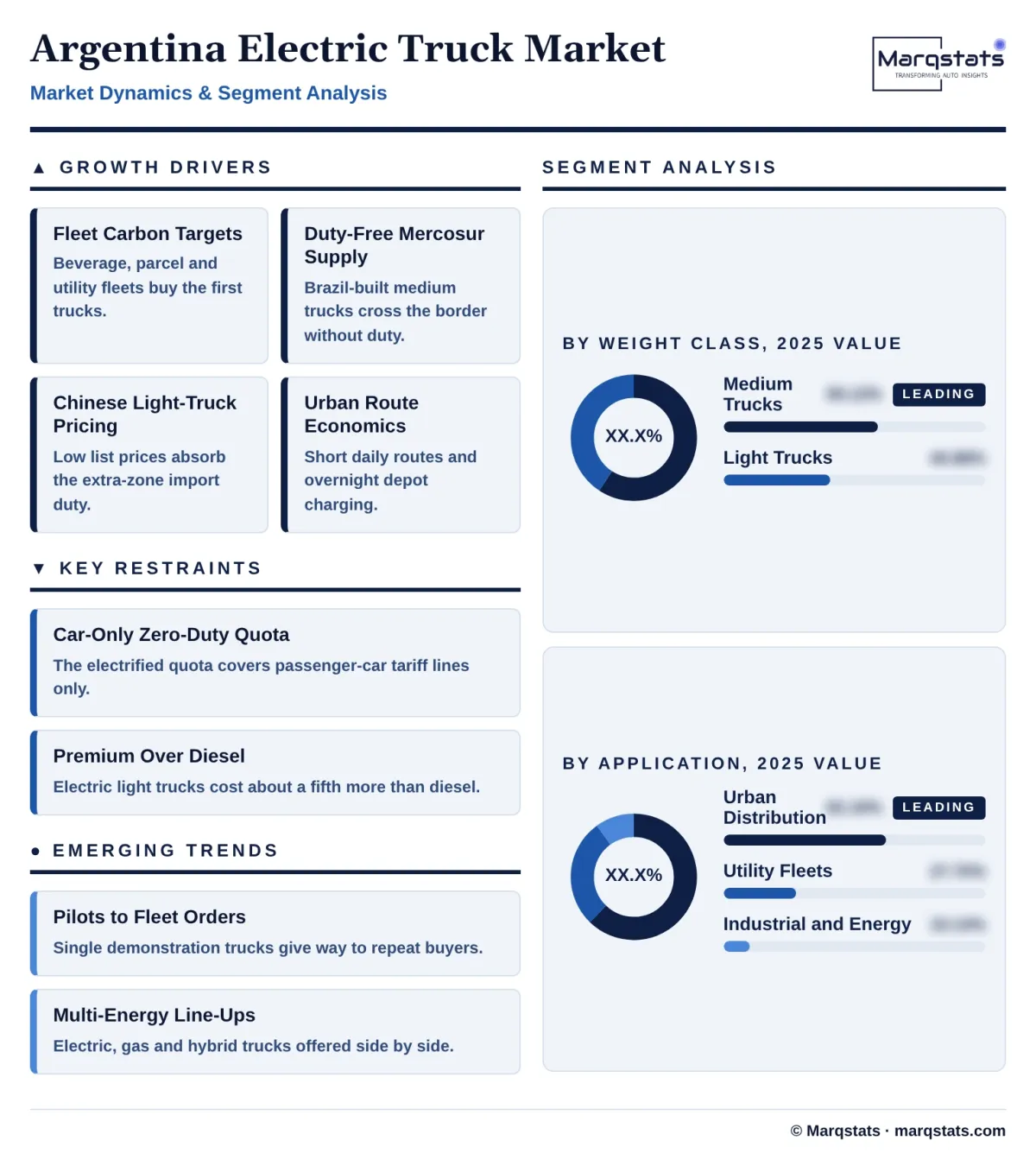
Light trucks were the volume leader in 2025 with 11 of 16 units, and the value runner-up with USD 0.605 million, or 40.88% of the market. The class is almost entirely the Foton e-Aumark, a truck of about 6 tonnes gross weight with an 81.14 kWh battery, launched in Argentina in 2023 and sold through Grupo Corven. Buyers are utilities and urban distributors who need a small chassis for city-centre deliveries and service calls.
Marqstats forecasts 78 light trucks worth USD 3.90 million in 2030, a value CAGR of 45.16%. The class grows more slowly than the market because its average price falls from USD 55,000 to USD 50,000 as more Chinese models arrive, and because medium and heavy trucks gain share. Its 2030 value share is 31.25%.
Medium trucks are the value leader: five units worth USD 0.875 million, 59.12% of 2025 value. The reference model is the Volkswagen e-Delivery, 14.5 tonnes gross weight, 300 kW motor and up to 250 km of range, built in Resende, Brazil. Beverage distribution is the classic duty cycle: dense urban routes, heavy loads and a return to the depot each night.
We forecast 46 medium trucks worth USD 6.90 million in 2030, a value CAGR of 51.14% and a 2030 share of 55.29%. Duty-free Brazilian sourcing is the reason this class holds value leadership even though each truck costs about three times a light truck.
No battery-electric heavy truck was registered for road use in 2025. The electric quarry truck that Holcim Argentina put to work at its Capdeville plant in Mendoza in 2024 is an off-road machine and sits outside this market.
Marqstats expects the first road-registered heavy electric trucks in 2027, in short-haul port, cement or beverage shuttles, and forecasts six units worth USD 1.68 million in 2030, 13.46% of value, priced at USD 280,000 each.
Urban distribution, covering beverage, parcel, retail and food delivery, held 62.16% of 2025 value, about USD 0.92 million, and reaches USD 7.70 million in 2030 at a CAGR of 52.95%. The e-Delivery at Express Logística and the light trucks run by parcel and retail operators set the pattern: fixed routes, depot charging and a corporate buyer with a published carbon target. The segment keeps a 61.70% share in 2030.
Utility and service fleets held 27.70% of 2025 value, about USD 0.41 million, and reach USD 2.69 million in 2030 at a CAGR of 45.68%. Electricity distributors are natural buyers because they own the grid connection and want to show electrification in their own fleet; Edenor bought the first commercial e-Aumark in September 2024. Municipal waste and maintenance trucks join this segment after 2027. Share falls to 21.55% as distribution fleets scale faster.
Industrial and energy fleets, covering road-registered trucks serving cement plants, mines, oil and gas sites and agribusiness hubs, held 10.14% of 2025 value, about USD 0.15 million. They are the fastest-growing application, reaching USD 2.09 million in 2030 at a CAGR of 69.36%, because heavy trucks on fixed short shuttles enter this segment first. The 2030 share is 16.75%.
By Geography
Buenos Aires Metropolitan Area (AMBA)
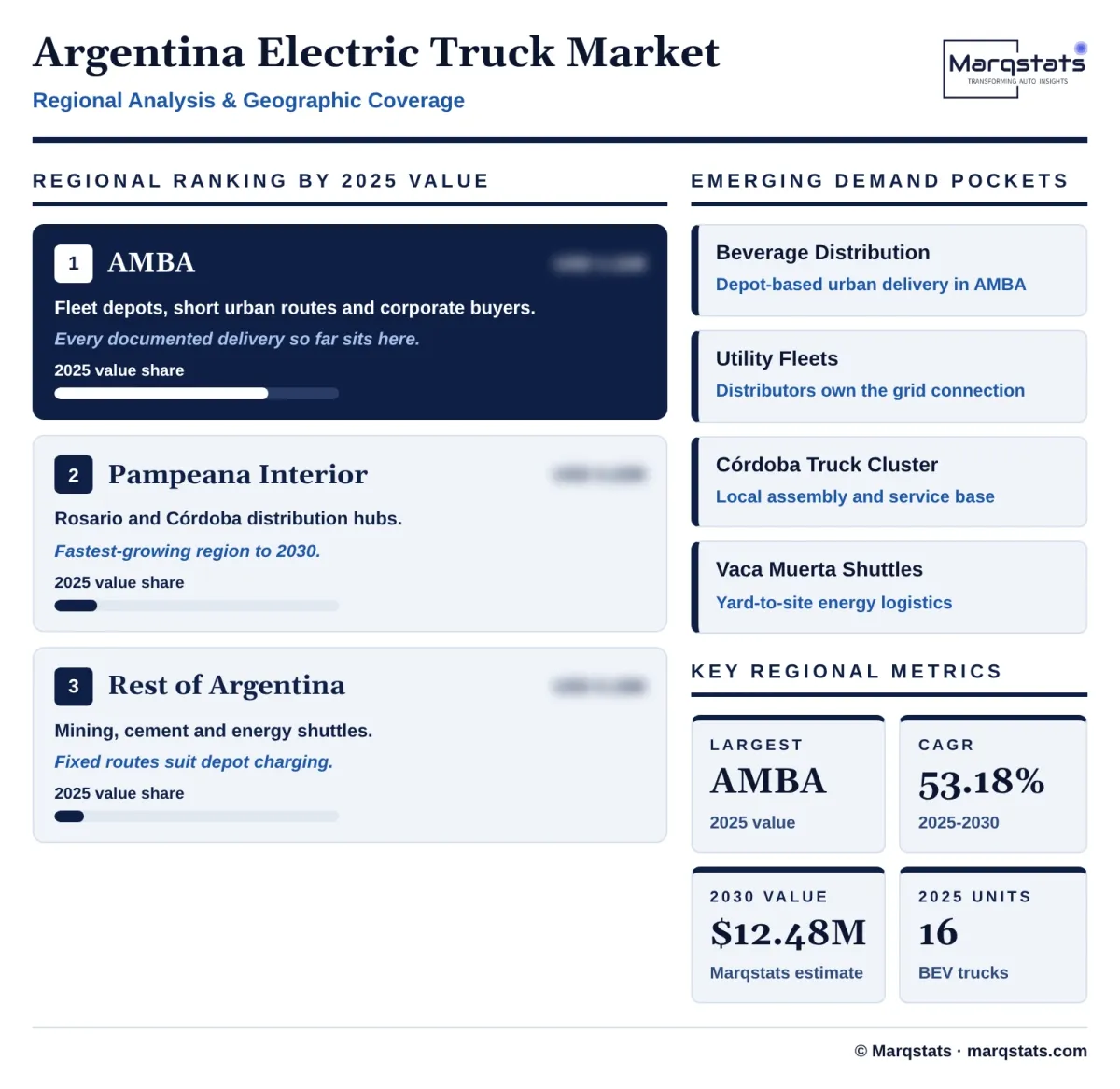
AMBA, the City of Buenos Aires and its surrounding districts, is the largest region with 75.00% of 2025 value, about USD 1.11 million. Every documented electric truck delivery so far, the e-Delivery at Mercado Central and the Edenor e-Aumark, sits inside it. Fleet headquarters, depots with medium-voltage connections and short urban routes all coincide here.
Marqstats forecasts USD 7.74 million in 2030 at a CAGR of 47.46%. AMBA share falls to 62.02% because the interior starts from a lower base, but the metropolitan area remains the place where fleet orders are signed and where most trucks are registered.
Pampeana Interior
The rest of Buenos Aires Province with Córdoba, Santa Fe, Entre Ríos and La Pampa held 14.86% of 2025 value, about USD 0.22 million, and is the fastest-growing region, reaching USD 3.00 million in 2030 at a CAGR of 68.63%. Rosario and Córdoba are logistics hubs with food, beverage and agribusiness distribution, and Córdoba hosts Volkswagen Camiones y Buses truck assembly, which gives the region a dealer and service base for electric medium trucks. The 2030 share is 24.04%.
Rest of Argentina
Cuyo, the Northwest, the Northeast and Patagonia together held 10.14% of 2025 value, about USD 0.15 million, and reach USD 1.74 million in 2030 at a CAGR of 63.26%. Demand comes from mining, cement and energy operators, including the Vaca Muerta oil and gas cluster in Neuquén, where fixed shuttles between yards and sites suit depot charging. Long distances and fewer service points keep the share at 13.94% in 2030.
How Competition Is Evolving
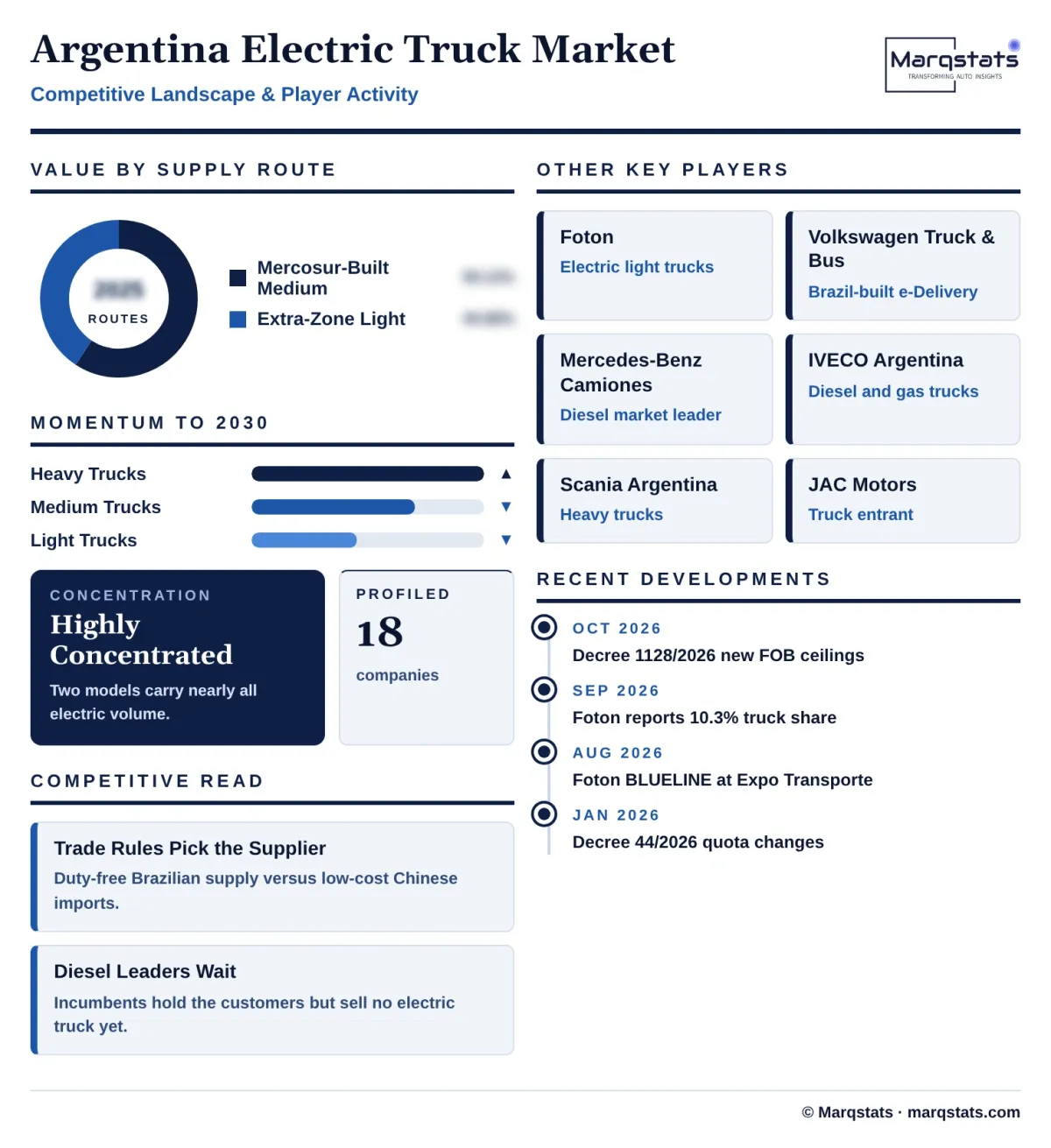
The market is highly concentrated by supply route rather than by brand competition. In 2025 extra-zone Chinese light trucks, essentially the Foton e-Aumark sold by Grupo Corven, held 40.88% of value, and Brazil-built medium trucks, led by the Volkswagen e-Delivery, held 59.12%. ACARA registration data confirm Foton at 11 battery-electric units in 2025; Marqstats does not publish a brand share for the medium class because its five units are an estimate from delivery records rather than a registry count.
The diesel leaders are absent from the electric count. Mercedes-Benz Camiones y Buses held 33.4% of the 2025 truck market and 45.9% of the light-truck segment with the Accelo, yet registered no battery-electric truck. IVECO, Scania and the locally assembled Volkswagen range likewise sold diesel and gas trucks. Their absence is a timing choice, not a capability gap: each group sells battery-electric trucks in Europe or Brazil, and each could import them duty-free from a Mercosur plant or at full duty from Europe.
Competition through 2030 will be decided by three actions. The first is a Chinese brand assembling or sourcing within Mercosur to escape the extra-zone duty. The second is an incumbent offering a Brazil-built electric medium truck with dollar list pricing and finance. The third is a large fleet order, of the kind Foton targets with its BLUELINE range, that gives one supplier a reference customer and a service base in AMBA. Marqstats profiles 18 companies and institutions across these layers.
Companies Covered
Companies covered in the report include:
Recent Market Activity
Table of Contents
Coverage & Segmentation
Included: new battery-electric trucks above 3.5 tonnes gross vehicle weight registered for road use in Argentina, in light (3.5 to 8 t), medium (8 to 16 t) and heavy (above 16 t, including tractors) classes, valued at dealer transaction price excluding IVA and including any import duty, in US dollars. History covers 2021 to 2025, the base year is 2025 and the forecast runs from 2026 to 2030.
Excluded: electric vans and pickups of 3.5 tonnes or less, such as the Renault Kangoo E-Tech, Ford E-Transit and Foton E-VIEW Connect; electric buses; off-road mining and quarry haul trucks; hybrid, natural-gas and fuel-cell trucks; chargers, depot electrical works, batteries sold separately, finance and maintenance.
Related pages and do-not-add notes: the global Electric Truck Market page contains Argentina within its emerging-market volumes, so this page is a deep-dive slice of it and should not be added to it. The Brazil Electric Truck Market and Mexico Electric Truck Market pages size other countries on the same vehicle basis; Marqstats uses the Brazil page midpoint price of USD 175,000 for Brazil-built medium trucks here. The Argentina EV Maintenance Market page sizes service spend across all electric vehicles and is a different layer; do not add. That page converts at ARS 1,200 per USD, while this page uses the verified 2025 average of ARS 1,245; dollar values are unaffected.