Market Snapshot
Middle bar: base-year value × (1 + CAGR), rounded to two decimals. This is a calculated illustration, not a separately researched annual estimate.
The Lithuania used car market size is estimated at USD 3,554.22 million in 2025 and is projected to reach USD 4,307.16 million by 2030, growing at a CAGR of 3.92% over 2026 – 2030. Used passenger car transactions ease from 386,689 to 381,165, while domestic ownership transfers lead with 57.21% of 2025 value.
Lithuania is one of the most used-car-dependent markets in the European Union. Used passenger cars outsell new ones roughly nine to one, compared with about three to one across the EU. The market runs on two flows recorded by the state registry VĮ Regitra: first registrations of imported used cars, which reached 165,470 in 2025, and domestic ownership changes, which reached 221,219. Marqstats values these 386,689 transactions at an average of EUR 8,134, or EUR 3,145.33 million, converted at the 2025 European Central Bank average rate of USD 1.13 per euro.
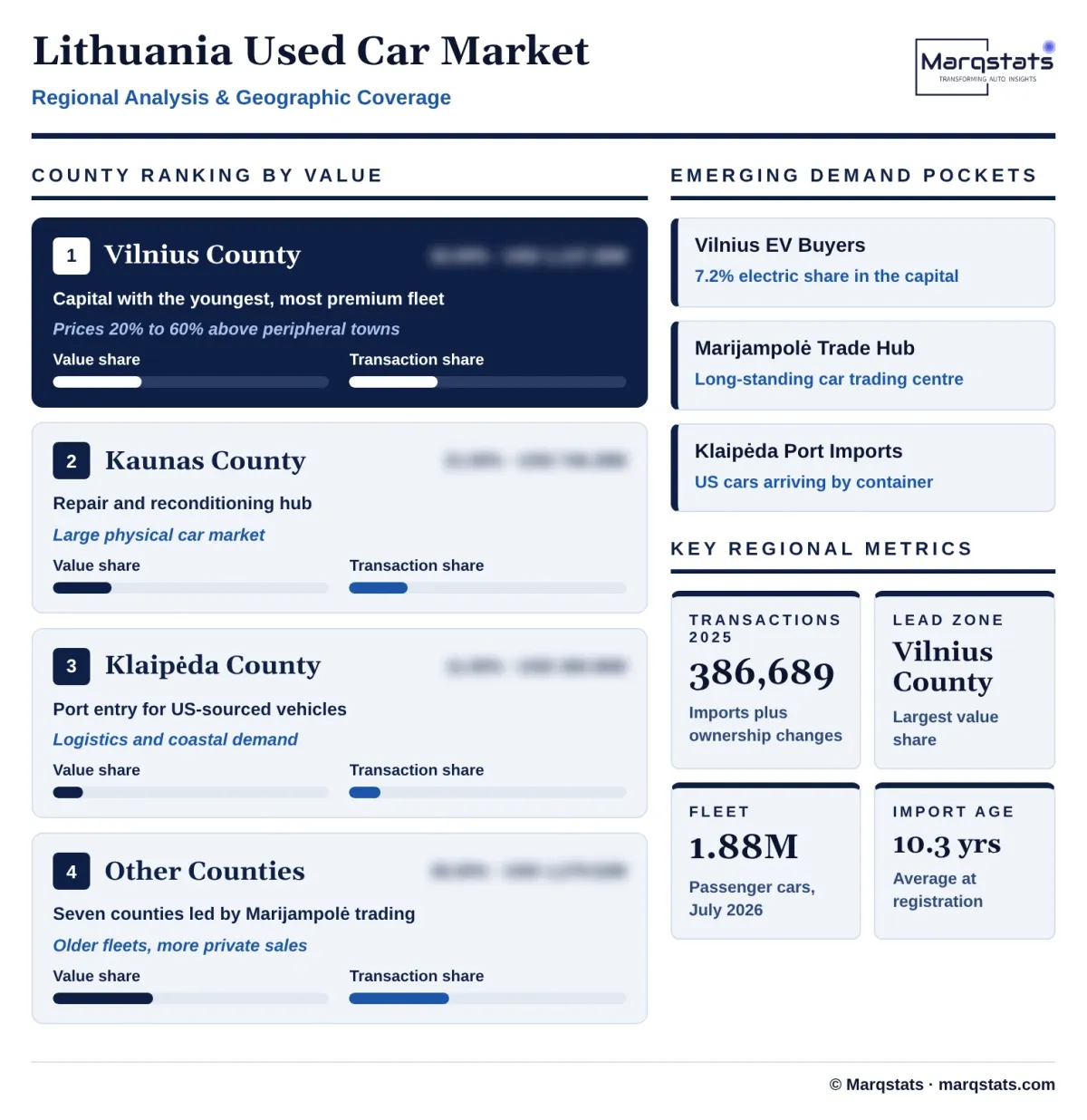
Demand is concentrated in the three largest cities. Vilnius County accounts for an estimated 32.00% of market value, Kaunas County for 21.00% and Klaipėda County for 11.00%. The study segments the market by transaction type (domestic ownership transfers and first registrations of imported used cars) and by sales channel (private sellers, independent dealers, and certified and franchise dealers), and covers M1 passenger cars only.
Key Takeaways
Market Overview & Analysis
Report Summary
Marqstats sizes the Lithuania used car market as the value of all used passenger car (M1) transactions recorded by VĮ Regitra in a year: first registrations of imported used cars and domestic ownership changes between Lithuanian owners. In 2025 these totalled 386,689 transactions, 165,470 imports and 221,219 ownership changes. Transactions are valued at an average of EUR 8,134, derived from AutoTyrimai turnover and transaction data, and converted to US dollars at the 2025 European Central Bank average of USD 1.13 per euro.
The market has a large, ageing fleet and a strong import habit. Lithuania had 1,876,309 registered passenger cars at July 2026, and cars changing owners domestically average about 14 years old. For three decades Lithuanian yards also re-exported repaired cars to Belarus, Russia and Central Asia; EU sanctions under Regulations 833/2014 and 765/2006 have curtailed that trade, so more processed stock now stays at home or goes to Latvia and Poland.
Prices diverge sharply by segment. The average price of compact and mid-size SUVs rose 9.5% between 2024 and the first half of 2026 to EUR 18,400, while mid-size saloons and estates fell 20.5% to EUR 15,500 as off-lease German diesels arrived in large numbers. Used battery electric cars fell 12.9% in 2025 to an average of EUR 24,500, pushed down by price cuts in the new EV market. Superminis fell 5.7% as buyers moved to crossovers. These shifts lift the average transaction value because buyers are trading up to higher-priced body styles.
The forecast rests on three conditions. Import volumes ease as the fleet stabilises and new-car sales take a larger share of renewal. Average values rise as hybrids, SUVs and younger Euro 6 cars replace Euro 4 and Euro 5 diesels. And the euro stays near its 2025 dollar rate. Under these conditions transactions settle at 381,165 in 2030 and market value reaches USD 4,307.16 million.
Lithuania Used Car Market Size and Forecast
The Lithuania used car market grows from USD 3,554.22 million in 2025 to USD 4,307.16 million in 2030, a CAGR of 3.92%. In euro terms the market grows from EUR 3,145.33 million to EUR 3,811.65 million. Transaction volume eases from 386,689 to 381,165, a decline of 0.29% a year, because import registrations slow as the fleet stabilises. The average transaction rises from EUR 8,134 to EUR 10,000 as the mix shifts toward younger hybrids, SUVs and dealer-sold cars.
Growth is uneven over the period. 2026 is a strong year, lifted by pension withdrawals that pushed Q2 transactions up 24%, and Marqstats expects volumes to ease in 2027 and 2028 as that demand is absorbed. Value growth continues through the period, driven by the rising share of hybrids, SUVs and certified dealer sales. Domestic ownership transfers grow at 6.68% a year in value, while imported used first registrations hold broadly flat.
Market Dynamics
Key Drivers
Five conditions support value growth, even as total transaction volume levels off.
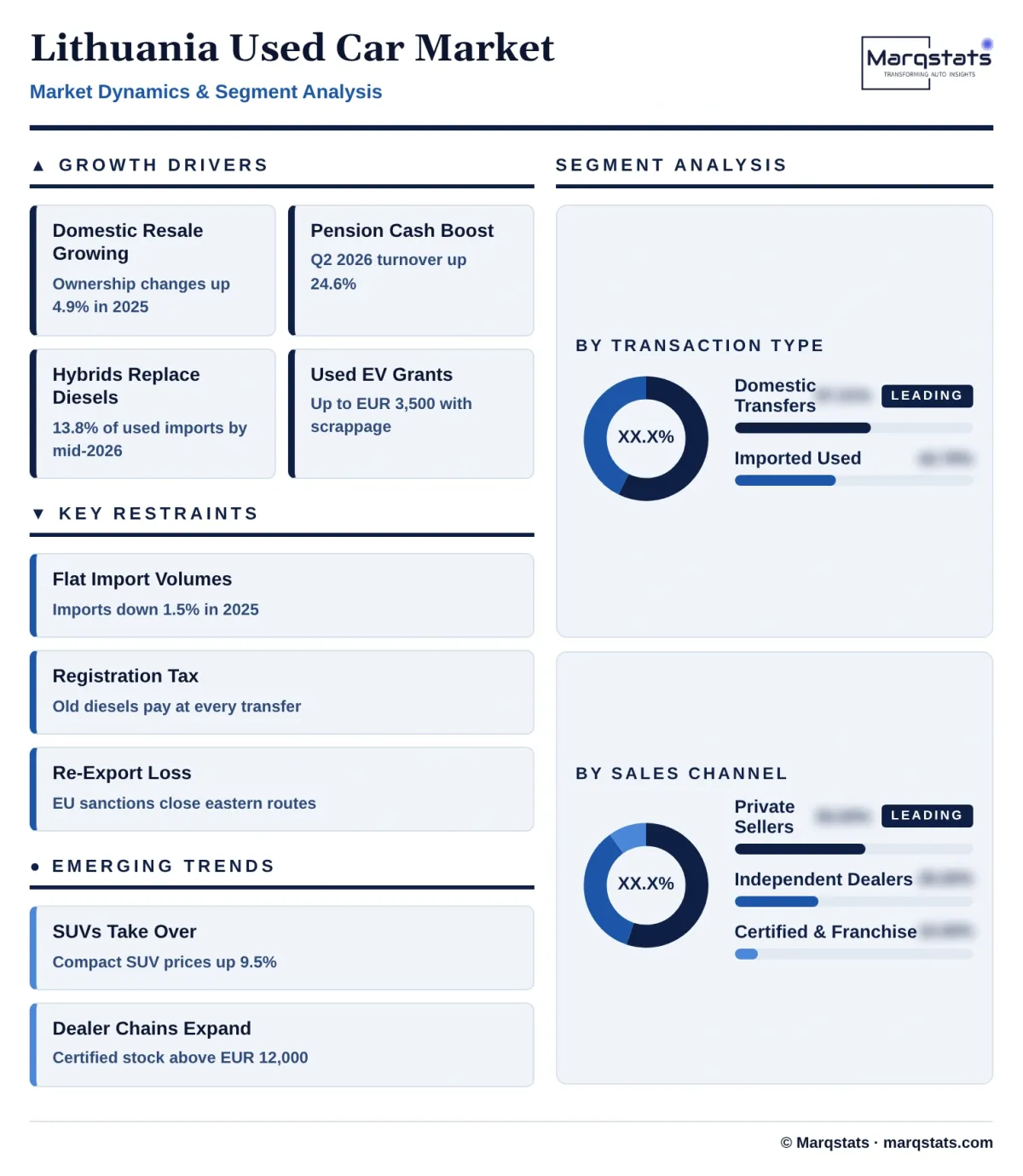
- Domestic resale is growing. Ownership changes rose 4.9% in 2025 to 221,219 and kept rising in 2026, with April transfers up 35.1% year on year to 25,524. Lithuania's fleet of 1,876,309 passenger cars is large relative to its population, so a growing share of demand is met by cars already in the country.
- Household cash and pension withdrawals are lifting demand. Second-pillar pension withdrawals paid about EUR 3 billion to some 580,000 people in the first quarter of 2026, and Q2 2026 used car turnover rose 24.6% to EUR 950.9 million. Wage growth and low unemployment support demand beyond this one-off boost. Real wages in Lithuania have grown faster than the EU average for several years, which allows more households to trade up from older diesels to younger hybrids and SUVs.
- Hybrids are replacing diesels. Hybrids reached 13.8% of used imports by mid-2026, sourced mainly from Western European lease returns. They hold value better than older diesels and pay less emissions-based registration tax, which lifts the average transaction value.
- Used EV grants support newer stock. The Environmental Projects Management Agency (APVA) offers EUR 2,500 for a used battery electric car up to four years old and EUR 1,000 for scrapping an old car, up to EUR 3,500 combined. The grants hold a price floor of about EUR 12,000 to EUR 16,000 for compact electric hatchbacks.
- Digital platforms make prices transparent. Autoplius.lt, owned by Baltic Classifieds Group, and Autogidas.lt list most used cars for sale, with VIN history checks through carVertical, SDK verification and finance calculators. Transparent pricing lowers search costs and speeds up transactions.
Key Restraints
Four constraints hold back volume and squeeze margins on older stock.
- Import volumes are flattening. Imported used registrations fell 1.5% in 2025 to 165,470, and Marqstats expects import volumes to ease through 2030 as the fleet stabilises and new-car registrations grow. With fewer imports, total transaction volume declines slightly over the forecast.
- Emissions-based registration tax penalises old diesels. The motor vehicle registration tax applies at first registration and on change of owner, and charges older, high-emission diesels EUR 200 to more than EUR 500 per transfer. The tax depresses residual values of Euro 4 and Euro 5 diesels such as the BMW X5, Audi Q7 and Volkswagen Touareg.
- Sanctions have cut off the re-export trade. EU sanctions on Russia and Belarus, tighter Lithuanian customs controls from June 2024 and manufacturer end-user declarations for Central Asian exports have closed the most profitable re-export routes for premium late-model cars. Yards that relied on re-export margins have lost volume.
- Odometer fraud still affects imported stock. Inspection data suggest a quarter or more of imported used cars carry altered mileage records, despite mileage logging at periodic technical inspection by Transeksta members and EUCARIS data sharing. Buyers pay less for cars without verified histories, which slows private sales.
Key Trends
Four shifts are changing what Lithuanians buy and how they buy it.
- SUVs are replacing estates and saloons. Average prices of compact and mid-size SUVs rose 9.5% between 2024 and the first half of 2026 to EUR 18,400, while mid-size saloons and estates fell 20.5% to EUR 15,500 as off-lease diesels flooded in. The Toyota RAV4, Volkswagen Tiguan and Peugeot 3008 are the fastest-growing used models.
- Dealer groups are institutionalising the market. BRC Autocentras, Longo Group, Inchcape Motors, Møller Auto and Wheelstreet sell inspected, warranted cars with verified SDK provenance and integrated financing. They are taking share in cars priced above EUR 12,000, leaving the sub-EUR 8,000 tier to independent yards.
- Unsecured loans are financing older cars. Bank leasing from Swedbank, SEB, Luminor and Šiaulių bankas funds cars up to eight to ten years old with comprehensive insurance, so buyers of older cars increasingly use unsecured loans from Revolut Bank, NEO Finance and other non-bank lenders, which carry no vehicle age limit.
- Vilnius commands a price premium. Used car prices in Vilnius run 20% to 60% higher than in peripheral municipalities such as Tauragė, Utena and Alytus, reflecting higher incomes and a newer, more premium and more electric fleet.
Strategic Implications
- For dealers, the growth is in value, not volume. With transactions flat and the average price rising toward EUR 10,000, dealers that stock younger hybrids and SUVs and sell them with warranties, verified SDK histories and financing will grow faster than the market. Certified and franchise dealers are forecast to grow at 12.70% a year.
- For importers, sourcing must follow the fuel shift. Diesel's share of imports fell from 62.6% to 57.2% in a year, and the registration tax punishes old diesels at every transfer. Importers should weight purchasing toward Dutch and German hybrid lease returns and Euro 6 petrol cars.
- For lenders, older cars are an underserved segment. Most transactions involve cars over ten years old that bank leasing will not fund, which leaves room for unsecured auto loans with clear pricing and fast approval.
- For platforms and data providers, verified history is the product. With a quarter or more of imported cars carrying altered mileage, buyers pay for VIN checks, inspection reports and price benchmarks. Autoplius.lt, Autogidas.lt and carVertical can deepen these services, and dealers can use them to justify higher prices on verified stock. Insurers and lenders can also use verified histories to price risk on older cars more accurately.
- The most likely path is flat volume with rising value. The research identifies no pending, dated decision that would move the 2030 value materially from the base case. Marqstats therefore states a single base case rather than alternative scenarios.
Market Segmentation
Domestic ownership changes between Lithuanian owners account for 221,219 transactions in 2025, 57.21% of the market and USD 2,033.37 million. They are the leading and faster-growing transaction type, rising to 65.22% of value and USD 2,809.13 million by 2030, a 6.68% CAGR. The cars average about 14 years old, and diesel makes up two thirds of the stream. Growth comes from the large stock of cars imported between 2015 and 2020 now reaching their second and third Lithuanian owners, and from the Q2 2026 surge, when ownership changes rose 23% year on year to 68,800. Private sales dominate this stream, but dealers increasingly take older cars as trade-ins and resell them with inspections.
First registrations of imported used cars account for 165,470 transactions in 2025, 42.79% of the market and USD 1,520.85 million. Value eases to USD 1,498.03 million by 2030, a 0.30% annual decline, and share falls to 34.78% as import volumes slow. Imports average about 10 years old, and Germany supplies close to half of them. France, the Netherlands and Belgium follow, and a smaller flow of insurance-salvage cars arrives from the United States through Klaipėda for repair. Monthly imports recovered strongly in 2026, rising 11.7% in January to August, but Marqstats expects volumes to ease after 2026 as the fleet stabilises and new-car sales take a larger share of renewal.
Private sellers account for an estimated 55.00% of 2025 value, USD 1,954.82 million across about 212,679 transactions. They remain the largest channel but their share falls to 48.00% by 2030, with value growing at 1.13% a year to USD 2,067.44 million. Private sales are concentrated in older, cheaper cars listed on Autoplius.lt and Autogidas.lt. The SDK requirement means every private listing now carries a verifiable code, which has improved trust and shortened selling times, but private sellers cannot offer warranties or financing, so buyers of newer cars are moving to dealers.
Independent dealers and yards account for an estimated 35.00% of 2025 value, USD 1,243.98 million, rising to 37.00% and USD 1,593.65 million by 2030, a 5.08% CAGR. They dominate sales below EUR 8,000 and handle most imported stock reconditioned in Kaunas, Marijampolė and Utena. Many have formalised as companies since the SDK reform and now offer consumer-loan referrals and basic warranties. Their margins on old diesels are under pressure from registration tax, so the stronger yards are shifting stock toward Euro 6 petrol cars and hybrids.
Certified and franchise dealers account for an estimated 10.00% of 2025 value, USD 355.42 million, and are the fastest-growing channel. Their share rises to 15.00% and value to USD 646.07 million by 2030, a 12.70% CAGR, as Inchcape, Møller Auto, BRC Autocentras and Longo expand certified used programmes. These dealers offer manufacturer-backed inspections, warranties of up to two years, verified mileage and leasing at bank rates. Their stock is younger and more expensive than the market average, so a small share of transactions accounts for a growing share of value.
By Geography
Vilnius County
Vilnius County is the largest regional market, with an estimated 32.00% of 2025 value, about USD 1,137.35 million. Higher incomes, a younger and more premium fleet and a 7.2% electric share in the capital support prices 20% to 60% above peripheral towns. Franchise dealers, certified used centres and leasing companies are concentrated here. The Gariūnai market on the western edge of the city remains a reference point for budget cars, while buyers of newer hybrids and SUVs use dealer showrooms and online platforms. Marqstats expects Vilnius County to gain share slightly as the market moves upmarket.
Kaunas County
Kaunas County accounts for an estimated 21.00% of 2025 value, about USD 746.39 million. Kaunas is a hub for vehicle repair and reconditioning and hosts one of the largest physical car markets, so it handles a large share of imported stock before resale. Repaired cars from Kaunas yards are sold across Lithuania and to buyers in Latvia and Poland, and the county has a strong base of independent dealers serving buyers in the sub-EUR 8,000 tier.
Klaipėda County
Klaipėda County accounts for an estimated 11.00% of 2025 value, about USD 390.96 million. The Port of Klaipėda receives container shipments of US-sourced vehicles, and the county has strong demand from port, logistics and coastal tourism businesses. Repair yards near the port recondition US-sourced cars to EU standards before resale, and the county has a higher share of petrol cars than the national average because of these imports.
Other Counties
The remaining seven counties account for an estimated 36.00% of 2025 value, about USD 1,279.52 million. Marijampolė is a long-standing car trading centre, and Šiauliai, Panevėžys, Alytus, Utena, Tauragė and Telšiai counties have older fleets, lower prices and a higher share of private sales. Marijampolė in particular combines a historic car market with repair, logistics and export businesses that serve buyers from across the Baltic states. County shares are a Marqstats allocation based on registry and listing distribution.
How Competition Is Evolving
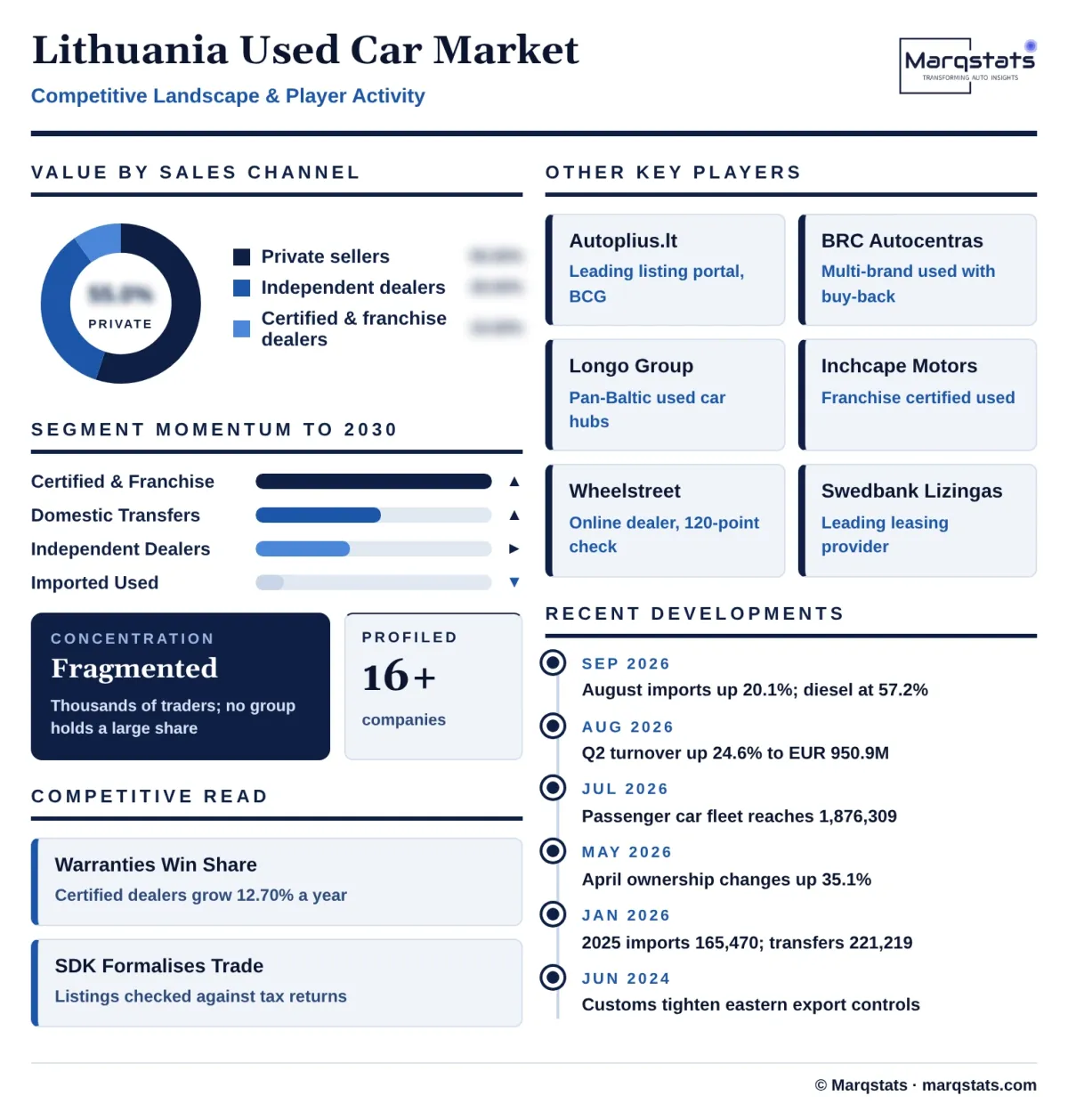
The Lithuania used car market is fragmented. Marqstats estimates private sellers account for 55.00% of 2025 value, independent dealers and yards for 35.00% and certified and franchise dealers for 10.00%. Thousands of small traders operate, many of them now registered as companies or individual businesses following the SDK reform, and no dealer group holds a large share of transactions.
Organised retail is consolidating. BRC Autocentras sells multi-brand used cars with buy-back leasing and warranties in Vilnius and Kaunas. Longo Group runs pan-Baltic used car hubs with central reconditioning and fixed prices. Inchcape Motors and Møller Auto run manufacturer-backed used programmes for BMW, Ford, Mazda, Volkswagen and Audi, and Wheelstreet sells online with a 120-point inspection and delivery.
Competition is moving from price to trust. Buyers fear hidden accident damage, flood exposure and altered odometers, so dealers now compete on inspection reports, verified service histories from carVertical and Regitra, and written warranties. Longo publishes fixed prices online and buys cars outright, while Wheelstreet offers a 120-point inspection and home delivery. Smaller yards respond by partnering with inspection firms and finance brokers. This shift favours dealers with capital to hold younger, more expensive stock.
Platforms and lenders shape competition. Autoplius.lt, owned by Baltic Classifieds Group, is the leading listing portal, with Autogidas.lt strong in budget and regional listings. Swedbank, SEB, Luminor and Šiaulių bankas dominate leasing, while Revolut Bank and NEO Finance compete in unsecured auto loans. Dealers that combine verified histories, warranties and financing are best placed to take share from private sales.
Companies Covered
Companies covered in the report include:
Recent Market Activity
Table of Contents
Coverage & Segmentation
The study covers the Lithuania used car market nationally, with 2025 as the base year, 2021 – 2025 as the historical period and 2026 – 2030 as the forecast period. Values are in US dollars, converted from euros at the 2025 European Central Bank average of USD 1.13 per euro. The market is defined as the value of used passenger car (M1) transactions recorded by VĮ Regitra: first registrations of imported used cars and domestic ownership changes. It is segmented by transaction type and sales channel.
Light commercial vehicles, motorcycles, buses and trucks are excluded, as are new-car sales, vehicles re-exported without Lithuanian registration, and finance, insurance and aftersales revenue. The average transaction value, the channel splits and the county allocation are Marqstats estimates built on Regitra registry data and AutoTyrimai market statistics.