Market Snapshot
The India electric two-wheeler components market size is estimated at USD 1,217.79 million in 2025 and is projected to reach USD 3,742.25 million by 2030, growing at a CAGR of 25.17% over 2026 – 2030. Demand follows 1,342,248 electric two-wheelers registered in 2025, rising to an estimated 4,450,000 by 2030.
Marqstats defines the market as the value of electric-drive components fitted to high-speed electric scooters and motorcycles in India: the traction battery pack with its battery management system, the traction motor, the motor controller, the charger and DC-DC converter, the vehicle control unit with telematics and the digital cluster, the high- and low-voltage wiring harness, and the reduction gear or belt drive. It covers original equipment supply at OEM transfer price and replacement parts sold for the vehicles in service. Frames, body panels, suspension, brakes, wheels and tyres are excluded, because they are common to petrol two-wheelers.
The battery pack and BMS account for 57.70% of 2025 value, original equipment supply for 94.95% and South India for 70.14%, where TVS Motor Company, Ather Energy, Ola Electric and Hero MotoCorp assemble their electric scooters. The aftermarket grows fastest, at 45.05% a year. The study segments the market by component, vehicle type, sales channel and region.
Key Takeaways
Market Overview & Analysis
Report Summary
Marqstats sizes the India electric two-wheeler components market as the value of the electric-drive content in high-speed electric scooters and motorcycles, at the price the vehicle maker pays its supplier or its own captive unit, plus the value of replacement parts bought for vehicles in service. In 2025 that content averaged about INR 74,950 per vehicle, or USD 861.49 at the 2025 average rate of INR 87.00 per US dollar, across 1,342,248 registrations, giving USD 1,156.34 million of factory supply and USD 61.45 million of replacement demand.
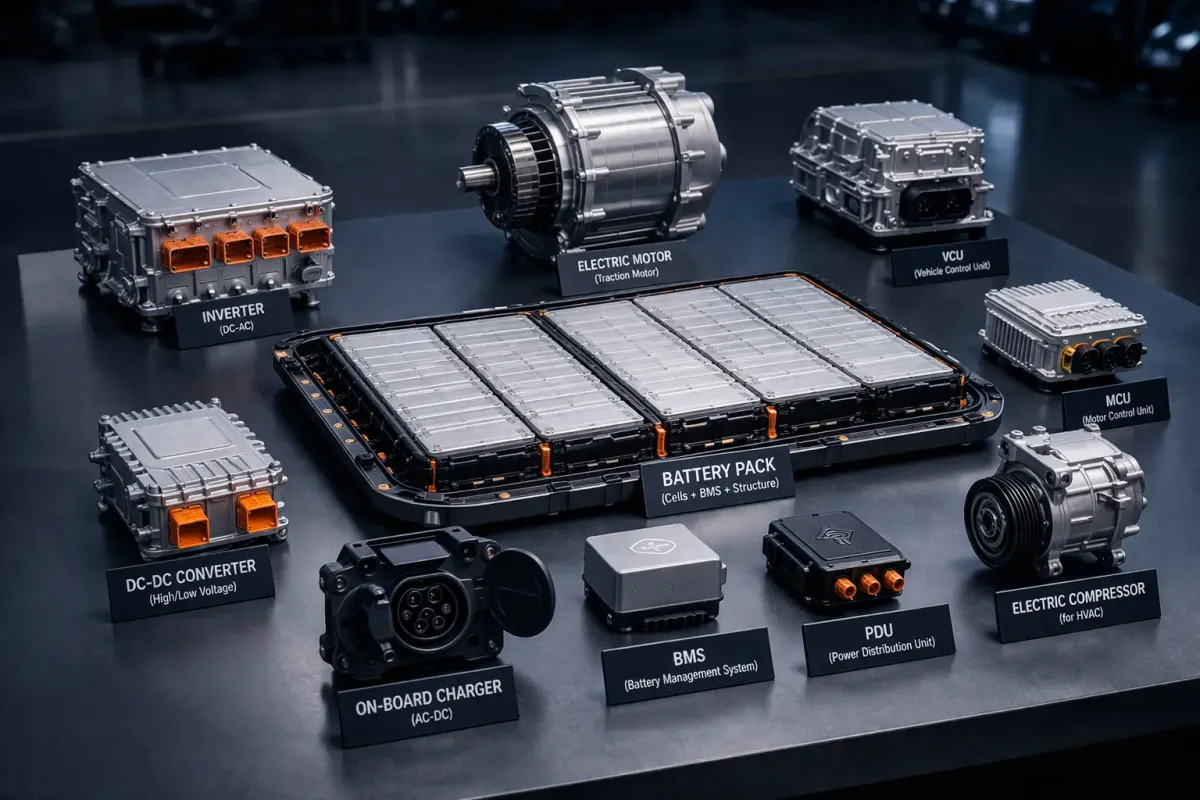
An electric two-wheeler differs from a petrol scooter in seven assemblies. A lithium-ion pack of about 2 to 5 kWh, built from cylindrical 18650 or 21700 cells or from prismatic or pouch cells, stores the energy and carries a battery management system that measures cell voltages and temperatures and isolates the pack on a fault. A permanent magnet motor, mounted in the rear hub or in the frame as a mid-drive, turns the wheel through a belt, chain or reduction gear. A motor controller switches the battery current through MOSFET power stages. A charger, carried on board or supplied as a portable unit, and a DC-DC converter for the 12-volt circuit complete the power path, while a vehicle control unit, a telematics module and a digital cluster run the software and the rider interface.
These parts are made by three groups of companies. Integrated vehicle makers such as Ola Electric Mobility and Ather Energy design their own packs, controllers and software and assemble packs in their own plants. Legacy two-wheeler makers such as TVS Motor Company, Bajaj Auto and Hero MotoCorp assemble packs in house in several cases but buy motors, controllers, chargers, clusters and harnesses from Tier 1 suppliers. Specialist suppliers including Sona BLW Precision Forgings, Uno Minda, Minda Corporation, Sedemac Mechatronics, Lucas TVS, Bosch Limited, Pricol and Samvardhana Motherson International supply those parts, and cell makers such as Exide Energy Solutions and Amara Raja Energy and Mobility are starting domestic cell output.
Two official series describe the vehicle base and they differ. The VAHAN registration database of the Ministry of Road Transport and Highways records 1,342,248 electric two-wheelers in calendar 2025, while the Federation of Automobile Dealers Associations (FADA) reports 1,279,951 retail units, a series that leaves out Telangana. Marqstats uses the VAHAN total for volume because components are fitted to every vehicle registered, and uses the FADA maker split for shares.
Rules shape the content. Battery packs must meet AIS-156 with its third amendment, which added thermal propagation, ingress and BMS requirements in two phases from December 2022 and March 2023, and cells must be certified under IS 16893. PM E-DRIVE support requires a localised bill of materials, and the GST Council kept electric vehicles at 5% when the September 2025 reform cut petrol two-wheelers up to 350 cc from 28% to 18%, while lithium-ion batteries sold separately stay at 18%.
India Electric Two-Wheeler Components Market Size and Forecast
The India electric two-wheeler components market grows from USD 1,217.79 million in 2025 to USD 3,742.25 million in 2030, a CAGR of 25.17%. Marqstats expects USD 1,915.40 million in 2026, USD 2,354.06 million in 2027, USD 2,800.04 million in 2028 and USD 3,275.98 million in 2029. In rupee terms the market rises from about INR 10,595 crore to INR 32,558 crore.
2026 is the year of the step change. Provisional VAHAN data put September 2026 registrations at about 2.03 lakh, up about 85% from 1,04,056 in September 2025, with TVS Motor Company, Bajaj Auto, Ather Energy and Hero MotoCorp all growing faster than the market they served a year earlier. Marqstats therefore places 2026 registrations at about 2,170,000 and component value at USD 1,915.40 million, then slows growth to 2,700,000 vehicles in 2027, 3,250,000 in 2028, 3,850,000 in 2029 and 4,450,000 in 2030, a 27.09% annual rate from the 2025 base.
The base is built from content per vehicle. Marqstats estimates average 2025 OEM transfer prices of INR 43,750 for the battery pack and BMS, INR 8,500 for the traction motor, INR 6,000 for the motor controller, INR 4,000 for the charger and DC-DC converter, INR 6,500 for the VCU, telematics and cluster, INR 2,700 for the wiring harness and INR 3,500 for the transmission and drive hardware, a total of INR 74,950. That total of USD 861.49 sits inside the USD 800 to 1,200 per electric two-wheeler range on the live Marqstats India Electric Vehicle Components page.
Content falls while volume rises. Marqstats expects the battery line to fall from INR 43,750 to INR 36,000 per vehicle, the motor from INR 8,500 to INR 7,600 and the controller from INR 6,000 to INR 5,000, while electronics and transmission content rise with connected features and a larger share of electric motorcycles. Average content therefore falls to INR 65,450 in 2030.
The aftermarket is built from the fleet. Marqstats estimates about 2,797,000 high-speed electric two-wheelers in service at the start of 2025 and about 15,601,597 at the start of 2030. Replacement packs rise from 2.0% to 3.0% of that fleet a year as early vehicles leave their battery warranties, and other replacement spending rises from about INR 1,050 to INR 1,150 per vehicle in service each year.
Marqstats tracks four indicators to monitor the forecast: monthly VAHAN electric two-wheeler registrations and the electric share of all two-wheelers, the use of the PM E-DRIVE electric two-wheeler allocation to 31 March 2028, the start of domestic cell output at Exide Energy Solutions and Amara Raja, and the price of imported cells and rare earth magnets.
Market Dynamics
Key Drivers
Five forces are lifting component demand faster than the electric two-wheeler market itself.
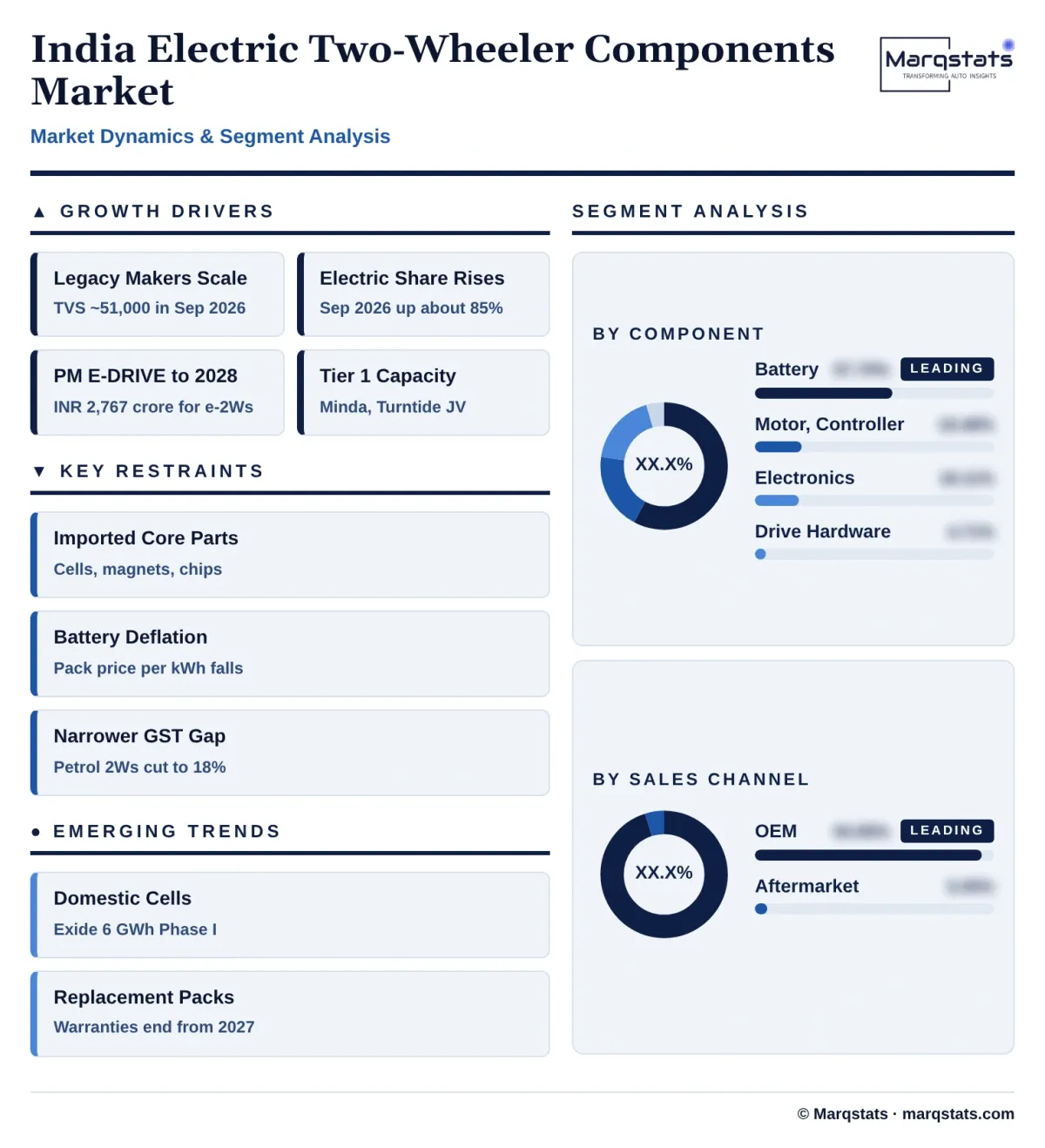
- Legacy makers are scaling electric output. Provisional VAHAN data for September 2026 put TVS Motor Company at about 51,000 electric two-wheelers and Hero MotoCorp at about 23,000, up about 124% and 81% from a year earlier, and both buy most of their motors, controllers, chargers and clusters from Tier 1 suppliers, which turns their volume directly into supplier orders.
- Electric share of all two-wheelers is rising. FADA put electric models at 6.31% of the 20,295,650 two-wheelers retailed in 2025, and with monthly electric registrations up about 85% in September 2026, every point of share adds about 200,000 vehicles a year at current market size.
- PM E-DRIVE support runs to March 2028. The Ministry of Heavy Industries amended the scheme on 10 August 2026, raising total outlay from INR 10,900 crore to INR 11,900 crore, the electric two-wheeler allocation from INR 1,772 crore to INR 2,767 crore and the supported volume from 2,479,120 to 4,579,120 vehicles, with support only for models priced up to INR 1.5 lakh ex-factory.
- Localisation incentives favour domestic suppliers. The Production Linked Incentive scheme for automobiles and auto components, with an outlay of INR 25,938 crore, rewards advanced automotive technology parts with at least 50% domestic value addition, and the INR 18,100 crore advanced chemistry cell scheme supports 50 GWh of cell capacity.
- Tier 1 suppliers are adding electric capacity. Minda Corporation agreed in March 2026 to form a motor and controller joint venture with Turntide Technologies, and component makers such as Sona BLW Precision Forgings, Uno Minda and Lucas TVS now treat electric two-wheeler motors, controllers and chargers as core product lines rather than side projects.
Key Restraints
Four constraints hold back value growth and keep core content imported.
- Core materials are still imported. Cells, rare earth magnets and power semiconductors come mostly from China and other Asian suppliers, and China's controls on rare earth exports in 2025 showed how quickly a magnet shortage can hold back motor supply, which is why the Union Cabinet approved a INR 7,280 crore scheme for 6,000 tonnes a year of domestic sintered magnet capacity on 26 November 2025.
- Battery prices deflate value. Marqstats expects the OEM pack price to fall by about a quarter per kWh between 2025 and 2030, so the largest component line grows more slowly than vehicle volume and the market value grows at 25.17% a year against 27.09% for vehicles.
- The tax gap with petrol models narrowed. The September 2025 GST reform kept electric vehicles at 5% but cut petrol two-wheelers up to 350 cc from 28% to 18%, which halves the tax advantage of an electric scooter at the showroom and keeps vehicle makers pressing suppliers on price.
- The subsidy is small and capped. The PM E-DRIVE incentive is INR 2,500 per kWh, capped at INR 5,000 a vehicle and at 15% of the ex-factory price, so it no longer covers the cost gap and vehicle makers recover it through cheaper packs and fewer variants.
Key Trends
Four shifts are changing what an Indian electric two-wheeler kit contains and who supplies it.
- Domestic cells start to arrive. Exide Energy Solutions completed Phase I of its 6 GWh lithium-ion cell plant at Devanahalli near Bengaluru in September 2026, and Amara Raja opened a customer qualification plant at Divitipalli in Telangana in July 2026 to validate cylindrical and prismatic cells for electric vehicle makers, with 2 GWh of bulk output planned from June 2027.
- Joint ventures bring motor and controller technology. Minda Corporation agreed in March 2026 to form a joint venture with Turntide Technologies, holding 49% against 51% for Turntide, to make motor controllers, electric motors and thermal pumps for Indian vehicle makers.
- Software becomes part of the kit. Vehicle makers sell connected features through apps and over-the-air updates, so the vehicle control unit, telematics module and TFT cluster gain content while hardware lines deflate.
- Replacement packs become a business. Vehicles sold in the 2022 to 2024 growth years leave their battery warranties between 2027 and 2030, so vehicle makers, battery assemblers and independent workshops are building refurbishment and replacement channels for packs, chargers and controllers.
Strategic Implications
- For Tier 1 suppliers, the legacy makers are the anchor customers. TVS Motor Company, Bajaj Auto and Hero MotoCorp hold more than half of retail and buy motors, controllers, chargers and clusters externally, so suppliers that qualify on their next platforms secure multi-year volume, while integrated makers buy mainly mechanical and electrical parts.
- For new entrants, electronics and replacement parts are the open ground. Battery lines face deflation and captive competition, while VCUs, telematics, clusters, chargers and replacement controllers keep content per vehicle and do not require a cell plant.
- For vehicle makers, localisation is now a cost lever as much as a subsidy condition. Domestic cells from Exide Energy Solutions and Amara Raja and domestic magnets under the INR 7,280 crore scheme reduce exposure to import controls and currency swings, which matters more than an incentive capped at INR 5,000 a vehicle.
- For battery and service businesses, the replacement wave starts in 2027. Packs from the vehicles sold in the 2022 to 2024 growth years leave warranty, and companies that can test, refurbish and replace packs at scale will capture a layer that Marqstats expects to grow at about 45% a year.
- For investors, content per vehicle is the figure to watch. Vehicle volume is visible every month on VAHAN, but the value that reaches suppliers depends on the pack price per kWh and on how much electronics each model carries, so supplier disclosures on kit value are a better guide to revenue than registrations alone.
Market Segmentation
Battery packs and battery management systems account for 57.70% of 2025 value, USD 702.67 million, rising to USD 2,029.66 million by 2030, a 23.63% CAGR, while their share falls to 54.23%. Marqstats estimates an average OEM pack of about 3.2 kWh at about INR 13,672 per kWh in 2025, including cells, BMS, enclosure, busbars and thermal barriers required under AIS-156. The 2025 value matches the USD 702.67 million on the live Marqstats India Electric Two-Wheeler Battery page; the forecast here holds a slower path because it applies cell price deflation, so the two forecasts should not be added or mixed.
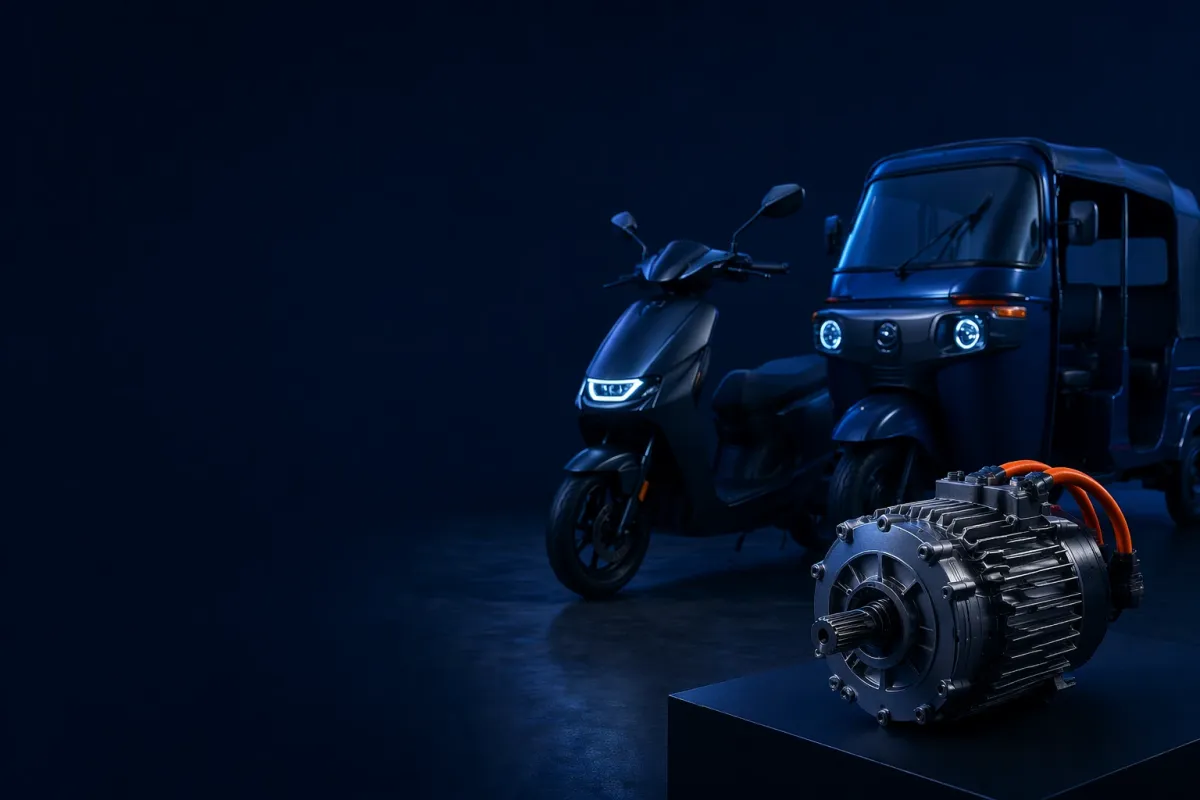
Traction motors account for 11.27% of 2025 value, USD 137.22 million, and reach USD 425.86 million by 2030, a 25.42% CAGR. Hub motors dominate low-cost scooters, while mid-drive permanent magnet motors with belt or chain drives serve Ather Energy, Ola Electric and TVS Motor Company models. Each motor carries an imported neodymium magnet, the part targeted by the INR 7,280 crore rare earth magnet scheme.
Motor controllers account for 8.21% of 2025 value, USD 100.00 million, rising to USD 301.12 million by 2030, a 24.67% CAGR. Sedemac Mechatronics, Lucas TVS, Bosch Limited and Minda Corporation supply controllers to vehicle makers that do not design their own, and the Minda Corporation joint venture with Turntide Technologies adds a new controller source.
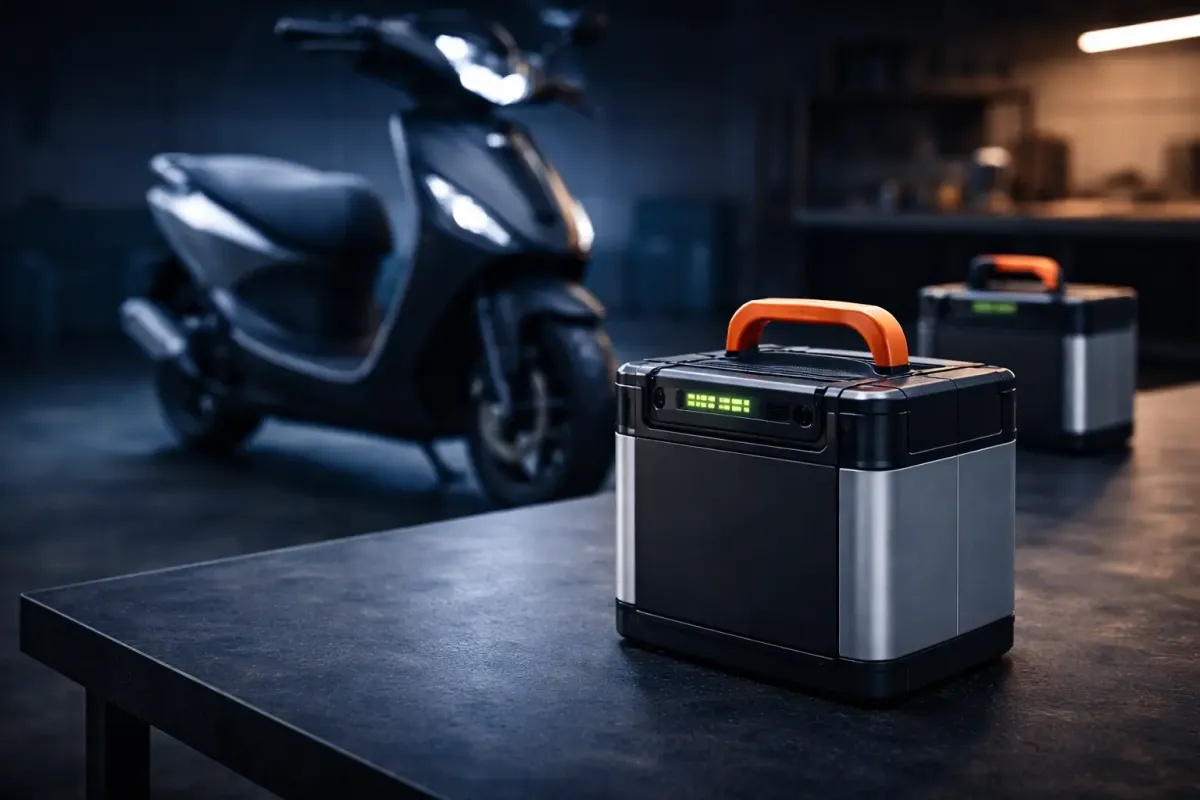
Chargers and DC-DC converters account for 5.90% of 2025 value, USD 71.84 million, and grow at 26.83% a year to USD 235.78 million. Most electric scooters are charged from a home socket through an on-board or portable charger, which is also one of the parts most often replaced in service.
Vehicle control units, telematics modules and digital clusters account for 8.57% of 2025 value, USD 104.33 million, and reach USD 372.56 million by 2030, a 28.99% CAGR, as content per vehicle rises with connected features. Pricol, Uno Minda and Minda Corporation supply clusters and connected modules to legacy makers, while Ather Energy and Ola Electric write their own software.
Wiring harnesses and connectors account for 3.64% of 2025 value, USD 44.36 million, rising to USD 157.16 million by 2030, a 28.79% CAGR. Samvardhana Motherson International and Minda Corporation supply harnesses that join the pack, controller, motor and electronics at 48 to 96 volts. The live Marqstats India EV Wire Harness page covers all electric vehicle types and is a broader parent of this line.
Transmission and drive hardware, meaning the reduction gear, belt or chain drive and motor mounting, accounts for 4.71% of 2025 value, USD 57.37 million, and grows at 30.86% a year to USD 220.11 million as electric motorcycles, which use chain drives and larger gears, gain share.
Electric scooters account for 96.42% of 2025 value, USD 1,174.14 million, and reach USD 3,336.11 million by 2030, a 23.23% CAGR. Step-through frames leave room for a floorboard or under-seat pack, and the best-selling models from TVS Motor Company, Bajaj Auto, Ather Energy, Hero MotoCorp and Ola Electric are all scooters.
Electric motorcycles account for 3.58% of 2025 value, USD 43.65 million, and grow fastest at 56.22% a year to USD 406.14 million and 10.85% of the market by 2030. Marqstats estimates about 33,556 electric motorcycles in 2025, about 2.5% of units, rising to about 356,000 by 2030, and content per motorcycle about 1.45 times the scooter average because of larger packs, stronger motors and chain drives.
Factory supply accounts for 94.95% of 2025 value, USD 1,156.34 million, and reaches USD 3,347.73 million by 2030, a 23.69% CAGR, as content per vehicle falls from INR 74,950 to INR 65,450 while volume grows at 27.09% a year.
Replacement parts account for 5.05% of 2025 value, USD 61.45 million, and grow fastest, at 45.05% a year, to USD 394.52 million and 10.54% of the market by 2030. Replacement packs rise from about 55,940 to 468,050 a year, a 52.94% annual rate, and chargers, controllers, motors and clusters make up the rest.
By Geography
South India
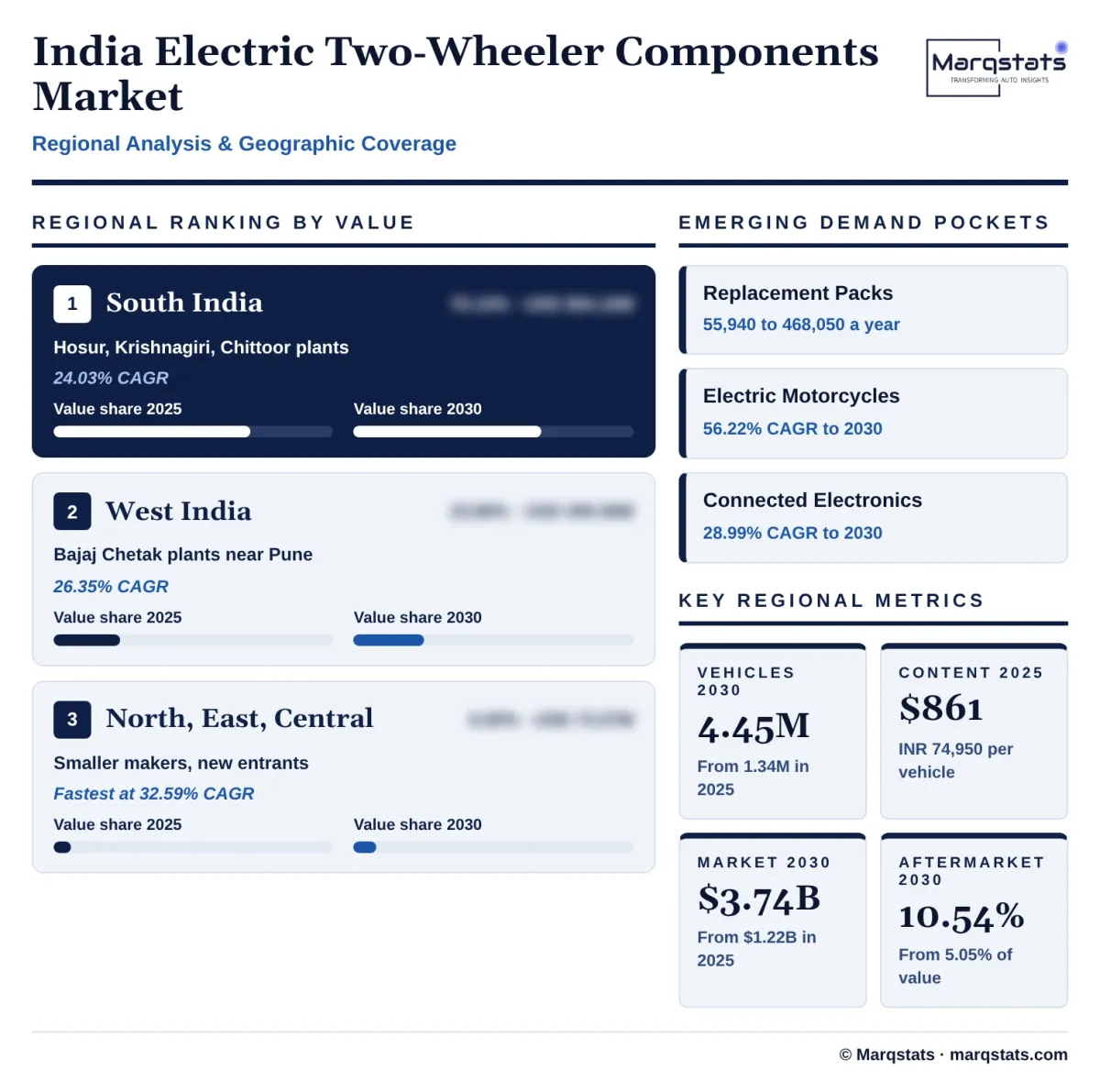
South India accounts for 70.14% of 2025 value, USD 854.16 million, and reaches USD 2,507.31 million by 2030, a 24.03% CAGR, while its share eases to 67.00%. Marqstats allocates value by where vehicles are assembled, because that is where components are delivered. TVS Motor Company and Ather Energy build in Hosur, Ola Electric at its Krishnagiri plant, Greaves Electric Mobility in Ranipet, Hero MotoCorp at Chittoor, River at Hoskote and Pure EV in Hyderabad, and these makers held 70.14% of FADA-tracked retail in 2025. The Amara Raja cell corridor in Telangana and supplier clusters around Hosur and Bengaluru strengthen the region further.
West India
West India accounts for 23.86% of 2025 value, USD 290.56 million, rising to USD 935.56 million by 2030, a 26.35% CAGR, and its share rises to 25.00%. Bajaj Auto builds the Chetak range near Pune, where BGAUSS and Kinetic Green also assemble, and Pune is also home to the controller maker Sedemac Mechatronics. Bajaj Auto held 21.08% of FADA-tracked retail in 2025, and provisional VAHAN data put it at about 23.5% of September 2026 registrations.
North, East and Central India
North, East and Central India account for 6.00% of 2025 value, USD 73.07 million, and grow fastest, at 32.59% a year, to USD 299.38 million and 8.00% of the market by 2030. The region holds smaller makers in Haryana, Rajasthan and Uttar Pradesh, and Marqstats expects new electric scooters from makers with plants in the north to add volume in the later years of the forecast.
How Competition Is Evolving
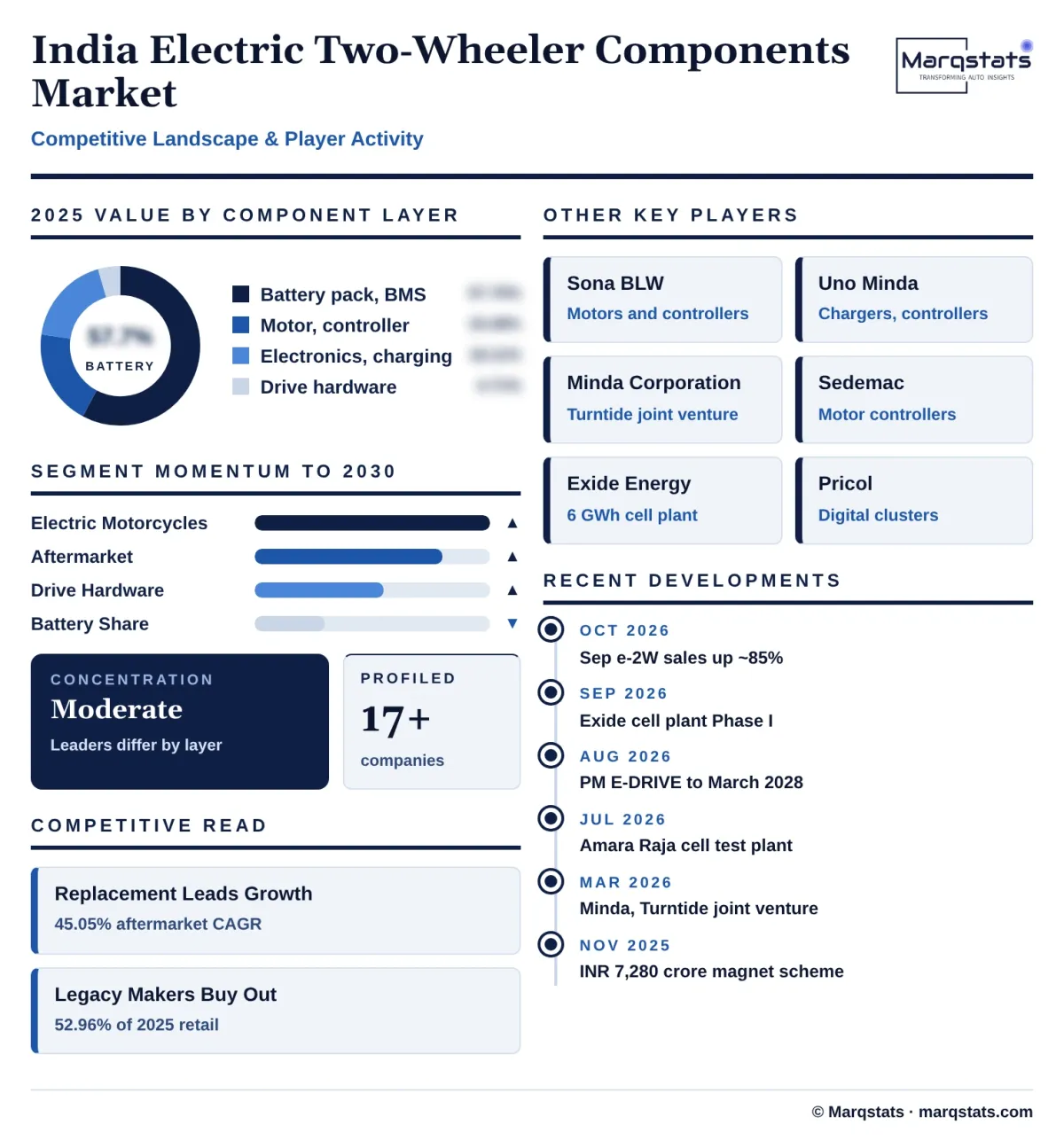
The supply side is split by component rather than concentrated in one layer. Battery packs are assembled largely in house by Ola Electric Mobility, Ather Energy, TVS Motor Company and Bajaj Auto, or bought from pack makers, with cells imported or, from 2026, partly sourced from Exide Energy Solutions. Motors and controllers come from a mix of captive units and Tier 1 suppliers including Sona BLW Precision Forgings, Lucas TVS, Bosch Limited, Sedemac Mechatronics and Minda Corporation. Clusters, chargers and harnesses come from Pricol, Uno Minda, Minda Corporation and Samvardhana Motherson International.
Vehicle maker shares decide supplier shares. FADA reported 2025 retail of 298,881 for TVS Motor Company, 269,847 for Bajaj Auto, 200,797 for Ather Energy, 199,318 for Ola Electric, 109,168 for Hero MotoCorp and 56,486 for Greaves Electric Mobility, out of 1,279,951. Provisional VAHAN data for September 2026 put TVS Motor Company at about 26.3% of registrations, Bajaj Auto at about 23.5%, Ather Energy at about 14.7%, Hero MotoCorp at about 11.7% and Ola Electric at about 6.5%, so the integrated makers lost share to makers that buy more of their kit.
Marqstats describes competition by component layer, since suppliers report electric parts inside wider segments. Battery packs and BMS account for 57.70% of 2025 value, motors and controllers for 19.48%, electronics, chargers and harnesses for 18.11% and transmission hardware for 4.71%. Each layer has different leaders, and no supplier leads more than two layers.
Partnerships with foreign technology owners are the usual route into the market. Minda Corporation formed its joint venture with Turntide Technologies in March 2026, Sona BLW Precision Forgings supplies motors and controllers built on its own designs, and cell makers have licensed chemistries from overseas partners to start domestic output.
Barriers rise with each rule. A pack must pass AIS-156 tests, cells need IS 16893 certification, and vehicles seeking PM E-DRIVE support need a localised bill of materials, so suppliers with test facilities and audit-ready records hold an advantage over traders that import finished parts.
Companies Covered
Companies covered in the report include:
Recent Market Activity
Table of Contents
Coverage & Segmentation
The study covers the India electric two-wheeler components market, with 2025 as the base year and 2026 – 2030 as the forecast period. Values are in US dollars at INR 87.00 per US dollar, the 2025 average, at OEM transfer price for factory supply and at trade price for replacement parts. It covers battery packs and BMS, traction motors, motor controllers, chargers and DC-DC converters, VCUs with telematics and clusters, wiring harnesses and transmission hardware for high-speed electric scooters and motorcycles, segmented by component, vehicle type, sales channel and region.
Frames, body panels, suspension, brakes, wheels, tyres, low-speed electric two-wheelers, electric three-wheelers, charging stations and battery swapping services are excluded. The coverage is a two-wheeler subset of the live Marqstats India Electric Vehicle Components report, and its battery and motor lines sit inside the live India Electric Two-Wheeler Battery and India Two-Wheeler and Three-Wheeler Motor reports, so the figures must not be added to them. Splits and the forecast are Marqstats estimates.