Market Snapshot
The India electric truck charging infrastructure market is valued at USD 15.30 million in 2025 and reaches USD 173.24 million by 2030, a CAGR of 62.48%. Captive depot chargers, OEM-run battery swap stations and the first corridor plazas carry the growth, while publicly funded truck chargers have yet to be installed.
The market is small because the truck fleet behind it is small. India sold roughly 800 heavy-duty electric trucks in 2025, the figure NITI Aayog Member Rajiv Gauba gave at the fifth e-FAST India Summit on 7 September 2026. VAHAN shows 821 electric N3 trucks registered between January and July 2026, out of 196,103 heavy goods carriers, so the fleet is still below half a percent of new heavy-truck registrations. Every truck that does arrive, however, brings a dedicated charger or swap slot with it, because no shared public network exists yet that can serve a 55-tonne tractor on a working schedule.
Marqstats sizes this market as the installed value of truck-dedicated charging positions in each year: depot DC chargers, corridor ultra-fast and megawatt-class chargers, and heavy-duty battery swap stations, each priced with its grid connection, electrical balance of plant, civil works, installation and site software. The construction converts at a fixed INR 87.00 per USD. In 2025 it equals INR 133.1 crore of spend; by 2030 it reaches about INR 1,507.2 crore. Charger hardware alone is the smaller half of every rupee. That matters.
Key Takeaways
Market Overview & Analysis
Report Summary
Electric trucks in India are past the demonstration stage and have not yet reached the network stage. That gap defines the infrastructure market. The Ministry of Heavy Industries notified a dedicated e-truck incentive on 10 July 2025, worth INR 500 crore for 5,643 trucks, paying INR 5,000 per kWh of battery up to a cap of INR 9.6 lakh per vehicle and conditional on scrapping an older diesel truck. Heavy e-truck sales then roughly quadrupled, from about 200 in 2024 to about 800 in 2025. Yet the scheme had supported only 55 e-trucks by 22 July 2026, and the public charging component had sanctioned 6,562 charging points without a single installation. The trucks that moved were bought by shippers and operators who built their own energy supply. The state paid for trucks. It did not yet pay for chargers.
The problem for anyone sizing this market is that most of it is invisible. A captive depot charger at a cement plant does not appear on the Bureau of Energy Efficiency public charger registry, and a swap station run by a truck maker is reported as a press release rather than as a statistic. Marqstats therefore counts physical positions: we estimate 210 dual-gun depot chargers rated 120 kW to 240 kW were installed for trucks in 2025, alongside 14 corridor chargers rated 240 kW to 360 kW and three heavy-duty swap stations, the first of them at the Jawaharlal Nehru Port Authority in September 2025. Each position is priced at its full installed cost, including the transformer and the cable trench, because that is what the buyer pays.
Three conclusions follow. The market will be front-loaded in 2026 and 2027, when swap networks announced in 2026 are commissioned, and then broaden as corridor plazas and the first megawatt chargers arrive after 2028. Public money will matter later than the policy calendar suggests, because sanctioned chargers have not yet been built. And the binding constraint on every project is the grid connection, not the charger, which means distribution utilities decide the pace more than equipment makers do. Annual figures in a market this young should be read as project timing as much as trend. One port contract can move a year.
India Electric Truck Charging Infrastructure Market Size and Forecast
Marqstats estimates the market at USD 0.25 million in 2021, USD 0.55 million in 2022, USD 1.29 million in 2023, USD 3.41 million in 2024 and USD 15.30 million in 2025, rising to USD 173.24 million in 2030. The 2025 base and the 2030 forecast imply a CAGR of 62.48% and absolute growth of USD 157.94 million. The step from 2024 to 2025, a factor of about 4.5, tracks the step in heavy e-truck sales from about 200 to about 800 units, which is the relationship the model is built on: a new truck creates demand for a charging position within the same year, because operators commission the charger or contract the swap slot when the truck is delivered.
Growth through 2030 is not even. Marqstats expects a larger share of the five-year increase to land in 2026 and 2027 than a smooth curve implies, for two dated reasons. Energy In Motion told the market in July 2026 that it would take its heavy-duty swap network to 40 stations by March 2027, and VAHAN data already show 821 electric N3 registrations in the first seven months of 2026, against 419 in the eight months from April to November 2025. After 2027 the mix shifts towards corridor charging and away from depots, so value grows faster than installed depot positions. The cumulative stock of truck-dedicated charging bays, which Marqstats puts at about 628 by the end of 2025, passes 13,000 by 2030 on the same construction.
The forecast rests on a truck forecast that is consistent with the live Marqstats India Electric Truck Market page, which values electric trucks at USD 180.00 million in 2025 and USD 1,800.00 million in 2030. Charging infrastructure equals about 8.5% of truck value in 2025 and about 9.6% in 2030. The ratio rises because public and corridor charging has to be built ahead of the trucks that will use it, while depot charging is built alongside them. That is an arithmetic consequence of the network build, not an independent signal of demand, and a buyer should treat it as such.
The grid connection costs almost as much as the charger
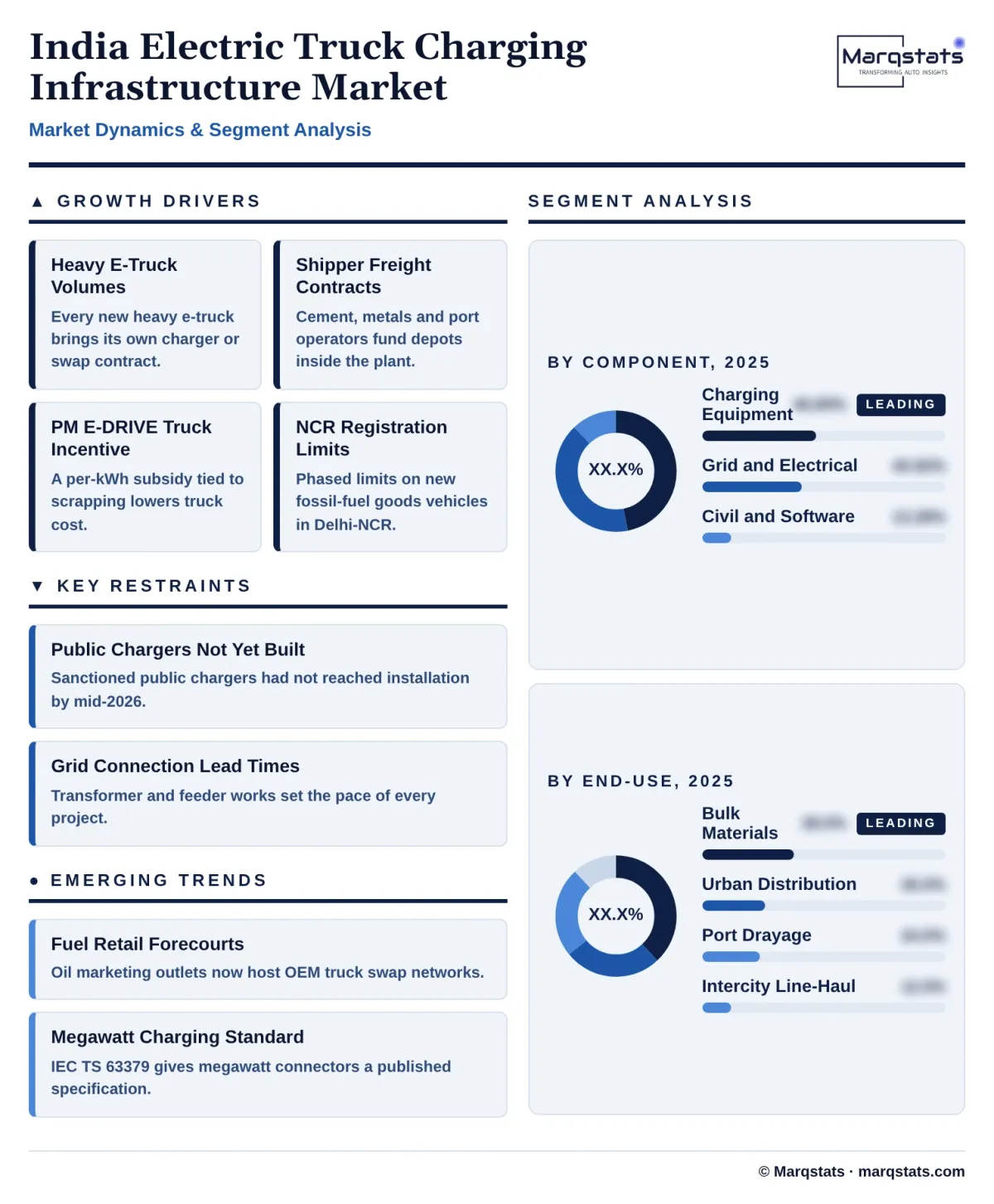
In a truck charging project, the transformer bay is the critical path and the charger is a catalogue item. Marqstats prices a representative depot position, one dual-gun 240 kW DC charger, at about INR 22 lakh for the equipment and about INR 27.3 lakh for everything around it: a share of an 11 kV to 433 V distribution transformer and high-tension switchgear, low-tension cabling and power-factor correction, the DISCOM line extension and inspection approvals, the reinforced plinth and turning apron, and the site controller. On that basis grid connection and electrical balance of plant account for 40.92% of 2025 market value, USD 6.26 million, against 46.80%, USD 7.16 million, for charging and swap equipment.
The policy record shows the same weighting. The PM E-DRIVE operational guidelines for public charging, released in late September 2025, fund up to 80% of upstream infrastructure at most sites and 100% at government premises where charging is free to the public, which is an admission that the upstream works are where projects stall. The Ministry of Power guidelines of September 2024 cap the tariff for public charging stations at the average cost of supply, with 0.7 times that rate in solar hours and 1.3 times outside them, and make distribution licensees liable to penalties for connection delays. Neither instrument shortens the time it takes to energise a 1.5 MVA connection on a congested feeder. Cables take months. Chargers ship in weeks.
The pure EVSE hardware inside this market, chargers only and excluding swap-station equipment, is USD 5.92 million in 2025 and USD 55.77 million in 2030, or 38.69% of 2025 value. Marqstats publishes it separately so that charger-hardware pages on the site can reconcile to it. Reports that size truck charging on charger shipments alone will come out at well under half of this figure, and the difference is definitional rather than empirical.
Swapping has moved from pilot to network in eighteen months
Heavy-duty battery swapping in India is a truck-maker business model, and it scaled faster than plug-in corridor charging. The first fleet of 50 swappable-battery heavy trucks was flagged off at the Jawaharlal Nehru Port Authority on 25 September 2025 with a dedicated swap station, and the port targets electric operation for 90% of its internal heavy fleet of about 600 trucks by the end of 2026. A battery swapping-cum-charging station opened at Sonipat in Haryana in October 2025. By 3 September 2026, Energy In Motion had opened its second swap station at the port, with nearly 150 of its trucks working inside it.
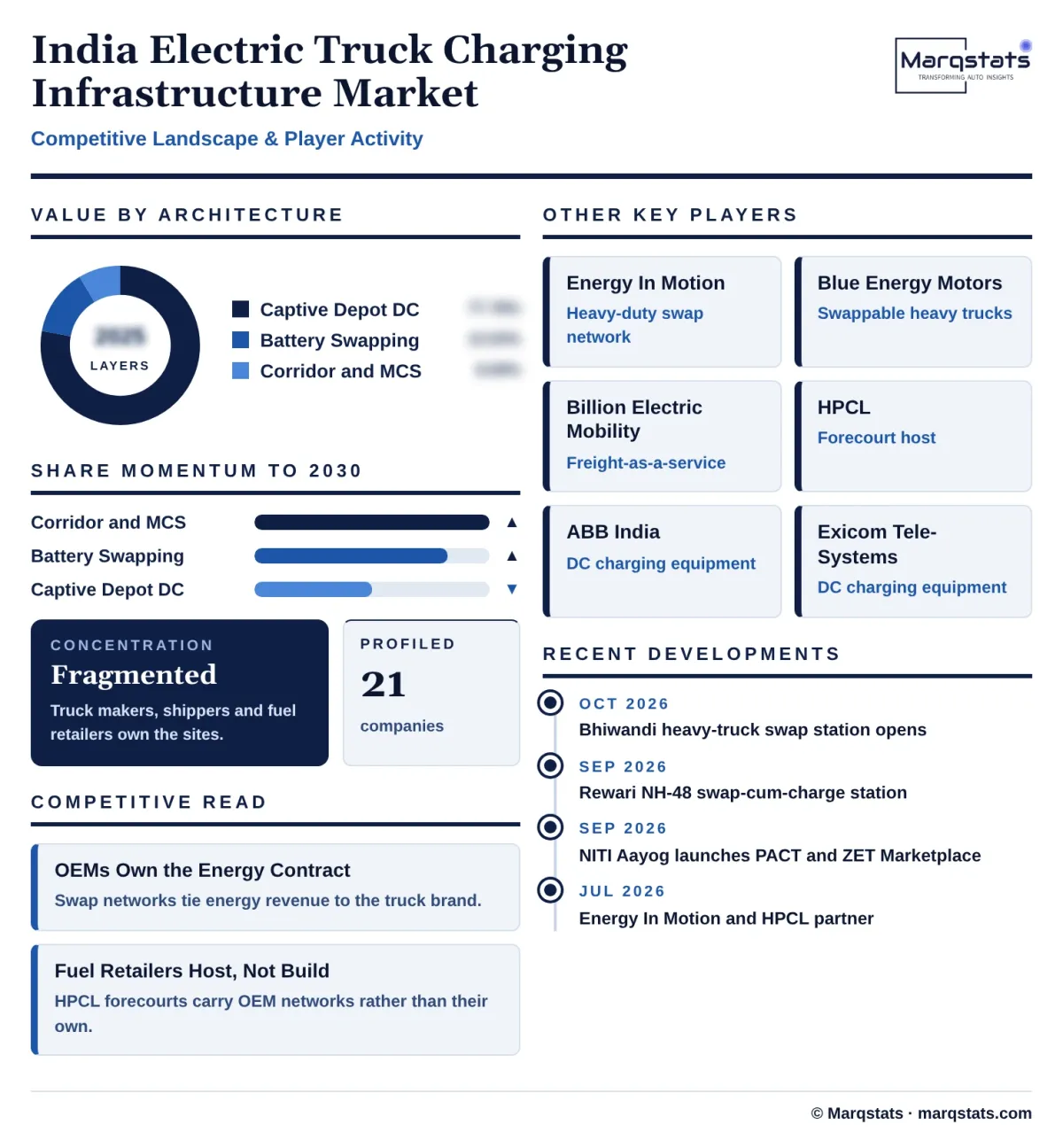
The network step came in mid-2026. On 27 July 2026 Energy In Motion and Hindustan Petroleum Corporation Limited said six heavy-duty swap stations were operating in Delhi-NCR and the port area with combined capacity of 840 swaps a day, and that swap-and-charge hubs would follow on the Mumbai-Pune, Delhi-Jaipur and Chennai-Bengaluru corridors at HPCL outlets. Its Rewari station on NH-48, reported on 29 September 2026, has a 2.5 MW connected load, a 350 kWh battery format and a seven-minute swap against 55 to 60 minutes on a plug-in charger. Blue Energy Motors and HPCL opened a heavy-duty swap station at Bhiwandi, reported on 27 October 2026, with swaps under five minutes for a fleet the company puts at more than 1,400 trucks.
Marqstats values swap stations at about INR 6 crore each in 2025, excluding the battery inventory, which belongs to the battery and battery-leasing markets. Swap stations held 13.53% of 2025 value, USD 2.07 million, and reach USD 40.77 million in 2030, a CAGR of 81.50%. The constraint is format lock-in. Each OEM network serves its own battery, so a corridor with two swap brands needs two stations.
Market Dynamics
Key Drivers
Four forces move capital into truck charging, and the first two are commercial rather than regulatory.
- Heavy e-truck volumes are compounding from a small base: about 800 heavy-duty electric trucks were sold in 2025, according to NITI Aayog, and VAHAN recorded 821 electric N3 registrations between January and July 2026, with 208 in July alone. Each truck brings a dedicated charger or swap contract, so infrastructure demand follows deliveries within months.
- Shipper decarbonisation contracts lock in captive depots: Billion Electric Mobility agreed in July 2026 to deploy more than 150 heavy-duty electric trucks for JK Cement Limited, after an October 2025 freight corridor with Hindalco Industries Limited in Gujarat. Cement, aluminium and port operators sign multi-year freight contracts that fund depot chargers inside the plant boundary.
- The PM E-DRIVE e-truck incentive reduces vehicle cost: the notification of 10 July 2025 pays INR 5,000 per kWh, capped at INR 9.6 lakh for the 18.5 to 35 tonne class, within an INR 500 crore budget for 5,643 trucks. The scheme runs to 31 March 2028, and its total outlay was raised to INR 11,900 crore, as reported on 11 August 2026.
- Delhi-NCR registration limits create a dated demand step: the Commission for Air Quality Management cleared a phased ban on new fossil-fuel and CNG N1 goods vehicles on 18 August 2026, from 1 January 2027 in Delhi, 1 July 2027 in five high-density districts and 1 January 2028 elsewhere in NCR, with N2 trucks following in stages to January 2029. Every N2 delivery truck replaced in NCR needs a depot charger.
Key Restraints
The restraints are specific, and two of them sit outside the control of anyone who sells chargers.
- Public charging money has not reached the ground: as of 22 July 2026, 6,562 public chargers had been sanctioned under PM E-DRIVE and none installed, and the INR 2,000 crore charging budget lists 1,800 bus chargers but no truck-specific quantity. Corridor operators cannot plan on a subsidy that has not yet converted into a single energised connection.
- Grid connection is the critical path: a depot of three 240 kW dual-gun chargers needs a dedicated transformer of about 1.5 MVA, and Marqstats estimates grid and electrical works at 40.92% of 2025 market value. Utilities face penalties for delay under the September 2024 Ministry of Power guidelines, but the penalty does not shorten a feeder upgrade.
- Truck volumes remain a rounding error in the heavy fleet: the 821 electric N3 trucks registered from January to July 2026 compare with 196,103 heavy goods carriers in the same months, and PM E-DRIVE had supported only 55 e-trucks against its 5,643 target by 22 July 2026. A corridor charger needs traffic that most corridors do not yet have.
- Battery format fragmentation splits the swap market: Energy In Motion, Blue Energy Motors and SUN Mobility Private Limited each run their own battery formats, so a shared corridor station must duplicate equipment for each brand, raising cost per swap until one format wins share.
Key Trends
The trends that matter are the ones that change who owns the charger.
- Fuel retailers are becoming truck energy hosts: Hindustan Petroleum Corporation Limited signed with Energy In Motion in July 2026 and opened a heavy-duty swap station with Blue Energy Motors at Bhiwandi in October 2026. Oil marketing company forecourts on freight corridors are the obvious sites, and they bring land and an existing power connection.
- Megawatt charging has a published standard: CharIN announced the publication of IEC TS 63379 for the Megawatt Charging System on 9 February 2026. The PM E-DRIVE guidelines already specify 250 kW to 500 kW CCS-II units with at least 120 kW per gun for buses and trucks, so megawatt hardware is the next tier rather than a separate market.
- Demand aggregation is replacing one-off pilots: NITI Aayog launched the Platform for Aggregating Clean Transport and the Zero Emission Truck Marketplace at the e-FAST India Summit on 7 September 2026. Freight demand visibility per corridor is what a charging investor needs before building a plaza ahead of the trucks.
- Swap-cum-charge hybrids are the default corridor format: the Rewari station on NH-48 combines swapping and plug-in charging on a 2.5 MW connection and is designed for more than 150 vehicles a day. Hybrid sites spread the grid connection cost across both use cases.
Strategic Implications
- For entrants: the first profitable position is not a public corridor plaza but a contracted depot or swap site with an anchor shipper. Depots held 77.78% of 2025 value, and every documented deployment in 2025 and 2026, from the port at Nhava Sheva to the JK Cement contract, started with a named freight customer. A corridor plaza built before PACT-level demand aggregation exists will run at low utilisation.
- For incumbent charge point operators: passenger-car networks do not transfer. A heavy truck needs a drive-through bay, a 240 kW to 500 kW charger and a transformer sized for it, so a car-charging forecourt is not a truck site. The CPOs that win truck business will be those that partner with truck makers and fuel retailers, as Energy In Motion and Blue Energy Motors have done with HPCL, rather than those with the most car chargers.
- For equipment and electrical suppliers: the larger opportunity is around the charger. Grid connection and electrical balance of plant are worth USD 6.26 million in 2025 and USD 72.23 million in 2030. Suppliers of compact substations, switchgear and liquid-cooled cable assemblies should target truck projects as packaged power systems, because the buyer's real problem is time to energisation.
- For investors and policymakers: the subsidy calendar runs ahead of the build calendar. The PM E-DRIVE public charging component had installed none of its 6,562 sanctioned chargers by 22 July 2026. Funding upstream works at truck-specific sites, and tying it to utility connection deadlines, would move the corridor segment faster than another round of equipment subsidy.
Market Segmentation
Captive depot charging is the incumbent and will remain the largest segment through 2030. It covers dual-gun DC chargers of 120 kW to 240 kW installed inside a shipper plant, logistics yard, mine or port terminal, used overnight or between shifts. Marqstats estimates 210 such chargers were installed for trucks in 2025, worth USD 11.90 million, or 77.78% of market value.
Its share falls to 52.43% in 2030, when depot value reaches USD 90.83 million at a CAGR of 50.15%. The decline is relative, not absolute: depots grow with every truck, but corridor and swap networks grow faster because they are built ahead of traffic. Depot economics are the strongest in the market, because the operator controls utilisation and can sub-meter an existing high-tension connection.
Heavy-duty swapping is the OEM-led challenger. Stations run by Energy In Motion, Blue Energy Motors and the port operator at Nhava Sheva replace a discharged pack in five to seven minutes, which matters for drayage and corridor duty where a one-hour charge loses a trip. Marqstats counts three stations commissioned in 2025, worth USD 2.07 million, or 13.53% of value, priced without the battery inventory.
By 2030 the segment reaches USD 40.77 million and 23.53% of value, at an 81.50% CAGR. The swap networks announced in 2026 front-load that growth: eight stations were operational on Energy In Motion's network by late September 2026, with seven more in installation.
Corridor charging is the smallest segment today and the fastest-growing one. It covers public or semi-public truck chargers of 240 kW and above at highway sites and freight plazas, and from 2028 the first Megawatt Charging System installations. Marqstats estimates 14 corridor truck chargers in 2025, worth USD 1.33 million, or 8.69% of value.
By 2030 it reaches USD 41.64 million and 24.04% of value, a 99.13% CAGR, including about USD 7.72 million of megawatt-class equipment in that year. The rate is high because the base is small; the risk is utilisation, which depends on how quickly corridor freight demand aggregates.
Charging and swap equipment is the largest single component but not the majority of spend. It includes DC charger cabinets and dispensers, liquid-cooled cables, swap robots and battery charging racks. It was worth USD 7.16 million in 2025, 46.80% of value, and reaches USD 79.23 million in 2030, 45.73% of value, at a 61.73% CAGR. Unit prices fall about 4% a year on Marqstats assumptions, which keeps the share flat even as volumes rise.
Grid and electrical works are the component that sets project timelines. They include distribution transformers, high-tension and low-tension switchgear, power-factor correction, cabling, metering and the DISCOM line extension. Marqstats values them at USD 6.26 million in 2025, 40.92% of value, rising to USD 72.23 million in 2030, 41.69% of value, a 63.09% CAGR. Their share edges up because corridor and megawatt sites need larger connections per bay.
Civil works and site software are the smallest component and the most site-specific. They cover heavy axle-load plinths, turning aprons, canopies, the site controller and the charge management link. They were worth USD 1.88 million in 2025, 12.28% of value, and reach USD 21.78 million in 2030, 12.58% of value. Fleet-wide depot energy management platforms sold as software are excluded and sized on a separate Marqstats page.
Bulk materials haulage is the largest application because its trucks run short, fixed loops between plant, mine and railhead. Contracts such as Billion Electric Mobility with JK Cement Limited, and the Montra Rhino 5538 deliveries to UltraTech Cement Limited in January 2026, are of this type. Marqstats puts the application at 38.0% of 2025 value, USD 5.81 million, falling to 31.0% in 2030, USD 53.70 million.
Port drayage is the proving ground for swapping. The Jawaharlal Nehru Port Authority target of converting 90% of about 600 internal heavy trucks by the end of 2026 makes it the densest single cluster of electric heavy trucks in India. Marqstats puts drayage at 24.0% of 2025 value, USD 3.67 million, and 15.0% in 2030, USD 25.99 million, as other uses catch up.
Urban distribution, mostly N2 trucks between 3.5 and 12 tonnes, is the application the Delhi-NCR registration limits act on directly. Together with municipal and other uses, Marqstats puts it at 26.0% of 2025 value, USD 3.98 million, and 24.0% in 2030, USD 41.58 million. The share holds because the CAQM phase-in for N2 runs to January 2029.
Intercity line-haul is the smallest application today and the one that changes the market most by 2030. It depends on corridor charging and swap hubs on routes such as Mumbai-Pune, Delhi-Jaipur and Chennai-Bengaluru. Marqstats puts it at 12.0% of 2025 value, USD 1.84 million, rising to 30.0% in 2030, USD 51.97 million.
By Geography
West India
The West is where Indian electric trucking became a business rather than a pilot. Maharashtra registered 466 of the 821 electric N3 trucks recorded between January and July 2026, an EV share of 1.59% of heavy goods registrations, and 153 of 419 between April and November 2025. The Nhava Sheva port cluster, the Mumbai-Pune corridor served by Blue Energy Motors, and the Gujarat corridor of Billion Electric Mobility with Hindalco Industries Limited all sit here.
Marqstats estimates the West, covering Maharashtra, Gujarat, Goa and Madhya Pradesh, at 46.0% of 2025 market value, about USD 7.04 million. Regional figures are published for the base year only, because state-level infrastructure forecasts would rest on project announcements rather than registration data.
North India
The North is the region where regulation, not freight contracts, sets the pace. The CAQM limits on new fossil-fuel goods vehicle registrations apply to Delhi from 1 January 2027 and to Gurugram, Faridabad, Sonipat, Ghaziabad and Gautam Buddha Nagar from 1 July 2027. Haryana recorded 63 electric N3 registrations between April and November 2025, and the Sonipat swapping-cum-charging station and the Rewari NH-48 station give the region its first corridor sites.
Marqstats estimates the North, covering Delhi-NCR, Haryana, Uttar Pradesh, Rajasthan and Punjab, at 22.0% of 2025 value, about USD 3.37 million. Rajasthan registered 113 electric N3 trucks between January and July 2026, the second-highest state count.
South India
The South has the trucks and the routes but fewer anchor depots. Karnataka recorded 45 electric N3 registrations between April and November 2025, and the Chennai-Bengaluru corridor is one of the three on which Energy In Motion and HPCL plan swap-and-charge hubs. JK Cement Limited operations in Karnataka are among the bulk freight users served by Billion Electric Mobility.
Marqstats estimates the South, covering Karnataka, Tamil Nadu, Andhra Pradesh, Telangana and Kerala, at 21.0% of 2025 value, about USD 3.21 million.
East and Central India
East and Central India are the mining and steel belt, and the region where captive depots will dominate longest. Chhattisgarh recorded 49 electric N3 registrations between January and July 2026, an EV share of 0.58%. Iron ore, coal and steel logistics run on short, fixed loops that suit captive depots and swapping.
Marqstats estimates East and Central India, covering Odisha, West Bengal, Jharkhand, Chhattisgarh and Bihar, at 11.0% of 2025 value, about USD 1.68 million.

How Competition Is Evolving
The market is fragmented. Its most important players do not sell chargers. Marqstats describes competition by layer, because no registry publishes company shares of truck charging value. Truck makers that run energy networks, led by Energy In Motion and Blue Energy Motors, own the swap layer. Shippers and fleet operators own most depot chargers. Equipment makers, including ABB India Limited, Siemens Limited, Delta Electronics India Private Limited and Exicom Tele-Systems Limited, supply cabinets and dispensers into both. Fuel retailers, led by Hindustan Petroleum Corporation Limited, are becoming hosts.
The competitive question in 2026 is not who sells the best 240 kW charger but who controls the truck's energy contract. A swap network tied to a truck brand captures the energy margin for the life of the vehicle; a depot charger sold to a shipper is a one-time equipment sale. The July 2026 partnership between Energy In Motion and HPCL, followed by the Blue Energy Motors and HPCL station at Bhiwandi in October 2026, shows the fuel retailers choosing to host OEM networks rather than build a brand-neutral truck network of their own.
Two structural cautions matter for anyone modelling this market. VAHAN ranks truck makers by registrations, which is a sound measure of truck share but says nothing about charger share, because a truck maker may supply the swap station or leave the customer to buy a charger. And the large public charging networks run by oil marketing companies and Tata Power EV Charging Solutions Limited are counted on the India EV charging station page; only their truck-dedicated bays fall inside this market.
Companies Covered
Companies covered in the report include:
Recent Market Activity
Table of Contents
Coverage & Segmentation
The market covers charging and battery swapping infrastructure dedicated to electric goods vehicles in CMVR categories N2 (above 3.5 tonnes up to 12 tonnes) and N3 (above 12 tonnes) in India. It includes depot DC chargers, corridor chargers of 240 kW and above, megawatt-class chargers, and heavy-duty swap stations, each with grid connection, electrical balance of plant, civil works, installation and site software. It excludes the trucks, the battery packs and swap-station battery inventory, electricity sold through the chargers, and chargers for buses, cars, two-wheelers and three-wheelers. The value is a Marqstats construction: installed positions multiplied by full installed cost, converted at INR 87.00 per USD.
Four live Marqstats pages touch this market, and none should be added to it. The India Electric Truck Market page values the trucks, USD 180.00 million in 2025; this market is the infrastructure those trucks need and is not part of that figure. The India EV Charging Station Market page, USD 487 million in 2025, includes public chargers of every type; the corridor truck chargers here sit inside it, so the two must not be summed. The Electric Heavy Duty Truck Charging Infrastructure Market page, USD 4.80 billion globally in 2025, covers trucks above 15 tonnes and excludes swapping; removing swap stations from the figure here leaves USD 13.23 million in 2025, before the further removal of N2 trucks below 15 tonnes that the global page also leaves out. The India Commercial EV Depot Energy Management Software Market page, USD 24 million in 2025, sizes fleet software, which is excluded here except for bundled site controllers. Do not add.