Market Snapshot
The India electric tractor market is valued at USD 3.16 million in 2025 and is forecast to reach USD 10.47 million by 2030, a CAGR of 27.07%. Volume rises from 208 registered units to 700. Growth comes from two start-ups, one state subsidy and a diesel emission rule, not from central EV incentives.
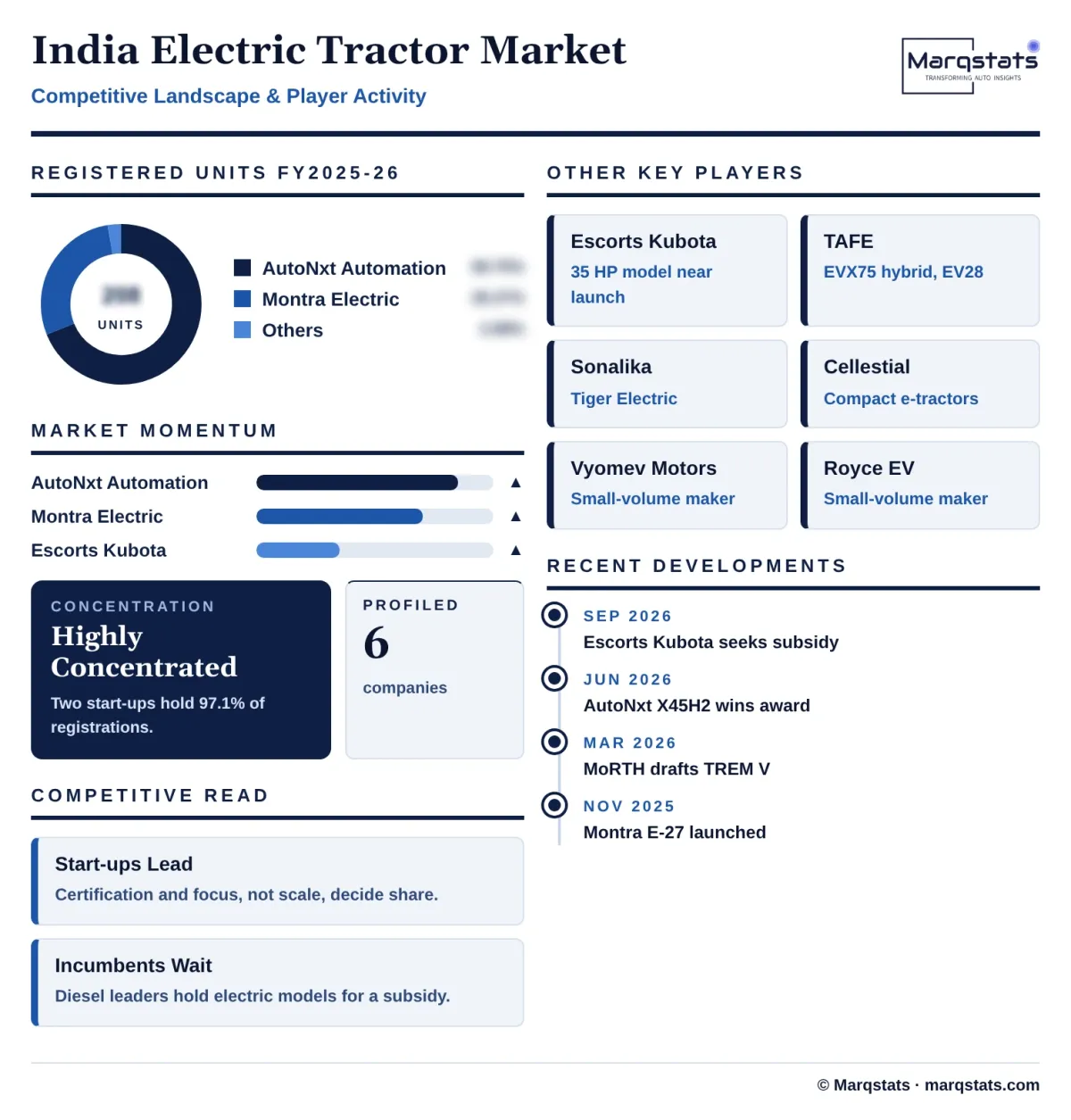
India sold 1,160,231 tractors at wholesale in FY2025-26, and 208 of them were battery-electric. That is one in 5,578, or 0.018%. AutoNxt Automation Private Limited registered 143 and TI Clean Mobility Private Limited, which sells under the Montra Electric brand, registered 59. Four smaller names shared the remaining six. None of the incumbents that build the other 1.16 million tractors appears in the electric register.
Marqstats sizes the market as units multiplied by a volume-weighted ex-showroom price, converted at INR 87.00 per US dollar. The 2025 value equals INR 27.49 crore at a blended INR 13.22 lakh per tractor. The figures form the India slice of the global Marqstats Electric Tractor Market page and match its 700-unit, 27.47% unit-CAGR India path to 2030. Hybrid tractors and electric tractor-trucks sit outside the count.
Key Takeaways
Market Overview & Analysis
Report Summary
India is the largest tractor market in the world by volume and one of the smallest electric tractor markets by penetration. The 208 battery-electric registrations of FY2025-26 compare with 1,050,077 tractor retail registrations reported by the Federation of Automobile Dealers Associations (FADA) for the same year. The electric tractor is therefore a niche product inside a booming diesel market, and its growth rate tells more about two companies and one state than about the farm economy.
We built the market from registered units and listed prices rather than from a top-down share of the tractor industry. That choice matters. A share-based method that applies an EV penetration rate borrowed from trucks or three-wheelers overstates the market by an order of magnitude, because commercial EV penetration in India runs on urban fleets that charge in depots, while tractors work in fields on rationed agricultural power supply, often limited to a fixed daily shift.
The outlook is steady rather than explosive. Unit volume rises 3.37 times between 2025 and 2030, value 3.31 times, and the 2030 total of 700 tractors is still below 0.1% of an industry that ICRA expects to reach about 1.2 million units in FY2027. The decisive variable is whether the Ministry of Heavy Industries or the Ministry of Agriculture and Farmers Welfare creates a tractor category in a purchase incentive. Our forecast assumes it does not before 2030, and the page states where the trajectory would change if it did.
India Electric Tractor Market Size and Forecast
Value moves from USD 0.33 million in 2021 to USD 0.45 million in 2022, USD 0.52 million in 2023, USD 0.72 million in 2024 and USD 3.16 million in 2025, then on the forecast path to USD 4.02 million in 2026, USD 5.10 million in 2027, USD 6.48 million in 2028, USD 8.24 million in 2029 and USD 10.47 million in 2030. Units follow the same line: 30, 40, 45 and 60 tractors in 2021 to 2024, 208 in 2025, then 265, 338, 431, 549 and 700. The 2021 to 2024 values are Marqstats estimates of demonstration, institutional and farm-only deliveries before RTO registration of electric tractors scaled; the 2025 figure is anchored on the 208 registrations reported for FY2025-26.
The step from 60 units in 2024 to 208 in 2025 is a registration event as much as a demand event. Maharashtra registered its first electric tractor, an AutoNxt machine, at the Thane Regional Transport Office in June 2025, under the INR 1.5 lakh purchase subsidy of the Maharashtra EV Policy 2025. From that point the state grant could only be claimed on a registered machine, so deliveries that earlier stayed off the books began to appear in the register.
Price holds near INR 13 lakh across the forecast. The 2025 blend of INR 13.22 lakh, or USD 15,192 per unit, reflects the AutoNxt X45H2 listed at INR 15.51 lakh ex-showroom and the Montra Electric E-27 launched at INR 10.75 lakh. By 2030 the blend is INR 13.01 lakh, or USD 14,957. Battery cost declines pull the price of each model down, and a shift toward 35 to 50 HP machines pulls the average up, so the two forces roughly cancel. Value CAGR of 27.07% therefore sits just below the unit CAGR of 27.47%. The value series is a Marqstats construction, built from registered units and listed prices, since no Indian body publishes electric tractor sales in rupees.
These figures form the India slice of the global Marqstats Electric Tractor Market, which is USD 55.63 million in 2025 and USD 126.10 million in 2030. India is 5.7% of global value in 2025 and 8.3% in 2030, consistent with the global page, and 27.1% of 2025 global units, on 208 of 768 machines. India is a unit market on cheap machines; Europe remains the value market.
A Two-Company Register Inside a 1.16 Million Unit Industry
The Indian electric tractor is a start-up product, and the register proves it. Of the 208 battery-electric tractors registered in FY2025-26, AutoNxt Automation took 143, or 68.75%, and Montra Electric took 59, or 28.37%. Vyomev Motors registered three, and EVBharat Range, Modika International under the Franklin EV name and Royce EV registered one each, a combined 2.88%. These are counts as reported in the FY2025-26 manufacturer tallies published in April 2026; Marqstats has not re-extracted them from the Vahan portal.
The incumbents are absent for a reason. Mahindra & Mahindra Limited alone dispatched 505,930 tractors in FY2025-26, a 43.61% wholesale share, and its dealers sell what farmers can finance. International Tractors Limited has listed the Sonalika Tiger Electric since 2020 at a launch price of INR 5.99 lakh, yet registered no electric unit in FY2025-26. Escorts Kubota Limited told the India Clean Transportation Summit in September 2026 that its next electric tractor is almost through development but will not launch widely without a subsidy. For a company selling a 35 HP diesel tractor at about INR 5 lakh, a 2.5-times price on the electric version is a product that its own dealers cannot place.
The start-ups accept that constraint because they sell to different buyers. AutoNxt targets institutional and industrial work, from sugar mill yards to biomass haulage, where daily hours are high and diesel is the main cost. Montra Electric, a clean mobility brand of the Murugappa Group, sells the E-27 through 17 dealerships in 10 states and positions it on running cost. Both start-ups own the certification and the after-sales skills the incumbents have not yet committed to, and that is the entry barrier that matters more than capital.
Why the GST Cut Hurt the Electric Tractor
Tax parity arrived in September 2025, and it worked against electric models. Before 22 September 2025 a diesel tractor carried 12% GST and an electric vehicle 5%, a seven-point advantage worth roughly INR 35,000 on a INR 5 lakh diesel tractor equivalent. The 56th GST Council meeting on 3 September 2025 moved tractors and farm machinery to 5% and tractor tyres and parts from 18% to 5%. Both powertrains now pay the same rate.
The consequence is visible in the diesel numbers rather than the electric ones. Domestic tractor wholesale rose 23.47% in FY2025-26 to 1,160,231 units, and FADA retail climbed from 882,825 to 1,050,077 registrations. A cheaper diesel tractor widened the absolute price gap that electric models have to close. Marqstats treats the GST change as neutral for electric demand in rate terms and negative in relative-price terms, which is one reason the 2026 forecast of 265 units is modest.
TREM V Arrives First Where Electric Tractors Are Strongest
Emission regulation will raise diesel prices first in the compact class, which is exactly where electric tractors compete today. The Ministry of Road Transport and Highways draft of 3 March 2026 moves tractors below 25 HP and above 75 HP to TREM Stage V from 1 October 2026. Tractors from 25 to 50 HP move to TREM IIIAA on 1 April 2028 and to full Stage V on 1 April 2032, and the 50 to 75 HP band upgrades directly in 2032.
Industry executives quoted on the draft expect full Stage V to lift tractor prices by up to 15% to 20%. In the 25 to 50 HP band, where most Indian tractors are sold, that cost arrives after 2030 and lies outside the forecast. Below 25 HP it arrives in late 2026, and a compact electric tractor such as an AutoNxt X25H2 then competes with a diesel machine carrying after-treatment cost. Marqstats therefore gives the up to 30 HP class the faster growth of the two power segments, rising from 32.6% of value in 2025 to 42.0% in 2030.
Market Dynamics
Key Drivers
Four forces carry the market from 208 to 700 units, and each one is narrower than the headline EV story suggests.
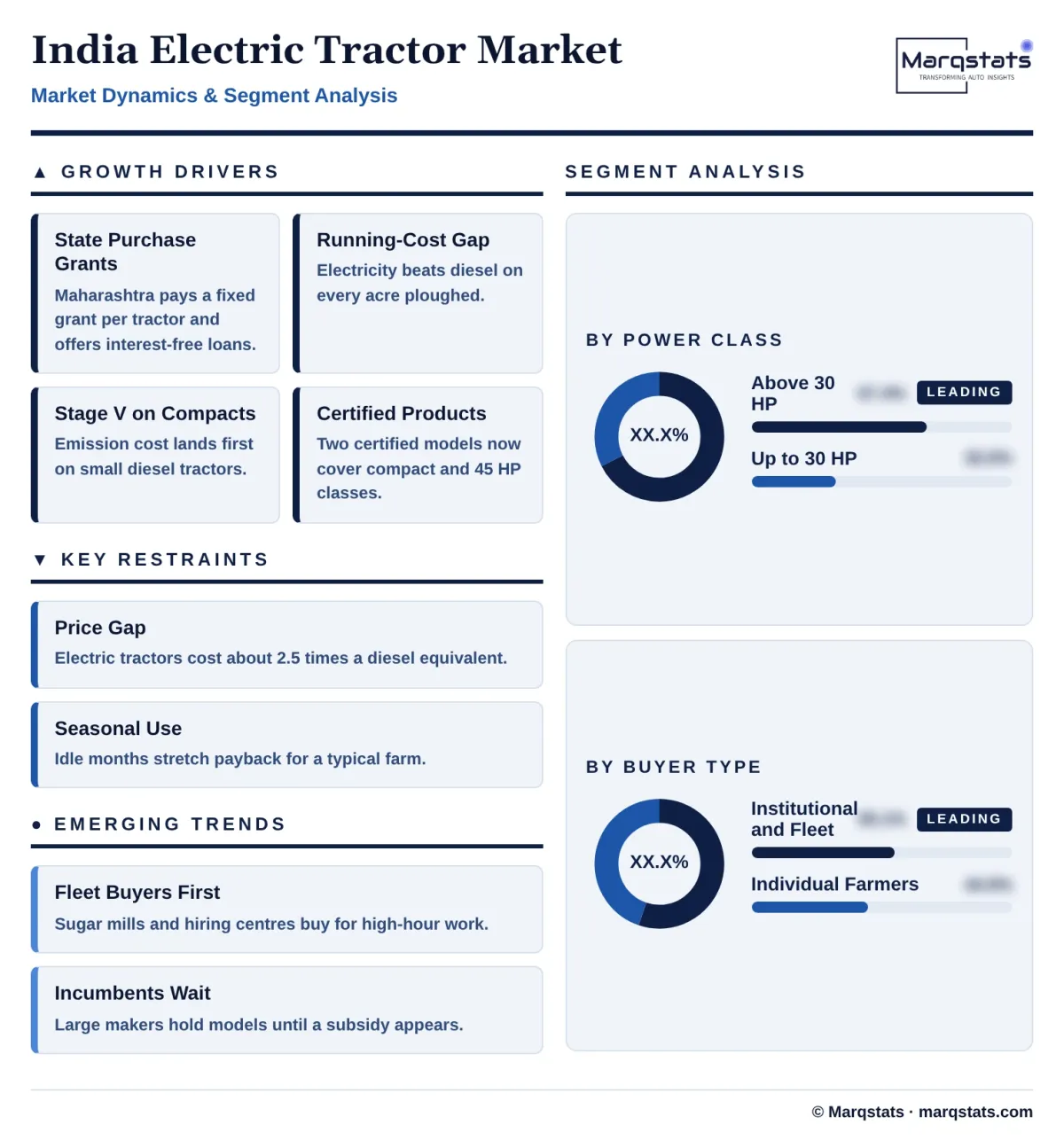
- State purchase grants: the Maharashtra EV Policy 2025, approved in April 2025 with an outlay of INR 1,993 crore, pays INR 1.5 lakh per electric tractor and the state-run Annasaheb Patil Economic Development Corporation offers interest-free loans. That single instrument explains why West India holds 44.9% of 2025 value.
- Running-cost gap on high-hour work: Maharashtra Transport Minister Pratap Sarnaik put ploughing one acre at INR 1,200 to INR 1,500 with diesel and about INR 300 with an electric tractor in June 2025. The saving compounds only where a tractor works long days, which is why sugar mills, brick kilns and custom hiring centres buy first.
- Stage V cost on compact diesel tractors: the TREM V draft of March 2026 applies to tractors below 25 HP from 1 October 2026, adding after-treatment cost to the diesel machines that compete most directly with 25 to 27 HP electric models such as the Montra Electric E-27.
- Product availability and certification: the Montra Electric E-27 arrived at INR 10.75 lakh in November 2025 with a 22.37 kWh LFP battery, and the AutoNxt X45H2 won Electric Tractor of the Year 2026 in June 2026. Two certified products in two power classes give dealers a range to sell.
Key Restraints
Three restraints cap the market below 0.1% of tractor sales through 2030.
- Purchase price gap: Escorts Kubota Limited puts a 35 HP electric tractor at about INR 12.5 lakh against about INR 5 lakh for diesel, a 2.5-times gap. Without a central incentive, most smallholders cannot finance the difference even when lifetime cost is lower.
- Seasonal utilisation: a farm tractor works intensely in sowing and harvest windows and sits idle for long stretches. ICRA estimates a four- to five-year payback on the incremental cost after battery replacement, which is long for a farmer whose credit is tied to one crop cycle.
- Rural charging and grid supply: agricultural feeders in most farm states run on rationed daily shifts, and a 38.4 kWh battery such as that of the AutoNxt X45H2 needs a three-phase connection. Farms without daytime supply have to charge overnight or install solar, which adds cost the price comparison ignores.
Key Trends
Three trends shape who wins the 700-unit market of 2030.
- Institutional and fleet buying: sugar mills, custom hiring centres, municipal bodies and industrial yards take 55.1% of 2025 value because they run tractors long enough to recover the premium. Their share falls to 45.0% by 2030 as prices and financing improve for individual farmers.
- Incumbent entry on hold: TAFE showed the EVX75 hybrid at Agritechnica in November 2025 and the TAFE EV28 reached the Tractor of the Year 2026 finals, while Escorts Kubota has a 35 HP electric tractor near launch. Each is waiting for a subsidy signal before committing dealer stock.
- Battery size growing with horsepower: the market is moving from 22 kWh packs on 27 HP machines to 38 kWh packs on 45 HP machines, which keeps the average price near INR 13 lakh even as battery cost per kWh falls.
Strategic Implications
- For entrants: sell hours, not horsepower. The economics close only for buyers running a tractor most days of the year, so the first 500 customers are sugar mills, custom hiring centres and industrial yards, financed through operating leases. Certification and a service van in each district matter more than a 50 HP specification.
- For incumbents: the cost of waiting is low until 2028 and rises after. Below 25 HP, Stage V from October 2026 narrows the diesel price advantage first, and a compact electric model sold through existing dealers is the cheapest way to hold that class without re-engineering diesel engines twice.
- For suppliers and investors: the volume is too small to justify dedicated tractor cell or motor capacity before 2030. Pack and motor suppliers should treat tractors as a variant of their electric three-wheeler and light commercial platforms, and investors should value start-ups on fleet contracts and service reach rather than on registration counts.
Market Segmentation
Machines above 30 HP hold 67.4% of 2025 value, USD 2.13 million, and reach USD 6.07 million in 2030, or 58.0% of the market. The class is built on the AutoNxt X45H2, a 45 HP tractor with a 38.4 kWh battery listed at INR 15.51 lakh ex-showroom, and on the AutoNxt X35H2. These are the machines that do haulage and heavy tillage work for institutional buyers.
The share falls because the diesel tractors these models replace sit in the 41 to 50 HP band, which now accounts for nearly two-thirds of Indian tractor sales and faces Stage V only in 2032. Electric models above 30 HP therefore compete against a diesel machine whose price will not rise for emission reasons inside the forecast. Marqstats still expects this class to remain the larger by value in 2030, because each unit carries a bigger battery and a higher price.
Compact machines up to 30 HP account for 32.6% of 2025 value, USD 1.03 million, and grow to USD 4.40 million in 2030, a 42.0% share. The Montra Electric E-27 anchors the class: 27 HP equivalent, 90 Nm, a 22.37 kWh LFP battery, about 4.5 hours of runtime and a charge time of 2 hours 15 minutes, at INR 10.75 lakh ex-showroom.
This is the faster-growing class for two reasons. Orchard, vineyard, nursery and inter-row work suits a quiet, low-hour machine that charges overnight, and the TREM V draft lifts the cost of diesel tractors below 25 HP from 1 October 2026. Escorts Kubota already sells a 25 HP electric tractor to hobby farmers in the United States, which signals the class it would launch first in India once a subsidy appears.
Institutional and fleet buyers take 55.1% of 2025 value, USD 1.74 million, falling to 45.0%, or USD 4.71 million, in 2030. The group includes sugar mills, brick kilns, biomass and industrial yards, municipal bodies, custom hiring centres and demonstration purchases by state agencies. Utilisation is the common thread: a tractor that runs eight or more hours a day reaches break-even in about three years on Escorts Kubota figures.
This is a Marqstats estimate built from the applications each manufacturer markets and from the price gap that keeps individual farmers out. The share declines, rather than collapses, because operating leases and battery financing spread slowly into rural credit.
Individual farmers account for 44.9% of 2025 value, USD 1.42 million, and become the larger group by 2030 at 55.0%, or USD 5.76 million. In Maharashtra, the INR 1.5 lakh state grant and interest-free loans through the Annasaheb Patil Economic Development Corporation bring the electric tractor within reach of larger farmers.
Growth here depends on finance more than on product. A farmer comparing an INR 10.75 lakh electric E-27 with a diesel compact at around half the price needs a lender that values fuel savings, and that lending is still limited to a few states.
By Geography
West India
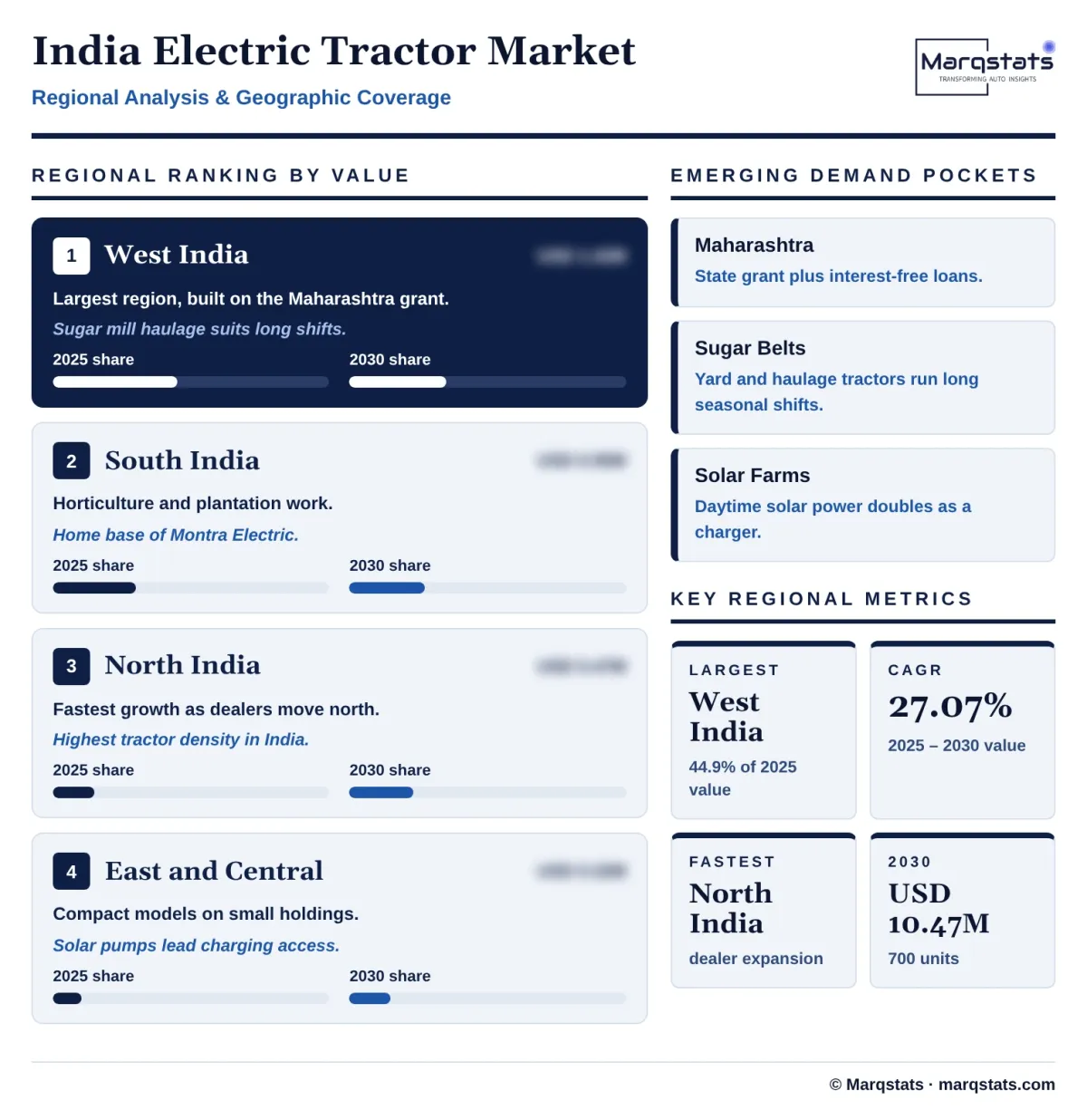
West India is the largest region at USD 1.42 million in 2025, 44.9% of value, and reaches USD 3.66 million in 2030, when its share eases to 35.0%. Maharashtra drives the region. It pays INR 1.5 lakh per electric tractor under the Maharashtra EV Policy 2025, registered the first AutoNxt tractor at the Thane Regional Transport Office in June 2025 and hosts AutoNxt itself.
Sugarcane is the second reason. Maharashtra and Gujarat run large cooperative sugar mills whose yard and haulage tractors work long seasonal shifts, which is the duty cycle that recovers an electric premium fastest. The share declines only because other regions start from a lower base.
South India
South India holds USD 0.95 million in 2025, 30.1% of value, and grows to USD 2.83 million in 2030, a 27.0% share. Montra Electric belongs to the Chennai-based Murugappa Group, which gives the brand its home base and service reach in the region.
Horticulture, plantation and orchard work in Tamil Nadu, Karnataka and Andhra Pradesh suits compact electric tractors, and the region has the densest network of electric three-wheeler service skills that dealers can redeploy. The pace is held back by small landholdings and the absence of a tractor-specific state grant.
North India
North India is the fastest-growing region, from USD 0.47 million in 2025, 14.9% of value, to USD 2.41 million in 2030, 23.0%. Montra Electric extended the E-27 into northern markets in 2025, and Punjab, Haryana and western Uttar Pradesh have the highest tractor density per hectare in India.
The region buys large diesel tractors in the 41 to 50 HP band for wheat and paddy, so early electric demand comes from sugar mills, cold-chain yards and custom hiring centres rather than field tillage. Growth accelerates once a 45 HP electric model is sold through a northern dealer network.
East and Central India
East and Central India accounts for USD 0.32 million in 2025, 10.1% of value, rising to USD 1.57 million in 2030, a 15.0% share. Madhya Pradesh, Bihar, Odisha and Chhattisgarh have fragmented holdings and growing demand for compact tractors, but limited daytime agricultural power supply.
Solar pumps and feeder separation programmes are the leading indicator here. Where a farm already has daytime solar power for irrigation, the same supply can charge a 22 kWh tractor battery, and Marqstats expects the region to adopt compact models first.
How Competition Is Evolving
The market is highly concentrated. AutoNxt Automation and Montra Electric registered 202 of 208 electric tractors in FY2025-26, or 97.1%, and the next four names registered six between them. Concentration reflects certification and focus rather than scale. The incumbents that sell 1.16 million diesel tractors a year have the dealers, finance arms and brand trust to take the market quickly, and have chosen to wait.
Competition runs on three layers. The first is certification: a tractor needs type approval before RTO registration, and the Montra Electric E-27 is sold as ARAI-certified. The second is the service network: Montra Electric sells through 17 dealerships in 10 states, while AutoNxt relies on direct and institutional sales. The third is financing: interest-free state loans in Maharashtra and operating leases for fleets close more deals than any specification change.
Incumbents hold options rather than products. Tractors and Farm Equipment Limited showed the EVX75 hybrid at Agritechnica in November 2025 and reached the Tractor of the Year 2026 finals with the TAFE EV28. Escorts Kubota Limited has a 35 HP electric tractor almost through development. International Tractors Limited has listed the Sonalika Tiger Electric since 2020. Any one of them could double the market in a year by placing electric stock with existing dealers, which is the main upside to the Marqstats forecast.
Companies Covered
Companies covered in the report include:
Recent Market Activity
Table of Contents
Coverage & Segmentation
Inclusions: new battery-electric agricultural tractors sold or registered in India as complete machines, in all power classes, valued at ex-showroom price including 5% GST and before state subsidies. The base year is 2025, history runs from 2021 to 2025 and the forecast from 2026 to 2030. Segments cover power class (up to 30 HP, above 30 HP) and buyer type (institutional and fleet, individual farmers), and four regions: West, South, North, and East and Central India.
Exclusions: hybrid and diesel-electric tractors such as the TAFE EVX75; electric tractor-trucks and prime movers in category N3, which belong to the Marqstats India Electric Truck Market; electric terminal tractors; electric power tillers and walk-behind cultivators; electric agricultural UTVs, which the Marqstats Global Electric Agriculture UTV study covers; implements, chargers, solar systems, battery replacements and used tractors.
Sibling boundaries: India Electric Tractor Market is a dedicated deep-dive of the India slice of the Marqstats Electric Tractor Market (USD 55.63 million in 2025, USD 126.10 million in 2030). Do not add this page to the global figure; it is already inside it. Do not add it to the Off Highway Electric Vehicle Market, which counts tractors among its segments, or to the India Electric Truck Market, which excludes agricultural tractors.