Market Snapshot
Middle bar: base-year value × (1 + CAGR), rounded to two decimals. This is a calculated illustration, not a separately researched annual estimate.
The global electric mining light vehicle market size is estimated at USD 102.98 million in 2025 and is projected to reach USD 419.70 million by 2030, growing at a CAGR of 32.45% over 2026 – 2030. Annual deliveries rise from about 1,240 vehicles to 6,730, a 40.26% annual rate, while the average ex-factory price falls from about USD 83,048 to USD 62,363 per vehicle as cheaper factory-built electric utes take a larger share.
Marqstats defines the market as the ex-factory value of new battery-electric light vehicles below 8.5 tonnes gross vehicle weight delivered to underground and surface mine sites: purpose-built underground utility vehicles and personnel carriers, certified mine-spec electric conversions of Toyota LandCruiser and Hilux chassis, and factory-built electric utes and light trucks fitted to mine specification. Haul trucks, load-haul-dump loaders, drills, graders, heavier underground utility carriers, hybrid and diesel vehicles, chargers and site electrical systems sold separately are excluded.
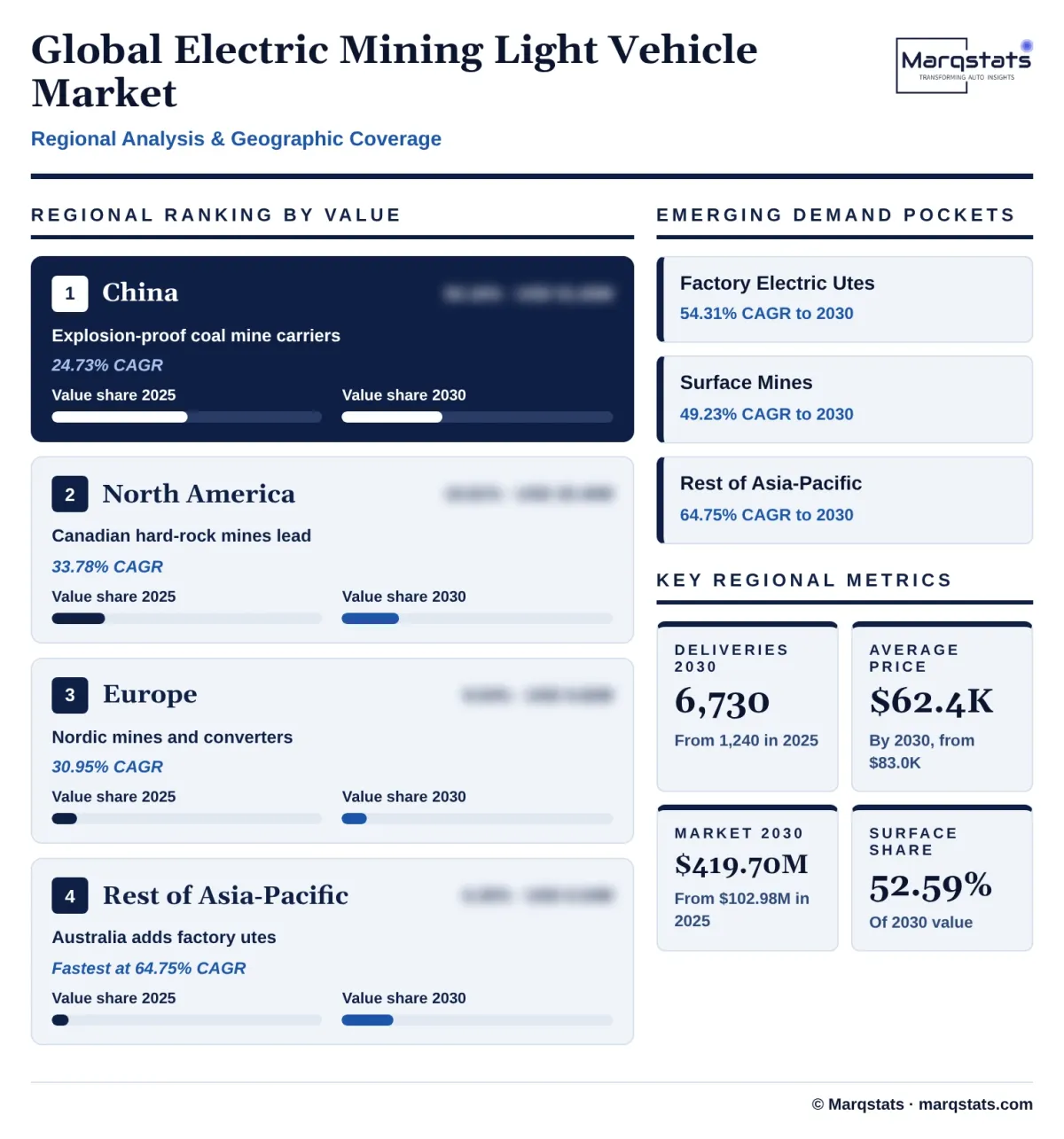
Purpose-built underground vehicles account for an estimated 61.25% of 2025 value and underground sites for 71.04%. China accounts for 50.16% of 2025 value and North America for 19.81%. The study segments the market by vehicle architecture, operating environment, commodity mined and region.
Key Takeaways
Market Overview & Analysis
Report Summary
Marqstats sizes the electric mining light vehicle market as the ex-factory value of new battery-electric vehicles below 8.5 tonnes gross vehicle weight that carry people, tools and parts around mine sites. In 2025 about 1,240 vehicles were delivered worldwide, worth an estimated USD 102.98 million at an average ex-factory price of about USD 83,048.
Light vehicles are the most numerous machines on a mine and the least visible in electrification plans. Supervisors, electricians, fitters, surveyors and geologists drive them, crews ride in them between the portal and the face, and service trucks carry fuel, lubricants and spare parts to production machines. Large surface operations run fleets of several hundred light vehicles, and every underground mine runs dozens. Most are diesel Toyota LandCruiser 70 Series and Hilux utes fitted with rollover protection, buggy whips, beacons and two-way radios, or purpose-built underground utility vehicles with low profiles and heavy-duty frames.
Underground light vehicles were electrified first because of air. Every diesel engine in a decline adds particulate, nitrogen oxides and heat that the mine must remove with ventilation, and occupational limits on diesel particulate exposure have tightened in Australia, Canada and the United States. A battery vehicle adds none of these, so mine planners can size ventilation around fewer diesel engines, a saving that matters most in deep, hot mines. Canadian mines led: Vale used Rokion vehicles at its Creighton nickel mine in Sudbury from 2020, Torex Gold placed a record Rokion order for its Media Luna project in Mexico in July 2023, and Aeris Resources doubled its Rokion fleet at Tritton in New South Wales in October 2023.
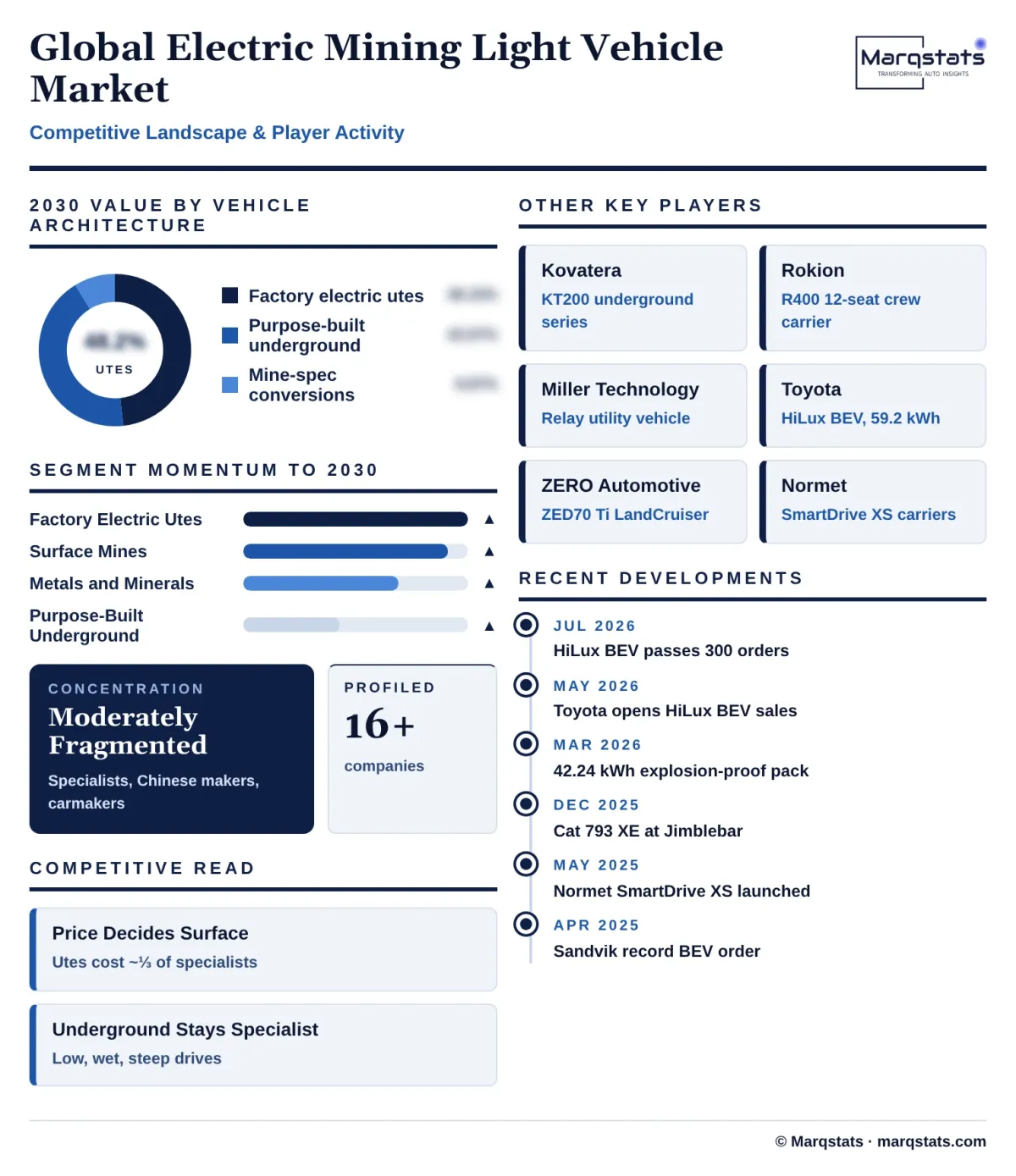
Three types of vehicle compete. Purpose-built underground vehicles, such as the Kovatera KT200 series, the Rokion R400 crew carrier that seats up to 12 people and the Miller Technology Relay, are designed for low backs, steep ramps, corrosive water and constant impact. Certified conversions, from Tembo e-LV, ZERO Automotive, 3ME Technology and others, replace the diesel drivetrain of a LandCruiser or Hilux with an electric motor and battery while keeping the familiar body and parts. Factory-built electric utes, led by the Toyota HiLux BEV launched in Australia in 2026 and Chinese electric pickups, arrive ready for road registration and need only mine fit-out.
China is a separate market with its own vehicles. Chinese underground coal mines move people and material in trackless rubber-tyred vehicles that must be explosion-proof, and suppliers are replacing flameproof diesel and lead-acid designs with encapsulated lithium battery packs. A March 2026 study in Coal Science and Technology described a 42.24 kWh explosion-proof lithium supply fitted to the WLR-19 vehicle with over 40% higher specific energy than the flameproof unit it replaced.
The market grew from about 300 vehicles worth USD 31.50 million in 2021 to 450 in 2022, 640 in 2023 and 900 in 2024, worth USD 80.40 million, as Chinese explosion-proof carriers scaled and Western mines moved from single trial vehicles to small fleets. Marqstats expects about 1,950 deliveries worth USD 141.00 million in 2026, the first year in which a major carmaker sells a factory electric ute aimed at mining fleets.
Regulation and certification shape vehicle design in each market. In Canada, underground vehicles must meet CANMET and provincial mining regulations, and in the United States, the Mine Safety and Health Administration approves electrical equipment for underground use, so road vehicles need modification and certification before they can go underground. Chinese coal mines require explosion-proof certification for every vehicle that enters the workings. In Australia, mine light vehicles on surface sites are usually road-registered utes fitted to each miner's site standard, which is why a factory electric ute can be adopted quickly once it meets those standards.
Global Electric Mining Light Vehicle Market Size and Forecast
The global electric mining light vehicle market grows from USD 102.98 million in 2025 to USD 419.70 million in 2030, a CAGR of 32.45%. Marqstats expects deliveries of about 2,850 vehicles worth USD 190.50 million in 2027, 3,950 worth USD 250.00 million in 2028 and 5,250 worth USD 328.00 million in 2029, before reaching 6,730 vehicles in 2030.
Prices fall because the mix changes, not because each vehicle gets much cheaper. The average ex-factory price falls from about USD 105,000 in 2021 to USD 89,333 in 2024, USD 83,048 in 2025, USD 72,308 in 2026 and USD 62,363 in 2030. Marqstats estimates a Western purpose-built underground vehicle at about USD 172,000 in 2025 and USD 160,000 in 2030, a certified conversion at USD 105,000 falling to USD 98,000, a Chinese explosion-proof carrier at USD 75,000 falling to USD 63,500, and a factory electric ute with mine fit-out at USD 55,000 falling to USD 47,000. Volume therefore grows at 40.26% a year while value grows at 32.45%.
Factory utes drive the volume. Marqstats estimates factory electric ute deliveries to mines rise from about 420 in 2025 to 4,300 in 2030, a 59.32% annual rate, while purpose-built underground vehicles rise from about 660 to 2,050 and conversions from about 160 to 380. Prices in Australian dollars are converted at USD 0.645 per AUD, the 2025 annual average.
The forecast is consistent with the live Marqstats electric mining equipment reports. The Australia Electric Mining Equipment report models 17 underground light and utility vehicle deliveries in 2025 rising to 80 by 2030, and the same Australian underground counts are used here. The Global Electric Mining Equipment report, worth USD 1.70 billion in 2025, counts production machines, surface haul trucks and heavier utility carriers; light vehicles below 8.5 tonnes sit largely outside its unit count, but up to about USD 24 million of Western purpose-built underground vehicles in 2025 may appear in both, so the two markets should not be added.
Marqstats tracks four indicators to monitor the forecast: factory electric ute orders from mining fleets, light vehicle replacement clauses in miner procurement tenders, explosion-proof battery certification in China, and the price gap between purpose-built underground vehicles and conversions.
The mix of vehicles changes over the forecast. Factory electric utes rise from 22.43% to 48.15% of value, surface mines from 28.96% to 52.59% and metal and other mineral mines from 58.24% to 69.70%. China remains the largest region but its share falls from 50.16% to 37.15% as Australia, North America and other regions add factory utes; Rest of Asia-Pacific rises from 6.35% to 18.91% of value.
Market Dynamics
Key Drivers
Five forces are pulling battery-electric light vehicles into mine fleets.
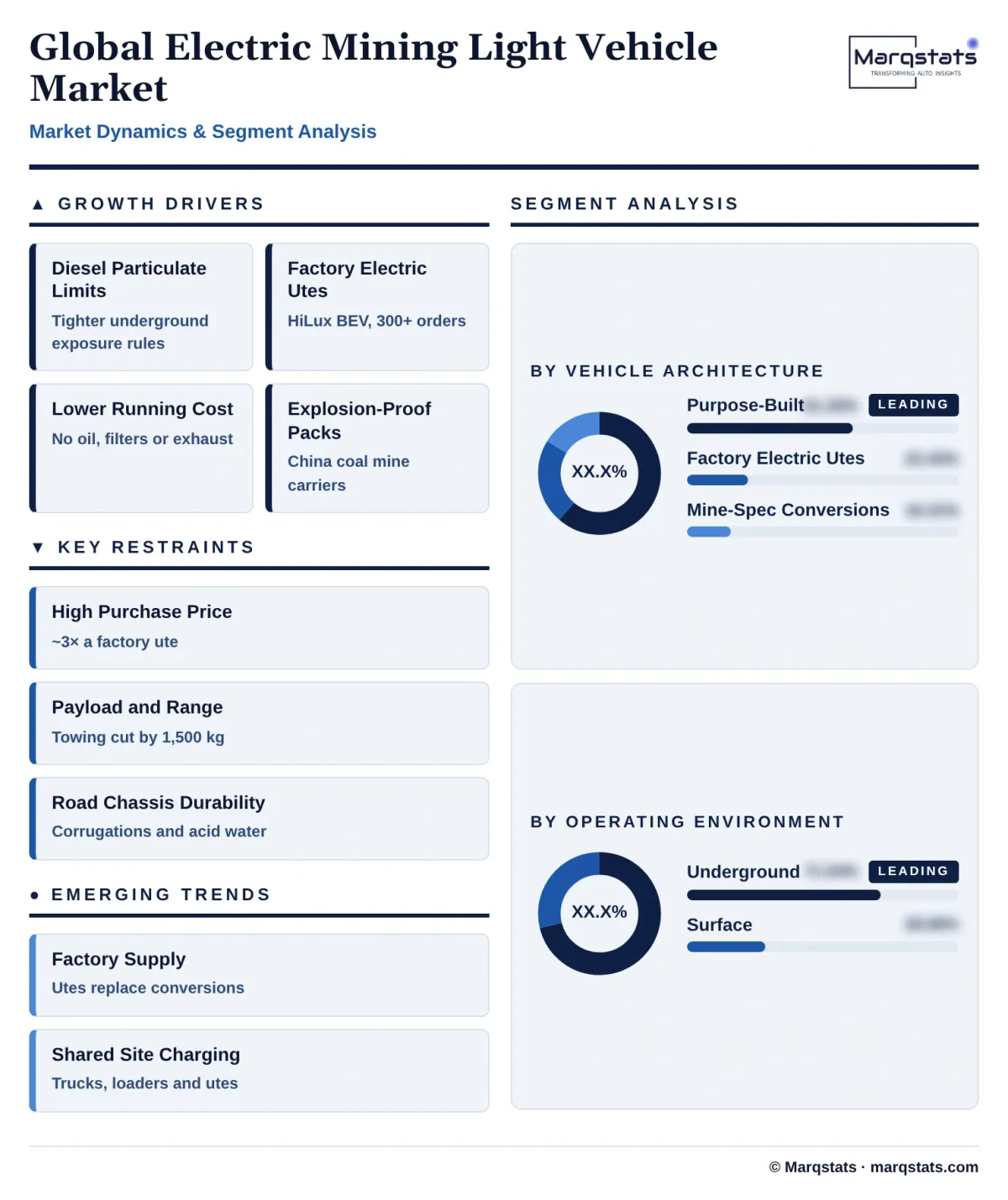
- Diesel particulate limits. Tightening occupational limits on diesel particulate exposure in underground mines in Australia, Canada and the United States make every diesel engine in a decline a compliance cost, and battery light vehicles are the easiest diesel engines to remove because they do not need heavy charging infrastructure.
- Lower running cost. A light vehicle that covers 100 to 150 km a shift uses a small fraction of its diesel equivalent's energy cost and needs no oil changes, filters or exhaust treatment, so cost per km falls even where diesel is subsidised.
- Miner decarbonisation targets. BHP, Rio Tinto, Vale and Fortescue have committed to cut operational emissions, and light vehicles are the part of the diesel fleet that can be replaced now with vehicles on sale. BHP Mitsubishi Alliance put Miller Technology Relay vehicles into crew transport at Broadmeadow, and BHP is among the first HiLux BEV customers.
- Factory electric utes. Toyota Australia began selling the HiLux BEV in May 2026 with a 59.2 kWh battery and up to 315 km of range, and took more than 300 orders by July, mostly from mining, construction and energy fleets, giving miners a supported, road-registrable vehicle from the supplier that already dominates their fleets.
- Explosion-proof batteries in China. Encapsulated lithium battery supplies certified for coal mines let Chinese suppliers replace diesel and lead-acid trackless rubber-tyred vehicles with battery personnel and material carriers.
Key Restraints
Four constraints slow the replacement of diesel light vehicles at mine sites.
- High purchase price. A purpose-built underground battery vehicle costs about three times a factory electric ute and roughly twice a diesel underground utility vehicle, which keeps adoption at mid-tier miners slow where capital is tight.
- Range and payload on surface sites. The HiLux BEV loses payload and 1,500 kg of braked towing capacity against diesel versions and covers about 220 km on a real-world test, so long-distance surface runs and towing still need diesel.
- Durability of road chassis. Corrugated haul roads, acidic mine water and constant shock shorten the life of road-derived frames and suspensions, a risk for conversions and factory utes used underground.
- Charging and parts at remote sites. Remote mines need chargers, spare batteries and trained electricians before a fleet can switch, and small suppliers struggle to support vehicles across many sites.
Key Trends
Four shifts are changing which electric light vehicles miners buy and how they run them.
- From conversion to factory supply. Factory electric utes from Toyota and Chinese carmakers reduce the need to rebuild diesel LandCruisers and Hilux utes for surface duty, leaving conversions for niche and underground roles.
- Larger battery crew carriers underground. Suppliers are adding bigger battery crew and logistics carriers; Normet launched its SmartDrive XS series with a 3.5-tonne payload in May 2025, alongside more than 60 SmartDrive M-series units already in service on six continents.
- Shared site charging. Mines plan chargers and site power for haul truck, loader and light vehicle fleets together, as the BHP, Rio Tinto and Caterpillar trial of Cat 793 XE battery trucks at Jimblebar from December 2025 tests charging, energy management and supply.
- Safer lithium chemistries. Lithium iron phosphate and encapsulated explosion-proof packs replace nickel-rich cells and lead-acid batteries in vehicles that work close to people underground.
Strategic Implications
- For carmakers, the mine site is a fleet market worth winning first. A factory electric ute that keeps diesel-level payload, offers mine fit-out from the factory and is supported by the dealer network miners already use can take most of the surface light vehicle opportunity.
- For purpose-built vehicle makers, underground is the defensible niche. Low-profile, explosion-proof and heavy-duty designs certified for underground use cannot be replaced by road utes, so suppliers should concentrate on underground crew, service and emergency roles.
- For conversion specialists, the window is narrowing on surface sites. Conversions keep a role in vehicles that factory makers do not electrify, such as LandCruiser 70 Series cab-chassis builds and specialist service bodies.
- For miners, light vehicles are the fastest emissions cut available. Replacing light vehicles first builds charging, maintenance and safety skills before larger battery machines arrive.
- For charging and power suppliers, light vehicles create the first steady load. Depot and workshop chargers for light vehicles can be sized to grow into the charging systems later needed for battery loaders and trucks.
- For investors, the value pool is moving to volume suppliers. Growth in deliveries comes mainly from factory utes and Chinese carriers, so returns depend on scale and dealer reach rather than on the high margins of low-volume specialist vehicles.
Market Segmentation
Purpose-built battery utility vehicles and personnel carriers for underground mines account for 61.25% of 2025 value, USD 63.08 million and about 660 vehicles, rising to USD 180.36 million by 2030, a 23.38% CAGR, while their share falls to 42.97%. About 520 of the 2025 vehicles are Chinese explosion-proof carriers for coal and metal mines, and about 140 are Western vehicles such as the Kovatera KT200 series, the Rokion R400 and the Miller Technology Relay, priced near USD 172,000 each. The segment keeps its value because nothing else can work in low, wet, steep underground drives, but it loses share to cheaper factory utes on the surface.
Certified electric conversions of Toyota LandCruiser and Hilux vehicles account for 16.31% of 2025 value, USD 16.80 million and about 160 vehicles, and grow at 17.26% a year to USD 37.24 million and 8.87% of 2030 value. Tembo e-LV, ZERO Automotive with its second-generation ZED70 Ti based on the LandCruiser 79 Series, 3ME Technology and other converters keep the familiar body, parts and service network, but factory electric utes now offer the same benefit without a rebuild.
Factory-built electric utes and light trucks fitted to mine specification account for 22.43% of 2025 value, USD 23.10 million and about 420 vehicles, mostly Chinese electric pickups at Chinese open-pit mines, and grow fastest, at 54.31% a year, to USD 202.10 million and 48.15% of 2030 value. The Toyota HiLux BEV, sold in Australia from May 2026 with more than 300 orders mainly from mining and energy fleets, turns this into the largest segment by 2030.
Underground mines account for 71.04% of 2025 value, USD 73.16 million, and grow at 22.15% a year to USD 198.98 million, while their share falls to 47.41%. Battery vehicles remove diesel particulate and heat where workers breathe them, which is why underground mines adopted battery light vehicles years before surface sites.
Surface mines account for 28.96% of 2025 value, USD 29.82 million, and grow at 49.23% a year to USD 220.72 million and 52.59% of 2030 value. Open-pit operations run hundreds of supervisor, service and survey utes each, and factory electric utes now give them a vehicle that fits existing fleet processes.
Coal mines account for 41.76% of 2025 value, USD 43.00 million, and grow at 24.22% a year to USD 127.16 million and 30.30% of 2030 value. Chinese underground coal mines buy most of the explosion-proof battery carriers, and Australian coal miners such as BHP Mitsubishi Alliance and Newcastle Coal are early buyers of battery crew vehicles and factory electric utes.
Metal and other mineral mines account for 58.24% of 2025 value, USD 59.98 million, and grow at 37.29% a year to USD 292.54 million and 69.70% of 2030 value. Deep hard-rock gold, nickel and copper mines in Canada, Australia, Latin America and the Nordic countries adopted purpose-built battery vehicles first, and large iron ore and copper open pits add the bulk of factory ute demand.
By Geography
China
China accounts for 50.16% of 2025 value, USD 51.65 million and about 750 vehicles, and grows at 24.73% a year to USD 155.91 million and 37.15% of the market by 2030. Explosion-proof lithium battery personnel and material carriers replace diesel and lead-acid trackless rubber-tyred vehicles in underground coal mines, and electric pickups serve open-pit mines. China remains the largest region, but its share falls as factory utes spread elsewhere.
North America
North America accounts for 19.81% of 2025 value, USD 20.40 million and about 175 vehicles, and grows at 33.78% a year to USD 87.43 million and 20.83% of 2030 value. Canadian hard-rock mines in Ontario, Quebec and Manitoba are the largest users of Kovatera, Rokion and Miller Technology vehicles, and battery-electric underground machine orders, such as Epiroc's order for Hudbay Minerals' Lalor mine, bring light vehicles into the same fleets.
Rest of Asia-Pacific
Rest of Asia-Pacific accounts for 6.35% of 2025 value, USD 6.54 million and about 87 vehicles, and grows fastest, at 64.75% a year, to USD 79.37 million and 18.91% of 2030 value. Australia drives the region: underground light and utility vehicle deliveries rise from about 17 in 2025 to 80 by 2030, in line with the Marqstats Australia Electric Mining Equipment report, while factory electric utes from Toyota, led by HiLux BEV orders from BHP and Newcastle Coal, add about 1,100 surface vehicles a year by 2030.
Europe
Europe accounts for 9.54% of 2025 value, USD 9.82 million and about 95 vehicles, and grows at 30.95% a year to USD 37.81 million and 9.01% of 2030 value. Nordic underground mines run battery fleets from Normet, Epiroc and Sandvik, and Tembo e-LV in the Netherlands and GHH Group in Germany supply converted light vehicles.
Latin America
Latin America accounts for 8.84% of 2025 value, USD 9.10 million and about 85 vehicles, and grows at 32.48% a year to USD 37.14 million and 8.85% of 2030 value. Underground copper and gold mines in Chile, Peru and Mexico, including Torex Gold's Media Luna project with its record Rokion order, lead adoption, and Vale studied light vehicle electrification with BYD in Brazil.
Middle East and Africa
The Middle East and Africa account for 5.31% of 2025 value, USD 5.47 million and about 48 vehicles, and grow at 32.14% a year to USD 22.04 million and 5.25% of 2030 value. Deep South African gold and platinum mines use battery vehicles to reduce heat and particulate in workings, and new battery and cable-electric machine orders in Africa, such as Epiroc's SEK 380 million drill order in March 2026, extend electrification to support fleets.
How Competition Is Evolving
The electric mining light vehicle market is moderately fragmented. Three groups of suppliers compete: specialist makers of purpose-built underground vehicles, led by Kovatera, Rokion, Miller Technology and Safescape, with Normet, Epiroc and MacLean at the heavier end of the class; Chinese makers of explosion-proof battery carriers for coal mines; and carmakers and converters supplying electric utes, led by Toyota, with Tembo e-LV, ZERO Automotive, 3ME Technology and GHH Group converting existing vehicles.
Two business models compete. Specialist makers sell low-volume vehicles engineered and certified for underground duty, competing on durability, safety certification and support at remote sites. Carmakers and converters sell high-volume road-derived vehicles at lower prices through dealer networks miners already use, competing on purchase price, parts availability and familiarity for drivers and workshops.
Supply relationships matter. Battery packs, motors and inverters come from automotive and industrial suppliers, and charging equipment from specialists such as Tritium, which supplied fast chargers for the Miller Technology Relay vehicles at Broadmeadow. Mine fleet rental companies and dealers such as Kuuwa Rentals in Western Australia let miners trial electric light vehicles before buying.
Competition will be decided by price per vehicle and by support. Suppliers that offer mine-spec vehicles with factory warranties, local parts and trained technicians at remote sites will capture most fleet replacement orders.
Product ranges are widening. Normet added the SmartDrive XS series in May 2025, ZERO Automotive released a second-generation electric LandCruiser 79 Series with 50% more power and charging in under 30 minutes, and Toyota added a factory battery-electric HiLux in 2026. GHH Group agreed in 2021 to acquire 3,000 Tembo conversion kits, showing how large incumbent underground suppliers use conversions to fill their light vehicle ranges.
Companies Covered
Companies covered in the report include:
Recent Market Activity
Table of Contents
Coverage & Segmentation
The study covers the global electric mining light vehicle market, with 2025 as the base year, 2021 – 2025 as the historical period and 2026 – 2030 as the forecast period. Values are in US dollars at ex-factory prices including the battery, and volumes are annual deliveries to mine sites. The market is segmented by vehicle architecture, operating environment, commodity mined and region. Australian dollar figures are converted at USD 0.645 per AUD, the 2025 annual average.
Haul trucks, load-haul-dump loaders, drills, graders, heavier underground utility carriers above 8.5 tonnes gross vehicle weight, hybrid and diesel vehicles, uncertified workshop conversions, chargers and site electrical systems sold separately are excluded. This market overlaps with the utility class of the Marqstats Global Electric Mining Equipment report and with the light and utility vehicle counts of the Australia and Canada Electric Mining Equipment reports, and the figures should not be added together. Segment and regional splits are Marqstats estimates built on supplier and miner disclosures, carmaker sales announcements, technical publications and vehicle price benchmarks.