Market Snapshot
The global vehicle aftermarket sound deadening material market size is estimated at USD 837.98 million in 2025 and is projected to reach USD 1,089.57 million by 2030, growing at a CAGR of 5.39% over 2026 – 2030. Material sold rises from about 22.26 million to 27.88 million square metres, and battery electric vehicles supply 38.33% of the added value.
Marqstats defines the market as the value of acoustic damping, decoupling, absorbing and barrier material bought to treat a vehicle after it leaves the factory, covering constrained-layer damping mats, bitumen mats, foam and fiber decouplers, mass-loaded vinyl barriers and liquid-applied damping coatings. Buyers are vehicle owners, car audio and customisation installers, body shops and fleet or van converters. Factory-fitted insulation, installation labour, tyre-cavity foam and engine encapsulation are excluded.
North America leads with 47.57% of 2025 value and Asia-Pacific grows fastest at 9.27% a year. Butyl constrained-layer damping mats are the largest material at 38.00% of value, and online do-it-yourself sales are the largest channel at 46.00%. The study segments the market by material type, vehicle type, sales channel and region.
Key Takeaways
Market Overview & Analysis
Report Summary
Marqstats sizes the vehicle aftermarket sound deadening material market as the value of acoustic material bought to treat vehicles after sale. In 2025 about 22.26 million square metres of material were sold worldwide, worth an estimated USD 837.98 million at an average price of about USD 37.65 per square metre. The market is small beside the roughly USD 52.92 billion that US owners spent on accessories and performance parts in 2025, but it is growing as electric vehicles remove engine noise and expose road and tyre noise.
Sound deadening is not one product. A constrained-layer damping mat is a sheet of butyl rubber bonded to a thin aluminium face that converts panel vibration into heat, and it is the product most owners mean by the phrase. A decoupler or absorber of closed-cell foam or fiber sits over the mat and stops the trim panel from rattling and absorbs airborne noise. A mass-loaded vinyl barrier is a dense sheet that blocks sound, and a liquid-applied coating is sprayed into wheel arches and cavities. Anti-vibration damping sheets built on bitumen are the lowest-priced layer. Factory-fitted insulation, installation labour, tyre-cavity foam, engine encapsulation and building acoustic products are excluded.
The report is written for four readers. Material and brand owners decide which product tier and which vehicle-specific kits to launch. Distributors and online sellers decide which brands to list and how to price kits against single sheets. Car audio, customisation and body shop owners decide whether to sell treatment as a package. Investors and suppliers of butyl, aluminium foil and foam decide where capacity will be needed as electric vehicles enter the used-car fleet.
Global Vehicle Aftermarket Sound Deadening Material Market Size and Forecast
The global vehicle aftermarket sound deadening material market grows from USD 837.98 million in 2025 to USD 1,089.57 million in 2030, a CAGR of 5.39%. Marqstats expects value of USD 880.01 million in 2026, USD 925.48 million in 2027, USD 975.00 million in 2028 and USD 1,029.38 million in 2029. Material sold rises from 22.26 million square metres to 23.21 million in 2026, 24.24 million in 2027, 25.35 million in 2028, 26.56 million in 2029 and 27.88 million in 2030, a 4.61% annual rate.
Value grows faster than volume because the average price rises from about USD 37.65 per square metre in 2025 to about USD 39.08 in 2030. Two effects lift it: electric vehicles take a dearer multi-layer mix, and butyl mats replace bitumen sheets. Faster unit growth in Asia-Pacific, where material sells for about USD 27.50 per square metre against USD 47.00 in North America, holds the average down. The gap between the 5.39% value rate and the 4.61% volume rate is the price and mix effect.
The base is built from vehicles, not from the larger markets above it. Marqstats estimates a light-vehicle fleet of 1,625 million cars, sport utility vehicles, pickups and vans in 2025: about 350 million in North America, 375 million in Europe, 610 million in Asia-Pacific, 100 million in Latin America and 190 million in the Middle East, Africa and the Commonwealth of Independent States. Each region is multiplied by the share of vehicles treated each year, from 0.20% in Asia-Pacific to 0.56% in North America, which gives about 5,686,360 treatments. A treatment uses 3.91 square metres on average and is worth about USD 147.
The forecast moves four inputs. The light-vehicle fleet grows from 1,625 million to 1,765 million, and battery electric vehicles rise from 40.0 million to 91.0 million. The share of vehicles treated each year rises by about 0.02 to 0.04 percentage points in each region as online kits spread. The price per square metre rises by about 3% to 5% over the period, and an electric vehicle is estimated to be treated 2.0 times as often as a combustion vehicle in 2025 and 2.1 times in 2030, with 1.50 to 1.55 times the material.
A cross-check places the build in context. North America at USD 398.60 million is equivalent to 0.75% of the USD 52.92 billion of accessory and performance parts the Specialty Equipment Market Association reports for the United States, so the market is a thin slice of customisation spending. The Dynamat Xtreme bulk pack of 36 square feet, about 3.34 square metres, lists at USD 239.95 on a US audio parts site, about USD 71.74 per square metre, so the Marqstats global average of USD 37.65 reflects a large volume of cheaper sheet.
Marqstats tracks four indicators to monitor the forecast: battery electric vehicle fleet by region, the online share of kit sales, the price of butyl rubber and aluminium foil, and the share of vehicles treated each year in North America and China.
Market Dynamics
Key Drivers
Five forces are lifting spend on aftermarket sound deadening material beyond what fleet growth alone would deliver.
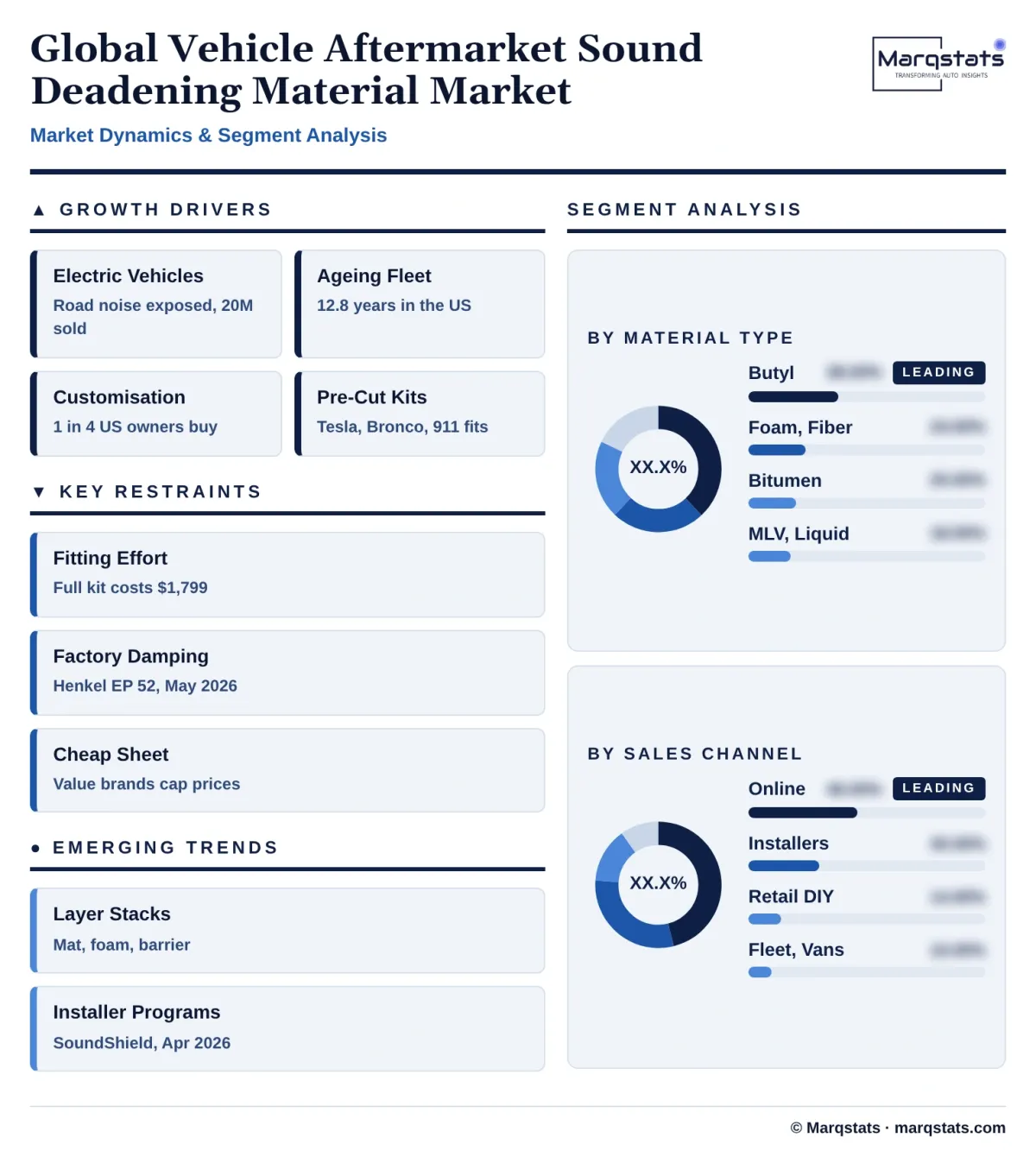
- Electric vehicles expose road and tyre noise. The International Energy Agency reports more than 20 million electric car sales in 2025, about one in four new cars, a fleet of nearly 80 million vehicles and a projection of 23 million sales, nearly 30% of new cars, in 2026, and an electric drivetrain removes the engine sound that masks wheel and body noise.
- An ageing fleet. The US light-vehicle fleet of about 289 million vehicles averaged 12.8 years of age in May 2025, and the European Union car fleet of 255,999,373 cars in 2024 averaged 12.7 years, so a large pool of vehicles has lost factory insulation to age and is worth treating.
- Customisation culture. The Specialty Equipment Market Association reported on 7 July 2026 that US accessory and performance parts sales reached USD 52.92 billion in 2025, that about one in four vehicle owners bought such products and that more than half of buyers are under 40, which is the age group that buys installation kits online.
- Vehicle-specific kits. Dynamic Control sells pre-cut Dynamat kits for the Tesla Model 3 and Model Y, and ResoNix Sound Solutions sells kits for the Ford Bronco and Porsche 911, which cut a job that once needed measuring and cutting sheet to a kit that fits one vehicle.
- China's large fleet. The Ministry of Public Security reported 366 million automobiles in China at the end of 2025 and 26.19 million new automobile registrations during the year, and close to 55% of new cars sold in China in 2025 were electric, so a very large pool of quiet vehicles is entering the market.
Key Restraints
Four constraints slow the market and cap the price that value-tier and premium suppliers can charge.
- Installation effort. A treatment means removing trim and cleaning panels, and a single car door needs about 5 square feet of mat, so a full-cabin job is slow. ResoNix Sound Solutions lists its entry-level full-vehicle kit at USD 1,799, which is beyond the budget of most owners and keeps the average treatment to doors and boot.
- Factory insulation keeps improving. Henkel AG & Co. KGaA launched TEROSON EP 52 on 12 May 2026, a structural adhesive that adds vibration damping to welded joints and removes the need for traditional bitumen sheets, and every gain in factory damping reduces the need to retrofit it.
- Price pressure from cheaper sheet. Value-tier mats sold through online marketplaces cost far less per square metre than premium butyl, and Marqstats estimates that value tiers hold about half of material area, which caps the average price and keeps the premium brands to the vehicles whose owners are willing to pay.
- Specification and safety concerns. Interior materials in the United States must meet the burn-rate limit of 102 millimetres per minute in 49 CFR 571.302, and Rogers Corporation noted on 24 September 2025 that vehicle makers are updating internal specifications to reference UL 94 flame ratings. Buyers of unbranded sheet with no published test data take a risk that installers and insurers avoid.
Key Trends
Four shifts are changing what is sold, how it is packaged and who buys it.
- Pre-cut kits by vehicle. Brands now sell door, floor, boot and roof kits cut to a named model, and a US Tesla accessories retailer lists a Dynamat kit for the Cybertruck, which raises the price per kit and lowers the skill needed to fit it.
- Multi-layer systems. SoundShield describes its range as triple-layer acoustic solutions, and the ResoNix Stage-3 door kit combines 20 square feet of butyl mat with 6 square feet of melamine foam and mass-loaded vinyl, so the sale is moving from one sheet to a stack.
- Installer programmes. SoundShield, which promotes itself as designed by installers for installers, named Aligned Sales & Marketing Group as its representative for the western United States on 30 April 2026, a sign that the professional channel is being built rather than left to online sellers.
- Fire and heat specifications. As Rogers Corporation noted on 24 September 2025, vehicle makers are moving to UL 94 flame ratings, and suppliers of aftermarket mats near battery packs and cabin electronics are expected to publish matching test data.
Strategic Implications
- For premium brand owners, the electric vehicle owner is the best customer. An electric vehicle is treated more often and with more material, so vehicle-specific kits for the best-selling electric models, sold with installation guides, win more value per sale than another general-purpose sheet.
- For value-tier sellers, the risk is the specification. Cheap bitumen sheet is losing share, and sellers that publish a burn-rate and loss-factor test report can hold price while those that do not will be driven out by marketplace reviews and insurers.
- For installers and body shops, treatment is a package sale. Customers who come for an audio upgrade can be sold a door and boot treatment at the same visit, and a kit price list that matches ResoNix and Dynamat tiers lets a shop quote in minutes.
- For distributors, the stock to carry is the kit. Single sheets are available online at any price, so distributors that win do so with pre-cut kits for the vehicles in their territory, and with training that brings installers to the brand.
- For investors and raw material suppliers, electrification is the figure to watch. A one-point rise in the battery electric share of the fleet moves value more than a one-point rise in the fleet itself, so battery electric fleet data is a better leading indicator than vehicle sales alone.
Market Segmentation
Butyl constrained-layer damping mats are the largest group at 38.00% of 2025 value, USD 318.42 million, rising to USD 446.72 million and 41.00% by 2030, a 7.01% CAGR. The mats are sold under brands such as Dynamat, ResoNix and SoundShield and are tested for loss factor, and ResoNix states a composite loss factor of 0.6 at 200 hertz on the SAE J1637 Oberst bar test for its 124-mil mat.
Foam and fiber decouplers and absorbers account for 24.00% of 2025 value, USD 201.12 million, and reach USD 283.29 million by 2030, a 7.09% CAGR. Closed-cell foam stops trim rattle and fiber absorbs airborne sound, and the layers sell with every full-cabin kit, which is why they gain as owners buy stacks rather than single sheets.
Bitumen and asphaltic mats account for 20.00% of 2025 value, USD 167.60 million, and fall to USD 163.44 million and 15.00% by 2030, a decline of 0.50% a year. They are the lowest-priced layer and are used where cost matters more than loss factor, but heat softening and odour push owners towards butyl, and vehicle makers are moving damping into the body structure.
Mass-loaded vinyl barriers account for 10.00% of 2025 value, USD 83.80 million, and reach USD 98.06 million by 2030, a 3.19% CAGR. The dense sheet blocks airborne noise through floors and bulkheads and is bought mainly by owners of electric vehicles and vans after the damping layer is in place.
Liquid-applied damping coatings account for 8.00% of 2025 value, USD 67.04 million, rising to USD 98.06 million and 9.00% of the market by 2030, a 7.90% CAGR. Henkel sells the TEROSON liquid-applied sound deadener range, and the sprays are used in wheel arches and underbodies where a sheet cannot be fitted.
Passenger cars and crossovers account for 41.00% of 2025 value, USD 343.57 million, rising to USD 457.62 million by 2030, a 5.90% CAGR. They are the largest vehicle group because they are the largest part of the fleet, and electric models such as the Tesla Model 3 and Model Y have the widest range of pre-cut kits.
Pickups and full-size sport utility vehicles account for 30.00% of 2025 value, USD 251.39 million, and reach USD 315.98 million by 2030, a 4.68% CAGR. The Specialty Equipment Market Association reports that pickups made up 30% of US accessory sales in 2025 and that nearly 13 million pickups were accessorised, and large cabins take more material per vehicle.
Light commercial vans account for 17.00% of 2025 value, USD 142.46 million, and grow at 6.60% a year to USD 196.12 million. Van converters and fleets treat cargo bulkheads, floors and wheel arches, and campervan builders use damping and decoupling to cut drumming from the load area.
Classic, muscle and custom vehicles account for 12.00% of 2025 value, USD 100.56 million, and reach USD 119.85 million by 2030, a 3.57% CAGR. These vehicles have no factory insulation to speak of, so owners use full kits, and restoration shops and car audio builders buy at the premium end.
Online sales to do-it-yourself buyers account for 46.00% of 2025 value, USD 385.47 million, rising to USD 555.68 million and 51.00% by 2030, a 7.59% CAGR. Brand stores and marketplaces sell kits cut to a vehicle, and installation videos replace the workshop for door and boot jobs.
Professional installers account for 30.00% of 2025 value, USD 251.39 million, and reach USD 305.08 million by 2030, a 3.95% CAGR. Car audio shops, customisation shops and body shops buy by the roll and through distributors, and brands such as SoundShield and Dynamat build dealer programmes for them.
Physical retail to do-it-yourself buyers accounts for 14.00% of 2025 value, USD 117.32 million, and falls to USD 119.85 million and 11.00% by 2030, a 0.43% CAGR. Parts stores and car audio retailers stock single sheets and small packs, but shelf space limits range and price.
Fleet and van converters account for 10.00% of 2025 value, USD 83.80 million, and reach USD 108.96 million by 2030, a 5.39% CAGR. Buyers purchase in bulk for vans, campervans and service vehicles on a tender or a contract with a distributor.
By Geography
North America
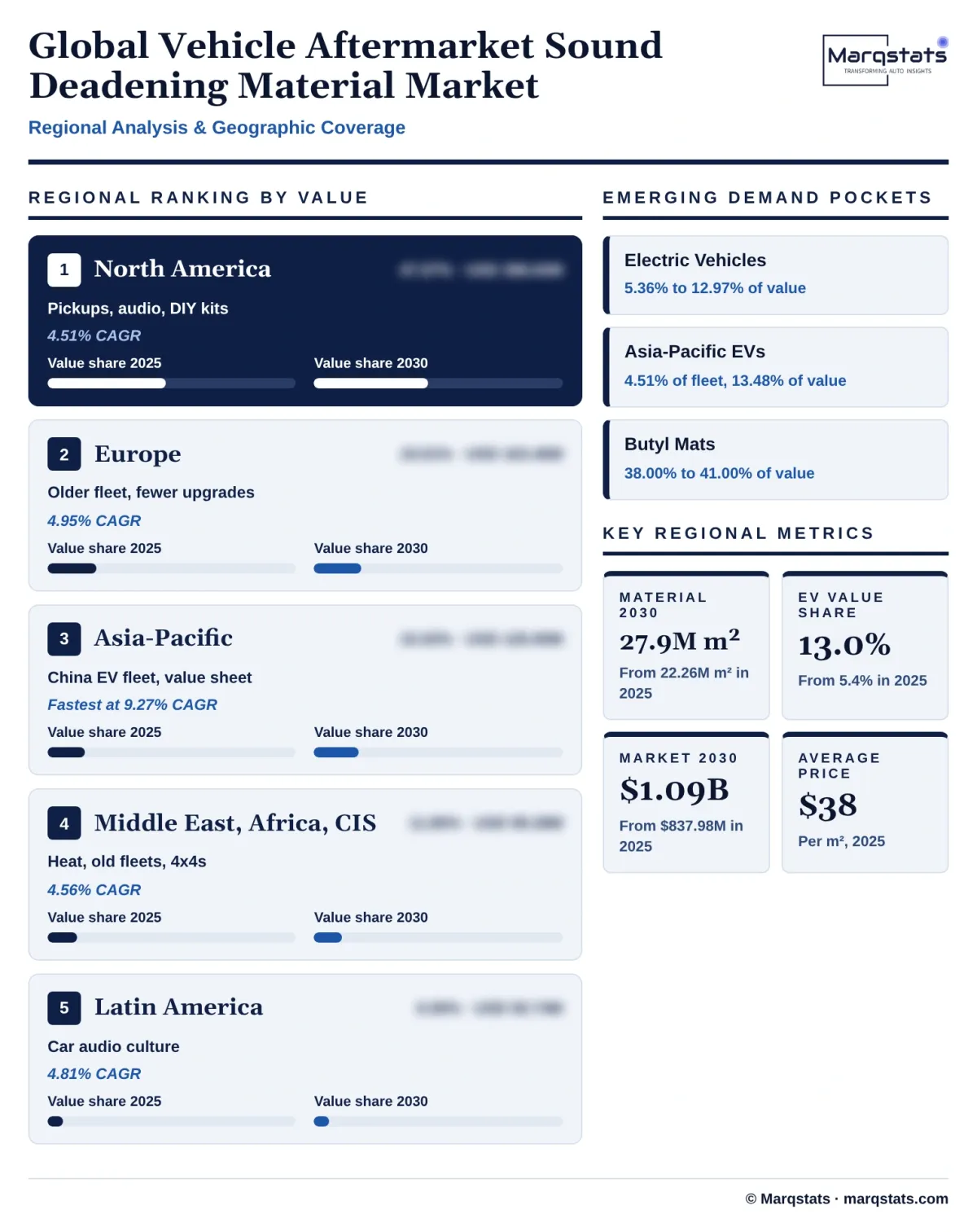
North America accounts for 47.57% of 2025 value, USD 398.60 million and about 8.45 million square metres, rising to USD 496.99 million by 2030, a 4.51% CAGR, while its share falls to 45.61%. Marqstats estimates a fleet of 350 million light vehicles across the United States, Canada and Mexico, of which the United States alone holds about 289 million with an average age of 12.8 years, and about 0.56% of vehicles are treated each year. The Specialty Equipment Market Association reported on 7 July 2026 that US accessory and performance parts sales were USD 52.92 billion in 2025, with pickups at 30% of sales and about one in four owners buying. The region has the highest price at USD 47.00 per square metre, because premium butyl and vehicle kits sell best here.
Europe
Europe accounts for 19.51% of 2025 value, USD 163.46 million and about 3.78 million square metres, and grows at 4.95% a year to USD 208.17 million and 19.11% of the market by 2030. Marqstats estimates a fleet of 375 million light vehicles, of which the European Union holds 255,999,373 cars in 2024 at an average age of 12.7 years. Treatment rates are about half those of North America at 0.27% of vehicles a year, because a larger share of vehicles are small cars with factory insulation and fewer owners fit audio upgrades. Electric vehicles reach 1.87% of the fleet in 2025 on the Marqstats estimate, and the diisocyanate restriction in the REACH regulation, which has required training for users of products with 0.1% free diisocyanate since 24 August 2023, affects liquid and foam products.
Asia-Pacific
Asia-Pacific accounts for 15.02% of 2025 value, USD 125.90 million and about 4.52 million square metres, and grows fastest, at 9.27% a year, to USD 196.14 million and 18.00% of the market by 2030. China holds 366 million automobiles according to the Ministry of Public Security and registered 26.19 million new ones in 2025, and the International Energy Agency reports that close to 55% of new cars sold in China in 2025 were electric, so Marqstats estimates that battery electric vehicles are 4.51% of the regional fleet and supply 13.48% of regional value. Material sells at about USD 27.50 per square metre, the lowest of the regions, because value-tier sheet from local makers dominates, and Japan, South Korea and Australia are premium pockets.
Latin America
Latin America accounts for 6.06% of 2025 value, USD 50.74 million and about 1.69 million square metres, rising to USD 64.19 million by 2030, a 4.81% CAGR. Marqstats estimates a fleet of 100 million light vehicles excluding Mexico and treatment of about 0.44% of vehicles a year, because the region has a strong car audio culture and an old fleet. Electric vehicles are still under 1% of the fleet, so growth rests on audio and comfort upgrades.
Middle East, Africa and CIS
The Middle East, Africa and the Commonwealth of Independent States account for 11.85% of 2025 value, USD 99.28 million and about 3.82 million square metres, and grow at 4.56% a year to USD 124.08 million by 2030. Marqstats estimates a fleet of 190 million light vehicles and treatment of about 0.50% of vehicles a year, driven by heat and noise insulation in the Gulf, an old fleet in Russia and neighbouring states where Standartplast sells damping mats, and 4x4 and commercial fleets in Africa.
How Competition Is Evolving
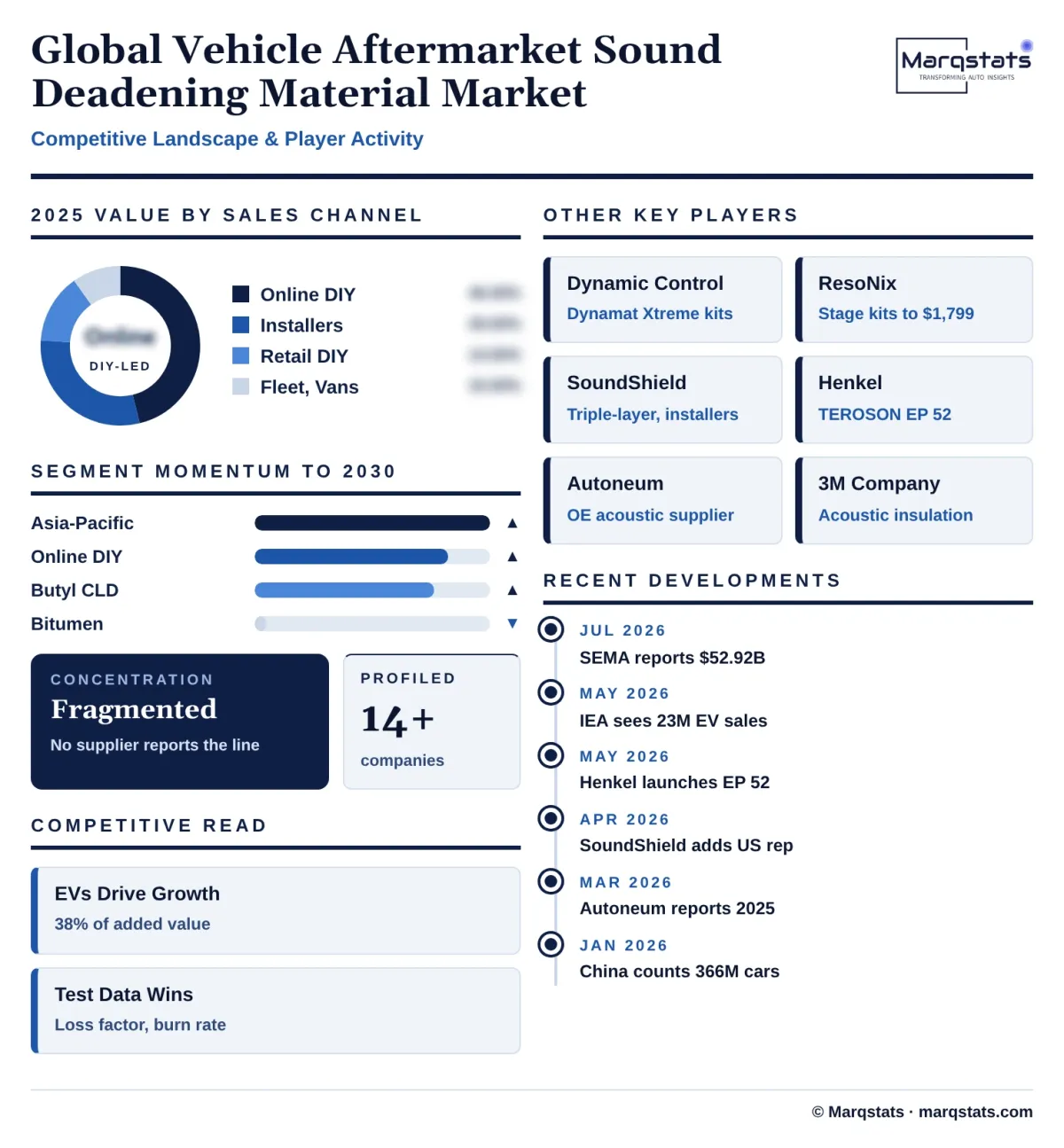
The market is fragmented and supplied in layers. Premium butyl specialists such as Dynamic Control, which sells Dynamat, ResoNix Sound Solutions and SoundShield sell vehicle kits through their own stores, installers and distributors. Value brands, among them Noico, Kilmat and Standartplast, sell sheet through online marketplaces at lower prices. Chemical groups such as Henkel AG & Co. KGaA sell liquid-applied damping, and 3M Company sells acoustic insulation. Original-equipment suppliers such as Autoneum Holding AG make the factory-fitted insulation that the aftermarket repairs or improves.
Marqstats describes competition by channel and layer because none of these companies reports the aftermarket line. Online do-it-yourself sales, at 46.00% of 2025 value, are won on listing quality, price per kit and vehicle fit. Professional installers, at 30.00%, are won through dealer programmes, training and technical data, as SoundShield showed when it named Aligned Sales & Marketing Group as its western US representative on 30 April 2026.
The group results show how small the aftermarket is inside the large suppliers. Autoneum Holding AG reported 2025 sales of CHF 2,290.6 million and EBIT of CHF 126.9 million on 12 March 2026, and it supplies acoustic and thermal management to vehicle makers rather than to owners. Henkel AG & Co. KGaA launched TEROSON EP 52 on 12 May 2026 for vehicle structures. Neither reports a retail sound deadening line.
Competition will be decided by test data, kit range and channel. Premium brands differ on published loss factor, temperature range and flame performance, on the number of vehicle models covered by pre-cut kits and on how well they serve installers. Value brands differ on price and on whether they publish any test data, and buyers increasingly compare the two on marketplace reviews and installation videos.
Barriers to entry are low for sheet and higher for kits. A seller can import butyl or bitumen sheet in a container, but a seller of vehicle kits needs templates for each model, a brand that installers trust and test data that satisfies the US burn-rate rule in 49 CFR 571.302 and the OEM specifications that buyers cite. Entrants therefore focus on a single vehicle group, such as electric vehicles or vans, before widening the range.
Companies Covered
Companies covered in the report include:
Recent Market Activity
Table of Contents
Coverage & Segmentation
The study covers the global vehicle aftermarket sound deadening material market, with 2025 as the base year and 2026 – 2030 as the forecast period. Values are in US dollars at the material level, meaning the retail or wholesale price of constrained-layer damping mats, bitumen mats, foam and fiber decouplers and absorbers, mass-loaded vinyl barriers and liquid-applied damping coatings bought to treat cars, sport utility vehicles, pickups and light commercial vans after the vehicle has left the factory. Volume is measured in million square metres. The market is segmented by material type, vehicle type, sales channel and region.
Factory-fitted insulation, installation labour, tyre-cavity noise foam, engine encapsulation and underbody shields, exhaust and audio equipment, and building and industrial acoustic products are excluded. Tyre-cavity foam is covered by the Marqstats Automotive Tire Noise Reduction Foam Market report and is not added here, and sound deadening sold within country accessories reports is not additive to this global report. UNECE Regulation No. 51 limits exterior pass-by noise and does not regulate interior treatment, so it sets no rule for the products sized here. All figures are in US dollars, and splits and the forecast are Marqstats estimates.