Market Snapshot
Middle bar: base-year value × (1 + CAGR), rounded to two decimals. This is a calculated illustration, not a separately researched annual estimate.
The global EV traction motor housing market size is estimated at USD 2,360.28 million in 2025 and is projected to reach USD 4,448.98 million by 2030, growing at a CAGR of 13.52% over 2026 – 2030. Annual housing volume rises from about 28.30 million units to 59.67 million, a 16.09% annual rate, while the average ex-factory price falls from about USD 83.39 to USD 74.56 per finished housing.
Marqstats defines the market as the ex-factory value of finished, machined and leak-tested enclosures for electric traction motors, sold by casting and machining suppliers to carmakers and electric drive suppliers or produced in carmaker-owned foundries and valued at equivalent prices. It covers stator housings, cooling jackets, end shields and the motor section of integrated electric drive unit casings for battery-electric and plug-in hybrid cars, vans, buses and trucks. Auxiliary motor housings, stator and rotor laminations, magnets, copper windings, shafts, inverter covers, gearbox-only casings and battery enclosures are excluded.
Water-jacket housings account for an estimated 64.20% of 2025 value and high-pressure die casting for 71.45%. China produces 71.01% of housing units and 61.31% of value. The study segments the market by cooling architecture, manufacturing process, vehicle type and region.
Key Takeaways
Market Overview & Analysis
Report Summary
Marqstats sizes the EV traction motor housing market as the value of the finished enclosure that holds the stator and rotor of an electric traction motor. In 2025 about 22.01 million electrified vehicles were built worldwide, including more than 20 million electric cars and about 1.21 million electric vans, buses and trucks. At an average of 1.286 traction motors per vehicle, they needed about 28.30 million housings, worth an estimated USD 2,360.28 million at an average ex-factory price of about USD 83.39.
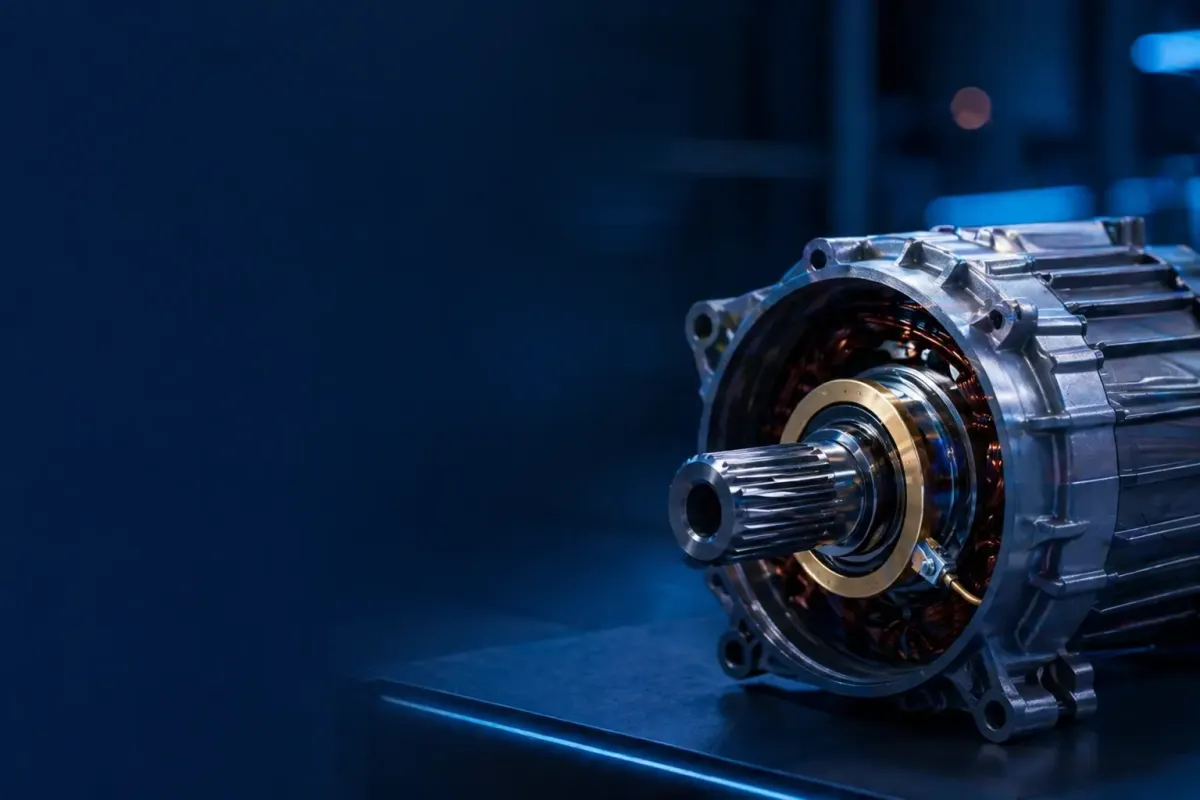
A traction motor housing does several jobs. It holds the stator in place with a precise press fit, keeps the air gap between stator and rotor within tight limits, carries the bearings that support the rotor shaft, contains the coolant or oil that removes heat, and provides the mounting points that fix the motor to the gearbox, inverter and vehicle subframe. Because it carries coolant under pressure, every finished housing is leak tested, usually with helium, before it is shipped.
Most housings are aluminium castings. Aluminium-silicon alloys combine low weight, good thermal conductivity and easy recycling, and they suit high-pressure die casting, which can produce thin walls of 3.0 to 4.5 millimetres in cycle times of around 90 seconds. Low-pressure and gravity die casting are used where internal cooling channels need sand cores, extruded aluminium sleeves are used for simple cylindrical stator housings, and sand casting is used for large, thick-walled housings for heavy trucks and for prototypes. Magnesium housings are about a third lighter than aluminium but are used only in a few performance applications because of cost and corrosion risk.
Design is moving from separate parts to integrated castings. Early electric vehicles used a standalone cylindrical motor housing bolted to a separate gearbox and inverter. Most new electric drive units combine the motor, a single-speed gearbox and the inverter in one assembly, so the motor housing often shares walls and mounting faces with the gearbox casing. This raises the value and complexity of each casting and favours suppliers that can cast, machine and test large parts.
The market grew from about 7.98 million housings worth USD 814.72 million in 2021 to 12.76 million worth USD 1,227.01 million in 2022, 17.64 million worth USD 1,608.21 million in 2023 and 22.57 million worth USD 1,966.70 million in 2024. Marqstats expects about 33.20 million housings worth USD 2,707.45 million in 2026.
Several rules shape demand. In China, the dual-credit policy and purchase tax exemption support new energy vehicle output. In the EU, Regulation (EU) 2019/631 sets fleet carbon dioxide targets that pushed carmakers to register more battery-electric cars at the end of 2025. In North America, USMCA requires a high share of regional content in core parts, which encourages local casting and machining, and in India incentives depend on local value addition. None of these rules regulates housings directly, but each decides where and how many housings are made.
Housing makers serve two kinds of customer. Some sell finished housings to carmakers that assemble their own motors, while others supply electric drive suppliers such as Bosch, BorgWarner, Aisin and Linamar, which build complete drive units. Vertically integrated carmakers, including Tesla and BYD, cast many of their own housings. Marqstats values captive production at the same ex-factory prices as purchased housings so that the market reflects all housings made, not only those traded.
Global EV Traction Motor Housing Market Size and Forecast
The global EV traction motor housing market grows from USD 2,360.28 million in 2025 to USD 4,448.98 million in 2030, a CAGR of 13.52%. Marqstats expects about 38.85 million housings worth USD 3,097.60 million in 2027, 45.08 million worth USD 3,514.67 million in 2028 and 52.07 million worth USD 3,970.38 million in 2029, before reaching 59.67 million housings in 2030.
Vehicle output drives volume. Marqstats expects global electrified vehicle output to rise from about 22.01 million in 2025 to 25.60 million in 2026 and 44.80 million in 2030. The IEA reported that electric car sales grew by 20% to exceed 20 million in 2025 and expects about 23 million in 2026, close to 28% of all cars sold, while electric truck sales more than doubled to 9% of truck sales worldwide in 2025.
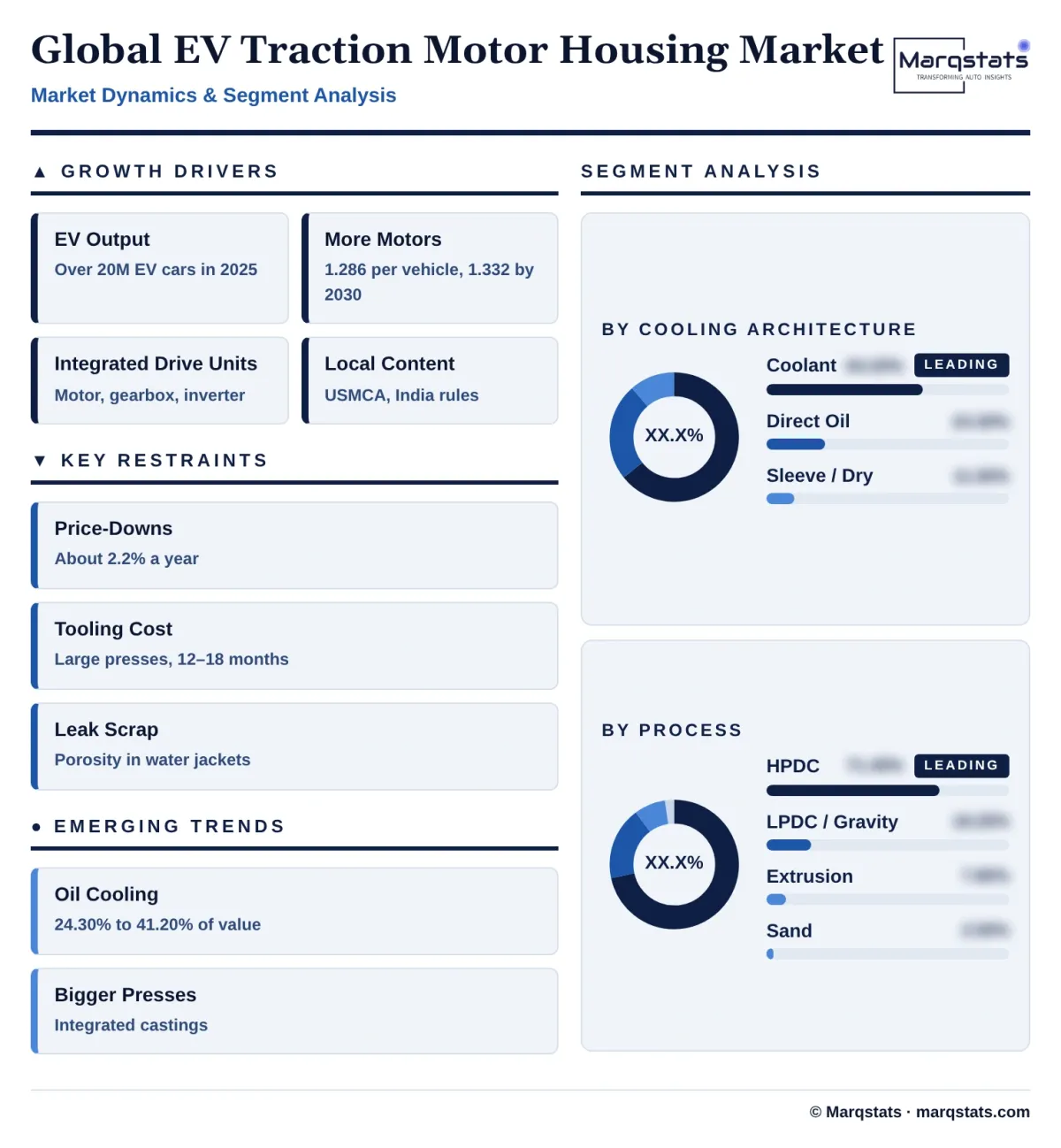
Motors per vehicle add a second layer of growth. In 2025 about 73.80% of electrified vehicles used one traction motor, 24.20% used two and 2.00% used three or four, an average of 1.286 motors per vehicle. Marqstats expects the average to rise to 1.332 by 2030 as dual-motor all-wheel drive spreads in sport utility vehicles, pickups and premium cars, so housing volume grows at 16.09% a year, faster than vehicle output.
Prices fall steadily. The average ex-factory price of a finished housing falls from about USD 102 in 2021 to USD 87.14 in 2024, USD 83.39 in 2025 and USD 74.56 in 2030. Faster casting cycles, larger presses that make several parts at once, automated inspection and annual price-down clauses in supply contracts push prices down, partly offset by a richer mix of oil-cooled, integrated and commercial vehicle housings.
Sensitivity is concentrated in two assumptions. A change of 0.05 in the average number of motors per vehicle moves 2025 volume by about 1.10 million housings and value by about USD 91.77 million, and a change of USD 5.00 in the average price moves 2025 value by about USD 141.53 million. Marqstats tracks electric vehicle output by region, all-wheel-drive mix, the share of integrated drive units and supplier price-down terms to monitor the forecast.
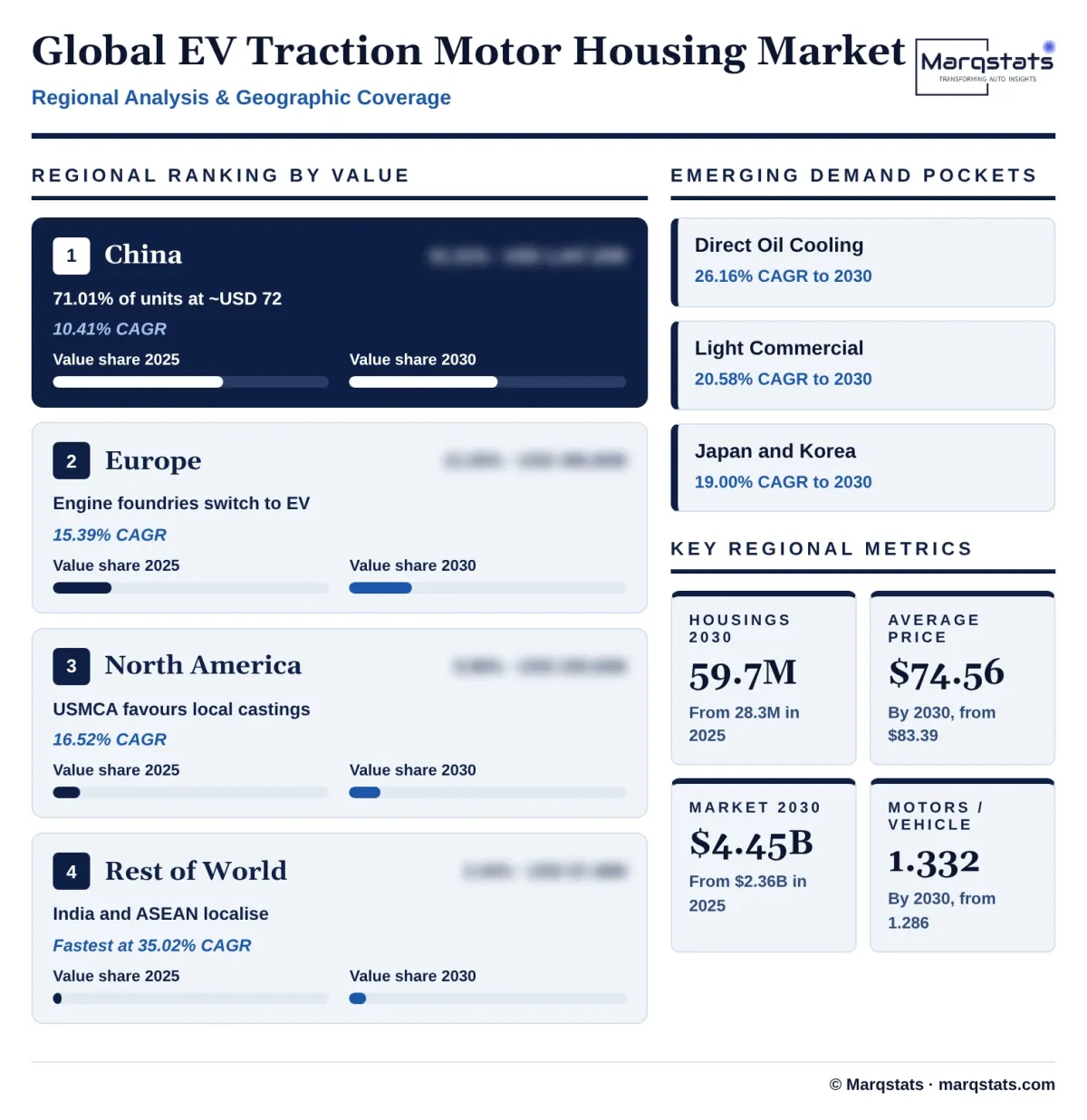
The regional mix changes over the forecast. China remains the largest producer but its share of value falls from 61.31% to 53.37% as carmakers localise housing supply in Europe, North America, India and Southeast Asia. Rest of World grows fastest, at 35.02% a year, from USD 57.48 million to USD 257.88 million, as India and Southeast Asian countries require more local content in electric vehicles.
Pricing differs sharply by region. Marqstats estimates the average 2025 ex-factory price of a finished housing at about USD 72 in China, USD 108 in Europe, USD 112 in Japan and South Korea, USD 124 in North America and USD 95 in Rest of World, reflecting differences in labour, energy and equipment cost, part complexity and the mix of commercial vehicle housings. By 2030 Marqstats expects these to fall to about USD 62, USD 95, USD 98, USD 110 and USD 84 respectively.
Market Dynamics
Key Drivers
Five forces are lifting demand for traction motor housings faster than electric vehicle sales.
- Electric vehicle output keeps rising. More than 20 million electric cars were sold worldwide in 2025, and the IEA expects about 23 million in 2026. China produced 16.626 million new energy vehicles in 2025, up 29%, and the EU registered 1,880,370 battery-electric cars, 17.4% of the market.
- More motors per vehicle. Dual-motor all-wheel drive in sport utility vehicles, pickups and premium cars, and tri-motor and quad-motor performance models, lift average housing demand to 1.286 per vehicle in 2025 and 1.332 by 2030.
- Integrated electric drive units. Combining motor, gearbox and inverter in one casting family raises the value of each casting and concentrates orders with suppliers that have large high-pressure die-casting cells and precision machining.
- Electrified commercial vehicles. Electric vans, buses and trucks need larger, thicker-walled housings for high-torque motors, worth two to four times as much as a passenger car housing.
- Local content rules. The USMCA rules of origin, Indian incentives tied to local value addition and similar rules in Southeast Asia push carmakers to buy housings from local foundries rather than import them.
Key Restraints
Four constraints squeeze housing suppliers even as volumes rise.
- Annual price-downs. Supply contracts typically require price reductions each year, so the average housing price falls by about 2.2% a year and suppliers must keep cutting cost to protect margins.
- High tooling and equipment cost. A high-pressure die-casting cell of 3,500 to 6,000 tonnes and its tooling require large upfront investment, and development and approval cycles take 12 to 18 months before revenue starts.
- Porosity and leak scrap. Housings with cast-in cooling channels are prone to gas porosity that causes coolant leaks at test, and scrap rates on complex water-jacket castings can be several times those of simpler oil-cooled shells.
- Uneven electric vehicle demand outside China. Slower or volatile electric vehicle growth in Europe and North America leaves new casting capacity underused, as shown by Nemak's plan to close its Herzogenburg plant in Austria because of low volumes.
Key Trends
Four shifts are changing how traction motor housings are designed, cast and bought.
- Direct oil cooling. Carmakers and drive suppliers such as Bosch are moving to oil sprayed onto the windings or pumped through the rotor, which removes heat more effectively and allows simpler housings without double-walled water jackets.
- Larger presses and integrated castings. Foundries are installing presses of 4,500 tonnes and above to cast integrated drive unit casings and, in China, large underbody castings that combine several structural parts.
- Automated inspection. Robot-mounted cameras, software defect detection and inline leak testing are replacing manual checks on housing lines to reduce scrap and labour cost.
- Recycled aluminium and certified supply. European and North American carmakers increasingly require recycled content and responsible sourcing certification, favouring suppliers certified under the Aluminium Stewardship Initiative.
Strategic Implications
- For casting suppliers, integrated drive unit casings are the growth opportunity. Suppliers that combine large high-pressure die-casting cells, precision machining and leak testing under one roof can win larger, more complex parts and reduce exposure to price pressure on simple stator sleeves.
- For carmakers and drive suppliers, dual sourcing across regions reduces risk. Local housing supply in each major assembly region helps meet rules of origin and avoids tariffs, while Chinese suppliers provide a cost benchmark.
- For Chinese suppliers, overseas plants protect access to Western carmakers. Building casting and machining capacity in Europe, Mexico and Southeast Asia lets them serve customers that require local content.
- For equipment makers, automation and larger presses are the main demand. Foundries need faster cells, vacuum systems, inline inspection and leak testing to meet cost-down targets.
- For investors, utilisation matters more than capacity. New plants pay back only when electric vehicle programmes reach planned volumes, so contracts with several carmakers and a mix of electric and conventional parts reduce risk.
- For carmakers choosing a cooling design, the casting is part of the decision. Moving from water jackets to direct oil cooling simplifies the housing, reduces scrap and can lower cost per part, but it requires new tooling and machining, so the switch is best made at a new platform launch.
Market Segmentation
Housings with cast-in spiral or serpentine channels carrying water-glycol coolant account for 64.20% of 2025 value, USD 1,515.30 million, and grow at 8.62% a year to USD 2,291.22 million by 2030, while their share falls to 51.50%. They remain the standard design for mass-market single-motor vehicles.
Housings for motors cooled by oil sprayed onto the stator end windings or pumped through the rotor shaft account for 24.30% of 2025 value, USD 573.55 million, and grow fastest, at 26.16% a year, to USD 1,832.98 million and 41.20% of the market by 2030. Removing the double-walled water jacket simplifies the casting and reduces porosity scrap.
Two-piece housings with an extruded inner sleeve pressed into an outer casing, and dry shells used with external cooling, account for 11.50% of 2025 value, USD 271.43 million, and grow at 3.65% a year to USD 324.78 million and 7.30% of the market.
High-pressure die casting, mostly with vacuum assistance, accounts for 71.45% of 2025 value, USD 1,686.42 million, and grows at 15.67% a year to USD 3,492.45 million and 78.50% of the market by 2030, because it delivers thin walls, near-net shapes and short cycle times.
Low-pressure and gravity die casting, used where cooling channels need sand cores, accounts for 18.25% of 2025 value, USD 430.75 million, and grows at 6.23% a year to USD 582.82 million, with its share falling to 13.10%.
Extruded aluminium profiles machined into cylindrical stator sleeves account for 7.80% of 2025 value, USD 184.10 million, and grow at 8.42% a year to USD 275.84 million.
Low-pressure sand casting for large heavy-truck housings and prototypes accounts for 2.50% of 2025 value, USD 59.01 million, and grows at 10.65% a year to USD 97.87 million.
Battery-electric and plug-in hybrid passenger cars account for 88.60% of 2025 value, USD 2,091.21 million and about 25.08 million housings, and grow at 12.53% a year to USD 3,772.74 million, 84.80% of 2030 value.
Electric vans and light trucks account for 7.10% of 2025 value, USD 167.58 million and about 2.01 million housings, and grow at 20.58% a year to USD 427.10 million as delivery fleets electrify.
Electric buses and medium and heavy trucks account for 4.30% of 2025 value, USD 101.49 million and about 1.22 million housings, and grow at 19.67% a year to USD 249.14 million. Their housings are larger and thicker-walled to carry continuous torque above 2,500 Nm.
By Geography
China
China is the largest producer, with 61.31% of 2025 value, USD 1,447.20 million and about 20.10 million housings, 71.01% of world volume, rising to USD 2,374.60 million by 2030, a 10.41% CAGR, while its share of value falls to 53.37%. CAAM reported new energy vehicle production of 16.626 million in 2025, up 29%, and exports of 2.615 million. Suppliers such as Wencan Group, Guangdong Hongtu Technology and Anda Group, and carmaker-owned foundries such as BYD, run large high-pressure die-casting cells and sell housings at an average of about USD 72, the lowest of any region.
Europe
Europe accounts for 21.05% of 2025 value, USD 496.80 million and about 4.60 million housings, and grows at 15.39% a year to USD 1,016.50 million and 22.85% of the market by 2030. The EU registered 1,880,370 battery-electric cars in 2025, 17.4% of the market, and 1,015,887 plug-in hybrids, while petrol registrations fell 18.7% and diesel 24.2%, pushing engine foundries to switch capacity to electric parts. Nemak, Georg Fischer's former casting plants, DGS Druckguss Systeme and carmaker foundries lead supply, at an average price of about USD 108.
North America
North America accounts for 9.98% of 2025 value, USD 235.60 million and about 1.90 million housings, and grows at 16.52% a year to USD 506.00 million by 2030. USMCA rules of origin favour local castings, and Nemak's Augusta, Georgia plant completed initial test production in 2026 and is ramping deliveries for a BMW sport utility vehicle programme. Mexico supplies a large share of castings for US assembly plants, and the average price is about USD 124.
Japan and South Korea
Japan and South Korea account for 5.22% of 2025 value, USD 123.20 million and about 1.10 million housings, and grow at 19.00% a year to USD 294.00 million by 2030. Ryobi, Ahresty and Aisin supply Japanese carmakers, and much of the output is exported in electric drive units.
Rest of World
Rest of World, led by India, Thailand, Indonesia and Brazil, accounts for 2.44% of 2025 value, USD 57.48 million, and grows fastest, at 35.02% a year, to USD 257.88 million and 5.80% of the market by 2030. Local content incentives push carmakers to buy housings from local foundries; Endurance Technologies began production at a new Rs 400.9 crore aluminium die-casting plant in Maharashtra in September 2026.
How Competition Is Evolving
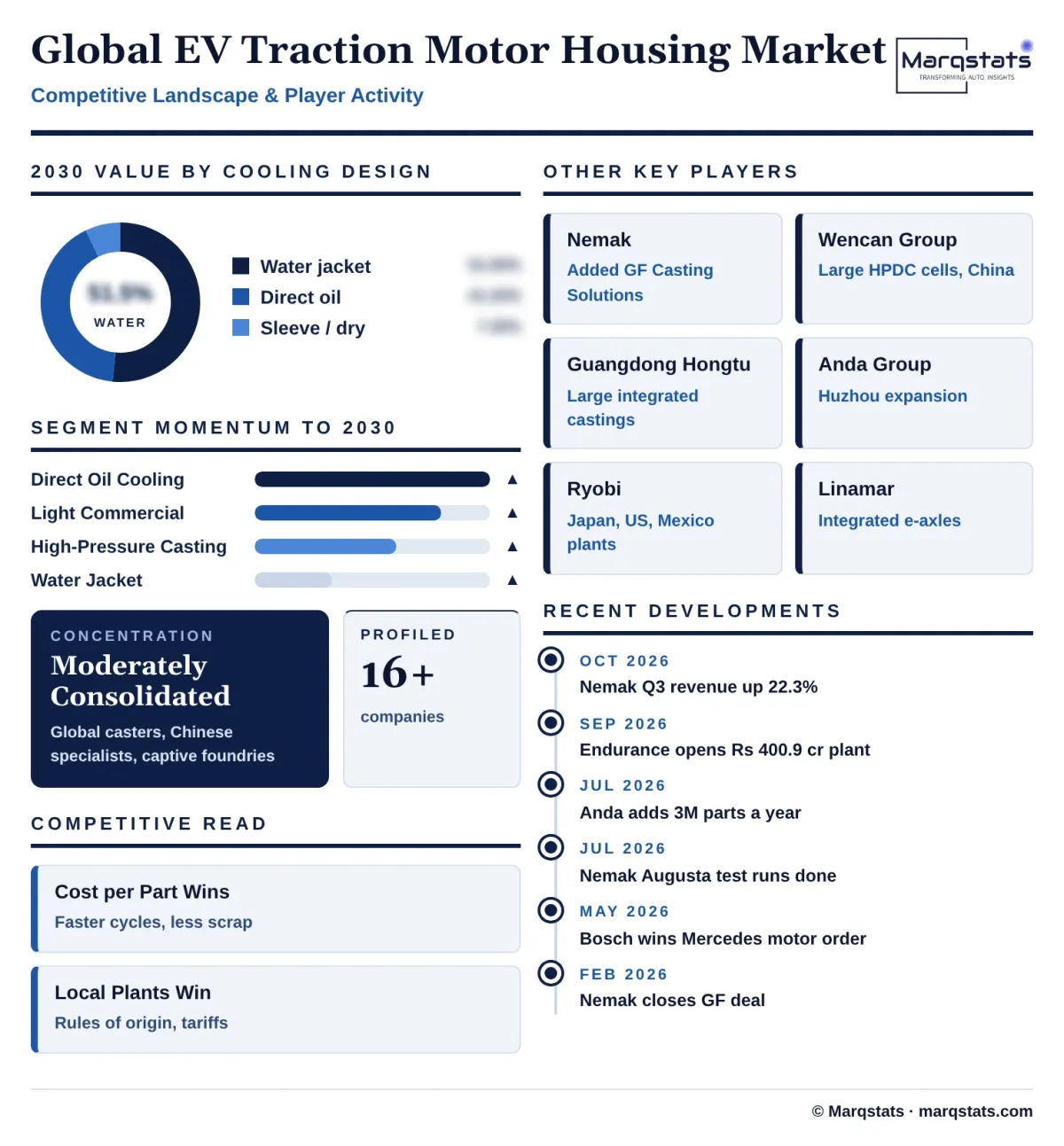
The EV traction motor housing market is moderately consolidated. Large global casting groups, Chinese high-pressure die-casting specialists, Japanese suppliers and the in-house foundries of vertically integrated carmakers such as Tesla and BYD supply most of the volume.
Nemak is the largest independent supplier outside China after its acquisition of GF Casting Solutions automotive business, which brought nine plants in Austria, China, Germany, Romania and the United States and about USD 707 million of 2024 revenue. Nemak reported third quarter 2026 revenue of USD 1.501 billion, up 22.3%, helped by the acquired plants.
Chinese suppliers compete on scale and price. Wencan Group, Guangdong Hongtu Technology and Anda Group operate many large presses, supply domestic and foreign carmakers, and are building capacity for motor and inverter housings. Wencan won orders worth CNY 700 to 800 million for motor housings from a German carmaker in 2024.
Competition is decided by cost per finished housing, scrap rates and the ability to cast and machine integrated drive unit casings. Suppliers with regional plants close to carmaker assembly, automated inspection and certified recycled aluminium will win the largest programmes.
Japanese and Western suppliers compete on quality and customer access. Ryobi and Ahresty supply Japanese carmakers from plants in Japan, North America and Asia, Linamar and BorgWarner design and build integrated drive units, and DGS Druckguss Systeme makes complex aluminium and magnesium housings in Europe and China. Carmakers with their own foundries, led by Tesla and BYD, make a large share of their own housings and set cost benchmarks for outside suppliers.
Companies Covered
Companies covered in the report include:
Recent Market Activity
Table of Contents
Coverage & Segmentation
The study covers the global EV traction motor housing market, with 2025 as the base year, 2021 – 2025 as the historical period and 2026 – 2030 as the forecast period. Values are in US dollars at ex-factory prices for finished, machined and leak-tested housings, and volumes are housing units produced for new electrified vehicles. Regions are defined by the location of housing production. The market is segmented by cooling architecture, manufacturing process, vehicle type and region.
Auxiliary motor housings, active motor parts, inverter and gearbox-only casings, battery enclosures and electric two- and three-wheelers are excluded. Aluminium gravity and low-pressure die-cast housings are also part of Marqstats' broader automotive aluminium gravity die casting study; the two should not be added. Segment and regional splits are Marqstats estimates built on vehicle production data, motor fitment ratios and casting price benchmarks.