Market Snapshot
Middle bar: base-year value × (1 + CAGR), rounded to two decimals. This is a calculated illustration, not a separately researched annual estimate.
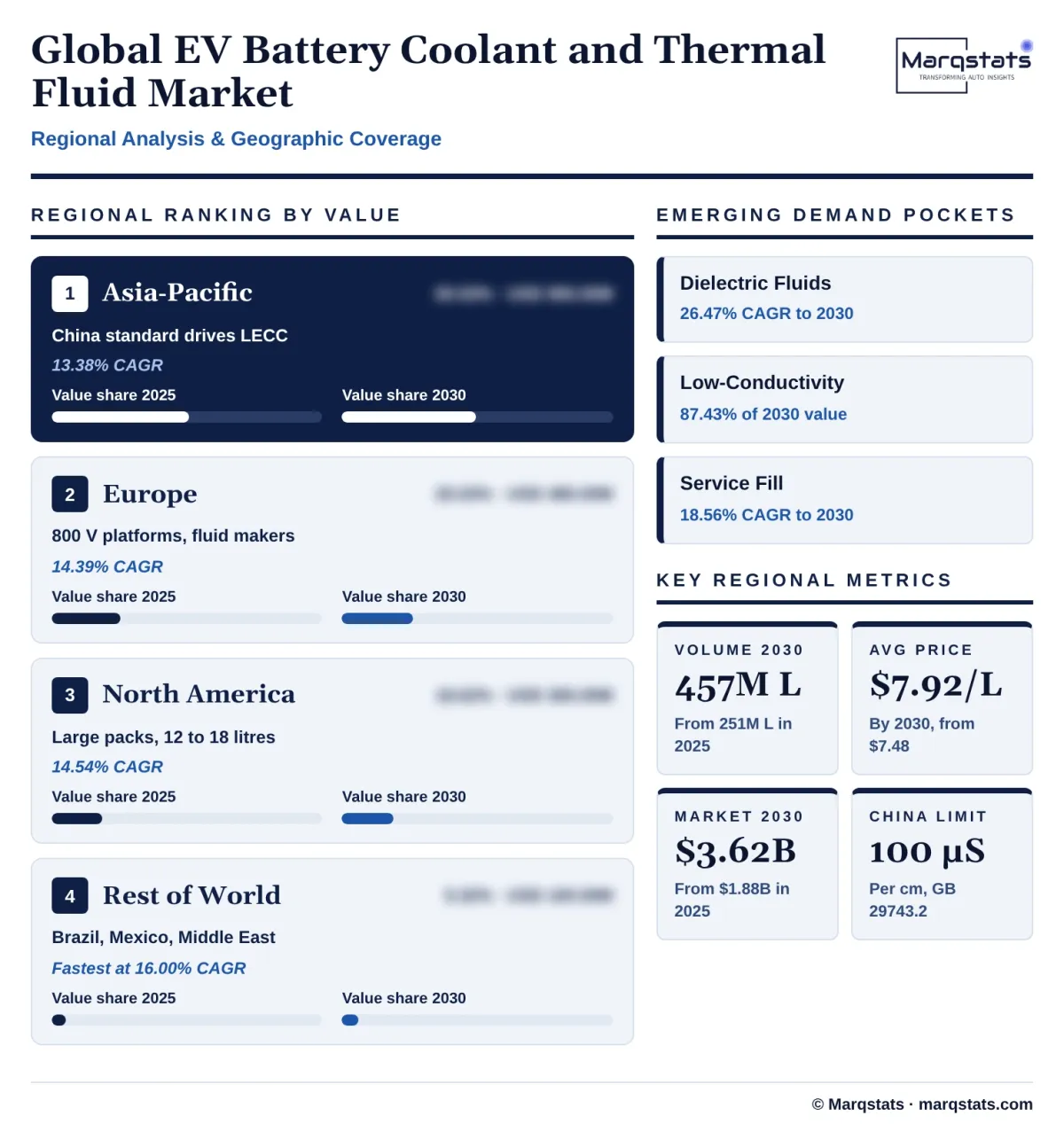
The global EV battery coolant and thermal fluid market size is estimated at USD 1,880.00 million in 2025 and is projected to reach USD 3,620.00 million by 2030, growing at a CAGR of 14.00% over 2026 – 2030. Fluid volume rises from about 251.30 million litres to 457.30 million litres, a 12.72% annual rate, while the average blended price rises from about USD 7.48 to USD 7.92 per litre as low-conductivity and dielectric fluids replace conventional glycol coolant.
Marqstats defines the market as the value of heat-transfer fluids made to circulate in or across the traction battery of battery electric, plug-in hybrid and fuel cell vehicles. It covers low electrical conductivity glycol-water coolants for cold plates and cooling channels, conventional glycol coolants still used in battery loops, and dielectric thermal fluids that touch cells, busbars and terminals directly. It includes factory first fill and aftermarket, warranty and service fill. Cooling hardware, refrigerants, transmission and e-axle lubricants and stationary storage are excluded.
Low-conductivity coolants account for 65.05% of 2025 value, passenger cars for 65.43% and factory fill for 81.38%. Asia-Pacific accounts for 50.53% of 2025 value and Europe for 25.53%. The study segments the market by coolant chemistry, vehicle type, sales channel and region.
Key Takeaways
Market Overview & Analysis
Report Summary
Marqstats sizes the EV battery coolant and thermal fluid market as the value of fluids used to cool and heat the traction battery of electric vehicles. In 2025 about 251.30 million litres of battery coolant and thermal fluid were sold worldwide, worth an estimated USD 1,880.00 million at an average of about USD 7.48 per litre. Factory fill accounted for about 216.30 million litres and aftermarket and service fill for about 35.00 million litres.
Most electric vehicles cool their batteries indirectly. A mixture of water and ethylene glycol flows through aluminium cold plates or channels under or between cells, removing heat during driving and fast charging and warming the battery in cold weather. Ordinary engine coolant is not ideal for this job. Its corrosion inhibitors and dissolved salts let it conduct electricity at several thousand µS/cm, so a leak onto live high-voltage parts can cause current to flow, corrosion and the release of hydrogen gas.
Low electrical conductivity coolants, known as LECCs, solve this by using purified glycol, deionised water and inhibitors that do not add ions. Fresh LECCs typically measure well below 100 µS/cm. Clariant's Genantin EV-LC, for example, has a typical conductivity of 54 µS/cm while still protecting against corrosion when mixed with poor-quality or salty water. Lower conductivity reduces the risk of short circuits and limits hydrogen generation if coolant reaches energised parts.
Dielectric thermal fluids go further. Synthetic hydrocarbons, gas-to-liquids isoparaffins and esters do not conduct electricity, so they can touch cells, busbars and terminals directly. Immersion cooling removes the need for cold plates and thermal pads and keeps cells within a narrow temperature band, but it needs far more fluid per pack and costs more per litre. These fluids are still a small share of the market, used mainly in performance vehicles, commercial vehicle trials and concept cars.
The market grew from USD 490.00 million in 2021 to USD 800.00 million in 2022, USD 1,140.00 million in 2023 and USD 1,490.00 million in 2024, a 39.96% annual rate from 2021 to 2025 as electric vehicle output more than tripled. Marqstats expects USD 2,140.00 million in 2026 and USD 3,620.00 million in 2030, with growth slowing as vehicle output matures and price increases come mainly from the chemistry shift.
The market overlaps with the Marqstats Global EV Battery Immersion Cooling report. That report sizes immersion cooling systems at USD 136.00 million in 2025, including the first fill of dielectric fluid. The dielectric thermal fluid segment here is aligned with that report: its first-fill fluid of USD 14.50 million in 2025 and USD 46.00 million in 2030, plus a small top-up and replacement fill, gives USD 17.00 million and USD 55.00 million. The two values must not be added together.
Standards have moved quickly. ASTM D8566-24 sets a specification for glycol-based electric vehicle coolant with low electrical conductivity, and ASTM D8634-25 sets a test method for measuring conductivity in electric vehicle coolants, so that suppliers and carmakers measure it the same way. China's GB 29743.2-2025 goes further by making requirements mandatory for coolant sold for electric vehicles, covering classification, technical requirements, test methods, marking and packaging. Together these rules are turning low conductivity from a premium feature into a basic requirement.
Battery safety rules add to the pressure. China's GB 38031-2025 requires no fire or explosion after a single cell goes into thermal runaway, applying to new type approvals from 1 July 2026 and to existing types from 1 July 2027. Coolant is not the only safety measure in a pack, but a coolant that keeps conductivity and hydrogen generation low if it leaks onto live parts helps carmakers reduce one known cause of electrical faults inside the battery.
Global EV Battery Coolant and Thermal Fluid Market Size and Forecast
The global EV battery coolant and thermal fluid market grows from USD 1,880.00 million in 2025 to USD 3,620.00 million in 2030, a CAGR of 14.00%. Marqstats expects USD 2,140.00 million in 2026, USD 2,430.00 million in 2027, USD 2,770.00 million in 2028 and USD 3,160.00 million in 2029.
Volume follows vehicle output and the growing fleet. Total fluid volume rises from about 251.30 million litres in 2025 to 286.00 million in 2026, 321.32 million in 2027, 361.20 million in 2028, 404.50 million in 2029 and 457.30 million in 2030. Factory fill rises at 11.47% a year, from 216.30 million to 372.30 million litres, in line with electric vehicle output growing at 12.12% a year. Service fill rises faster, at 19.42% a year, from 35.00 million to 85.00 million litres, as more vehicles reach coolant service intervals and repair.
Price rises because of mix, not inflation. The average blended price per litre rises from about USD 6.55 in 2021 to USD 7.48 in 2025 and USD 7.92 in 2030, a 1.15% annual increase. Within each chemistry, prices are broadly stable or falling as production scales. The increase comes from LECCs and dielectric fluids, which cost more than conventional coolant, taking a larger share of the litres sold.
Fill volume per vehicle is a key assumption. Marqstats estimates average factory fill at about 10.5 litres per electric vehicle in 2025 across battery and linked cooling loops, rising to 12 to 18 litres in large North American pickups and SUVs with 80 to 130 kWh packs. Each 1-litre change in average factory fill changes 2030 demand by about 36.50 million litres, worth about USD 289 million at the 2030 average price.
Marqstats tracks four indicators to monitor the forecast: enforcement of GB 29743.2-2025 in China, adoption of ASTM D8566-24 by carmakers in North America and Europe, the pace of immersion cooling in trucks and buses, and the share of electric vehicles reaching coolant service intervals. Faster adoption of low-conductivity specifications outside China would push value above the base path, while slower electric vehicle sales in North America would slow it.
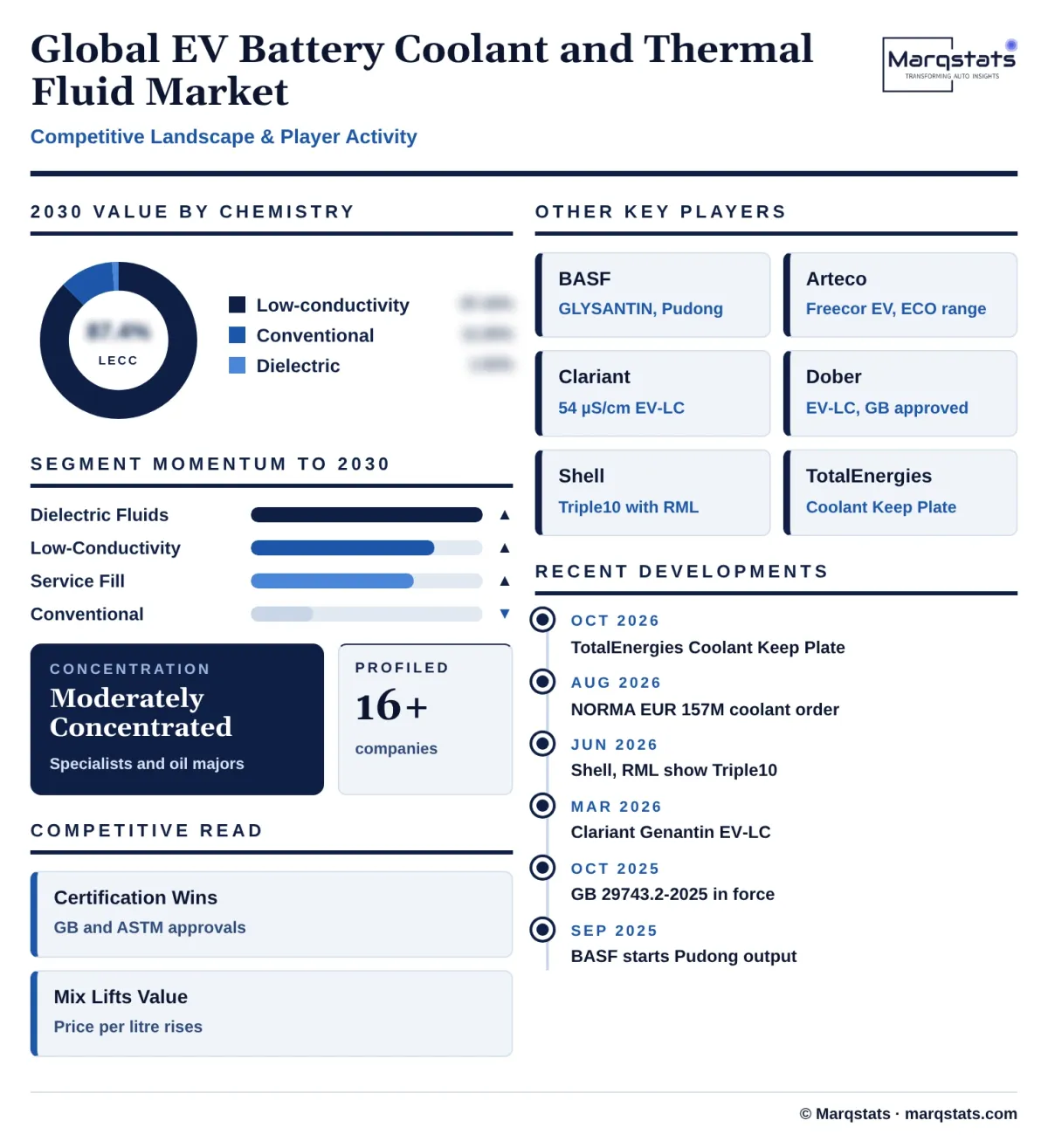
The mix of the market changes over the forecast. Low-conductivity coolants rise from 65.05% of value in 2025 to 87.43% in 2030, dielectric fluids from 0.91% to 1.52%, and conventional glycol coolant falls from 34.04% to 11.05%. Commercial vehicles rise from 24.47% to 29.56% of value and service fill from 18.62% to 22.65%, while Asia-Pacific stays close to half of the market.
Price per litre varies widely by chemistry. Marqstats estimates low-conductivity coolant at about USD 7.50 per litre at factory-fill prices, conventional coolant at a lower price, and dielectric thermal fluids at roughly USD 10 to USD 22 per litre depending on base fluid and volume. A typical cold-plate battery loop holds about 10 litres, while an immersion-cooled pack can hold around 40 litres or more, which is why each immersion-cooled vehicle adds much more fluid value than a conventional one.
Market Dynamics
Key Drivers
Five forces are lifting demand for purpose-made battery coolants and thermal fluids.
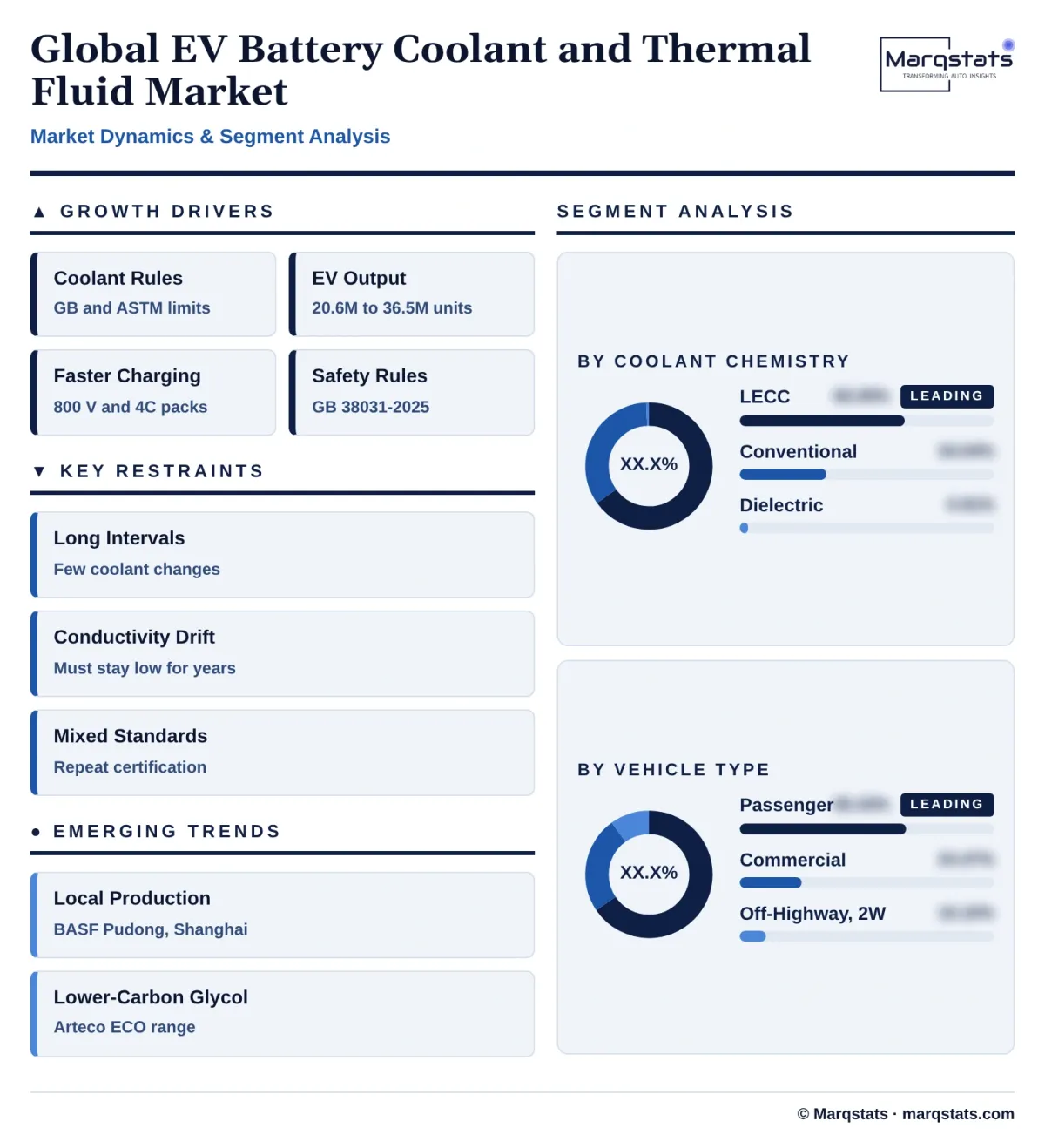
- Mandatory low-conductivity standards. China's GB 29743.2-2025 took effect on 1 October 2025 and sets requirements for electric vehicle coolants, including conductivity below 100 µS/cm for fresh coolant. ASTM D8566-24 sets a similar specification for glycol-based electric vehicle coolants with low electrical conductivity in other markets.
- Rising electric vehicle output. Marqstats estimates about 20.60 million electric vehicles were built in 2025, rising to 36.50 million by 2030, and every vehicle needs a factory fill of battery coolant.
- Faster charging and higher voltages. 800-volt platforms and charging rates of 4C and above produce more heat in cells and need coolants that move heat quickly while staying electrically safe.
- Stricter battery safety rules. China's GB 38031-2025, which applies to new type approvals from 1 July 2026, requires no fire or explosion after a single cell fails. Coolants that reduce hydrogen generation and short-circuit risk support compliance.
- A growing fleet needing service. As electric vehicles age, coolant top-ups, replacements and repairs create aftermarket demand for certified low-conductivity coolant.
- Lower-carbon supply chains. Carmakers are asking suppliers to cut emissions from purchased materials, creating demand for coolants made from renewable or recycled glycol with certified traceability.
Key Restraints
Four constraints limit how fast value grows in battery coolants and thermal fluids.
- Long service intervals. Many electric vehicles use long-life coolant that may last the life of the vehicle or need changing only after many years, limiting aftermarket volume per vehicle.
- Conductivity rises in service. Glycol breaks down and metals dissolve over time, raising conductivity. Coolants must keep low conductivity for years, which raises formulation and testing costs.
- Different standards in different regions. China, ASTM and carmaker specifications use different limits and test methods, so suppliers must certify the same coolant several times.
- Cost and weight of dielectric fluids. Immersion cooling needs much more fluid per pack than cold plates and the fluids cost more per litre, which limits use in mass-market cars.
Key Trends
Four shifts are changing how battery coolants are formulated, tested and supplied.
- Standard test methods. ASTM D8634-25 sets a method for measuring conductivity in electric vehicle coolants, helping suppliers and carmakers compare results. Uniform test methods reduce disputes over whether a coolant meets a specification and make it easier to qualify one coolant for several carmakers.
- Localised production in China. Global suppliers are making certified coolant in China, as BASF does at its Pudong site in Shanghai, to win factory-fill business from Chinese carmakers.
- Lower-carbon coolants. Coolants made from renewable or recycled glycol, such as Arteco's ECO range under ISCC PLUS mass balance, help carmakers cut supply chain emissions.
- Immersion cooling demonstrators. Fluid suppliers use concept cars and battery partnerships, such as Shell with RML and TotalEnergies with XING Mobility, to show what dielectric fluids can do.
Strategic Implications
- For coolant makers, certification is the entry ticket. Suppliers need coolant approved to GB 29743.2-2025 and ASTM D8566-24, with test data that shows conductivity stays low over the life of the vehicle.
- For carmakers, coolant is part of the safety case. Specifying low-conductivity coolant and checking it during service reduces short-circuit and hydrogen risks if coolant leaks.
- For aftermarket distributors, stocking the right product matters. Workshops need clearly labelled EV coolants and guidance on not mixing them with engine coolant.
- For fluid suppliers in immersion cooling, commercial vehicles are the near-term market. Truck, bus and off-highway packs offer larger fills and stronger reasons to adopt immersion than mass-market cars.
- For investors, value growth comes from mix. Total litres grow with vehicle output, but higher-priced LECCs and dielectric fluids lift value faster than volume.
- For regulators, harmonised limits would help. Aligning conductivity limits and test methods across China, ASTM and carmaker specifications would cut certification costs and make it easier for workshops to choose the right coolant.
Market Segmentation
Low electrical conductivity glycol-water coolants account for 65.05% of 2025 value, USD 1,223.00 million, rising to USD 3,165.00 million by 2030, a 20.95% CAGR, and 87.43% of the market. They use purified ethylene glycol, deionised water and inhibitor packages that do not add ions, keeping conductivity below 100 µS/cm. BASF, Arteco, Clariant, Dober, Prestone and CCI are among suppliers.
Conventional glycol-water coolants still used in battery loops account for 34.04% of 2025 value, USD 640.00 million, and shrink by 8.97% a year to USD 400.00 million and 11.05% of value by 2030. Their conductivity of several thousand µS/cm no longer meets new electric vehicle standards, so they are being replaced in new vehicles, with remaining demand mostly from older models and the aftermarket.
Dielectric thermal fluids, including synthetic hydrocarbons, gas-to-liquids isoparaffins and esters, account for 0.91% of 2025 value, USD 17.00 million, and grow fastest, at 26.47% a year, to USD 55.00 million and 1.52% of 2030 value. Shell, TotalEnergies, ExxonMobil, Castrol and Petronas lead. The segment equals the first-fill fluid in the Marqstats Global EV Battery Immersion Cooling report, USD 14.50 million in 2025 and USD 46.00 million in 2030, plus a small top-up and replacement fill.
Passenger battery electric and plug-in hybrid cars account for 65.43% of 2025 value, USD 1,230.00 million, rising to USD 2,250.00 million by 2030, a 12.84% CAGR, while their share falls to 62.15%.
Light, medium and heavy commercial vehicles account for 24.47% of 2025 value, USD 460.00 million, and grow fastest, at 18.39% a year, to USD 1,070.00 million and 29.56% of 2030 value, because larger packs need more coolant and hard duty cycles demand stronger cooling.
Off-highway equipment, two-wheelers and specialist vehicles account for 10.10% of 2025 value, USD 190.00 million, rising to USD 300.00 million by 2030, a 9.57% CAGR, as many small vehicles use air cooling or small coolant volumes.
Factory first fill at vehicle and battery assembly plants accounts for 81.38% of 2025 value, USD 1,530.00 million, rising to USD 2,800.00 million by 2030, a 12.85% CAGR, while its share falls to 77.35%.
Aftermarket, warranty and service fill accounts for 18.62% of 2025 value, USD 350.00 million, and grows at 18.56% a year to USD 820.00 million and 22.65% of 2030 value as the electric vehicle fleet ages.
By Geography
Asia-Pacific
Asia-Pacific is the largest region, with 50.53% of 2025 value, USD 950.00 million, rising to USD 1,780.00 million by 2030, a 13.38% CAGR, while its share falls slightly to 49.17%. China's new energy vehicle output and GB 29743.2-2025 drive the switch to low-conductivity coolant, and global suppliers such as BASF have started local production. Electric vehicle growth in Thailand, Indonesia, India, Japan and South Korea adds volume. Because GB 29743.2-2025 covers coolant sold for electric vehicles nationally, Chinese aftermarket channels are also moving to certified low-conductivity products, which supports service-fill value in the region.
Europe
Europe accounts for 25.53% of 2025 value, USD 480.00 million, rising to USD 940.00 million by 2030, a 14.39% CAGR, and 25.97% of the market. EU fleet CO2 targets and about 1.88 million new battery electric car registrations in 2025 support demand. Premium 800-volt platforms and suppliers such as BASF, Arteco, Clariant, Shell and TotalEnergies make Europe a centre for new coolant and dielectric fluid development.
North America
North America accounts for 18.62% of 2025 value, USD 350.00 million, rising to USD 690.00 million by 2030, a 14.54% CAGR, and 19.06% of the market. Large pickup and SUV packs of 80 to 130 kWh need 12 to 18 litres of coolant per vehicle, and ASTM D8566-24 is the main reference specification. Electric truck and bus programmes in the United States and Canada add larger fills per vehicle, and workshops are adding dedicated EV coolant service as more vehicles leave warranty.
Rest of World
The rest of the world accounts for 5.32% of 2025 value, USD 100.00 million, and grows fastest, at 16.00% a year, to USD 210.00 million and 5.80% of 2030 value, led by Brazil, Mexico, Türkiye and the Middle East. High temperatures in these markets increase the need for coolants that resist breakdown.
How Competition Is Evolving
The EV battery coolant and thermal fluid market is moderately concentrated. Coolant specialists such as BASF, Arteco, Clariant, Dober, Prestone and CCI lead low-conductivity glycol coolants. Oil majors such as Shell, TotalEnergies, ExxonMobil, Castrol and Petronas lead dielectric thermal fluids. Regional blenders and lubricant makers such as Sinopec and S-OIL supply domestic carmakers and the aftermarket.
Certification is the main competitive tool in low-conductivity coolant. BASF launched GLYSANTIN ELECTRIFIED low electrical conductivity coolants in Shanghai in September 2025 and started production at its Pudong site to supply Chinese carmakers. Dober's EV-LC coolant gained GB 29743.2 approval in March 2025 after testing by RIOH Automobile Testing Technology. Clariant's Genantin EV-LC has a typical conductivity of 54 µS/cm.
In dielectric fluids, partnerships with battery makers are central. TotalEnergies Lubrifiants signed an agreement with XING Mobility in August 2025 to promote immersion-cooled batteries. LION Smart and Castrol announced a direct-cooled battery module in November 2025. S-OIL signed an agreement with Beomhan Uni Solution in June 2025 covering immersion-cooled storage and EV battery packs, including a circulating immersion-cooled pack fitted to an electric bus for testing. Petronas supplies the coolant for the Mercedes-AMG high-performance battery.
Hardware suppliers also shape demand. NORMA Group won the largest order in its history in August 2026, worth about EUR 157 million over 10 years, for coolant-carrying thermal management systems on future platforms of a leading European carmaker. TotalEnergies unveiled the Coolant Keep Plate in October 2026, a passive safety technology for immersion-cooled lithium-ion batteries.
Competition will be decided by certification, local supply and long-term conductivity performance. Suppliers that can show their coolant stays below conductivity limits throughout its life, produce it close to Chinese, European and North American assembly plants and support workshops with the right service products will win the largest factory-fill contracts.
Companies Covered
Companies covered in the report include:
Recent Market Activity
Table of Contents
Coverage & Segmentation
The study covers the global EV battery coolant and thermal fluid market, with 2025 as the base year, 2021 – 2025 as the historical period and 2026 – 2030 as the forecast period. Values are in US dollars at constant 2025 exchange rates, and volumes are in litres of fluid sold. The market is segmented by coolant chemistry, vehicle type, sales channel and region. The dielectric thermal fluid segment is aligned with the first-fill fluid in the Marqstats Global EV Battery Immersion Cooling report (USD 14.50 million in 2025, USD 46.00 million in 2030), plus a small top-up and replacement fill, and the two values must not be added.
Cooling hardware such as chillers, pumps, valves, cold plates, hoses and thermal interface materials, refrigerants such as R-1234yf and R-744, transmission and e-axle lubricants and coolants for stationary storage are excluded. Segment and regional splits are Marqstats estimates built on vehicle output data, fill volume per vehicle, price per litre benchmarks and supplier disclosures.