Market Snapshot
Middle bar: base-year value × (1 + CAGR), rounded to two decimals. This is a calculated illustration, not a separately researched annual estimate.
The global EV battery underbody shield market size is estimated at USD 1,341.60 million in 2025 and is projected to reach USD 2,776.65 million by 2030, growing at a CAGR of 15.66% over 2026 – 2030. Factory-fitted shield sets rise from about 16.5 million to 34.0 million a year, a 15.53% annual rate, as electric vehicle output roughly doubles and more packs carry a dedicated plate beneath them.
Marqstats defines the market as the value of dedicated bottom protection plates, skid plates and under-pack armour fitted beneath the traction battery packs of battery electric and plug-in hybrid passenger cars, electric light commercial vehicles and electric medium and heavy commercial vehicles. It covers steel, aluminium, thermoplastic and sheet moulding compound composite and carbon fibre plates, their fasteners and integrated insulation layers, sold to carmakers and pack makers or as replacement and accessory parts. Pack trays and lower housings that hold the cells, top covers, side sills, cooling plates, cell enclosures, plastic aero undertrays and splash guards are excluded.
Battery electric passenger cars account for 71.49% of 2025 value and steel plates for 44.00%. Asia-Pacific accounts for 68.00% of 2025 value and Europe for 18.00%. The study segments the market by material, vehicle type, sales channel and region.
Key Takeaways
Market Overview & Analysis
Report Summary
Marqstats sizes the EV battery underbody shield market as the value of the dedicated plates that protect the underside of traction battery packs. In 2025 about 16.5 million new electric vehicles left the factory with such a plate, worth an estimated USD 1,242.30 million, and replacement and accessory sales added USD 99.30 million, for a total of USD 1,341.60 million.
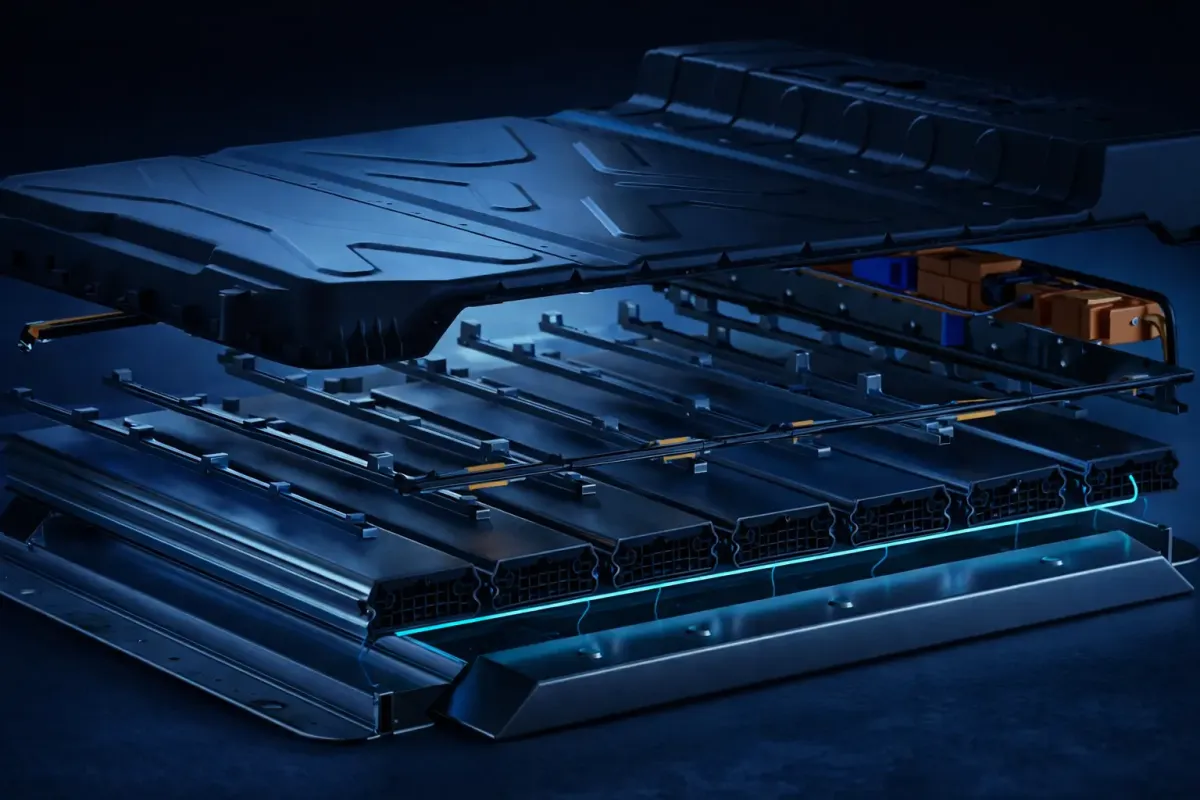
Most electric vehicles carry the battery as a flat pack under the floor, between the axles, where it is the lowest large part of the car. The pack tray or lower housing holds the cells and seals out water, but stones, kerbs, bollards, road debris and grounding on ramps or speed bumps can dent or puncture it. A separate shield beneath the tray absorbs and spreads the force of a strike, protects the cooling plate and cells above it, and in many designs adds thermal insulation and noise damping.
Shield design depends on pack design and vehicle type. Mass-market Chinese battery electric cars often use a stamped high-strength steel guard of about 1 to 2 mm bolted beneath an aluminium or steel tray. European and North American platforms increasingly use aluminium sheet or long-fibre thermoplastic and sheet moulding compound plates, which weigh less and insulate the pack. Off-road and luxury vehicles add thicker armour, such as the 26 mm carbon-containing panel on the Mercedes-Benz G 580, and pickups and SUVs often carry optional skid plates as accessories.
Not every pack has a separate shield. Some designs integrate the bottom plate into the tray or the vehicle floor, plug-in hybrids often place smaller packs in the tunnel or under the rear seat, and many truck and bus packs sit beside the frame or on the roof. Marqstats estimates that 82% of battery electric cars, 68% of plug-in hybrid and range-extended cars, 80% of electric vans and 45% of electric trucks and buses built in 2025 carried a dedicated underbody shield.
The market grew from an estimated USD 410.00 million in 2021 to USD 668.00 million in 2022, USD 880.00 million in 2023 and USD 1,105.00 million in 2024, a 26.76% annual rate from 2021 to 2025, as global electric car sales rose from about 6.6 million to more than 20 million. Marqstats expects USD 1,560.00 million in 2026, when the IEA expects about 23 million electric cars to be sold.
The market is a small part of total battery enclosure spending. Pack trays, lower housings, top covers, side sills and crash frames are worth several times more, and suppliers such as Minth report battery housing as one of their largest businesses. Marqstats sizes the bottom shield on its own because it is a separate part with its own suppliers, materials and replacement demand, and because China's bottom impact test now puts it at the centre of pack certification.
Each material has its own production route. Steel guards are blanked and stamped from high-strength coil in a few press strokes, coated against corrosion and bolted to the tray with a set of fasteners. Aluminium plates are stamped from 5000 or 6000 series sheet or cut from extrusions. Long-fibre thermoplastic and glass mat thermoplastic plates are compression moulded from heated blanks of polypropylene or polyamide reinforced with glass fibre, sometimes with local reinforcement and an insulating layer, and sheet moulding compound plates are compression moulded from thermoset resin and chopped glass. Carbon fibre armour is laid up or compression moulded in low volumes for luxury and off-road vehicles.
Regulation shapes shield design in every major market. China's GB 38031-2025 replaces GB 38031-2020 and adds a bottom impact test in which a 30 mm impactor strikes the pack three times at 150 J with the battery at 95% or higher charge, after which the pack must show no leakage, rupture, fire or explosion and must keep its insulation resistance. The standard also requires no fire or explosion for at least two hours after a cell enters thermal runaway and adds a fast-charge cycle test. It applies to new type approvals from 1 July 2026 and to existing types from 1 July 2027. In Europe and other markets that apply UN Regulation No. 100, carmakers set their own underbody strike tests, which are often less demanding than the Chinese test.
Global EV Battery Underbody Shield Market Size and Forecast
The global EV battery underbody shield market grows from USD 1,341.60 million in 2025 to USD 2,776.65 million in 2030, a CAGR of 15.66%. Marqstats expects USD 1,560.00 million in 2026, USD 1,835.00 million in 2027, USD 2,110.00 million in 2028 and USD 2,430.00 million in 2029.
The forecast multiplies electric vehicle output by shield fitment and average shield value for each vehicle type. Marqstats expects about 27.0 million battery electric cars, 11.5 million plug-in hybrid and range-extended cars, 2.1 million electric vans and 0.95 million electric trucks and buses in 2030, against 13.2 million, 7.1 million, 0.9 million and 0.32 million in 2025.
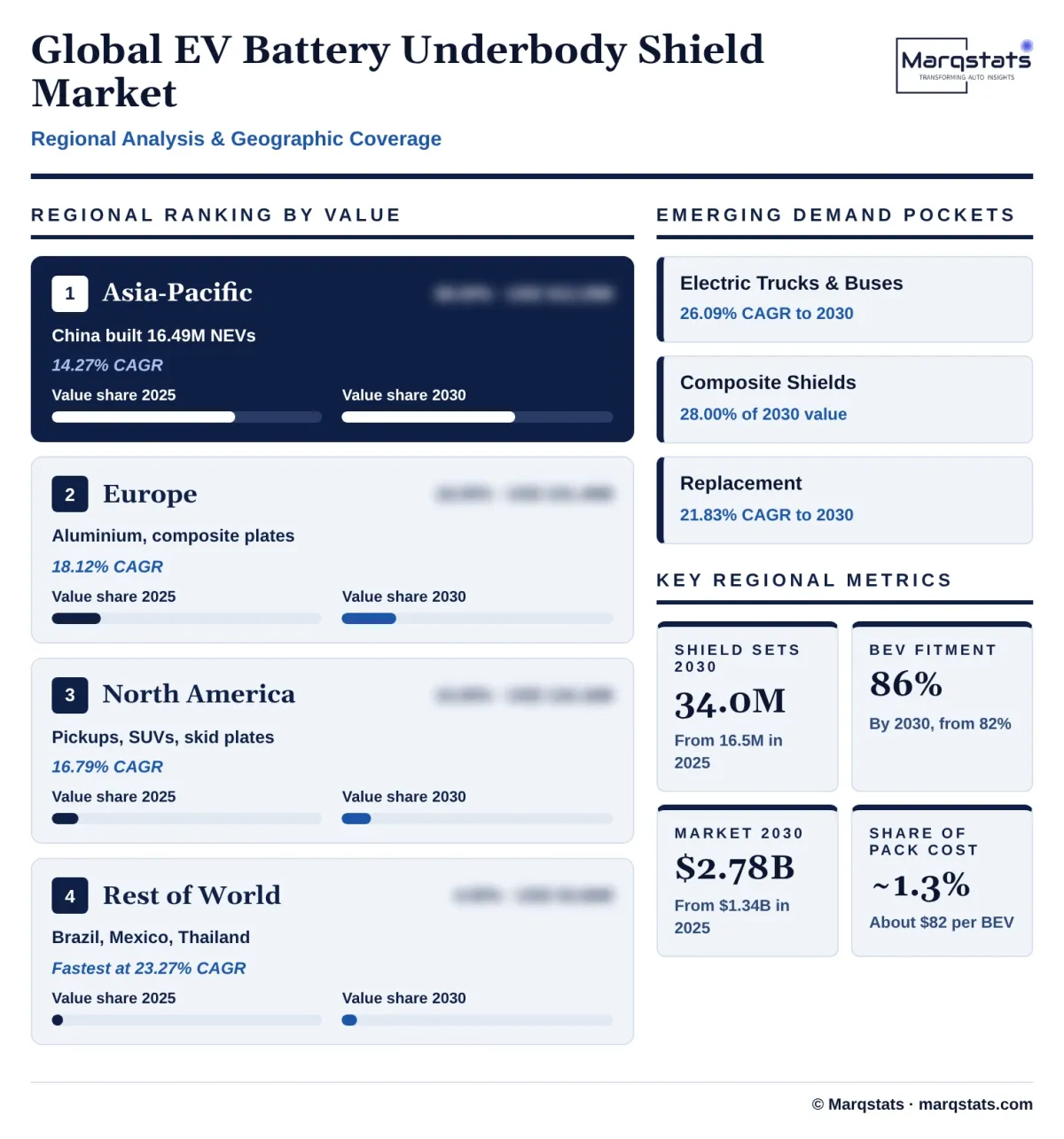
Fitment rises across vehicle types. Marqstats expects the share of battery electric cars with a dedicated shield to rise from 82% to 86%, plug-in hybrid and range-extended cars from 68% to 74%, vans from 80% to 84% and trucks and buses from 45% to 52%, as China's bottom impact test applies to all new vehicles from July 2027 and carmakers in other regions adopt similar test cases for export models.
Value per vehicle falls slightly. The average shield costs about USD 82 on a battery electric car in 2025, falling to USD 78 by 2030 as steel and aluminium plates are made thinner and more efficiently, while composites and thicker heavy-vehicle armour lift the mix. The average factory-fitted shield is worth about USD 75.22 in 2025 and USD 73.85 in 2030.
Replacement and accessory demand rises faster than factory fitment. Marqstats estimates that about 0.9% of fitted shields are replaced each year after damage, at an average replacement price of about USD 135 to 140 including dealer margin, and that accessory skid plates for pickups, SUVs and off-road vehicles add about USD 30 million a year in 2025 and USD 60 million by 2030.
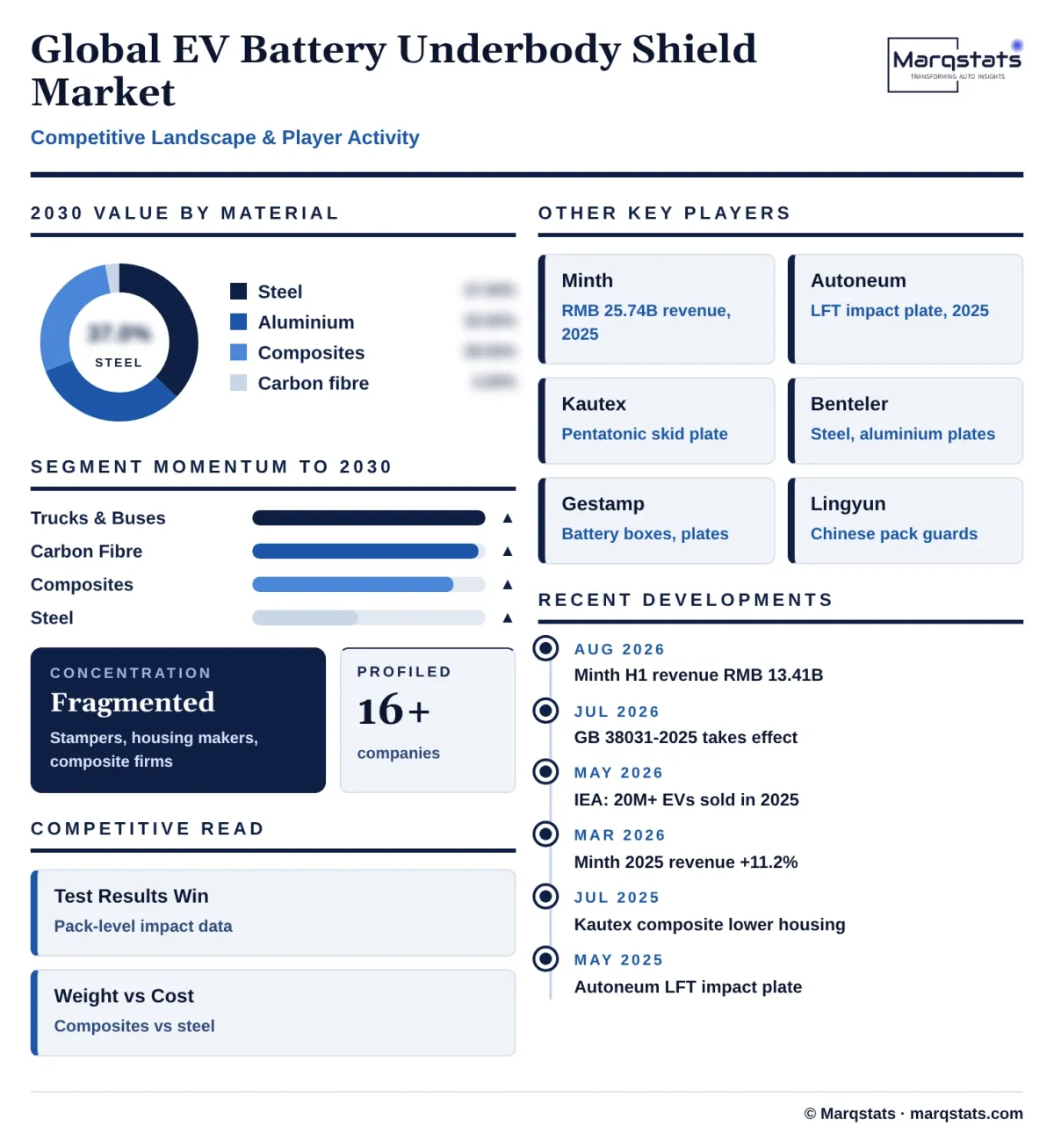
The mix shifts towards composites and heavy vehicles. Thermoplastic and sheet moulding compound composites rise from 21.00% to 28.00% of value and carbon fibre and hybrid armour from 2.00% to 3.00%, while steel falls from 44.00% to 37.00% and aluminium from 33.00% to 32.00%. Trucks and buses rise from 2.72% to 4.20% of value and replacement and accessory sales from 7.40% to 9.60%. Europe rises from 18.00% to 20.00% of value and the rest of the world from 4.00% to 5.50%.
Marqstats tracks four indicators to monitor the forecast: monthly electric vehicle production by type, the share of new Chinese battery types certified to GB 38031-2025, steel, aluminium and polypropylene prices, and announcements of integrated tray and shield designs that remove a separate shield from the bill of materials.
Market Dynamics
Key Drivers
Five forces are lifting demand for the plates that protect the underside of EV battery packs.
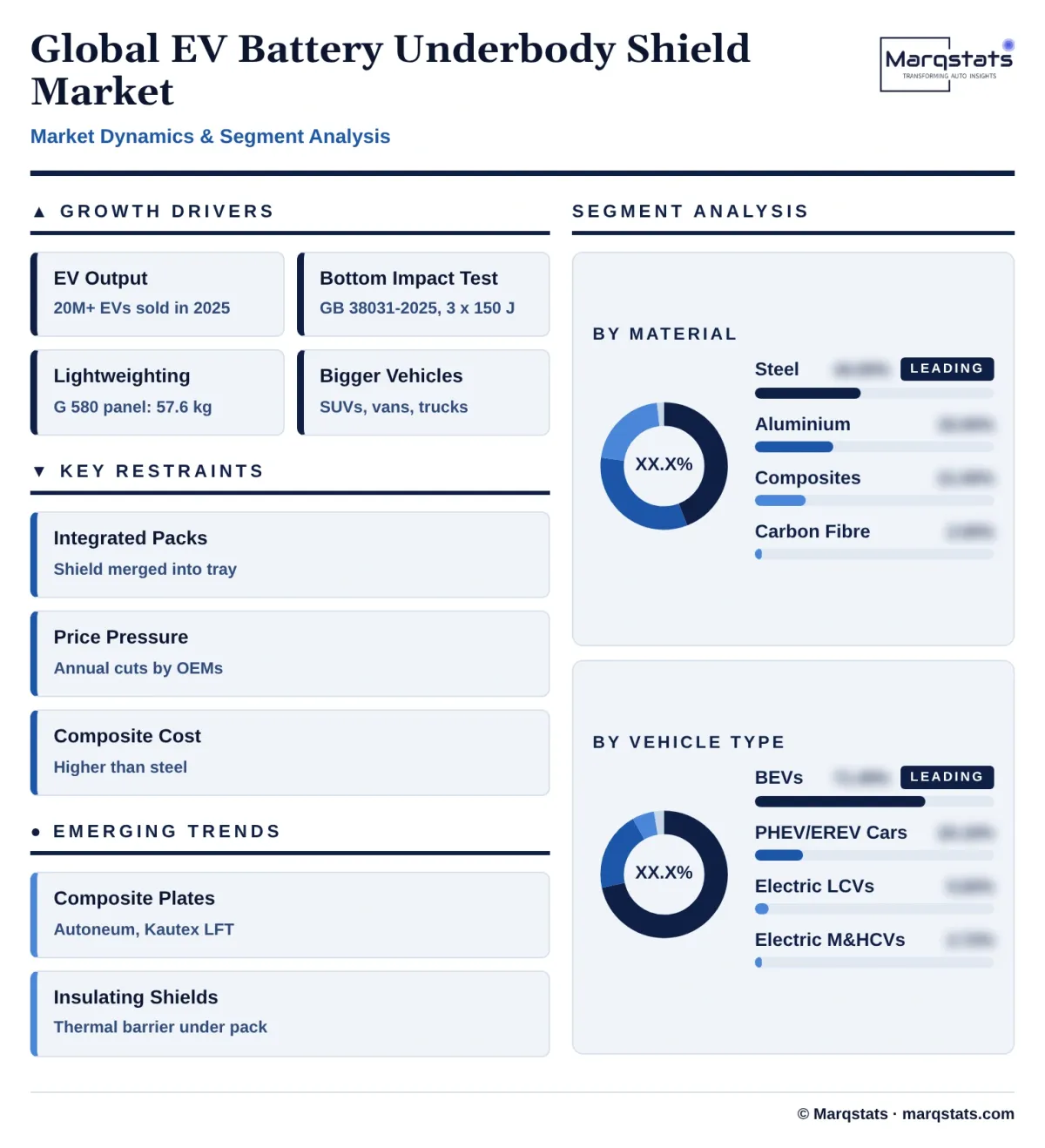
- Growing electric vehicle output. Global electric car sales passed 20 million in 2025, up 20%, and the IEA expects about 23 million in 2026. Every new battery electric car with an underfloor pack is a candidate for a shield.
- China's bottom impact test. GB 38031-2025 applies to new type approvals from 1 July 2026 and to all types from 1 July 2027 and requires packs to survive three 150 J strikes from a 30 mm impactor at high charge without leakage, rupture, fire or explosion, which pushes pack makers to add or upgrade shields.
- Thermal runaway rules. The same standard requires no fire or explosion for at least two hours after a cell enters thermal runaway, so pack makers want shields that do not crack under impact and that add insulation beneath the pack.
- Lightweighting. Every kilogram saved beneath the floor adds range, and composite shields from Autoneum and Kautex weigh less than steel, while the G 580 panel weighs about a third of an equivalent steel part.
- Larger and heavier vehicles. Electric SUVs, pickups, vans and trucks carry larger packs with more exposed area and greater risk of grounding, which raises shield size and value per vehicle.
- Electric commercial vehicles. Electric vans, trucks and buses carry large packs under the frame or floor, so each vehicle needs a large shield, adding volume even where passenger car sales slow.
Key Restraints
Four constraints hold back value growth for underbody shield suppliers.
- Integrated pack designs. Some carmakers merge the shield into the tray or the vehicle floor, or place smaller packs in protected positions, which removes a separate part from the bill of materials.
- Price pressure. Carmakers and pack makers buy shields as low-cost parts and seek annual price cuts, and Chinese steel guards sell for a fraction of composite plates.
- Cost of composites. Long-fibre thermoplastic and carbon fibre plates cost more than steel, which limits their use to premium, export and heavy vehicles until volumes grow.
- Slower growth in some markets. The end of US federal electric vehicle tax credits on 30 September 2025 and tariff changes slow North American electric vehicle output, which limits shield volume in the region.
Key Trends
Four shifts are changing how battery underbody shields are designed, made and bought.
- Composite shields. Autoneum launched a long-fibre thermoplastic impact protection plate in May 2025 and Kautex put its Pentatonic thermoplastic composite skid plate into series production in 2024, both lighter than metal plates.
- Shields that insulate. Composite plates add a thermal barrier beneath the pack, which reduces heating and cooling energy and adds a layer of protection in a thermal event.
- Lower housings that double as shields. Kautex won an order in July 2025 for a thermoplastic composite lower battery housing for a multi-brand battery electric platform, which combines tray and shield in one part.
- Tougher armour for heavy vehicles. Electric pickups, off-road SUVs and trucks use thicker steel, aluminium or carbon-containing armour, often offered as optional skid plates.
- Recycled materials. Carmakers selling into Europe ask for recycled aluminium and recyclable thermoplastic shields to reduce the carbon footprint they must declare for batteries under the EU Battery Regulation.
Strategic Implications
- For shield suppliers, certification support wins business. Suppliers that can run or support GB 38031-2025 bottom impact tests and show results at the pack level help pack makers pass type approval and become preferred sources.
- For pack makers, the shield is a low-cost safety margin. Spending a few more dollars on a stronger or better-insulating shield can avoid costly redesigns of the tray and cells to pass bottom impact tests.
- For carmakers, material choice is a range decision. Moving from steel to composite plates saves weight beneath the floor, and the G 580 shows savings of about two thirds on heavy armour.
- For material suppliers, composite demand is growing. Long-fibre thermoplastic, glass mat thermoplastic and sheet moulding compound suppliers gain as shields move from steel to composite on European and premium platforms.
- For investors, fitment rate is the key assumption. Revenue growth for shield suppliers depends on electric vehicle output and on how many packs carry a separate shield, so integrated pack designs are the main risk to watch.
- For policy makers, the Chinese bottom impact test is a model. Other regions that want fewer battery fires after underbody damage can adopt similar pack-level strike tests, which would raise shield fitment and quality outside China.
Market Segmentation
Stamped high-strength steel plates account for 44.00% of 2025 value, USD 590.30 million, and grow at 11.72% a year to USD 1,027.36 million, while their share falls to 37.00% by 2030. Steel guards are the low-cost choice for mass-market Chinese battery electric cars and for heavy vehicles, and benefit from high impact strength at low cost.
Aluminium sheet and extruded plates account for 33.00% of 2025 value, USD 442.73 million, and grow at 14.95% a year to USD 888.53 million, 32.00% of 2030 value. Aluminium shields are common on European and North American platforms and pair with aluminium pack trays to save weight.
Long-fibre thermoplastic, glass mat thermoplastic and sheet moulding compound plates account for 21.00% of 2025 value, USD 281.74 million, and grow at 22.51% a year to USD 777.46 million, 28.00% of 2030 value. Autoneum and Kautex lead in this segment, and composite plates add thermal insulation to impact protection.
Carbon fibre and hybrid armour accounts for 2.00% of 2025 value, USD 26.83 million, and grows fastest, at 25.43% a year, to USD 83.30 million and 3.00% of 2030 value, used on luxury and off-road battery electric vehicles such as the Mercedes-Benz G 580.
Shields for battery electric cars account for 71.49% of 2025 value, USD 959.05 million, and grow at 15.87% a year to USD 2,003.08 million, 72.14% of 2030 value. Large underfloor packs and the new Chinese bottom impact test make the shield a standard part on most models.
Shields for plug-in hybrid and range-extended cars account for 20.19% of 2025 value, USD 270.92 million, and grow at 12.06% a year to USD 478.81 million. Smaller packs and protected positions lower fitment and value per vehicle, though range-extended SUVs in China carry large underfloor packs that need full shields.
Shields for electric vans and light trucks account for 5.60% of 2025 value, USD 75.08 million, and grow at 18.88% a year to USD 178.28 million as electric van output more than doubles.
Shields for electric trucks and buses account for 2.72% of 2025 value, USD 36.55 million, and grow fastest, at 26.09% a year, to USD 116.48 million and 4.20% of 2030 value, as heavy electric trucks in China and Europe put large packs under the frame.
Shields fitted on the production line account for 92.60% of 2025 value, USD 1,242.30 million, and grow at 15.10% a year to USD 2,510.10 million, 90.40% of 2030 value. They are designed and tested with the pack and sourced on multi-year platform contracts.
Replacement shields sold through dealers and parts distributors and accessory skid plates account for 7.40% of 2025 value, USD 99.30 million, and grow at 21.83% a year to USD 266.55 million, 9.60% of 2030 value, as the electric vehicle fleet ages and grows.
By Geography
Asia-Pacific
Asia-Pacific is the largest market, with 68.00% of 2025 value, USD 912.29 million, rising to USD 1,777.06 million by 2030, a 14.27% CAGR, while its share falls to 64.00%. China built 16.49 million new energy vehicles in 2025 according to CAAM, including 2.62 million for export, and GB 38031-2025 applies to every new battery type sold in China. Chinese pack makers such as CATL and BYD and suppliers such as Minth and Lingyun make most of the region's shields, and Japan, South Korea and India add smaller volumes.
Europe
Europe accounts for 18.00% of 2025 value, USD 241.49 million, and grows at 18.12% a year to USD 555.33 million and 20.00% of the market by 2030. European carmakers use more aluminium and composite shields than Chinese carmakers, Autoneum and Kautex supply thermoplastic plates and housings, and UN Regulation No. 100 sets the battery safety requirements for type approval.
North America
North America accounts for 10.00% of 2025 value, USD 134.16 million, and grows at 16.79% a year to USD 291.55 million and 10.50% of the market by 2030. Electric pickups and SUVs carry large packs and thicker armour, and accessory skid plates are popular, though the end of federal tax credits in September 2025 slows electric vehicle output.
Rest of the World
The rest of the world accounts for 4.00% of 2025 value, USD 53.66 million, and grows fastest, at 23.27% a year, to USD 152.71 million by 2030, as Brazil, Mexico, Turkey, Thailand and Indonesia add electric vehicle assembly and rough roads raise replacement demand.
How Competition Is Evolving
The EV battery underbody shield market is fragmented. Pack makers and carmakers buy shields from steel and aluminium stampers, battery housing makers and composite specialists, and many Chinese pack makers source local steel guards. Leading suppliers include Minth, Lingyun, Benteler, Gestamp, Magna, KIRCHHOFF Automotive and Constellium in metal, and Autoneum, Kautex Textron and Teijin in composites.
Battery housing makers bundle the shield with the tray. Minth, the largest battery housing maker, reported 2025 revenue of RMB 25.74 billion, up 11.2%, with its body structure business, formerly named battery housing, at RMB 7.53 billion before eliminations, and first-half 2026 revenue of RMB 13.41 billion with a 28.6% gross margin.
Composite specialists compete on weight and insulation. Autoneum launched a long-fibre thermoplastic impact protection plate in May 2025, validated with several European carmakers, and Kautex followed its Pentatonic composite skid plate, in series production since 2024, with a July 2025 order for a thermoplastic composite lower battery housing.
Competition will be decided by test results, weight and cost. Suppliers that can show bottom impact results at the pack level, keep weight low and meet the price of steel guards will win the most platforms as GB 38031-2025 applies to all new vehicles from July 2027.
Accessory and replacement suppliers form a separate tier. Aftermarket brands and carmaker accessory programmes sell skid plates for electric pickups and SUVs, and dealers sell replacement shields after underbody damage, a channel that grows with the fleet.
Price and test performance move together. A steel guard on a mass-market Chinese car costs a few tens of dollars, an aluminium or composite plate on a European car more than USD 100, and heavy armour on luxury, off-road or truck platforms several hundred dollars. Each new shield design must be tested with the pack and qualified with the carmaker for one to two years before volume production, which favours suppliers already on a platform.
Companies Covered
Companies covered in the report include:
Recent Market Activity
Table of Contents
Coverage & Segmentation
The study covers the global EV battery underbody shield market, with 2025 as the base year, 2021 – 2025 as the historical period and 2026 – 2030 as the forecast period. Values are in US dollars at the price paid by carmakers and pack makers for factory-fitted shields and at distributor prices for replacement and accessory shields, converted at 2025 average exchange rates such as RMB 7.18 and EUR 0.885 per US dollar. The market is segmented by material, vehicle type, sales channel and region, with factory-fitted shields allocated by where vehicles are built.
Pack trays and lower housings that hold the cells, top covers, side sills, crash frames, cooling plates, cell cans and covers, plastic aero undertrays, wheel arch liners, splash guards and shields for hybrid vehicles without a plug, two-wheelers and stationary storage are excluded. The market sits inside the scope of the Marqstats Electric Vehicle Battery Components Market, overlaps with the India EV Battery Casing Market where Indian pack casings include a bottom plate, and does not overlap with the Global EV Battery Cell Cans and Cases Market, which covers cell-level enclosures; the figures should not be added together. Segment and regional splits are Marqstats estimates built on vehicle production data, fitment and price benchmarks and supplier disclosures.