Market Snapshot
Middle bar: base-year value × (1 + CAGR), rounded to two decimals. This is a calculated illustration, not a separately researched annual estimate.
The global electric SUV market size is estimated at USD 553.25 billion in 2025 and is projected to reach USD 975.65 billion by 2030, growing at a CAGR of 12.01% over 2026 – 2030. Deliveries rise from about 12.24 million vehicles to 24.70 million, a 15.08% annual rate, while the average wholesale price falls from about USD 45,200 to USD 39,500 per vehicle.
Marqstats defines the market as the wholesale value of new battery electric, plug-in hybrid and extended-range electric sport utility vehicles and crossovers, measured at factory-gate prices before sales taxes, registration fees, dealer discounts and consumer incentives. Compact, mid-size and full-size SUVs are covered. Electric sedans, hatchbacks, estates and pickup trucks, vans and other light commercial vehicles, full and mild hybrids that cannot charge from the grid, and fuel cell vehicles are excluded.
Battery electric SUVs account for an estimated 66.90% of 2025 value and mid-size SUVs for 44.84%. China accounts for 44.27% of 2025 value and 58.01% of deliveries. The study segments the market by powertrain, vehicle size and region.
Key Takeaways
Market Overview & Analysis
Report Summary
Marqstats sizes the global electric SUV market as the factory-gate wholesale value of new battery electric, plug-in hybrid and extended-range electric sport utility vehicles and crossovers. In 2025 about 12.24 million electric SUVs were delivered worldwide, worth an estimated USD 553.25 billion at an average wholesale price of about USD 45,200.
Electric SUVs sit within a much larger electric car market. More than 20 million electric cars were sold worldwide in 2025, up 20% from 2024, so one in four new cars sold was electric. Battery electric cars made up 65% of electric car sales. Marqstats estimates that SUVs and crossovers account for about 60% of electric car deliveries and an even larger share of value, because they are larger and more expensive than electric sedans and hatchbacks.
The SUV became the leading electric body style for practical and commercial reasons. A tall body leaves room for a battery under the floor without reducing cabin space, buyers prefer the higher seating position, and higher prices helped carmakers absorb the cost of early batteries. In the United States, light-truck classification also gave SUVs more lenient fuel economy and emissions targets than sedans of the same size, so carmakers focused their electric programmes on crossovers, SUVs and pickups.
Two powertrains compete. Battery electric SUVs rely only on the battery and account for 65.03% of 2025 deliveries. Plug-in hybrid and extended-range SUVs pair a battery of about 30 to 52 kWh with a petrol engine that charges the battery or drives the wheels, offering electric driving in town and quick refuelling on long trips. Extended-range models from Li Auto, AITO and others are popular in China, especially in large family SUVs.
The market grew from USD 186.30 billion and about 3.45 million vehicles in 2021 to USD 272.85 billion in 2022, USD 365.05 billion in 2023 and USD 466.24 billion in 2024. Growth slowed from 46.46% in 2022 to 18.66% in 2025 as prices fell and the Chinese market matured. Marqstats expects about 14.15 million deliveries worth USD 623.50 billion in 2026.
Policy differs sharply between regions. China supports new energy vehicles through purchase tax relief, which was halved from January 2026, and trade-in subsidies. The EU sets binding fleet CO2 targets under Regulation (EU) 2019/631, with an added flexibility that lets carmakers average compliance over 2025 to 2027. The United States ended its federal purchase credit in September 2025 and repealed vehicle greenhouse gas standards in February 2026. Tariffs on Chinese-built electric cars in the EU, the United States and Brazil are pushing Chinese carmakers to build factories abroad.
Battery demand concentrates in SUVs. Because their size and weight require batteries 20% to 30% larger than comparable sedans, electric SUVs account for a disproportionate share of automotive battery demand. This makes the segment the largest customer for battery makers and the main beneficiary of falling cell prices, but it also means that every kilowatt-hour of battery capacity used in a large SUV cannot go into smaller, cheaper cars, a tension that shapes carmaker product planning and policy debates in Europe and Asia.
Global Electric SUV Market Size and Forecast
The global electric SUV market grows from USD 553.25 billion in 2025 to USD 975.65 billion in 2030, a CAGR of 12.01%. Marqstats expects USD 623.50 billion in 2026, USD 701.76 billion in 2027, USD 786.25 billion in 2028 and USD 877.00 billion in 2029. Annual value growth slows gradually from 12.70% in 2026 to 11.25% in 2030.
Deliveries grow faster than value. Marqstats expects about 14.15 million deliveries in 2026, 16.32 million in 2027, 18.81 million in 2028, 21.60 million in 2029 and 24.70 million in 2030, a 15.08% annual rate. The average wholesale price falls from USD 54,000 in 2021 to USD 45,200 in 2025, USD 43,000 in 2027 and USD 39,500 in 2030, even as cars gain larger screens, more computing power and more driver assistance features.
Battery costs drive the price fall. Lithium iron phosphate cells, which avoid cobalt and nickel, cell-to-pack designs that remove modules, and the scale of Chinese battery and vehicle factories have lowered the cost of each kilowatt-hour. Because SUVs need larger batteries than sedans, typically 75 to 100 kWh for battery electric models against 50 to 60 kWh for smaller cars, each fall in battery cost has a larger effect on SUV prices.
The value of the market is sensitive to price. Marqstats estimates that each USD 1,000 change in the average wholesale price changes the 2025 market value by about USD 12.24 billion, and each percentage point change in the SUV share of electric car sales changes 2025 deliveries by about 205,000 vehicles.
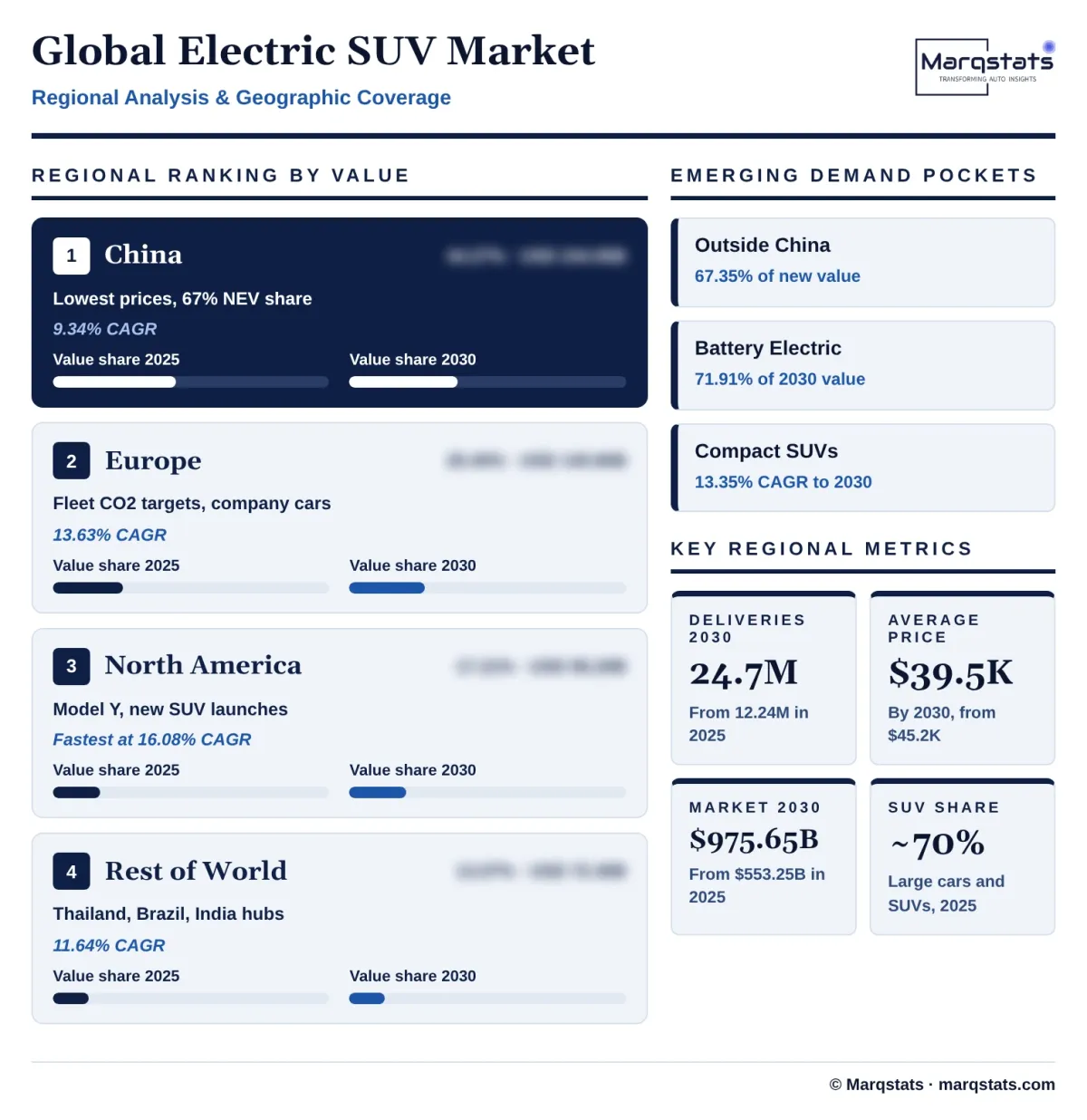
The mix shifts over the forecast. Battery electric SUVs rise from 66.90% to 71.91% of value, compact SUVs from 28.93% to 30.69%, and markets outside China from 55.73% to 60.76%. Marqstats tracks four indicators to monitor the forecast: the electric share of new car sales in each region, average battery pack prices, tariff and trade decisions on Chinese-built vehicles, and changes to emissions rules and purchase incentives in Europe and the United States.
Regional growth rates diverge. Marqstats expects deliveries to grow at 11.71% a year in China, from 7.10 million to 12.35 million, at 17.56% a year in Europe, from 2.20 million to 4.94 million, at 19.84% a year in North America, from 1.40 million to 3.46 million, and at 20.73% a year in the rest of the world, from 1.54 million to 3.95 million. Average prices are lowest in China and highest in North America and Europe, so the faster growth of Western markets supports total value even as prices fall in every region.
Market Dynamics
Key Drivers
Five forces keep the sport utility vehicle at the centre of passenger car electrification.
- Buyers prefer SUVs. Families and fleet drivers choose the higher seating position, larger boot and flexible cabin of an SUV, and carmakers have launched most new electric models as SUVs. About half of the electric models on sale worldwide are SUVs.
- Battery costs keep falling. Cheaper lithium iron phosphate cells and simpler cell-to-pack designs reduce the cost of the large batteries that SUVs need, bringing battery electric SUVs to price parity with petrol SUVs in China and narrowing the premium elsewhere.
- Dedicated electric platforms improve efficiency. Platforms designed only for electric cars, such as Geely SEA, Hyundai E-GMP, Volkswagen MEB and BMW Neue Klasse, place the battery under a flat floor and use 800-volt systems for faster charging, giving more cabin space and range than platforms shared with petrol cars.
- Europe requires lower fleet emissions. EU CO2 targets for new cars, averaged over 2025 to 2027, push carmakers to sell more electric models, and SUVs are where carmakers earn the margins needed to fund their electric programmes.
- Chinese carmakers are expanding abroad. Chinese passenger car exports rose 73.7% year on year to 917,000 vehicles in September 2026, led by electric and plug-in hybrid SUVs, and BYD, Chery, Geely and Great Wall are building factories in Hungary, Thailand, Brazil and other markets.
Key Restraints
Four constraints slow the spread of electric SUVs beyond China.
- Weaker US policy. The end of the federal USD 7,500 purchase credit in September 2025 and the repeal of federal vehicle greenhouse gas standards in February 2026 reduce both consumer incentives and regulatory pressure on carmakers to sell electric SUVs in the United States.
- Tariffs and trade barriers. EU countervailing duties of 7.8% to 35.3% on top of the standard 10% import duty, 100% US tariffs on Chinese electric vehicles and rising import duties in Brazil raise the cost of Chinese-built SUVs in these markets.
- Price premiums outside China. Battery electric cars still cost around 20% more than petrol equivalents in Europe and battery electric SUVs just under 25% more in the United States, slowing adoption among private buyers.
- Large batteries use scarce resources. Electric SUVs need batteries 20% to 30% larger than comparable sedans, increasing demand for lithium and other battery materials and raising the cost of each vehicle.
Key Trends
Four shifts are changing how electric SUVs are engineered, priced and sold.
- Extended-range SUVs in China. Large family SUVs with a petrol engine that recharges the battery, such as Li Auto and AITO models, offer long range without public charging and remain popular in China, even as their share of global electric car sales has eased.
- Compact electric SUVs. Carmakers are launching smaller and cheaper SUVs on dedicated platforms with lithium iron phosphate batteries, aimed at European and Asian city buyers.
- Local production abroad. Chinese carmakers are building SUV factories in Hungary, Thailand, Brazil and elsewhere to avoid tariffs, while European carmakers are localising battery production, as BMW did when it began Gen 6 battery production in Shenyang in October 2026.
- 800-volt platforms and faster charging. New electric SUVs from BMW, Hyundai, XPeng, Zeekr and others use 800-volt systems and silicon carbide power electronics to cut charging times and improve efficiency.
Strategic Implications
- For established carmakers, dedicated platforms are essential. Electric SUVs built on platforms shared with petrol cars carry weight and packaging compromises; platforms designed only for electric vehicles, such as BMW Neue Klasse, give better range, charging and cabin space.
- For Chinese carmakers, local factories protect growth. Building SUVs inside the EU, Thailand, Brazil and other markets avoids tariffs and supports market share as growth outside China outpaces the domestic market.
- For battery makers, SUVs remain the largest customer. Large SUV batteries make this segment the most important source of demand for automotive cells, and cheaper lithium iron phosphate cells are opening the compact SUV segment.
- For suppliers, high-voltage components are the growth path. 800-volt inverters, onboard chargers, heat pumps and structural castings for electric SUVs offer more growth than parts for petrol engines.
- For charging operators, highway hubs matter. Electric SUVs with large batteries benefit most from 350 kW and faster chargers on motorways, where long trips create the largest charging needs.
- For policymakers, SUV growth raises efficiency questions. Larger and heavier electric SUVs use more energy and battery materials per kilometre than smaller cars, so vehicle taxation based on weight or battery size, as some European countries are considering, could shift demand towards compact models over the forecast period.
Market Segmentation
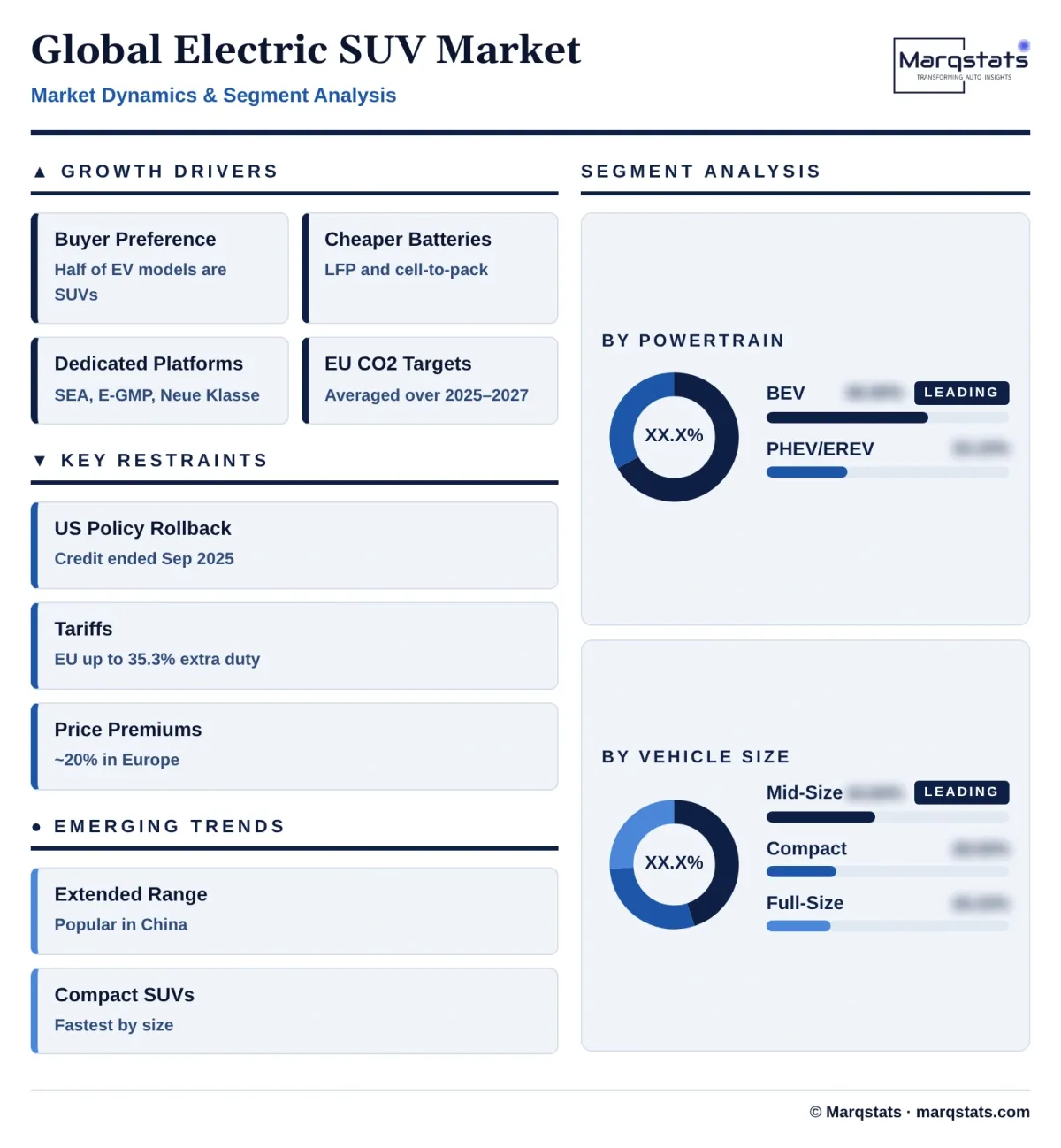
Battery electric SUVs account for 66.90% of 2025 value, USD 370.14 billion and about 7.96 million vehicles, rising to USD 701.60 billion and 71.91% of the market by 2030, a 13.64% CAGR. Tesla Model Y, BYD Yuan Plus, Volkswagen ID.4, BMW iX3 and Hyundai Ioniq 5 lead the segment, and falling battery costs and wider fast charging support growth.
Plug-in hybrid and extended-range SUVs account for 33.10% of 2025 value, USD 183.11 billion and about 4.28 million vehicles, rising to USD 274.05 billion by 2030, an 8.40% CAGR, while their share falls to 28.09%. BYD Song Plus DM-i, Li Auto L-series and AITO models lead in China, where buyers value long range without depending on public chargers.
Compact SUVs, about 4.30 to 4.65 metres long with 55 to 70 kWh batteries, account for 28.93% of 2025 value, USD 160.05 billion and about 4.85 million vehicles, and grow fastest, at 13.35% a year, to USD 299.43 billion by 2030.
Mid-size SUVs, about 4.65 to 4.90 metres long with 70 to 95 kWh batteries, are the largest segment, with 44.84% of 2025 value, USD 248.06 billion and about 5.62 million vehicles, rising to USD 413.42 billion by 2030, a 10.76% CAGR. Tesla Model Y, BMW iX3, Li Auto L7 and XPeng G9 lead the segment.
Full-size and luxury SUVs, over 4.90 metres long with batteries of 95 to 130 kWh, account for 26.23% of 2025 value, USD 145.14 billion and about 1.77 million vehicles, rising to USD 262.80 billion by 2030, a 12.61% CAGR. Kia EV9, Li Auto L9, Mercedes-Benz EQS SUV and Rivian R1S lead, and the segment earns the highest margins.
By Geography
China
China is the largest market, with 44.27% of 2025 value, USD 244.95 billion and about 7.10 million vehicles, rising to USD 382.85 billion by 2030, a 9.34% CAGR, while its share of value falls to 39.24%. Electric cars made up almost 55% of new car sales in China in 2025, and new energy vehicles reached 67% of domestic passenger car sales in September 2026. Intense price competition keeps prices the lowest in the world, and the halving of purchase tax relief from January 2026 and tighter trade-in subsidies slow domestic growth, pushing carmakers to export.
Europe
Europe, covering the EU, EFTA and the United Kingdom, accounts for 25.45% of 2025 value, USD 140.80 billion and about 2.20 million vehicles, rising to USD 266.76 billion by 2030, a 13.63% CAGR. Battery electric cars took 17.4% of EU new car registrations in 2025, up from 13.6% in 2024, and plug-in hybrids 9.4%. Fleet CO2 targets, company car taxation and the UK zero emission vehicle mandate support demand, while BMW is building the Neue Klasse iX3 around the clock at Debrecen in Hungary.
North America
North America accounts for 17.21% of 2025 value, USD 95.20 billion and about 1.40 million vehicles, and grows fastest, at 16.08% a year, to USD 200.68 billion by 2030 from a low base. Electric cars took just under 10% of US new car sales in 2025, most of them SUVs and crossovers. The end of the federal purchase credit in September 2025 and the repeal of vehicle greenhouse gas standards in February 2026 slow near-term growth, while new models from Tesla, Rivian, Hyundai, BMW and others and the move to the NACS charging standard support it.
Rest of World
The rest of the world accounts for 13.07% of 2025 value, USD 72.30 billion and about 1.54 million vehicles, rising to USD 125.36 billion by 2030, an 11.64% CAGR. Thailand, Brazil, India, Australia, Japan, South Korea, Turkey and the Gulf states lead, with growth supported by Chinese imports and new local factories, such as BYD's plants in Thailand and Camaçari in Brazil.
How Competition Is Evolving
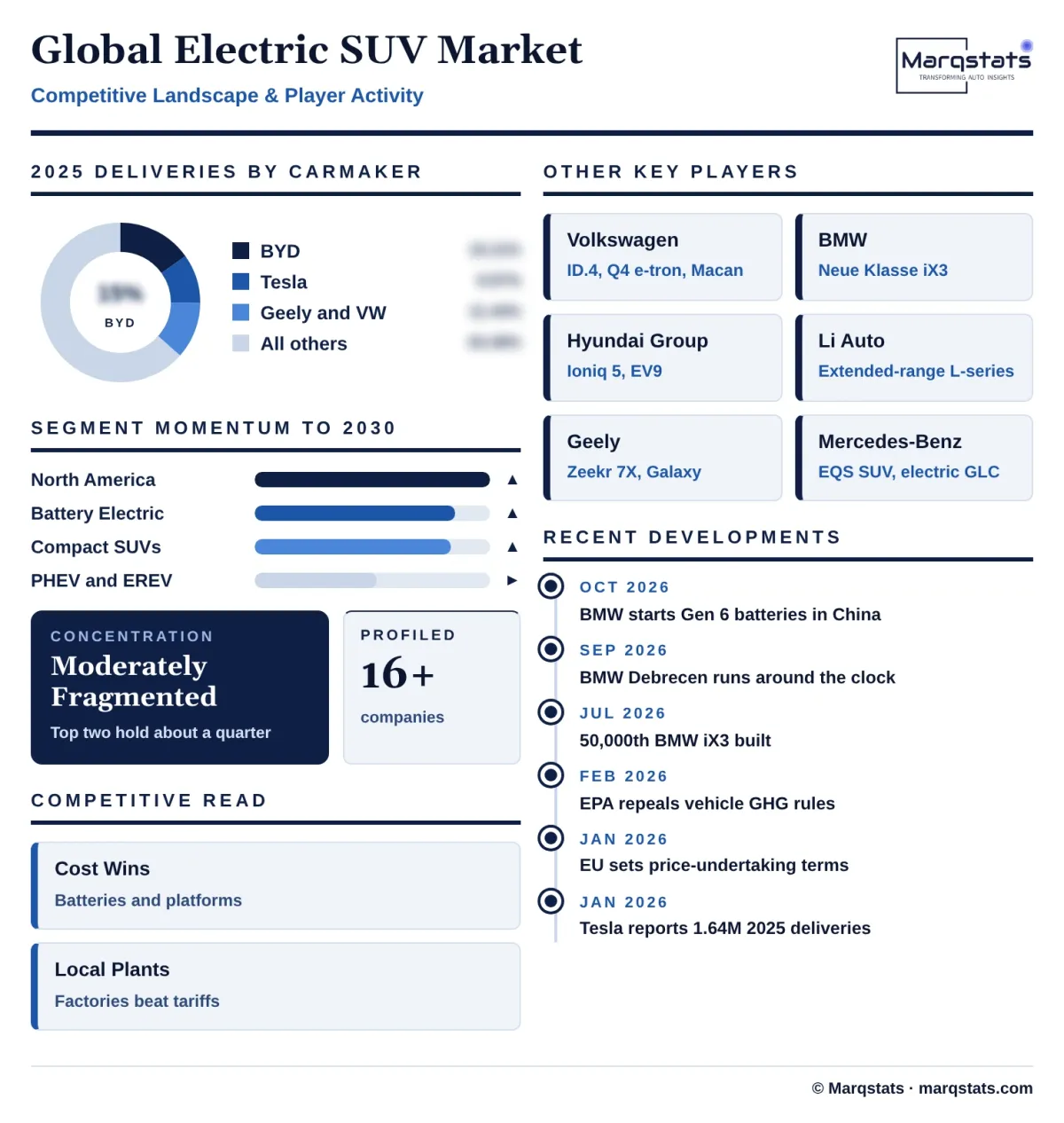
The electric SUV market is moderately fragmented. Marqstats estimates that BYD accounts for about 15% of 2025 deliveries, Tesla for about 10%, Geely Holding for about 6%, Volkswagen Group for about 6%, Li Auto for about 4%, BMW for about 3% and Hyundai Motor Group for about 3%, with more than half of deliveries spread across dozens of other carmakers, mostly Chinese.
Tesla delivered 1,636,129 vehicles in 2025, of which 1,585,279 were Model 3 and Model Y, and the Model Y remained the world's best-selling electric SUV. BYD sold about 4.6 million vehicles in 2025, including more than 1 million overseas, and makes its own batteries, power electronics and drive units, giving it a cost advantage across its SUV range.
European and Korean carmakers compete on dedicated platforms and premium brands. Volkswagen Group sells the ID.4, ID.5, Audi Q4 and Q6 e-tron and Porsche Macan, BMW is ramping up the Neue Klasse iX3, and Hyundai Motor Group sells the Ioniq 5, Kia EV9 and Genesis GV60 on its E-GMP platform.
Competition will be decided by cost, software and local production. Carmakers that combine low battery costs, dedicated platforms, competitive driver assistance software and factories inside their main markets will gain share as growth moves outside China.
Chinese carmakers lead on cost and speed. Li Auto, AITO, Geely's Zeekr and Galaxy brands, Changan's Deepal and Avatr, Great Wall's Haval and Tank, XPeng and NIO launch new SUV models faster than most Western competitors, often with extended-range options, advanced driver assistance and large screens as standard. Their move into Europe, Southeast Asia, Latin America and the Middle East, supported by local assembly, is the main competitive challenge for established carmakers outside China.
Companies Covered
Companies covered in the report include:
Recent Market Activity
Table of Contents
Coverage & Segmentation
The study covers the global electric SUV market, with 2025 as the base year, 2021 – 2025 as the historical period and 2026 – 2030 as the forecast period. Values are in US dollars at factory-gate wholesale prices, and volumes are new vehicle deliveries. The market is segmented by powertrain, vehicle size and region.
Electric sedans, hatchbacks, estates and pickup trucks, vans and light commercial vehicles, full and mild hybrids that cannot charge from the grid, fuel cell vehicles and used vehicles are excluded. Value splits by powertrain, size and region are Marqstats estimates built on registration data, carmaker disclosures and average price benchmarks for each segment.